Stop Loss Insurance Market Overview
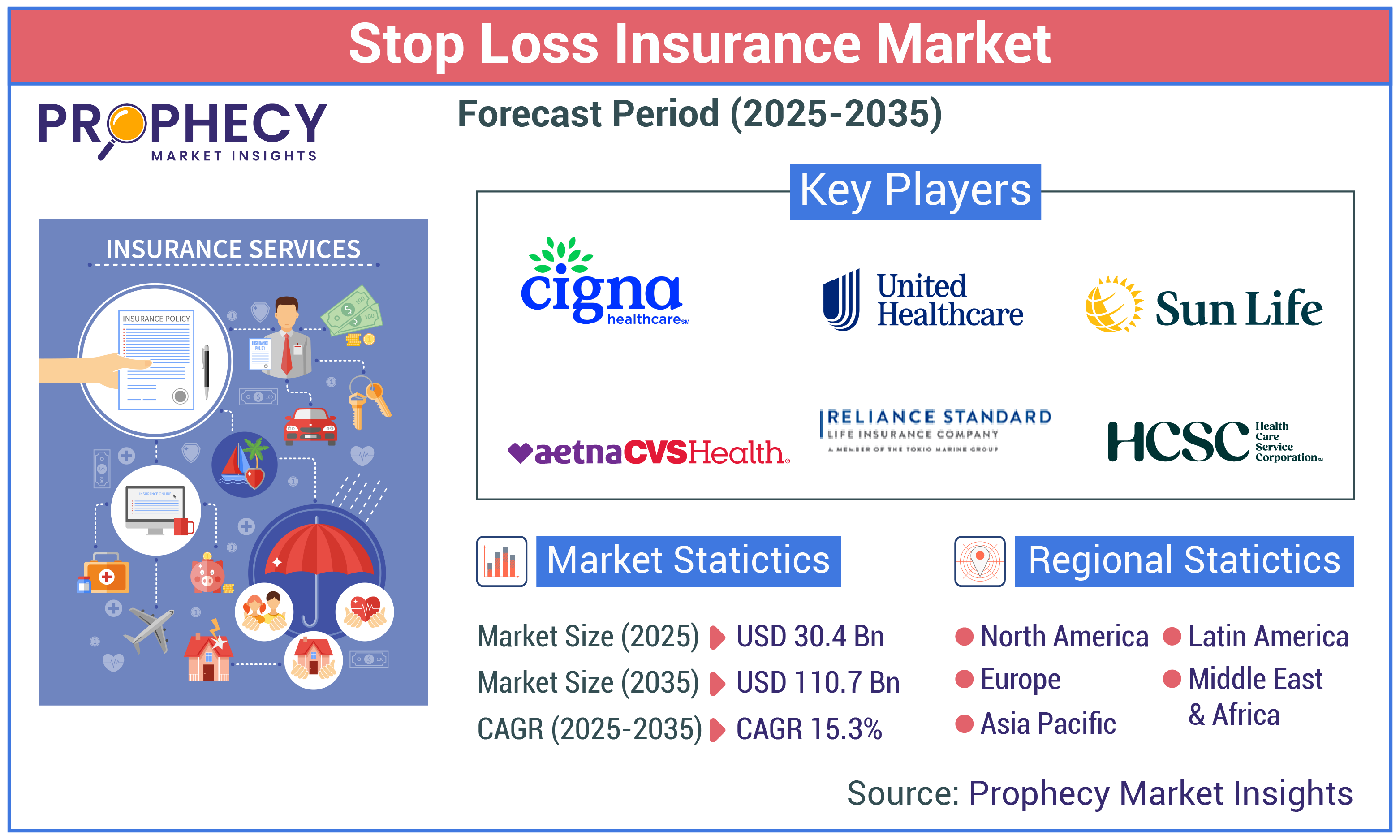
- By 2035, the stop loss insurance market size is contemplated to enlarge at a valuation of USD 110.7 Billion.
- In 2024, the stop loss insurance market valuation was USD 27.0 Billion.
- Stop loss insurance market is developing at a CAGR of 15.3%.
Stop Los Insurance is a type of coverage that protects employers who self-fund their employee health benefits by limiting their financial risk. It reimburses the employer for claims that are more than a fixed range, either per-employee base (specific stop loss) or in the entire group loss. It unexpectedly helps protect against high medical costs, ensures financial stability, and continues employee coverage without severe stress on better budget and company resources.
The growth of the stop loss insurance market is inspired by the increasing number of employers transferring to self-funded health plans to better control health care and achieve flexibility. Increasing incidence of high-cost medical claims has further increased the demand for financial security through stop loss coverage. Additionally, insurers are increasing their offerings with advanced analytics and digital tools, leading to more tail and efficient solutions that support risk management and financial stability for employers.
The future of stop los insurance market is expected to shape from the increasing need to continuously increase self-funded health plans and manage high-cost medical claims. The insurers will focus more on advanced technologies such as AI and Predictive Analytics, which are to enhance the processes of underwriting, pricing and claims. Additionally, employers must adopt innovative solutions such as prisoners and flexible stop loss structures, which will provide better risk management, cost control and transparency to employers.
Recession Risk & Tariff Analysis:
- The risk of recession and increasing tariffs can slow down the stop loss insurance market by slowing down the cost of slowing down the cost of health care and reducing the desire of the employer to adopt self-funded plans.
- Disruptions of tariff-powered inflation and supply chain can lead to high medical claim costs, while economic uncertainty may tighten the margin and investment returns of insurers. As a result, the market may experience more cautious underwriting and slow premium growth during economic recession.
Impact of Generative AI on Stop Loss Insurance Market:
- Generative AI has been designed to replace the Stop Los Insurance Market by increasing AI, streamlining claims, streamlining claims and enabling personal policy design. By analyzing large versions of healthcare and claiming data, the generative AI can identify the pattern, predict high-risk claims, and generate dynamic pricing models.
- This leads to fast decision making, reduce administrative costs and improve risk evaluation. Eventually, the AI adopt the eclipse empowers the insurers to offer employers to offer more efficient, sewn and competitive stop loss solutions.
Stop Loss Insurance Market Drivers & Restraints
Key Drivers:
The Market is Experiencing Steady Growth due to Increased Prevalence of Chronic Diseases
The increasing prevalence of chronic diseases such as diabetes, cancer and heart conditions consists of high and more frequent health care claims, often with significant costs for ongoing treatment and special care. For employers with self-funded health plans, it poses an increased financial risk. Stop loss insurance becomes necessary in such scenarios, as it protects employers from horrific loss by capping its liability for high-cost claims. This increasing burden of chronic disease is a major driver that carries more outfits forward to ensure cost stability and adopt stop loss coverage to protect its financial health.
- For Instance, according to the data published by VOX MEDIA, LLC, each year 18 million people die from cardiovascular diseases that affect the heart and blood vessels and can lead to heart attacks, stroke, or heart failure. About 9 million people die each year from cancers, 4 million from chronic respiratory diseases such as asthma or COPD, and 2 million from diabetes. But both the burden of disease and access to modern health care are disproportionately distributed.
Restraints:
The Growth of the Market can be Disrupt by Regulatory Uncertainty Across Different States or Regions
Regulatory uncertainty arises in the stop loss insurance market because different states or regions have separate rules on minimum attachment points, policy structures and eligibility criteria, especially the U.S. Where some states control stop loss as traditional insurance while others do not. This incompatible compliance for the insurers and employers working in many courts creates challenges.
- Counterbalance Statements: The solution lies in clear federal guidelines or harmonious state regulations that standardize the major aspects of stop loss policies, as well as to help companies navigate and follow local laws efficiently with the use of special legal advisors or regulatory advisors.
Opportunities & Trends:
The Market can be boosted by Increase in Self-Funded Health Plans in Future
Growing changes towards self-funded health schemes are a major future tendency that is running the stop loss insurance market, as more employer-especially medium-sized and small businesses and benefits gain more control over cost and profit flexibility. Distant from fully insured schemes, self-funding exposes employers for financial risks of large claims, giving stops a significant protection to Stop Los Insurance. As healthcare spending increases and companies adapt the benefits when managing the risk, the demand for a sequential stop loss solution will increase. This trend is supported by digital tools and third-party administrators who simplify self-funding nutrition, making it more accessible and attractive in industries.
Stop Loss Insurance Market Segmentations & Regional Insights
Coverage type, industry vertical, enterprise size, distribution channel, and region are the divisions of the Stop loss insurance market.
By Coverage Type:
Aggregate stop loss insurance, and specific stop loss insurance are coverage type on which stop loss insurance market is segmented. The reason that specific stop loss insurance has the biggest stop loss insurance market share is that it protects against expensive claims from individual workers, which are more common and simpler for employers to anticipate and handle.
Although it provides an extra degree of assurance and guards against unforeseen high total claims throughout the group, aggregate stop loss insurance is the second-dominant category.
By Industry Vertical:
Based on the industry vertical, the stop loss insurance market is divided into healthcare, manufacturing, retail and e-commerce, IT and telecommunication, BFSI, and others. The healthcare sector has the biggest stop loss insurance market share as its employees' medical expenses are frequently high and uncertain, necessitating risk protection through stop loss coverage especially since many healthcare providers finance their own employee benefit plans.
Considering manufacturers frequently have big, diversified workforces with a range of health risks and are increasingly implementing self-funded plans to minimize rising benefit costs, the manufacturing industry is the second-dominant vertical.
By Enterprise Size:
Large enterprise, and small and medium size enterprise are enterprise size of the stop loss insurance market. Large businesses have the most stop loss insurance market share since they are more inclined to implement self-funded health plans because of their larger workforce, financial resources, and improved risk management and absorption capabilities.
Although previously cautious, small and medium-sized enterprises (SMEs) are the second-dominant group. Their adoption is increasing quickly as they look for more flexible and affordable options to fully insured plans.
By Distribution Channel:
On the distribution channel, stop loss insurance market is categorized into direct sales, insurance brokers & agents, and consulting firms. The highest stop loss insurance market share is held by insurance brokers and agents, who act as reliable middlemen to assist businesses, particularly those who are not accustomed to self-funding, in navigating the many policy alternatives, negotiating terms, and guaranteeing regulatory compliance.
With a focus on large companies that need data-driven insights, specialized stop loss solutions, and strategic benefit planning, consulting firms are the second most popular channel.
Regional Insights:
Geographically, the stop loss insurance market is studied across North America, Europe, Asia Pacific, Latin America, and the Middle East & Africa.
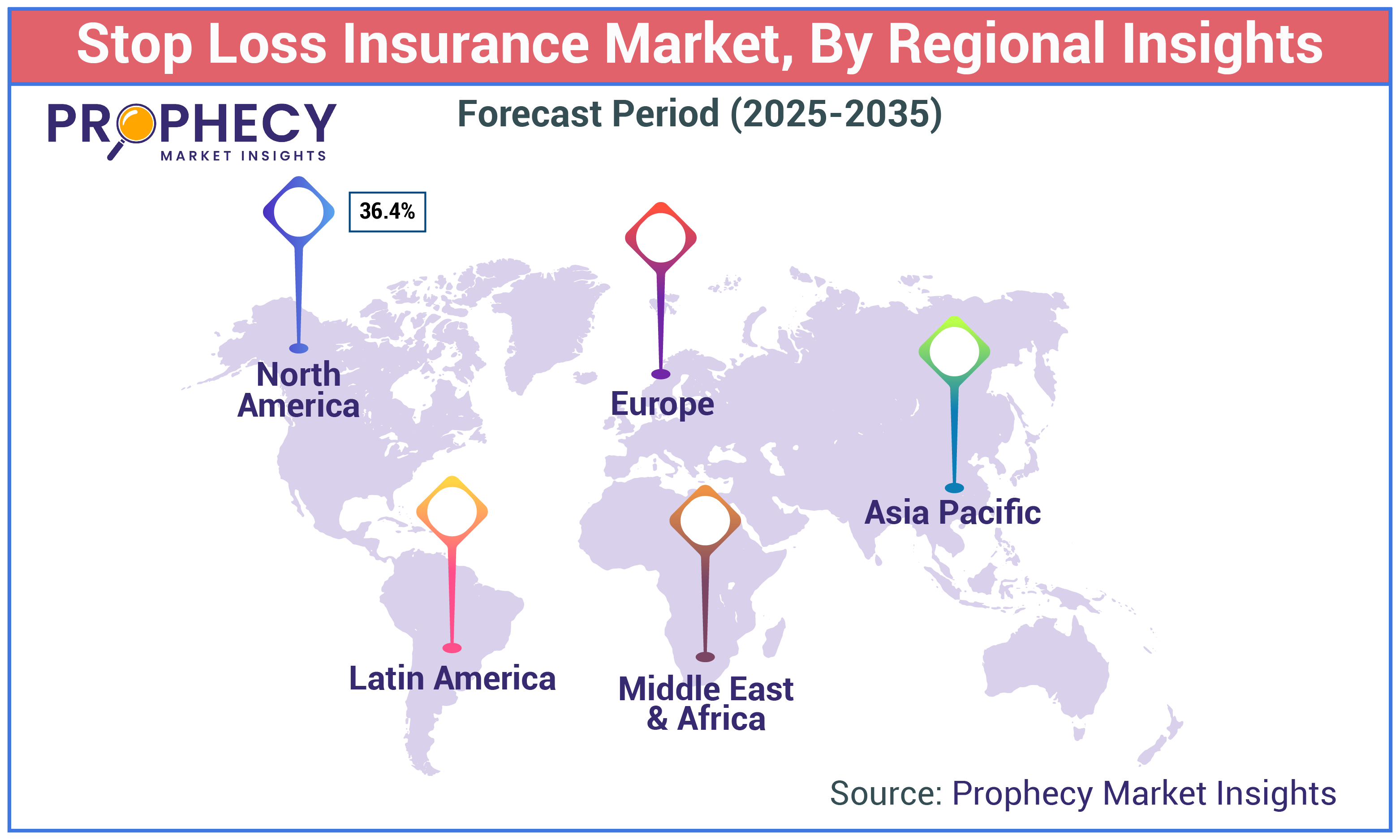
North America: Due to the extensive use of self-funded health plans in the US, especially by big and mid-sized firms looking to control growing healthcare costs, North America now maintains the greatest proportion of the stop loss insurance market. Market expansion is also fueled by the region's developed insurance system, advantageous regulatory framework, and high incidence of chronic illnesses.
- U.S. Stop Loss Insurance Market Insights:
The U.S. leads the stop loss insurance market in North America and across the world owing to its heavy dependence on employer-sponsored health plans and the fact that both large and mid-sized businesses frequently utilize self-funding. The United States has a well-established insurance market, growing healthcare expenses, and supportive regulations that promote the use of stop loss insurance as a risk management tool.
Europe: Supported by rising healthcare costs, increased employer knowledge of stop loss solutions, and growing interest in alternative health benefit funding models particularly in nations with flexible regulations and public healthcare cost pressures, Europe is the second-dominant area.
- Germany Stop Loss Insurance Market Insights:
Germany is becoming a major power in Europe owing to its sizable industrial workforce, rising healthcare expenditures, and steady transition to flexible, employer-driven benefit plans. However, because of its size and level of experience with self-funded health plans, the United States continues to dominate the industry.
Asia Pacific: The stop loss insurance market is expanding in the Asia-Pacific (APAC) area as a result of growing employer-sponsored health benefit uptake, rising healthcare costs, and more knowledge of self-funded insurance schemes. The need for stop loss coverage is rising as more APAC businesses look for affordable solutions to deal with unforeseen medical costs, particularly among major local and international enterprises.
- Japan Stop Loss Insurance Market Insights:
Japan is now leading the APAC market upon account of its strong insurance infrastructure, high medical costs, and aging population, which supports risk management techniques including stop loss insurance.
Stop Loss Insurance Market Report Scope:
|
Attribute |
Details |
|
Market Size 2025 |
USD 30.4 Billion |
|
Projected Market Size 2035 |
USD 110.7 Billion |
|
CAGR Growth Rate |
15.3% (2025-2035) |
|
Base year for estimation |
2024 |
|
Forecast period |
2025 – 2035 |
|
Market representation |
Revenue in USD Billion & CAGR from 2025 to 2035 |
|
Regional scope |
North America - U.S. and Canada Europe – Germany, U.K., France, Russia, Italy, Spain, Netherlands, and Rest of Europe Asia Pacific – China, India, Japan, Australia, Indonesia, Malaysia, South Korea, and Rest of Asia-Pacific Latin America - Brazil, Mexico, Argentina, and Rest of Latin America Middle East & Africa – GCC, Israel, South Africa, and Rest of Middle East & Africa |
|
Report coverage |
Revenue forecast, company share, competitive landscape, growth factors, and trends |
Segmentation:
By Coverage Type:
- Aggregate Stop Loss Insurance
- Specific Stop Loss Insurance
By Industry Vertical:
- Healthcare
- Manufacturing
- Retail and E-commerce
- IT and Telecommunication
- BFSI
- Others
By Enterprise Size:
- Large Enterprise
- Small and Medium Size Enterprise
By Distribution Channel:
- Direct Sales
- Insurance Brokers & Agents
- Consulting Firms
By Region:
- North America
- U.S.
- Canada
- Europe
- Germany
- U.K.
- France
- Russia
- Italy
- Spain
- Netherlands
- Rest of Europe
- Asia Pacific
- China
- India
- Japan
- Australia
- Indonesia
- Malaysia
- South Korea
- Rest of Asia Pacific
- Latin America
- Brazil
- Mexico
- Argentina
- Rest of Latin America
- Middle East & Africa
- GCC
- Israel
- South Africa
- Rest of Middle East & Africa
Stop Loss Insurance Market Competitive Landscape & Key Players
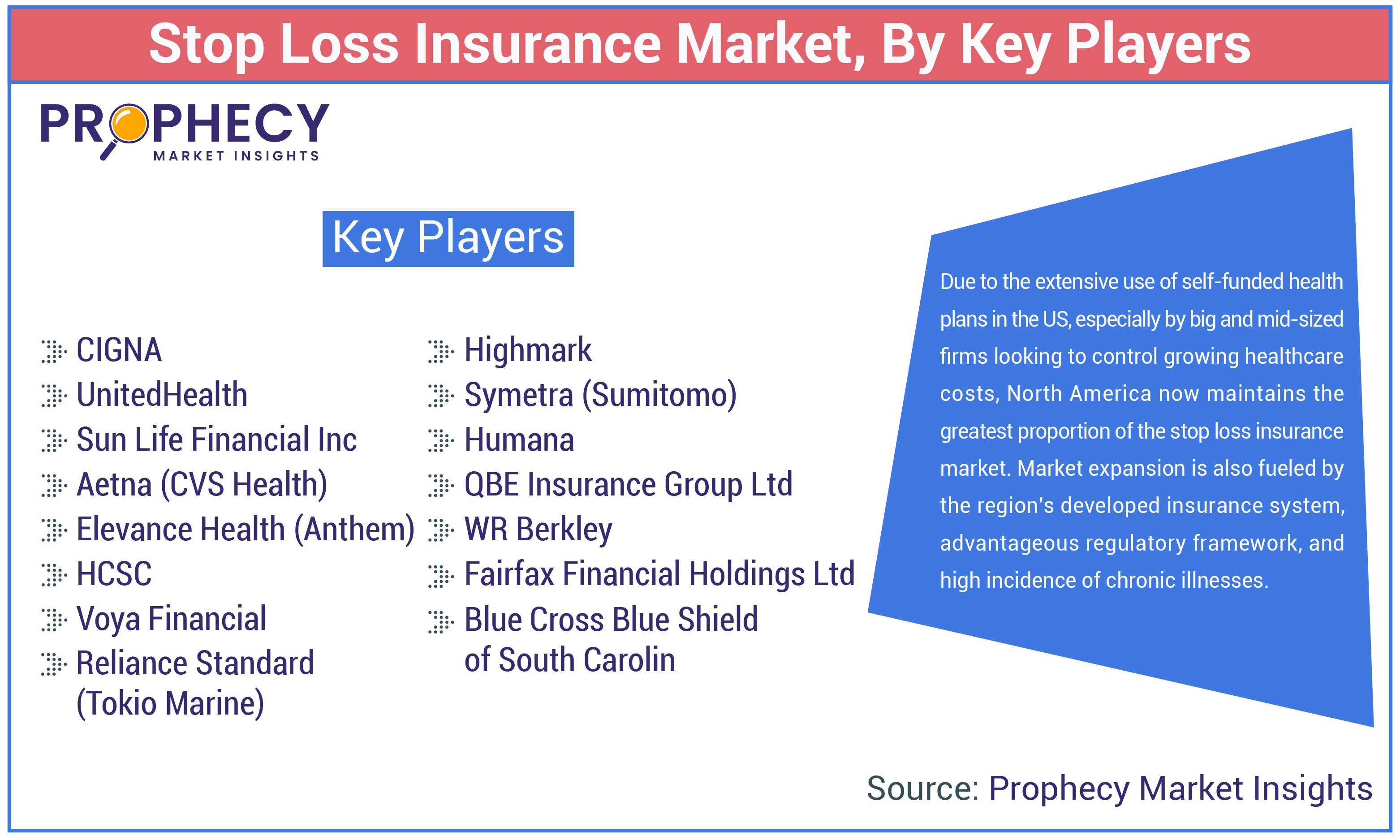
In order to develop, Stop Loss Insurance businesses use AI to improve underwriting, collaborate with brokers, provide flexible plans, enter new markets, and inform employers about self-funded benefits. The key players operating in the Stop Loss Insurance Market include, CIGNA, UnitedHealth, Highmark, Elevance Health (Anthem), Reliance Standard (Tokio Marine), and others.
Stop Loss Insurance Market Companies:
- CIGNA
- UnitedHealth
- Sun Life Financial Inc
- Aetna (CVS Health)
- Elevance Health (Anthem)
- Reliance Standard (Tokio Marine)
- HCSC
- Voya Financial
- Highmark
- Symetra (Sumitomo)
- Humana
- Blue Cross Blue Shield of South Carolina
- QBE Insurance Group Ltd
- WR Berkley
- Fairfax Financial Holdings Ltd
View an Additional List of Companies in the Stop Loss Insurance Market
Stop Loss Insurance Market Recent News
- In July 2025, for USD 1.25 billion, Nationwide, one of the biggest suppliers of financial services and insurance products in the United States, has successfully acquired The Allstate Corporation's employer stop loss division. This purchase positions the firm as a leading supplier in the employer stop loss sector by enhancing the financial services organization's capabilities, specific experience, and solid partnerships.
- In September 2024, to assist shield businesses with self-funded employee health plans from the devastating payments of medical claims, Prudential Financial, Inc. has launched a Stop Loss Insurance product. Employers can limit their possible employee healthcare expenses and shift some of the risk of claims to The Prudential Insurance Company of America by using Stop Loss Insurance.
Analyst View:
Employers with self-funded health plans are protected by Stop Loss Insurance, which helps maintain financial stability and predictable budgeting by paying for high medical claims, either individually or collectively. As more firms use self-funding to control escalating healthcare expenses and seek protection against expensive claims, the industry is expanding. To improve risk management, insurers are adding digital technologies and analytics to their portfolio. Future innovation will be fueled by cutting-edge technology such as artificial intelligence (AI) and adaptable coverage plans, which will provide companies with better cost management, transparency, and customized risk solutions.
More Related Reports
Cargo Insurance Market
Firestop Sealants Market
Cork Stopper Market
Cybersecurity Insurance Market
Health Insurance Third Party Administrators Market
Stop Loss Insurance Market Company Profile
|
Company Name |
Blue Cross Blue Shield of South Carolina |
|
Headquarter |
Columbia, South Carolina, United States |
|
CEO |
Michael Mizeur |
|
Employee Count |
11,000 Employees |
Stop Loss Insurance Market Highlights
FAQs
Stop loss insurance market size was valued at USD 30.4 Billion in 2025 and is expected to reach USD 110.7 Billion by 2035 growing at a CAGR of 15.3%.
Coverage type, industry vertical, enterprise size, distribution channel, and region are the segmentation for the Stop loss insurance market.
North America, Asia Pacific, Europe, Latin America, and the Middle East & Africa. North America is expected to dominate the market.
The key players operating the stop loss insurance market include CIGNA, UnitedHealth, Sun Life Financial Inc, Aetna (CVS Health), Elevance Health (Anthem), Reliance Standard (Tokio Marine), HCSC, Voya Financial, Highmark, Symetra (Sumitomo), Humana Blue Cross Blue Shield of South Carolina, QBE Insurance Group Ltd, WR Berkley, and Fairfax Financial Holdings Ltd.