Steel Rebar Market Overview
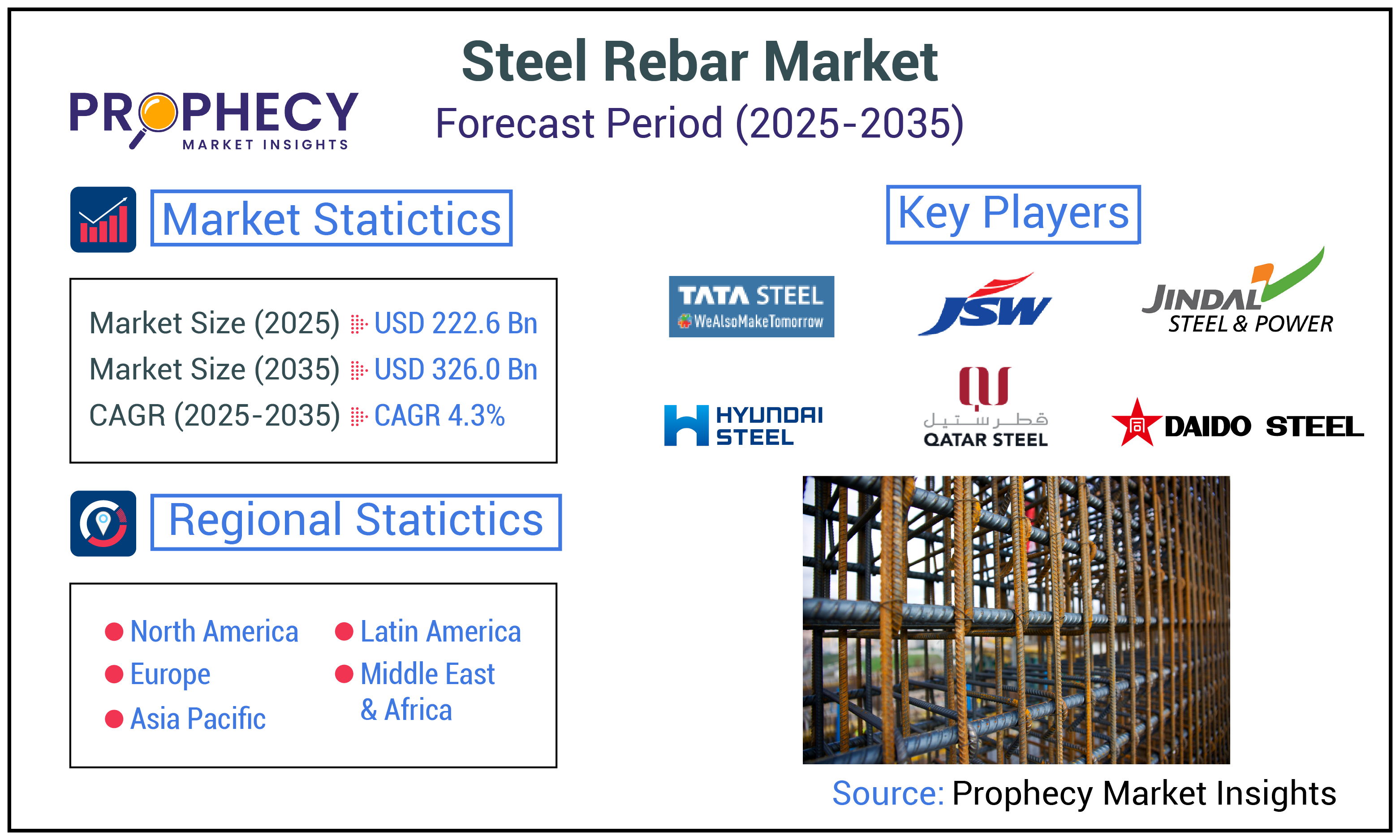
- By 2035, the steel rebar market size is contemplated to enlarge at a valuation of USD 326.0 Billion.
- In 2024, the steel rebar market valuation was USD 215 Billion.
- Steel rebar market is developing at a CAGR of 4.3%.
Steel rebar (reinforcing bar) is a steel rod or mesh of steel wires that is used as a tension device in reinforced concrete and masonry structures with the purpose of strengthening the concrete that is in compression and also to keep it. Its high tensile strength basically upgrades to the overall longevity and the structural stability of the constructions, bridges, and other types of infrastructure. Rebar to a large extent cuts the development of cracks and also withstands stress caused by variations in temperature, pressure of loads, and seismic activity, hence making the constructions safer and having a longer lifespan.
The steel rebar market growth is fueled by the need for infrastructure development, the trend of urbanization, and the requirement of residential and commercial construction from the global perspective. The funding from governments for public infrastructure projects such as bridges, roads, and railways, besides the growth of the industrial sector, is increasing the demand for rebar. Moreover, the change to high-strength and rust-resistant steel rebar, particularly in the areas vulnerable to earthquakes and close to the sea, is keeping up with the market trend further.
Steel rebar market will see a bright future with a sustained increase led by the rising infrastructure projects, particularly, in developing countries. Besides, the market trend is changing due to the need for high-strength, corrosion-resistant, and environmentally friendly rebar types, and the advent of digital construction tools and prefabrication. The implementation of sustainability objectives and the rise of efficiency in practice would propel the utilization of the industry and the level of innovation even further.
Recession Risk & Tariff Analysis:
- The steel rebar market has been hit with various problems that will be last for a short period of time. These problems include rising recession risks, tariff pressures, and slowing building demand. Overcapacity with construction materials in the world market is the cause of falling prices in the leading markets.
- Being the main importers of steel products especially for rebar, the U.S. and India are the two countries most affected by the tariffs that have been disrupting the trade flows and adding to the costs.
- As a result of these factors, there are delays in projects and investments are being done very cautiously, which is affecting the market's forecast of becoming positive and vibrant.
Impact of Generative AI on Steel Rebar Market:
- Generative AI is revolutionizing the steel rebar industry, the automation of such processes as bending, tying, and placement being the main reason for the change of the pace to faster and more accurate construction processes.
- Also, the installation of AI-powered machines combined with the use of vision-based quality inspection tools is a great step in the direction of achieving efficiency, lowering labor cost, and, at the same time, keeping the waste of materials at a minimum.
Steel Rebar Market Drivers & Restraints
Key Drivers:
Rapid Urbanization will Push Market Growth
Rapid urbanization means the quick growth of cities when a large number of people leave rural areas and come to urban centers because of better job opportunities, schools, and living standards. This change in population results in increased demand for housing, transportation, and services as well as infrastructure such as roads, bridges, and commercial buildings. As cities grow, the need for steel rebar grows also. So that new buildings can be made strong and last a long time, the governments and private developers have to put a lot of money into building projects.
- For Instance, according to the data published by World Bank Group, in order to fulfill the World Bank's purpose of eradicating poverty and promoting shared prosperity on a habitable world, more livable cities must be built. Currently, 4.4 billion people, or more than half of the world's population, reside in urban areas. This trend is predicted to continue, with nearly seven out of ten people living in cities by 2050, when the urban population is predicted to more than quadruple.
Restraints:
Trade Restrictions and Tariffs Could Affect Market Development
Trade barriers and tariffs in steel rebar, for instance, import levies and anti-dumping actions, may raise buyers' costs, cause disorder in international supply chains, and result in uncertain prices. Such impediments usually intend to safeguard local businesses yet may also restrict availability of materials that are either of better quality or cheaper, coming from foreign countries.
- Counterbalance Statements: Diversification of sourcing could be an answer through establishing trade relations with different countries, localize steel production to lessen reliance on imports, and take on long-term agreements that protect against abrupt changes are some of the measures that could be taken to ensure that supply remains constant, and costs remain predictable.
Opportunities & Trends:
Adoption of Advanced Rebar Types will be a Game-Changer Solution for the Market in Future
One of the key future trends that are shaping the steel rebar market is the adoption of advanced rebar types such as corrosion-resistant, epoxy-coated, stainless steel, and thermo-mechanically treated (TMT) rebars. These high-performance materials provide features such as strength, longevity, and resistance to difficult environmental conditions, and therefore are used in the infrastructure of coastal, seismic, and high-load areas. These days, the rules for building are getting stricter and people want to be greener. That means there will be more people wanting to buy rebar which will last for a long time and will not need to be taken care of very much. Thus, there will be more inventors creating new products and the market will be different.
Steel Rebar Market Segmentations & Regional Insights
Type, production process, coating, bar size, grade, end user, and region are the divisions of the steel rebar market.
By Type:
Deformed, and mild are type on which steel rebar market is segmented. With its high tensile strength and excellent concrete bonding qualities, deformed steel rebar dominates the steel rebar market share and is perfect for heavy-load constructions involving bridges, high-rise buildings, and industrial projects.
The second most popular form of rebar is mild steel, which is frequently utilized in low-stress applications involving road pavement and residential structures.
By Production Process:
Based on the production process, the steel rebar market is divided into electric-arc furnace, basic oxygen furnace, and others. The steel rebar market share is dominated by electric arc furnaces (EAFs) for the reason of their affordability, energy efficiency, and capacity to use scrap steel, which makes them more ecologically friendly and sustainable.
Large-scale, integrated steel production from raw iron ore is the main application for the second-dominant method, the Basic Oxygen Furnace (BOF).
By Coating:
Uncoated rebar, epoxy-coated rebar, galvanized rebar, and others are coating of the steel rebar market. Due to its widespread use in conventional building projects with less corrosive environmental conditions, uncoated rebar has the biggest steel rebar market share.
The second most common form of rebar is epoxy-coated, which is used for infrastructure that is subjected to moisture, salts, or chemicals, such bridges, maritime projects, and roads, since its protective covering greatly improves corrosion resistance.
By Bar Size:
On the bar size, steel rebar market is categorized into #3 (0.375 inch / 9.5 mm), #4 (0.500 inch / 12.7 mm), #5 (0.625 inch / 15.9 mm), #6 (0.750 inch / 19.1 mm), and others. Since #4 rebar (0.500 inch/12.7 mm) is so versatile and widely used in light infrastructure, commercial, and residential projects, it has the biggest steel rebar market size.
The second most popular size of rebar, #5 (0.625 inch/15.9 mm), is frequently utilized in heavier-duty applications where more tensile strength is needed, such as industrial foundations, bridges, and highways.
By Grade:
Grade 40, grade 60, grade 80, and others are grade of the steel rebar market. The steel rebar market size is dominated by grade 60 rebar primarily due to its high tensile strength, longevity, and wide range of applications in infrastructure, commercial, and residential construction.
The second most common grade, grade 40, is mostly utilized in low-load or smaller residential buildings where great strength is not necessary. Due to its price and simplicity of handling, it is nevertheless widely used in areas with lesser structural needs even though it is not as strong as Grade 60.
By End User:
The steel rebar market on the account of end user are categorized into residential, commercial, and industrial. Due to the massive volume of home construction brought on by urbanization, population increase, and government-backed affordable housing initiatives globally, the residential sector has the greatest market share in the steel rebar market.
The second-largest end user is the commercial sector, which is driven by the development of retail malls, office buildings, hospitals, and educational facilities.
Regional Insights:
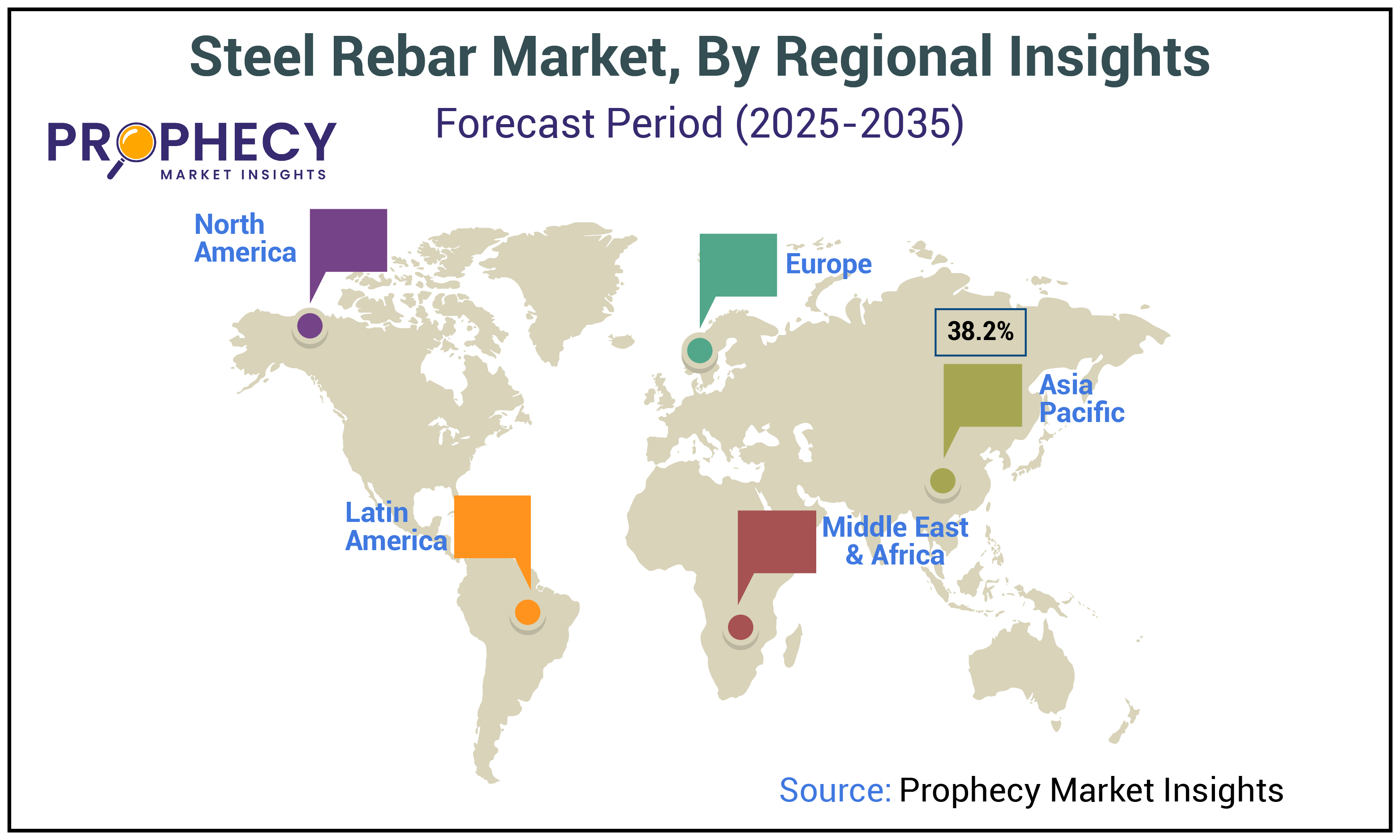
Geographically, the steel rebar market is studied across North America, Europe, Asia Pacific, Latin America, and the Middle East & Africa.
Asia Pacific: The steel rebar market is dominated by Asia-Pacific with 38.2% share, mainly on account of the region's enormous infrastructure development, fast urbanization, and population increase in nations notably China, India, and Southeast Asia. The ongoing need for steel rebar is fueled by government expenditures in housing, railroads, highways, and industrial developments.
- China Steel Rebar Market Insights:
Since China is the world's largest steel manufacturer and has a sizable construction industry, as well as substantial infrastructure projects including roads, rail networks, and urban housing, it leads the steel rebar market in the Asia-Pacific area. Initiatives led by the government, such the Belt and Road Initiative, increase demand for rebar both domestically and internationally.
North America: This is the second most dominating region, where the demand has been largely driven by the continued commercial and residential construction, the replacement of the aging infrastructure, and the use of high-strength, corrosion-resistant rebar in the projects all over the U.S. and Canada.
- U.S. Steel Rebar Market Insights:
The U.S. dominates the North American market. The main reasons for this are the massive modernization of infrastructure, the demand for residential housing, and the federal investments that have been made, for example, under programs such as the Infrastructure Investment and Jobs Act.
Europe: This region steel rebar market is expanding as a result of rising expenditures in green energy projects including wind farms and energy-efficient buildings, as well as renovations of existing structures. The need for high-quality, corrosion-resistant rebar is also being driven by the push for environmentally responsible construction and more stringent EU building safety and durability rules.
- Germany Steel Rebar Market Insights:
Germany is the market leader in Europe for the reason of its robust construction industry, emphasis on cutting-edge engineering, and extensive industrial and public infrastructure projects. It is a major buyer and influencer in the local steel rebar market due to its innovative leadership and commitment to high building standards.
Steel Rebar Market Report Scope:
|
Attribute |
Details |
|
Market Size 2025 |
USD 222.6 Billion |
|
Projected Market Size 2035 |
USD 326.0 Billion |
|
CAGR Growth Rate |
4.3% (2025-2035) |
|
Base year for estimation |
2024 |
|
Forecast period |
2025 – 2035 |
|
Market representation |
Revenue in USD Billion & CAGR from 2025 to 2035 |
|
Regional scope |
North America - U.S. and Canada Europe – Germany, U.K., France, Russia, Italy, Spain, Netherlands, and Rest of Europe Asia Pacific – China, India, Japan, Australia, Indonesia, Malaysia, South Korea, and Rest of Asia-Pacific Latin America - Brazil, Mexico, Argentina, and Rest of Latin America Middle East & Africa – GCC, Israel, South Africa, and Rest of Middle East & Africa |
|
Report coverage |
Revenue forecast, company share, competitive landscape, growth factors, and trends |
Segmentation:
By Type:
- Deformed
- Mild
By Production Process:
- Electric-Arc Furnace
- Basic Oxygen Furnace
- Others
By Coating:
- Uncoated Rebar
- Epoxy-Coated Rebar
- Galvanized Rebar
- Others
By Bar Size:
- #3 (0.375 inch / 9.5 mm)
- #4 (0.500 inch / 12.7 mm)
- #5 (0.625 inch / 15.9 mm)
- #6 (0.750 inch / 19.1 mm)
- Others
By Grade
- Grade 40
- Grade 60
- Grade 80
- Others
By End User:
- Residential
- Commercial
- Industrial
By Region:
- North America
- U.S.
- Canada
- Europe
- Germany
- U.K.
- France
- Russia
- Italy
- Spain
- Netherlands
- Rest of Europe
- Asia Pacific
- China
- India
- Japan
- Australia
- Indonesia
- Malaysia
- South Korea
- Rest of Asia Pacific
- Latin America
- Brazil
- Mexico
- Argentina
- Rest of Latin America
- Middle East & Africa
- GCC
- Israel
- South Africa
- Rest of Middle East & Africa
Steel Rebar Market Competitive Landscape & Key Players
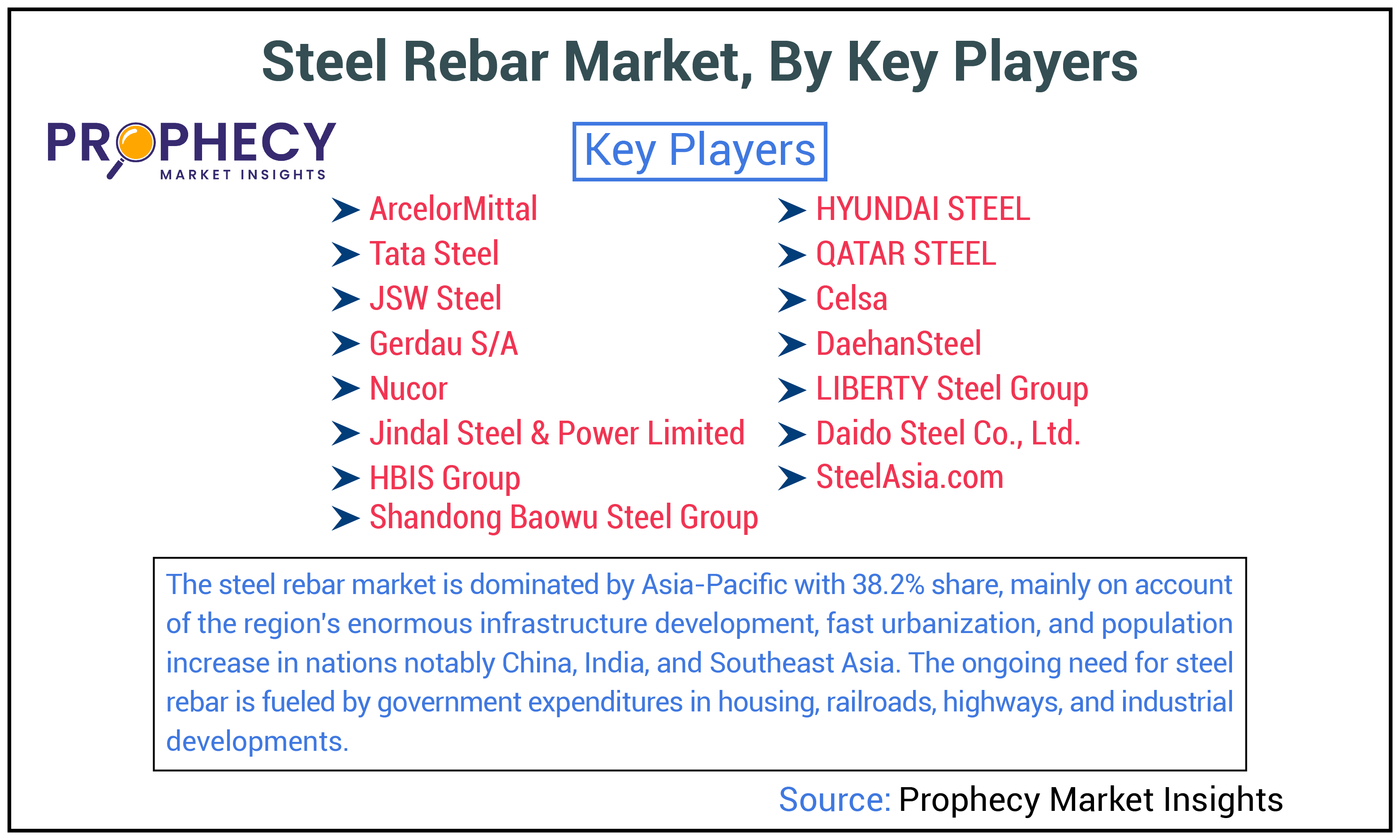
To address rising construction demand and maintain their competitiveness in a changing global market, steel rebar firms are concentrating on capacity growth, sophisticated and sustainable product development, strategic alliances, and geographic diversification. The key players operating in the steel rebar market include, ArcelorMittal, Tata Steel, HYUNDAI STEEL, Nucor, Jindal Steel & Power Limited, and others.
Steel Rebar Market Companies:
- ArcelorMittal
- Tata Steel
- JSW Steel
- Gerdau S/A
- Nucor
- Jindal Steel & Power Limited
- HBIS Group
- Shandong Baowu Steel Group
- HYUNDAI STEEL
- QATAR STEEL
- Celsa
- DaehanSteel
- LIBERTY Steel Group
- Daido Steel Co., Ltd.
- SteelAsia.com
View an Additional List of Companies in the Steel Rebar Market
Steel Rebar Market Recent News
- In February 2025, GFRP Tech introduces its product line in South Africa a few months after establishing its EnviraBar rebar and production plant there. The EnviraBar product line, which is made of a polymer matrix reinforced with fibers, is produced at GFRP Tech's brand-new, cutting-edge facility in Johannesburg's Linbro Park. It seeks to take the place of conventional steel rebar in building projects.
- In October 2024, with a focus on coastal areas, Shyam Metalics and Energy Ltd. (SMEL) has begun producing stainless steel rebar. This project backs the "Make in India" campaign and the Indian government's coastal development goal.
Analyst View:
The steel rebar is expanding rapidly due to urbanization, increased demand in residential and commercial building, and global infrastructure development. This trend is being supported by government expenditures in public works projects as well as a move toward high-strength, corrosion-resistant, and environmentally friendly rebar, particularly in seismic and coastal zones. With further growth in emerging nations and rising usage of digital construction tools, prefabrication, and sustainability-focused technologies that improve durability and efficiency, the industry appears to have a bright future.
More Related Reports
FRP Rebar Market
Galvanized Steel Market
Steel Market
Galvanized Steel Market
High Strength Steel Market
Steel Rebar Market Company Profile
|
Company Name |
ArcelorMittal |
|
Headquarter |
Luxembourg, Europe |
|
CEO |
Mr. Aditya Mittal |
|
Employee Count |
125,416 Employees |
Steel Rebar Market Highlights
FAQs
Steel rebar market size was valued at USD 222.6 Billion in 2025 and is expected to reach USD 326.0 Billion by 2035 growing at a CAGR of 4.3%.
Type, production process, coating, bar size, grade, end user, and region are the segmentation for the steel rebar market.
North America, Asia Pacific, Europe, Latin America, and the Middle East & Africa. Asia Pacific is expected to dominate the market.
The key players operating the steel rebar market include ArcelorMittal, Tata Steel, JSW Steel, Gerdau S/A, Nucor, Jindal Steel & Power Limited, HBIS Group, SHANDONG BAOWU STEEL GROUP, HYUNDAI STEEL, QATAR STEEL, Celsa, DaehanSteel, LIBERTY Steel Group, Daido Steel Co., Ltd., and SteelAsia.com.