Soft Tissue Repair Market Overview
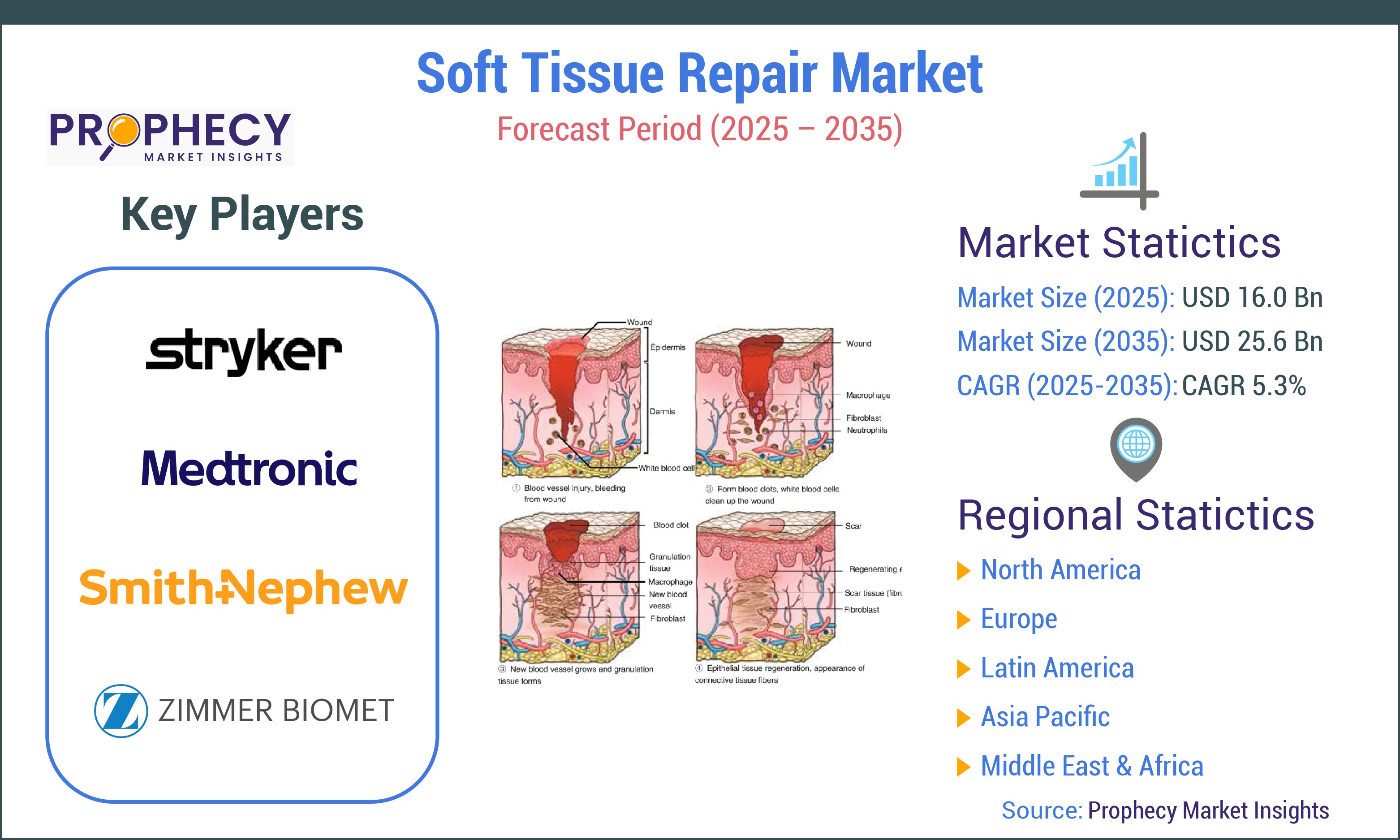
- By 2035, the soft tissue repair market size is contemplated to enlarge at a valuation of USD 25.6 Billion.
- In 2024, the soft tissue repair market valuation was USD 15.3 Billion.
- Soft tissue repair market is developing at a CAGR of 5.3%.
Soft tissue repairs refer to damaged muscles, tendons, ligaments or skin restoration and treatment due to trauma. This may include natural healing procedures or medical intervention such as sutures, grafts, or bioengineered materials. Major benefits include rapid recovery, low pain and swelling, restored mobility, prevention of further damage, and improvement in long -term functions and quality of life.
Many interconnected factors are expanding soft tissue repair markets: injuries related to sports and trauma (e.g., ACL tears, tendon breakdown, and hernias) increased athletic participation and rising road accident rate; increasing aerial healing and obese populations, which are more prone to musculoskeletal damage and slow therapy; technical success such as minimal invasive surgery, advanced synthetic/biological grafts, and regenerative remedies such as PRP and stem sale which improve results and recovery time; enabling access to these advanced processes improve healthcare expenses and improve better insurance coverage; and outpatient settings and emerging-marketed healthcare investment, which makes treatment more accessible and costing.
The soft tissue repair market is designed to develop more personalized, technology?driven care. Biologics and regenerative remedies (such as stem cells, exosomes, PRPs) are expected to be increased with advanced scaffolds and bio-engineer grafts. Surgical trends will bend into minimal invasive and robotic techniques for rapid, less painful recovery. Integration of digital tools such as AI guided diagnostics, wearable monitor, telemedicine, and smart strips equipped with sensor or drug delivery systems will monitor time and increase the results. Meanwhile, individual transplant repair will more customize the effectiveness, including 3D and deepened constructions and accurate and designed materials.
Recession Risk & Tariff Analysis:
- The soft tissue repair market faces the risk of recession and headwind related to tariffs. A global economic recession can reduce hospital budget and delay alternative surgery, slowing down the purchase of the device.
- On the tariff's front, 26–27% on Indian medical-device exports, such as American tariffs, erect "mutual" duties-the risk to disrupt increased costs and supply chains for producers. These measures reduce the competition of exporters and forces companies to either increase prices or transfer production, eventually affect the access and strength of soft-tissue repair products and strength.
Impact of Generative AI on Soft Tissue Repair Market:
- Generative AI is rapidly changing the soft tissue repair market by enabling more individual and accurate solutions. It helps designing patient-specific scaffolds, predicts tissue behavior, and optimizing the material through AI-operated modeling.
- In clinical settings, it supports AI-directed diagnostics, surgical planning and post-operative monitoring, which reduces better results and recovery time. Overall, the generic AI soft tissue repair is promoting innovation, efficiency and cost-efficiency in the ecosystem.
Soft Tissue Repair Market Drivers & Restraints
Key Drivers:
Rising Number of Injuries Related to Sports will Push Market Growth
Increasing number of sports-related injuries-as ligament is promoting the demand for soft tissue repair procedures, operated by increased participation in both tears, tendon breakdowns, and muscle strains and professional athletics. Millions of people want annual emergency treatment and in many of these cases require surgical intervention to stabilize and heal damaged soft tissues. This bounce not only enhances awareness and use of advanced repair devices such as organic grafts, fixation screws and stitches, but also accelerates adopting minimum invasive techniques motivating innovation and making the market comprehensive.
- For Instance, according to the data published The Johns Hopkins University, In the U.S., about 30 million children and teens participate in some form of organized sports, and more than 3.5 million injuries each year. More than 3.5 million children ages 14 and younger get hurt annually playing sports or participating in recreational activities. More than 775,000 children, ages 14 and younger, are treated in hospital emergency rooms for sports-related injuries each year.
The Market is Driven by Growing Incidences of Road Accidents
Increasing incidents of road accidents which claims about 1.19 million that causes 20-50million non -gentle injuries worldwide demanding soft tissue repair processes to address complex trauma, such as ligament tears, tendon breakdowns, and deep muscles. These injuries often require advanced reconstruction techniques such as biological grafts, fixation devices, and scaffold-assisted healing to restore the function and prevent complications. Consequently, the increase in road raff traffic trauma is an important catalyst for an increase in soft tissue repair market.
- For Instance, according to the data published WHO, approximately 1.19 million people die each year as a result of road traffic crashes. Road traffic injuries are the leading cause of death for children and young adults aged 5–29 years. 92% of the world's fatalities on the roads occur in low- and middle-income countries, even though these countries have around 60% of the world's vehicles.
Restraints:
Reimbursement Challenges, Particularly for Novel Therapies Could Affect Market Development
Reimbursement challenges for novel soft tissue repair therapy such as biological grafts, stem cell treatment, or regenerative scaffolding-from their high cost and limited long-term diagnostic data, insurance companies hesitate to provide coverage. This limits the reach of the patient and discourages healthcare providers to adopt these innovations.
- Counterbalance Statements: A potential solution is to install results from clear, evidence-based clinical guidelines and large-scale tests supported by real-world data. Additionally, early confusion with regulatory and payment bodies during product development can help manufacturers to align innovations with reimbursement structure, which can ensure rapid and wide coverage.
Opportunities & Trends:
Integration of Digital Tools will be a Game-Changer Solution for the Market in Future
Integration of digital tools is an important future tendency in the soft tissue repair market, which can enable clever, more personal and efficient care. How to evaluate, treat and track injuries that are changing technologies such as AI-operated diagnostics, wearable sensors, telemedicine platforms and smart straps with real-time monitoring capabilities. These devices increase surgical planning, predict complications, and improve post-operative care by monitoring the progression of continuous treatment. This digital shift not only optimizes clinical results, but also reduces the cost of recovery time and health care, making soft tissue repair more accessible and patient-centered.
Soft Tissue Repair Market Segmentations & Regional Insights
Product, material, application, end user, and region are the divisions of the soft tissue repair market.
By Product:
Suture anchors, interference screws, staples, tissue patch/mesh, laparoscopic instruments, and others are product on which soft tissue repair market is segmented. Due to their vital function in orthopedic and sports injury procedures, particularly for tendon and ligament reattachment, suture anchors have the biggest soft tissue repair market share.
Due to the increasing trend toward minimally invasive surgery for general, gynecologic, and hernia repair treatments, laparoscopic equipment come in second.
By Material:
Based on the material, the soft tissue repair market is divided into natural, and synthetic. Natural materials have the most soft tissue repair market share on account of their superior biocompatibility, low risk of immunological rejection, and capacity to work in tandem with the body's natural healing mechanisms.
The second-dominant market is made up of synthetic materials, which are becoming more popular due to their strength, consistency, and extended shelf life. Synthetics including polypropylene and polyglycolic acid are preferred in processes needing long-lasting structural support and cost effectiveness, although lacking the regeneration properties of natural materials.
By Application:
Hernia repair, breast reconstruction, skin repair, orthopedic repair, dental soft tissue repair, cardiology repair, and others are application of the soft tissue repair market. Considering musculoskeletal injuries, sports-related trauma, and age-related disorders including tendinitis and ligament tears are so common, orthopedic repair has the greatest soft tissue repair market share.
Due to the increase in hernia cases worldwide, particularly inguinal hernias, and the expanding use of mesh implants in minimally invasive surgical procedures, hernia repair is the second most common use.
By End User:
On the end user, soft tissue repair market is categorized into hospitals, specialty clinics, ambulatory surgical centers (ASCS), and others. Hospitals have the most market share in the soft tissue repair market as a consequence of their sophisticated surgical facilities, access to highly qualified medical personnel, and capacity to manage intricate treatments in orthopedic, cardiovascular, and reconstructive applications.
The second most common end user is ambulatory surgery centers (ASCs), which are becoming more and more popular due to their ability to do same-day procedures at less prices, with fewer risks of infection, and with a faster patient turnover rate.
Regional Insights:
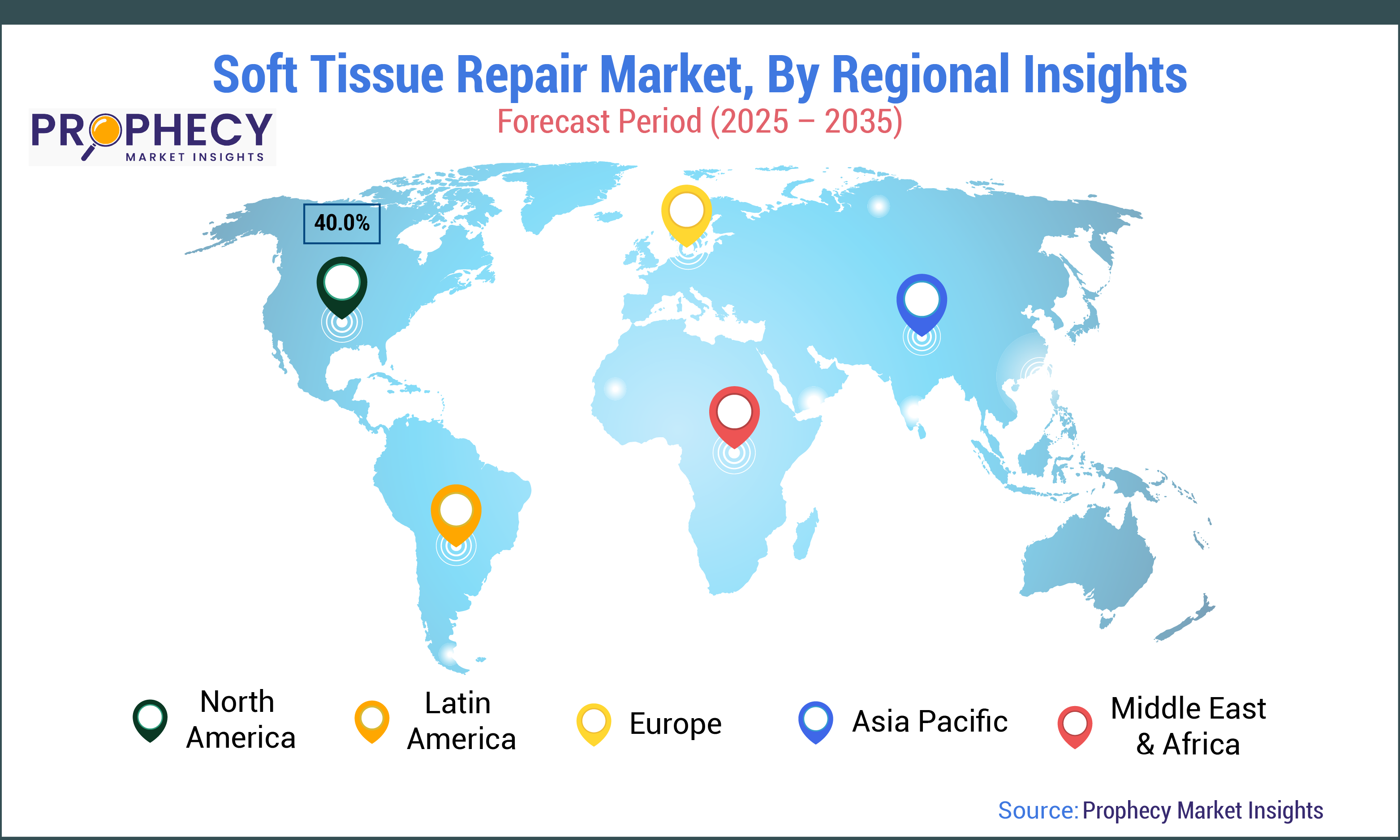
Geographically, the soft tissue repair market is studied across North America, Europe, Asia Pacific, Latin America, and the Middle East & Africa.
North America: With a market share of roughly 40%, North America dominates the soft tissue repair market for the reason of its advanced healthcare system, high healthcare costs, high rates of sports and traumatic injuries, advantageous reimbursement policies, and a large number of top medical device manufacturers in the US and Canada.
- U.S. Soft Tissue Repair Market Insights:
The U.S. leads the soft tissue repair market in North America by virtue of its sophisticated healthcare system, high number of orthopedic and sports-related procedures, significant presence of large medical device firms, and favorable reimbursement environment.
Europe: This is the second-largest region, making up around 23–28% of the worldwide market. Strong clinical research, aging populations, well-established healthcare systems, and the early adoption of cutting-edge, minimally invasive soft tissue repair technologies are the main drivers of its expansion.
- Germany Soft Tissue Repair Market Insights:
Due to its well-established healthcare system, big aging population, high rates of surgical procedures, and significant emphasis on medical research and technology adoption particularly in the orthopedic and reconstructive surgery segments, Germany is the top nation.
Asia Pacific: The soft tissue repair market in Asia-Pacific is expanding due to the region's large patient base, which includes a growing number of traumatic and sports-related injuries, improved healthcare infrastructure, rising medical costs, and greater knowledge of sophisticated surgical therapies.
- China Soft Tissue Repair Market Insights:
The market leader is China, which leads in adoption and revenue owing to its big population, quickly modernizing healthcare system, increasing government investment, emphasis on trauma care training, and growing domestic and foreign medical device businesses.
Soft Tissue Repair Market Report Scope:
|
Attribute |
Details |
|
Market Size 2025 |
USD 16.0 Billion |
|
Projected Market Size 2035 |
USD 25.6 Billion |
|
CAGR Growth Rate |
5.3% (2025-2035) |
|
Base year for estimation |
2024 |
|
Forecast period |
2025 – 2035 |
|
Market representation |
Revenue in USD Billion & CAGR from 2025 to 2035 |
|
Regional scope |
North America - U.S. and Canada Europe – Germany, U.K., France, Russia, Italy, Spain, Netherlands, and Rest of Europe Asia Pacific – China, India, Japan, Australia, Indonesia, Malaysia, South Korea, and Rest of Asia-Pacific Latin America - Brazil, Mexico, Argentina, and Rest of Latin America Middle East & Africa – GCC, Israel, South Africa, and Rest of Middle East & Africa |
|
Report coverage |
Revenue forecast, company share, competitive landscape, growth factors, and trends |
Segmentation:
By Product:
- Suture Anchors
- Interference Screws
- Staples
- Tissue Patch/Mesh
- Laparoscopic Instruments
- Others
By Material:
- Natural
- Synthetic
By Application:
- Hernia Repair
- Breast Reconstruction
- Skin Repair
- Orthopedic Repair
- Dental Soft Tissue Repair
- Cardiology Repair
- Others
By End User:
- Hospitals
- Specialty Clinics
- Ambulatory Surgical Centers (ASCs)
- Others
By Region:
- North America
- U.S.
- Canada
- Europe
- Germany
- U.K.
- France
- Russia
- Italy
- Spain
- Netherlands
- Rest of Europe
- Asia Pacific
- China
- India
- Japan
- Australia
- Indonesia
- Malaysia
- South Korea
- Rest of Asia Pacific
- Latin America
- Brazil
- Mexico
- Argentina
- Rest of Latin America
- Middle East & Africa
- GCC
- Israel
- South Africa
- Rest of Middle East & Africa
Soft Tissue Repair Market Competitive Landscape & Key Players
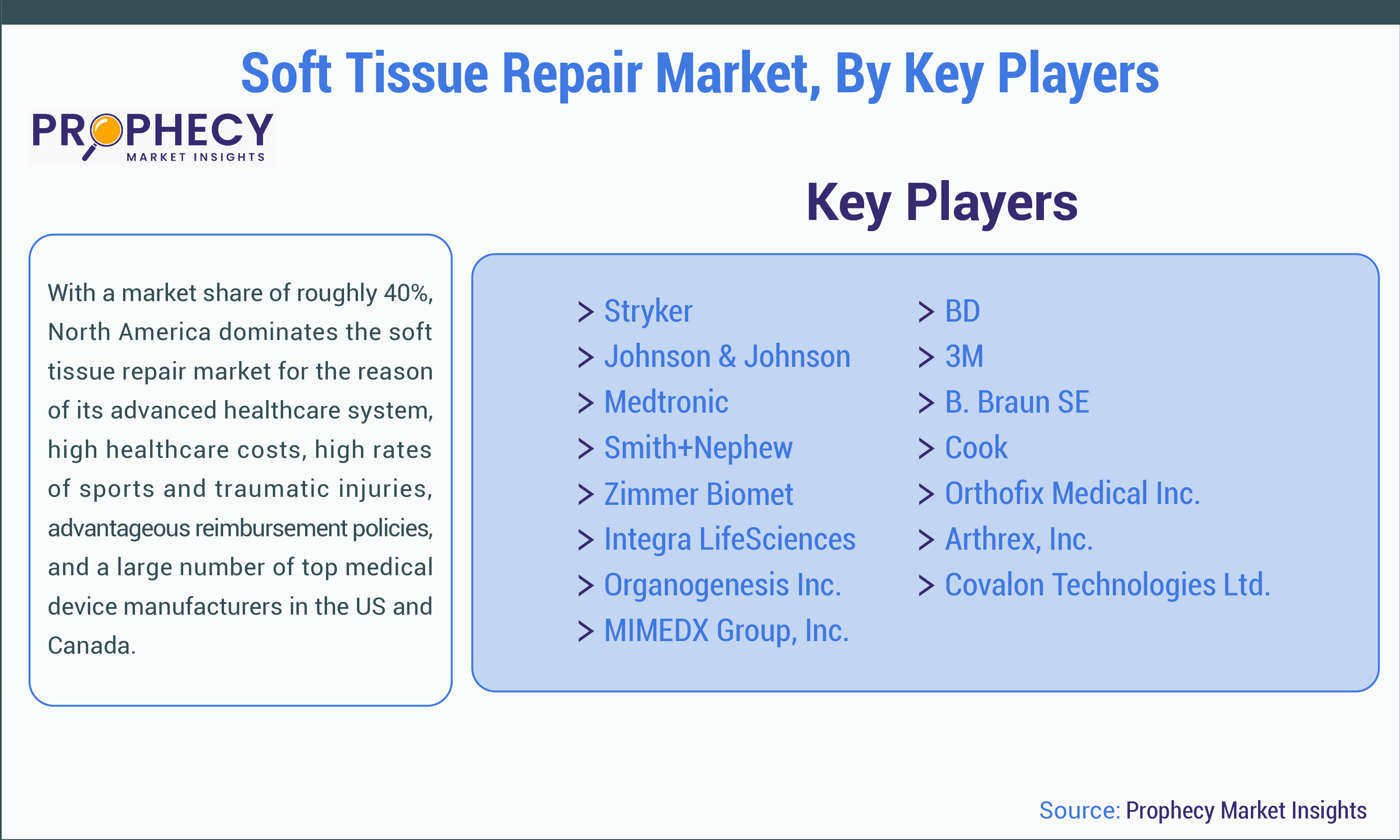
Investing in R&D to create cutting-edge biologics and minimally invasive treatments, establishing strategic alliances and acquisitions to broaden product portfolios, breaking into emerging markets to meet the rising demand for healthcare, and obtaining regulatory approvals and reimbursement coverage to encourage adoption are all important growth strategies for soft tissue repair businesses. The key players operating in the soft tissue repair market include, Stryker, Johnson & Johnson, BD, Zimmer Biomet, Integra LifeSciences, and others.
Soft Tissue Repair Market Companies:
- Stryker
- Johnson & Johnson
- Medtronic
- Smith+Nephew
- Zimmer Biomet
- Integra LifeSciences
- Organogenesis Inc.
- MIMEDX Group, Inc.
- BD
- 3M
- B. Braun SE
- Cook
- Orthofix Medical Inc.
- Arthrex, Inc.
- Covalon Technologies Ltd.
View an Additional List of Companies in the Soft Tissue Repair Market
Soft Tissue Repair Market Recent News
- In April 2025, Leading international medical technology firm BD announced the commercial availability of Phasix ST Umbilical Hernia Patch, the first and only completely absorbable hernia patch on the market made especially for umbilical hernias, along with its 510(k) approval from the US Food and Drug Administration (FDA). By using cutting-edge biomaterials to redefine tissue restoration and dependable, tested substitutes for permanent mesh, BD is broadening treatment choices to suit the needs of each patient.
- In June 2024, Axogen, Inc., a world pioneer in creating and promoting cutting-edge surgical treatments for damage to peripheral nerves, has announced the release of Avive Soft Tissue Matrix, its newest offering. Avive is a resorbable, multi-layer amniotic membrane allograft designed to act as a soft tissue barrier, offering tissue separation and temporary protection during the crucial stage of peripheral nerve recovery.
Analyst View:
Soft tissue repair offers advantages including quicker recovery, less discomfort, and more mobility by repairing injured muscles, tendons, ligaments, or skin through spontaneous healing or surgical procedures such as sutures and grafts. The market is expanding as a result of improvements in minimally invasive surgery, biologic grafts, and regenerative treatments like PRP and stem cells, as well as an increase in sports and trauma injuries, auto accidents, aging, and obese populations. In order to improve results and accessibility, future developments include wearable monitoring, robotic surgery, AI-guided tools, tailored, tech-driven treatment with a greater use of biologics, and 3D-printed, patient-specific implants.
More Related Reports
Soft Robotics Market
Soft Tissue Market
Tissue Transplantation Products and Services Market
Tissue Diagnostics (TDx) Market
Extremity Tissue Expanders Market
Soft Tissue Repair Market Company Profile
|
Company Name |
BD |
|
Headquarter |
Franklin Lakes, New Jersey, U.S. |
|
CEO |
Thomas Polen |
|
Employee Count |
75,000 Employees |
Soft Tissue Repair Market Highlights
FAQs
Soft tissue repair market size was valued at USD 16.0 Billion in 2025 and is expected to reach USD 25.6 Billion by 2035 growing at a CAGR of 5.3%.
Product, material, application, end user, and region are the segmentation for the target market.
North America, Asia Pacific, Europe, Latin America, and the Middle East & Africa. North America is expected to dominate the market.
The key players operating the soft tissue repair market include Stryker, Johnson & Johnson, Medtronic, Smith+Nephew, Zimmer Biomet, Integra LifeSciences, Organogenesis Inc., MIMEDX Group, Inc., BD, 3M, B. Braun SE, Cook, Orthofix Medical Inc., Arthrex, Inc., and Covalon Technologies Ltd.