Satellite Ground Station Market Overview
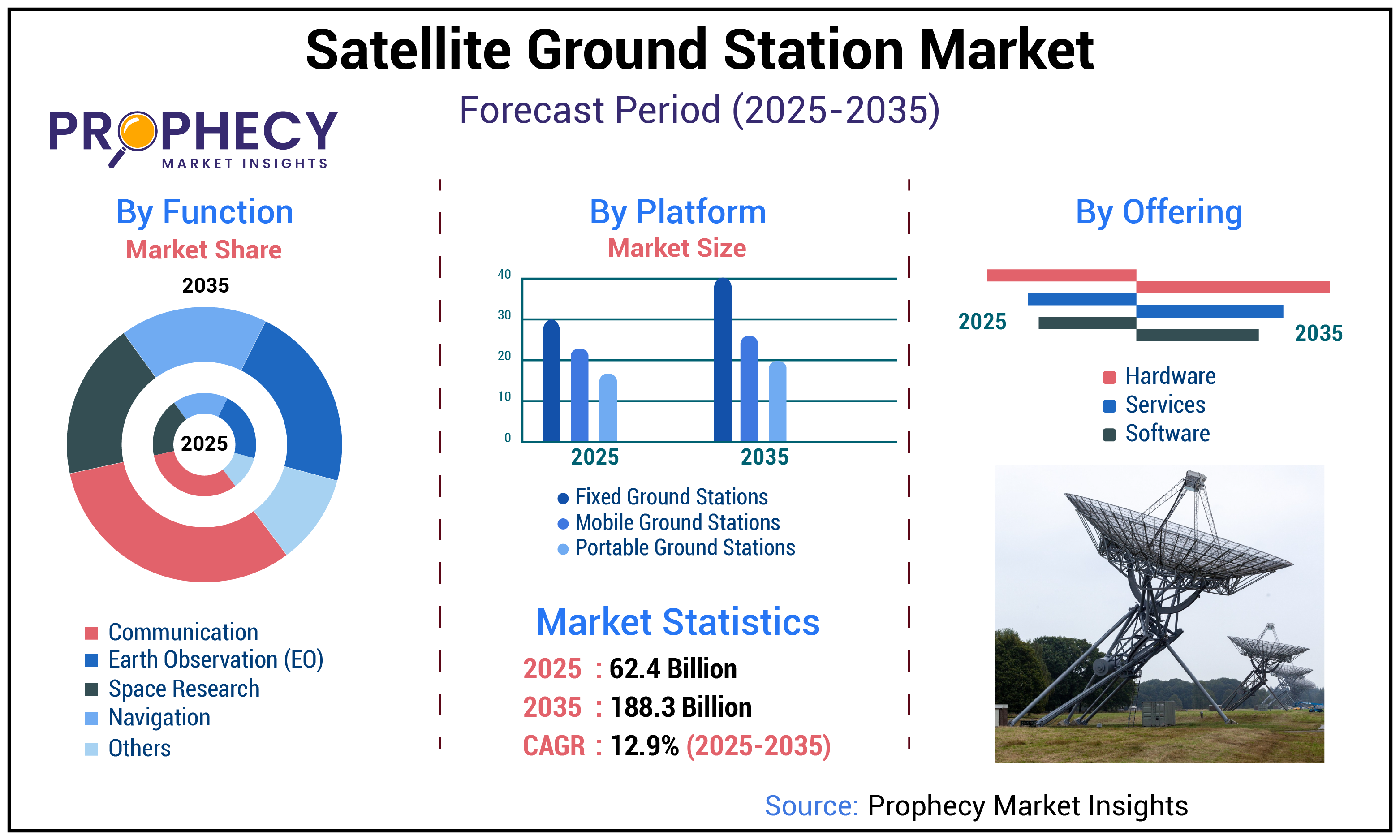
- 2024 Market Size: USD 54.0 Billion
- 2035 Projected Market Size: USD 188.3 Billion
- CAGR (2025-2035): 12.9%
- North America: Largest Market in 2024
A Satellite Ground Station is basically a facility on the ground which is fitted with antennas, receivers, transmitters as well as control systems that allow data transmission to satellites, telemetry, tracking, and command activities. Some of the main benefits are that the communication remains dependable and is done in real time, efficient data can be sent both from the Earth to the satellite and vice versa, better satellite management and supervision, connectivity without any geographical limitations, and assistance to vital areas such as meteorology, catastrophe management, and the military which can be securely communicated.
Development of the market for satellite ground stations is fueled by various factors among which are the need for data communication at high speeds, the number of satellites for communication, navigation, and the observation of the Earth, and also the use of services based on satellites in the areas of defense, weather monitoring, and disaster management. Moreover, the developments in ground station automation, cloud-based ground services and the increasing use of small satellites and LEO constellations have a positive influence on the market as they facilitate quicker, cheaper and more accessible, from anywhere in the world, satellite communication.
Global Regulations of Satellite Ground Stations:
- International Telecommunication Union (ITU): Manages radio frequency spectrum and space locations to ensure that there is no interference with satellites and earth stations.
- National Licensing Authorities: To use a specific frequency and operate a station, an operator must get a license from the proper authority (such as the FCC in the U.S. or Ofcom in the U.K.), which oversees the administration of radio frequencies in each country.
- Space Debris & Safety Guidelines: Abiding by environmentally friendly in space such as UNCOPUOS (the United Nations Committee on the Peaceful Uses of Outer Space) committee.
- Export Control Regulations: Countries implement regulations (such as ITAR in the United States) that limit the movement of space and ground station technologies for the sake of national security.
- Cybersecurity Standards: In order to protect data and communication, cybersecurity essentials on both global and regional scales must be used by the ground stations for satellite security.
- Data Protection & Privacy Laws: Rules governing the collection and use of satellite remote sensing and communication information, with special emphasis on the areas of defense and the civilian sector.
- Environmental Compliance: In certain areas, the installation of antennas and the grounding of the infrastructure must comply with environmentally friendly rules.
Current Industry Dynamics & Insights:
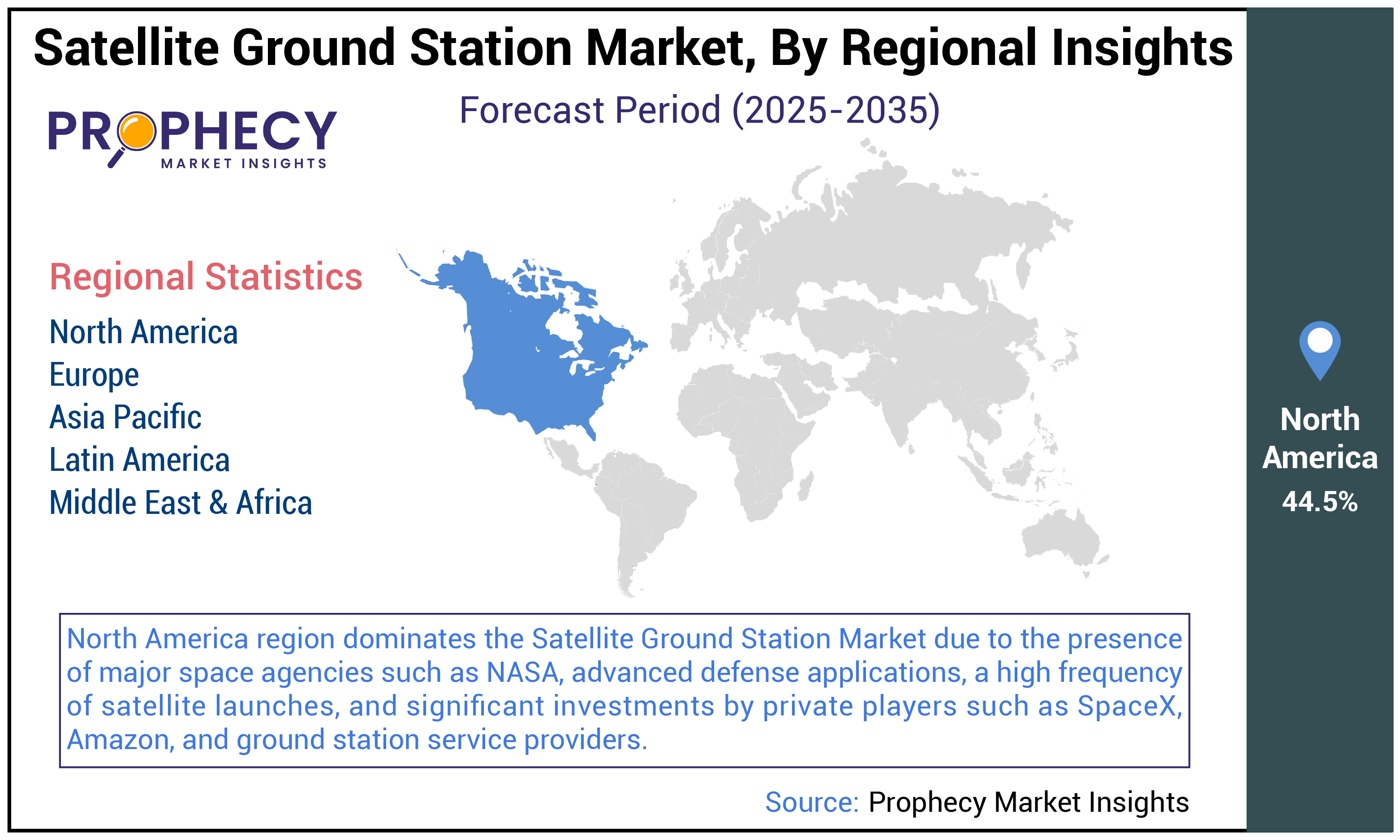
- North America has the largest regional share in the market, with almost 44.5%.
- Europe is second dominating region in the market.
- By offering, hardware dominates the satellite ground station market.
Satellite Ground Station Market Drivers & Restraints
Drivers and Restraints:
|
Drivers |
Restraints |
Opportunities & Trends |
|
|
|
Key Drivers:
Increasing Satellite Launches for Earth Observation, Navigation, and Broadband
Satellite launches for earth observation, navigation, and broadband expansion have been on the rise, which has led to a market growth. The reason for this is that these satellites need ground stations to be able to transfer data, track, and control, hence the increase in demand for ground stations. For real-time imaging, precise navigation, and high-speed global internet, there is a need for highly developed and flexible ground infrastructure, the requirement of which has become even more critical due to the growing number of satellites in space, particularly LEO constellations.
- For Instance, according to article published by Our World in Data, Objects are defined here as satellites, probes, landers, crewed spacecrafts, and space station flight elements launched into Earth orbit or beyond. The data captures around 88% of all objects launched.
Restraints:
Vulnerability to Cybersecurity Threats and Signal Interference
One factor that is hindering the development of the Satellite Ground Station Market is the potential for cyber-attacks and signal interference. Such a situation can lead to data breaches, interruptions in services, and even takeover of satellites, which can slow down the usage of the most sensitive areas such as defense, navigation, and communication sectors.
- Counterbalance Statements: Operators have been utilizing more sophisticated encryption, Al-powered threat detection, anti-jamming technologies, and secure cloud-based systems to address this problem, so that their satellite-ground communication can have unbreakable safety, data protection, and be dependable.
Opportunities & Trends:
Growth of Multi-Orbit Ground Stations
The availability of multi-orbit ground stations spanning several orbits is a significant trend that shapes a sustainable future for the Ground Station Market. Such stations allow an unbroken communication flow from GEO, MEO, and LEO satellites by just one combined platform. Besides lowering the cost of the necessary facilities, the adaptability also provides higher effectiveness and facilitates the growing number of different satellite constellations. The satellite communication networks of the next generation will rely heavily on multi-orbit stations as they enable operators to access flexible, compatible, and progressive solutions that in turn allow them to meet the rising requirements of globally available broadband, real-time data, and connectivity that is robust across different orbits.
Satellite Ground Station Market Segmentations & Regional Insights
Offering, platform, orbit, frequency band, function, end user, and region are the divisions of the satellite ground station market.
By Offering:
Hardware, software, and services are offering on which satellite ground station market is segmented. Hardware dominates the satellite ground station market share considering antennas, RF systems, modems, and related equipment comprise the basic infrastructure required for satellite communication, making them the most capital-intensive and necessary component.
Services come in second, driven by the growing demand for satellite data management, ground station operations, and cloud-based ground services, as operators outsource these functions to reduce costs and improve scalability, while software continues to grow steadily due to the rise of automation and AI integration.
By Platform:
Based on the platform, the satellite ground station market is divided into fixed ground stations, portable ground stations, and mobile ground stations. Fixed ground stations dominate the satellite ground station market size as they provide high-capacity, dependable, and permanent infrastructure required for ongoing satellite communication, broadcasting, and navigation services.
Mobile ground stations are the second-largest market, owing to their rising usage in military, disaster management, and remote region connection, where flexibility and quick deployment are vital, while portable stations are slowly expanding for smallsat and research applications.
By Orbit:
Low earth orbit (LEO), medium earth orbit (MEO), and geostationary earth orbit (GEO) are orbit of the satellite ground station market. Geostationary earth orbit (GEO) satellites dominate the satellite ground station market growth since they provide long-standing applications such as broadcasting, weather monitoring, and global communications with fewer satellites and more consistent coverage.
Low Earth Orbit (LEO) is the second-largest market, quickly increasing due to the proliferation of LEO constellations for high-speed broadband, Earth observation, and real-time data services, pushing demand for more complex and dispersed ground station networks.
- In June 2025, the world's first commercial high-orbit relay satellite program, the Cangyu Constellation of 13 satellites, is slated to launch its first geostationary Earth orbit (GEO) satellite, CY-G1, in 2026. The initiative, launched by Chinese commercial space business Cangyu Space, intends to create a worldwide space-based information network by 2030, consisting of four GEO, six medium Earth orbit (MEO), and three inclination geosynchronous orbit (IGSO) satellites.
By Frequency:
On the account of frequency, the satellite ground station market, is categorized into C-Band (4–8 GHz), X-Band (8–12 GHz), Ku-Band (12–18 GHz), Ka-Band (26.5–40 GHz), and Others. The Ku-Band (12-18 GHz) dominates the satellite ground station market as it is widely utilized for broadcasting, VSAT networks, and internet services, providing a good blend of capacity, coverage, and cost-effectiveness.
The Ka-Band (26.5-40 GHz) is the second-most popular section, with fast acceptance for high-capacity data communication and broadband internet, notably for LEO constellations, because to its ability to handle larger data rates while being more vulnerable to rain fade.
By Function:
Communication, earth observation (EO), space research, navigation, and others are function of the satellite ground station market. Communication dominates the satellite ground station market since ground stations are largely utilized for broadcasting, broadband connection, and telecommunications services, which account for the vast majority of satellite applications globally.
Earth Observation (EO) is the second-most important function, driven by increasing demand for real-time imagery and monitoring in agriculture, climate research, urban planning, and disaster management, making it a fast-developing category alongside communication.
By End User:
The satellite ground station market on the account of end user is categorized into commercial, military & defense, and others. The business sector dominates the satellite ground station market share due to the high demand for satellite-based internet, broadcasting, navigation, and Earth observation services in sectors such as telecom, agriculture, and transportation.
The military and defense industry is the second-largest category, driven by its reliance on secure satellite communication, surveillance, and navigation for intelligence, strategic operations, and disaster response, resulting in a sizable but smaller market than commercial uses.
Regional Insights:
Geographically, the satellite ground station market is studied across North America, Europe, Asia Pacific, Latin America, and the Middle East & Africa.
North America: This region dominates the satellite ground station market due to the presence of major space agencies such as NASA, advanced defense applications, a high frequency of satellite launches, and significant investments by private players such as SpaceX, Amazon, and ground station service providers.
- U.S. Satellite Ground Station Market Insights:
The U.S. leads the satellite ground station market in North America as to its massive satellite infrastructure, high number of launches, stringent military needs, and significant private sector expenditures from businesses such as SpaceX, Amazon, and KSAT.
Europe: This is the second most important area, due to activities from the European Space Agency (ESA), widespread adoption of Earth observation projects such as Copernicus, and rising demand for secure communication and navigation services across businesses.
- Germany Satellite Ground Station Market Insights:
Germany dominates the market in Europe since to its extensive ground station networks, support for ESA space programs, and strong industrial foundation in satellite communication and Earth observation technologies, making it a vital center for regional growth.
Asia Pacific: This region satellite ground station market size is rapidly expanding due to an increase in satellite launches for communication, Earth observation, and navigation, as well as rising demand for broadband connectivity in remote areas, expanding defense applications, and government investments in space programs.
- China Satellite Ground Station Market Insights:
China leads the APAC market since it has one of the most advanced and comprehensive space programs, a huge number of satellite launches, and considerable investment in both military and commercial satellite infrastructure, establishing itself as the regional leader.
Satellite Ground Station Market Report Scope:
|
Attribute |
Details |
|
Market Size 2025 |
USD 62.4 Billion |
|
Projected Market Size 2035 |
USD 188.3 Billion |
|
CAGR Growth Rate |
12.9% (2025-2035) |
|
Base year for estimation |
2024 |
|
Forecast period |
2025 – 2035 |
|
Market representation |
Revenue in USD Billion & CAGR from 2025 to 2035 |
|
Regional scope |
North America - U.S. and Canada Europe – Germany, U.K., France, Russia, Italy, Spain, Netherlands, and Rest of Europe Asia Pacific – China, India, Japan, Australia, Indonesia, Malaysia, South Korea, and Rest of Asia-Pacific Latin America - Brazil, Mexico, Argentina, and Rest of Latin America Middle East & Africa – GCC, Israel, South Africa, and Rest of Middle East & Africa |
|
Company Landscape |
Market Share Analysis of Companies Heat Map Analysis Company Overview, Products Overview Financial Information, Key Highlights Business Strategies Overview SWOT Analysis |
|
Report coverage |
Revenue forecast, company share, competitive landscape, growth factors, and trends |
|
Value Added Data Infosets |
Besides fundamental market insights such as the size of the market, growth rate, segmentation, regional study, and key players, our reports carry value-added data sets such as trade flow (import-export) analysis, production and consumption overview, price trend evaluation, supply and value chain mapping, and raw material availability. Moreover, we provide strategic tools as PESTLE and Porter’s Five Forces analysis, examination of the regulatory landscape, as well as monitoring of technology and innovation thereby providing a comprehensive overview which facilitates sensible and anticipatory decision-making. |
Segmentation:
By Offering:
- Hardware
- Antennas
- Transceivers
- Others
- Software
- Satellite Tracking
- Telemetry
- Others
- Services
- Encompasses Integration, Installation, Maintenance, and Satellite Network Management Services
- Others
By Platform:
- Fixed Ground Stations
- Portable Ground Stations
- Mobile Ground Stations
By Orbit:
- Low Earth Orbit (LEO)
- Medium Earth Orbit (MEO)
- Geostationary Earth Orbit (GEO)
By Frequency Band:
- C-Band (4-8 GHz)
- X-Band (8–12 GHz)
- Ku-Band (12–18 GHz)
- Ka-Band (26.5–40 GHz)
- Others
By Function:
- Communication
- Earth Observation (EO)
- Space Research
- Navigation
- Others
By End User:
- Commercial
- Military & Defense
- Others
By Region:
- North America
- U.S.
- Canada
- Europe
- Germany
- U.K.
- France
- Russia
- Italy
- Spain
- Netherlands
- Rest of Europe
- Asia Pacific
- China
- India
- Japan
- Australia
- Indonesia
- Malaysia
- South Korea
- Rest of Asia Pacific
- Latin America
- Brazil
- Mexico
- Argentina
- Rest of Latin America
- Middle East & Africa
- GCC
- Israel
- South Africa
- Rest of Middle East & Africa
Satellite Ground Station Market Competitive Landscape & Key Players
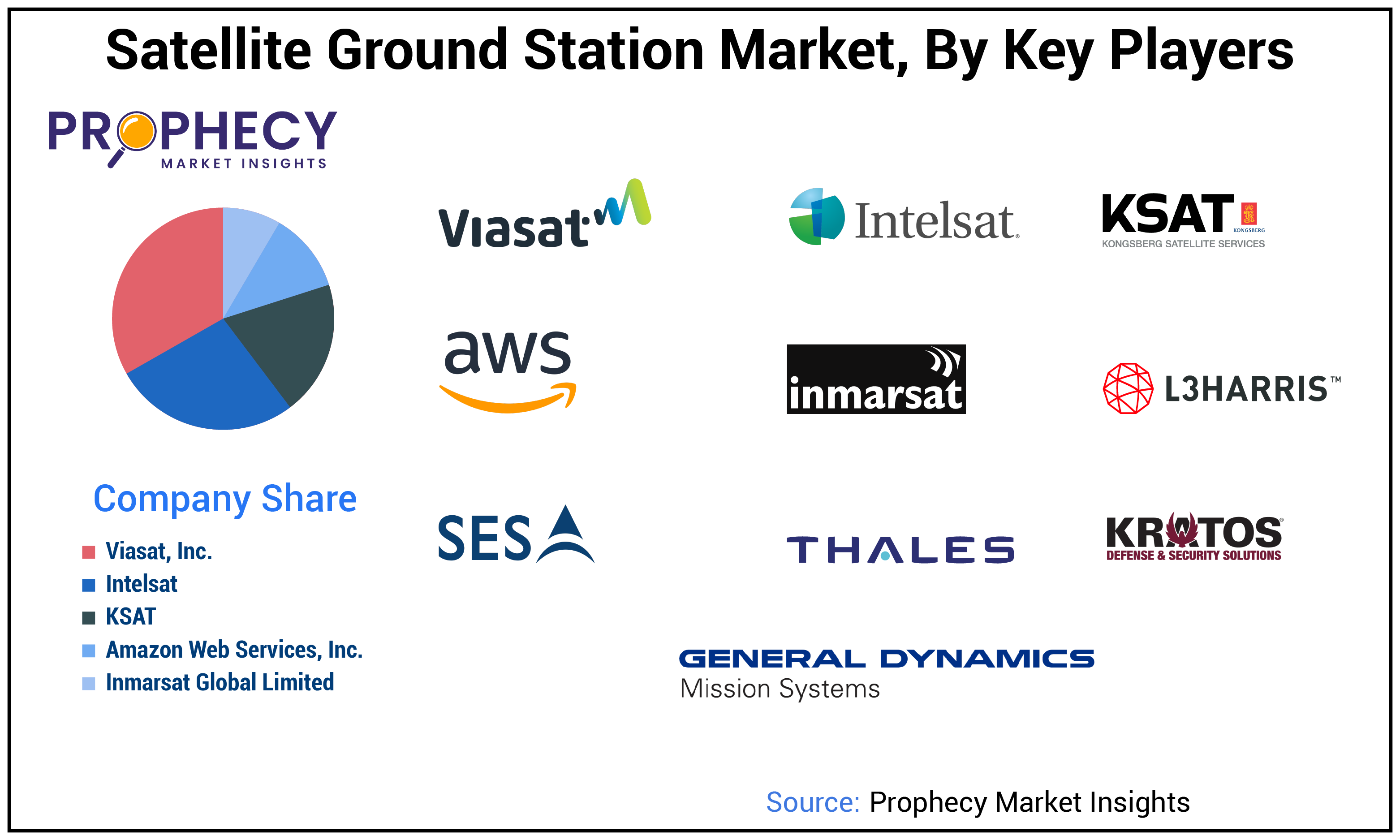
The key players operating in the satellite ground station market include, Intelsat, SES S.A., Amazon Web Services, Inc., and others. Satellite Ground Station firms prioritize global network development, cloud-based services, AI automation, strategic alliances, and multi-orbit/high-frequency technologies to drive growth and fulfill increased demand for rapid, dependable satellite communication.
Satellite Ground Station Market Companies:
- Viasat, Inc.
- Intelsat
- KSAT
- Amazon Web Services, Inc.
- Inmarsat Global Limited
- L3Harris Technologies, Inc.
- SES S.A.
- General Dynamics Mission Systems, Inc.
- Thales
- Kratos Defense & Security Solutions, Inc.
- Gilat Satellite Networks
- RTX
- Hughes Network Systems, LLC
View an Additional List of Companies in the Satellite Ground Station Market
Satellite Ground Station Market Recent News
- In July 2025, SatRev, a Polish space infrastructure provider, has handed over a new ground station to its client in Oman. The station's launch is part of the Polish business's growth into the Middle East space sector, and it signals the end of its continuous collaboration with ETCO Space, an Omani state-owned enterprise.
- In August 2025, KSAT, a ground station-as-a-service (GSaaS) startup, is deploying a fleet of in-orbit ground stations called "Hyper" to enable inter-satellite connection. The business stated that the Low Earth Orbit (LEO) fleet will provide low-latency communication, allowing satellites to utilize Hyper machines to transmit information to Earth while not over ground station locations.
Analyst View:
A satellite ground station is a building equipped with antennas and control systems that allow for real-time satellite communication, tracking, and data transmission, serving industries such as defense, meteorology, and disaster management. The satellite ground station market is expanding due to rising demand for high-speed data, more satellite launches, and the use of automation, cloud-based services, and LEO constellations, which make satellite communication quicker, cheaper, and more accessible throughout the world.
Analysis of Sources:
Primary Sources:
- In-depth interviews
- Company-specific data
- Surveys and questionnaires
- Focus group discussions (FGDs)
- Others
Secondary Sources:
- International Telecommunication Union (ITU)
- Federal Communications Commission (FCC, USA)
- European Space Agency (ESA, Europe)
- Others
More Related Reports
Small-satellite Launch Service Market
M2M Satellite Communication Market
Satellite Antenna Market
LEO Satellite Market
5G Satellite Communication Market
Satellite Ground Station Market Company Profile
|
Company Name |
Product Portfolio |
|
Viasat, Inc. |
Viasat’s Real-Time Earth (RTE) Satellite Ground Segment Service |
|
KSAT |
Global Ground Station Network |
|
Amazon Web Services, Inc. |
AWS Ground Station |
|
General Dynamics Mission Systems, Inc. |
Satellite Ground Systems |
|
Thales |
Ground Stations and Terminals |
Satellite Ground Station Market Highlights
FAQs
Satellite ground station market size was valued at USD 62.4 Billion in 2025 and is expected to reach USD 188.3 Billion by 2035 growing at a CAGR of 12.9%.
Platform, orbit, frequency band, function, end user, and region are the segmentation for the satellite ground station market.
Expanding global internet connectivity, advanced military and defense applications, ongoing space exploration and research missions, and so on are some of the satellite ground station market growth drivers.
North America, Asia Pacific, Europe, Latin America, and the Middle East & Africa. North America is expected to dominate the satellite ground station market.
The key players operating the satellite ground station market include Viasat, Inc., Intelsat, KSAT, Amazon Web Services, Inc., Inmarsat Global Limited, L3Harris Technologies, Inc., SES S.A., General Dynamics Mission Systems, Inc., NVIDIA Corporation, Kratos Defense & Security Solutions, Inc., Gilat Satellite Networks, RTX, and Hughes Network Systems, LLC.