Rockets And Missiles Market Overview
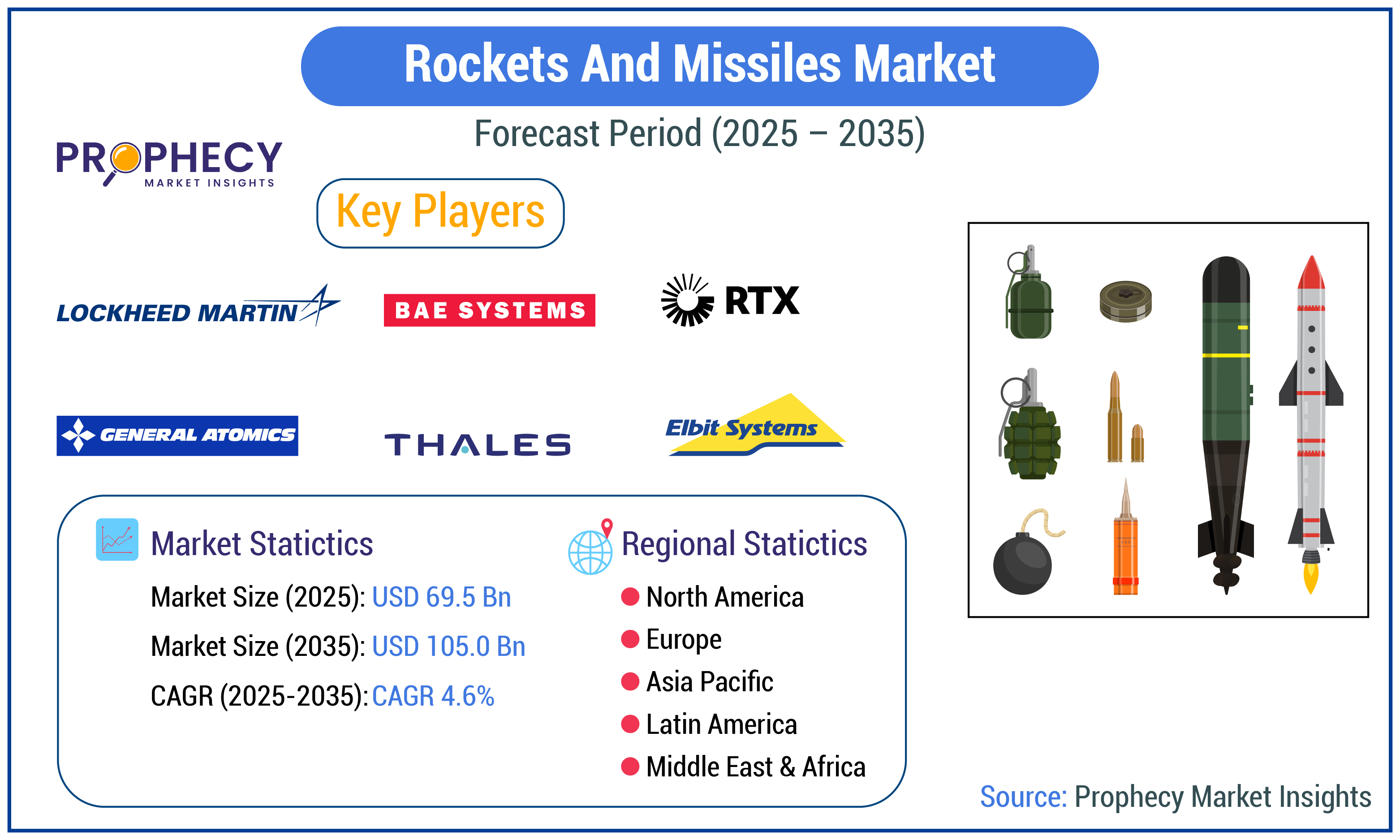
- By 2035, the rockets and missiles market size is contemplated to enlarge at a valuation of USD 105.0 Billion.
- In 2024, the rockets and missiles market valuation was USD 66.9 Billion.
- Rockets and missiles market is developing at a CAGR of 4.6%.
A rocket is a gas-expelled vehicle that can be directed or unguided and is mostly employed for scientific and space exploration objectives. A missile, on the other hand, is a guided weapon with navigation systems for precise hitting in war situations that is intended to deliver explosives to designated targets. As a reflection of their distinct technological and practical responsibilities, missiles are exclusively military in nature, whereas rockets have a wide range of civil uses.
The rockets and missiles market are expanding due to increased geopolitical tensions, growing global defense budgets, and the upgrading of armed forces around the globe. To improve its strategic and tactical capabilities, including as precision attack, long-range deterrent, and missile defense systems, nations are investing in cutting-edge rocket and missile technology. The rockets and missiles market are also growing as a result of technical developments including hypersonic weaponry, better propulsion systems, and improved guiding technology. The rockets and missiles market as a whole is further boosted by the increasing need for satellite deployment and space exploration, which also fuels rocket development.
The quick development of hypersonic weapons, the growing use of AI for guidance and targeting, and the move toward modular and multi-role missile systems are some of the future trends in the rocket and missiles market. In order to increase accuracy and range, nations are also concentrating on improving missile defense capabilities and incorporating next-generation technology. Furthermore, it is anticipated that the market dynamics will change in the upcoming years due to the increased interest in reusable rocket systems for both military and commercial uses.
Recession Risk & Tariff Analysis:
- Due to steady government military spending, which frequently stays the same or even rises during economic downturns for national security concerns, recession threats may not have a significant effect on the rockets and missiles market. Prolonged recessions, however, may result in delayed procurement initiatives and budgetary restrictions.
- Trade restrictions and tariffs can raise manufacturing costs and cause supply chain disruptions, particularly when they apply to raw resources including high-tech components and rare earth elements.
Impact of Generative AI on Rockets and Missiles Market:
- With its ability to speed up design processes, optimize intricate engineering simulations, and improve mission planning through sophisticated predictive analytics, generative AI is set to have a big influence on the rocket and missiles business.
- By quickly creating and testing a large number of design iterations, it helps expedite the development of materials, propulsion systems, and aerodynamics. Generative AI has the potential to enhance autonomous decision-making in missile guiding systems, target recognition, and threat assessment in defense applications.
Rockets And Missiles Market Drivers & Restraints
Key Drivers:
Growing Geopolitical Unrest Will Drive Market Expansion
As countries prioritize enhancing their defense capabilities to repel threats and demonstrate strategic supremacy, the rockets and missiles market is growing at a rapid rate due to rising geopolitical tensions. More money is being spent on missile systems for both offensive and defensive uses as a result of conflicts, territorial disputes, and rivalries, especially in areas that include the Asia-Pacific, the Middle East, and Eastern Europe. To improve their military preparedness and deterrent capabilities, nations are speeding up the development and acquisition of sophisticated missiles, such as long-range, hypersonic, and anti-access/area-denial (A2/AD) weapons. Innovation and growth in the worldwide rocket and missile business are directly fueled by this spike in demand.
- For Instance, according to the data published by Economics Observatory, Geopolitical risks posed by elections, polarization and conflicts within and between states have inevitable knock-on effects on the economy, both globally and for individual countries. This year more than ever, managing these risks and shoring up institutions that promote stability are essential.
Restraints:
Concerns over Arms Proliferation Could Affect Market Development
The possibility of sophisticated weaponry getting into the hands of terrorist organizations, rogue nations, or unapproved players raises concerns about the spread of guns in the market for rockets and missiles, which might destabilize areas and intensify wars. An arms race and a threat to international security can result from the proliferation of missile technology, especially when countries purchase long-range or nuclear-capable weapons.
- Counterbalance Statements: The transfer of sensitive technology is regulated by international agreements such as the Missile Technology Control Regime (MTCR) and strategic export controls. The major strategies for reducing missile proliferation while preserving international stability include enhancing multilateral collaboration, enhancing monitoring of the illegal weapons trade, and encouraging openness and diplomatic interaction.
Opportunities & Trends:
The Future of the Market Looks Promising due to Rapid Development of Hypersonic Weapons
Hypersonic weapons' unparalleled speed, mobility, and capacity to circumvent existing missile defense systems make their rapid development a significant future trend in the rocket and missiles industry. By decreasing opponent response time and raising the possibility of a successful target engagement, hypersonic missiles which may travel at speeds greater than Mach 5 offer substantial strategic benefits. Global competitiveness is being fueled by major military countries making significant investments in hypersonic research in an effort to obtain technical dominance and dissuade enemies. As a result of this arms race, which is speeding up innovation, raising defense spending, and changing military doctrines, hypersonic technology will play a major role in how the market for rockets and missiles develops in the future.
Rockets And Missiles Market Segmentations & Regional Insights
Product, speed, propulsion, launch mode, application, and region are the divisions of the rockets and missiles market.
By Product:
The rockets and missiles market are divided based on the products of missiles and rockets. The rockets and missiles market share dominated by missiles for the reason of its numerous uses in the military industry, including surface-to-air, tactical, cruise, and ballistic missiles.
However, considering serve their purpose in short-range military operations and space launch systems, rockets are the second most popular class.
By Speed:
Based on the speed, the rockets and missiles market are divided into supersonic, subsonic, and hypersonic. The rockets and missiles market share has been taken over by supersonic missiles solely due to their mature technology, speed, and precision balance, which makes them popular for both offensive and defense uses.
The second-dominant group is subsonic missiles, particularly cruise missiles comparable to the Tomahawk, which are preferred for their stealth and long-range accuracy.
By Propulsion:
Solid, liquid, hybrid, ramjet, turbojet, and others are propulsion of the rockets and missiles market. Solid propulsion is the predominant technology in rockets and missiles market share owing to its ease of use, dependability, minimal maintenance requirements, and quick launch speed. These qualities make it perfect for a variety of military uses, such as tactical and ballistic missiles.
The second-dominant section is liquid propulsion, which is preferred for its excellent performance and controllability, particularly in space and long-range applications.
By Launch Mode:
On the launch mode, rockets and missiles market is categorized into d surface-to-surface, surface-to-air, air-to-air, air-to-surface, subsea-to-surface, and others. The most popular launch method for rockets and missiles is surface-to-surface as a consequence of its extensive usage in long-range strikes, strategic deterrence, and land-based military operations.
Due to the growing requirement for air defense systems to defend against aerial threats including fighter planes, drones, and approaching missiles, surface-to-air launches are the second most common launch mechanism.
By Application:
Defense, space exploration, commercial launch services, and scientific research are application of the rockets and missiles market. Due to ongoing global military spending, rising geopolitical tensions, and the ongoing need for cutting-edge missile systems for combat dominance, strategic deterrence, and national security, defense commands the greatest rocket and missiles market share.
The second most popular use is space exploration, which is driven by expanding public and private sector projects to build space infrastructure, launch satellites, and explore deep space.
Regional Insights:
Geographically, the rockets and missiles market is studied across North America, Europe, Asia Pacific, Latin America, and the Middle East & Africa.
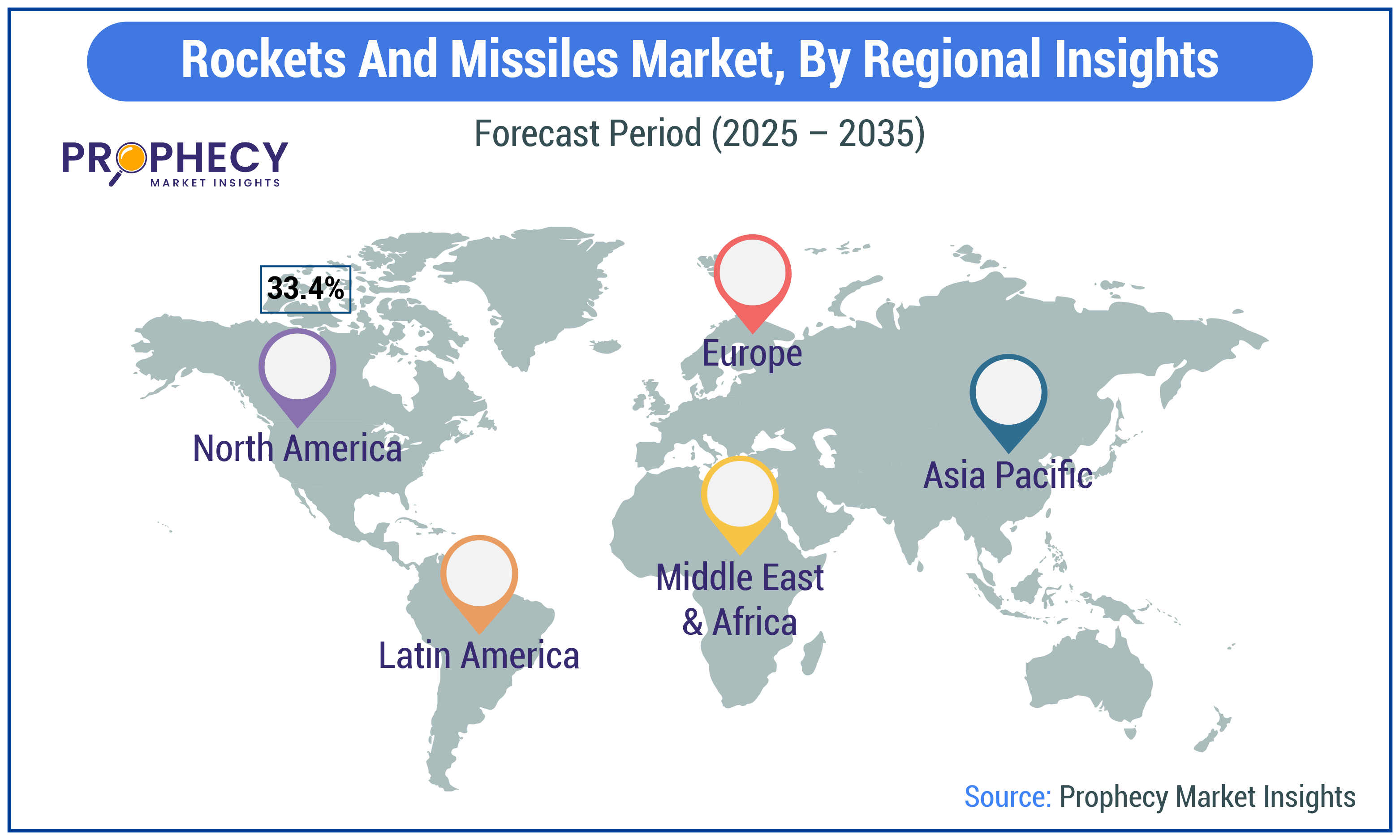
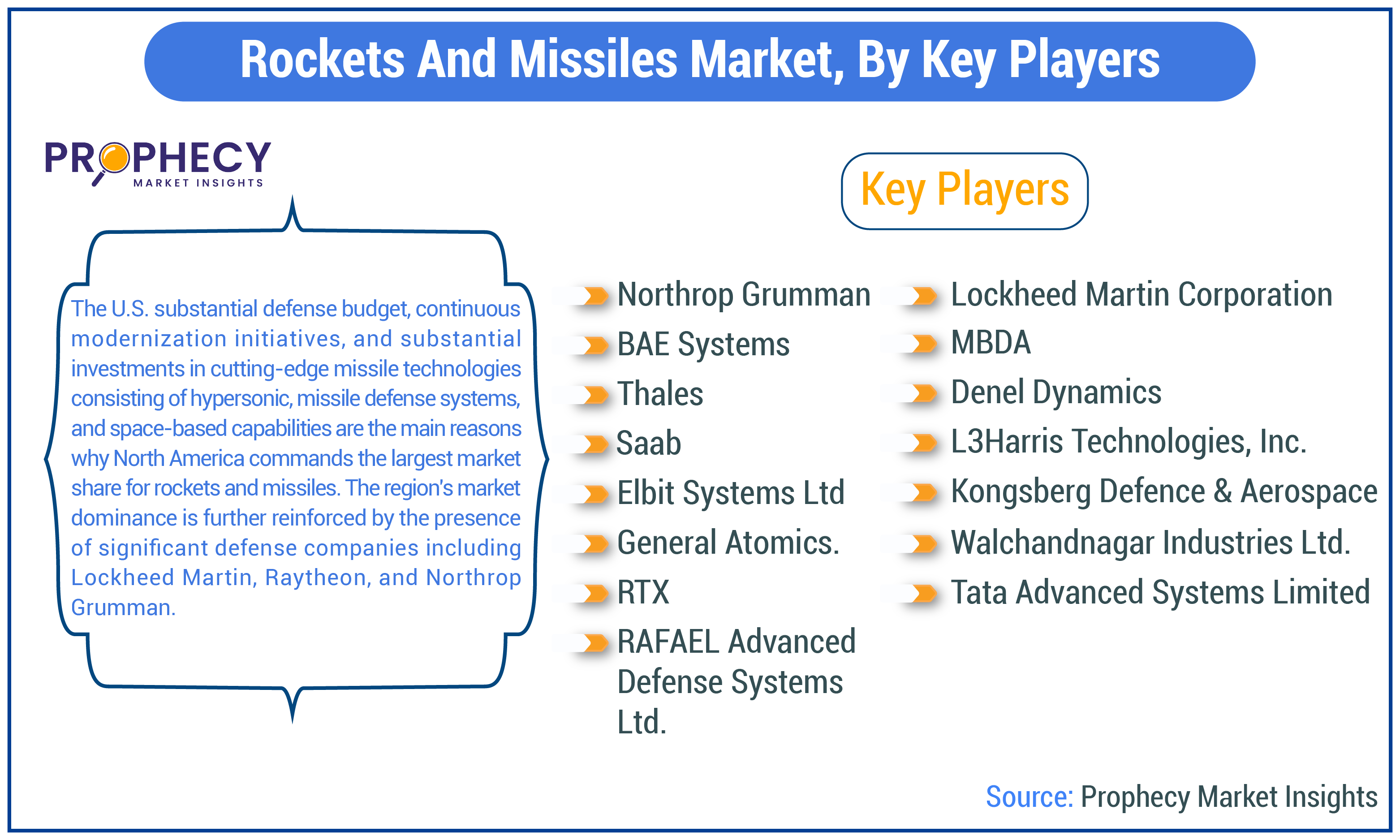
North America: The U.S. substantial defense budget, continuous modernization initiatives, and substantial investments in cutting-edge missile technologies consisting of hypersonic, missile defense systems, and space-based capabilities are the main reasons why North America commands the largest market share for rockets and missiles. The region's market dominance is further reinforced by the presence of significant defense companies including Lockheed Martin, Raytheon, and Northrop Grumman.
- U.S. Rockets and Missiles Market Insights:
U.S. leads the rocket and missile market in North America due to its enormous defense budget, sophisticated R&D facilities, and presence of top defense companies consisting of Lockheed Martin, Raytheon, and Northrop Grumman. The United States continuously makes investments in next-generation missile systems, such as missile defense and hypersonic weapons, in order to preserve its military dominance in the world.
Asia Pacific: Due to growing geopolitical tensions, territorial conflicts, and increased military spending by nations notably China, India, and South Korea, the Asia-Pacific region is currently the second-dominant market. These countries are developing their own missile capabilities at a rapid pace, which is driving regional market expansion.
- China Rockets and Missiles Market Insights:
China's ambitious military modernization efforts, territorial aspirations, and emphasis on improving strategic deterrent capabilities have made it the dominating force in the Asia-Pacific region. China makes significant investments in a variety of missile systems, such as ballistic, cruise, and anti-ship missiles, with the goal of competing with Western military might and establishing its dominance in the area.
Europe: Increased defense expenditure, elevated geopolitical tensions particularly in the wake of the Russia-Ukraine conflict and a drive for greater military self-reliance among EU countries are all contributing factors to the growth of the European rocket and missile market. Modern missile systems with air defense, anti-tank, and long-range attack capabilities are being purchased by European nations for both offensive and defensive uses.
- France Rockets and Missiles Market Insights:
By virtue of its sophisticated military sector, robust R&D skills, and presence of large manufacturers including MBDA and Safran that serve both local and export markets, France leads the European rockets and missiles market.
Rockets and Missiles Market Report Scope:
|
Attribute |
Details |
|
Market Size 2025 |
USD 69.5 Billion |
|
Projected Market Size 2035 |
USD 105.0 Billion |
|
CAGR Growth Rate |
4.6% (2025-2035) |
|
Base year for estimation |
2024 |
|
Forecast period |
2025 – 2035 |
|
Market representation |
Revenue in USD Billion & CAGR from 2025 to 2035 |
|
Regional scope |
North America - U.S. and Canada Europe – Germany, U.K., France, Russia, Italy, Spain, Netherlands, and Rest of Europe Asia Pacific – China, India, Japan, Australia, Indonesia, Malaysia, South Korea, and Rest of Asia-Pacific Latin America - Brazil, Mexico, Argentina, and Rest of Latin America Middle East & Africa – GCC, Israel, South Africa, and Rest of Middle East & Africa |
|
Report coverage |
Revenue forecast, company share, competitive landscape, growth factors, and trends |
Segmentation:
By Product:
- Missiles
- Rocket
By Speed:
- Supersonic
- Subsonic
- Hypersonic
By Propulsion:
- Solid
- Liquid
- Hybrid
- Ramjet
- Turbojet
- Others
By Launch Mode:
- Surface-to-Surface
- Surface-to-Air
- Air-to-Air
- Air-to-Surface
- Subsea-to-Surface
- Others
By Application:
- Defense
- Space Exploration
- Commercial Launch Services
- Scientific Research
By Region:
- North America
- U.S.
- Canada
- Europe
- Germany
- U.K.
- France
- Russia
- Italy
- Spain
- Netherlands
- Rest of Europe
- Asia Pacific
- China
- India
- Japan
- Australia
- Indonesia
- Malaysia
- South Korea
- Rest of Asia Pacific
- Latin America
- Brazil
- Mexico
- Argentina
- Rest of Latin America
- Middle East & Africa
- GCC
- Israel
- South Africa
- Rest of Middle East & Africa
Rockets And Missiles Market Competitive Landscape & Key Players
By increasing their online presence, utilizing social media and influencer marketing, providing Surface-to-Surface disposable and customized lens alternatives, investing in virtual try-on technology, and focusing on growing markets, colored contact lens firms may propel their growth. Partnerships with eye care specialists and beauty businesses may increase reach and reputation even more. The key players operating in the Rockets and Missiles Market include, Lockheed Martin Corporation, Northrop Grumman, RTX, Saab, Elbit Systems Ltd, and others.
Rockets and Missiles Market Companies:
- Lockheed Martin Corporation
- Northrop Grumman
- BAE Systems
- Thales
- Saab
- Elbit Systems Ltd
- RAFAEL Advanced Defense Systems Ltd.
- General Atomics.
- RTX
- MBDA
- Denel Dynamics
- L3Harris Technologies, Inc.
- Kongsberg Defence & Aerospace
- Walchandnagar Industries Ltd.
- Tata Advanced Systems Limited
View an Additional List of Companies in the Rockets and Missiles Market
Rockets And Missiles Market Recent News
- In June 2025, the successful launch of UP Aerospace's high-performance Spyder rocket marks an important milestone. Launch Complex 36 hosted the first flight at 7:00 AM MST, ushering in a new age of hypersonic mission capabilities. Following the UP Aerospace SpaceLoft rocket launches that have been in service for 20 years, the mission exceeded the threshold of hypersonic speeds.
Analyst View:
The rockets and missiles market are expanding rapidly due to increased geopolitical tensions, growing defense spending, and international military modernization initiatives. While missiles are solely military and have guidance systems for accurate targeting, rockets are used for both civil and scientific objectives, such as satellite launches and space research. The rockets and missiles market is expanding more quickly thanks to technological developments including AI-based navigation, better propulsion, and hypersonic weaponry. Future developments include improved missile defense, the creation of modular, multi-role systems, and an increasing emphasis on reusable rocket technology for both military and commercial uses.
More Related Reports
High Speed Blowers Market
Interceptor Missiles Market
SUV Wheel Speed Sensor Market
Marine Medium Speed Engine Oil Market
Marine Slow Speed Engine Oil Market
Rockets And Missiles Market Company Profile
|
Company Name |
Lockheed Martin Corporation |
|
Headquarter |
Bethesda, Maryland, U.S. |
|
CEO |
Jim Taiclet |
|
Employee Count |
121,000 Employees |
Rockets And Missiles Market Highlights
FAQs
Rockets and missiles market size was valued at USD 69.5 Billion in 2025 and is expected to reach USD 105.0 Billion by 2035 growing at a CAGR of 4.6%.
Product, speed, propulsion, launch mode, application, and region are the segmentation for the target market.
North America, Asia Pacific, Europe, Latin America, and the Middle East & Africa. North America is expected to dominate the market.
The key players operating the rockets and missiles market include Lockheed Martin Corporation, Northrop Grumman, BAE Systems, Thales, Saab, Elbit Systems Ltd, RAFAEL Advanced Defense Systems Ltd., GENERAL ATOMICS., RTX, MBDA, Denel Dynamics, L3Harris Technologies, Inc., Kongsberg Defence & Aerospace, Walchandnagar Industries Ltd., Tata Advanced Systems Limited.