Quantum Computing As A Service Market Overview
- 2024 Market Size: USD 2.5 Billion
- 2035 Projected Market Size: USD 51.8 Billion
- CAGR (2025-2030): 35.8%
- North America: Largest Market in 2024
Quantum Computing-as-a-Service (QCaaS) is a cloud-based model that enables organizations to use quantum computing power from far away without having to have the costly quantum hardware. The main advantages of QCaaS are the cost of entry is lowered as no physical installation is needed, the possibility to grow and the flexibility to try out other quantum technologies and thus, faster innovation by these industries that can utilize the technology to solve the real-world problems, speed up their R&D process and thus get a better competitive position in the market.
The quantum computing-as-a-service (QCaaS) market gets more and more attention. The main reasons behind this growth are the rising need of the customers for the use of quantum computing to solve very complex problems in a lot of different areas such as finance, pharmaceuticals, energy, and logistics. Such problems are beyond the capabilities of classical computers. The adoption is being driven by multiple factors. For instance, the cost-effectiveness of using the cloud instead of possessing quantum hardware has made cloud access more attractive. Moreover, there has been a steady rise in investments in quantum research across the globe. The seamless integration of QCaaS with the current cloud ecosystems is also playing a vital role in adoption.
The Rise of Quantum Computing and Its Impact on Cloud Infrastructure:
- One of the major effects that the rise of quantum computing has on the cloud infrastructure is that it changes the whole range of the cloud offering with the addition of a high-performance unit that is specialized in quantum computing and can be accessed through any cloud platform.
- This not only makes quantum capabilities available to everyone but also forces cloud providers to develop their infrastructure with networks that have low latency, advanced orchestration, and APIs that are ready for quantum, thereby changing cloud ecosystems into centers for innovation and problem-solving of the next generation.
Current Industry Dynamics & Insights:
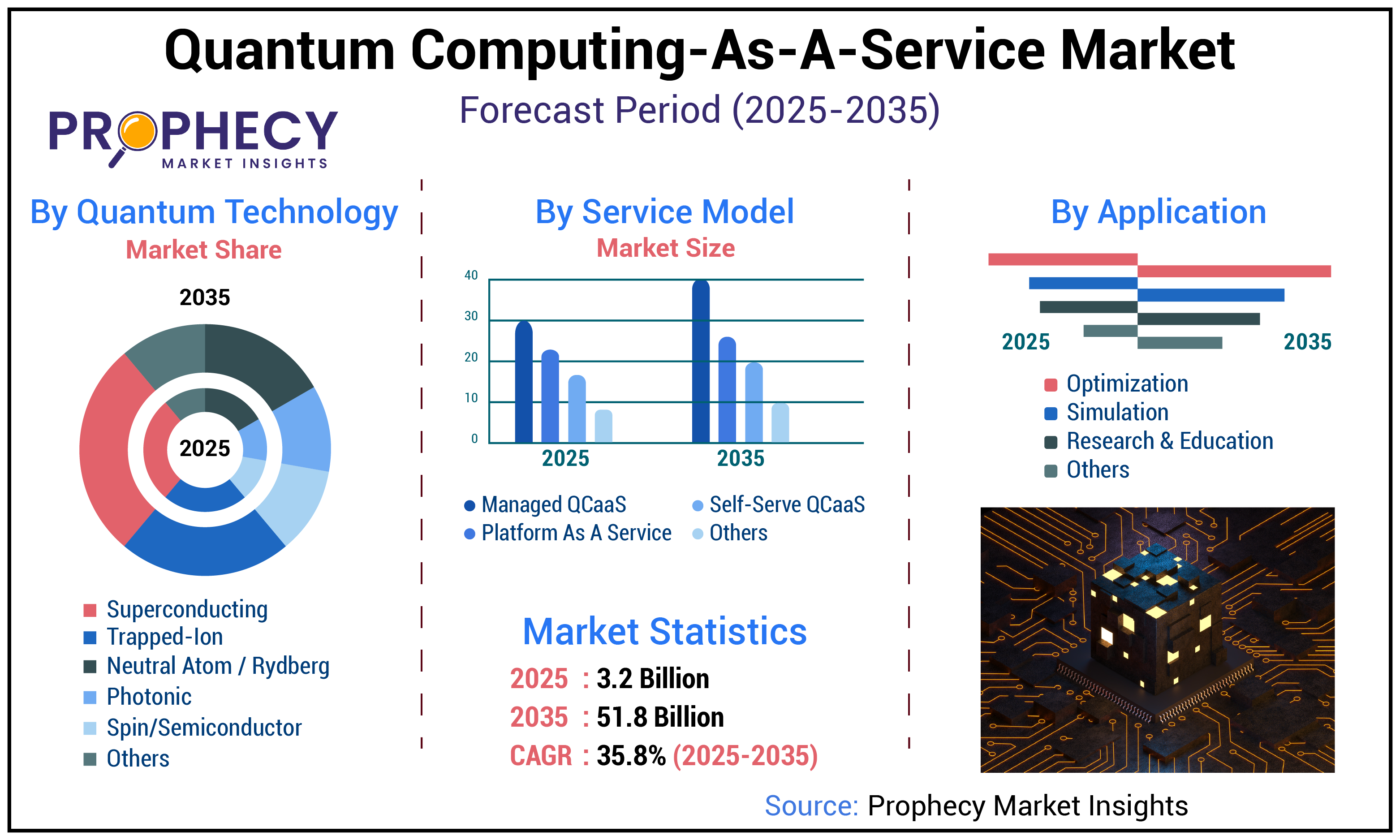
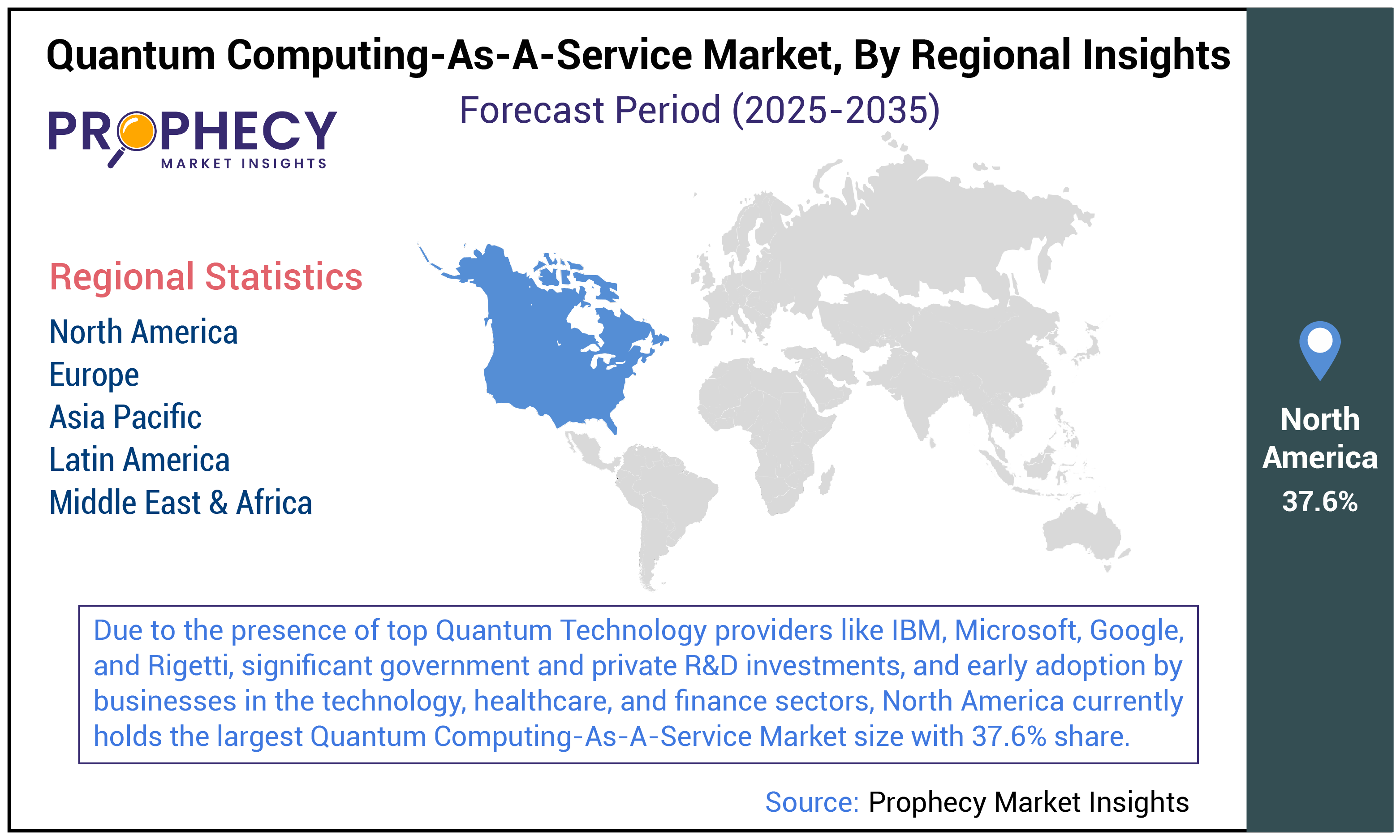
- North America has the largest regional share in the market, with almost 37.6%.
- Europe is second dominating region in the market.
- By Service Model, Managed QCaaS dominate the Quantum Computing-as-a-Service Market.
Quantum Computing As A Service Market Drivers & Restraints
Drivers and Restraints:
|
Drivers |
Restraints |
Opportunities & Trends |
|
|
|
Key Drivers:
Rising Adoption of Quantum Computing
One of the major factors driving the growth for Quantum Computing as a Service (QCaaS) market is the increasing adoption of quantum computing by various industries to solve complex problems that traditional computing cannot solve efficiently. There is a growing demand for affordable and easy-to-use platforms such as QCaaS as many organizations are trying quantum solutions for optimization, drug discovery, financial modeling, and advanced simulations. The rising acceptance of this accelerates innovation, draws larger investments, and promotes ecosystem partnerships, which at the end of the day, leads to an increase in the Quantum Computing-as-a-Service market.
- For Instance, according to article published by AIMultiple, quantum computing is expected to make its first significant breakthroughs in four key industries: chemical, pharmaceutical/life sciences, financial services, and transportation/mobility. These sectors are positioned to be early beneficiaries of quantum technology, with potential economic gains reaching USD 2 trillion in value by 2035.
Restraints:
Quantum Skills Gap
One of the major obstacles in the QCaaS market is the scarcity of adequately trained quantum developers and researchers. This shortage of talent is the reason why companies have difficulty using quantum technology for the creation of applicable solutions. In other words, unless there are contiguously competent specialists in areas such as quantum algorithms, programming frameworks, and hardware optimization who will drive the market, the acceptance rate of quantum technologies is probably to be low and confined to a few players only.
- Counterbalance Statements: One major fix is to increase handling courses, school cooperation, free-source gadgets, and internet-based getting to know stages that may open the field of the quantum world, create a bigger workforce, and quicken the growth of the market.
Opportunities & Trends:
Quantum Error Correction and Fault-Tolerant Architectures
The evolution of quantum error correction and fault-tolerant architectures is becoming a key trend that will have a significant impact on the quantum computing as a service (QCaaS) market, as the existing quantum systems are still grappling with high error rates and limited stability. To reach the ideal state, researchers use the mentioned methods that will lead to the increased reliability and as a result, the accuracy, and the scalability of the quantum computers which will make them applicable for use in the critical tasks of the real world. This accomplishment will certainly increase user trust, Moreover, it will widen QCaaS usage in different sectors like the bank, medical and power industries. With such an event, we can foresee QCaaS as a major player in future cloud computing.
Quantum Computing As A Service Market Segmentations & Regional Insights
Service model, quantum technology, deployment, application, end user, and region are the divisions of the quantum computing-as-a-service market.
By Service Model:
Managed qcaas, self-serve qcaas, platform as a service, and others are service model on which quantum computing-as-a-service market is segmented. At the moment, Managed QCaaS has the most quantum computing-as-a-service market share as most businesses choose end-to-end managed services with provider-led advice, advising, and algorithm optimization since they lack the internal ability to handle complicated quantum workloads.
The second most popular market is Platform as a Service (PaaS), which is being driven by an increase in demand from researchers and developers who need workflow tools, simulators, and SDKs to create, test, and integrate quantum applications in hybrid cloud environments. This promotes innovation and the creation of unique solutions.
By Quantum Technology:
Based on the quantum technology, the quantum computing-as-a-service market is divided into Superconducting, Superconducting qubits have the most market share in the quantum computing-as-a-service market as they are the most developed and extensively used technology, supported by well-known companies notably IBM, Google, and Rigetti, and have developed developer ecosystems and cloud integration.
With businesses including IonQ and Quantinuum propelling commercial adoption, trapped-ion qubits are the second most popular technology. They are preferred for their high fidelity, extended coherence durations, and appropriateness for accurate quantum operations.
- In April 2025, the development of one of India's most potent quantum computers with 25 superconducting qubits was announced by Bangaluru-based QpiAI, one of the eight companies chosen under the Department of Science and Technology's (DST) National Quantum Mission.
By Deployment:
Public Cloud QCaaS, Private/virtual Private QCaaS, Edge/lab Access, and Others are deployment of the quantum computing-as-a-service market. With support from top providers consisting of AWS, IBM, Microsoft, and Google, Public Cloud QCaaS is the most affordable, scalable, and easily accessible option in the quantum computing-as-a-service market growth, making it the go-to option for businesses and researchers everywhere.
Given that highly regulated industries consisting of finance, defense, and healthcare require more security, data sovereignty, and dedicated infrastructure to run sensitive quantum workloads, Private/Virtual Private QCaaS is the second dominant model. This has led to its steady adoption alongside public cloud offerings.
By Application:
Optimization, simulation, cryptography & security, Monte Carlo & risk analytics, research & education, and others are application of the quantum computing-as-a-service market. Optimization has the most quantum computers-as-a-service market share since sectors including manufacturing, banking, and logistics depend more and more on quantum systems to handle challenging scheduling, routing, and resource allocation issues that are difficult for traditional computers to handle.
The second most popular use is simulation, especially in the fields of chemistry, materials science, and pharmaceuticals. In these fields, quantum computing speeds up research and development and medication development by enabling precise modeling of chemical interactions and the identification of novel materials.
By End User:
The quantum computing-as-a-service market on the account of end user are categorized into financial services & insurance, life sciences & pharma, chemicals & materials, energy & utilities, manufacturing & automotive, and others. Financial Services & Insurance has the most Quantum computing-as-a-service (qcaas) market share since it was one of the first industries to use QCaaS, investing extensively in quantum computing for risk modeling, fraud detection, cryptography, and portfolio optimization.
The demand for sophisticated drug discovery, molecular modeling, and tailored treatment, where quantum computing speeds up research and development and lowers costs, propels Life Sciences & Pharma to become the second most important end user.
Regional Insights:
Geographically, the quantum computing-as-a-service market is studied across North America, Europe, Asia Pacific, Latin America, and the Middle East & Africa.
North America: Due to the presence of top quantum technology providers like IBM, Microsoft, Google, and Rigetti, significant government and private R&D investments, and early adoption by businesses in the technology, healthcare, and finance sectors, North America currently holds the largest quantum computing-as-a-service market size with 37.6% share.
- U.S. Quantum Computing-as-a-Service Market Insights:
Due to the presence of significant government funding, early enterprise adoption across the technology, healthcare, and finance sectors, and the presence of major quantum technology providers consisting of IBM, Google, Microsoft, and Rigetti, the United States leads the North American market for quantum computing-as-a-service.
Europe: This is the second most dominant region in quantum computing-as-a-service market growth, due to expanding government programs, academic research centers, and developing industry-university partnerships, especially in the U.K., Germany, and France, which are promoting quantum innovation and hastening the implementation of QCaaS on a regional scale.
- U.K. Quantum Computing-as-a-Service Market Insights:
The U.K. is in the forefront of innovation, commercialization, and uptake of QCaaS solutions in Europe thanks to robust government-backed quantum projects, top-notch research institutions, and active industry-academia cooperation.
Asia Pacific: Increased government spending on quantum research, growing cloud computing adoption, growing R&D in finance, materials, and pharmaceuticals, and growing partnerships between tech startups and international quantum providers are the main factors propelling the growth of the Quantum Computing-as-a-Service market in Asia Pacific.
- China Quantum Computing-as-a-Service Market Insights:
In addition to its substantial funding for quantum computing initiatives, sophisticated research infrastructure, strong national focus on quantum technology, and strategic alliances with global technology companies, China leads the APAC market in QCaaS adoption and innovation.
Quantum Computing-as-a-Service Market Report Scope:
|
Attribute |
Details |
|
Market Size 2025 |
USD 3.2 Billion |
|
Projected Market Size 2035 |
USD 51.8 Billion |
|
CAGR Growth Rate |
35.8% (2025-2035) |
|
Base year for estimation |
2024 |
|
Forecast period |
2025 – 2035 |
|
Market representation |
Revenue in USD Billion & CAGR from 2025 to 2035 |
|
Regional scope |
North America - U.S. and Canada Europe – Germany, U.K., France, Russia, Italy, Spain, Netherlands, and Rest of Europe Asia Pacific – China, India, Japan, Australia, Indonesia, Malaysia, South Korea, and Rest of Asia-Pacific Latin America - Brazil, Mexico, Argentina, and Rest of Latin America Middle East & Africa – GCC, Israel, South Africa, and Rest of Middle East & Africa |
|
Company Landscape |
Market Share Analysis of Companies Heat Map Analysis Company Overview, Products Overview Financial Information, Key Highlights Business Strategies Overview SWOT Analysis |
|
Report coverage |
Revenue forecast, company share, competitive landscape, growth factors, and trends |
|
Value Added Data Infosets |
Besides fundamental market insights such as the size of the market, growth rate, segmentation, regional study, and key players, our reports carry value-added data sets such as trade flow (import-export) analysis, production and consumption overview, price trend evaluation, supply and value chain mapping, and raw material availability. Moreover, we provide strategic tools as PESTLE and Porter’s Five Forces analysis, examination of the regulatory landscape, as well as monitoring of technology and innovation thereby providing a comprehensive overview which facilitates sensible and anticipatory decision-making. |
Segmentation:
By Service Model:
- Managed QCaaS
- Self-serve QCaaS
- Platform as a Service
- Others
By Quantum Technology:
- Superconducting
- Trapped-ion
- Neutral atom / Rydberg
- Photonic
- Spin/semiconductor
- Others
By Deployment:
- Public Cloud QCaaS
- Private/virtual Private QCaaS
- Edge/lab Access
- Others
By Application:
- Optimization
- Simulation
- Research & Education
- Others
By End User:
- Financial services & insurance
- Life sciences & pharma
- Chemicals & materials
- Energy & utilities
- Manufacturing & automotive
- Others
By Region:
- North America
- U.S.
- Canada
- Europe
- Germany
- U.K.
- France
- Russia
- Italy
- Spain
- Netherlands
- Rest of Europe
- Asia Pacific
- China
- India
- Japan
- Australia
- Indonesia
- Malaysia
- South Korea
- Rest of Asia Pacific
- Latin America
- Brazil
- Mexico
- Argentina
- Rest of Latin America
- Middle East & Africa
- GCC
- Israel
- South Africa
- Rest of Middle East & Africa
Quantum Computing As A Service Market Competitive Landscape & Key Players
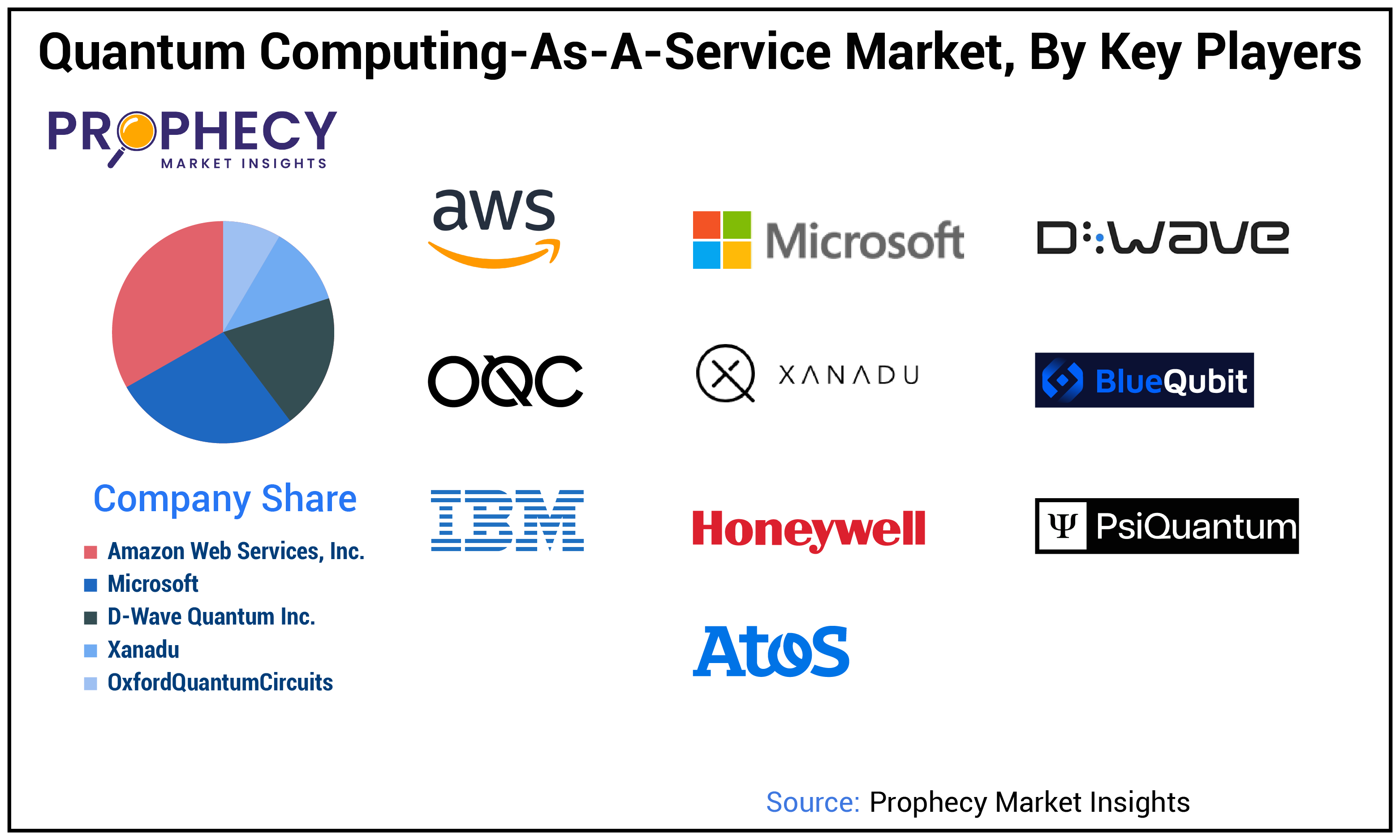
The key players operating in the quantum computing-as-a-service market include, Microsoft, IBM, Xanadu, and others. Cloud service expansion, strategic alliances, quantum R&D advancement, developer platform enhancement, and industry-specific solutions are ways that QCaaS organizations might flourish.
Quantum Computing-as-a-Service Market Companies:
- Amazon Web Services, Inc.
- Microsoft
- D-Wave Quantum Inc.
- Xanadu
- OxfordQuantumCircuits
- BlueQubit
- IBM
- Honeywell International Inc.
- PsiQuantum
- Atos SE
- PASQAL
- Qilimanjaro Quantum Tech
- Riverlane
- QC Ware
- Multiverse Computing
View an Additional List of Companies in the Quantum Computing-as-a-Service Market
Quantum Computing As A Service Market Recent News
- In April 2025, At the RIKEN RQC-FUJITSU Collaboration Center, Fujitsu Limited and RIKEN announced the creation of a world-class 256-qubit superconducting quantum computer. The 64-qubit iteration, which was introduced in October 2023 with assistance from the Japanese Ministry of Education, Culture, Sports, Science, and Technology, is the foundation of this new quantum computer. It also integrates recently discovered high-density implementation approaches.
- In March 2025, SEALSQ Corp, a company specializing in Semiconductors, PKI, and Post-Quantum technology hardware and software products, and ColibriTD, a pioneering quantum technology company, launches a Quantum Cloud Computing Service to enable enterprises and research institutions to leverage quantum-powered solutions.
- In September 2024, using the cloud to advance quantum computing with workable short-term solutions. The first Quantum as a Service (QaaS) platform for quantum and hybrid computing, Bia Quantum Cloud Computing Service, was introduced by QuiX Quantum, the European leader in photonic quantum computing hardware.
- In November 2022, as part of the Group's hybrid computing strategy, Atos and IQM have announced the signing of a collaboration to supply end-to-end quantum computing technologies and capabilities. Through this agreement, IQM's Quantum Processing Unit (QPU) will be integrated into Atos' QLM and, more widely, into Atos' quantum application development platform, as the industry shifts to real-world quantum computing applications.
Analyst View:
A cloud-based paradigm called quantum computing-as-a-service (QCaaS) enables businesses to use quantum computing without having to buy pricey hardware. It provides cost effectiveness, scalability, and the freedom to test out various quantum technologies. Due to increased demand from sectors such as banking, pharmaceuticals, energy, and logistics to tackle challenges outside the scope of traditional computers, its market is expanding quickly.
The affordability of cloud access, rising worldwide investments in quantum research, and smooth interaction with current cloud ecosystems all of which promote quicker innovation and greater competitive advantage are important motivators.
Analysis of Sources:
Primary Sources:
- In-depth interviews
- Company-specific data
- Surveys and questionnaires
- Focus group discussions (FGDs)
- Others
Secondary Sources:
- National Quantum Initiative Act (NQIA)
- National Science Foundation (NSF)
- UK National Quantum Technologies Programme (UKNQTP)
- Others
More Related Reports
Spatial Computing Market
Fog Computing Market
Cloud Computing in Energy Market
Edge Computing Market
Quantum Computing Market
Quantum Computing As A Service Market Company Profile
|
Company Name |
Product Portfolio |
|
Amazon Web Services, Inc. |
Quantum Cloud Computing Service |
|
Microsoft |
Azure Quantum Computing |
|
D-Wave Quantum Inc. |
D-Wave Leap Quantum Cloud Service |
|
OxfordQuantumCircuits |
Quantum-computing-as-a-service (QCaaS) |
|
BlueQubit |
Quantum Computing Software |
Quantum Computing As A Service Market Highlights
FAQs
Quantum computing-as-a-service market size was valued at USD 3.2 Billion in 2025 and is expected to reach USD 51.8 Billion by 2035 growing at a CAGR of 35.8%.
Service model, deployment, application, end user, and region are the segmentation for the quantum computing-as-a-service market.
Rising demand for complex problem-solving, increasing R&D investments, integration with cloud ecosystems, and so on are some of the Quantum Computing-as-a-Service Market growth drivers.
North America, Asia Pacific, Europe, Latin America, and the Middle East & Africa. North America is expected to dominate the quantum computing-as-a-service market.
Through the optimization of quantum algorithms, automation of simulations, and reduction of development time, generative AI propels the QCaaS industry and increases the accessibility and value of quantum computing for sectors such as materials science, finance, and pharmaceuticals.
The key players operating the quantum computing-as-a-service market include Amazon Web Services, Inc., Microsoft, D-Wave Quantum Inc., Xanadu, OxfordQuantumCircuits, BlueQubit, IBM, Honeywell International Inc., PsiQuantum, Atos SE, PASQAL, Qilimanjaro Quantum Tech, Riverlane, QC Ware, and Multiverse Computing.