Open Banking Market Overview
- 2025 Market Size: USD 35.30 Billion
- 2036 Projected Market Size: USD 351.98 Billion
- CAGR (2026-2036): 23.5%
- North America: Largest Market in 2025
Regulations, rising customer demands, and the digital transformation of financial services are driving the open banking industry's explosive growth. Through the use of defined APIs, open banking essentially enables the secure flow of financial data between banks, fintech companies, and outside sources. New applications including instantaneous account-to-account transfers, tools for wealth management and budgeting, integrated finance, customized lending, and credit evaluation are made possible by this shift. As financial systems get more linked, banks are changing from isolated product providers to platform-oriented service providers, while fintech startups exploit data access to develop more quickly and deliver more tailored consumer experiences.
However, despite great momentum, hurdles exist, including inconsistent legal alignment across regions, legacy system integration constraints, and consumer trust problems connected to data protection and consent management. Still, the industry trajectory remains clear: Open Banking is reshaping the global financial landscape from product-centric banking to data-driven, modular, and interoperable financial ecosystems, creating opportunities for new revenue models, strategic alliances, and transformative user experiences.
Open Banking Regulations:
- Europe: The European Union’s revised Payment Services Directive (PSD2) mandates open banking across member states. PSD2 also dictates customer rights and protections (including Strong Customer Authentication) and security requirements for electronic payments. The European Banking Authority (EBA) develops technical standards and guidelines for open banking, while national competent authorities (NCAs) in each country are responsible for enforcing the regulations.
- Australia: The Consumer Data Right (CDR) guidelines enable consumers to share their data with accredited third parties, and emphasizes the consumer’s right to access personal data and their right to control who can have access to it. The Australian Competition and Consumer Commission (ACCC) is the primary regulator for CDR, while the Office of the Australian Information Commissioner (OAIC) oversees data privacy aspects.
- Other regions: Some countries have adopted or are developing their own open banking regulations. Notable examples include Singapore (regulated by the Monetary Authority of Singapore), Japan (regulated by the Financial Services Agency), and Hong Kong (regulated by the Hong Kong Monetary Authority).
Current Industry Dynamics & Insights:
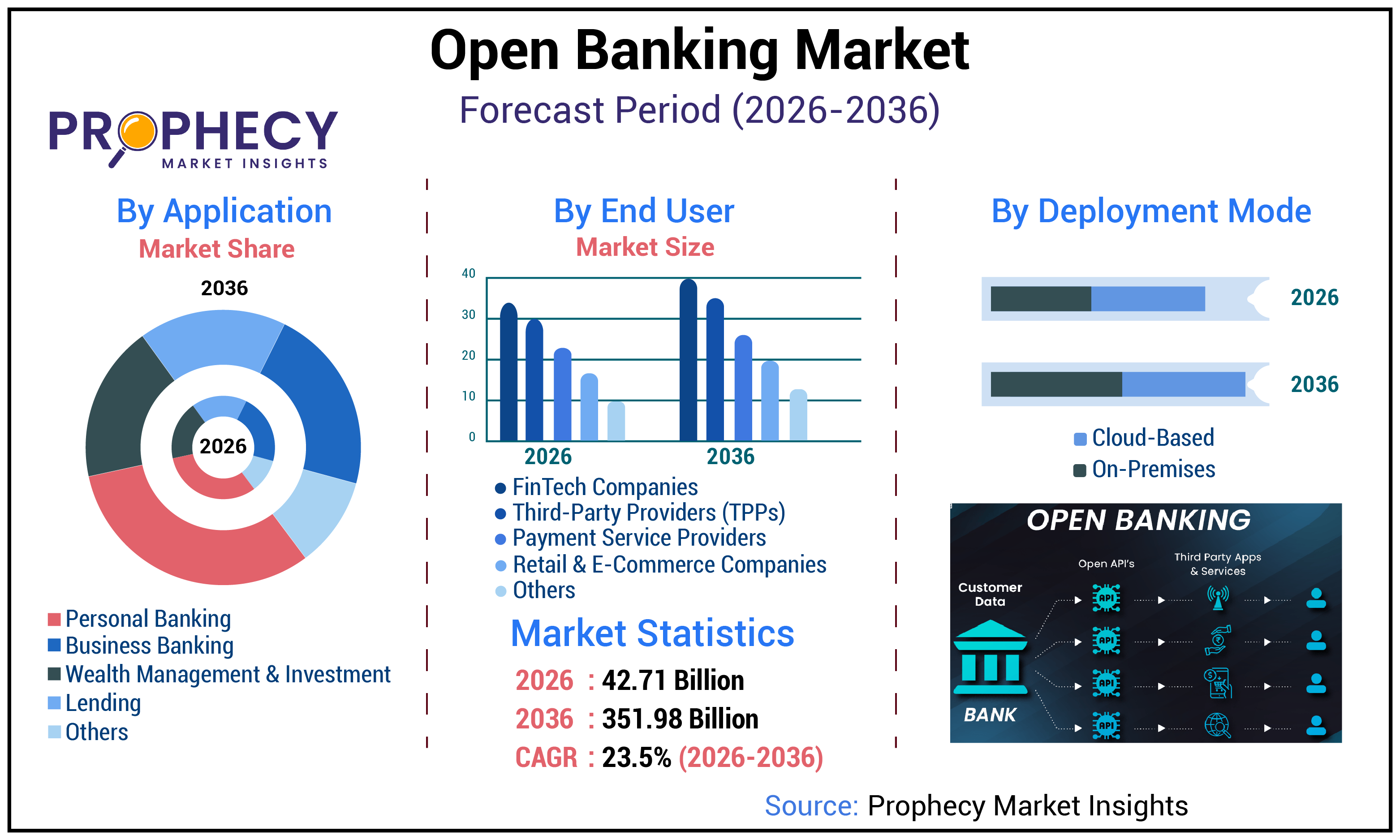
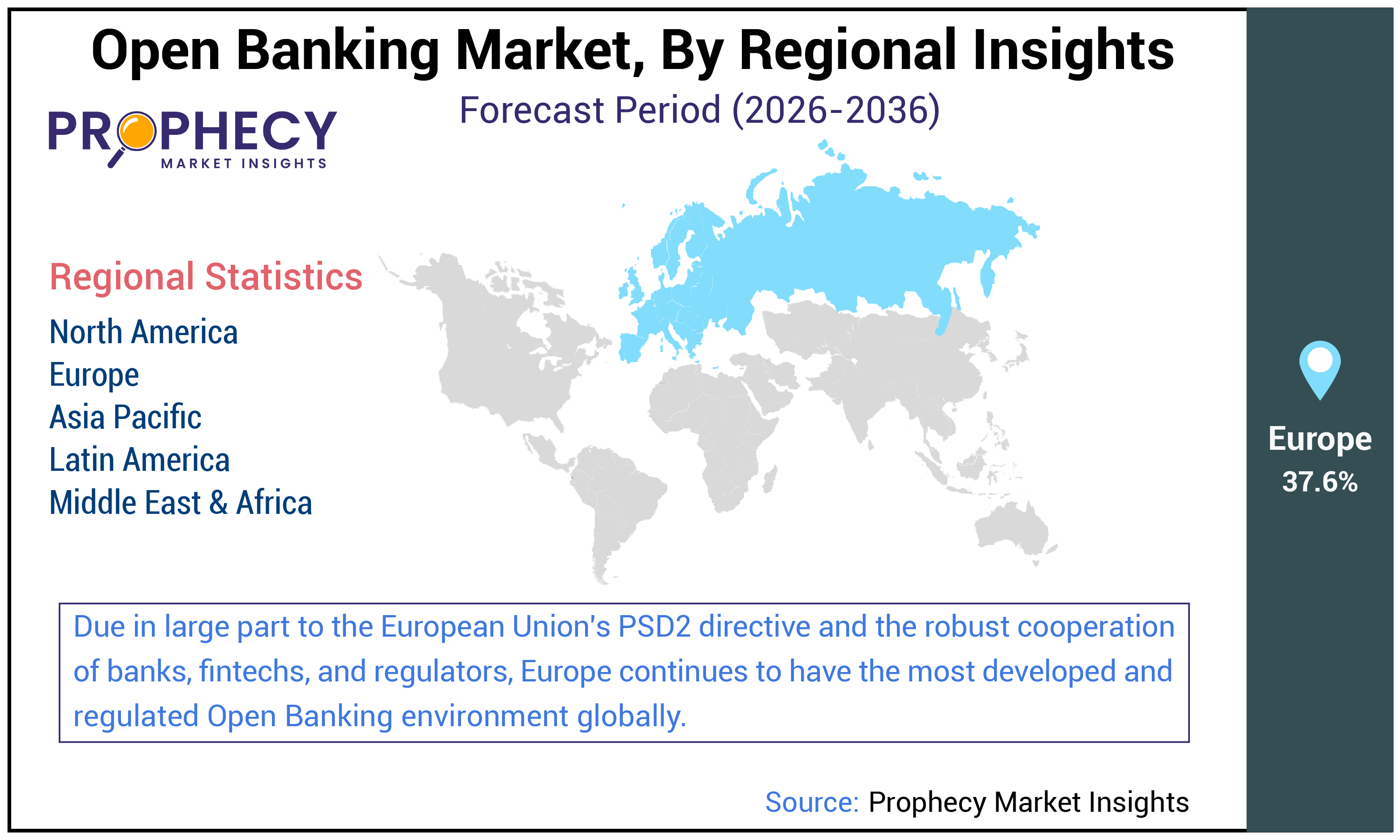
- Europe has the largest regional share in the market, with almost 37.6%.
- North America is second dominating region in the market.
- By Component, solution dominate the open banking market growth.
Open Banking Market Drivers & Restraints
Drivers and Restraints:
|
Drivers |
Restraints |
Opportunities & Trends |
|
|
|
Key Drivers:
Rising Regulatory push and government mandates
- Government-driven regulation is a powerful accelerator of the open banking market. PSD2 and Open Banking Standard regulations, which require banks to open their systems through secure APIs, paved the way for transformation in regions such as Europe and the United Kingdom. This ended the banks' monopoly on financial data, allowing third-party innovation and competition. As a result, fintech firms, challenger banks, and AI-powered financial consulting platforms might provide specialized services such as real-time payments, automated budgeting, and alternative credit rating.
- The legislative drive has also improved security and interoperability by encouraging standard authentication frameworks such as as Strong Customer Authentication (SCA) and tokenized data exchange. As other regions follow suit such as Australia (CDR), India (Account Aggregator), Brazil (Open Finance), and Saudi Arabia's Open Banking Framework the approach shifts from regulatory compliance to commercially driven innovation.
- For instance, in November 2025, The Federal government has committed to “advancing” Open Banking in Canada by introducing legislation to complete the Consumer-Driven Banking Act and extending the framework to include payment initiation by mid-2027, while oversight will move to the Bank of Canada.
Restraints:
Data Privacy and Cybersecurity Risks
- One of the key obstacles to the adoption of open banking is still consumer data privacy. Opening API access increases the number of entities dealing with sensitive financial data, introducing new risk pathways for breaches, fraud, unauthorized access, identity theft, and abuse of personal information. High-profile global assaults have made both regulators and customers more cautious, limiting adoption in places without rigorous privacy regulations.
- Counterbalance Statements: In essence, although data exposure concerns remain a critical limitation, increasing cybersecurity frameworks, stringent legislation, and developing technological standards are enabling secure and managed open banking environments transforming risk into a driver of innovation and trust.
Opportunities & Trends:
Expansion into Digital Financial Ecosystems
The expanding capacity to build interconnected digital financial ecosystems that go beyond conventional banking operations is one of the biggest prospects in the Open Banking sector. Open banking promotes easy data exchange between banks, fintech companies, payment platforms, insurance organizations, wealth management providers, and alternative credit networks. A new wave of integrated financial services—where clients may access loans, payments, investments, budgeting tools, rewards, and customized banking offers through a single interface are made possible by this interoperability.
Open Banking Market Segmentations & Regional Insights
Component, deployment mode, application, end user, and region are the divisions of the open banking market.
By Component:
Solution and services are component on which open banking market is segmented. Solution have the most open banking market share since they are necessary for financial institutions and fintechs need API-based platforms especially account aggregation and payment initiation to enable real-time data sharing, digital payments, and compliance with regulatory frameworks such as PSD2.
The second-largest portion is held by services, which include risk management, compliance, and payment and money transfer services. Service providers help banks and fintechs with implementation, cybersecurity, regulatory compliance, API security testing, and user experience improvement as open banking grows.
By Deployment Mode:
Based on the deployment mode, the open banking market is divided into cloud-based, and on-premises. Cloud-based deployment leads the open banking market share owing to its scalability, cost-effectiveness, quick deployment cycles, and improved integration with API ecosystems. Cloud environments are preferred by fintechs, neobanks, and digital-first banks because they provide real-time processing, AI-driven analytics, and modular architecture.
On-premises deployment ranks second and remains relevant primarily among traditional banks and financial institutions prioritizing data sovereignty, stringent compliance, and internal security control
By Application:
The open banking market is categorized into personal banking, business banking, wealth management & investment, lending and others on the account of application. Adoption is driven by personal banking since open banking allows for digital payments, personal financing, financial wellness platforms, budgeting tools, spending analysis, and highly customized financial advice. Growing digital-native client bases and real-time transaction capabilities accelerate this market.
Business banking is the second-dominant market due to rising demand for automated invoicing, expense monitoring, fast settlements, cash-flow insights, credit assessment tools, and embedded lending services particularly for SMEs and e-commerce enterprises.
By End User:
The open banking market on the account of end user is categorized fintech companies, third-party providers (TPPs), payment service providers, retail & e-commerce companies and others FinTech compaines dominate open banking market share as they rely significantly on open APIs to provide financial services such as digital wallets, lending platforms, automated accounting tools, neobanking services, and AI-powered financial personalization engines. They are positioned as important adopters and accelerators of the open banking trend due to their rapid innovation, flexible deployment, and customer-focused services.
Third-Party Providers (TPPs) includes account information and payment initiation service providers—are the second strongest user category. Their importance is expanding due to legislative frameworks that provide access to financial data, enabling new business models in payments, credit scoring, financial advice, and alternative lending movement.
Regional Insights:
Geographically, the open banking market is studied across North America, Europe, Asia Pacific, Latin America, and the Middle East & Africa.
Europe: Due in large part to the European Union's PSD2 directive and the robust cooperation of banks, fintechs, and regulators, Europe continues to have the most developed and regulated open banking environment globally. Digital payments, API-based banking services, and fintech technologies that prioritize security, consent-based data exchange, and transparency have all been quickly adopted in the area.
- U.K. Open Banking Market Insights:
The UK's adoption continues to accelerate as millions of users now rely on open banking for digital payments, personal finance management, lending, and business banking automation. With a dense concentration of neobanks, digital-only financial platforms, and regulatory bodies actively supporting innovation, the UK remains the benchmark for how open banking can evolve into a mainstream financial service model.
North America: This region is fast transitioning into a major open banking hub, driven mostly by technological investment, banking modernization efforts, and consumer demand for digital financial services. Unlike Europe, legislation is not the key impetus behind adoption; instead, market demand and collaboration between banks and fintech aggregators are accelerating expansion.
- U.S. Open Banking Market Insights:
U.S. is at the core of this transformation, benefiting from its big financial ecosystem, high smartphone penetration, and growing trust in digital-first financial solutions. Although federal law is still changing, prominent banks and fintechs have already developed solid relationships to promote secure data-sharing frameworks, digital payments, and embedded finance. As a result, the United States is becoming a significant future economic engine as open banking moves from an experimental stage to widespread acceptance.
Asia Pacific: This region is experiencing quick development in open banking adoption, powered by digital payments, financial inclusion programs, and the rise of super-apps integrating numerous financial services. While the area is different in adoption speed, regulatory maturity is rising as more governments establish frameworks to allow secure data sharing and competitive financial ecosystems.
- Australia Open Banking Market Insights:
Australia leads the region and is regarded as one of the early global adopters of open banking, thanks to its Consumer Data Right (CDR) regulation, which provides consumers with complete ownership over their financial data. This legislative certainty, along with a digitally engaged consumer base, has allowed Australian banks and fintechs to develop sophisticated lending, payment, insurance, and wealth management options.
Open Banking Market Report Scope:
|
Attribute |
Details |
|
Market Size 2026 |
USD 42.71 Billion |
|
Projected Market Size 2036 |
USD 351.98 Billion |
|
CAGR Growth Rate |
23.5% (2026-2036) |
|
Base year for estimation |
2025 |
|
Forecast period |
2026 – 2036 |
|
Market representation |
Revenue in USD Billion & CAGR from 2026 to 2036 |
|
Regional scope |
North America - U.S. and Canada Europe – Germany, U.K., France, Russia, Italy, Spain, Netherlands, and Rest of Europe Asia Pacific – China, India, Japan, Australia, Indonesia, Malaysia, South Korea, and Rest of Asia-Pacific Latin America - Brazil, Mexico, Argentina, and Rest of Latin America Middle East & Africa – GCC, Israel, South Africa, and Rest of Middle East & Africa |
|
Company Landscape |
Market Share Analysis of Companies Heat Map Analysis Company Overview, Products Overview Financial Information, Key Highlights Business Strategies Overview SWOT Analysis |
|
Report coverage |
Revenue forecast, company share, competitive landscape, growth factors, and trends |
|
Value Added Data Infosets |
Fundamental market insights such as the size of the market, growth rate, segmentation, regional study, and key players, our reports carry value-added data sets such as trade flow (import-export) analysis, production and consumption overview, price trend evaluation, supply and value chain mapping, and raw Deployment Mode availability. Moreover, we provide strategic tools as PESTLE and Porter’s Five Forces analysis, examination of the regulatory landscape, as well as monitoring of technology and innovation thereby providing a comprehensive overview which facilitates sensible and anticipatory decision-making. |
Segmentation:
By Component:
- Solution
- Account Aggregation Platforms
- Payment Initiation Platforms
- Others
- Services
- Payment & Money Transfer Services
- Compliance & Risk Management Services
- Others
By Deployment Mode:
- Cloud-Based
- On-Premises
By Application:
- Personal Banking
- Business Banking
- Wealth Management & Investment
- Lending
- Others
By End User:
- FinTech Companies
- Third-Party Providers (TPPs)
- Payment Service Providers
- Retail & E-Commerce Companies
- Others
By Region:
- North America
- U.S.
- Canada
- Europe
- Germany
- U.K.
- France
- Russia
- Italy
- Spain
- Netherlands
- Rest of Europe
- Asia Pacific
- China
- India
- Japan
- Australia
- Indonesia
- Malaysia
- South Korea
- Rest of Asia Pacific
- Latin America
- Brazil
- Mexico
- Argentina
- Rest of Latin America
- Middle East & Africa
- GCC
- Israel
- South Africa
- Rest of Middle East & Africa
Open Banking Market Competitive Landscape & Key Players
The open banking market is very dynamic, with competitiveness determined by technological innovation, regulatory adoption, and collaboration among banks, fintech providers, and technology platforms. The landscape is no longer dominated by traditional banks; instead, it is made up of incumbents, digital-first financial institutions, API banking platforms, regulators, cybersecurity organizations, and embedded finance actors.
Open Banking Market Companies:
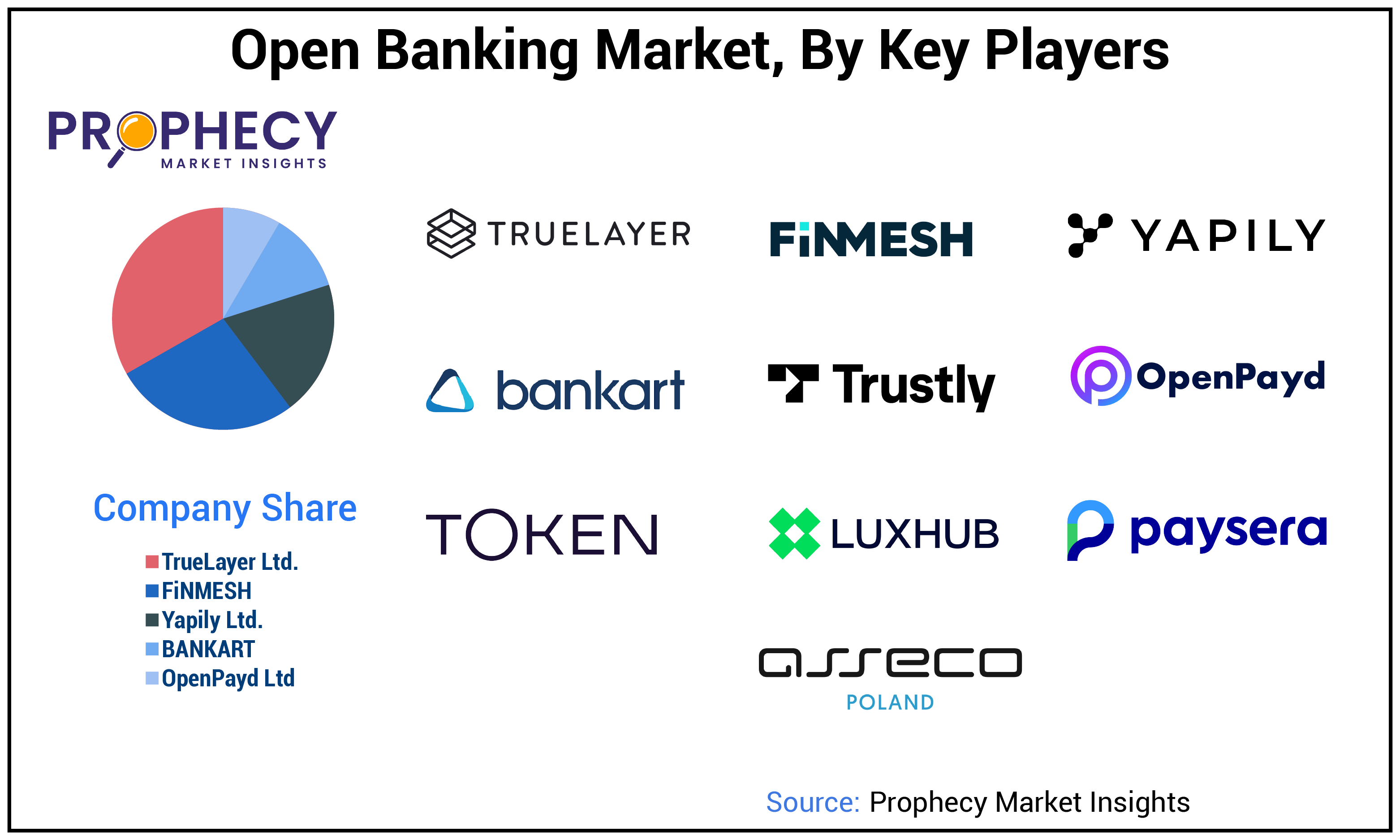
- TrueLayer Ltd.
- FiNMESH
- Yapily Ltd.
- BANKART
- OpenPayd Ltd
- Trustly, Inc.
- Token.io Ltd
- Paysera
- LUXHUB
- Asseco Poland
- Plaid Inc.
- Bud Financial Inc
- Worldline S.A.
- MX Technologies
View an Additional List of Companies in the Open Banking Market
Open Banking Market Recent News
- In November 2025, SBS, the global financial technology company that more than 1,500 financial institutions rely on to digitally transform the way they operate, announced the new version of its SBP Open Banking Platform, designed to help banks deliver next-generation digital payments and embedded finance services across Europe. The cloud-native, SaaS platform enables banks and financial institutions to accelerate their digital transformation while staying compliant with evolving regulations
- In June 2025, Fabrick, an Italian company operating in the Open Finance industry, has completed the acquisition from SCHUFA Holding AG of 75% of finAPI, one of the leading players in Open Banking in Germany. The acquisition, authorized by regulatory authorities, expands the international perspective of Fabrick and enables the development of synergies for innovation in digital payments across Europe.
- In October 2020, OpenPayd, the API-led Banking-as-a-Service provider, today announced the launch of a new partnership with leading open banking infrastructure provider, Token.io, to bring Open Banking to OpenPayd’s customers.
Analyst View:
Regulation-driven adoption is giving way to innovation-driven growth as the open banking ecosystem approaches maturity. While Europe continues to act as the model market, the transformation happening in North America and accelerating pace across Asia-Pacific show that open banking is transforming from a compliance obligation to a competitive differentiator for financial institutions and fintechs.
The industry is being shaped by API quality, security design, ecosystem relationships, and the capacity to extend into open financial and embedded finance use cases. Major firms are aiming toward platform convergence, merging services such as payments, identity verification, lending intelligence, and financial data analytics under consolidated offerings.
Analysis of Sources:
Primary Sources:
- In-depth interviews
- Company-specific data
- Surveys and questionnaires
- Focus group discussions (FGDs)
- Others
Secondary Sources:
- World Bank Open Data
- Financial Conduct Authority
- Australian Banking Association
- Others
More Related Reports
Retail E-commerce Packaging Market
Stem Cell Banking Market
Digital Banking Platform Market
E-Commerce Automotive Aftermarket
E-commerce Market
Open Banking Market Company Profile
|
Company Name |
Product Portfolio |
|
TrueLayer Ltd. |
Open Banking Platform |
|
OpenPayd Ltd |
Open Banking Platform |
|
Trustly, Inc. |
Open Banking Platform |
|
Paysera |
Open Banking Platform |
Open Banking Market Highlights
FAQs
Open banking market size was valued at USD 42.71 Billion in 2026 and is expected to reach USD 351.98 Billion by 2036 growing at a CAGR of 23.5%.
Component, deployment mode, application, end user, and region are the segmentation for the open banking market.
Growing demand for real-time, personalized financial services, increased use of data analytics, AI, and automation in financial decision-making, rapid fintech adoption, and so on are some of the open banking market growth drivers.
North America, Asia Pacific, Europe, Latin America, and the Middle East & Africa. Europe is expected to dominate the open banking market.
The key players operating the open banking market include TrueLayer Ltd., FiNMESH, Yapily Ltd., BANKART, OpenPayd Ltd, Trustly, Inc., Token.io Ltd, Paysera, Asseco Poland, Plaid Inc., Bud Financial Inc, Worldline S.A., and MX Technologies