Naloxone Spray Market Overview
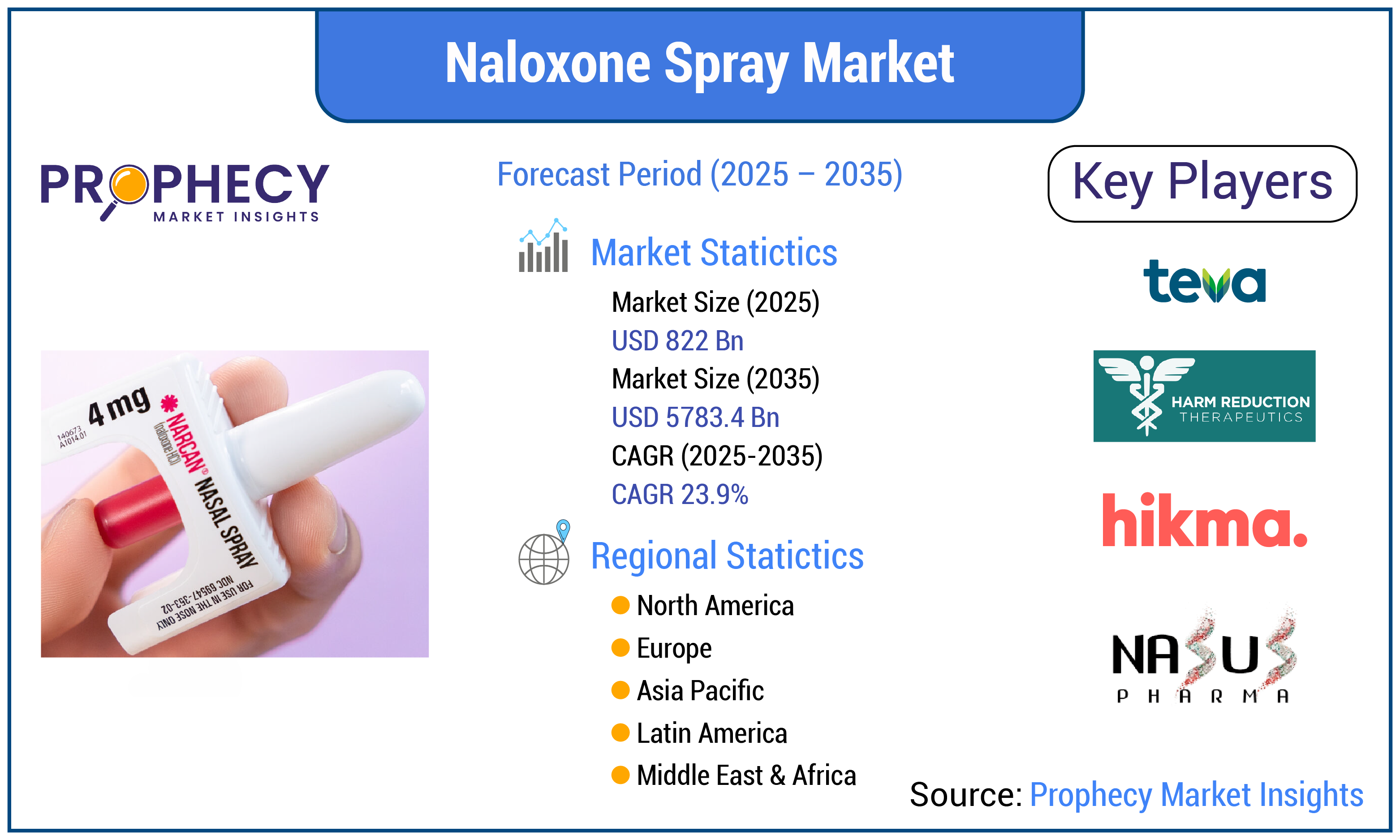
- By 2035, the naloxone spray market size is contemplated to enlarge at a valuation of USD 5783.4 Billion.
- In 2024, the naloxone spray market valuation was USD 662 Billion.
- Naloxone spray market is developing at a CAGR of 23.9%.
Naloxone spray is a rapid acting, nasal-controversial drug that is used to reversed the life-threatening effects of opioid overdose, including slow breathing and loss of consciousness. It works by rapidly binding for opioid receptors in the brain, blocking the effects of opioids such as heroin, or prescription painkillers. The major benefits of Naloxone spray are ease of use without the need of needles, a quick start of action, and it has an important role in saving life during opioid overdose emergency conditions, which makes it an important tool first and equally an important tool.
Naloxone spray market growth is largely inspired by rising opioid overdose crisis, which has inspired comprehensive public health initiatives and government policies with the aim of increasing overdose reversal kits. Intranasal formulations are becoming more popular because of their quick onset, needle-free design, and ease of application, which enable laypeople and first responders to take immediate action. Additionally, aggressive support from regulators (eg, OTC approval), expansion of telemedicine platforms, better insurance coverage, and invasive pricing programs such as California's CalRx are more inexpensive and easily available to Naloxone sprays.
Naloxone spray market is expected to continue its rapid expansion, major future trends include continuous comprehensive access through OTC approval, California's CalRx initiatives such as state-led affordable options, integration in telemedicine platforms, and innovative distribution methods such as vending machines and drone delivery-all the wider communities’ uptake and lively use.
Recession Risk & Tariff Analysis:
- Naloxone spray can withstand the market recession and medium challenges at the market, as healthcare can affect budget reduction and high import cost pricing and supply for materials.
- However, these impacts are expected to be limited due to strong government support, increase in availability of OTCs and costless initiatives such as California, which help to maintain market stability and access even during economic recession.
Impact of Generative AI on Naloxone Spray Market:
- The generative AI is positively affecting the Naloxone spray market by increasing the prediction of risk, optimization of distribution in high-need areas and improving product growth efficiency.
- This helps pharmaceutical companies to manufacture and compliance processes, causing cost reduction and rapid market distribution. Overall, AI integration supports better access and accountability in dealing with opioid overdose.
Naloxone Spray Market Drivers & Restraints
Key Drivers:
Rising Opioid Overdose Cases has caused the Market to Develop Considerably
Cases of rising opioid overdose are a major driver of naloxone spray market growth, as the misuse of opioids and the increasing prevalence of related ambush has created immediate demand for rapid, accessible overdose reversal solutions. Naloxone spray, with its fast-acting and easy-to-use format, is widely adopted by emergency respondents, healthcare providers and even the general public to prevent deaths. This growing requirement for life saving interventions is motivating governments, health organizations and communities to expand the distribution programs, leading to a significant increase in the naloxone spray market size.
- For Instance, according to the data published by WHO, worldwide, about 296 million people (or 5.8% of the global population aged 15–64 years) used drugs at least once in 2021. Among them, about 60 million people used opioids. About 39.5 million people lived with drug use disorders in 2021(2). Most people dependent on opioids used illicitly cultivated and manufactured heroin, but the proportion of those using prescription opioids is growing.
Restraints:
Limited Awareness & Training could Affect Market Development
Limited awareness and training about how to use Naloxone sprays are significant obstacles to its widespread effectiveness, especially in the risk of opioid overdose among non-healing individuals and communities. Many people are unaware of that Naloxone is available, how it works, or is not ready to use it in emergency. This reduces the possibility of timely intervention during overdose events.
- Counterbalance Statements: A major solution is largely implementing community-based education programs including free training sessions, public health campaigns, and distribution of easy understanding instructions. Participating with schools, workplaces, pharmacies and local organizations can help normalize the use of naloxone and more people can effectively respond to overdose situations.
Opportunities & Trends:
Expansion in Telemedicine & Online Platforms could be Used to Investigate Future Market Prospects
Extension in telemedicine and online platforms is ready to be a strong future tendency for the naloxone spray market, as remote healthcare delivery makes it easy to educate, write and distribute risks at risk in rural areas, especially in stand or risky people in rural areas. Telemedicine-Hospital Pharmacies opioid education and naloxone distribution programs prove effective in improving confidence, and overdose response is also a leading to life saved life-the health system is rapidly embracing a virtual initiative. As telehealth use has continued the projection to about 6% Retail Pharmacy claim lines to integrate Naloxone in these digital care pathways in early 2023, which enables timely intervention, streamlined access and comprehensive community access, eventually strengthening market growth.
Naloxone Spray Market Segmentations & Regional Insights
Category, type, dosage, age group, distribution channel, and region are the divisions of the naloxone spray market.
By Category:
Branded, and generic are category on which naloxone spray market is segmented. Branded naloxone spray currently holds its early FDA approval, strong brand recognition, comprehensive distribution networks, and the biggest naloxone spray market share due to trust between healthcare providers especially in hospitals.
Generic, which later entered the market, is now second; They are receiving due to the strong increase in community distribution programs that provide cheap options, taking advantage of rapid low prices, availability of OTC, and brand-name demand.
By Type:
Based on the type, the naloxone spray market is divided into prescription, and over-the-counter (OTC). Branded OTC Naloxone products currently hold the largest naloxone spray market share, which is supported by strong policy and brand recognition, to provide it online without pharmacies, retail stores and online due to approval of Narkan for over-the-counter use.
Prescription-based Naloxone sprays remain the second largest segment, which are created by traditional distribution through healthcare settings such as a standing order or healthcare settings under the clinician oversight, especially benefiting from insurance coverage and low out-off-pocket costs for some patients.
By Dosage:
2Mg/Actuation, 4Mg/Actuation, and others are dosage of the naloxone spray market. 4MG/Actuation dose is currently the largest part of the Naloxone spray market almost globally 60-68%, thanks to its high plasma absorption, strong efficacy against Hospital Pharmacy opioids such as emergency responders and hospitals.
2mg/activation format is in second place, obtaining traction for gentle dose, low -prone return risk, and suitable for individuals with low opioid tolerance or environment where low rapid intervention is preferred.
By Age Group:
The naloxone spray market on the account of age group categorized into pediatric, adults, and geriatric. The adult age group gives the largest Naloxone spray market share, as most opioid overdose cases occur between adults, especially working persons (18–64), which leads to the highest demand and use in this segment.
The pediatric group holds the second largest part with the safety and efficacy established for the age of 0–17-especially supports its adoption in adolescent-schools, homes and emergency services, although with a slightly more vigilant dose and monitoring requirements.
By Distribution Channel:
Hospital pharmacy, retail pharmacy, and online pharmacy are distribution channel on which market is categorized. Hospital pharmacies currently have the largest Naloxone Spray market share about 40-50%-Back Hospital (especially emergency department) is on the front rows of treatment of opioid overdose and often requires stocking of naloxone by recognition standards.
Retail pharmacies followed as the second largest channel at around 40%, benefiting from over-the-counter availability, comprehensive access, and offering pharmacist education and training, making Naloxone easier for individuals to get and use Naloxone out of clinical settings.
Regional Insights:
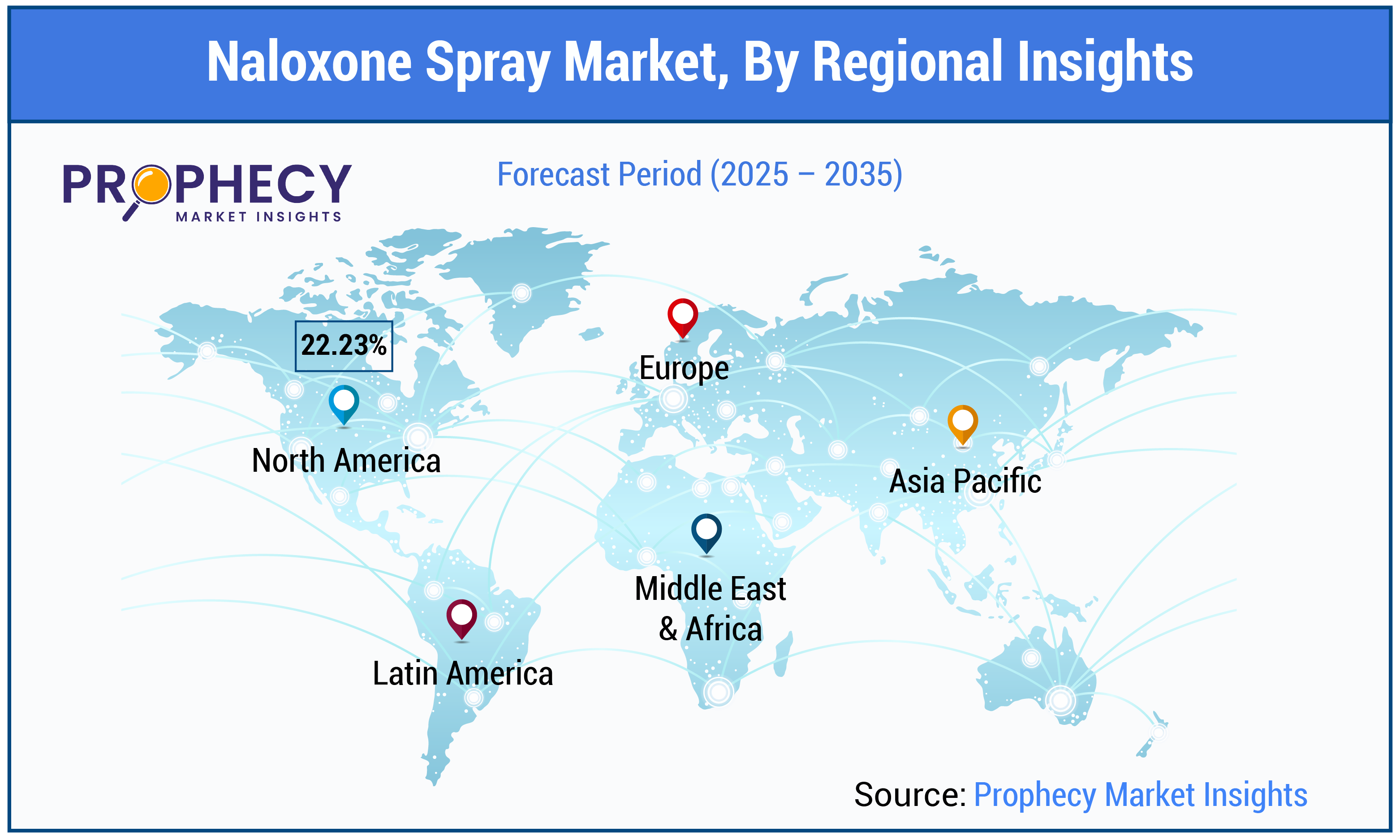
Geographically, the naloxone spray market is studied across North America, Europe, Asia Pacific, Latin America, and the Middle East & Africa.
North America: This region has the largest Naloxone spray market share, mainly due to the ongoing Opioid crisis of the region, especially in the U.S., which is responsible for the highest number of opioids related to opioids globally. This public health emergency has inspired adequate government intervention including federal and state-funded Naloxone Distribution Program, Standing Pharmacy Order and comprehensive over-the-counter (OTC) approval.
- U.S. Naloxone Spray Market Insights:
In North America, the U.S. dominates the Naloxone spray market due to its severe opioid crisis, which is responsible for more than 80% of deaths from North America's Opioid overdose. It has included aggressive federal and state-level funding, comprehensive Naloxone distribution programs, over-the-counter (OTC) approval, and public safety and school systems.
Europe: This ranks as a second-cruel region due to increasing attention to loss of loss in loss, raises awareness about opioid related incompleteness, and government-led initiatives in countries such as UK, Germany and Norway increase. While the Opioid crisis of Europe is less severe than in North America, the adoption of Naloxone as a public health tool is increasing by regulations on non-profit organizations, national health services and take-home naloxone kits.
- U.K. Naloxone Spray Market Insights:
In Europe, the U.K. leads the market due to the policies of its active damage reduction, the government funded Naloxone programs and national efforts to distribute sprays in high-risk communities, jails and addiction treatment centers. The UK's Centralized Health Services System (NHS) and the clear regulatory structure support easier access and adoption than other European countries.
Asia Pacific: This is emerging as the fastest growing region (-10–25% CAGR) for Pacific Naloxone sprays, which is inspired by an increase in opioid misuse, rapid expansion of healthcare infrastructure, and NGOs in countries such as India, China, Australia, and South East Asia.
- India Naloxone Spray Market Insights:
Within the region, India is dominating the concerns of growing opioid addiction, active efforts by public health bodies and NGOs and thanks to emergency response and naloxone in rural healthcare thanks, as well as cooperation for improvement in domestic drug manufacturing and cooperation.
Naloxone Spray Market Report Scope:
|
Attribute |
Details |
|
Market Size 2025 |
USD 822 Billion |
|
Projected Market Size 2035 |
USD 5783.4 Billion |
|
CAGR Growth Rate |
23.9% (2025-2035) |
|
Base year for estimation |
2024 |
|
Forecast period |
2025 – 2035 |
|
Market representation |
Revenue in USD Billion & CAGR from 2025 to 2035 |
|
Regional scope |
North America - U.S. and Canada Europe – Germany, U.K., France, Russia, Italy, Spain, Netherlands, and Rest of Europe Asia Pacific – China, India, Japan, Australia, Indonesia, Malaysia, South Korea, and Rest of Asia-Pacific Latin America - Brazil, Mexico, Argentina, and Rest of Latin America Middle East & Africa – GCC, Israel, South Africa, and Rest of Middle East & Africa |
|
Report coverage |
Revenue forecast, company share, competitive landscape, growth factors, and trends |
Segmentation:
By Category:
- Branded
- Generic
By Type:
- Prescription
- Over-the-Counter (OTC)
By Dosage:
- 2Mg/Actuation
- 4Mg/Actuation
- Others
By Age group:
- Pediatric
- Adults
- Geriatric
By Distribution Channel:
- Hospital Pharmacy
- Retail Pharmacy
- Online Pharmacy
By Region:
- North America
- U.S.
- Canada
- Europe
- Germany
- U.K.
- France
- Russia
- Italy
- Spain
- Netherlands
- Rest of Europe
- Asia Pacific
- China
- India
- Japan
- Australia
- Indonesia
- Malaysia
- South Korea
- Rest of Asia Pacific
- Latin America
- Brazil
- Mexico
- Argentina
- Rest of Latin America
- Middle East & Africa
- GCC
- Israel
- South Africa
- Rest of Middle East & Africa
Naloxone Spray Market Competitive Landscape & Key Players
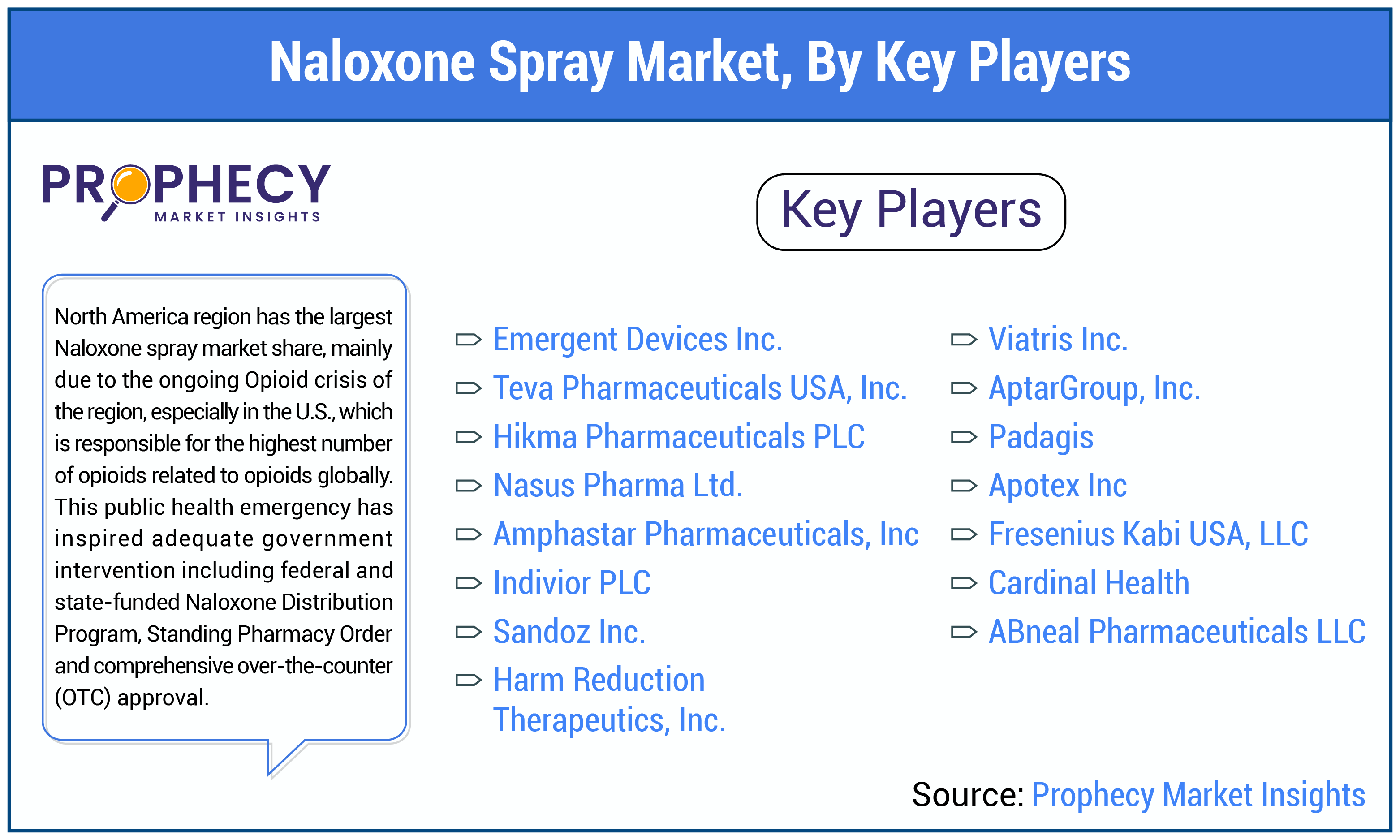
The key players operating in the naloxone spray market include, Emergent Devices Inc., Teva Pharmaceuticals USA, Inc., Sandoz Inc., Nasus Pharma Ltd., and others. Major development strategies for Naloxone spray companies include expanding the availability of over-the-counter (OTC), partnership with governments and NGOs for large-scale distribution, investing in public awareness campaigns, entering emerging markets and developing cost-affected generics. Additionally, taking advantage of digital health platforms and telemedicine for widespread access and real -time access is becoming increasingly important.
Naloxone Spray Market Companies:
- Emergent Devices Inc.
- Teva Pharmaceuticals USA, Inc.
- Harm Reduction Therapeutics, Inc.
- Hikma Pharmaceuticals PLC
- Nasus Pharma Ltd.
- Amphastar Pharmaceuticals, Inc
- Indivior PLC
- Sandoz Inc.
- Viatris Inc.
- AptarGroup, Inc.
- ABneal Pharmaceuticals LLC
- Padagis
- Apotex Inc
- Fresenius Kabi USA, LLC
- Cardinal Health
View an Additional List of Companies in the Naloxone Spray Market
Naloxone Spray Market Recent News
- In January 2025, the worldwide pharmaceutical firm Hikma Pharmaceuticals PLC (Hikma) today announced that it has partnered exclusively with Emergent BioSolutions (Emergent) to sell KLOXXADO naloxone HCl nasal spray 8 mg in the United States and Canada. The US Food and Drug Administration (FDA) authorized KLOXXADO in April 2021 for the emergency management of known or suspected opioid overdose in adults and children who exhibit respiratory and/or central nervous system depression. The first over-the-counter naloxone medication approved by the FDA for the emergency treatment of opioid overdose is NARCAN Nasal Spray 4 mg, which is distributed by Emergent.
- In August 2023, NARCAN Naloxone HCl Nasal Spray 4 mg available on store shelves and online starting in September, according to Emergent BioSolutions Inc. Access to NARCAN Nasal Spray over-the-counter (OTC) enables more individuals to respond to opioid emergencies, potentially saving lives and ensuring the safety of loved ones and communities. Given the alarming number of deaths from the pandemic, which is mostly caused by synthetic opioids such as fentanyl, increasing access and awareness is essential.
- In March 2023, Amphastar Pharmaceuticals, Inc. declared that its New Drug Application ("NDA") for naloxone hydrochloride nasal spray 4mg, which is administered using the company's exclusive nasal delivery device, has been approved by the U.S. Food and Drug Administration ("FDA"). For both adult and pediatric patients, naloxone hydrochloride nasal spray 4 mg is recommended for the immediate treatment of known or suspected opioid overdose, as evidenced by respiratory and/or central nervous system depression.
Analyst View:
By blocking opioid receptors in the brain, naloxone spray, a quick-acting, needle-free nasal medicine, can cure potentially fatal opioid overdoses. It is an essential tool for both medical professionals and spectators in emergency situations due to its simplicity of use and quick impact. The expanding opioid overdose issue, more government assistance, over-the-counter approvals, and improved access through telemedicine and affordable programs including California's CalRx are all contributing to the market's rapid growth. Future developments include expanded over-the-counter availability, state-led affordability initiatives, and creative distribution strategies including vending machines and drones to increase accessibility and community acceptance.
More Related Reports
Thermal Spray Material Market
Prescription Sunglasses Market
Oral Solid Dosage Excipients Market
Oral Solid Dosage Excipients Market
Pediatric Radiology Market
Naloxone Spray Market Company Profile
|
Company Name |
Viatris Inc. |
|
Headquarter |
Canonsburg, Pennsylvania, U.S. |
|
CEO |
Scott A. Smith |
|
Employee Count |
32,000 Employees |
Naloxone Spray Market Highlights
FAQs
Naloxone spray market size was valued at USD 822 Billion in 2025 and is expected to reach USD 5783.4 Billion by 2035 growing at a CAGR of 23.9%.
Category, type, dosage, age group, distribution channel, and region are the segmentation for the target market.
North America, Asia Pacific, Europe, Latin America, and the Middle East & Africa. North America is expected to dominate the market.
The key players operating the naloxone spray market include Emergent Devices Inc., Teva Pharmaceuticals USA, Inc., Harm Reduction Therapeutics, Inc., Hikma Pharmaceuticals PLC, Nasus Pharma Ltd., Amphastar Pharmaceuticals, Inc, INDIVIOR PLC, Sandoz Inc., Viatris Inc., AptarGroup, Inc., ABneal Pharmaceuticals LLC, Amphastar Pharmaceuticals, Inc, Padagis, Apotex Inc, Fresenius Kabi USA, LLC, and Cardinal Health.