Music Tourism Market Overview
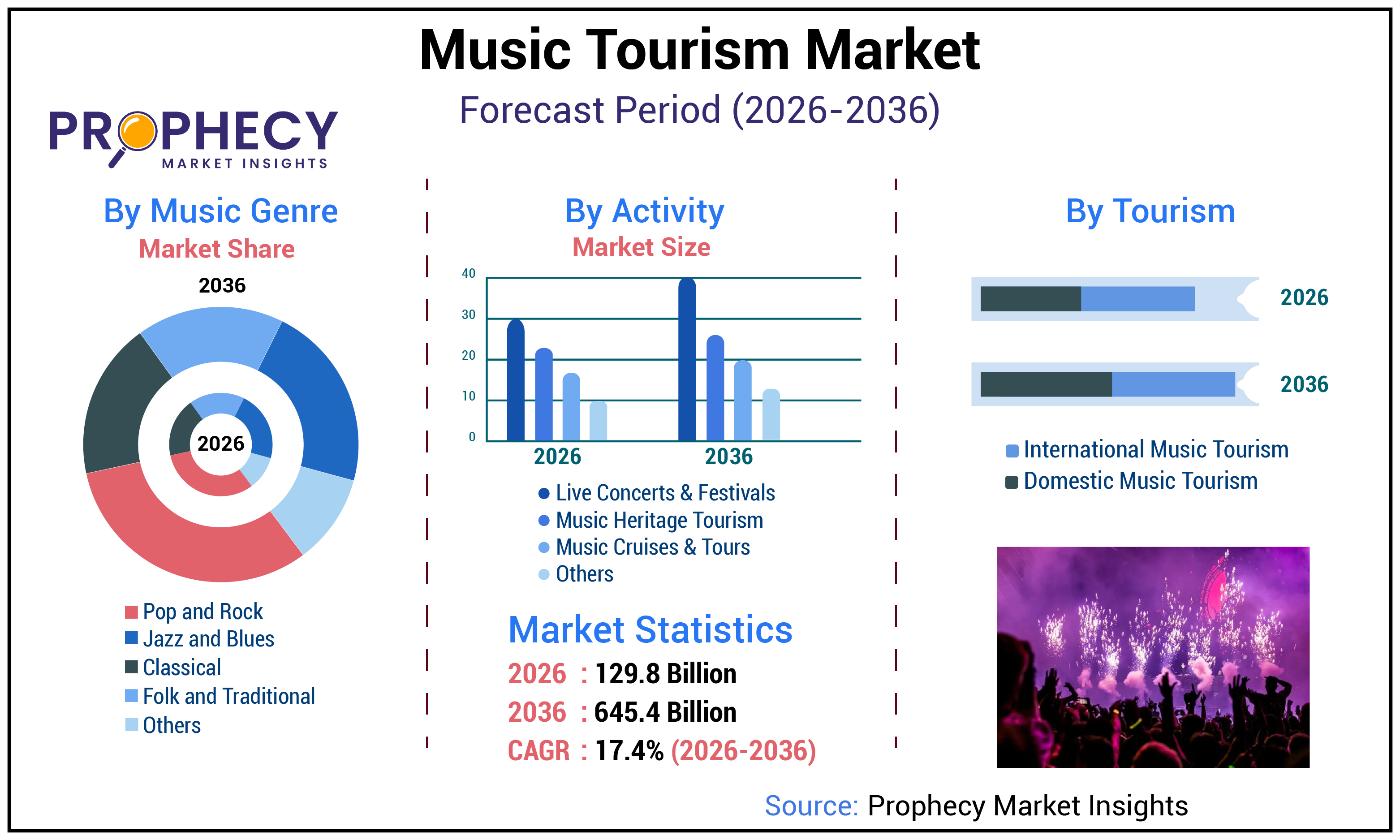
- 2025 Market Size: USD 110.6 Billion
- 2036 Projected Market Size: USD 645.4 Billion
- CAGR (2026-2036): 17.4%
- Europe: Largest Market in 2025
Music tourism is traveling that people do because they want to enjoy musical events, festivals, concerts, or places linked with music history and culture. It is the consumption of live music shows, taking a tour on a music landmark that is famous, or digging the roots of a genre or artist. Such travel means to the world become richer through culture and feel, and also they do provide a good deal of money to the local hospitality, transport, and entertainment sectors. Besides that, music tourism still helps artists and local communities, makes the city famous worldwide, and educates travelers in the different musical traditions.
Fans attending live concerts and global music festivals is one of the major reasons that have led the music tourism market to grow tremendously. There are also factors such as more money being spent on leisure and cultural experiences, and social media's contribution to the promotion of music events and the destinations that people visit because of music.
In addition, more people have been able to access music tourism as a result of better travel facilities, lower airfare, and the use of music events in the tourism marketing mix. The strong emotional connection that people have with music, coupled with their craving for unique and immersive travel experiences, is what makes the market to be expanding everywhere in the world.
Guidelines for the issue of permission for the Music Tourism:
- Regulations related to permission granting for music tourism events generally require that the organizers first secure authorization from the local authorities and the tourism departments as a way to ensure safety, conformity with the law, and the least possible environmental or social disturbance.
- The permitted operations are usually limited to such aspects as the approval of the venue, management of the crowd, control of sound levels, measures for the safety of the public, and observance of local laws regarding noise, sanitation, and waste management.
- If there were organizers, they would also have to coordinate with the police, fire, and health departments, get the proper licenses for music performances, and if applicable, for the sale of alcohol, as well as ensure the insurance of the participants.
- Besides that, as far as sustainability is concerned, being compliant with accessibility requirements and observing the cultural sensitivity guidelines are often cited as ways of giving the responsible music-tourism facilitation a green light.
Current Industry Dynamics & Insights:
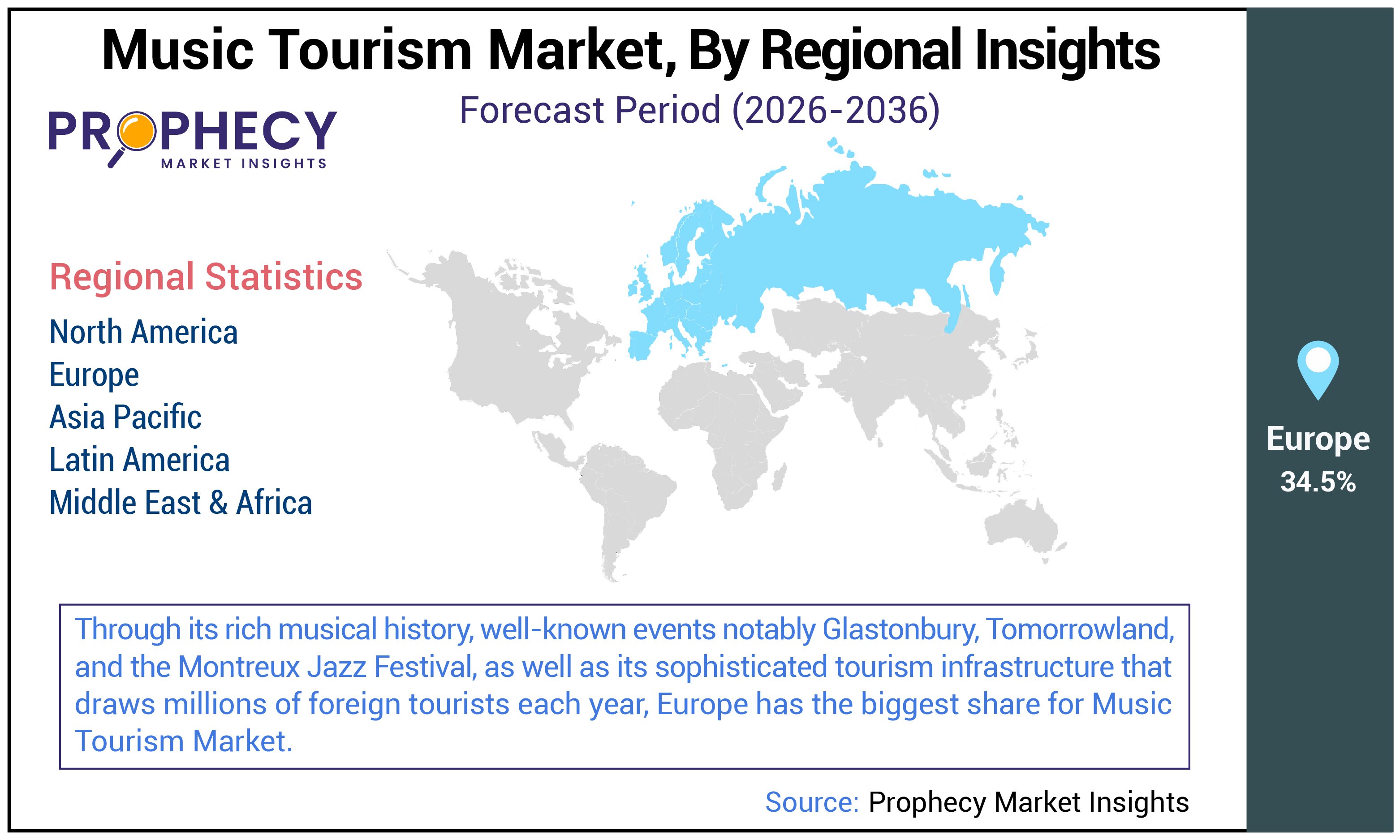
- Europe has the largest regional share in the market, with almost 34.5%.
- North America is second dominating region in the market.
- By tourism type, international music tourism dominate the music tourism market share.
Music Tourism Market Drivers & Restraints
Drivers and Restraints:
|
Drivers |
Restraints |
Opportunities & Trends |
|
|
|
Key Drivers:
Rising Travel Spending
The music tourism market is expanding largely due to the increase in travel spending that is a result of more people being willing to allocate funds for leisure, entertainment and unique cultural experiences. Consumers with higher disposable incomes enhance the global flow of live music and heritage events as they become able to attend music festivals, concerts, and the as in distant countries.
Consequently, the demand for flights, hotels, and local services is increasing. This increased spending not only sustains event organizers but also revitalizes regional economies through the promotion of hospitality, transport, and retail sectors. As travelers become more experience-based, music tourism is growing as a preferred form of cultural and recreational travel.
- For instance, according to the data published by World Travel & Tourism Council, in 2024, Travel & Tourism's contribution to global GDP totalled USD 10.9 trillion. This includes direct, indirect, and induced impacts of the sector. As a share, Travel & Tourism represented 10% of the global economy. Travel & Tourism is also an important source of employment. In 2024, the sector supported a total of 357 million jobs globally, which is approximately 1 in 10 jobs.
Restraints:
Licensing and Regulatory Hurdles
Music tourism sector is a major victim of growth hampering issues in the form of licensing and regulatory hurdles, which in turn cause delays, increase costs, and create operational challenges for event organizers. Inefficient and complicated approval procedures for noise levels, crowd permits, performance rights, and alcohol sales may result in fewer investments and thus the number of large-scale music events decreases.
- Counterbalance Statements: Local administrations and tourism boards may deal with such difficulties by restructuring the licensing system, creating single-window clearance mechanisms, as well as issuing easily understandable event safety and compliance regulations. Facilitating rules serve as a motive for more organizers to manage music festivals, thus tourism and the local economy get activated and develop further.
Opportunities & Trends:
Expanding Role of Influencers and Digital Marketing in Tourism Promotion
The growing significance of influencers and digital marketing is being recognized as a lead music tourism market trend in the near future. As social media platforms are becoming the main source of information for travelers regarding the events they want to attend and their awareness. Influencers, by sharing genuine and engaging content, which motivates their followers to take part in the same experiences, are the ones who best advocate music festivals, concerts, and destinations.
Hence, digital campaigns, live streaming, and interactive content generate a buzz in the online community, luring both local and international audiences. Since the younger generation of travelers is a heavy user of digital media when making travel decisions, the partnership with influencers and the use of marketing strategies based on data will be the main factors behind the continuation of the demand for music tourism as well as the reshaping of the future of music tourism promotion.
Music Tourism Market Segmentations & Regional Insights
Tourism type, music genre, activity type, booking channel, and region are the divisions of the music tourism market.
By Tourism Type:
Domestic music tourism, and international music tourism are tourism type on which music tourism market is segmented. In recognition of the fact that significant international festivals, concerts, and cultural events draw tourists from other nations looking for distinctive musical and cultural experiences, international music tourism has the greatest music tourism market share. Large worldwide crowds attend well-known events including Coachella, Tomorrow land, and Glastonbury, which results in substantial travel, lodging, and entertainment expenditures.
Domestic tourism is a robust and continuously expanding component of the entire market due to lower travel costs, improved accessibility, and government programs supporting regional cultural tourism.
By Music Genre:
Based on the music genre, the music tourism market is divided into pop and rock, jazz and blues, classical, folk and traditional, and others. Through its enormous worldwide fan base, broad appeal, and well-known festivals and events notably Glastonbury, Coachella, and Rock in Rio, which draw millions of people annually, pop and rock music tourism has the biggest music tourism market share.
Due to its strong cultural ties, devoted fan base, and heritage-rich locations like New Orleans, Montreux, and Copenhagen, jazz and blues music tourism is the second most popular category. Travelers with an interest in culture who are looking for genuine, immersive musical experiences are drawn to jazz and blues festivals.
By Activity Type:
The music tourism market is categorized into live concerts and festivals, music heritage tourism, music cruises and tours, and others on the account of activity type. Knowing that they provide expansive, immersive experiences that draw both domestic and foreign tourists and generate substantial revenue from ticket sales, sponsorships, and tourism services, live concerts and festivals have the biggest music tourism market size.
In order to engage with musical history and culture, tourists are increasingly visiting notable music landmarks, museums, and the birthplaces of well-known performers, making music heritage tourism the second most popular category. Growing interest in experience travel and cultural preservation supports this market.
By Booking Channel:
The music tourism market on the account of booking channel is categorized online travel agencies, offline travel agencies, direct booking, and others. In spite of the increasing digitalization of travel services, simple pricing comparisons, and easy access to tickets, lodging, and travel packages on a single platform, online travel agencies (OTAs) have largest music tourism market share.
In order to guarantee authenticity, obtain early access, and obtain special deals or add-on experiences, many tourists prefer to buy tickets directly from event organizers, official festival websites, or artist platforms, making direct booking the second most popular category.
Regional Insights:
Geographically, the music tourism market is studied across North America, Europe, Asia Pacific, Latin America, and the Middle East & Africa.
Europe: Through its rich musical history, well-known events notably Glastonbury, Tomorrowland, and the Montreux Jazz Festival, as well as its sophisticated tourism infrastructure that draws millions of foreign tourists each year, Europe has the biggest share for music tourism market. Attendance is also increased by the continent's varied music culture and convenient cross-border travel inside the EU.
- U.K. Music Tourism Market Insights:
With regard to its internationally renowned festivals including Glastonbury and Reading & Leeds, a rich musical heritage that includes legendary performers consisting of The Beatles and Queen, and a sophisticated event infrastructure that draws millions of foreign tourists each year, the United Kingdom leads the European music tourism market.
North America: This region market is dominated by the U.S., is the second most important region. Major events including Coachella, Lollapalooza, and South by Southwest generate enormous amounts of domestic and international travel. North America is a major location for the expansion of music tourism due to its robust entertainment industries and high consumer buying power.
- U.S. Music Tourism Market Insights:
In part to its enormous entertainment sector, which hosts well-known events includes Coachella, Lollapalooza, and Austin City Limits, the United States leads the market in North America. The United States is a global center for music tourism due to its high consumer expenditure on live entertainment, sophisticated ticketing systems, and robust engagement from international artists.
Asia Pacific: The combination of rising disposable incomes, growing youth populations, growing interest in regional and international music festivals, and robust government programs supporting cultural tourism, the Asia-Pacific (APAC) music tourism market is expanding quickly.
- Japan Music Tourism Market Insights:
In light of its thriving music culture, internationally renowned festivals includes Fuji Rock and Summer Sonic, sophisticated event infrastructure, and significant worldwide influence through J-pop and anime music, Japan leads the APAC industry. Japan is a popular destination for both local and foreign music tourists due to its blend of traditional and modern music experiences.
Music Tourism Market Report Scope:
|
Attribute |
Details |
|
Market Size 2026 |
USD 129.8 Billion |
|
Projected Market Size 2036 |
USD 645.4 Billion |
|
CAGR Growth Rate |
17.4% (2026-2036) |
|
Base year for estimation |
2025 |
|
Forecast period |
2026 – 2036 |
|
Market representation |
Revenue in USD Billion & CAGR from 2026 to 2036 |
|
Regional scope |
North America - U.S. and Canada Europe – Germany, U.K., France, Russia, Italy, Spain, Netherlands, and Rest of Europe Asia Pacific – China, India, Japan, Australia, Indonesia, Malaysia, South Korea, and Rest of Asia-Pacific Latin America - Brazil, Mexico, Argentina, and Rest of Latin America Middle East & Africa – GCC, Israel, South Africa, and Rest of Middle East & Africa |
|
Company Landscape |
Market Share Analysis of Companies Heat Map Analysis Company Overview, Products Overview Financial Information, Key Highlights Business Strategies Overview SWOT Analysis |
|
Report coverage |
Revenue forecast, company share, competitive landscape, growth factors, and trends |
|
Value Added Data Infosets |
Besides fundamental market insights such as the size of the market, growth rate, segmentation, regional study, and key players, our reports carry value-added data sets such as trade flow (import-export) analysis, production and consumption overview, price trend evaluation, supply and value chain mapping, and raw material availability. Moreover, we provide strategic tools as PESTLE and Porter’s Five Forces analysis, examination of the regulatory landscape, as well as monitoring of technology and innovation thereby providing a comprehensive overview which facilitates sensible and anticipatory decision-making. |
Segmentation:
By Tourism Type:
- Domestic Music Tourism
- International Music Tourism
By Music Genre:
- Pop and Rock
- Jazz and Blues
- Classical
- Folk and Traditional
- Others
By Activity Type:
- Live Concerts and Festivals
- Music Heritage Tourism
- Music Cruises and Tours
- Others
By Booking Channel:
- Online Travel Agencies
- Offline Travel Agencies
- Direct Booking
- Others
By Region:
- North America
- U.S.
- Canada
- Europe
- Germany
- U.K.
- France
- Russia
- Italy
- Spain
- Netherlands
- Rest of Europe
- Asia Pacific
- China
- India
- Japan
- Australia
- Indonesia
- Malaysia
- South Korea
- Rest of Asia Pacific
- Latin America
- Brazil
- Mexico
- Argentina
- Rest of Latin America
- Middle East & Africa
- GCC
- Israel
- South Africa
- Rest of Middle East & Africa
Music Tourism Market Competitive Landscape & Key Players
Creating appealing festival packages and cultural experiences through collaborations with local governments, travel agents, and event organizers is one of the main growth strategies for music tourism businesses. To more successfully reach audiences around the world, businesses are also utilizing data-driven targeting, influencer partnerships, and digital marketing. Competitiveness is being increased by entering growing markets, providing sustainable and personalized travel options, and using technology as smartphone apps for easy booking and event information.
Music Tourism Market Companies:
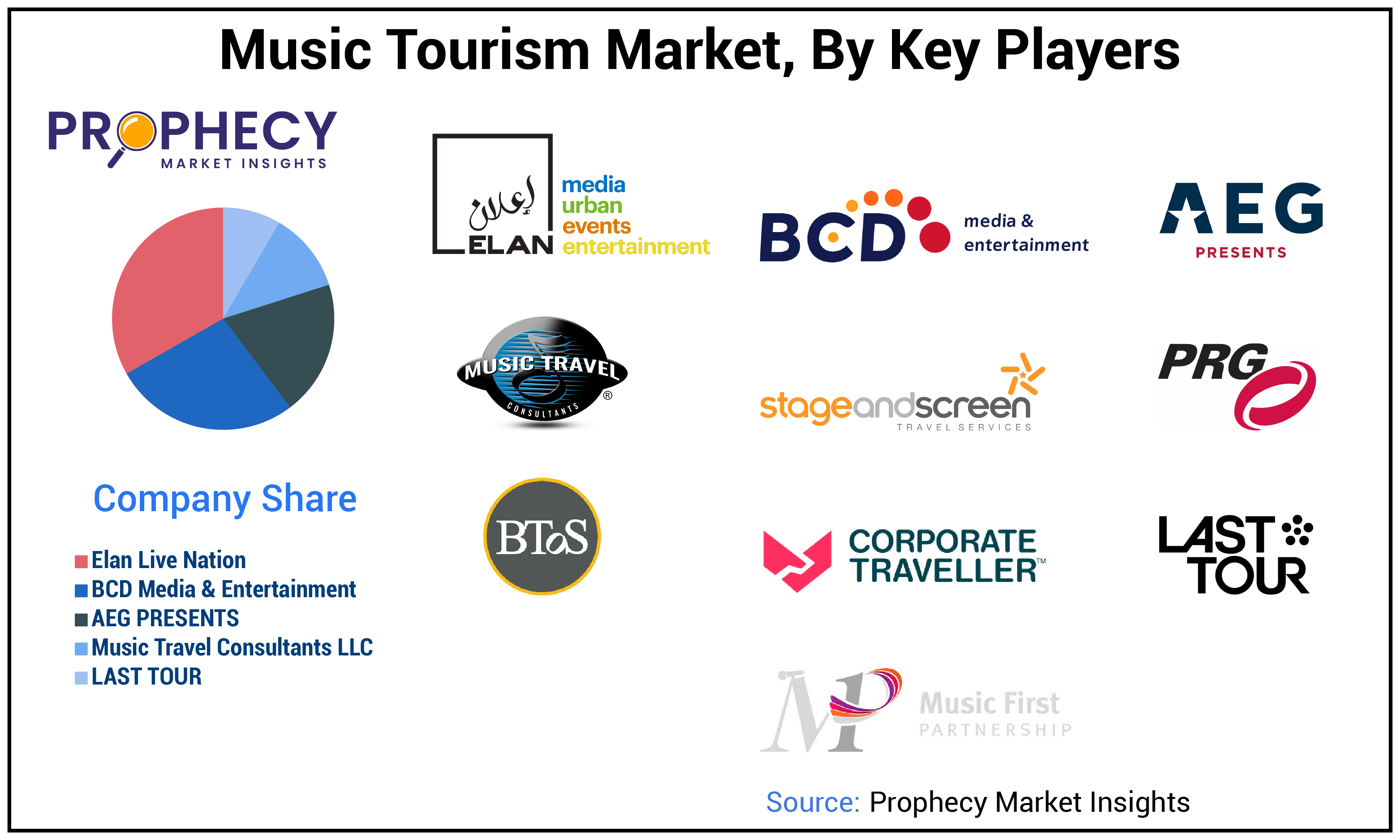
- Elan Live Nation
- BCD Media & Entertainment
- AEG PRESENTS
- Music Travel Consultants LLC
- LAST TOUR
- Club Europe Group Travel
- Production Resource Group, L.L.C.
- Corporate Traveller
- Traveltec Touristic Services S.L.
- BToS Productions
- Stage and Screen
- Music First Partnership
- Music & Travel
- Club Europe Group Travel
- Travel Places
View an Additional List of Companies in the Music Tourism Market
Music Tourism Market Recent News
- In September 2025, In order to showcase one of Thailand's most distinctive folk traditions and promote sustainable tourism through green event practices, the Tourism Authority of Thailand (TAT) is organizing the "Molam Festival" to present Isan's unique musical history on a worldwide scale. The festival will be held in Udon Thani from September 26–28 at Thung Sri Muang and in Roi Et from September 19–21 at Roi Et Tower.
Analyst View:
Traveling for live music events, festivals, concerts, or locations associated with musical legacy and culture is known as "music tourism." Through hospitality, transportation, and entertainment, it greatly strengthens local economies while enhancing guests' cultural experiences.
Growing attendance at international festivals, increased expenditure on leisure and cultural activities, social media promotion, and easier access to travel are the main factors driving the market's expansion. Furthermore, music tourism is a flourishing and growing global trend due to people's emotional connection to music and their need for immersive, unforgettable experiences.
Analysis of Sources:
Primary Sources:
- In-depth interviews
- Company-specific data
- Surveys and questionnaires
- Focus group discussions (FGDs)
- Others
Secondary Sources:
- UN World Tourism Organization (UNWTO)
- United Nations Educational, Scientific and Cultural Organization (UNESCO)
- World Travel & Tourism Council (WTTC)
- European Commission
- Others
More Related Reports
U.S Stock Music Market
Cloud Music Services Market
Stock Music Market
Background Music Market
Asia Pacific Stock Music Market
Music Tourism Market Company Profile
|
Company Name |
Product Portfolio |
|
Music Travel Consultants LLC |
Custom Performance Tours |
|
BCD Media & Entertainment |
Music & Touring |
|
Love Music Travel Ltd |
Music Holidays |
|
Corporate Traveller |
Music Industry Travel |
|
Production Resource Group, L.L.C. |
Music and Concert Production Services |
Music Tourism Market Highlights
FAQs
Music tourism market size was valued at USD 129.8 Billion in 2026 and is expected to reach USD 645.4 Billion by 2036 growing at a CAGR of 17.4%.
Tourism type, music genre, activity type, booking channel, and region are the segmentation for the music tourism market.
Expansion of live music festivals and artist tours, increased global musical awareness through digital streaming and social media, rising disposable incomes, favorable government support for cultural events, and improvements in digital ticketing, and so on are some of the music tourism market growth drivers.
North America, Asia Pacific, Europe, Latin America, and the Middle East & Africa. Europe is expected to dominate the music tourism market.
The key players operating the music tourism market include Elan Live Nation, BCD Media & Entertainment, AEG PRESENTS, Music Travel Consultants LLC, LAST TOUR, Club Europe Group Travel, Production Resource Group, L.L.C., Corporate Traveller, BToS Productions, Stage and Screen, Music First Partnership, Music & Travel, Club Europe Group Travel, and Travel Places.