Medical Telepresence Robots Market Overview
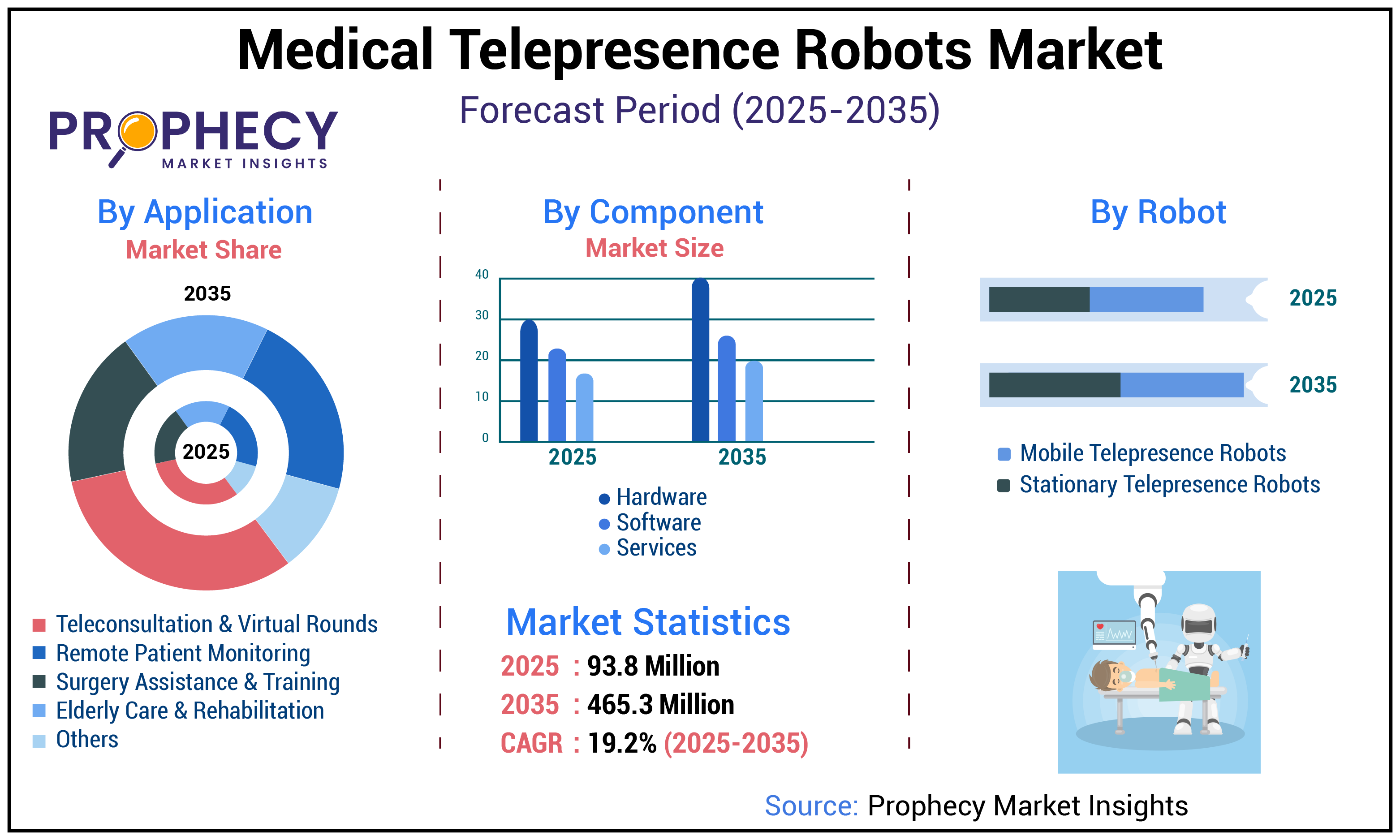
- 2024 Market Size: USD 81.0 Million
- 2035 Projected Market Size: USD 465.3 Million
- CAGR (2025-2035): 19.2%
- North America: Largest Market in 2024
Medical telepresence robots are robots that have been remotely controlled and are fitted with cameras, microphones, and screens which enable doctors/medical professionals to have instant, virtual interactions with patients without being physically present. Some of the benefits of telemedicine are better access to health care in less accessible or neglected areas, quick medical consultations, lower travel costs and time, improved patient monitoring, as well as increased cooperation between healthcare providers.
Medical telepresence robots have experienced tremendous growth due to the above-mentioned factors. The growth of telepresence robots in the medical field is fueled by multiple factors such as rising demand for remote healthcare, increasing adoption of telemedicine, advancements in robotics and Al, shortage of healthcare professionals, and the need for real-time patient monitoring and consultation, especially in rural and underserved regions.
Investment Scenario in the Medical Telepresence Robots Industry:
- The medical telepresence robots’ market is seeing a favorable investment scenario, largely due to the digitalization of healthcare, growing demand for telehealth, and helpful government policies.
- Creative investment capitals, institutions in the healthcare sphere, along with the tech companies are led to R&D, strategy deals, and product improvement. They make these hefty investments primarily to have Al integration, mobility, and remote diagnostic features enhanced.
- The increasing backing in terms of finance demonstrates the trust that the market has for the long-term value it can bring to the healthcare sector i.e. making care more efficient, less expensive and available to more people all over the world.
Current Industry Dynamics & Insights:
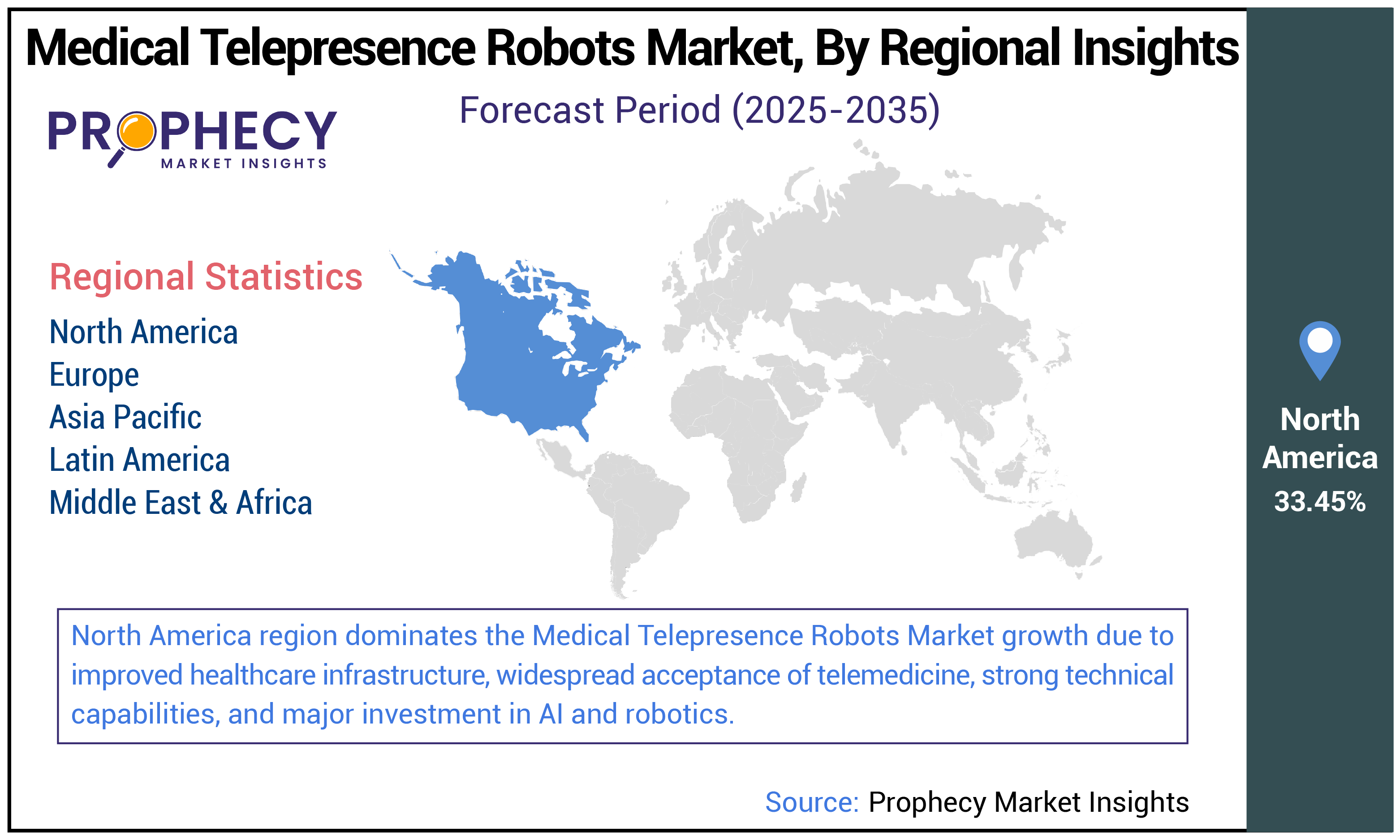
- North America has the largest regional share in the market, with almost 33.45%.
- Europe is second dominating region in the market.
- By Component, hardware dominates the medical telepresence robots market share.
- On the product type, mobile telepresence robots are the most commercially adopted in the medical telepresence robots market.
Medical Telepresence Robots Market Drivers & Restraints
Drivers and Restraints:
|
Drivers |
Restraints |
Opportunities & Trends |
|
|
|
Key Drivers:
Rising Shortage of Healthcare Professionals
One of the key factors leading to the market growth of medical telepresence robots is the healthcare professional shortage that is constantly rising. Such robots allow physicians and experts to remotely consult, diagnose, and monitor patients, thus facilitating the bridging of the gaps in the medical workforce. When limited medical staff are in short supply, particularly in rural or underserved areas, telepresence robots are able to extend their reach so that more patients can receive care. In this way, telepresence robots not only improve access to healthcare but also assist in lowering the workload of healthcare professionals who are already overburdened and increase the efficiency of the entire healthcare system.
- For Instance, according to data published by McKinsey & Company, A global healthcare worker shortage of at least ten million is expected by 2030. Closing that shortage could avert 189 million years of life lost to early death and disability and boost the global economy by $1.1 trillion.
Restraints:
Technical Malfunctions
Technical malfunctions conductive to connectivity issues, fault in software or hardware, etcetera, can hamper the expansion of medical telepresence robots in a significant way by cutting down communication, reducing performance as well as user confidence.
- Counterbalance Statements: Manufacturers are putting their energies mainly into reliable system design, frequent software updates, Al-enabled predictive maintenance as well as backup connectivity to make performance as trustworthy as possible. Such measures, in their opinion, are not only going to help them ensure the seamless operation of their devices but also build trust with healthcare practitioners and consumers alike.
Opportunities & Trends:
Rising Demand for Surgery Assistance & Training Healthcare Models
The need for Surgery Assistance & Training healthcare models that integrate physical treatment with online consultations is becoming a leading trend in the market of medical telepresence robots. As patients can now perform routine check-ups, follow-ups, and specialist consultations remotely, thus saving time and physical visits would be utilized only when necessary. By applying this method, the capacity for adaptability is tapped, the problem of overcrowding in hospitals is alleviated and the option of permanent observation of the patient is provided, which means that telepresence robots are a vital part of the efficient and patient-friendly health care delivery system.
Medical Telepresence Robots Market Segmentations & Regional Insights
Component, product type, control mechanism, application, end user, and region are the divisions of the medical telepresence robots market.
By Component:
Hardware, software, and services are component on which medical telepresence robots market is segmented. Hardware dominates the medical telepresence robotics market share due to the robots' physical components such as cameras, displays, sensors, and navigation systems are vital, expensive, and serve as the technology's basis.
Software is the second most significant component given that it allows for AI integration, remote connectivity, data security, and user-friendly interfaces, all of which are becoming increasingly vital for improving robot operation and assuring smooth doctor-patient interactions.
By Robot Type:
Based on the product type, the medical telepresence robots market is divided into mobile telepresence robots, and stationary telepresence robots. Mobile telepresence robots have the greatest medical telepresence robots market share since its ability to travel between hospital rooms, ICUs, and clinics allows doctors to communicate with various patients and personnel in real time, boosting efficiency and flexibility in care delivery.
Stationary telepresence robots are the second most popular group, mostly utilized for fixed-location consultations and remote monitoring, making them useful in telemedicine settings but less adaptable than mobile robots.
By Control Mechanism:
Remote-controlled robots, autonomous/ai-enabled robots, and semi-autonomous robots are control mechanism of the medical telepresence robots market. Remote-controlled robots presently occupy the majority of the medical telepresence robots market share as they are widely adopted, cost-effective, and allow doctors to directly conduct consultations with real-time precision.
Autonomous/AI-enabled robots are the second most popular group, spurred by advances in AI and navigation technologies that improve productivity and eliminate the need for continual manual operation, however their popularity is still increasing due to increased prices and complexity.
By Application:
The medical telepresence robots market, on the account of application can categorized into teleconsultation & virtual rounds, remote patient monitoring, surgery assistance & training, elderly care & rehabilitation, and others. Teleconsultation and virtual rounds account for the majority of the medical telepresence robots market considering they are the most popular and urgent use case, allowing doctors to remotely visit patients, conduct check-ups, and cooperate with medical personnel efficiently.
Remote patient monitoring is the second most popular sector, driven by the increased need for ongoing care for chronic illness patients and the elderly, which helps prevent hospital readmissions and improves long-term healthcare management.
By End User:
Hospitals & clinics, ambulatory surgery centers (ascs), long-term care facilities & nursing homes, homecare settings, and others are end users of the medical telepresence robots market. Hospitals and clinics dominate the medical telepresence robots market as they demand advanced telepresence solutions for patient rounds, consultations, and specialist access across different departments, making them the leading purchasers of such equipment.
Long-term care institutions and nursing homes are the second most important area, driven by an aging population and the demand for constant monitoring and remote consultations to improve patient care and decrease staffing issues.
Regional Insights:
Geographically, the medical telepresence robots market is studied across North America, Europe, Asia Pacific, Latin America, and the Middle East & Africa.
North America: This region dominates the medical telepresence robots market growth due to improved healthcare infrastructure, widespread acceptance of telemedicine, strong technical capabilities, and major investment in AI and robotics.
- U.S. Medical Telepresence Robots Market Insights:
North America's medical telepresence robots market is dominated by the United States as to its sophisticated healthcare infrastructure, high telemedicine usage, significant R&D expenditure, and presence of major robotics businesses.
Europe: This is the second most dominant region, thanks to increased government initiatives for digital healthcare, expanding demand for telehealth solutions, and growing awareness of cost-effective remote patient care in both urban and rural locations.
- Germany Medical Telepresence Robots Market Insights:
Germany dominates the European market, thanks to high healthcare standards, government backing for digital health projects, early acceptance of breakthrough medical technology, and a rising emphasis on enhancing patient access through remote care solutions.
Asia Pacific: The medical telepresence robots market in APAC is expanding as a result of increased healthcare digitalization, an aging population, a dearth of medical personnel in remote regions, and government efforts supporting telemedicine and intelligent hospital solutions.
- Japan Medical Telepresence Robots Market Insights:
Japan leads the APAC market due to the combines superior robotics technology, robust healthcare infrastructure, and a significant need for aged care solutions, making it an early user of medical telepresence robots.
Medical Telepresence Robots Market Report Scope:
|
Attribute |
Details |
|
Market Size 2025 |
USD 93.8 Million |
|
Projected Market Size 2035 |
USD 465.3 Million |
|
CAGR Growth Rate |
19.2% (2025-2035) |
|
Base year for estimation |
2024 |
|
Forecast period |
2025 – 2035 |
|
Market representation |
Revenue in USD Million & CAGR from 2025 to 2035 |
|
Regional scope |
North America - U.S. and Canada Europe – Germany, U.K., France, Russia, Italy, Spain, Netherlands, and Rest of Europe Asia Pacific – China, India, Japan, Australia, Indonesia, Malaysia, South Korea, and Rest of Asia-Pacific Latin America - Brazil, Mexico, Argentina, and Rest of Latin America Middle East & Africa – GCC, Israel, South Africa, and Rest of Middle East & Africa |
|
Company Landscape |
Market Share Analysis of Companies Heat Map Analysis Company Overview, Products Overview Financial Information, Key Highlights Business Strategies Overview SWOT Analysis |
|
Report coverage |
Revenue forecast, company share, competitive landscape, growth factors, and trends |
|
Value Added Data Infosets |
Besides fundamental market insights such as the size of the market, growth rate, segmentation, regional study, and key players, our reports carry value-added data sets such as trade flow (import-export) analysis, production and consumption overview, price trend evaluation, supply and value chain mapping, and raw material availability. Moreover, we provide strategic tools as PESTLE and Porter’s Five Forces analysis, examination of the regulatory landscape, as well as monitoring of technology and innovation thereby providing a comprehensive overview which facilitates sensible and anticipatory decision-making. |
Segmentation:
By Component:
- Hardware
- Camera & Display Systems
- Navigation & Mobility Systems
- Others
- Software
- Remote Monitoring & Control Software
- AI & Autonomous/AI-Enabled Robots Integration
- Others
- Services
- Deployment & Integration
- Maintenance & Support
- Others
By Robot Type:
- Mobile Telepresence Robots
- Stationary Telepresence Robots
By Control Mechanism:
- Remote-Controlled Robots
- Autonomous/AI-Enabled Robots
- Semi-Autonomous Robots
By Application:
- Teleconsultation & Virtual Rounds
- Remote Patient Monitoring
- Surgery Assistance & Training
- Elderly Care & Rehabilitation
- Others
By End User:
- Hospitals & Clinics
- Ambulatory Surgery Centers (ASCs)
- Long-Term Care Facilities & Nursing Homes
- Homecare Settings
- Others
By Region:
- North America
- U.S.
- Canada
- Europe
- Germany
- U.K.
- France
- Russia
- Italy
- Spain
- Netherlands
- Rest of Europe
- Asia Pacific
- China
- India
- Japan
- Australia
- Indonesia
- Malaysia
- South Korea
- Rest of Asia Pacific
- Latin America
- Brazil
- Mexico
- Argentina
- Rest of Latin America
- Middle East & Africa
- GCC
- Israel
- South Africa
- Rest of Middle East & Africa
Medical Telepresence Robots Market Competitive Landscape & Key Players
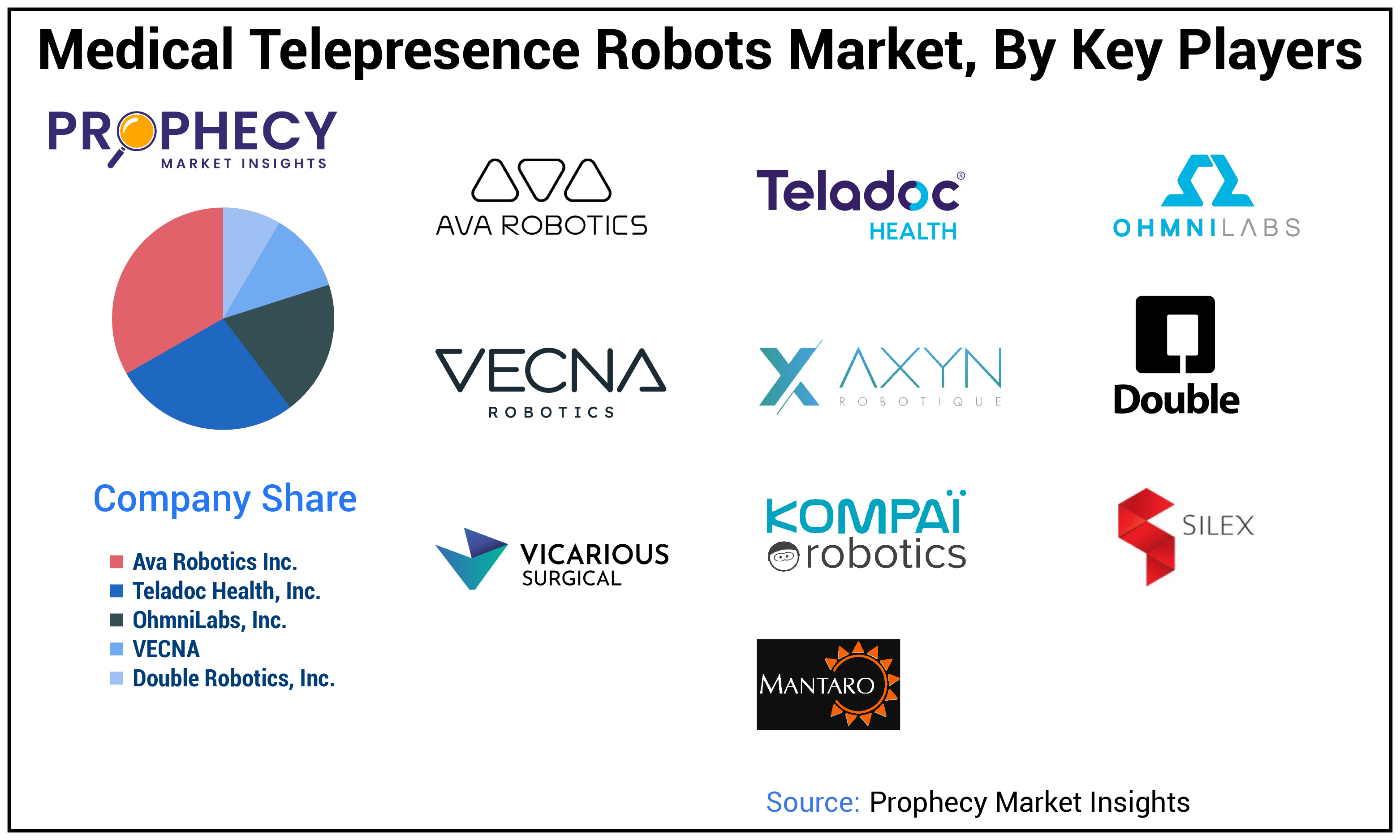
The key players operating in the medical telepresence robots market include, Teladoc Health, Inc., AXYN Robotique, VECNA, and others. Key expansion initiatives include investing in AI and robotics R&D, developing hospital collaborations, entering foreign markets, improving software, and assuring regulatory compliance and cybersecurity.
Medical Telepresence Robots Market Companies:
- Ava Robotics Inc.
- Teladoc Health, Inc.
- OhmniLabs, Inc.
- VECNA
- Double Robotics, Inc.
- VGo Communications, Inc.
- AXYN Robotique
- Vicarious Surgical
- SilexPro
- Kompaï Robotics
- Xaxxon
- Mantaro
- Intuitive Surgical Operations, Inc.
View an Additional List of Companies in the Medical Telepresence Robots Market
Medical Telepresence Robots Market Recent News
- In July 2024, Teladoc Health has received a patent for a telepresence robot with social behavior characteristics. The robot can recognize humans, decide whether they are in an emergency, and change its distance appropriately. This idea attempts to improve human-robot interactions in a variety of work contexts.
- In August 2024, VSee Health, Inc., a provider of comprehensive telehealth services that customize workflow streams and improve patient care, and Ava Robotics, a developer of intelligent robots for the workplace, today announced a collaboration to develop telepresence solutions for the inpatient intensive care market, including the creation of a VSee-powered Ava robot that enables providers to extend their reach and provide personalized care remotely.
Analyst View:
Medical telepresence robots, which are outfitted with cameras, microphones, and screens, allow doctors to interact with patients virtually, providing advantages such as improved access to healthcare in remote areas, faster consultations, lower travel costs, better monitoring, and increased collaboration among providers. Their market is expanding due to increased telemedicine use, need for remote healthcare, improvements in robots and AI, healthcare personnel shortages, and the necessity for real-time patient care in underdeveloped areas.
Analysis of Sources:
Primary Sources:
- In-depth interviews
- Company-specific data
- Surveys and questionnaires
- Focus group discussions (FGDs)
- Others
Secondary Sources:
- European Commission
- World Health Organization
- National Institutes of Health
- Others
More Related Reports
Surgical Robots Market
Medical Writing Market
AI in Medical Diagnostics Market
Medical Equipment Financing Market
Medical Imaging Information System Market
Medical Telepresence Robots Market Company Profile
|
Company Name |
Product Portfolio |
|
Ava Robotics Inc. |
Ava Telepresence Robots |
|
OhmniLabs, Inc. |
Telepresence Robot |
|
Double Robotics, Inc.. |
Telepresence Robot |
|
VGo Communications, Inc. |
Robotic Telepresence for Healthcare |
|
AXYN Robotique |
Telepresence Robot |
Medical Telepresence Robots Market Highlights
FAQs
Medical telepresence robots market size was valued at USD 93.8 Million in 2025 and is expected to reach USD 465.3 Million by 2035 growing at a CAGR of 19.2%.
Component, product type, control mechanism, application, end user, and region are the segmentation for the medical telepresence robots market.
An aging population and rising chronic diseases, necessitating remote care solutions, and the COVID-19 pandemic accelerated, and so on are some of the medical telepresence robots market growth drivers.
North America, Asia Pacific, Europe, Latin America, and the Middle East & Africa. North America is expected to dominate the medical telepresence robots Market.
Generative AI improves medical telepresence robots by allowing for smarter patient interactions, real-time diagnostic assistance, individualized treatment recommendations, and better decision-making, boosting the efficiency, accuracy, and accessibility of remote healthcare services.
The key players operating the medical telepresence robots market include Ava Robotics Inc., Teladoc Health, Inc., OhmniLabs, Inc., VECNA, Double Robotics, Inc., VGo Communications, Inc., AXYN Robotique, Vicarious Surgical, SilexPro, Kompaï Robotics, Xaxxon, Mantaro, and Intuitive Surgical Operations, Inc.