Ligases Enzyme Market Overview
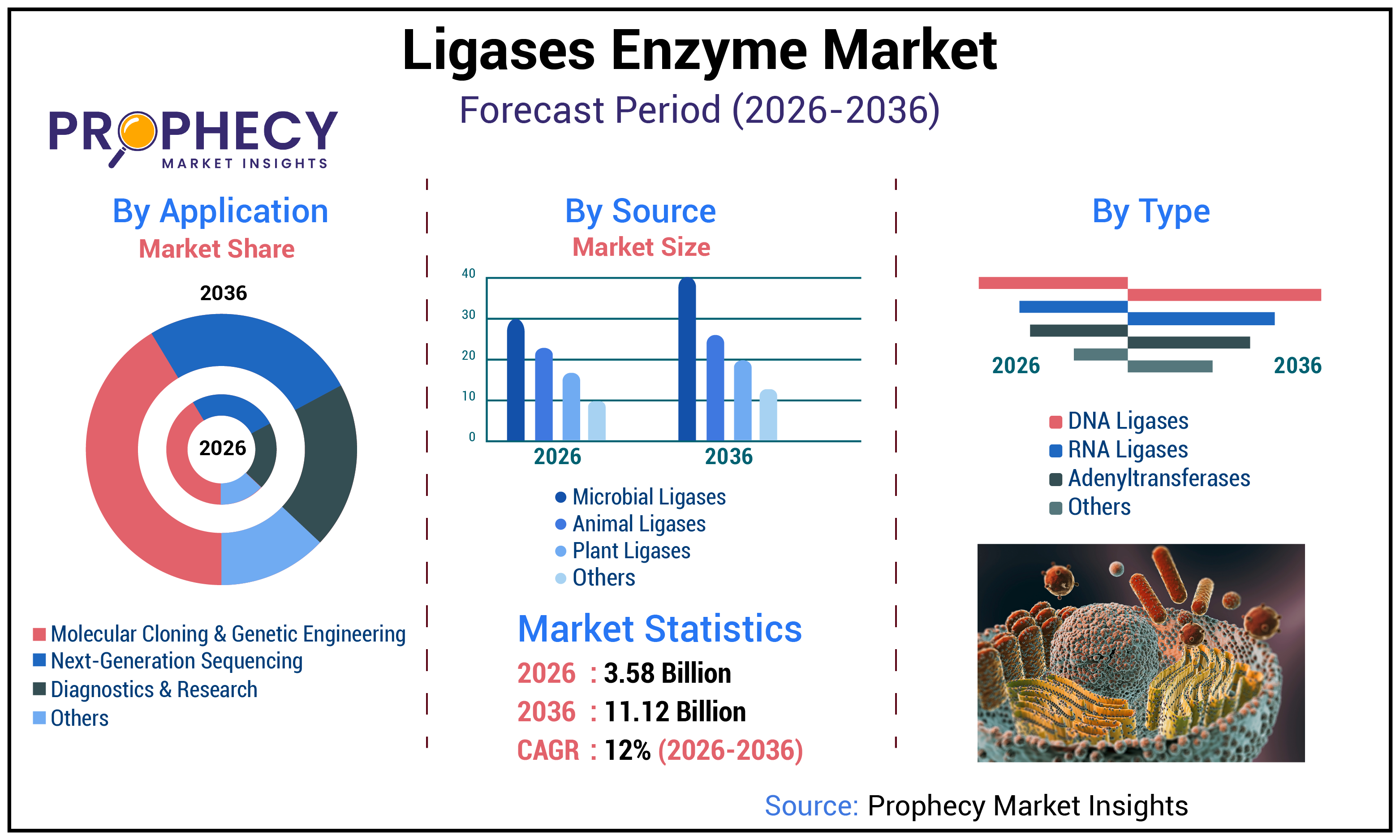
- 2025 Market Size: USD 3.20 Billion
- 2036 Projected Market Size: USD 11.12 Billion
- CAGR (2026-2036): 12%
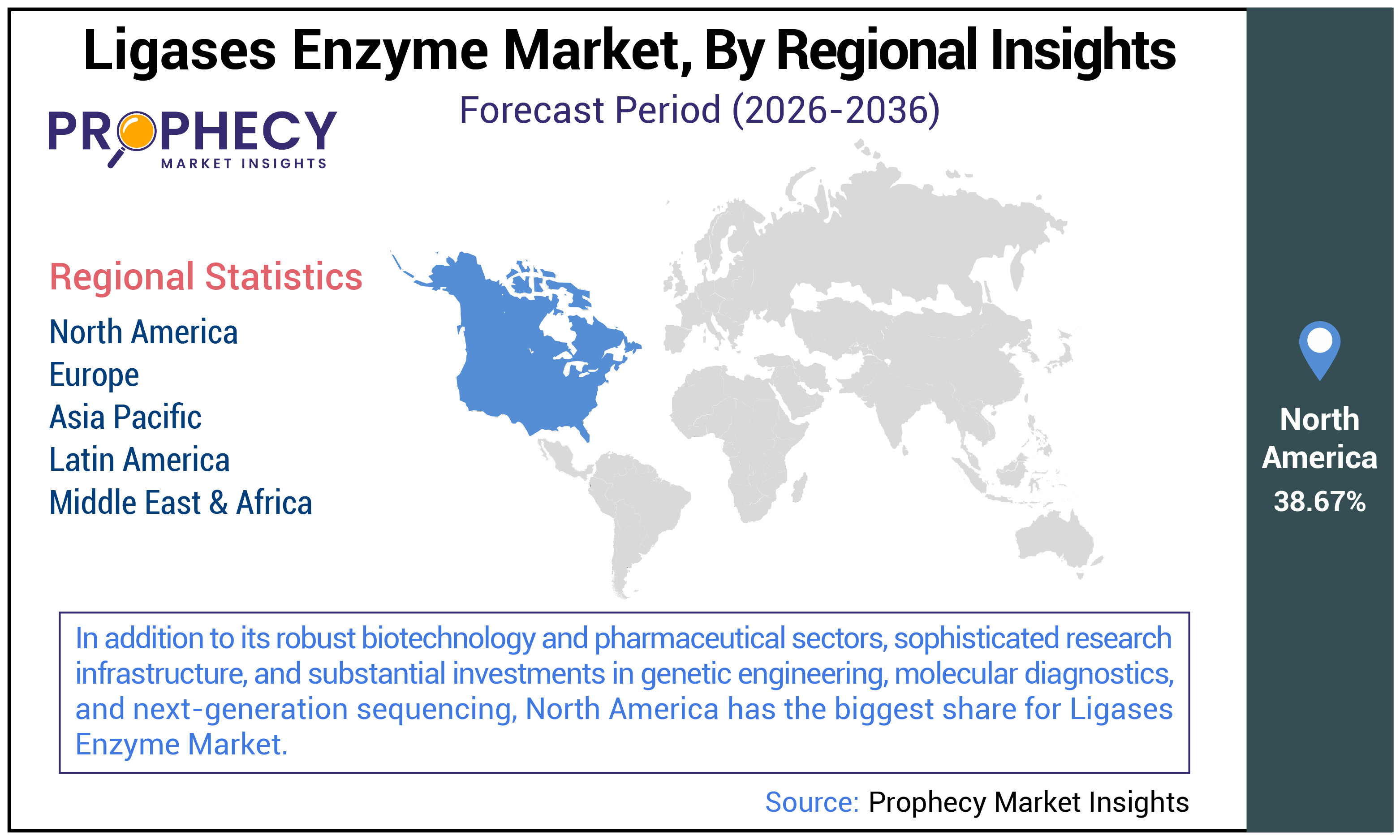
- North America: Largest Market in 2025
Ligases are biological catalysts that facilitate the union of two molecules through the creation of a new chemical bond, generally aided by ATP energy. In the case of biotechnological applications, the use of ligases, particularly DNA ligases, is a must for connecting the DNA fragments that are a part of the genetic engineering, cloning, and sequencing experiments.
The first and foremost advantages of these enzymes are the following: they make possible accurate DNA repair and recombination, increase the genetic manipulation's performance, help the progress of research in molecular biology and diagnostics, and pave the way for the development of new drugs, agricultural products, and industrial biotechnology.
Ligases enzyme market expansion is majorly influenced by their rising demand in genetic engineering, molecular diagnostics, and next-generation sequencing (NGS) applications. The market is getting fueled by the increased spending in biotechnological and pharmaceutical-based research and the progression of gene therapy and synthetic biology besides the above applications.
Besides that, the increased use of ligases in precision medicine, DNA repair studies, and agricultural biotechnology, which, in turn, attracts more users, is also a significant factor behind the market growth. At the same time, innovations in enzyme engineering help improve performance and availability in the commercial sector.
Evaluation of Ligases Enzyme:
- A evaluation of ligase enzymes centers on the efficiency, specificity, stability, and compatibility of the enzymes in different biochemical and industrial applications.
- Their performance is measured in terms of their catalytic ability for molecular bonding to be precise, especially in the case of DNA or RNA ligation.
- Fast reaction rates, almost error-free operations, and stability under various temperature and pH conditions are characteristics of high-performance ligases.
- More than ever, the quality, yield, and affordability of ligases have been significantly improved through recombinant technology, thus making them indispensable instruments in genetic engineering, molecular diagnostics, and drug development.
Current Industry Dynamics & Insights:
- North America has the largest regional share in the market, with almost 38.67%.
- Europe is second dominating region in the market.
- By type, DNA ligases dominate the ligases enzyme market share.
Ligases Enzyme Market Drivers & Restraints
Drivers and Restraints:
|
Drivers |
Restraints |
Opportunities & Trends |
|
|
|
Key Drivers:
Prevalence of Genetic Disorders
The increasing occurrence of genetic disorders is one of the major reasons that the ligases enzyme market is expanding. It is a situation that calls for in-depth genetic research, diagnostic, and therapy development. Ligases are indispensable units in DNA repair, sequencing, and gene editing to recognize and rectify genetic abnormalities.
As the emphasis of healthcare and research shifts to the study of hereditary diseases, use of bio enzymes in diagnostics, precision medicine, and gene therapy has gone up markedly which turned out to be market growth.
- For instance, according to the data published by Genehome, There are an estimated 10,000 different types of single-gene diseases (also called monogenic diseases), which are diseases caused by mutations in a single gene. 10 out of every 1000 people are affected. This means that between 70 million and 80 million people in the world are living with one of these diseases.
Restraints:
Regulatory Hurdles for Biotech and Enzyme-Based Products
Regulatory obstacles for biotech and enzyme-based products have the potential to slow down market expansion through the postponement of product approvals, a rise in development costs, and limitations in global commercialization. High safety, quality, and environmental standards set tight constraints around the speed at which companies can launch new ligase enzymes.
- Counterbalance Statements: Companies have the option to hire a clear regulatory strategy, to invest in compliance testing at an early stage and to collaborate with the regulatory authorities for the facilitation of the approval process in order to get rid of these obstacles. They can also shorten the waiting period and open more markets by improving their documentation, quality assurance, and acquiring global certifications.
Opportunities & Trends:
Growing Investments in Enzyme-Based Drug Development
One of the foremost future trends of the ligases enzyme market is the ramping up of investments in enzyme-based drug development. Enzymes offer high specificity and efficiency to the biochemical reactions, which make them the best agents for targeted therapies. Correspondingly, ligases are the closest ones being tested to discover their eventual use in gene repair, molecular diagnostics, and biopharmaceutical production.
The rise in investment by pharmaceutical companies and research organizations is the major factor that keeps the innovation in enzyme engineering, stability improvement, and bulk production going thus, new therapeutic applications are being unfolded and the total market volume is getting increased.
Ligases Enzyme Market Segmentations & Regional Insights
Type, source, application, end user, and region are the divisions of the ligases enzyme market.
By Type:
DNA ligases, RNA ligases, adenyltransferases, and others are type on which ligases enzyme market is segmented. In recognition of their crucial involvement in DNA replication, repair, and molecular cloning processes that are fundamental to genetic engineering, next-generation sequencing (NGS), and biotechnology research DNA ligases have the biggest ligases enzyme market share.
Due to their increasing application in RNA sequencing, RNA modification research, and the developing field of RNA-based therapies and diagnostics, RNA ligases constitute the second-dominant category.
By Source:
Based on the source, the ligases enzyme market is divided into microbial ligases, animal ligases, plant ligases, and others. With respect to their ease of production, affordability, and ability to be genetically engineered for high yield and stability, microbial ligases have the biggest ligases enzyme market share. This makes them perfect for large-scale commercial and research applications.
The second-largest group is animal ligases, which are mostly employed in therapeutic and biomedical research as their biological significance and efficiency in intricate cellular and molecular processes.
By Application:
The ligases enzyme market is categorized into molecular cloning and genetic engineering, next-generation sequencing, diagnostics and research, and others on the account of application. Considering ligases are essential tools for linking DNA fragments, creating recombinant DNA, and facilitating gene manipulation all essential tasks in biotechnology and pharmaceutical research molecular cloning and genetic engineering have the most market share in the ligases enzyme market.
Due to its growing use in genomics, precision medicine, and disease diagnostics where ligases are essential for library preparation and adapter ligation procedures next-generation sequencing (NGS) is the second most popular application.
By End User:
The ligases enzyme market on the account of end user is categorized biotechnology companies, pharmaceutical and biopharma companies, academic and research institutes, and others. Due to the fact that they are the main users of ligases for applications including genetic engineering, molecular cloning, and sequencing all of which are essential to creating new biotechnological goods and innovations biotechnology businesses have the most ligase enzyme market share.
The second-dominant sector is made up of pharmaceutical and biopharmaceutical businesses, which are increasingly using ligases in drug discovery, gene therapy, and biologics research to produce effective and focused therapeutic solutions.
Regional Insights:
Geographically, the ligases enzyme market is studied across North America, Europe, Asia Pacific, Latin America, and the Middle East & Africa.
North America: In addition to its robust biotechnology and pharmaceutical sectors, sophisticated research infrastructure, and substantial investments in genetic engineering, molecular diagnostics, and next-generation sequencing, North America has the biggest share for ligases enzyme market.
- U.S. Ligases Enzyme Market Insights:
Due to its highly developed biotechnology and pharmaceutical sectors, substantial support for genomic research, and the presence of major market players involved in enzyme manufacture and innovation, the U.S. leads the North American ligase enzyme market.
Europe: Driven by growing genomic research projects, rising enzyme-based technology use, and advantageous regulatory frameworks encouraging innovation in life sciences and medicinal development, Europe is the second-dominant market.
- Germany Ligases Enzyme Market Insights:
Between its robust biopharmaceutical sector, sophisticated research infrastructure, and growing investments in molecular biology, genetic engineering, and enzyme-based applications, Germany leads the European market. Both nations gain from strong academic partnerships and government programs that support technology innovation and advances in life science.
Asia Pacific: This region ligase enzymes market share is expanding quickly as a result of growing biotechnology research, increased investments in pharmaceutical manufacturing, and growing use of genetic engineering and molecular diagnostics.
- China Ligases Enzyme Market Insights:
Due to its extensive genomic research programs, robust biotechnology infrastructure, and substantial funding for the development of enzyme-based drugs and diagnostics, China leads the APAC market. Japan and India, which are making significant strides in molecular biology and healthcare biotechnology, are closely behind.
Ligases Enzyme Market Report Scope:
|
Attribute |
Details |
|
Market Size 2026 |
USD 3.58 Billion |
|
Projected Market Size 2036 |
USD 11.12 Billion |
|
CAGR Growth Rate |
12% (2026-2036) |
|
Base year for estimation |
2025 |
|
Forecast period |
2026 – 2036 |
|
Market representation |
Revenue in USD Billion & CAGR from 2026 to 2036 |
|
Regional scope |
North America - U.S. and Canada Europe – Germany, U.K., France, Russia, Italy, Spain, Netherlands, and Rest of Europe Asia Pacific – China, India, Japan, Australia, Indonesia, Malaysia, South Korea, and Rest of Asia-Pacific Latin America - Brazil, Mexico, Argentina, and Rest of Latin America Middle East & Africa – GCC, Israel, South Africa, and Rest of Middle East & Africa |
|
Company Landscape |
Market Share Analysis of Companies Heat Map Analysis Company Overview, Products Overview Financial Information, Key Highlights Business Strategies Overview SWOT Analysis |
|
Report coverage |
Revenue forecast, company share, competitive landscape, growth factors, and trends |
|
Value Added Data Infosets |
Besides fundamental market insights such as the size of the market, growth rate, segmentation, regional study, and key players, our reports carry value-added data sets such as trade flow (import-export) analysis, production and consumption overview, price trend evaluation, supply and value chain mapping, and raw material availability. Moreover, we provide strategic tools as PESTLE and Porter’s Five Forces analysis, examination of the regulatory landscape, as well as monitoring of technology and innovation thereby providing a comprehensive overview which facilitates sensible and anticipatory decision-making. |
Segmentation:
By Type:
- DNA Ligases
- RNA Ligases
- Adenyltransferases
- Others
By Source:
- Microbial Ligases
- Animal Ligases
- Plant Ligases
- Others
By Application:
- Molecular Cloning and Genetic Engineering
- Next-Generation Sequencing
- Diagnostics and Research
- Others
By End User:
- Biotechnology Companies
- Pharmaceutical and Biopharma Companies
- Academic and Research Institutes
- Others
By Region:
- North America
- U.S.
- Canada
- Europe
- Germany
- U.K.
- France
- Russia
- Italy
- Spain
- Netherlands
- Rest of Europe
- Asia Pacific
- China
- India
- Japan
- Australia
- Indonesia
- Malaysia
- South Korea
- Rest of Asia Pacific
- Latin America
- Brazil
- Mexico
- Argentina
- Rest of Latin America
- Middle East & Africa
- GCC
- Israel
- South Africa
- Rest of Middle East & Africa
Ligases Enzyme Market Competitive Landscape & Key Players
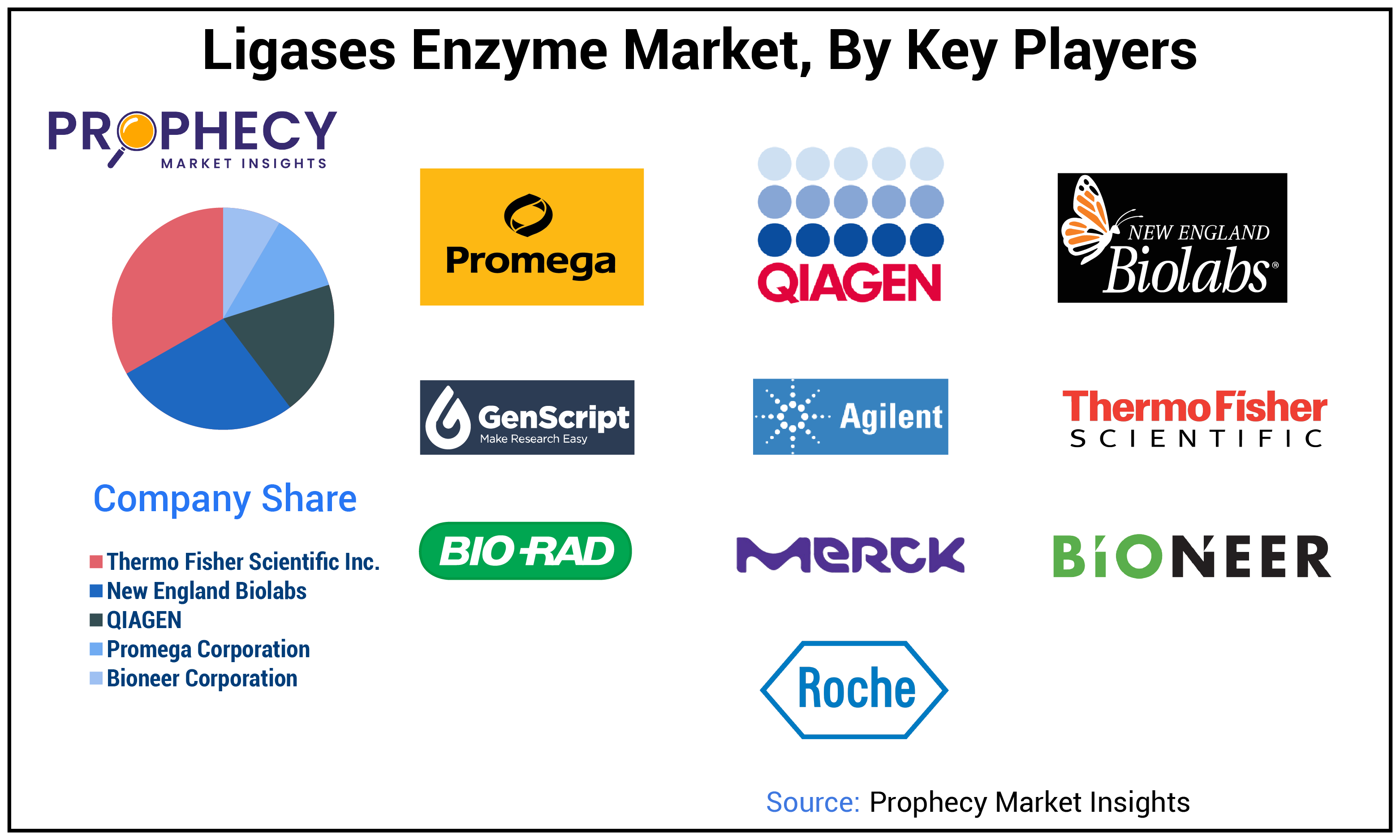
Investing in research and development to produce more effective, stable, and affordable enzyme versions through recombinant and protein engineering technologies is one of the main growth strategies for ligase enzyme firms. In order to broaden their application areas in genomics, diagnostics, and therapies, companies are also concentrating on strategic partnerships with biotech and pharmaceutical companies.
Ligases Enzyme Market Companies:
- Thermo Fisher Scientific Inc.
- New England Biolabs
- QIAGEN
- Promega Corporation
- Bioneer Corporation
- GenScript
- Agilent Technologies Inc.
- Merck KGaA
- Fortis Life Sciences, LLC
- F. Hoffmann-La Roche Ltd
- Bio-Rad Laboratories, Inc.
- ArcticZymes Technologies
- Creative Enzymes
- GenScript
- Jena Bioscience GmbH
View an Additional List of Companies in the Ligases Enzyme Market
Ligases Enzyme Market Recent News
- In October 2025, T4 DNA Ligase, a new recombinant enzyme from Cocoon Bioscience, is very effective, highly pure, and more than 60% less expensive than comparable products on the market. This is the most recent addition to our growing array of enzymes, all of which were created with the help of our CrisBio platform, a special expression method that turns insect chrysalises into organic bioreactors.
Analyst View:
Ligases are crucial enzymes for genetic engineering, cloning, and sequencing because they use ATP energy to catalyze the joining of molecules, especially DNA fragments. Their significance in biotechnology stems from their capacity to facilitate accurate DNA repair, improve genetic manipulation, and support molecular biology and diagnostics.
Growing demand in genetic engineering, molecular diagnostics, and next-generation sequencing, as well as increased investments in biopharma research, gene therapy, and synthetic biology, as well as advancements in enzyme engineering that improve performance and commercial use, are driving the market for ligases enzymes.
Analysis of Sources:
Primary Sources:
- In-depth interviews
- Company-specific data
- Surveys and questionnaires
- Focus group discussions (FGDs)
- Others
Secondary Sources:
- European Food Safety Authority (EFSA)
- European Commission
- U.S. National Institutes of Health (NIH)
- Others
More Related Reports
Food Enzyme Market
Enzyme Replacement Therapy Market
Enzyme Linked Immunosorbent Assay (ELISA) Market
Enzymes Market
Enzyme Replacement Therapy Market
Ligases Enzyme Market Company Profile
|
Company Name |
Product Portfolio |
|
Thermo Fisher Scientific Inc. |
DNA Ligase |
|
New England Biolabs |
DNA Ligase |
|
QIAGEN |
High-Efficiency Enzymes for DNA Ligation |
|
Promega Corporation |
Molecular Biology Enzymes |
|
Takara Bio Inc. |
Ligation Enzymes |
Ligases Enzyme Market Highlights
FAQs
Ligases enzyme market size was valued at USD 3.58 Billion in 2026 and is expected to reach USD 11.12 Billion by 2036 growing at a CAGR of 12%.
Type, source, application, end user, and region are the segmentation for the ligases enzyme market.
Increasing use of genomics, genetic engineering, and synthetic biology for applications as personalized medicine and gene therapy, and so on are some of the ligases enzyme market growth drivers.
North America, Asia Pacific, Europe, Latin America, and the Middle East & Africa. North America is expected to dominate the ligases enzyme market.
The key players operating the ligases enzyme market include Thermo Fisher Scientific Inc., New England Biolabs, QIAGEN, Promega Corporation, Bioneer Corporation, GenScript, Agilent Technologies Inc., Merck KGaA, F. Hoffmann-La Roche Ltd, Bio-Rad Laboratories, Inc., ArcticZymes Technologies, Creative Enzymes, GenScript, and Jena Bioscience GmbH.