Laboratory Consumables Market Overview
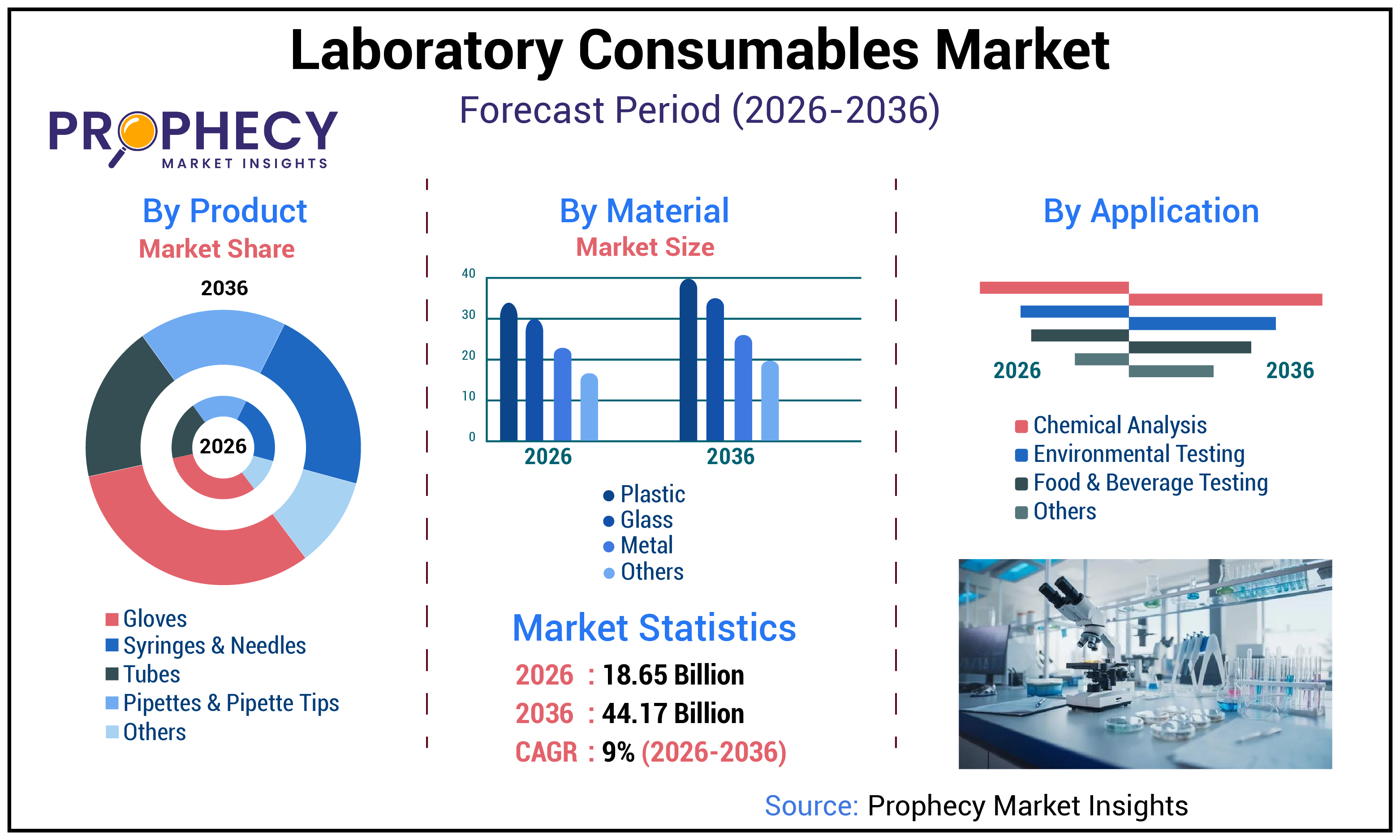
- 2025 Market Size: USD 17.11 Billion
- 2036 Projected Market Size: USD 44.17 Billion
- CAGR (2026-2036): 9%
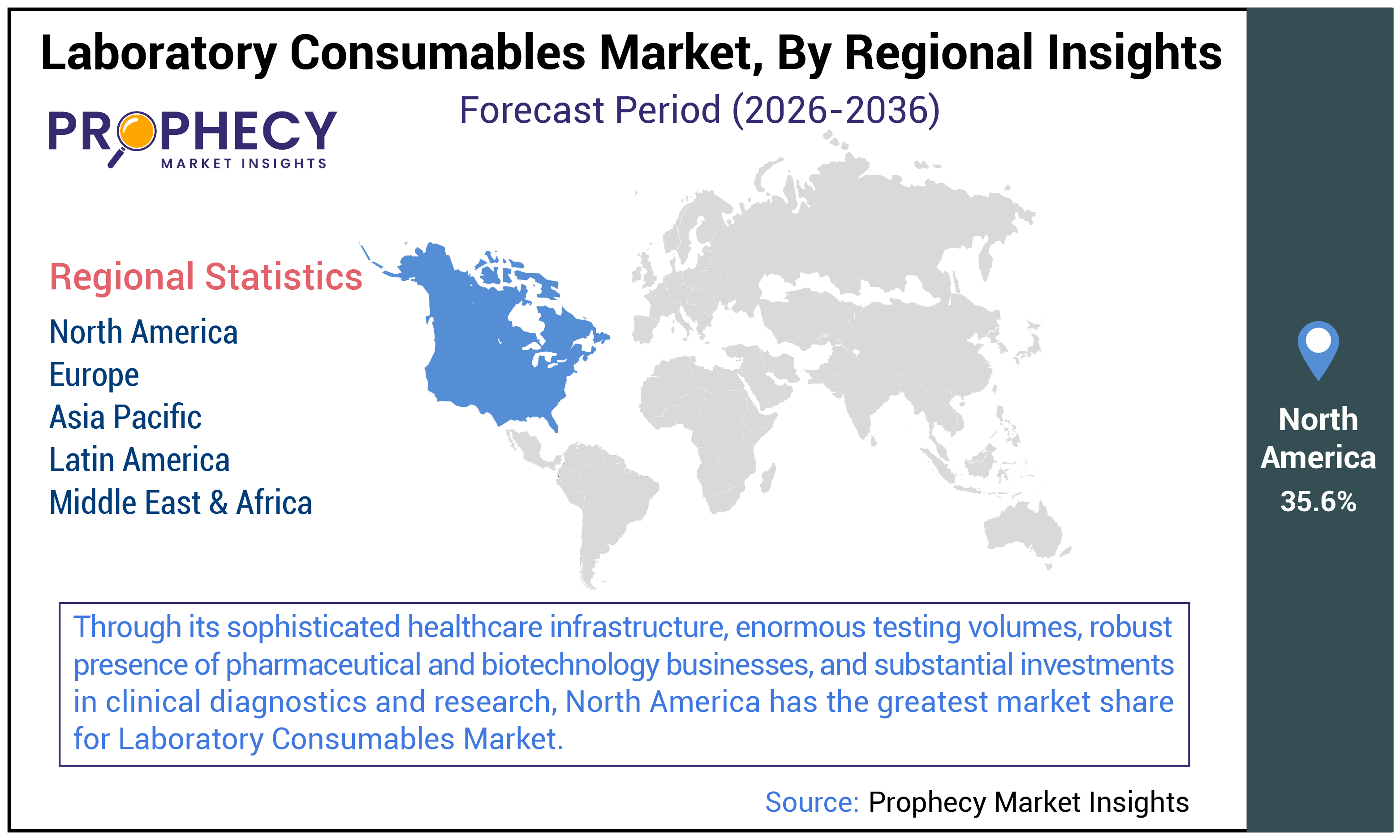
- North America: Largest Market in 2025
Laboratory consumables are the disposable or semi-disposable items that are typically used in labs during routine experiments, sample handling, storage, and analysis. Examples of such products include gloves, syringes, pipette tips, tubes, vials, filters, petri dishes, and slides. These products are necessary as they prevent contamination during testing, facilitate the accuracy and reliability of the results, ensure safety and hygiene, minimize the risks of cross-contamination, and enhance the efficiency of the workflow by enabling fast and easy replacement in the middle of laboratory operations.
The need for high-quality disposable items that ensure accuracy and contamination-free workflows is the major factor that fuels the growth of the Laboratory Consumables market. This is due to an increase in the volume of clinical diagnostics, pharmaceutical R&D, and biotechnology research globally. Besides that, the market is being propelled to a steady expansion by factors such as the increasing healthcare infrastructure, the rise in disease testing, the advancements in the life sciences sector, and the transition to single-use products for enhanced safety and mobility.
Technical Specifications of Laboratory Consumables:
- Consumables used in laboratories usually incorporate technical features in their specification such as resistance to chemicals, compatibility with sterilization (gamma irradiation, autoclave, or ethylene oxide), and materials specially made for purity most often polypropylene, polyethylene, borosilicate glass, or medical-grade plastics.
- They are made with very close dimensional tolerances to assure that they are leak-proof, tightly sealing, and can be used together with a large variety of laboratory instruments.
- A lot of consumables conform to ISO and ASTM standards, provide RNase/DNase-free and pyrogen-free options for molecular biology, and have clear graduation markings, temperature tolerance intervals, and ergonomically optimized designs for the performance of both simple and complex laboratory processes.
Current Industry Dynamics & Insights:
- North America has the largest regional share in the market, with almost 35.6%.
- Europe is second dominating region in the market.
- By product type, gloves dominate the laboratory consumables market growth.
Laboratory Consumables Market Drivers & Restraints
Drivers and Restraints:
|
Drivers |
Restraints |
Opportunities & Trends |
|
|
|
Key Drivers:
Higher Testing Volumes due to Aging Population and Chronic Diseases
The increasing number of tests due to an aging population and the rise of chronic diseases is a major factor that materially elevates the demand for laboratory consumables as a result of old adults who normally require frequent diagnostic tests, monitoring, and disease management assessments. In fact, diseases such as diabetes, cardiovascular diseases, cancer, and immune disorders require continuous laboratory analysis, thereby, pushing the demand for consumables as tubes, vials, reagents, pipette tips, and collection devices to grow further.
As healthcare systems broaden their diagnostic capabilities to handle the increasing number of patients, laboratories are turning to more single-use, sterile, and high-quality consumables thus, sustaining consistent market growth.
- For instance, according to the data published by WHO, by 2030, 1 in 6 people in the world will be aged 60 years or over. At this time the share of the population aged 60 years and over will increase from 1 billion in 2020 to 1.4 billion. By 2050, the world’s population of people aged 60 years and older wll double (2.1 billion). The number of persons aged 80 years or older is expected to triple between 2020 and 2050 to reach 426 million.
Restraints:
Quality Inconsistencies among Low-Cost Manufacturers
Quality variations of inexpensive biomedical consumables from low-cost manufacturers may hamper the growth of the market as unreliable or substandard consumables result in inaccurate test results, contamination risks, and workflow disruptions, thus laboratories lose trust in budget suppliers. These problems make customers choose expensive brands, thus small players get less market penetration and the total pace of regional adoption, where income is low, decreases.
- Counterbalance Statements: The remedy is to confirm tight quality control through worldwide quality standards such as ISO and ASTM, third-party certification, better sourcing of raw materials, and giving money to the automated part of production. Besides that, vendor auditing and open quality records can be good tools in performance stability which is a precondition for wider acceptance and stable market growth.
Opportunities & Trends:
Expansion of 3D Printing Technology for Customizable Labware
One of the significant future trends of the 3D printing technology expansion is the customizable labware that 3D printing allows laboratories to design and produce specialized consumables tailored to unique experiments or equipment needs, which traditional mass manufacturing cannot easily deliver. With this ability, laboratories can do rapid prototyping, small-batch production that is cost-efficient, and on-demand labware replacement, thus, they become less dependent on third-party suppliers and the lead times get minimized.
In addition, 3D printing enables the use of sophisticated, biocompatible materials and facilitates the innovation of complex geometries that can improve the accuracy of the experiments. As more people get involved in this, it will create a new level of flexibility, reduce the lab’s operating costs, and be a driving force behind the next-generation laboratory consumables.
Laboratory Consumables Market Segmentations & Regional Insights
Product type, material, application, end user, and region are the divisions of the laboratory consumables market.
By Product Type:
Gloves, syringes & needles, tubes, pipettes & pipette tips, and others are product type on which laboratory consumables market is segmented. Gloves have the most laboratory consumables market share since they are necessary for fundamental safety, contamination control, and adherence to hygienic laws in all laboratory environments, including clinical, research, pharmaceutical, and industrial. They are the most commonly purchased consumable due to their high rate of consumption, disposable nature, and requirement for use in the majority of operations.
In spite of their crucial function in sample collection, injections, and preparation in clinical diagnostics, hospitals, and biopharma labs, syringes and needles usually rank second. They have a dominant position after gloves as their ongoing use in laboratory operations, patient testing, and vaccine distribution, which guarantees strong, steady demand.
By Material:
Based on the material, the laboratory consumables market is divided into plastic, glass, metal, and others. As plastic is lightweight, affordable, chemically resistant, and suitable for high-volume manufacturing, it has the largest laboratory consumables market size. This makes it perfect for disposable items as tubes, pipette tips, vials, and petri dishes, which are essential to daily laboratory workflows. Adoption is further boosted by its compatibility with sterilizing techniques and the growing supply of medical-grade and molecular-grade polymers.
Glass is the second-largest category upon account of its exceptional chemical purity, heat resilience, and reusability, which make it crucial for high-precision research applications including microbiology, analytical chemistry, and high-temperature processes. Even if metal is utilized in specialized tools, its share is still lower than that of glass and plastic.
By Application:
The laboratory consumables market is categorized into chemical analysis, environmental testing, food & beverage testing, and others, on the account of application. Given that chemical analysis encompasses a wide range of industries, including pharmaceuticals, biotechnology, clinical diagnostics, and academic research, it has the largest laboratory consumables market share. This is due to the ongoing demand for consumables consisting of pipette tips, tubes, vials, and filters used in routine analytical procedures. It is the most consumable-intensive segment due to its extensive use in molecular biology, medication research, and quality control.
Supported by growing international rules on pollution monitoring, water quality assessment, and soil analysis all of which necessitate regular sample collection and processing environmental testing is the second-dominant area. Considering food and beverage testing is more specialized and has a smaller testing volume, it continues to expand steadily.
By End User:
The laboratory consumables market on the account of end user is categorized academic & research institutes, hospitals & diagnostic laboratories, contract research organizations (CROs), and others. Hospitals and diagnostic laboratories have the biggest laboratory consumables market share since they use consumables consisting of tubes, vials, syringes, gloves, and pipette tips continuously for high testing volumes for disease diagnosis, routine health checks, and chronic condition monitoring. Demand is further fueled by their sizable patient base and requirement for stringent sterility standards.
Due to the widespread use of consumables in experiments, molecular biology research, drug development investigations, and teaching labs, academic and research institutes come in second. Despite their rapid growth as a result of outsourced pharmaceutical R&D, CROs' overall market share is still lower than that of hospitals and academic institutions.
Regional Insights:
Geographically, the laboratory consumables market is studied across North America, Europe, Asia Pacific, Latin America, and the Middle East & Africa.
North America: Through its sophisticated healthcare infrastructure, enormous testing volumes, robust presence of pharmaceutical and biotechnology businesses, and substantial investments in clinical diagnostics and research, North America has the greatest market share for laboratory consumables market. Strict regulations that maintain the demand for sterile, high-quality consumables also benefit the area.
- U.S. Laboratory Consumables Market Insights:
Given that it has the largest network of hospitals, diagnostic labs, biotech companies, pharmaceutical companies, and research institutions in the world all of which contribute to exceptionally high testing volumes and ongoing demand for high-quality consumables the United States dominates the laboratory consumables market in North America. Its dominance is further reinforced by high R&D spending, cutting-edge lab technologies, and a sizable presence of top manufacturers.
Europe: Due to its established research facilities, increasing focus on environmental and food safety testing, and significant public and private funding for academic and life sciences research, Europe is the second-dominant area. Strong adoption of cutting-edge laboratory technology continues in both areas, propelling consistent market expansion.
- Germany Laboratory Consumables Market Insights:
Germany is the market leader in Europe owing to its robust biotechnology and pharmaceutical industries, sophisticated research infrastructure, and vast networks of academic and commercial laboratories. The nation is the leading donor in Europe as its emphasis on innovation, high standards of quality, and ongoing investment in life sciences research.
Asia Pacific: The increasing prevalence of chronic diseases, growing diagnostic testing volumes, expanding healthcare infrastructure, and significant investments in pharmaceutical and biotechnology research across major nations are all contributing factors to the APAC laboratory consumables market's rapid growth. Additionally, the area is seeing an increase in academic research, food safety monitoring, and environmental testing, all of which increase the consumption of consumables.
- China Laboratory Consumables Market Insights:
Due to its large population, which drives high diagnostic demand, significant government investments in healthcare and life sciences, the quick growth of hospitals and research facilities, and the increasing presence of both domestic and foreign manufacturers of laboratory supplies, China dominates the APAC market.
Laboratory Consumables Market Report Scope:
|
Attribute |
Details |
|
Market Size 2026 |
USD 18.65 Billion |
|
Projected Market Size 2036 |
USD 44.17 Billion |
|
CAGR Growth Rate |
9% (2026-2036) |
|
Base year for estimation |
2025 |
|
Forecast period |
2026 – 2036 |
|
Market representation |
Revenue in USD Billion & CAGR from 2026 to 2036 |
|
Regional scope |
North America - U.S. and Canada Europe – Germany, U.K., France, Russia, Italy, Spain, Netherlands, and Rest of Europe Asia Pacific – China, India, Japan, Australia, Indonesia, Malaysia, South Korea, and Rest of Asia-Pacific Latin America - Brazil, Mexico, Argentina, and Rest of Latin America Middle East & Africa – GCC, Israel, South Africa, and Rest of Middle East & Africa |
|
Company Landscape |
Market Share Analysis of Companies Heat Map Analysis Company Overview, Products Overview Financial Information, Key Highlights Business Strategies Overview SWOT Analysis |
|
Report coverage |
Revenue forecast, company share, competitive landscape, growth factors, and trends |
|
Value Added Data Infosets |
Fundamental market insights such as the size of the market, growth rate, segmentation, regional study, and key players, our reports carry value-added data sets such as trade flow (import-export) analysis, production and consumption overview, price trend evaluation, supply and value chain mapping, and raw material availability. Moreover, we provide strategic tools as PESTLE and Porter’s Five Forces analysis, examination of the regulatory landscape, as well as monitoring of technology and innovation thereby providing a comprehensive overview which facilitates sensible and anticipatory decision-making. |
Segmentation:
By Product Type:
- Gloves
- Syringes & Needles
- Tubes
- Pipettes & Pipette Tips
- Others
By Material:
- Plastic
- Glass
- Metal
- Others
By Application:
- Chemical Analysis
- Environmental Testing
- Food & Beverage Testing
- Others
By End User:
- Academic & Research Institutes
- Hospitals & Diagnostic Laboratories
- Contract Research Organizations (CROs)
- Others
By Region:
- North America
- U.S.
- Canada
- Europe
- Germany
- U.K.
- France
- Russia
- Italy
- Spain
- Netherlands
- Rest of Europe
- Asia Pacific
- China
- India
- Japan
- Australia
- Indonesia
- Malaysia
- South Korea
- Rest of Asia Pacific
- Latin America
- Brazil
- Mexico
- Argentina
- Rest of Latin America
- Middle East & Africa
- GCC
- Israel
- South Africa
- Rest of Middle East & Africa
Laboratory Consumables Market Competitive Landscape & Key Players
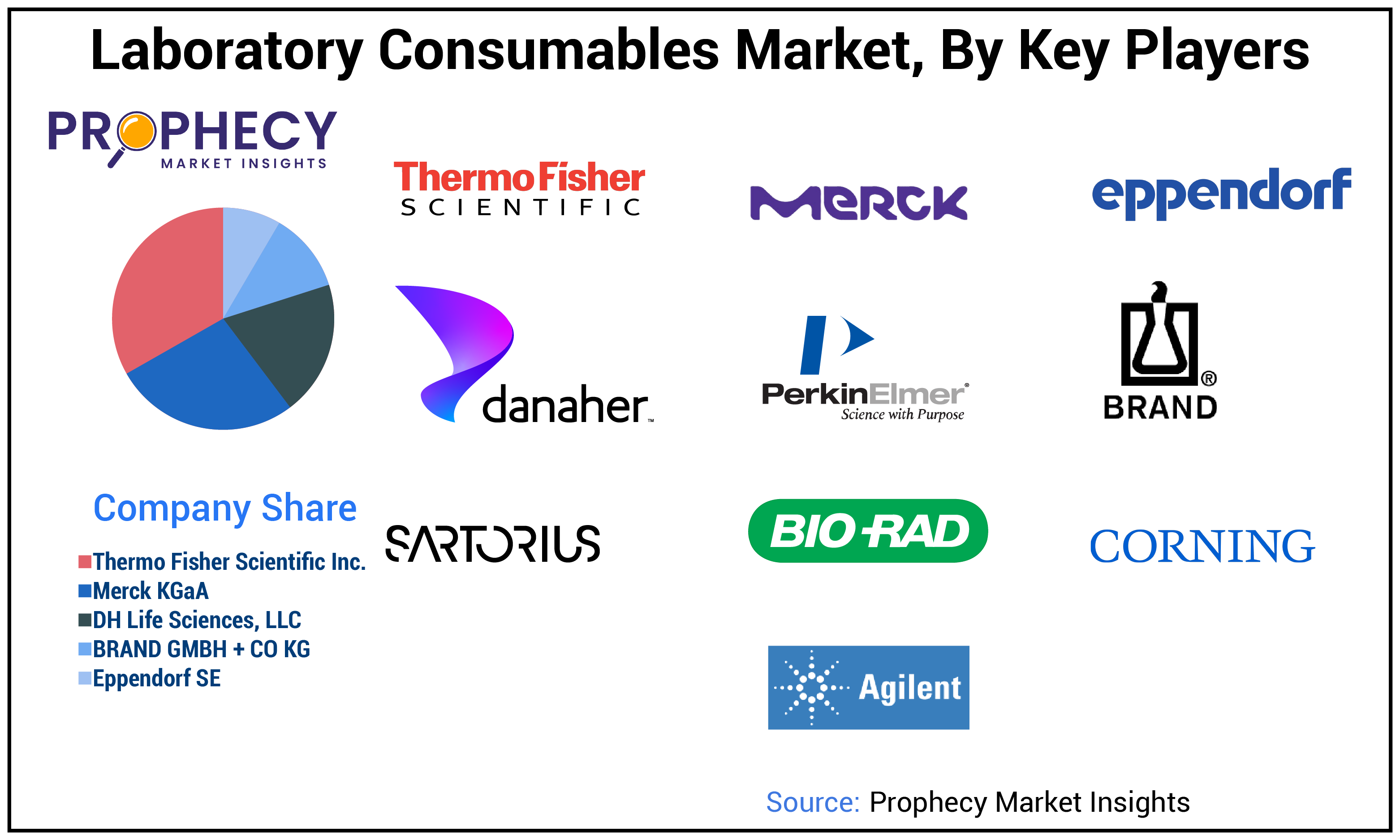
By creating high-purity, sterile, and customized consumables to satisfy changing laboratory requirements, laboratory consumables companies are concentrating on growth through product innovation. In order to diversify their product offerings, they are exploring mergers and acquisitions, growing geographically into emerging markets, and establishing strategic alliances with hospitals, CROs, and research centers for long-term supply and joint development.
Laboratory Consumables Market Companies:
- Thermo Fisher Scientific Inc.
- Merck KGaA
- DH Life Sciences, LLC
- BRAND GMBH + CO KG
- Eppendorf SE
- Corning Incorporated
- Sartorius AG
- Agilent Technologies, Inc.
- PerkinElmer
- Bio-Rad Laboratories, Inc.
- VWR International, LLC
- Greiner Bio-One International GmbH
- VITLAB GmbH
- Starlab International GmbH
View an Additional List of Companies in the Laboratory Consumables Market
Laboratory Consumables Market Recent News
- In July 2025, SATO Europe, a leading provider of auto-ID and labelling solutions, proudly announces the launch of its new European Technical Lab in France, dedicated to enhancing technical expertise and innovation within the consumables sector. This significant investment highlights SATO’s commitment to delivering unmatched quality and tailored solutions to its customers and partners. The newly established lab empowers SATO Europe's consumables division with greater autonomy, enabling swift identification and qualification of solutions tailored to specific customer requirements.
Analyst View:
Essential disposable or semi-disposable devices that guarantee safety, avoid contamination, and preserve precision in lab processes include gloves, syringes, pipette tips, and tubes. Growing clinical diagnostics, pharmaceutical and biotech research, growing healthcare infrastructure, rising illness testing, developments in life sciences, and the trend toward single-use goods are all factors driving the market and raising need for dependable, high-quality consumables.
Analysis of Sources:
Primary Sources:
- In-depth interviews
- Company-specific data
- Surveys and questionnaires
- Focus group discussions (FGDs)
- Others
Secondary Sources:
- Food and Agriculture Organization
- European Centre for Disease Prevention and Control (ECDC)
- European Medicines Agency (EMA)
- Eurostat
- Others
More Related Reports
Dental Consumables Market
Laboratory Accessories Market
Dental Laboratory Sealers Market
Laboratory Information Management System (LIMS) Market
Diabetes Laboratory Immunoassays Market
Laboratory Consumables Market Company Profile
|
Company Name |
Product Portfolio |
|
Thermo Fisher Scientific Inc. |
Laboratory Consumables Portfolio |
|
Eppendorf SE |
Lab Consumables |
|
Corning Incorporated |
Lab Essentials including Pipettes, Tubes, Dishes, Flasks, Plates, and Benchtop Equipment |
|
Agilent Technologies, Inc. |
Lab Consumables |
Laboratory Consumables Market Highlights
FAQs
Laboratory consumables market size was valued at USD 18.65 Billion in 2026 and is expected to reach USD 44.17 Billion by 2036 growing at a CAGR of 9%.
Product type, material, application, end user, and region are the segmentation for the laboratory consumables market.
The increased R&D investment in pharmaceuticals, biotechnology, and life sciences, alongside growing demand for advanced diagnostic tests and a greater emphasis on accuracy and precision in research, and so on are some of the laboratory consumables market growth drivers.
North America, Asia Pacific, Europe, Latin America, and the Middle East & Africa. North America is expected to dominate the laboratory consumables market.
The key players operating the laboratory consumables market include Thermo Fisher Scientific Inc., Merck KGaA, DH Life Sciences, LLC, BRAND GMBH + CO KG, Eppendorf SE, Corning Incorporated, Sartorius AG, Agilent Technologies, Inc., Bio-Rad Laboratories, Inc., VWR International, LLC, Greiner Bio-One International GmbH, VITLAB GmbH, and Starlab International GmbH