Industrial Ovens Market Overview
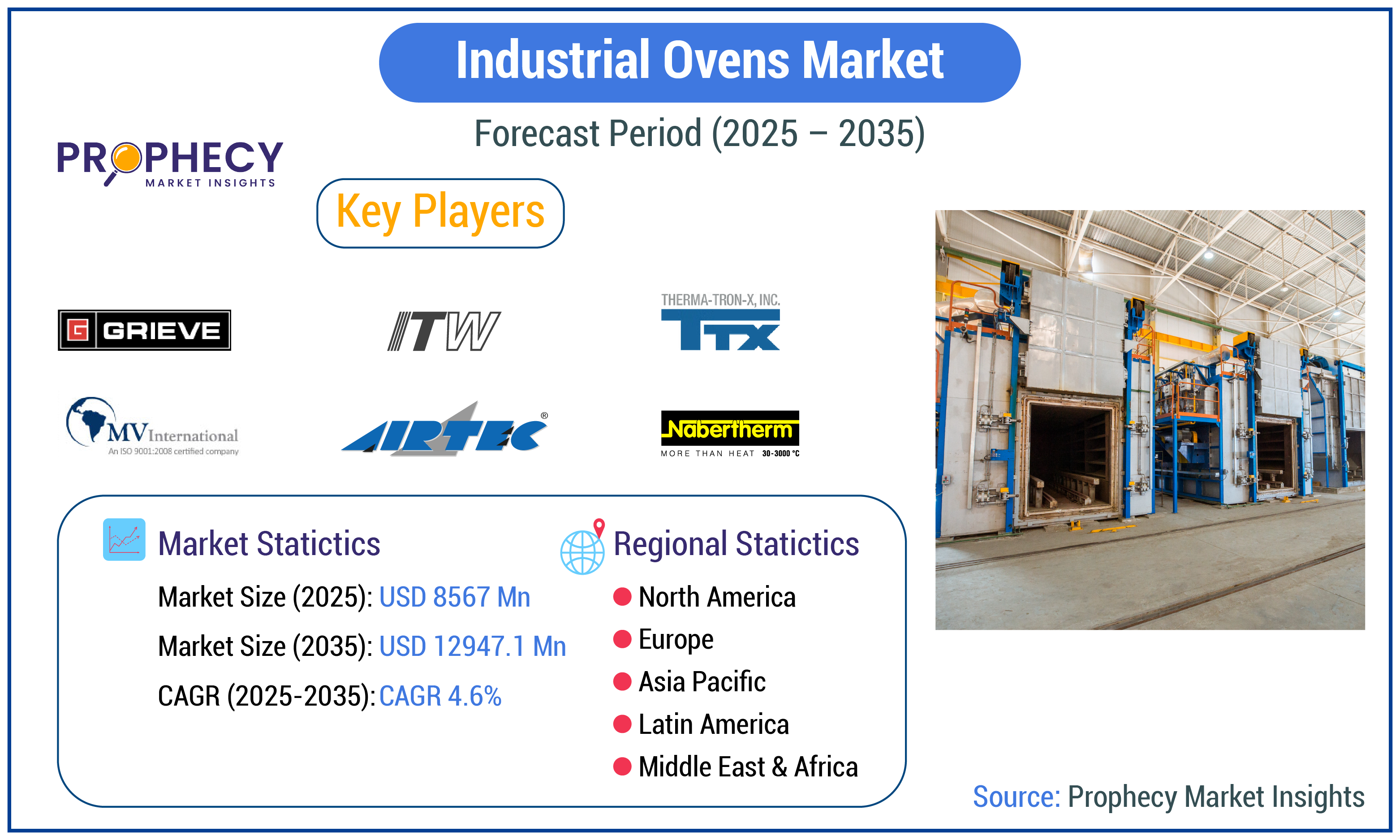
- By 2035, the industrial ovens market size is contemplated to enlarge at a valuation of USD 12947.1 Million.
- In 2024, the industrial ovens market valuation was USD 8250 Million.
- Industrial ovens market is developing at a CAGR of 4.6%.
Industrial ovens are heated spaces used for a number of industrial processes, such as baking, curing, or drying parts, components, or finished goods. Large or small volume applications, batch or continuous usage with a conveyor line, and a range of temperature ranges, sizes, and configurations are all possible with industrial ovens. Applications for these ovens are many and include food manufacturing, chemical processing, and even the electronics sector, where circuit boards are passed through a conveyor oven to affix surface-mount components.
The swift industrialization in industries consisting of automotive, aerospace, electronics, food processing, pharmaceuticals, and chemicals contributes to the industrial ovens market evolution for industrial ovens as they enable operations which need dependable and efficient thermal processing. Coupled with the development of automated production and IoT-enabled automation, innovations in technology which includes electric, infrared, and conveyor system integration enable improved energy efficiency, reduced interruptions, and cheaper costs. Energy-efficient versions with comprehensive soundproofing and management systems have grown increasingly widespread as a consequence of environmentally friendly requirements and increasing price tags on energy. Conveyor and walk-in ovens that have been optimized for speed, uniformity in behavior, and flexibility are in substantial demand on account of the increasing number of quick-service restaurants, commercial bakeries, and high-volume food processing; these elements all contribute to responsible for the industrial ovens market growth.
Trends which include the increasing adoption of intelligent, Internet of Things-enabled technologies for automation and real-time monitoring, and also an intense campaign for environmentally friendly and energy-effective develops, are expected to drive the industrial ovens market in the future. Conveyor and continuous-process ovens are set to become increasingly common in order to meet large quantities industrial demands, and the industrial ovens market is expected to expand primarily an outcome of the fast industrialization of areas including Asia-Pacific. In the years that follow, the industry will continue to grow consistently owing to modern innovations notably digital twins and industrial metaverse integration that will continue to enhance design and operational efficiency.
Recession Risk & Tariff Analysis:
- Recessions and tariffs provide immediate hazards to the industrial ovens market since they might decrease capital expenditures in important sectors and boost manufacturing facilities costs for essential components including steel and aluminum. These variables could influence revenue margins or lead infrastructure upgrades to need to be rescheduled.
- Yet companies are making adjustments by renegotiating supplier conditions and moving sourcing to areas with cheaper tariffs. Notwithstanding these obstacles, consistent demand from industries including electronics and food processing is anticipated to support the market's continued relative resilience.
Impact of Generative AI on Industrial Ovens Market:
- By facilitating quality control, predictive maintenance, and smarter design, generative AI is starting to gain traction in the industrial oven industry. Engineers can improve oven components, such insulation and heating elements, from the early digital twin stage with AI-driven generative design, which speeds up time to market and improves energy efficiency. AI-powered real-time monitoring reduces unscheduled downtime by automating maintenance and analyzing sensor data to detect part failure.
Industrial Ovens Market Drivers & Restraints
Key Drivers:
Rising Importance of Industrial Ovens to Food Industry to Propel Market Development
An essential component of the food sector are industrial ovens. They facilitate quicker and more effective meal preparation. Although industrial ovens cook food goods completely and uniformly, they can assist to improve their quality. This can guarantee food safety and help maintain nutrients. By swiftly and uniformly cooking huge amounts of food, industrial ovens can contribute to increased manufacturing efficiency. The production process may save time and money as a result. Industrial ovens can be tailored to meet specific needs or bought in advance. In light of this, the producers may choose what's best for them. Large batches of food, or even the same batch again, if necessary, can be processed in these ovens by food producers.
Restraints:
Energy Consumption Concern Could Affect Market Development
Due to the high operating costs and environmental effects of operating ovens at high temperatures for prolonged periods of time, energy consumption is a major problem in the market for industrial ovens, particularly in energy-intensive sectors such as metal treatment and food processing. Stricter pollution standards and growing energy costs make this problem worse.
- Counterbalance Statements: Energy-efficient ovens with improved insulation, heat recovery systems, and intelligent automation that optimizes temperature and cycle durations are being adopted by manufacturers in response to this issue. Making the switch to electric or hybrid heating systems and performing routine maintenance also contributes to cost savings, energy conservation, and environmental objectives.
Opportunities & Trends:
Sustainability Trend can Drive Growth of the Market in Future
Rising environmental concern and sustainability trend can drive the industrial oven market in the future. As one of the main advantages of industrial ovens is their outstanding effectiveness, which allows manufacturers to transform as much as 88 percent of their electrical power into radiant heat. Furthermore, compared to systems that rely on fossil fuels, these ovens have a negligible environmental impact since they employ an electric heat source that emits no pollutants and drastically lowers carbon dioxide emissions.
- For Instance, according to the data published by Totoweb, four waves of Glocalities surveys among 189,996 respondents from 20 countries between 2014 and 2019 reveal that the great majority of people worldwide is united by a rise of environmental concern. In 2014, 71% of people globally were worried about the damage that humans cause to the planet. This figure has risen steadily to 77% in 2019.
Industrial Ovens Market Segmentations & Regional Insights
Product, process, energy source, temperature range, application, end user, and region are the divisions of the Industrial Ovens Market.
By Product:
Curing oven, baking oven, drying oven, reflow oven, and others are type on which industrial ovens market is segmented. Due to their crucial function in curing coatings, adhesives, and composites especially in high-volume sectors including automotive, aerospace, and electronics curing ovens now possess the greatest industrial ovens market share in the industrial ovens market, making them the most popular product type worldwide.
Drying ovens, which are widely used in industries such pharmaceuticals, chemicals, ceramics, and food processing for moisture removal, sterilization, and temperature testing, are the second-most dominating category. These industries' growing demand has supported their steady expansion.
By Process:
Based on the process, the industrial ovens market is divided into batch, and continuous. The reason continuous industrial ovens possessed a substantial industrial ovens market share is due to the fact they are effective at managing high-volume, reliable production processes. This makes them perfect for sectors includes food processing, electronics, and automotive where automation, speed, and consistency are essential.
The second-dominant group is batch ovens, which are prized for their versatility in processing small-batch bespoke projects and a range of product sizes. Despite their lower total volume capacity, these ovens are appropriate for use in R&D labs, aerospace, and specialty manufacturing.
By Energy Source:
Electric, natural gas, infrared, and others are energy source of the industrial ovens market. Due to its energy economy, simplicity in controlling temperature, cleaner operation, and growing popularity in sectors including electronics, pharmaceuticals, and food processing where accuracy and contamination-free conditions are essential, electric industrial ovens are currently holding a significant industrial ovens market share.
Notwithstanding their greater emissions as compared to electric alternatives, natural gas ovens remain the second-dominant market and are especially preferred in heavy industries including metal processing and automotive since they are more affordable for large-scale, high-temperature activities.
By Temperature Range
On the temperature range, industrial ovens market is categorized into low-temperature ovens (3–6?°F), mid-range ovens (7–9?°F), and high-temperature ovens (10–12?°F). Due to their critical significance in heavy-duty applications including metal treatment, aerospace, and automotive sectors, where severe heat is needed for operations including annealing, sintering, and stress relief, high-temperature industrial ovens (10–12 °F) retain the biggest industrial ovens market share.
The second most popular category of ovens are mid-range models (7–9 °F), which provide a compromise between performance and energy consumption and are used extensively in sectors including plastics, electronics, and food processing where steady, regulated heating is required but high temperatures are not.
By Application:
Composite curing, adhesive & epoxy processing, sterilization / quality testing, polymer/plastic melting & molding, coating curing, and others are application of the industrial ovens market. Since long-lasting, superior surface finishes are crucial in the automotive, aerospace, and electronics sectors particularly with the growing use of powder coatings and sophisticated polymers coating curing has the greatest industrial ovens market share.
Although composite materials used in wind energy, lightweight constructions, and aircraft are growing at a rapid rate and require precise temperature cycles to maintain structural integrity, adhesive and epoxy processing, also known as composite curing, is now the second most popular application.
By End User:
The industrial ovens market on the account of end user are categorized into food & beverage, chemical & petroleum, electrical & electronics, automotive, aerospace, pharmaceutical, and others. Although commercial food manufacturing and processing facilities require equipment for baking, drying, roasting, and sterilization where speed, cleanliness, and uniformity are critical food and beverage is the largest end-user category in the industrial ovens market size.
The electrical and electronics industry, which is the second-largest segment, requires precisely controlled ovens for processes including solder reflow, component curing, and moisture removal in printed circuit boards and semiconductor manufacturing. As a result, oven adoption for quality-sensitive electronics processes has increased significantly.
Regional Insights:
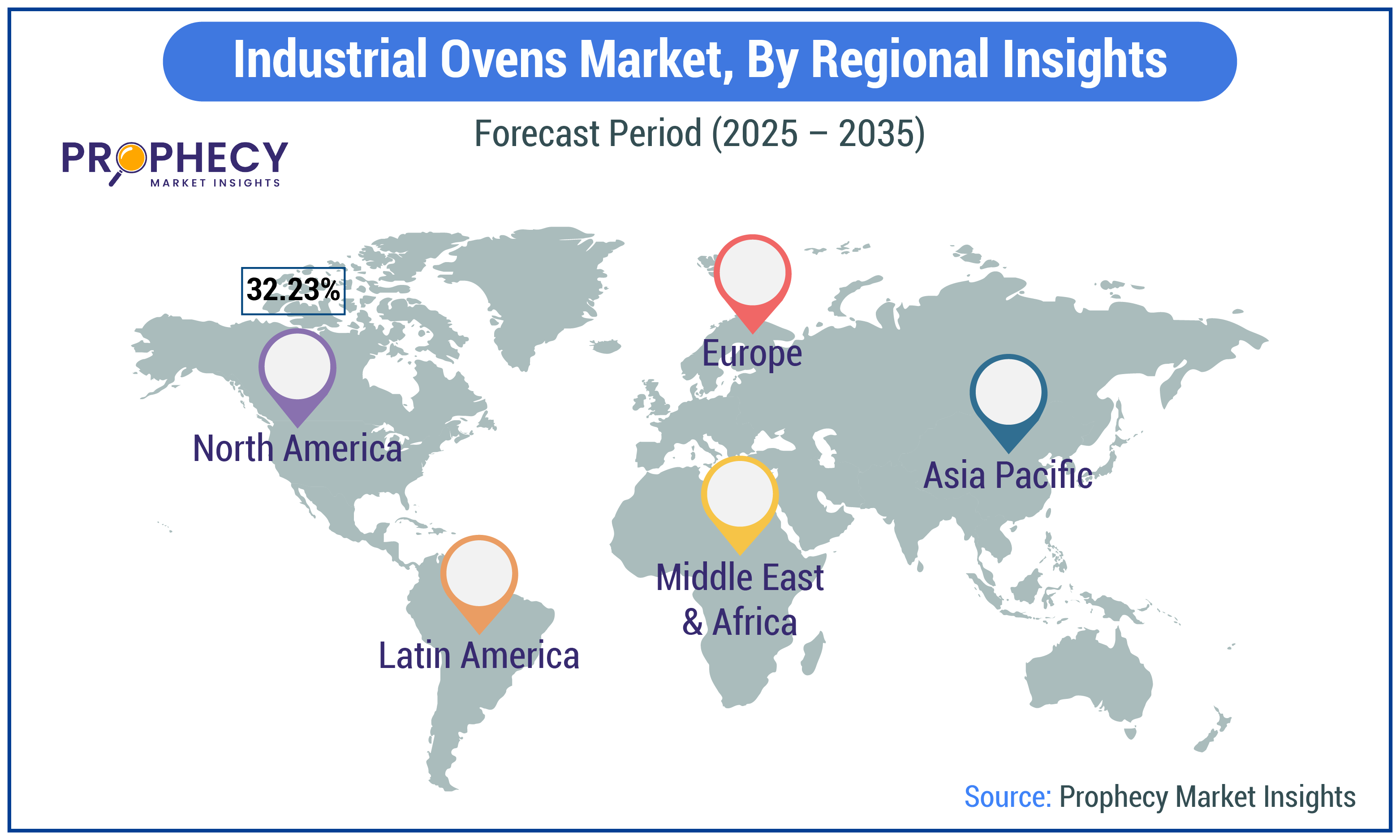
Geographically, the industrial ovens market is studied across North America, Europe, Asia Pacific, Latin America, and the Middle East & Africa.
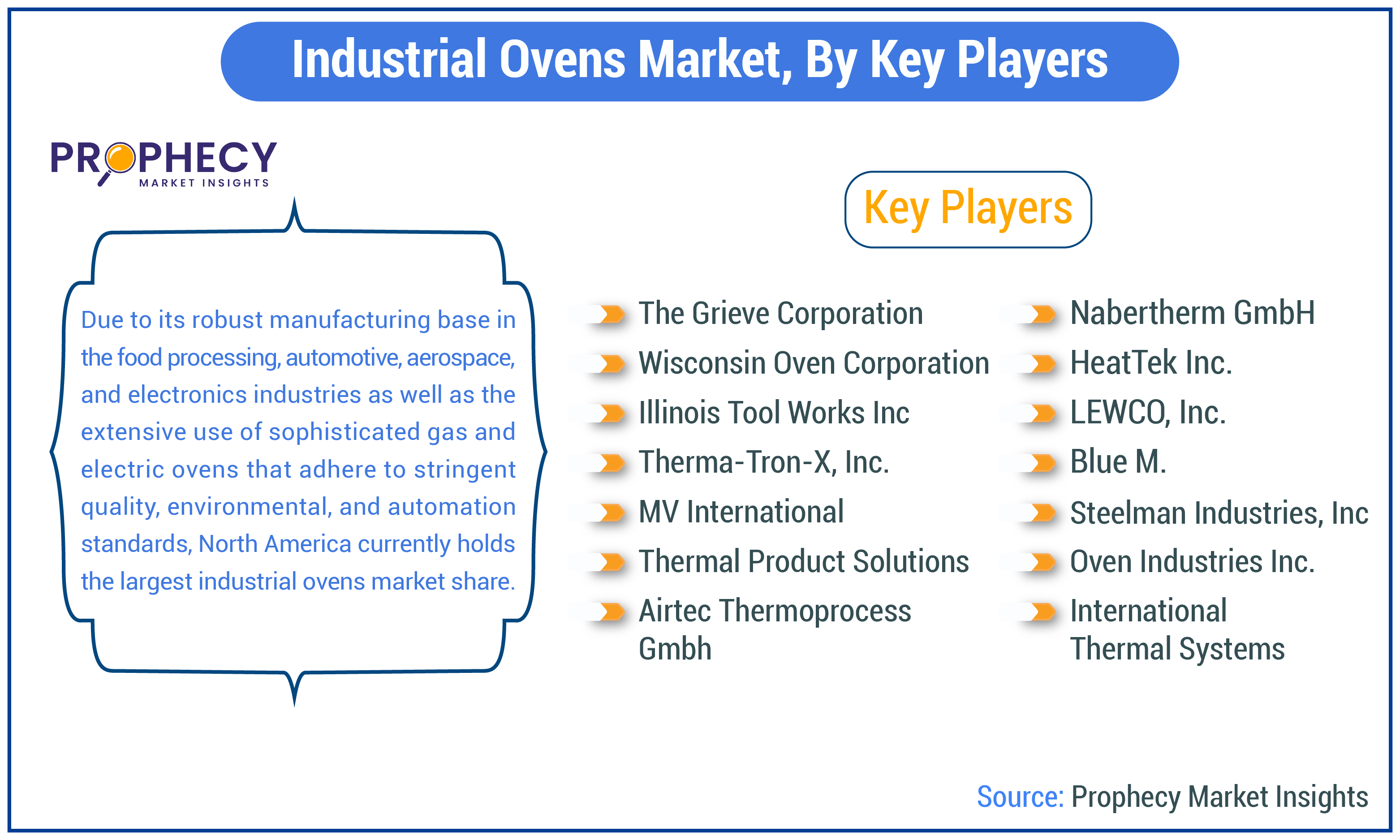
North America: Due to its robust manufacturing base in the food processing, automotive, aerospace, and electronics industries as well as the extensive use of sophisticated gas and electric ovens that adhere to stringent quality, environmental, and automation standards, North America currently holds the largest industrial ovens market share.
- U.S. Industrial Ovens Market Insights:
In light of its sophisticated manufacturing infrastructure, robust automotive, aerospace, and food processing sectors, and early adoption of intelligent and energy-efficient oven technology, the United States leads the North American industrial ovens market.
Asia Pacific: The second-largest and fastest-growing region is Asia-Pacific, driven by the need for both continuous and specialist ovens, the continued growth of the steel, solar cell, electronics, and bakery industries, and the rising industrialization of China, India, and Southeast Asia.
- China Industrial Ovens Market Insights:
China dominates the Asia-Pacific market on account of its enormous industrial base, fast urbanization, government backing for the expansion of manufacturing, and rising demand for processed foods, electronics, and auto parts.
Europe: A robust automotive and aerospace base that demands heat treatment and curing processes, a regional shift toward eco-friendly electric ovens supported by supportive government policies, and the growing use of ovens in food manufacturing (to meet rising consumer demand and efficiency mandates) are all driving growth in Europe's industrial ovens market.
- Germany Industrial Ovens Market Insights:
Due to its strong industrial infrastructure, leadership in metal processing, coatings, and automobiles, as well as its early adoption of cutting-edge oven technology, Germany dominates the region by a significant margin.
Industrial Ovens Market Report Scope:
|
Attribute |
Details |
|
Market Size 2025 |
USD 8567 Million |
|
Projected Market Size 2035 |
USD 12947.1 Million |
|
CAGR Growth Rate |
4.6% (2025-2035) |
|
Base year for estimation |
2024 |
|
Forecast period |
2025 – 2035 |
|
Market representation |
Revenue in USD Million & CAGR from 2025 to 2035 |
|
Regional scope |
North America - U.S. and Canada Europe – Germany, U.K., France, Russia, Italy, Spain, Netherlands, and Rest of Europe Asia Pacific – China, India, Japan, Australia, Indonesia, Malaysia, South Korea, and Rest of Asia-Pacific Latin America - Brazil, Mexico, Argentina, and Rest of Latin America Middle East & Africa – GCC, Israel, South Africa, and Rest of Middle East & Africa |
|
Report coverage |
Revenue forecast, company share, competitive landscape, growth factors, and trends |
Segmentation:
By Product:
- Curing Oven
- Baking Oven
- Drying Oven
- Reflow Oven
- Others
By Process:
- Batch
- Continuous
By Energy Source:
- Electric
- Natural Gas
- Infrared
- Others
By Temperature Range:
- Low-Temperature Ovens (3–6?°F)
- Mid-Range Ovens (7–9?°F)
- High-Temperature Ovens (10–12?°F)
By Application:
- Composite Curing
- Adhesive & Epoxy Processing
- Sterilization / Quality Testing
- Polymer/Plastic Melting & Molding
- Coating Curing
- Others
By End User:
- Food & Beverage
- Chemical & Petroleum
- Electrical & Electronics
- Automotive
- Aerospace
- Pharmaceutical
- Others
By Region:
- North America
- U.S.
- Canada
- Europe
- Germany
- U.K.
- France
- Russia
- Italy
- Spain
- Netherlands
- Rest of Europe
- Asia Pacific
- China
- India
- Japan
- Australia
- Indonesia
- Malaysia
- South Korea
- Rest of Asia Pacific
- Latin America
- Brazil
- Mexico
- Argentina
- Rest of Latin America
- Middle East & Africa
- GCC
- Israel
- South Africa
- Rest of Middle East & Africa
Industrial Ovens Market Competitive Landscape & Key Players
Investing in cutting-edge technology includes IoT integration, AI-based predictive maintenance, and energy-efficient designs are important growth strategies for industrial oven firms in order to satisfy the growing need for sustainability and automation. The key players operating in the industrial ovens market include, The Grieve Corporation, Wisconsin Oven Corporation, LEWCO, Inc., Airtec Thermoprocess Gmbh, MV International, and others.
Industrial Ovens Market Companies:
- The Grieve Corporation
- Wisconsin Oven Corporation
- Illinois Tool Works Inc
- Therma-Tron-X, Inc.
- Airtec Thermoprocess Gmbh
- MV International
- Nabertherm GmbH
- HeatTek Inc.
- LEWCO, Inc.
- Blue M.
- International Thermal Systems
- Thermal Product Solutions
- Steelman Industries, Inc
- Oven Industries Inc.
View an Additional List of Companies in the Industrial Ovens Market
Industrial Ovens Market Recent News
- In May 2025, the first wafer baking oven with induction heating, the OptiBake, was introduced by the Bühler Group. It uses up to 50% less energy than traditional gas-fired ovens. OptiBake, which is made for flat and hollow wafers, eliminates combustion and pollutants including CO?, CO, and NOx by directly heating baking plates using electromagnetic fields.
- In September 2024, in collaboration with Unique Steel Products Kitchen Whiz UNOX, a leading Italian company recognized for its cutting-edge commercial ovens, has formally opened the UNOX Lounge in Bengaluru. Culinary experts have a rare chance to see UNOX ovens up close in this cutting-edge area.
Analyst View:
Due to the fast industrialization of industries that depend on effective thermal processing, such as automotive, aerospace, electronics, food processing, and pharmaceuticals, the market for industrial ovens is expanding rapidly. These ovens may be used in batch or continuous settings for a variety of tasks, including drying, baking, and curing. Conveyor integration, IoT-enabled automation, electric and infrared heating, and other technological developments are lowering operating costs and increasing energy efficiency. Global trends toward sustainability and smart manufacturing, in addition to rising demand from the quick-service and food processing sectors, are propelling market development. Innovations including digital twins and industrial metaverse applications will drive future growth, especially in quickly emerging regions including Asia-Pacific.
More Related Reports
Industrial Boiler Market
Industrial Lubricants Market
Industrial Sugar Market
Industrial Microwave Heating Equipment Market
Industrial Internet of Things Market
Industrial Ovens Market Company Profile
|
Company Name |
The Grieve Corporation |
|
Headquarter |
Round Lake, Illinois |
|
CEO |
Tony Caringella |
|
Employee Count |
51-200 Employees |
Industrial Ovens Market Highlights
FAQs
Industrial ovens market size was valued at USD 8567 Million in 2025 and is expected to reach USD 12947.1 Million by 2035 growing at a CAGR of 4.6%.
Product, process, energy source, temperature range, application, end user, and region are the segmentation for the target market.
North America, Asia Pacific, Europe, Latin America, and the Middle East & Africa. North America is expected to dominate the market.
The key players operating the industrial ovens market include The Grieve Corporation, Wisconsin Oven Corporation, Illinois Tool Works Inc, Therma-Tron-X, Inc., Airtec Thermoprocess Gmbh, MV International, Nabertherm Gmbh, HEATTEK INC., LEWCO, Inc., Blue M., International Thermal Systems, Thermal Product Solutions, Steelman Industries, Inc, and Oven Industries Inc.