Industrial Next Generation Refrigerants Market Overview
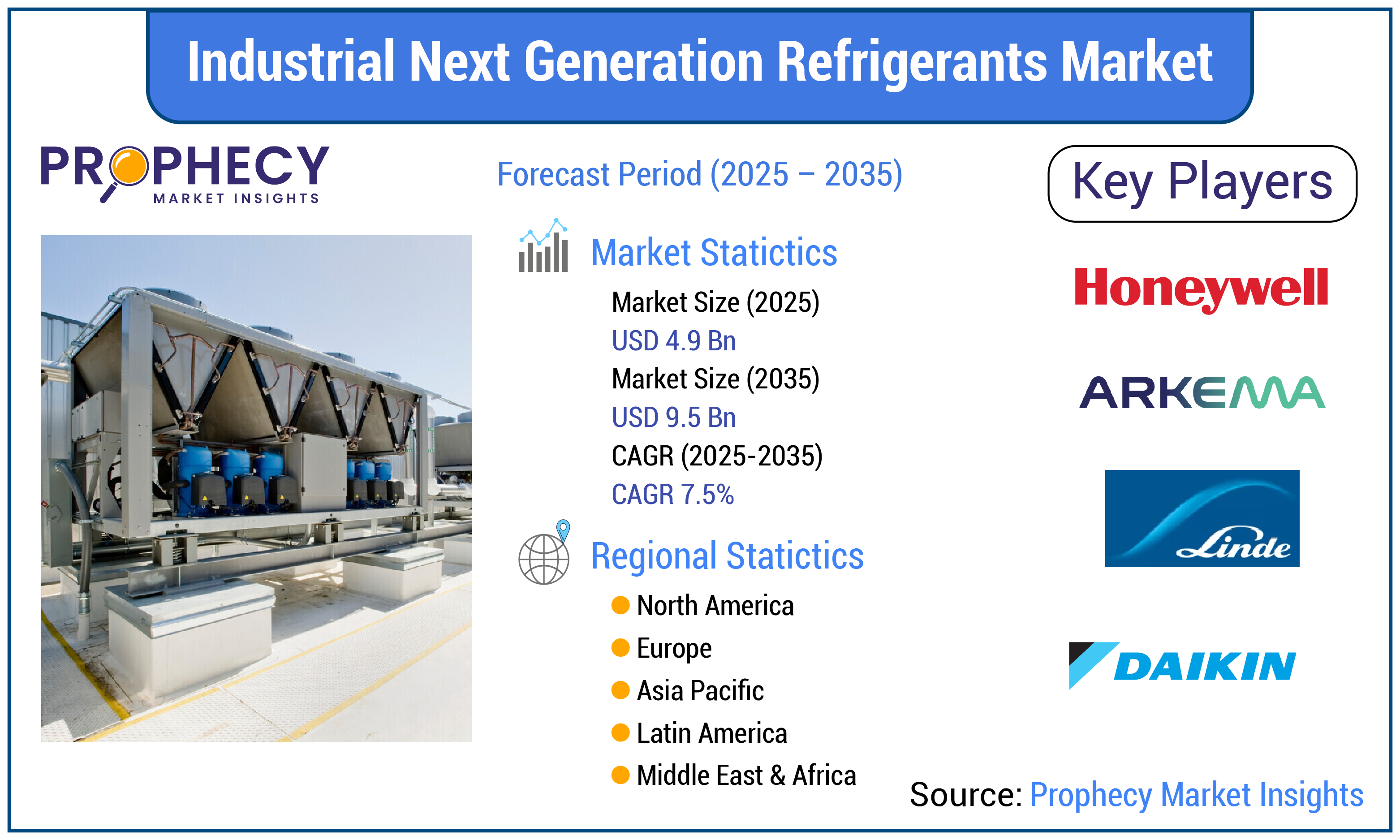
- By 2035, the industrial next generation refrigerants market size is contemplated to enlarge at a valuation of USD 9.5 Billion.
- In 2024, the industrial next generation refrigerants market valuation was USD 4.6 Billion.
- Industrial next generation refrigerants market is developing at a CAGR of 7.5%.
Industrial Next Generation Refrigerants are refrigerants designed to replace traditional high-GWP refrigerants in industrial systems. These refrigerants have options including ow-global warming potential (GWP) such as HFOs, that re natural refrigerants and blending advancement that meet modern regulatory and efficiency standards. The Industrial Next Generation Refrigerants market is projected to grow significantly with adoption of stringent regulation and push for sustainability.
The industrial next generation refrigerants market is anticipated to grow significantly with growing demand for energy-efficient cooling systems, strict environmental regulations and global phase-down of high-GWP refrigerants under frameworks such as Kigali Amendment. To achieve sustainability goals and lower carbon footprints, manufacturing sectors including food processing, cold chain logistics, and medicines are rapidly utilizing low-GWP alternatives. Furthermore, the transition from traditional to next-generation refrigerants is being driven by advancements in refrigeration technology and growing awareness of the implications of climate change, majorly in emerging economies with growing industrial infrastructure at rapid pace.
The industrial next generation refrigerants market is witnessing various trends that include powerful transition towards low?GWP and natural options such as ammonia, CFO and HFO blends driven by strong environmental pressure and tightening global regulations. Substantial technological developments are additionally taking place in the industry, with intelligent controls, sophisticated heat exchangers, and cascade refrigeration systems improving safety and efficiency, particularly for cold-chain, process cooling, and heat pump applications.
Recession Risk & Tariff Analysis:
- The industrial next generation refrigerants market faces significant challenges majorly for raising input costs for refrigerant production equipment and pressure vessels, with U.S. tariffs on steel and aluminum along with policies that could push the U.S. and potentially global economy into recession with up to 60% estimation.
- Higher procurement cost, supply chain disruptions, and unpredictable investment planning can be faced by refrigerant manufacturers and users. Tariffs might influence protective price hikes or currency-driven inflation that increase project costs and disrupt the industrial demand in food processing, cold chains, and HVAC sectors.
Impact of Generative AI on Industrial Next Generation Refrigerants Market:
- The industrial next generation refrigerants market is revolutionized by generative AI with accelerating R&D, design optimization, and regulatory compliance processes. Thermodynamic behaviors of alternative refrigerants can be modeled with AI -driven simulations that reduces time consumption and cost for developing low-GWP blends.
- Additionally, generative AI can be used in monitoring environmental regulations globally, helping the organizations step ahead of compliance need. Generative AI proves as essential tool improving the sustainability, and competitiveness across the refrigerant value chain.
Industrial Next Generation Refrigerants Market Drivers & Restraints
Key Drivers:
Global Regulatory Push Under Kigali Amendment Drives Surge in Demand for Low-GWP Industrial Refrigerants
The industrial next generation refrigerants market has one major growth factor with global regulatory push to phase down high-global warming potential (GWP) refrigerants, under the Kigali Amendment to the Montreal Protocol. Hydrofluorocarbons (HFCs) are strong greenhouse gases that should be reduced gradually under this internationally binding agreement. The goal is forcing industry to switch to low-GWP substitutes such HFOs, ammonia, CO?, and hydrocarbon-based refrigerants. Given regulatory momentum is pushing robust and sustained demand for efficient and safe climate friendly refrigerant solutions in the market.
- For Instance, in November 2024, 163 countries plus the EU ratified the Kigali Amendment, committing to phasedown schedules based on development status. Developed nations must reduce HFCs by 45% by 2024 and 85% by 2036, while emerging economies have longer timelines
Restraints:
The Market is Affected by the Resale and Investment Uncertainty
The high upfront cost associated with retrofitting existing systems and compatibility challenges have been a major restraint associated with industrial next generation refrigerants market. While many of the industrial refrigeration and cooling systems in use presently were designed for high-GWP HFCs, they cannot be used with low-GWP substitutes for HFOs, CO?, or ammonia without making major modifications. In developing regions, for cost-sensitive industries such financial and operational issues can slow the shifting to next-generation refrigerants.
- Counterbalance Statements: Long term benefits offsets the initial cost such as reduced regulatory compliance risks, lower energy consumption and improved system efficiency. Financial incentives, tax credits and funding support is being offered by many governments and international agencies to push for early adoption of low-GWP refrigerants for industrial users in long term.
Opportunities & Trends:
Sustainability Shift and Emerging Market Growth Propel Industrial Next Generation Refrigerants Adoption
With strong opportunities the industrial next generation refrigerants with global shift towards sustainable industrial practices. The demand for energy-efficient and ecologically friendly refrigeration systems continues to increase in emerging economies as sectors includes cold chain logistics, medicines, and food processing grow. Industries are adopting low-GWP refrigerants more rapidly as a result of increased awareness of climate change and stricter emissions standards. Investments in natural refrigerant technologies, strategic collaborations and green certification programs further drives the market potential for long-term.
Industrial Next Generation Refrigerants Market Segmentations & Regional Insights
System, component, connectivity, application, end user and region are the divisions of the industrial next generation refrigerants market.
By System:
Fluorocarbon, hydrocarbon, and inorganic are product type on which industrial next generation refrigerants market is segmented. Inorganic refrigerants have emerged as dominant segment in industrial next generation refrigerants market share. They are widely used for their excellent thermodynamic efficiency and zero or extremely low global warming potential (GWP), making them ideal for major industrial operations including chemical manufacture, cold storage, and food processing.
Hydrocarbon refrigerants are the second largest product category in the industrial next-generation refrigerants market size. With their low greenhouse gas footprint, great energy efficiency, and cost-effectiveness, these refrigerants are becoming increasingly common.
By Application:
Industrial refrigeration, heat pumps, domestic refrigeration, transport refrigeration and others are segmentation of industrial next generation refrigerants market. Due to extensive use of refrigeration systems in sectors such as food and beverage processing, pharmaceuticals, petrochemicals, and cold storage warehouses the industrial refrigeration holds dominant position in global industrial next generation refrigerants market share.
Heat Pumps stands as second dominant in the industrial next generation refrigerants market with its ability to reduce greenhouse gas emissions and lower energy consumption that is preferred by industries and pharmaceuticals sectors with increasing shift towards energy-efficient heating and cooling solutions.
By End-Use Industry:
The industrial next generation refrigerants market on the account of application is categorized into food & beverage, pharmaceuticals, chemicals, and others. The food and beverage industry are certainly the largest end-user category in the market for industrial next-generation refrigerants. The industry's severe requirement for precise temperature control, widespread use of cold storage facilities, and stringent food safety regulations calls for dependable and sustainable refrigeration systems are the main drivers of this leadership.
Pharmaceutical segment in end user industry holds second dominant position with the pharmaceutical industry relies steadily on sophisticated refrigeration systems that provide accurate thermal control and regulatory compliance due to a growing need for temperature-sensitive storage and transportation.
Regional Insights:
Geographically, the industrial next generation refrigerants market is studied across North America, Europe, Asia Pacific, Latin America, and the Middle East & Africa.
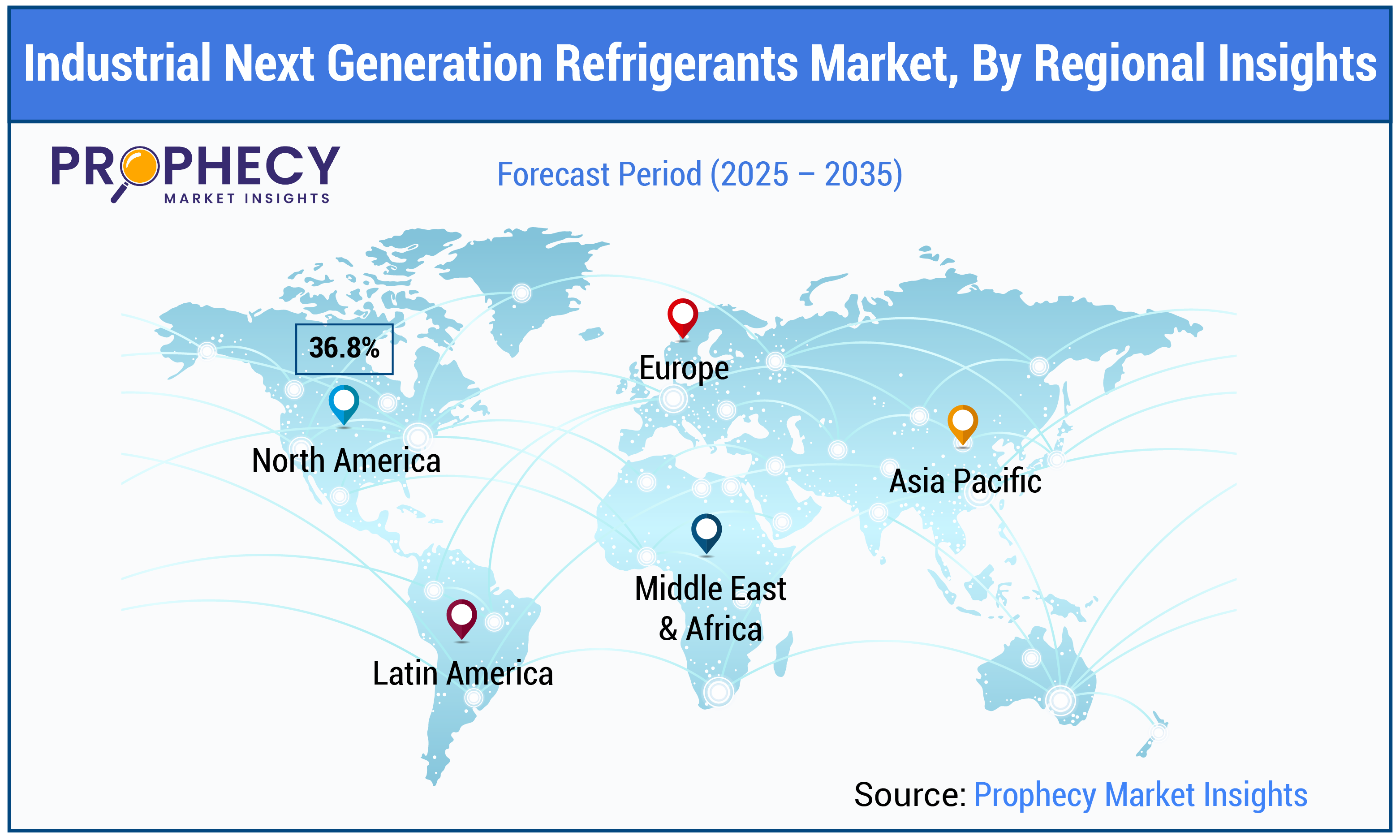
North America: This region holds the most industrial next generation refrigerants market share with technological innovations, stringent environmental regulations and growing industrial demand. Furthermore, plenty of significant producers and early individuals of low-GWP refrigerant technology, particularly in the fields of industrial refrigeration, heat pumps, and cold chain logistics, have operations in North America.
- U.S. Industrial Next Generation Refrigerants Market Insights:
U.S. dominate the North America industrial next generation refrigerants market with strong focus on sustainability, robust industrial base and regulatory leadership. The U.S. Environmental Protection Agency (EPA) has implemented strict guidelines under the SNAP program to phase down high-GWP refrigerants, driving widespread adoption of low-GWP alternatives majorly in industries such as cold storage, pharmaceuticals and food processing.
Asia Pacific: The industrial next generation refrigerants market in Asia-Pacific stands as second dominant with rapid urbanizations, industrialization and growing environmental awareness across China, India, Japan and South Korea. The industrial, food processing, and cold chain logistics industries—all of which are crucial sectors requiring efficient and sustainable refrigeration systems—are rising significantly in the region.
- China Industrial Next Generation Refrigerants Market Insights:
China leads the market among Asia-pacific region with its strong policy alignment with international climate agreements, well-established industry industrial base and growing cold chain infrastructure. China has taken significant steps to phase down high-GWP HFCs under the Kigali Amendment and has implemented national action plans promoting low-GWP alternatives.
Europe: Industrial Next Generation Refrigerants market is growing rapidly in Europe region, with most stringent environmental regulations on global scale and strong commitment to global climate mitigation. The F-Gas Regulation introduced by European Union aims to cut HFC emissions by two-thirds by the year 2030, regulating industries to adopt low-GWP and natural refrigerants such as CO?, ammonia, and hydrocarbons in Chemicals and industrial applications driving market growth in the region.
- Germany Industrial Next Generation Refrigerants Market Insights:
Germany is the industrial next generation refrigerants market leader in Europe due to its strict environmental policies, robust industrial infrastructure and its leadership in sustainable technologies. Germany is the key proponent of the EU’s F-Gas Regulation and has aggressively phased down high-GWP refrigerants and promoted the use of natural alternatives like CO?, ammonia in industrial applications.
Industrial Next Generation Refrigerants Market Report Scope:
|
Attribute |
Details |
|
Market Size 2025 |
USD 4.9 Billion |
|
Projected Market Size 2035 |
USD 9.5 Billion |
|
CAGR Growth Rate |
7.5% (2025-2035) |
|
Base year for estimation |
2024 |
|
Forecast period |
2025 – 2035 |
|
Market representation |
Revenue in USD Billion & CAGR from 2025 to 2035 |
|
Regional scope |
North America - U.S. and Canada Europe – Germany, U.K., France, Russia, Italy, Spain, Netherlands, and Rest of Europe Asia Pacific – China, India, Japan, Australia, Indonesia, Malaysia, South Korea, and Rest of Asia-Pacific Latin America - Brazil, Mexico, Argentina, and Rest of Latin America Middle East & Africa – GCC, Israel, South Africa, and Rest of Middle East & Africa |
|
Report coverage |
Revenue forecast, company share, competitive landscape, growth factors, and trends |
Segmentation:
By Product:
- Fluorocarbon
- Hydrocarbon
- Inorganic
By Application:
- Industrial Refrigeration
- Heat Pumps
- Domestic Refrigeration
- Transport Refrigeration
- Others
By End-User:
- Food & Beverage
- Pharmaceuticals
- Chemicals
- Others
By Region:
- North America
- U.S.
- Canada
- Europe
- Germany
- U.K.
- France
- Russia
- Italy
- Spain
- Netherlands
- Rest of Europe
- Asia Pacific
- China
- India
- Japan
- Australia
- Indonesia
- Malaysia
- South Korea
- Rest of Asia Pacific
- Latin America
- Brazil
- Mexico
- Argentina
- Rest of Latin America
- Middle East & Africa
- GCC
- Israel
- South Africa
- Rest of Middle East & Africa
Industrial Next Generation Refrigerants Market Competitive Landscape & Key Players
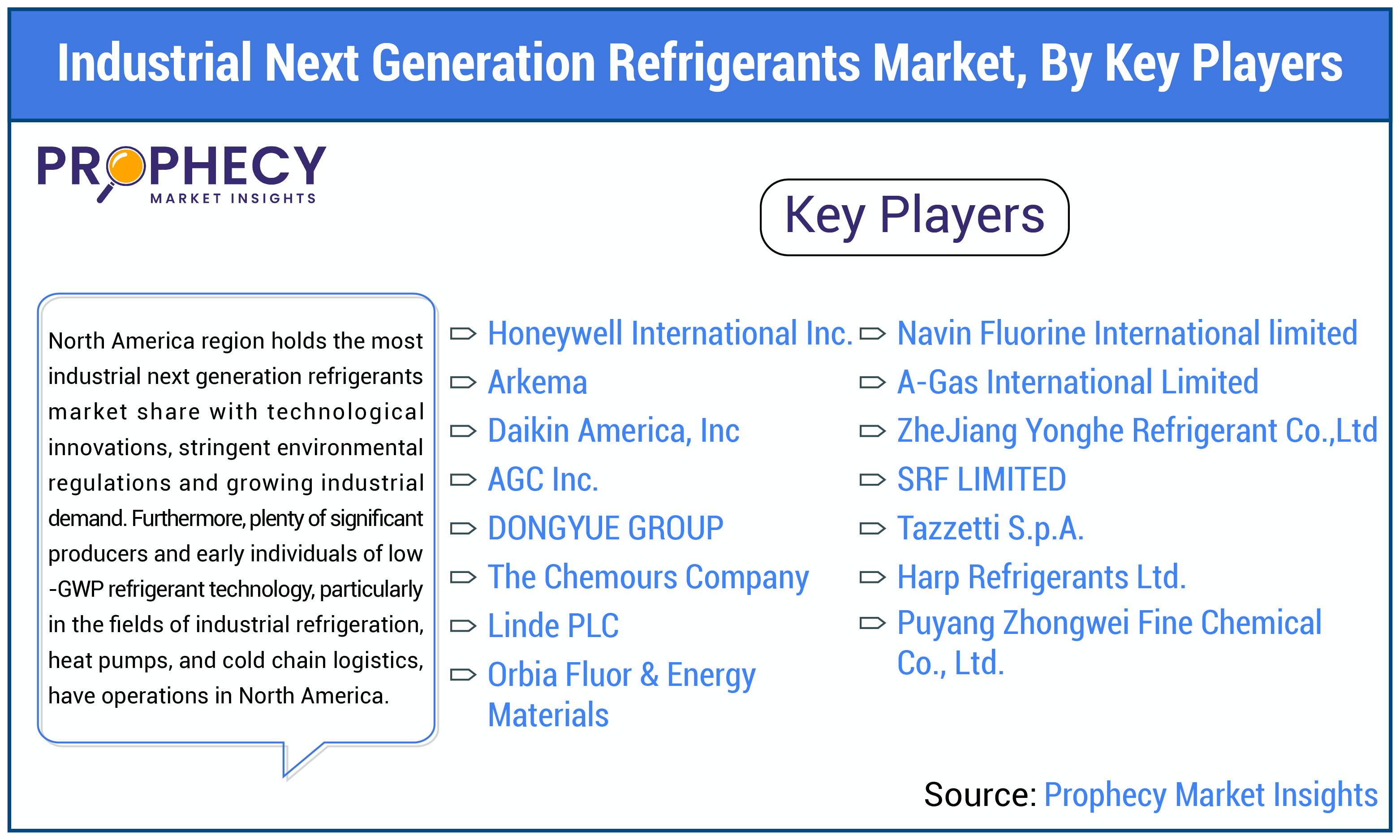
The key players operating in the industrial next generation refrigerants market include, Honeywell International Inc., Arkema, Navin Fluorine International limited, DONGYUE GROUP, The Chemours Company, and others. With the goal to meet international regulatory requirements and sustainability aims, major companies in the industrial next generation refrigerants market attempt to create and offer low-GWP, energy-efficient, and environmentally responsible refrigerant solutions.
Industrial Next Generation Refrigerants Market Companies:
- Honeywell International Inc.
- Arkema
- Daikin America, Inc
- AGC Inc.
- DONGYUE GROUP
- The Chemours Company
- Orbia Fluor & Energy Materials
- Linde PLC
- Navin Fluorine International limited
- A-Gas International Limited
- ZheJiang Yonghe Refrigerant Co.,Ltd
- SRF LIMITED
- Tazzetti S.p.A.
- Harp Refrigerants Ltd.
- Puyang Zhongwei Fine Chemical Co., Ltd.
View an Additional List of Companies in the Industrial Next Generation Refrigerants Market
Industrial Next Generation Refrigerants Market Recent News
- In April 2024, to incorporate Honeywell’s low-global warming potential Solstice 454B refrigerant Honeywell and Bosch partnered into Bosch’s new Florida Heat Pump series, reducing greenhouse gas emissions by 78% compared to traditional refrigerants. They will also provide training for Bosch technicians on the safe installation and maintenance of these advanced refrigerants, supporting the industry’s transition to more sustainable heating and cooling solutions under new EPA regulations.
- In June 2024, Joe Hudson Technologies announced the acquisition of USA Refrigerants for USD 20.7 million, aiming to create a dedicated refrigerant acquisition group to source a wide range of refrigerants, including recovered and reclaimed types.
- In December 2024, Daikin India and Rechi Precision established a joint venture, DAIKIN-RECHI India Pvt Ltd to design, manufacture, and sell rotary compressors for the Indian HVAC market, with operations expected to start by the end of the fiscal year 2025 aim to ensure a stable supply of high-quality, cost-effective compressors to meet growing demand in India, supporting Daikin’s long-term growth and local manufacturing expansion.
Analyst View:
Analyst given perspective says the industrial next generation refrigerants are anticipated for sustained growth with innovations in technology, powerful convergence of environmental regulation and sustainable cooling systems. While new economies hold tremendous untapped possibilities, major players are anticipated to profit from early investments in low-GWP technology and collaborative efforts.
More Related Reports
Industrial Boiler Market
Industrial Lubricants Market
Industrial Sugar Market
Industrial Microwave Heating Equipment Market
Industrial Internet of Things Market
Industrial Next Generation Refrigerants Market Company Profile
|
Company Name |
Linde PLC |
|
Headquarter |
Dublin, Ireland |
|
CEO |
Sanjiv Lamba |
|
Employee Count |
65,000 Employees |
Industrial Next Generation Refrigerants Market Highlights
FAQs
Industrial next generation refrigerants market size was valued at USD 4.9 Billion in 2025 and is expected to reach USD 9.5 Billion by 2035 growing at a CAGR of 7.5%.
Product type, application, and region are the segmentation for the target market.
North America, Asia Pacific, Europe, Latin America, and the Middle East & Africa. North America is expected to dominate the market.
The key players operating the industrial next generation refrigerants market include Honeywell International Inc., Arkema, Daikin America, Inc., AGC Inc., DONGYUE GROUP, The Chemours Company, Orbia Fluor & Energy Materials, Linde PLC, Navin Fluorine International limited, A-Gas International Limited, ZheJiang Yonghe Refrigerant Co.,Ltd , SRF LIMITED, Tazzetti S.p.A., Harp Refrigerants Ltd., and Puyang Zhongwei Fine Chemical Co., Ltd.