Hybrid Airships Market Overview
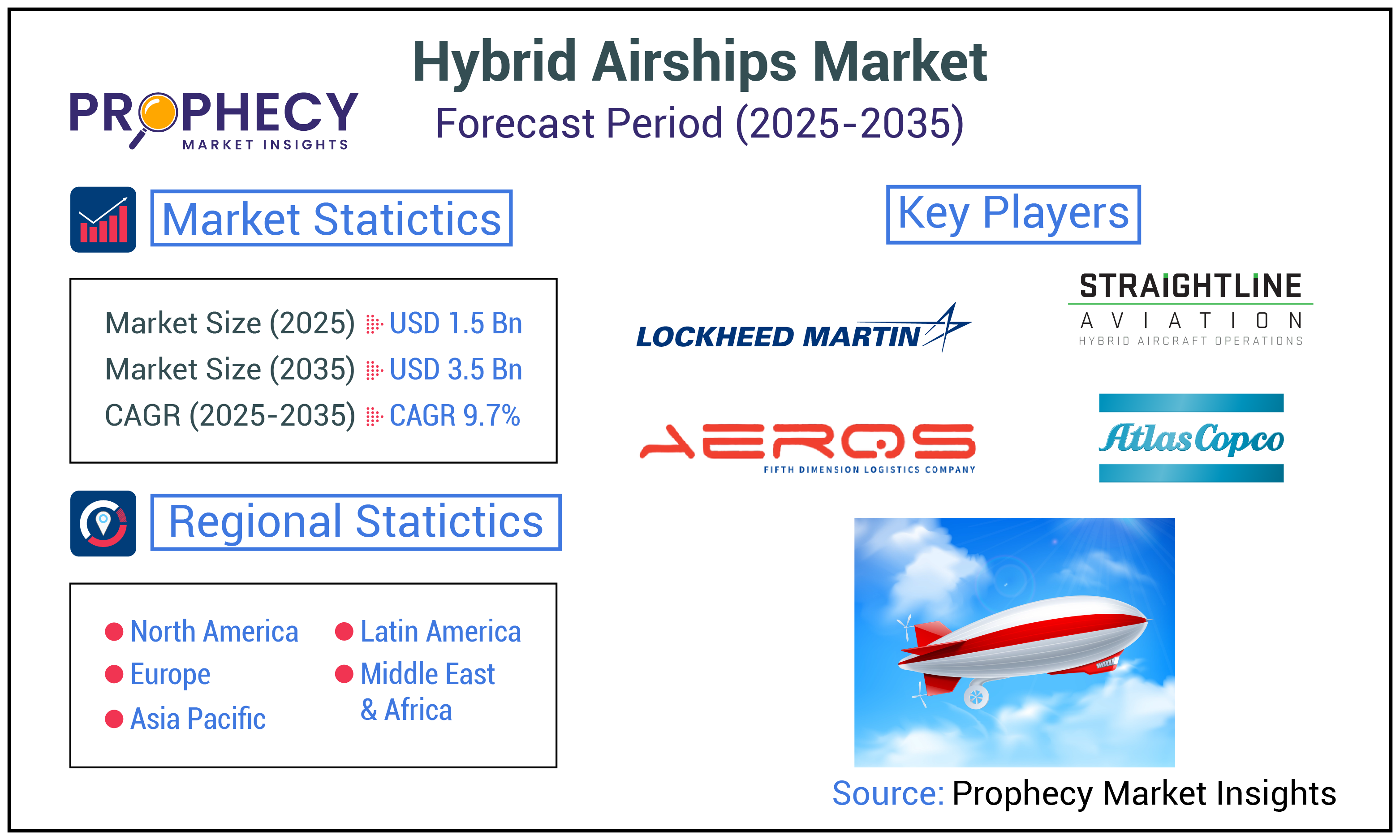
- By 2035, the hybrid airships market size is contemplated to enlarge at a valuation of USD 3.5 Billion.
- In 2024, the hybrid airships market valuation was USD 1.4 Billion.
- Hybrid airships market is developing at a CAGR of 9.7%.
Hybrid airships are innovative vehicles that blend the characteristics of airplanes, helicopters, and traditional airships. The combination of helium gas for lift, and engines or rotors for thrust and control enable them to perform vertical take-offs and landings. Their advantages are the potentials to transport oversize loads to areas without access or which are insufficiently developed, use less fuel than planes, and have a lesser effect on the environment.
The hybrid airships market is expanding owing to the increasing demand for eco-friendly transport, as these airships consume less fuel and emit fewer emissions than conventional aircraft. Moreover, their capability to transport heavy cargo to isolated areas without the need for landing strips makes them perfect for sectors such as mining, oil & gas, and emergency response. Advances in lightweight materials and hybrid propulsion systems have increased their efficiency and payload capacity, while the rising interest of the defense, tourism, and logistics industries also contributes to the market's expansion.
The prospects of the hybrid airships market are driven by the increasing demand for environmentally friendly and energy-saving modes of transport, particularly for isolated and inaccessible areas. Innovation in technology such as hybrid-electric propulsion, light-weight materials, and self-driving navigation are contributing to the practicability and adaptability of these airships. Hybrid airships will likely be used extensively in various fields such as logistics, surveillance, tourism, and emergency response. We are witnessing a growing trend of government and private sector investment in hybrid airship ventures, indicating an upsurge in their commercialization and the broadening of their market in the near future.
Recession Risk & Tariff Analysis:
- The hybrid airships market is expected to experience sluggish growth in the event of an economic downturn as firms tend to cut down on their expenditure on costly projects.
- Simultaneously, tariffs on aerospace components such as engines and materials may increase the cost of manufacturing, making it more challenging for global supply chains. These elements could postpone new product introductions and slow customer uptake, particularly in areas where there is a high sensitivity.
Impact of Generative AI on Hybrid Airships Market:
- Generative Al boosts the hybrid airships industry in various ways including intelligent design, improved fuel efficiency as well as the possibility of self-guided navigation.
- The technology facilitates the production of lighter, streamlined, and more fuel-efficient structures. One can also reap the benefits of on-the-spot flight modifications and also enhance predictive maintenance.
Hybrid Airships Market Drivers & Restraints
Key Drivers:
Rising Interest of Consumers in Eco-Friendly Transportation will Push Market Growth
Eco-friendly transportation are methods of travel that have very little negative effect on the environment, especially with regard to carbon emissions and energy usage. It is said that hybrid airships are good for the environment as they generate their lift with the use of helium and their power with a hybrid-electric motor, and the fuel they consume is a small fraction of that of traditional airplanes or helicopters. Hybrid airships are helping to keep the air clean by relying less on fossil fuels and using less large infrastructure such as runways. Increased use of airships can make logistics and passenger travel more sustainable. The cargo and passenger movement onboard hybrid airships can be extended to remote or delicate places without affecting the ecological balance of the area.
- For Instance, according to the data published by ScienceDirect, 25% of the European CO2 emissions originate from the transport sector, with the Green Deal aiming to cut transport-related emissions by 90% by 2050. One pillar for this green focus is the awareness of consumers about the role of transport in purchasing decisions.
Restraints:
Slow Speed Compared to Aircraft Could Affect Market Development
Hybrid airships typically operate at significantly slower speeds compared to airplanes. Consequently, they are not the best option for situations where cargo or passengers are required to be transported urgently, i.e., time-sensitive. Due to this drawback, the application of hybrid airships is also limited in certain types of sectors that depend heavily on fast-paced logistics such as e-commerce or express shipping.
- Counterbalance Statements: Regarding the challenge, a possible approach could be concentrating on projects that require less velocity, for example, the shipment of large or heavy products to isolated locations, surveillance activities, or scientific support. Also, the enhancement of hybrid propulsion and the implementation of a better aerodynamic design will not only raise the cruising speed but will also make hybrid airships more viable in the long term.
Opportunities & Trends:
Technological Advancements will be a Game-Changer Solution for the Market in Future
Technological advancements will remain a significant future trend in the hybrid airships market, being a major factor in the improvement of the efficiency, safety, and performance of the same. The adoption of innovative materials such as lightweight composites, implementation of hybrid-electric propulsion systems, and utilization of Al-based navigation techniques are gradually transforming the airships to be more energy-efficient, environmentally friendly and operator-friendly. This technology is changing the way we use airships. It is helping us to reduce the cost of operation, increase the cargo capacity as well as flight time with less fuel. The work done for research and development has been very positive, as a result, hybrid airships are being used in more and more areas such as logistics, defense, surveillance, and tourism, making them a possible sustainable air transport option.
Hybrid Airships Market Segmentations & Regional Insights
Type, payload capacity, propulsion type, application, end user, and region are the divisions of the hybrid airships market.
By Type:
Rigid hybrid airships, semi-rigid hybrid airships, and non-rigid hybrid airships are type on which hybrid airships market is segmented. Due in significant part to their simpler design, reduced cost, and extensive usage in tourist, advertising, surveillance, and light freight operations, non-rigid hybrid airships now have the highest hybrid airships market share. With regard to their low infrastructure requirements and lightweight enclosures, they are the most cost-effective choice for commercial operators.
Semi-rigid hybrid airships, which strike a compromise between structural support and flexibility, make up the second-largest sector. They are less expensive and need less infrastructure than completely rigid airships, but they have a higher cargo capacity and stability than non-rigid versions.
By Payload Capacity:
Based on the payload capacity, the hybrid airships market is divided into less than 5 tons, 5 – 20 tons, 20 – 50 tons, and more than 50 tons. In the hybrid airships market, the 5–20 ton payload segment has the largest hybrid airships market share as it fits the capacities of existing, proven platforms such as the Airlander 10, which can carry between 7 and 10 tons and is suitable for operations consisting of regional logistics, surveillance, or humanitarian missions where payload flexibility is crucial but infrastructure is limited.
Driven by growing interest in higher-capacity semi-rigid and rigid hybrid designs involving Lockheed's LMH-1 (based on the P791) and upcoming Aero craft models, which offer enough lift for heavy-lift logistics across remote areas without requiring runways, the 20–50-ton segment is the second largest.
By Propulsion Type:
Conventional propulsion, hydrogen fuel cell, electric or hybrid-electric propulsion, and solar-powered hybrid airships are propulsion type of the hybrid airships market. In the hybrid airship market, the propulsion type with the most hybrid airships market share is hybrid-electric propulsion, which combines conventional engines with electric motors and batteries. This is due to the fact that it strikes a balance between economy, operational dependability, and range providing fuel and pollution reductions without compromising power on heavier or longer flights.
Due to its zero-emission capabilities and increased energy efficiency, hydrogen fuel cell propulsion is becoming the second most popular kind of propulsion.
By Application:
On the application, hybrid airships market is categorized into cargo transportation, passenger transport, surveillance & monitoring, disaster relief & humanitarian aid, scientific research & environmental monitoring, aerial surveillance & border control, and others. Due to airships' remarkable endurance, prolonged hovering capabilities, and ability to carry sophisticated sensor suites for military, border patrol, environmental monitoring, and disaster response missions, the surveillance and monitoring application currently holds the largest share of the hybrid airships market, accounting for about 30% of the market.
The second-largest application is cargo transportation, which is expanding quickly since hybrid airships have the special capacity to transport huge or heavy items to isolated areas without infrastructure, providing economical and environmentally responsible logistical substitutes for conventional means of transportation.
By End User:
Defense & military, commercial logistics, oil & gas industry, agriculture & forestry, government agencies, and others are end user of the hybrid airships market. Due to their long-endurance capabilities and capacity to transport communication, surveillance, and reconnaissance devices across remote and conflict-prone areas a combination that defense ministries throughout the world strongly favor hybrid airships are most frequently used by the defense and military sector.
The second-largest market is Commercial Logistics, where hybrid airships are used by sectors including mining, oil and gas, and remote-area infrastructure to deliver heavy or enormous goods to areas without conventional transportation facilities.
Regional Insights:
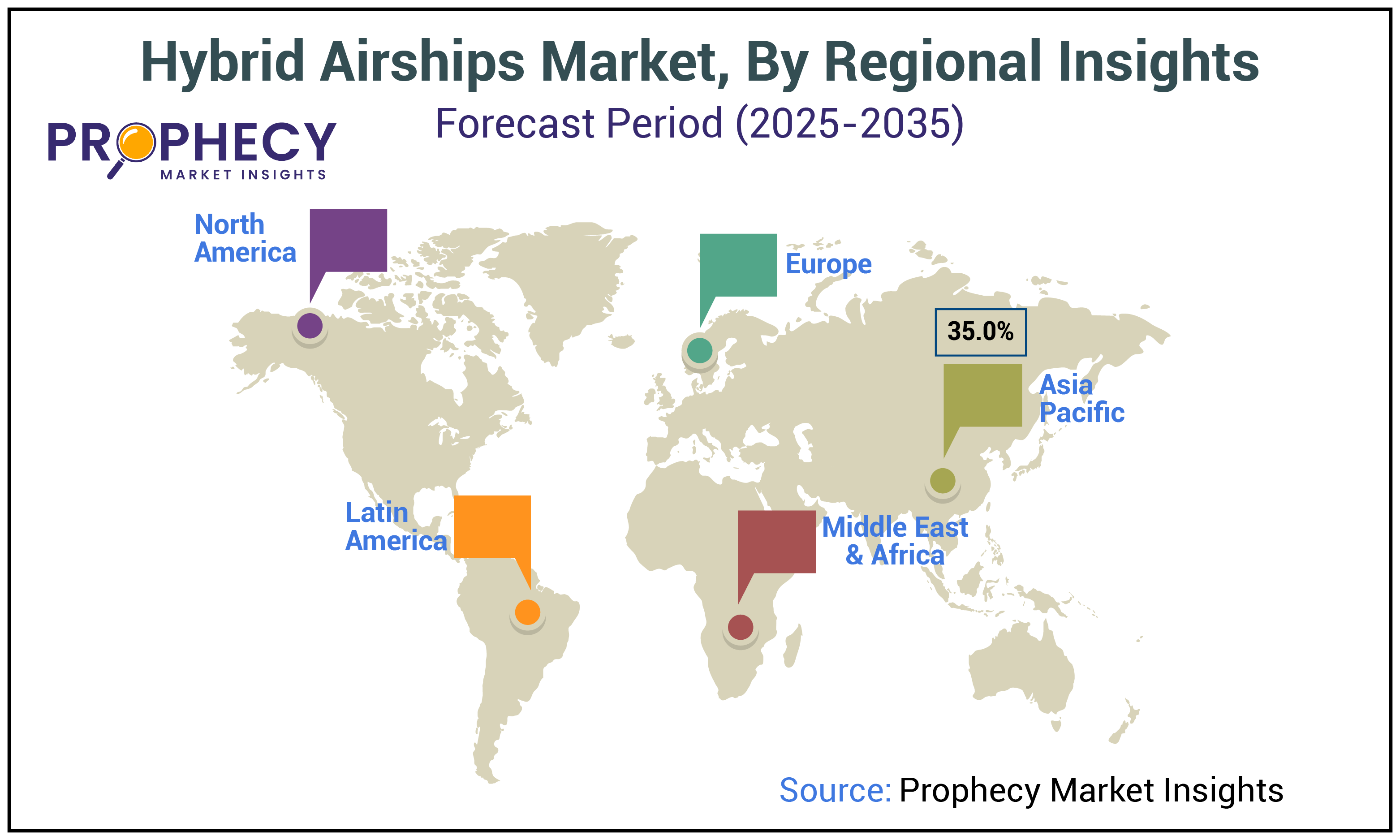
Geographically, the hybrid airships market is studied across North America, Europe, Asia Pacific, Latin America, and the Middle East & Africa.
North America: This region currently has the largest hybrid airships market share (about 35%) for hybrid airships market which is due to its robust aerospace sector, significant R&D expenditures, broad military and commercial adoption (particularly in logistics and surveillance), and encouraging innovation and regulatory environments in the United States and Canada.
- U.S. Hybrid Airships Market Insights:
The U.S. has the biggest share for hybrid airships market in North America for the reason of its robust defense industry, substantial R&D spending, and presence of industry leaders notably Lockheed Martin and LTA Research. The use of airships by the US military for logistics, surveillance, and reconnaissance, as well as NASA's encouragement of the development of high-altitude airships, further stimulates demand and innovation.
Europe: With a significant revenue share (~30%), Europe is the second-largest region. This is due to stringent environmental regulations, expanding aerospace innovation, growing applications in surveillance and green logistics, and public investments in airship programs in nations consisting of the United Kingdom, Germany, France, and Spain.
- U.K. Hybrid Airships Market Insights:
Due in large part to its flagship hybrid airship project, the Airlander 10, created by Hybrid Air Vehicles, the United Kingdom dominates the European market. The U.K. is a major base for hybrid airship innovation in the area on account of its strong government support, environmental objectives, and increased emphasis on sustainable air transportation.
Asia Pacific: The hybrid airships market is expanding quickly in the Asia-Pacific area due to a number of factors, including the need for environmentally friendly logistics to service geographically inaccessible areas, increased interest in maritime surveillance by the government and military, and public-private initiatives for smart city monitoring and rural connection.
- China Hybrid Airships Market Insights:
With over 85% of APAC's airship development efforts coming from China, the region's top nation, the country is bolstered by domestically constructed platforms consisting of as the AVIC AS700 and state-sponsored freight and surveillance operations.
Hybrid Airships Market Report Scope:
|
Attribute |
Details |
|
Market Size 2025 |
USD 1.5 Billion |
|
Projected Market Size 2035 |
USD 3.5 Billion |
|
CAGR Growth Rate |
9.7% (2025-2035) |
|
Base year for estimation |
2024 |
|
Forecast period |
2025 – 2035 |
|
Market representation |
Revenue in USD Billion & CAGR from 2025 to 2035 |
|
Regional scope |
North America - U.S. and Canada Europe – Germany, U.K., France, Russia, Italy, Spain, Netherlands, and Rest of Europe Asia Pacific – China, India, Japan, Australia, Indonesia, Malaysia, South Korea, and Rest of Asia-Pacific Latin America - Brazil, Mexico, Argentina, and Rest of Latin America Middle East & Africa – GCC, Israel, South Africa, and Rest of Middle East & Africa |
|
Report coverage |
Revenue forecast, company share, competitive landscape, growth factors, and trends |
Segmentation:
By Type:
- Rigid Hybrid Airships
- Semi-Rigid Hybrid Airships
- Non-Rigid Hybrid Airships
By Payload Capacity:
- Less than 5 Tons
- 5 – 20 Tons
- 20 – 50 Tons
- More Than 50 Tons
By Propulsion Type:
- Conventional Propulsion
- Hydrogen Fuel Cell
- Electric or Hybrid-Electric Propulsion
- Solar-Powered Hybrid Airships
By Application:
- Cargo Transportation
- Passenger Transport
- Surveillance & Monitoring
- Disaster Relief & Humanitarian Aid
- Scientific Research & Environmental Monitoring
- Aerial Surveillance & Border Control
- Others
By End User:
- Defense & Military
- Commercial Logistics
- Oil & Gas Industry
- Agriculture & Forestry
- Government Agencies
- Others
By Region:
- North America
- U.S.
- Canada
- Europe
- Germany
- U.K.
- France
- Russia
- Italy
- Spain
- Netherlands
- Rest of Europe
- Asia Pacific
- China
- India
- Japan
- Australia
- Indonesia
- Malaysia
- South Korea
- Rest of Asia Pacific
- Latin America
- Brazil
- Mexico
- Argentina
- Rest of Latin America
- Middle East & Africa
- GCC
- Israel
- South Africa
- Rest of Middle East & Africa
Hybrid Airships Market Competitive Landscape & Key Players
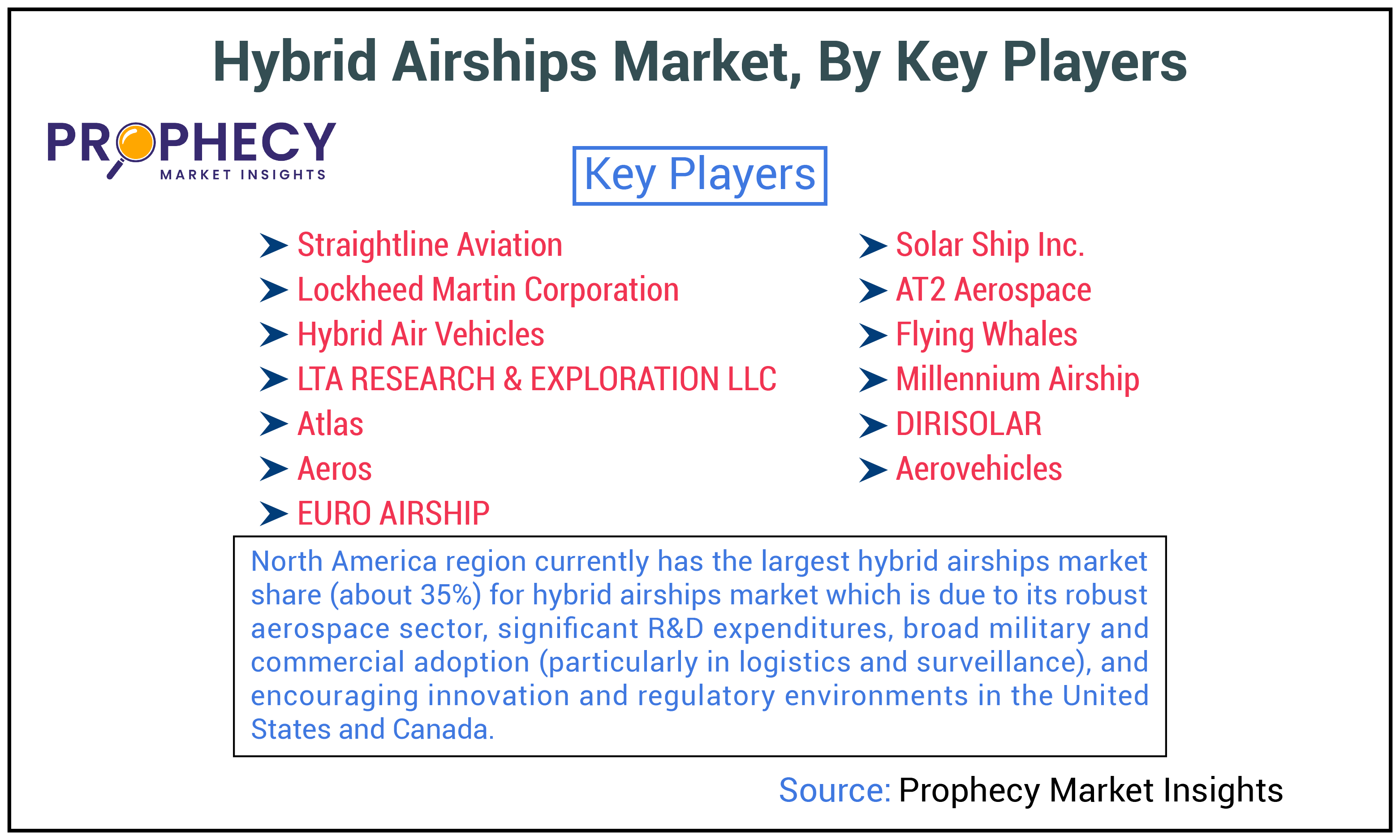
Hybrid airship manufacturers need to prioritize the use of advanced materials, the development of hybrid-electric technology, and building partnerships not only with the defense sector but also with the logistics sector. Aside from this, they can not only increase their growth in emerging markets but also gain the trust of industry stakeholders through regulatory compliance and pilot projects. The key players operating in the hybrid airships market include, Straightline Aviation, Lockheed Martin Corporation, AT2 AEROSPACE, Atlas, Aeros, and others.
Hybrid Airships Market Companies:
- Straightline Aviation
- Lockheed Martin Corporation
- Hybrid Air Vehicles
- LTA RESEARCH & EXPLORATION LLC
- Atlas
- Aeros
- EURO AIRSHIP
- Solar Ship Inc.
- AT2 Aerospace
- Flying Whales
- Millennium Airship
- DIRISOLAR
- Aerovehicles
View an Additional List of Companies in the Hybrid Airships Market
Hybrid Airships Market Recent News
- In July 2025, Hybrid Air Vehicles (HAV), a UK airship developer, is extending its business into the United States by establishing a new company in Virginia that is intended "to meet growing international demand." The Arlington, Virginia-based Hybrid Air Vehicles (US) Inc., led by experienced aerospace industry John Schumacher, will focus on regional clients, "particularly the US Government, aerospace primes, as well as commercial passenger and cargo transporters."
- In March 2025, Straightline Aviation in the UK has placed a historic purchase order for the hybrid airship with US-based AT2 Aerospace, a spin-out of Lockheed Martin and a leader in sustainable aviation technology. This agreement "marks a significant milestone in the advancement of eco-friendly air transportation solutions.
Analyst View:
Hybrid airships are cutting-edge vehicles that combine elements of conventional airships, helicopters, and aircraft to provide environmentally friendly, fuel-efficient transportation with the capacity to take off vertically. They are perfect for sectors including mining, oil and gas, emergency response, and defense since they can transport large loads to isolated or undeveloped locations without runways. Strong future commercialization and wider application across logistics, surveillance, and tourism are indicated by the growing demand for sustainable transportation, technological advancements such as hybrid-electric propulsion and lightweight materials, and growing government and private sector investment.
More Related Reports
Hybrid Solar Wind Energy Storage Market
Hybrid Cloud Market
Hybrid & Electric Cars Market
Hybrid Train Market
Hybrid EV Battery Market
Hybrid Airships Market Company Profile
|
Company Name |
Straightline Aviation |
|
Headquarter |
United Kingdom |
|
CEO |
Mark Dorey |
|
Employee Count |
15 Employees |
Hybrid Airships Market Highlights
FAQs
Hybrid airships market size was valued at USD 1.5 Billion in 2025 and is expected to reach USD 3.5 Billion by 2035 growing at a CAGR of 9.7%.
Type, payload capacity, propulsion type, application, end user, and region are the segmentation for the Hybrid airships market.
North America, Asia Pacific, Europe, Latin America, and the Middle East & Africa. North America is expected to dominate the market.
The key players operating the hybrid airships market include Straightline Aviation, Lockheed Martin Corporation, Hybrid Air Vehicles, LTA RESEARCH & EXPLORATION LLC, Atlas, Aeros, EURO AIRSHIP, SOLAR SHIP INC., AT2 Aerospace, Flying Whales, Millennium Airship, Dirisolar, and Aerovehicles.