Gas Turbines Market Overview
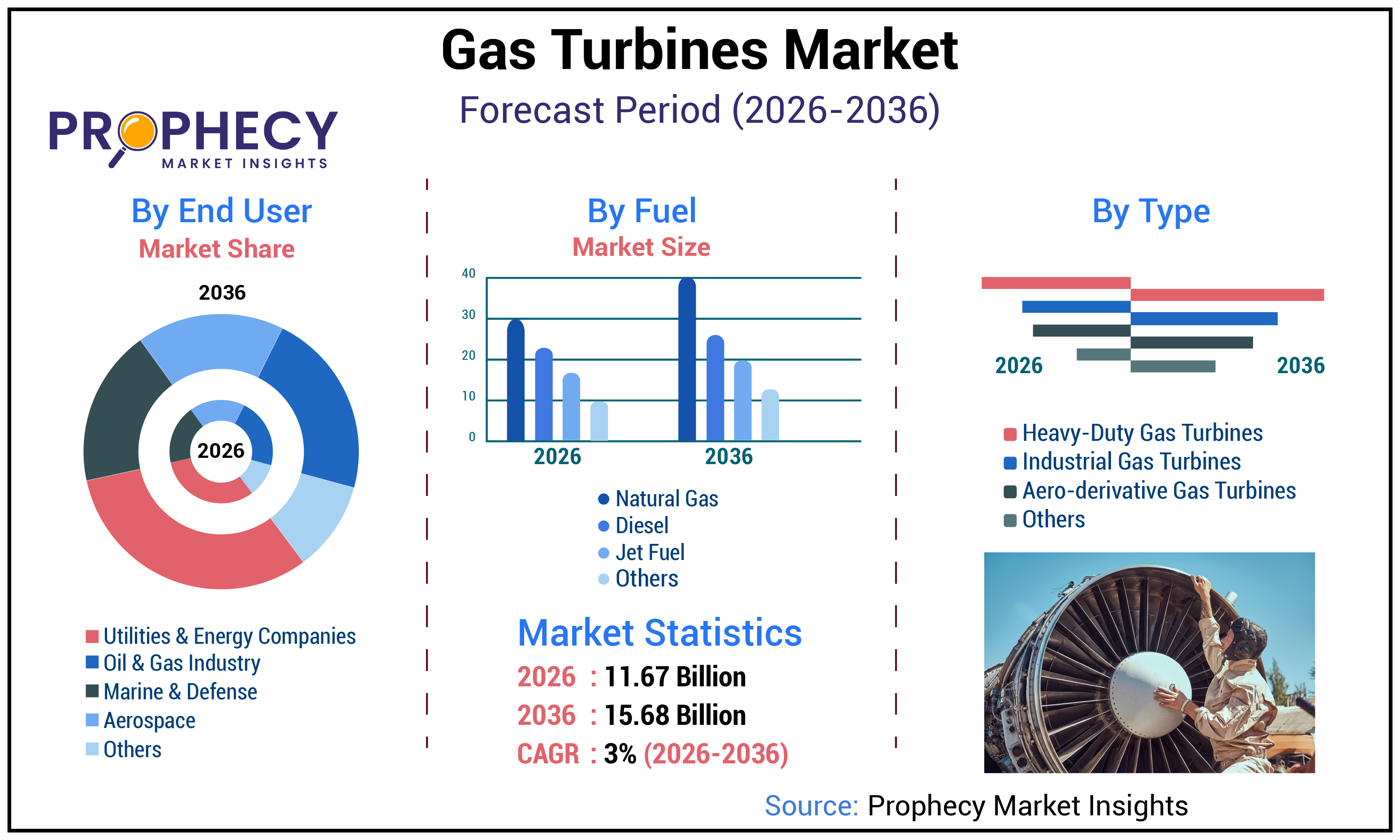
- 2025 Market Size: USD 11.33 Billion
- 2036 Projected Market Size: USD 15.68 Billion
- CAGR (2026-2036): 3%
- North America: Largest Market in 2025
Gas turbines are machines that create power through the process of burning fuel (such as natural gas or diesel) to produce high-pressure, high-velocity gas which spins a turbine that is used to drive electricity generators or mechanical equipment. Their use has been extended in sectors as power plants, airplanes, and industries due to their benefits of being efficient, taking up less space, being able to start up quickly, emission-free, and their capability to deliver stable power, making them suitable for both peak and base-load energy requirements.
Gas turbines market is expanding as the world's growing energy need, the increasing spending on power generation facilities, and the trend of clean and efficient energy supply. To add to the list of reasons for their growth, these machines are the major contributors to sustainable energy supply because they emit less carbon dioxide per kilowatt of power and do so at a very high efficiency level. Besides this, they are benefiting heavily from rapid industrialization, growing aviation and marine sectors, and the use of natural gas as a transitional fuel.
Advances in Gas Turbines:
- Present-day gas turbines have efficiency, emission reduction, and reliability enhancement as their main focus.
- Besides using advanced materials and coatings that are capable of withstanding very high temperatures, aerodynamic blade shapes for better performance, and digital monitoring and predictive maintenance technologies, among other innovations, they also have upgrades in combined cycle systems and coupling with renewable energy sources that make it possible for gas turbines to generate low-carbon, highly flexible, and economical electricity, thus supporting the global clean energy transition.
Current Industry Dynamics & Insights:
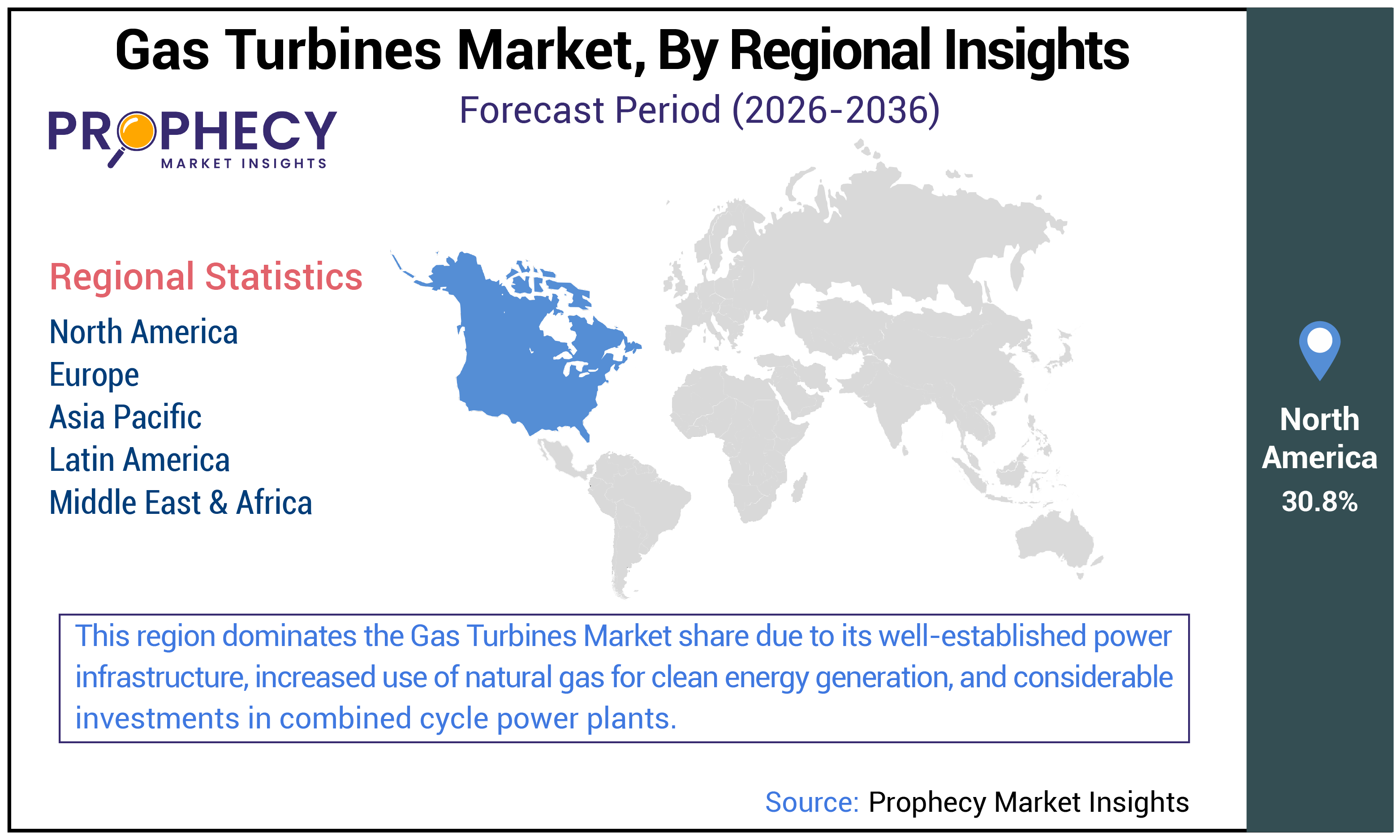
- North America has the largest regional share in the market, with almost 30.8%.
- Asia Pacific is second dominating region in the market.
- By type, heavy-duty gas turbines dominate the gas turbines market share.
Gas Turbines Market Drivers & Restraints
Drivers and Restraints:
|
Drivers |
Restraints |
Opportunities & Trends |
|
|
|
Key Drivers:
Rising Global Electricity Demand
Gas turbines are needed more than ever due to the global demand for electricity that is increasing all over the world. To meet the ever-growing need for consumption, utilities and industries require power generation solutions that are not only reliable but also flexible.
Gas turbines are the ones who can have the electricity production increased very quickly, be efficient in both base-load and peak-load conditions, and also be compatible with the existing power infrastructure, thus being the most suitable ones to solve the problem of the rising energy demand of urban and industrial areas that are getting bigger and spreading all over the world.
- For instance, according to the data published by IEA, Global electricity demand increased by 4.3% in 2024, a step change from the 2.5% growth seen in 2023. The average pace of electricity demand growth from 2010 to 2023 was 2.7%, double the rate of total energy demand growth over the same period.
Restraints:
Maintenance and Operational Complexity
The gas turbine market growth could be constrained by maintenance and operational complexities as these systems need skilled personnel, frequent inspections, and accurate handling to maintain efficiency and prevent downtime, which in turn raises the operational costs.
- Counterbalance Statements: Nevertheless, the problem is being resolved with the help of predictive maintenance, digital monitoring systems, and automation technologies that facilitate early issue detection, lessen the possibility of human error, and make operations simpler, thus alleviating limitations and enabling easier market adoption.
Opportunities & Trends:
Development of High-Efficiency Combined Cycle Turbines
One of the major future trends is the development of highly efficient combined-cycle turbines. In such a way, gas turbines can generate more electricity from the same fuel if they capture and reuse the waste heat, thus the overall efficiency can be improved significantly. This leads to the reduction of fuel costs and emissions, besides that, it makes power generation more eco-friendly and less expensive which, in turn, encourages a wider use of such technology in power plants and industrial sectors all over the globe.
Gas Turbines Market Segmentations & Regional Insights
Type, fuel type, power output, end user, and region are the divisions of the gas turbines market.
By Type:
Industrial gas turbines, aero-derivative gas turbines, heavy-duty gas turbines, and others are type on which gas turbines market is segmented. Heavy-duty gas turbines have the biggest market share among gas turbine types due to their high efficiency, dependability, and ability to operate continuously for large-scale power plants and industrial applications, making them ideal for base-load electricity generation.
Industrial gas turbines are the second most popular as they are adaptable, small, and suited for a variety of industrial and mechanical drive applications, providing flexibility for mid-sized power generating and process industries, driving their global acceptance.
By Fuel Type:
Based on the fuel type, the gas turbines market is divided into natural gas, diesel, jet fuel, and others. Natural gas dominates the gas turbines market since it is abundant, inexpensive, and produces lower emissions than other fuels, making it the favored choice for power production and industrial applications as the world shifts toward cleaner energy.
Diesel is the second most popular fuel type that it is readily available, reliable, and excellent for backup and off-grid power generation, particularly in areas with poor natural gas infrastructure, allowing for regular turbine running.
By Power Output:
The gas turbines market is categorized into small (Up to 5 MW), Medium (5–50 MW), Large (50–250 MW), Extra Large (Above 250 MW), on the account of power output. The Large (50-250 MW) segment dominates the gas turbines market share since these turbines are commonly employed in utility-scale power generating, combined cycle plants, and industrial facilities, providing the best balance of efficiency, capacity, and operational cost.
The Extra major (Above 250 MW) category is the second most dominant, driven by increased investments in major power plants and system expansion projects that require high-capacity turbines to supply vast energy demands economically and reliably.
By End User:
The gas turbines market on the account of end user is categorized utilities & energy companies, oil & gas industry, marine & defense, aerospace, and others. Utilities and energy companies dominate the gas turbines market share due to their employ them widely for large-scale electricity generation, benefiting from their high efficiency, quick start-up, and lower emissions when compared to coal-based systems.
The Oil & Gas Industry is the second most important end user, as gas turbines are essential for mechanical drives, remote power generation, and offshore operations, providing dependability and performance in harsh industrial settings.
Regional Insights:
Geographically, the gas turbines market is studied across North America, Europe, Asia Pacific, Latin America, and the Middle East & Africa.
North America: This region dominates the gas turbines market share due to its well-established power infrastructure, increased use of natural gas for clean energy generation, and considerable investments in combined cycle power plants.
- U.S. Gas Turbines Market Insights:
The U.S. leads the gas turbines market in North America owing to its vast natural gas reserves, strong focus on greener energy transition, and significant investment in modern power production infrastructure.
Asia Pacific: This region is the second most dominant, driven by rapid industrialization, rising electricity consumption, and expanding energy projects in nations such as China, India, and Japan, all of which are increasing the installation of efficient gas turbines.
- China Gas Turbines Market Insights:
China leads the Asia-Pacific market due to rapid industrial growth, large-scale urbanization, and government measures to minimize coal dependency by building natural gas-based power plants, all of which drive significant demand for sophisticated gas turbine technology.
Europe: The gas turbines market in Europe is expanding as the region accelerates its transition to low-carbon energy, modernizes its outdated power infrastructure, and integrates combined cycle power plants for cleaner and more efficient electricity generation.
- Germany Gas Turbines Market Insights:
Germany dominates the European market due to its strong emphasis on energy transition, significant investment in renewable integration with gas-based backup systems, and use of modern turbine technologies to assure dependable and sustainable power generation.
Gas Turbines Market Report Scope:
|
Attribute |
Details |
|
Market Size 2026 |
USD 11.67 Billion |
|
Projected Market Size 2036 |
USD 15.68 Billion |
|
CAGR Growth Rate |
3% (2026-2036) |
|
Base year for estimation |
2025 |
|
Forecast period |
2026 – 2036 |
|
Market representation |
Revenue in USD Billion & CAGR from 2026 to 2036 |
|
Regional scope |
North America - U.S. and Canada Europe – Germany, U.K., France, Russia, Italy, Spain, Netherlands, and Rest of Europe Asia Pacific – China, India, Japan, Australia, Indonesia, Malaysia, South Korea, and Rest of Asia-Pacific Latin America - Brazil, Mexico, Argentina, and Rest of Latin America Middle East & Africa – GCC, Israel, South Africa, and Rest of Middle East & Africa |
|
Company Landscape |
Market Share Analysis of Companies Heat Map Analysis Company Overview, Products Overview Financial Information, Key Highlights Business Strategies Overview SWOT Analysis |
|
Report coverage |
Revenue forecast, company share, competitive landscape, growth factors, and trends |
|
Value Added Data Infosets |
Besides fundamental market insights such as the size of the market, growth rate, segmentation, regional study, and key players, our reports carry value-added data sets such as trade flow (import-export) analysis, production and consumption overview, price trend evaluation, supply and value chain mapping, and raw material availability. Moreover, we provide strategic tools as PESTLE and Porter’s Five Forces analysis, examination of the regulatory landscape, as well as monitoring of technology and innovation thereby providing a comprehensive overview which facilitates sensible and anticipatory decision-making. |
Segmentation:
By Type:
- Industrial Gas Turbines
- Aero-derivative Gas Turbines
- Heavy-duty Gas Turbines
- Others
By Fuel Type:
- Natural Gas
- Diesel
- Jet Fuel
- Others
By Power Output:
- Small (Up to 5 MW)
- Medium (5–50 MW)
- Large (50–250 MW)
- Extra Large (Above 250 MW)
By End User:
- Utilities & Energy Companies
- Oil & Gas Industry
- Marine & Defense
- Aerospace
- Others
By Region:
- North America
- U.S.
- Canada
- Europe
- Germany
- U.K.
- France
- Russia
- Italy
- Spain
- Netherlands
- Rest of Europe
- Asia Pacific
- China
- India
- Japan
- Australia
- Indonesia
- Malaysia
- South Korea
- Rest of Asia Pacific
- Latin America
- Brazil
- Mexico
- Argentina
- Rest of Latin America
- Middle East & Africa
- GCC
- Israel
- South Africa
- Rest of Middle East & Africa
Gas Turbines Market Competitive Landscape & Key Players
Investing in research and development to produce more effective, stable, and affordable enzyme versions through recombinant and protein engineering technologies is one of the main growth strategies for ligase enzyme firms. In order to broaden their application areas in genomics, diagnostics, and therapies, companies are also concentrating on strategic partnerships with biotech and pharmaceutical companies.
Gas Turbines Market Companies:
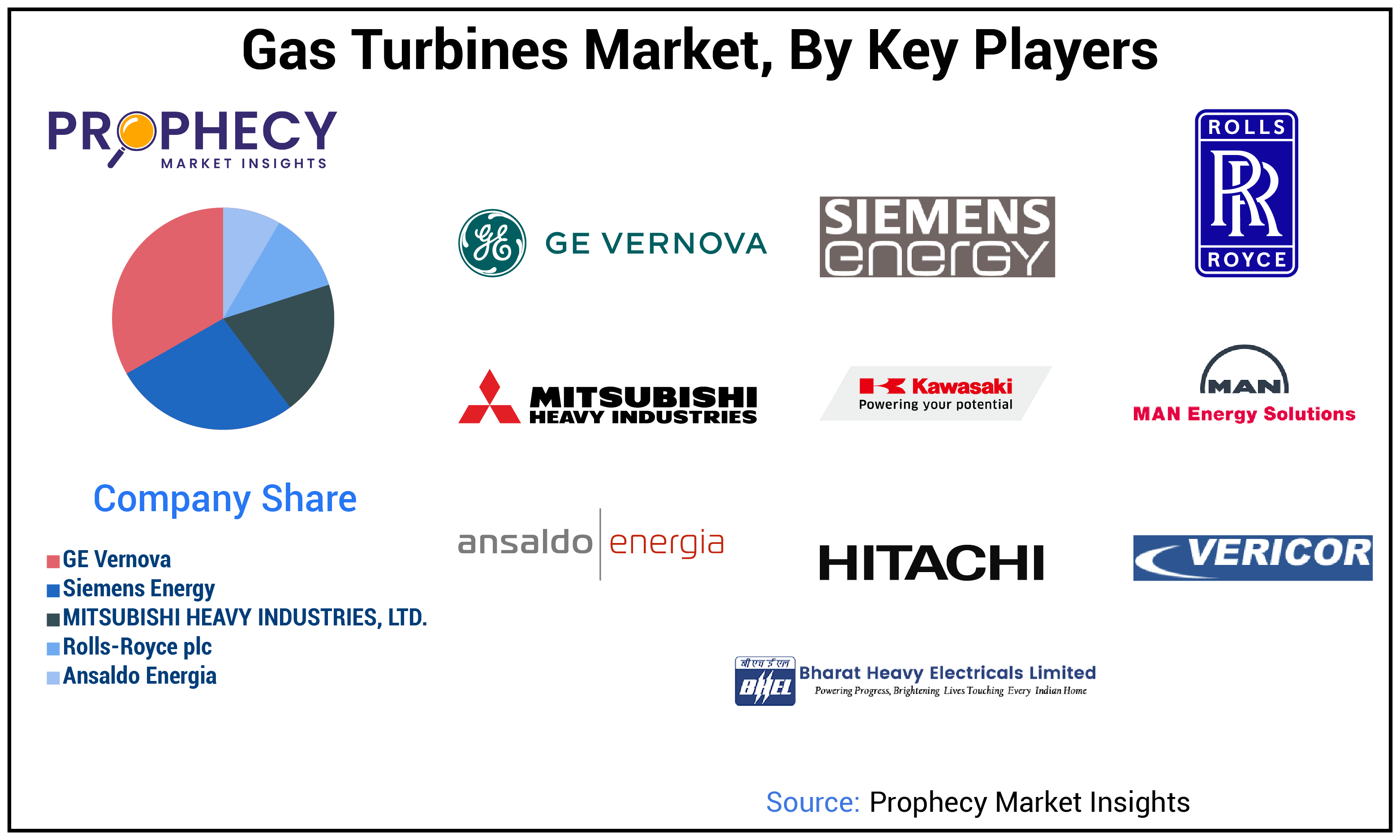
- GE Vernova
- Siemens Energy
- MITSUBISHI HEAVY INDUSTRIES, LTD.
- Rolls-Royce plc
- Ansaldo Energia
- Harbin Electric Corporation co.,Ltd
- MAN Energy Solutions Group
- Kawasaki Heavy Industries, Ltd.
- Doosan Enerbility
- Bharat Heavy Electricals Limited
- Hitachi Energy Ltd
- Vericor Power Systems
- Centrax Gas Turbines
- Harbin Electric Corporation co.,Ltd
- MAPNA Group
View an Additional List of Companies in the Gas Turbines Market
Gas Turbines Market Recent News
- In November 2025, GE Vernova Inc. stated that Jafurah Cogeneration Independent Steam and Power Plant (ISPP) has begun commercial operations. The factory is located around 125 kilometers southeast of Dammam, Saudi Arabia. GE Vernova provided a comprehensive solution that included the primary power plant equipment, the 7HA.01 gas turbine, and a 20-year service agreement that included maintenance and parts supply, with the goal of managing all aspects of the engine's life cycle.
Analyst View:
The gas turbines market is expanding fast as global energy demand rises, power generation investments increase, and the focus shifts to sustainable and efficient energy solutions. Gas turbines, which generate electricity by burning fuels such as natural gas or diesel, are prized for their high efficiency, compact design, quick start-up, and low emissions, making them suitable for both power plants and industrial applications. Their importance in promoting sustainable energy, together with growth in the industrial, aviation, and marine sectors, continues to drive global market expansion.
Analysis of Sources:
Primary Sources:
- In-depth interviews
- Company-specific data
- Surveys and questionnaires
- Focus group discussions (FGDs)
- Others
Secondary Sources:
- U.S. Energy Information Administration (EIA)
- International Energy Agency (IEA)
- European Commission (EC)
- Eurostat
- Others
More Related Reports
Fire and Gas Detection System Market
Medical Gases Market
Oil and Gas Accumulators Market
Liquefied Petroleum Gas Market
Cryogenic Gas Market
Gas Turbines Market Company Profile
|
Company Name |
Product Portfolio |
|
GE Vernova |
Aeroderivative and Heavy-Duty Gas Turbines |
|
Ansaldo Energia |
Heavy-Duty Gas Turbines |
|
MITSUBISHI HEAVY INDUSTRIES, LTD. |
Gas Turbines |
|
Rolls-Royce plc |
Marine Gas Turbines |
|
Kawasaki Heavy Industries, Ltd. |
Industrial Gas Turbines |
Gas Turbines Market Highlights
FAQs
Gas turbines market size was valued at USD 11.67 Billion in 2026 and is expected to reach USD 15.68 Billion by 2036 growing at a CAGR of 3%.
Type, fuel type, power output, end user, and region are the segmentation for the gas turbines market.
Rising global electricity demand driven by urbanization and industrialization, a global shift toward cleaner energy sources as natural gas, and so on are some of the gas turbines market growth drivers.
North America, Asia Pacific, Europe, Latin America, and the Middle East & Africa. North America is expected to dominate the gas turbines market.
The key players operating the gas turbines market include GE Vernova, Siemens Energy, MITSUBISHI HEAVY INDUSTRIES, LTD., Rolls-Royce plc, Ansaldo Energia, Harbin Electric Corporation co.,Ltd, MAN Energy Solutions Group, Kawasaki Heavy Industries, Ltd., Bharat Heavy Electricals Limited, Hitachi Energy Ltd, Vericor Power Systems, Centrax Gas Turbines, Harbin Electric Corporation co.,Ltd, and MAPNA Group.