Europe Hydrogen Ships Market Overview
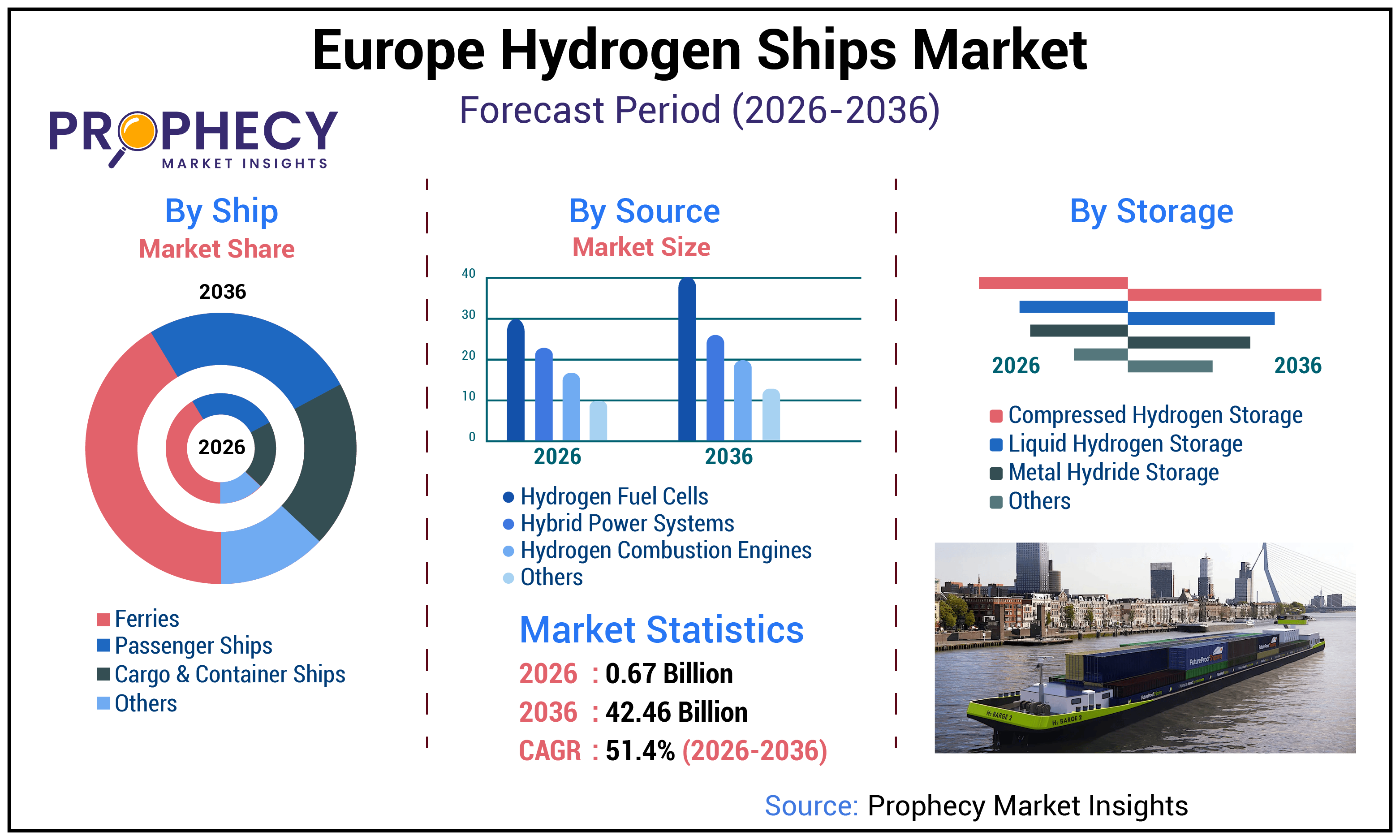
- 2026 Market Size: USD 0.67 Billion
- 2036 Projected Market Size: USD 42.46 Billion
- CAGR (2026-2036): 51.4%
Hydrogen ships are ships that use hydrogen fuel cells or hydrogen-based engines for power. In a fuel cell, hydrogen is combined with oxygen to generate electricity and the only emission is water vapor. In addition to zero CO2 emissions during use, they also produce less noise and less local pollutants, have a higher energy efficiency than conventional marine fuels, and could be a sustainable solution for the global maritime sector to reach carbon neutrality while maintaining vessel range and power.
Europe hydrogen ships market ??is expanding primarily as a result of the region’s aggressive decarbonization policies, the tightening of regulations on the emission of gases from the sea, and the setting by the EU of ambitious net-zero targets. The major injection of funds made by the government into the production of green hydrogen, the extension of the hydrogen bunkering infrastructure, and numerous large-scale pilot projects at ports such as Rotterdam and Hamburg are, together, the reasons for the rapid pace of the adoption.
Moreover, Europe’s position as the leader in marine clean technology, the cooperation between shipbuilders and energy companies, and the increasing need for zero-emission shipping solutions, to name a few, are the factors that are, collectively, pushing the market up.
Guidelines to Implement H2 Propulsion in North West Europe:
- Implementing guidelines of hydrogen (H2) propulsion in North West Europe concentrate on the creation of a thoroughly integrated ecosystem that links the supply of hydrogen, bunkering infrastructure, and vessel deployment.
- Some of the main moves comprise of green hydrogen production being made available to everyone on a large-scale basis, safety and regulatory frameworks being standardized in different countries, and various ports as Rotterdam, Antwerp, and Hamburg getting lined with hydrogen bunkering facilities.
- The collaboration between ship-owners, port authorities, energy suppliers, and policymakers is a must and at the same time the early entrants should be given subsidies and carbon-reduction credits as an incentive.
- To sum up, the region will be able to see a quick large-scale implementation of hydrogen-powered vessels if along with pilot projects there will be crew training and continuous technology validation that will help in operations going without risk.
Europe Hydrogen Ships Market Drivers & Restraints
Drivers and Restraints:
|
Drivers |
Restraints |
Opportunities & Trends |
|
|
|
Key Drivers:
Strict EU Maritime Emission Regulations
The Europe hydrogen ships market is expanding due to the regulations imposed by the EU on maritime emissions. These regulations have made it necessary for ship-owners to move away from fossil-fuel propulsion and towards low- and zero-emission alternatives. Various measures such as FuelEU Maritime, the EU Emissions Trading System expansion, and the Fit for 55 package are gradually increasing the penalties for vessels that are carbon-intensive and are setting targets for emissions reduction for new builds as well as for existing fleets.
Compliance with the use of conventional fuels is becoming more and more expensive due to these rules, thus investors are encouraged to invest in hydrogen propulsion, which not only allows ships to meet regulatory levels but also helps them avoid carbon costs and be in line with the requirements for decarbonization in the long term.
- For instance, according to the data published by European Maritime Safety Agency, The Fuel EU Maritime Regulation is a complementary regulation to the EU ETS, ensuring that the greenhouse gas intensity of fuels used by the shipping sector will gradually decrease over time. It contributes to the EU-wide target of reducing net emissions by at least 55% by 2030, and to achieving climate neutrality in 2050.
Restraints:
Slow Commercialization
Relatively to strict EU maritime emission regulations, e.g., Fit for 55 and FuelEU Maritime, the market is experiencing growth, as these regulations force ship-owners to adopt cleaner propulsion systems, thus making hydrogen a more attractive long-term zero-emission solution, which is supported by subsidies and compliance incentives. Actually, a slow commercialization of hydrogen ships due to the fact that it is a technology in its early stage, with high costs and limited large-scale deployment can limit the market development.
- Counterbalance Statements: Such a situation may be resolved by an accelerated pace of pilot projects, harmonized EU standards, increased funds for demonstration programs and, extending hydrogen bunkering infrastructure, thus the early movers will be less exposed to risks.
Opportunities & Trends:
Rapid Development of Hydrogen-Powered Ferries and Short-Sea Vessels
The fast growth of hydrogen-powered ferries and short-sea vessels is becoming a significant future trend for a reason these routes are perfect for the first use of hydrogen for a foreseeable distance, frequent port access, and lower fuel consumption compared to deep-sea ships. The increasing number of European countries using H2 ferries for passenger transport and regional logistics will thus lay the groundwork for hydrogen infrastructure, increase technology trust, and facilitate the spread of the hydrogen sector.
Europe Hydrogen Ships Market Segmentations & Regional Insights
Ship type, source, storage type, end user, and country are the divisions of the Europe hydrogen ships market.
By Ship Type:
Passenger ships, cargo & container ships, ferries, and others are type on which Europe Hydrogen Ships Market is segmented. Ferries hold the largest Europe hydrogen ships market share due to their operate on fixed, short-to-medium routes that are ideal for early hydrogen adoption, and many European countries especially in the Nordics, the U.K., Germany, and the Netherlands are actively deploying hydrogen-powered ferries through government-funded pilot projects.
Passenger ships are the second-largest market, driven by high demand for clean, quiet, and emission-free vessels for tourism and coastal transportation, as well as growing regulatory pressure on cruise and sightseeing operators to minimize emissions in environmentally sensitive areas.
By Source:
Based on the source, the Europe hydrogen ships market is divided into hydrogen fuel cells, hydrogen combustion engines, hybrid power systems, and others. In the Europe hydrogen ships market growth hydrogen fuel cells have the biggest market share given that they offer entirely zero-emission operations, are firmly aligned with EU decarbonization ambitions, and are commonly favored for ferries and passenger vessels operating in emission-controlled zones.
Hybrid power systems are the second most popular segment, as they provide a practical transition solution by combining hydrogen with batteries or conventional engines, lowering fuel risk while increasing efficiency and allowing operators to adopt hydrogen technology without completely overhauling existing power systems.
By Storage Type:
The Europe hydrogen ships market is categorized into compressed hydrogen storage, liquid hydrogen storage, metal hydride storage, and others on the account of application. Compressed hydrogen storage has the largest Europe hydrogen ships market share since it is the most mature, commercially available, and cost-effective technology, providing easier handling, established safety standards, and compatibility with short- and medium-range vessels commonly used in European waters.
Liquid hydrogen storage is the second-largest segment, driven by its higher energy density, which allows for longer maritime routes and larger vessels, but it lags behind compressed storage due to higher liquefaction costs, complex insulation requirements, and lower current infrastructure readiness.
By End User:
The Europe hydrogen ships market on the account of end user is categorized shipping companies, port authorities, defense organizations, offshore energy operators, and others. Shipping companies dominate Europe hydrogen ship market size since they are the first to invest in zero-emission boats to comply with EU decarbonization standards and decrease long-term operational expenses. They also operate the most diverse fleet (ferries, passenger vessels, and cargo ships), making them the primary drivers of early hydrogen adoption.
Port authorities are the second-largest category because they play an important role in establishing hydrogen bunkering infrastructure, facilitating pilot projects, and supporting green shipping lanes that speed up the transition to hydrogen-powered maritime operations across Europe.
By Country:
By country, the market is categorized into Germany, U.K., France, Russia, Italy, Spain, Netherlands, and Rest of Europe. Germany leads the Europe hydrogen ships market size due to its robust hydrogen ecosystem, considerable government investment, and early deployment of hydrogen-powered vessels and pilot projects in key ports such as Hamburg.
The country also leads in fuel-cell technology research and large-scale green hydrogen generation projects, providing it a technological and infrastructure advantage. Norway follows closely as the second-leading market, due to its rapid adoption of zero-emission ferries, strong maritime innovation regulations, and considerable expenditures in hydrogen-based maritime pilot programs along its coastal routes.
Europe Hydrogen Ships Market Report Scope:
|
Attribute |
Details |
|
Market Size 2026 |
USD 0.67 Billion |
|
Projected Market Size 2036 |
USD 42.46 Billion |
|
CAGR Growth Rate |
51.4% (2026-2036) |
|
Base year for estimation |
2025 |
|
Forecast period |
2026 – 2036 |
|
Market representation |
Revenue in USD Billion & CAGR from 2026 to 2036 |
|
Regional scope |
Europe – Germany, U.K., France, Russia, Italy, Spain, Netherlands, and Rest of Europe |
|
Company Landscape |
Market Share Analysis of Companies Heat Map Analysis Company Overview, Products Overview Financial Information, Key Highlights Business Strategies Overview SWOT Analysis |
|
Report coverage |
Revenue forecast, company share, competitive landscape, growth factors, and trends |
|
Value Added Data Infosets |
Besides fundamental market insights such as the size of the market, growth rate, segmentation, regional study, and key players, our reports carry value-added data sets such as trade flow (import-export) analysis, production and consumption overview, price trend evaluation, supply and value chain mapping, and raw material availability. Moreover, we provide strategic tools as PESTLE and Porter’s Five Forces analysis, examination of the regulatory landscape, as well as monitoring of technology and innovation thereby providing a comprehensive overview which facilitates sensible and anticipatory decision-making. |
Segmentation:
By Ship Type:
- Passenger Ships
- Cargo & Container Ships
- Ferries
- Others
By Source:
- Hydrogen Fuel Cells
- Hydrogen Combustion Engines
- Hybrid Power Systems
- Others
By Storage Type:
- Compressed Hydrogen Storage
- Liquid Hydrogen Storage
- Metal Hydride Storage
- Others
By End User:
- Shipping Companies
- Port Authorities
- Defense Organizations
- Others
By Country:
- Germany
- U.K.
- France
- Russia
- Italy
- Spain
- Netherlands
- Rest of Europe
Europe Hydrogen Ships Market Competitive Landscape & Key Players
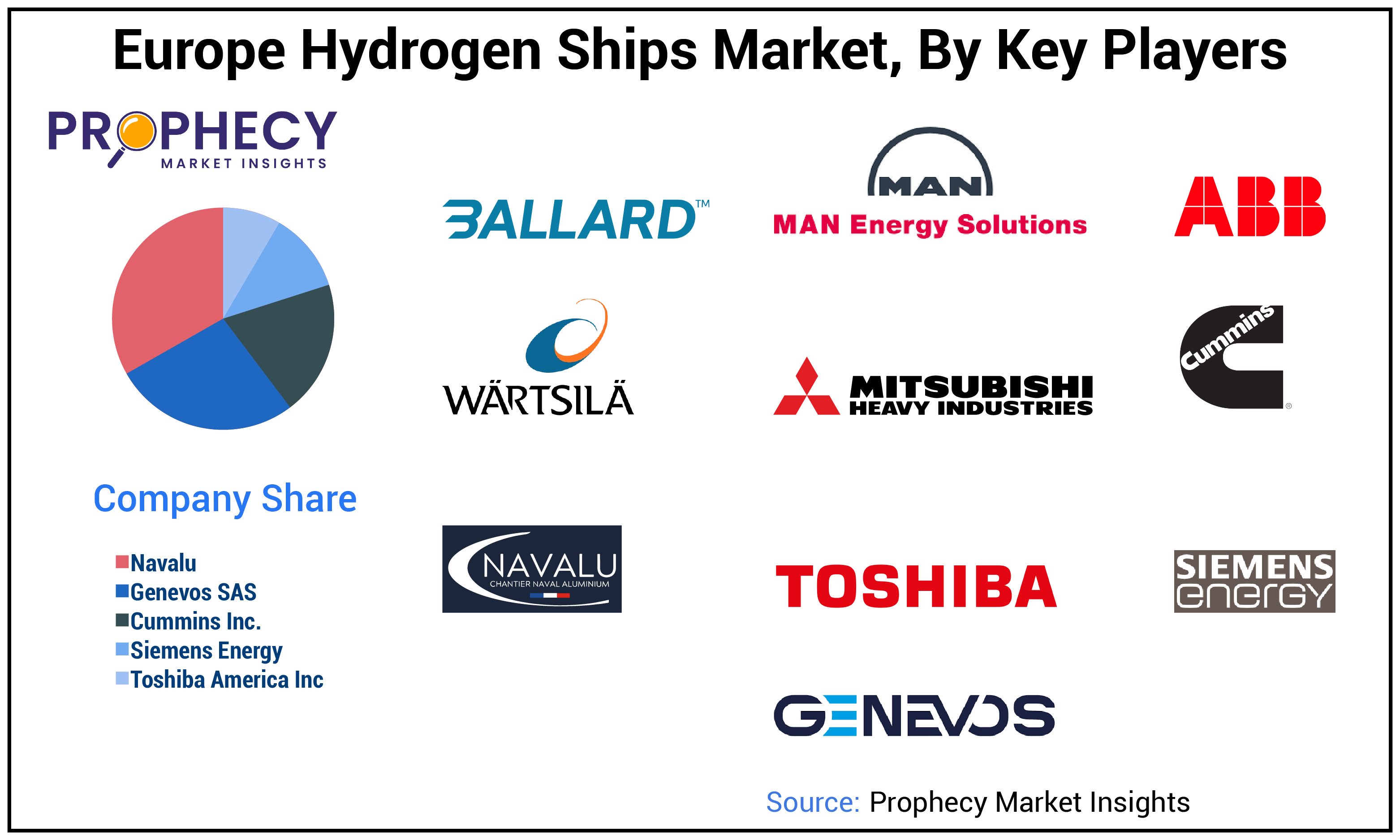
Hydrogen ship companies in Europe are concentrating on key growth strategies such as expanding pilot projects for hydrogen-powered ferries and coastal vessels, forming strategic alliances with shipyards, energy providers, and port authorities, and investing heavily in fuel cell and storage technology advances.
They are also increasing green hydrogen production through cooperation with renewable energy providers, creating hydrogen bunkering infrastructure at major ports, and aligning closely with EU regulatory frameworks such as FuelEU Maritime to secure compliance advantages.
Europe Hydrogen Ships Market Companies:
- Navalu
- Genevos SAS
- Cummins Inc.
- Siemens Energy
- Toshiba America Inc
- CMB.TECH nv
- HYDROGENIOUS MARITIME
- Ballard Power Systems
- MAN Energy Solutions
- ABB
- Wärtsilä
- MITSUBISHI HEAVY INDUSTRIES, LTD.
- Kawasaki Heavy Industries, Ltd.
- Norled
- PowerCell Sweden AB
Europe Hydrogen Ships Market Recent News
- In January 2025, Lithuania's Klaip?da State Seaport Authority has launched the country's first green hydrogen and electricity-powered vessel, aimed at improving port trash management with a strong environmental impact. This innovative €12 million initiative, a combined effort between the Port Authority and West Baltic Shipyard, represents a significant step towards sustainable maritime operations.
Analyst View:
Europe's hydrogen ship sector is fast expanding as the continent pushes for aggressive decarbonization and higher maritime emission rules, bolstered by the EU's net-zero ambitions. Strong government investments in green hydrogen generation, expansion of hydrogen bunkering facilities, and significant pilot projects at ports such as Rotterdam and Hamburg are driving acceptance. Europe's leadership in clean marine technology, collaboration between shipbuilders and energy suppliers, and increased demand for zero-emission boats all contribute to the market's momentum, establishing hydrogen ships as a vital solution for sustainable maritime transportation.
Analysis of Sources:
Primary Sources:
- In-depth interviews
- Company-specific data
- Surveys and questionnaires
- Focus group discussions (FGDs)
- Others
Secondary Sources:
- European Commission
- Eurostat
- Others
More Related Reports
Clean Hydrogen Market
Hydrogen Generation Market
Hydrogen Fuel Cell Vehicle Market
Hydrogen Market
Hydrogen Trucks Market
Europe Hydrogen Ships Market Company Profile
|
Company Name |
Product Portfolio |
|
MITSUBISHI HEAVY INDUSTRIES, LTD. |
Ship & Ocean |
|
MAN Energy Solutions |
Hydrogen Power Solutions |
|
ABB |
Fuel Cell Systems for Ships |
|
Wärtsilä |
Hybrid Marine System |
|
Norled |
Hydrogen Ferry |
FAQs
Europe hydrogen ships market size was valued at USD 0.67 Billion in 2026 and is expected to reach USD 42.46 Billion by 2036 growing at a CAGR of 51.4%.
Ship type, source, storage type, end user, and country are the segmentation for the Europe hydrogen ships market.
Increasing demand for sustainable maritime solutions, cross-border collaboration on hydrogen infrastructure, and a strong focus on developing renewable hydrogen production, and so on are some of the Europe hydrogen ships market growth drivers.
The key players operating the Europe hydrogen ships market include Navalu, Genevos SAS. Siemens Energy, Toshiba America Inc, CMB.TECH nv, HYDROGENIOUS MARITIME, Ballard Power Systems, MAN Energy Solutions, ABB, Wärtsilä, MITSUBISHI HEAVY INDUSTRIES, LTD., Kawasaki Heavy Industries, Ltd., Norled, and PowerCell Sweden AB.