Enterprise Llm Market Overview
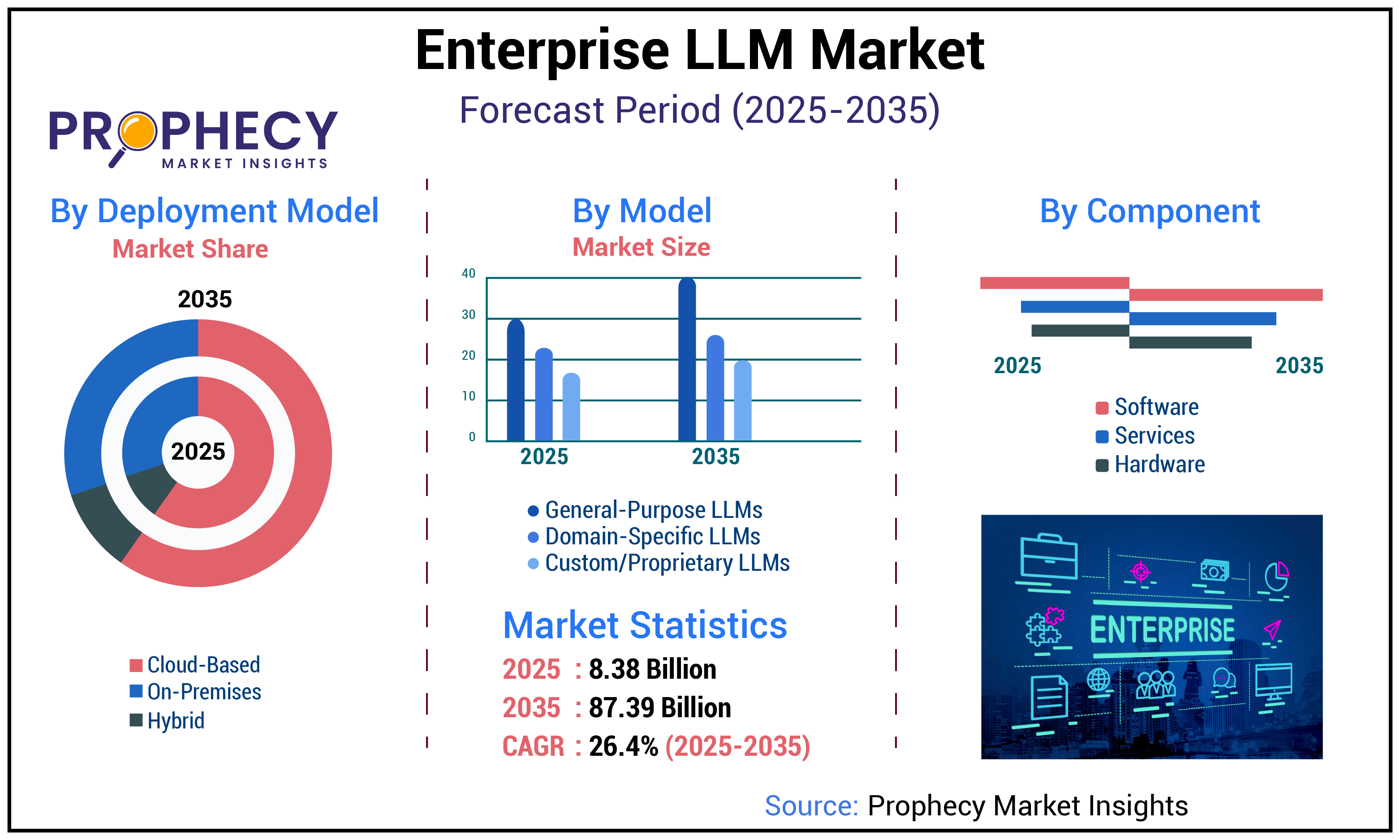
- 2024 Market Size: USD 6.8 Billion
- 2035 Projected Market Size: USD 87.39 Billion
- CAGR (2025-2035): 26.4%
- North America: Largest Market in 2024
An enterprise large language model (LLM) is a business-oriented AI-powered model that can comprehend, create, and evaluate human-like text in a wide range of enterprise applications. By its Consulting Services in a company, the repetitive activities in customer support, data analysis, content generation, and decision-making are automated.
To list the main advantages, apart from the optimized business processes, these are: enriched customer experiences, quick access to large volumes of data, less manual work, and the possibility for companies to deploy AI solutions as per the requirements of their particular sector that can be scaled up or down.
The enterprise LLM market is changing quickly due to the various industries are becoming more and more digitally transformed. The main reasons for this increase in demand are AI-driven automation, which is highly demanded in many sectors, and the need for data processing to be done at a much faster and more accurate way than before.
Improvements in natural language understanding, increasing cloud capacity, and the availability of off-the-shelf as well as customizable models are factors that help enterprises to easily get on board with this technology. Furthermore, companies want to improve the experience of their customers, save costs, and gain a competitive advantage in the market, which are the main reasons behind the massive deployment of enterprise LLM solutions.
The State of Enterprise LLM Preparedness and Adoption:
- The condition of enterprise LLM readiness and consulting services portrays a somewhat inconsistent scenario that is expanding. Large enterprises are quickly embedding LLMs into their operations, whereas SMEs are slowly venturing into pilot projects and cloud-based solutions.
- Companies are putting money into the necessary hardware, data governance, and AI talent to be able to deploy efficiently, but issues such as data privacy, model explainability, and regulatory compliance are still there.
- On the whole, LLMs are being perceived by enterprises more and more as instrumental means for automation, decision support, and improved customer engagement, thus indicating a gradual and steady move towards wider adoption in various industries.
Current Industry Dynamics & Insights:
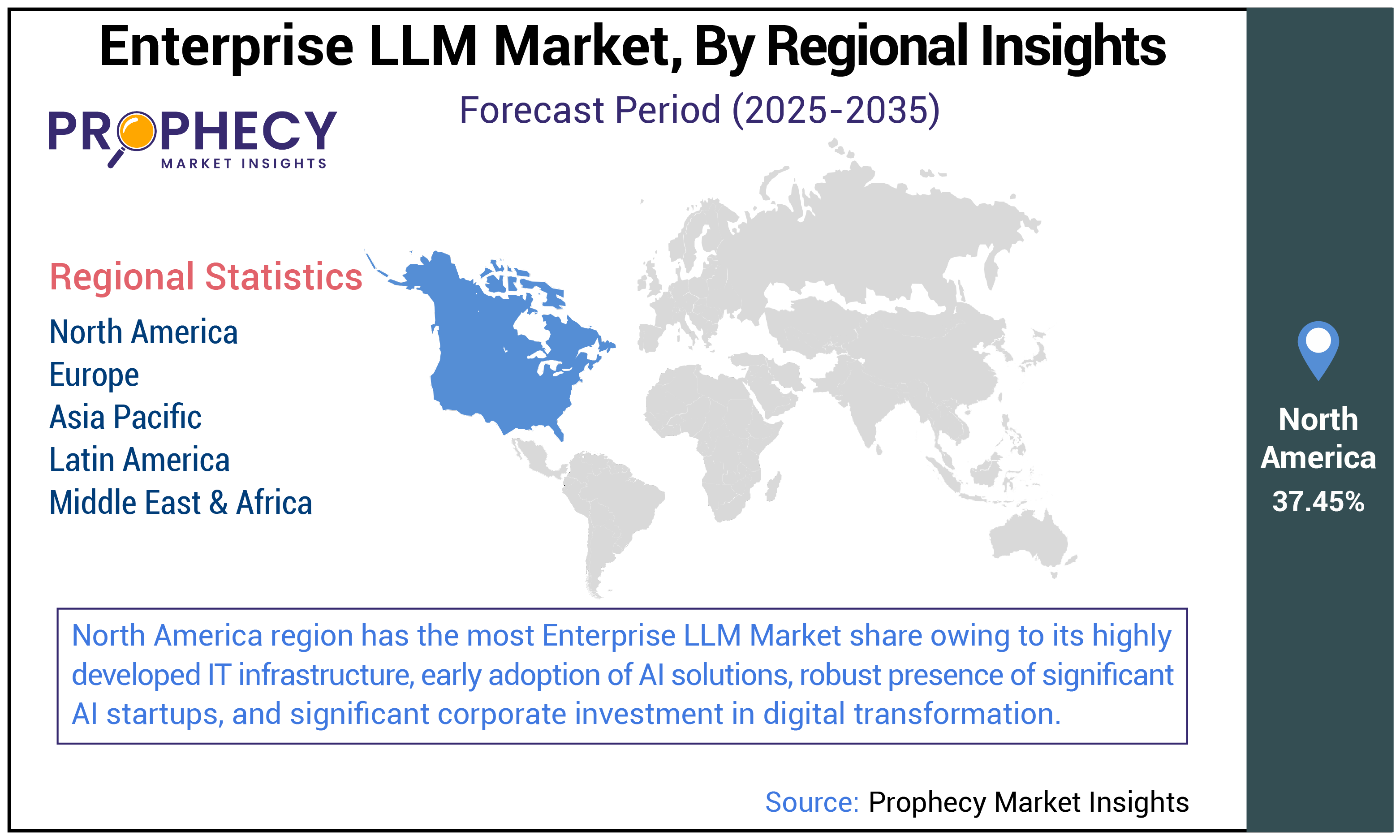
- North America has the largest regional share in the market, with almost 37.45%.
- Europe is second dominating region in the market.
- By component, software dominates the enterprise LLM market.
Enterprise Llm Market Drivers & Restraints
Drivers and Restraints:
|
Drivers |
Restraints |
Opportunities & Trends |
|
|
|
Key Drivers:
Growing Adoption of Cloud-based AI Solution
One of the main factors behind the expansion of the Enterprise LLM market is the increasing use of AI solutions based on the cloud by companies. These solutions provide excellent language models with flexible, scalable, and cost-effective access to users without the need for a significant investment in on-premises infrastructure.
Deployment is made easy by cloud platforms, which also provide integration that is seamless with the systems already in place in organizations of any size, thus, they can use LLM capabilities for automation, analytics, and customer engagement. Such accessibility is a powerful adoption accelerator, barrier to operations reducer, and market expander in that it makes advanced AI solutions available to a larger number of enterprises.
- For Instance, according to data published by Evans Data Corporation, the Cloud is the leading environment for AI and General-Purpose LLMs development, with nearly 9.7 million developers worldwide running their AI workloads in cloud infrastructure.
Restraints:
Limited AI Talent and Expertise in Enterprises
The expansion of the Enterprise LLM market could be limited by the scarcity of skilled AI talent and expertise, as companies might find it difficult to efficiently implement, fine-tune, and operate complex language models, which in turn results in a slower rate of adoption and less than optimal outcomes.
- Counterbalance Statements: One of the ways through which enterprises can bridge the gap in talent and still take advantage of LLM functionalities is by the following measures: Installing AI knowledge among internal employees, engaging with AI service vendors, utilizing pre-trained and ready-to-use LLM products, and adopting cloud-based platforms that facilitate deployment and management.
Opportunities & Trends:
Shift toward Domain-Specific and Custom LLMs
The move to domain-specific and custom LLMs is a major future trend of the Enterprise LLM market, which is caused by the fact that companies need AI models tailored to their industry, processes, and regulatory requirements more and more. Custom models offer higher precision, deeper contextual understanding, and observance of sector-specific standards, thus improving the performance of such applications as healthcare diagnostics, legal analysis, or financial risk assessment. The trend increases the size of the market as a result of enterprises being willing to pay for such solutions that enable them to get more relevant insights and have a competitive advantage.
Enterprise Llm Market Segmentations & Regional Insights
Component, model type, deployment model, application, end user, and region are the divisions of the enterprise LLM market.
By Component:
Hardware, software, and services are component on which enterprise LLM Market is segmented. The software component has largest enterprise LLM market share since it contains the fundamental LLM platforms, analytics tools, APIs, and model management solutions needed to deploy and use language models throughout businesses. As a result, it is the most popular and lucrative market segment.
The services component is the second most important one since, given the technical complexity and requirement for experience in corporate settings, Integration Services, integration, training, and support services are essential for the effective deployment, customization, and upkeep of LLMs.
By Model Type:
Based on the model type, the enterprise LLM market is divided into general-purpose LLMs, domain-specific LLMs, and custom/proprietary LLMs. General-purpose LLMs are the most often used solutions in the enterprise LLM market as they are ready-to-use and adaptable to a variety of applications in various industries, allowing for quicker adoption without requiring significant customization.
The second most popular LLMs are domain-specific ones, as businesses look for models that are specific to their use case or industry (e.g., healthcare, finance, or law) in order to increase accuracy, comply with regulations, and obtain more pertinent insights.
By Deployment Model:
Cloud-based, on-premises, and hybrid are deployment model of the enterprise LLM market. The cloud-based deployment strategy is the industry leader in the enterprise LLM market since it provides scalability, cost-effectiveness, and convenient access to robust LLMs without requiring a substantial amount of on-premises infrastructure, making it suitable for businesses of all sizes.
The second most popular deployment approach is on-premises due to businesses with stringent security, privacy, and compliance needs would rather run LLMs in-house to preserve control over private data and adhere to legal regulations.
By End User:
Retail and e-commerce, healthcare, finance and BFSI, and others are end users of the Enterprise LLM Market. The retail and e-commerce industry has the most enterprise LLM market share since companies are using LLMs more and more for chatbots, recommendation engines, sales forecasting, and personalized customer experiences—all of which increase revenue and customer engagement.
In the second-most-dominant area, finance and BFSI, LLMs are used for automated customer service, risk management, and fraud detection, where accuracy and efficiency are crucial, leading to widespread adoption in this sector.
Regional Insights:
Geographically, the enterprise LLM market is studied across North America, Europe, Asia Pacific, Latin America, and the Middle East & Africa.
North America: This region has the most enterprise LLM market share owing to its highly developed IT infrastructure, early adoption of AI solutions, robust presence of significant AI startups, and significant corporate investment in digital transformation.
- U.S. Enterprise LLM Market Insights:
The U.S. leads the enterprise LLM market in North America by virtue of its large number of top AI businesses, robust R&D capabilities, substantial cloud infrastructure, and early adoption of cutting-edge corporate AI solutions.
Europe: According to encouraging government initiatives, expanding investments in R&D, especially in industries as manufacturing, healthcare, and finance, and growing adoption of AI across industries, Europe is now the second most dominant region.
- U.K. Enterprise LLM Market Insights:
The U.K. is at the forefront of AI research in Europe owing to strong government policies, extensive use of AI technologies in industries including professional services, healthcare, and finance, and other factors.
Asia Pacific: Rapid digital transformation, rising cloud use, rising AI investments, and growing organizational attention on automation and data-driven decision-making are all contributing factors to the growth of the enterprise LLM market in the Asia-Pacific (APAC) region.
- China Enterprise LLM Market Insights:
China is the market leader among APAC nations because to its sizable enterprise base, substantial investment in AI R&D, encouraging government policies for AI adoption, and rising need for sophisticated language models in sectors like healthcare, e-commerce, and finance.
Enterprise LLM Market Report Scope:
|
Attribute |
Details |
|
Market Size 2025 |
USD 8.38 Billion |
|
Projected Market Size 2035 |
USD 87.39 Billion |
|
CAGR Growth Rate |
26.4% (2025-2035) |
|
Base year for estimation |
2024 |
|
Forecast period |
2025 – 2035 |
|
Market representation |
Revenue in USD Billion & CAGR from 2025 to 2035 |
|
Regional scope |
North America - U.S. and Canada Europe – Germany, U.K., France, Russia, Italy, Spain, Netherlands, and Rest of Europe Asia Pacific – China, India, Japan, Australia, Indonesia, Malaysia, South Korea, and Rest of Asia-Pacific Latin America - Brazil, Mexico, Argentina, and Rest of Latin America Middle East & Africa – GCC, Israel, South Africa, and Rest of Middle East & Africa |
|
Company Landscape |
Market Share Analysis of Companies Heat Map Analysis Company Overview, Products Overview Financial Information, Key Highlights Business Strategies Overview SWOT Analysis |
|
Report coverage |
Revenue forecast, company share, competitive landscape, growth factors, and trends |
|
Value Added Data Infosets |
Besides fundamental market insights such as the size of the market, growth rate, segmentation, regional study, and key players, our reports carry value-added data sets such as trade flow (import-export) analysis, production and consumption overview, price trend evaluation, supply and value chain mapping, and raw material availability. Moreover, we provide strategic tools as PESTLE and Porter’s Five Forces analysis, examination of the regulatory landscape, as well as monitoring of technology and innovation thereby providing a comprehensive overview which facilitates sensible and anticipatory decision-making. |
Segmentation:
By Component:
- Hardware
- GPUs
- AI Accelerators & TPUs
- Others
- Software
- LLM Platforms & Frameworks
- APIs & SDKs
- Others
- Services
- Consulting Services
- Integration Services
- Others
By Model Type:
- General-Purpose LLMs
- Domain-Specific LLMs
- Custom/Proprietary LLMs
By Deployment Model:
- Cloud-based
- On-premises
- Hybrid
By End User:
- Retail and E-commerce
- Healthcare
- Finance and BFSI
- Others
By Region:
- North America
- U.S.
- Canada
- Europe
- Germany
- U.K.
- France
- Russia
- Italy
- Spain
- Netherlands
- Rest of Europe
- Asia Pacific
- China
- India
- Japan
- Australia
- Indonesia
- Malaysia
- South Korea
- Rest of Asia Pacific
- Latin America
- Brazil
- Mexico
- Argentina
- Rest of Latin America
- Middle East & Africa
- GCC
- Israel
- South Africa
- Rest of Middle East & Africa
Enterprise Llm Market Competitive Landscape & Key Players
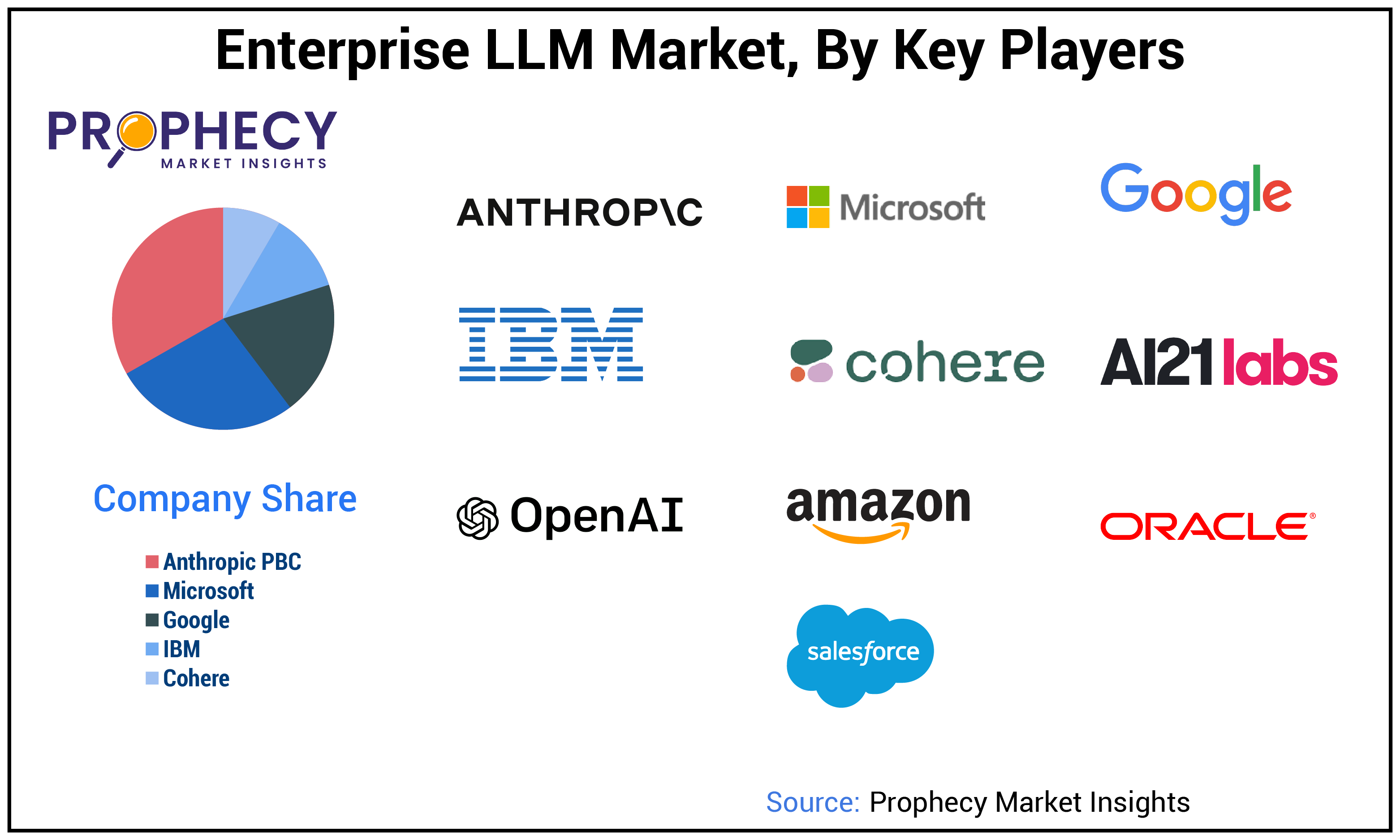
The key players operating in the enterprise LLM market include, Microsoft, Amazon Web Services, IBM, and others. Developing domain-specific and customizable models, growing cloud-based offerings, establishing strategic alliances with businesses and tech companies, investing in R&D for advanced NLP capabilities, and improving services such as integration, support, and training to promote adoption and provide customized AI solutions across industries are some of the main growth strategies for enterprise LLM companies.
Enterprise LLM Market Companies:
- Anthropic PBC
- Microsoft
- IBM
- Cohere
- AI21 Labs
- Amazon Web Services
- OpenAI
- Oracle
- Salesforce, Inc.
- Yandex
- Counsel AI Corporation
- Tencent Cloud
- Bacancy
- InData Labs
View an Additional List of Companies in the Enterprise LLM Market
Enterprise Llm Market Recent News
- In October 2025, Timbr.ai introduces its Enterprise LLM Foundation, a fundamental feature that enables businesses to control, grow, and maximize the use of LLM across structured data. The foundation, which is based on Timbr's SQL knowledge graph, consists of metric logic, access restrictions, AI-ready modeling, and SDKs to support responsible and effective LLM applications.
Analyst View:
An enterprise LLM is a business-oriented artificial intelligence model that improves productivity, customer satisfaction, and scalability by automating processes including data analysis, content production, customer support, and decision-making.
Digital transformation, the need for AI-powered automation, faster and more accurate data processing, sophisticated natural language understanding, cloud adoption, and the availability of customizable models all of which help businesses cut costs and obtain a competitive edge liar the main drivers of this market's explosive growth.
Analysis of Sources:
Primary Sources:
- In-depth interviews
- Company-specific data
- Surveys and questionnaires
- Focus group discussions (FGDs)
- Others
Secondary Sources:
- National Institute of Standards and Technology (NIST)
- Digital Government Hub
- Others
More Related Reports
Enterprise Data Lake Market
Enterprise Digital Labs Market
Enterprise Infrastructure Market
Enterprise Information Management Solutions Market
Enterprise Governance, Risk, and Compliance Market
Enterprise Llm Market Company Profile
|
Company Name |
Product Portfolio |
|
Anthropic PBC |
Augmented LLM |
|
Oracle |
Database LLMs |
|
Salesforce, Inc. |
Enterprise LLM |
|
AI21 Labs |
Enterprise LLM |
|
Bacancy |
LLM Integration Services |
Enterprise Llm Market Highlights
FAQs
Enterprise LLM market size was valued at USD 8.38 Billion in 2025 and is expected to reach USD 87.39 Billion by 2035 growing at a CAGR of 26.4%.
Component, model type, deployment model, end user, and region are the segmentation for the enterprise LLM market.
Increasing digital transformation across industries, advancements in natural language processing and machine learning, rise of cloud infrastructure and scalable AI platforms, and so on are some of the market growth drivers.
North America, Asia Pacific, Europe, Latin America, and the Middle East & Africa. North America is expected to dominate the enterprise LLM market.
The key players operating the enterprise LLM market include Anthropic PBC, Microsoft, Google, IBM, Cohere, AI21 Labs, Amazon Web Services, OpenAI, SilexPro, Salesforce, Inc., Yandex, Counsel AI Corporation, Tencent Cloud, Bacancy, and InData Labs.