Digital Twin Technology Market Overview
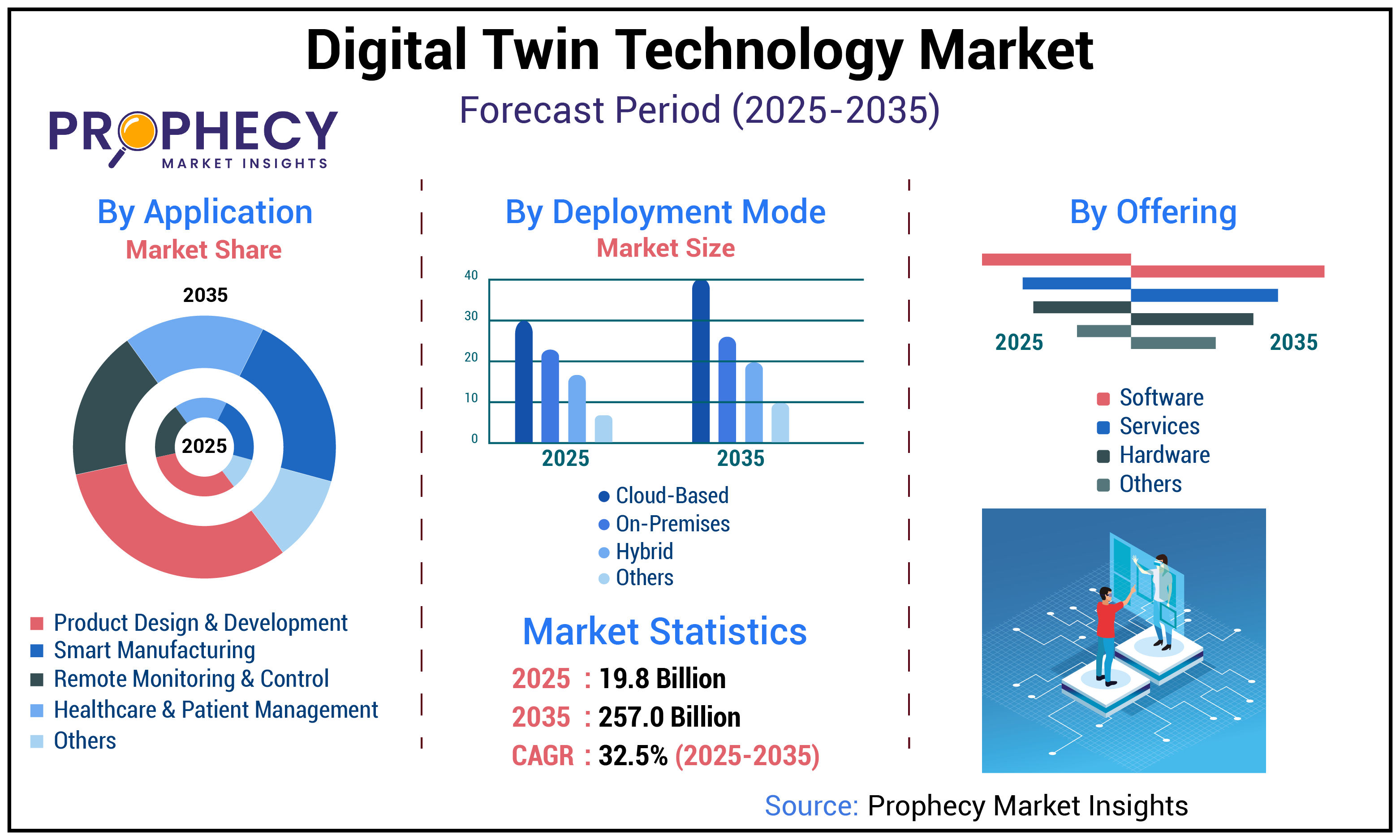
- By 2035, the digital twin technology market size is contemplated to enlarge at a valuation of USD 257.0 Billion.
- In 2024, the digital twin technology market valuation was USD 14.2 Billion.
- Digital twin technology market is developing at a CAGR of 32.5%.
Digital twin technology is the creation of a virtual or digital model of a tangible object, process, or system, which is always current with live data captured from sensors, IoT gadgets, and various other sources. The tech enables companies to visualize, oversee, and scrutinize the effectiveness, as well as forecast malfunction and improve usage all without the need for a physical test. Among the benefits are less downtime via predictive maintenance, the increased product design and quality, the saving of costs due to the efficient use of processes, the accelerated decision-making that is possible with the implementation of real-time insights, and the strengthened innovation as a result of the safe testing of the scenarios in a virtual environment.
One of the major reasons that digital twin technology market has been seeing an upward trend is that the Industry 4.0 has been getting more and more acceptance. Besides this, the trend of using IoT and AI for real-time monitoring, as well as the necessity of predictive maintenance for cost reduction, have also contributed to the market's development. The need for the industries to perform better and more productive in various sectors such as manufacturing, healthcare, automotive, and smart cities has become the major drivers for the market to expand due to the demand for product customization, decrease in time-to-market, and efficient utilization of resources.
The digital twin technology market landscape ahead will rely on the use of AI, machine learning, and advanced analytics that will enable them to make more autonomous decisions and self-optimize. The use of the technology will no longer be confined to the manufacturing industry but will be spread over the healthcare, retail, agriculture, and smart city sectors. User interaction will benefit from real-time 3D visualization and immersive AR/VR interfaces. The coming of 5G will make data transfer for digital twins much faster and thus, they will be highly responsive. Green initiatives, on the other hand, will be the reason why digital twins will be used in energy-saving and carbon footprint reduction aspects.
Digital Twin Technology Adoption Rate:
- The deployment of digital twins is projected to see an average growth of 36% within five years.
- Approximately 70% of technology leaders in major corporations actively pursue and allocate resources to digital twin initiatives.
- More than 42% of executives across various industries recognize the benefits of digital twins, with 59% planning to integrate them into their operations by 2028.
- Organizations using digital twins report an average of 15% improvement in sales, turnaround time and operational efficiency, with system performance gains exceeding 25%.
Digital Twin Technology Market Drivers & Restraints
Key Drivers:
Rising Industry 4.0 Adoption can drive the Growth of the Market
The growing use of Industry 4.0 means that companies are increasingly relying on cutting-edge technologies such as loT, Al, robotics, big data, and automation in the manufacturing and industrial sectors. By implementing these techniques, we can achieve greater connectivity and smart systems.
This transition allows for on-the-spot tracking, the prediction of machine breakdowns, and the ability for machines to make decisions on their own. As a result, effectiveness is elevated, expenses are kept low, and the output is amplified. Digital Twin Technology is the main instrument of Industry 4.0, as it enables the creation of virtual copies of assets and processes. In this way, enterprises have the possibility to try, research, and improve their activities while the actual systems remain intact.
- For Instance, according to the data published by McKinsey & Company, more than 400 global manufacturing companies, 94 percent of respondents indicated that Industry 4.0 helped them to keep their operations running during the crisis.
Restraints:
Complexity in Integration can obstructed the Magnification of Market
One of the main complications in the successful incorporation of Digital Twin Technology into the already established working environment of a company that is heavily dependent on legacy systems, old software or data that is not well managed, is the problem of complexity. This problem usually results in compatibility issues, extended implementation durations, and increased expenses as the tech has to be able to interact with IoT devices, enterprise systems, and analytics platforms without any interruptions.
- Counterbalance Statements: A feasible approach is to implement commonly used communication standards, open APIs, and software intermediaries that allow easy data flow between legacy and modern systems, as well as using gradual integration methods and established vendor relationships to lower the impact and guarantee the systems remain compatible.
Opportunities & Trends:
The Rise of 5G can Helps to Achieve the Development Goal
The 5G Development is identified as one of the primary future trends that will have a great impact on the Digital Twin Technology Market. 5G technology is capable of ultra-fast, low-latency, and high-capacity data transmission that allows real-time synchronization between physical assets and their virtual counterparts. Digital twins can access large amounts of sensor and loT data in a very short time with 5G; thus, they can improve the accuracy of simulations, remote monitoring, and predictive analytics, etc. This change will particularly be significant for areas such as self-driving cars, intelligent factories, and extensive infrastructure works, where quick decision-making and constant connection are necessary.
- For Instance, according to the data published by 5G Americas, the global wireless telecommunications industry achieved a historic milestone in 2024, with 5G connections reaching 2.25 billion worldwide. The momentum is expected to continue, with forecasts indicating 8.3 billion 5G connections by 2029, representing 59% of all global wireless technologies.
Digital Twin Technology Market Segmentations & Regional Insights
Offering, technology, deployment mode, application, end users, and region are the divisions of the digital twin technology market.
By Offering:
Software, services, and hardware are offerings on which digital twin technology market is segmented. Software dominates the digital twin technology market share as it is essential to the functionality of digital twins, allowing for modeling, simulation, data analytics, visualization, and interaction with IoT platforms.
The increased demand for advising, customization, integration, and continuous support to assure effective implementation and operation especially since enterprises frequently lack in-house knowledge for complicated deployments is driving the second-dominant market, services.
By Deployment Mode:
Cloud-Based, on-premises, and hybrid are deployment mode of the digital twin technology market. Cloud-based deployment has the most digital twin technology market share for the reason of its scalability, affordability, and capacity to offer real-time data access from any location, which makes it perfect for businesses with dispersed assets and international operations.
Despite greater setup and maintenance costs, on-premises deployment is the second most popular method and is favored by industries like healthcare, aerospace, and military where data security, regulatory compliance, and complete control over infrastructure are crucial.
By Organization Size:
Based on the organization size, the digital twin technology market is divided into small & medium enterprises (SMEs), and large enterprises. Large businesses dominate the digital twin technology market share as they have the capital, sophisticated infrastructure, and highly qualified personnel needed to deploy sophisticated digital twin solutions on a large scale, particularly in sectors consisting of manufacturing, automotive, aerospace, and energy.
The need to increase operational efficiency and competitiveness without requiring significant capital expenditure, as well as the growing availability of reasonably priced cloud-based digital twin solutions, are driving the expansion of Small & Medium Enterprises (SMEs), the second-dominant group.
By Application:
On the account of application, the digital twin technology market is divided into product design & development, remote monitoring & control, smart manufacturing, healthcare & patient management, and others. Product design & development is the market leader in the digital twin technology market growth since it allows for virtual prototyping, quicker innovation cycles, and cost savings by detecting design flaws prior to physical production. This makes it extremely valuable for industries such as manufacturing, automotive, and aerospace.
The second most popular use is smart manufacturing, which is fueled by Industry 4.0 and the need for automation, predictive maintenance, and real-time process optimization to increase productivity and decrease downtime in industrial processes.
By End User:
Manufacturing, automotive, healthcare & life sciences, energy & utilities, aerospace & defense, and others are end users of the digital twin technology market. Manufacturing has the most digital twin technology market share as it uses digital twins extensively for quality control, process optimization, predictive maintenance, and product design all of which are in line with Industry 4.0 goals to increase productivity and save expenses.
The requirement for sophisticated vehicle design, performance modeling under varied conditions, and integration with autonomous and connected vehicle technologies to spur innovation and enhance safety has made the automotive industry the second-dominant end-user category.
Regional Insights:
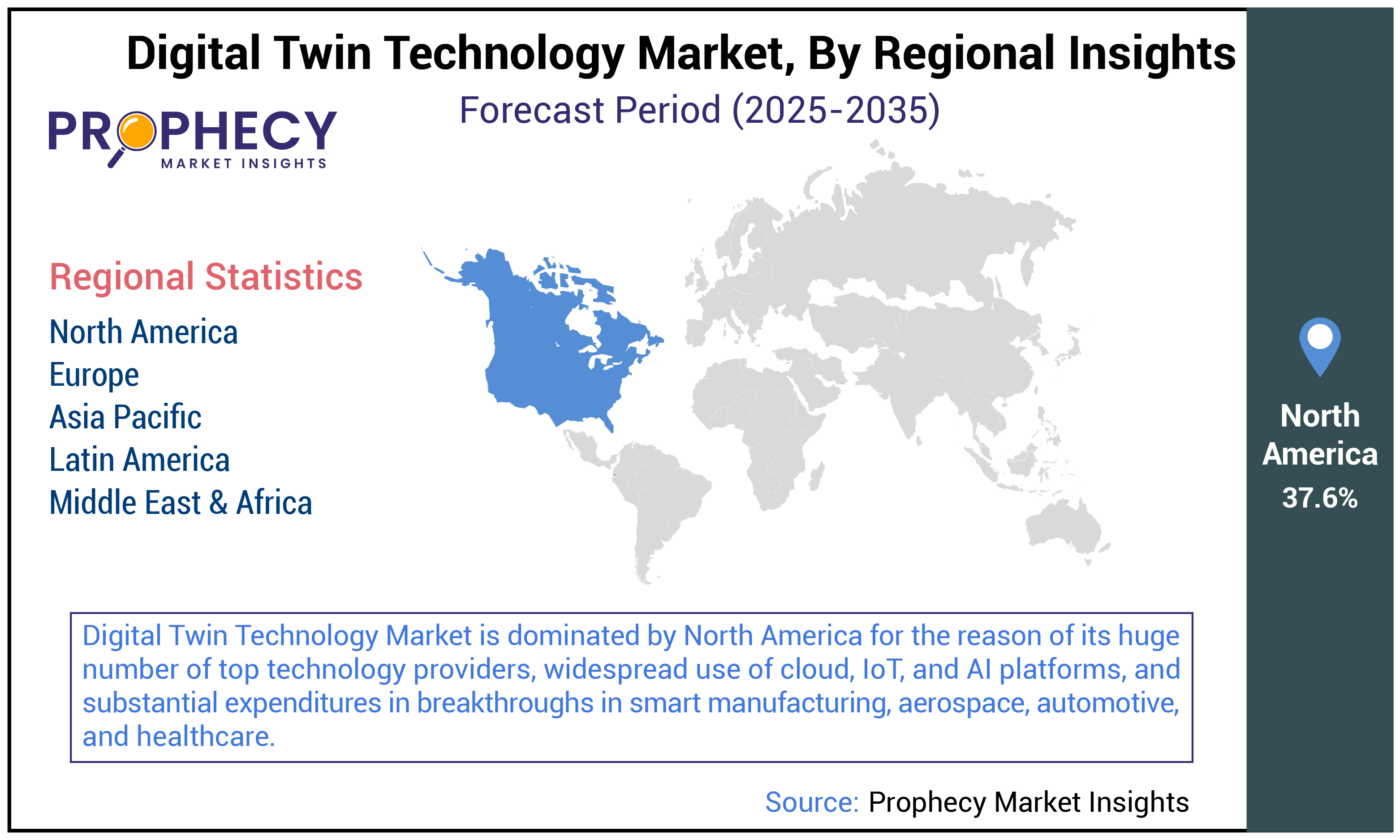
Geographically, the digital twin technology market is studied across North America, Europe, Asia Pacific, Latin America, and the Middle East & Africa.
North America: The digital twin technology market is dominated by North America for the reason of its huge number of top technology providers, widespread use of cloud, IoT, and AI platforms, and substantial expenditures in breakthroughs in smart manufacturing, aerospace, automotive, and healthcare.
- U.S. Digital Twin Technology Market Insights:
The U.S. leads the North American digital twin technology market as a consequence of its robust ecosystem of IoT and AI solution providers, leadership in technical innovation, and significant expenditures in smart infrastructure, automotive, aerospace, and healthcare projects.
Europe: With its sophisticated manufacturing hubs in Germany, the U.K., and France, as well as its emphasis on sustainability, energy efficiency, and the use of digital twins in the automotive, aerospace, and industrial sectors, Europe is the second-dominant area.
- Germany Digital Twin Technology Market Insights:
Germany dominates the market and is a leading adopter of digital twin solutions due to its sophisticated manufacturing sector, robust Industry 4.0 adoption, and worldwide leadership in automotive engineering, industrial automation, and precision manufacturing.
Asia Pacific: The digital twin technology market is expanding quickly in Asia Pacific as a result of government-led smart city and infrastructure projects, growing smart manufacturing efforts, increasing usage of IoT and AI, and faster industrial digitalization.
- China Digital Twin Technology Market Insights:
The vast industrial base, robust investments in Industry 4.0, quick rollout of 5G networks, and government initiatives encouraging digital transformation across industries are the main reasons China leads the regional market.
Digital Twin Technology Market Report Scope:
|
Attribute |
Details |
|
Market Size 2025 |
USD 19.8 Billion |
|
Projected Market Size 2035 |
USD 257.0 Billion |
|
CAGR Growth Rate |
32.5% (2025-2035) |
|
Base year for estimation |
2024 |
|
Forecast period |
2025 – 2035 |
|
Market representation |
Revenue in USD Billion & CAGR from 2025 to 2035 |
|
Regional scope |
North America - U.S. and Canada Europe – Germany, U.K., France, Russia, Italy, Spain, Netherlands, and Rest of Europe Asia Pacific – China, India, Japan, Australia, Indonesia, Malaysia, South Korea, and Rest of Asia-Pacific Latin America - Brazil, Mexico, Argentina, and Rest of Latin America Middle East & Africa – GCC, Israel, South Africa, and Rest of Middle East & Africa |
|
Report coverage |
Revenue forecast, company share, competitive landscape, growth factors, and trends |
Segmentation:
By Offering:
- Software
- Simulation Software
- Data Analytics & AI Software
- Others
- Services
- Consulting
- Implementation & Integration
- Others
- Hardware
- Sensors
- IoT Devices
- Others
By Deployment Mode:
- Cloud-Based
- On-Premises
- Hybrid
By Organization Size:
- Small & Medium Enterprises (SMEs)
- Large Enterprises
By Application:
- Product Design & Development
- Remote Monitoring & Control
- Smart Manufacturing
- Healthcare & Patient Management
- Others
By End User:
- Manufacturing
- Automotive
- Healthcare & Life Sciences
- Energy & Utilities
- Aerospace & Defense
- Others
By Region:
- North America
- U.S.
- Canada
- Europe
- Germany
- U.K.
- France
- Russia
- Italy
- Spain
- Netherlands
- Rest of Europe
- Asia Pacific
- China
- India
- Japan
- Australia
- Indonesia
- Malaysia
- South Korea
- Rest of Asia Pacific
- Latin America
- Brazil
- Mexico
- Argentina
- Rest of Latin America
- Middle East & Africa
- GCC
- Israel
- South Africa
- Rest of Middle East & Africa
Digital Twin Technology Market Competitive Landscape & Key Players
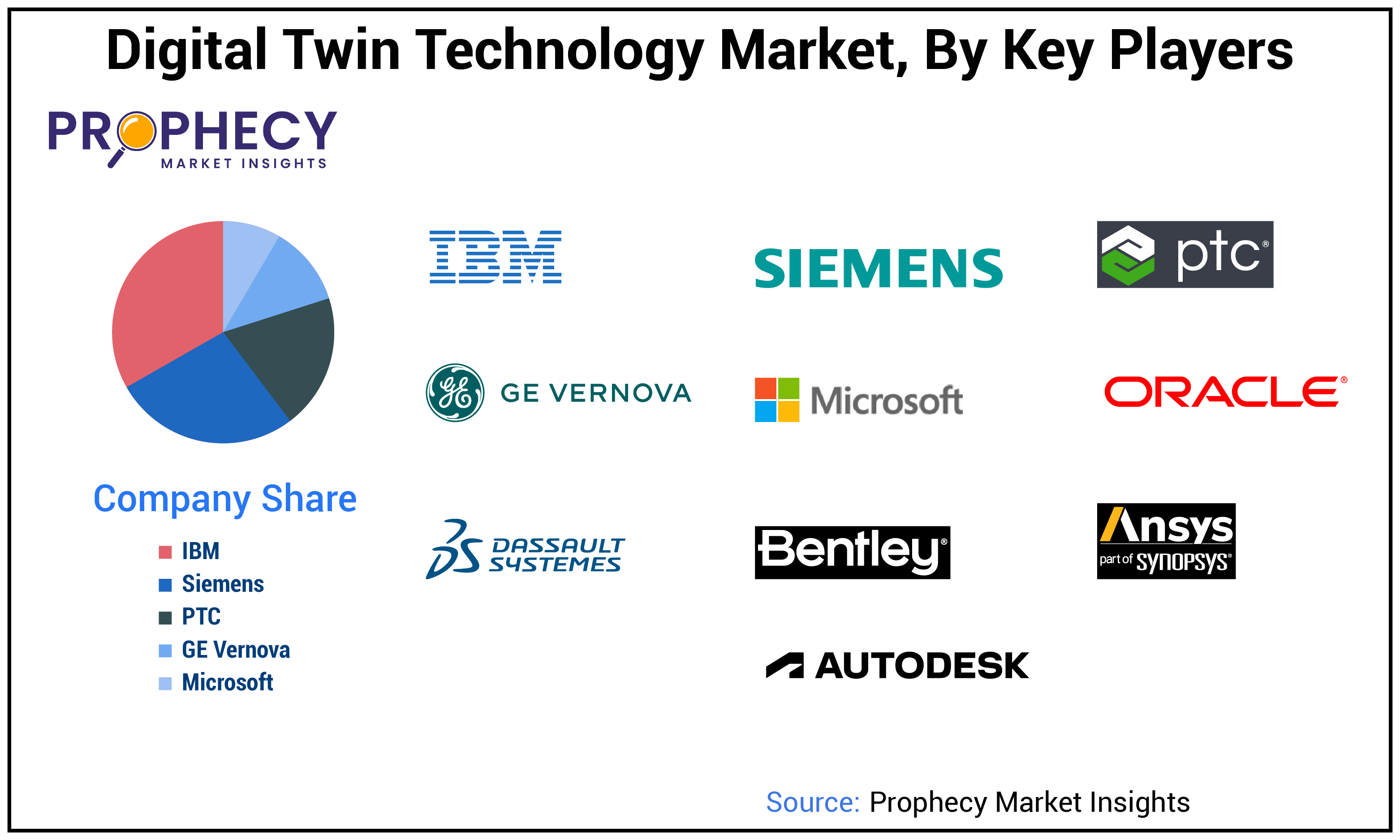
Integrating AI and analytics for more intelligent simulations, growing cloud-based solutions, establishing strategic alliances, concentrating on sector-specific applications, investing in interoperable platforms, and aiming for emerging markets with 5G-enabled real-time capabilities are some of the main growth strategies for businesses using digital twin technology. The key players operating in the Digital Twin Technology Market include, IBM, Siemens, BENTLEY SYSTEMS, INCORPORATED, Microsoft, Oracle, and others.
Digital Twin Technology Market Companies:
- IBM
- Siemens
- PTC
- GE Vernova
- Microsoft
- Oracle
- Dassault Systèmes
- ANSYS, Inc
- Bentley systems, incorporated
- Autodesk Inc.
- SAP SE
- AVEVA Solutions Limited
- Hexagon AB
- Altair Engineering Inc.
- Bosch Rexroth AG
View an Additional List of Companies in the Digital Twin Technology Market
Digital Twin Technology Market Recent News
- In February 2025, the healthcare artificial intelligence startup HEALWELL AI Inc., which specializes in preventative care, stated that VeroSource Solutions Inc., a subsidiary, has introduced additional Digital Twin capability on its in-house VS Data-as-a-Service Platform. A digital twin is a computerized model of a medical institution or system. Because it is a digital copy, analysis and forecasting may be done without directly affecting how the medical center runs.
- In January 2025, the transformational Digital Twin Testbed program, which gives members a chance to demonstrate innovation in digital twin evolution, was introduced by the Digital Twin Consortium (DTC). DTC members can use the initiative's collaborative, all-encompassing approach to design, test, evaluate, and verify digital twin systems as well as improve technology that enable them.
- In January 2025, A digital twin technology platform for banks created by Percipient, a fintech startup located in Singapore with extensive experience in banking technology transformation, has been purchased by Accenture. Through the purchase, Accenture's current banking modernization capabilities will be strengthened, assisting Asia Pacific financial services customers in accelerating the reinvention of their core systems, promoting innovation, and propelling development.
- In November 2024, in order to model the social effects of local government policies, Fujitsu said that it has created a new digital twin technology called Policy Twin. In order to facilitate effective and efficient service delivery in municipal preventive healthcare services, Fujitsu will begin providing Policy Twin.
Analyst View:
Using data from sensors, Internet of Things devices, and other sources, digital twin technology builds real-time virtual models of physical assets, processes, or systems. This allows for predictive maintenance, performance analysis, visualization, and monitoring without the need for physical testing. Increased acceptance of Industry 4.0, growing IoT and AI usage, the need for predictive maintenance, and the need for efficiency, customization, and quicker time-to-market across sectors including manufacturing, healthcare, automotive, and smart cities are all factors propelling its global expansion. Future developments include increased usage in environmental projects, better integration of AI and analytics, growth into new industries, improved AR/VR engagement, and quicker responsiveness through 5G.
More Related Reports
Digital Respiratory Devices Market
Digital Fluoroscopy System Market
Digital Health Market
Digital Pathology Market
Digital Signatures Market
Digital Twin Technology Market Company Profile
|
Company Name |
IBM |
|
Headquarter |
Armonk, New York, U.S. |
|
CEO |
Arvind Krishna |
|
Employee Count |
282,200 Employees |
Digital Twin Technology Market Highlights
FAQs
Digital twin technology market size was valued at USD 19.8 Billion in 2025 and is expected to reach USD 257.0 Billion by 2035 growing at a CAGR of 32.5%.
Offering, organization size, deployment mode, application, end user, and region are the segmentation for the digital twin technology market.
North America, Asia Pacific, Europe, Latin America, and the Middle East & Africa. North America is expected to dominate the market.
The key players operating the digital twin technology market include IBM, Siemens, PTC, GE Vernova, Microsoft, Oracle, Dassault Systèmes, ANSYS, Inc, Bentley systems, incorporated, Autodesk Inc., SAP SE, AVEVA Solutions Limited, Hexagon AB, Altair Engineering Inc., and Bosch Rexroth AG.