Delivery Robots Market Overview
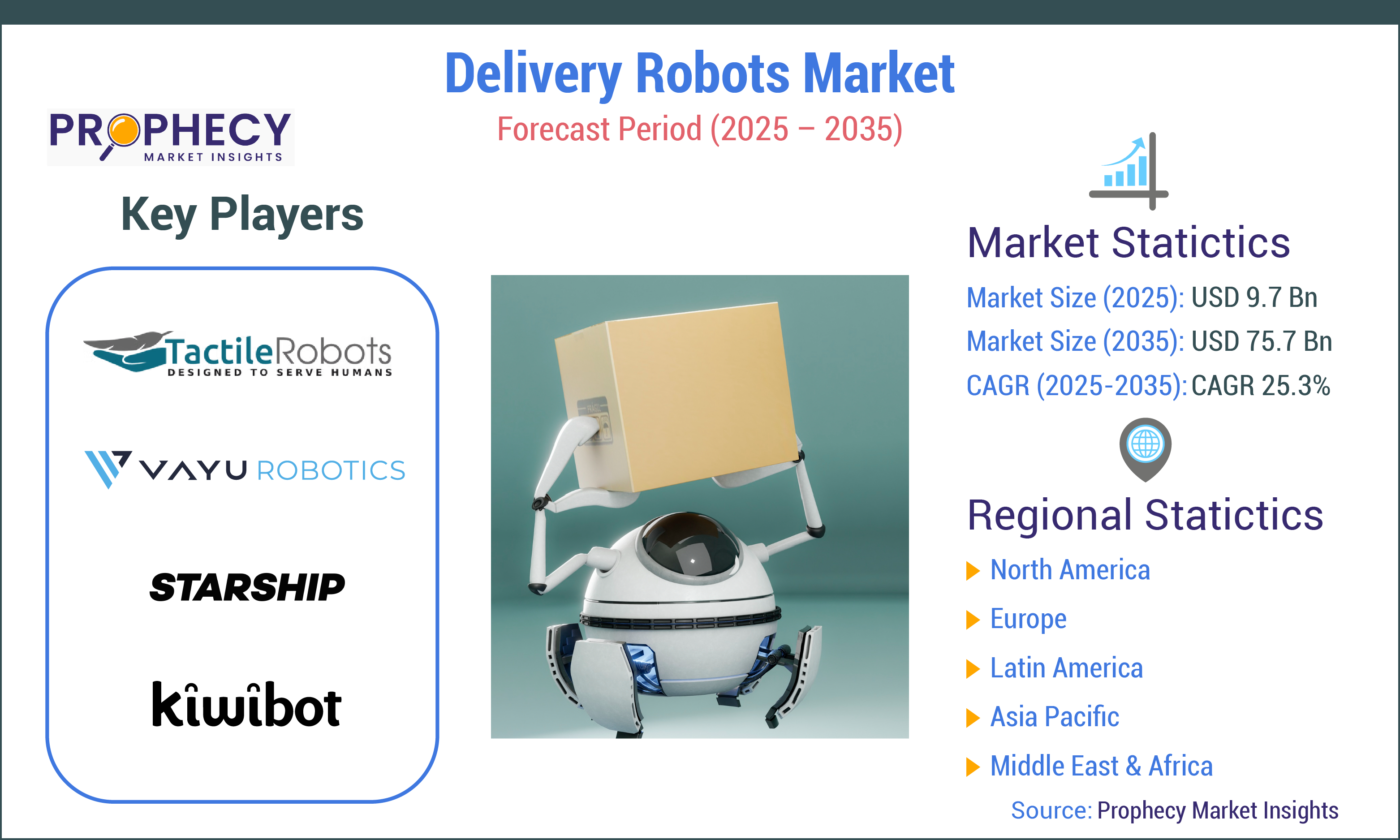
- By 2035, the delivery robots market size is contemplated to enlarge at a valuation of USD 75.7 Billion.
- In 2024, the delivery robots market valuation was USD 8.0 Billion.
- Delivery robots market is developing at a CAGR of 25.3%.
Delivery robots are self-driving machines designed to distribute items such as grocery, package, or medicines at short distances. They use sensors, GPS and AI to safely navigate. These robots are reduced to delivery time, cut the cost of labor and fuel, work around the clock and environmentally friendly. They are especially useful in urban areas, hospitals, complexes and during emergency or epidemic for contactless delivery.
A potent combination of market drivers, including end-commerce, food delivery, the rapid expansion of fuel-efficient need for mile logistics, the need to operate companies to automate the old labor scarcity, and rising labor costs that make human distribution less feasible, are driving the delivery robot boom. More intelligent, dependable robots are made possible by AI, robotics, sensors, navigation, and battery technology. Furthermore, customers' need for quick, contact-free delivery is growing.
The delivery robot market is ready to expand rapidly in the next decade, inspired by successes in AI, sensor tech, 5G/edge computing and stability. Businesses are rolling completely autonomous roads and indoor bots, especially in grocery, E commerce, healthcare and corporate complexes. Major trends include clever navigation through AI, Lidar and real-time edge computing; urban infrastructure integration (smart ONS IT framework, IOT), eco?friendly electric design, and collaborative "swarm" fleet. Regulatory clarity is improving, while the partnership of sector between robotics firms, retailers, logistics platforms and cities is accelerating adoption in new uses such as healthcare and pharmaceuticals.
Recession Risk & Tariff Analysis:
- The delivery robot market faces short -term challenges due to the risk of recession in the market and increasing tariffs on major components such as sensors and semiconductors.
- Businesses may delay automation investment due to economic recession, while tariffs - especially on imports from China are increasing production costs and squeezing profit margins.
- This pressure can temporarily slow down market growth; However, they can also make long-term changes to local manufacturing, cost adaptation and AI-operated efficiency towards greater adoption.
Impact of Generative AI on Delivery Robots Market:
- The generative AI is supercharging to the delivery robot by enabling smart navigation, real-time adaptability and task flexibility. Robots operated by generic models learn new routes and barriers-strategies, customize dynamic pricing and distribution routes, and handle diverse payloads-increase the patriotism by 10–25% and cut the deployment time in half.
- The use of Amazon's transformer-based AI reflects this change with its proteus and scout fleet, rapidly, cheap, and more reliable driving the last-meal services.
- Overall, the generative AI is unlocked the adaptive, scalable and cost -effective delivery solutions that are re -shaping the market.
Delivery Robots Market Drivers & Restraints
Key Drivers:
Rising Labor Costs will Push Market Growth
Increasing labor cost delivery robot is a major driver of development in the market, as businesses want a cost-effective option for human workers for final-meal logistics. Along with increasing wages in retail, food service and logistics areas - especially in urban areas - many companies are turning to autonomous distribution robots to reduce operations. Robots offer consistent performance, operate 24/7 without overtime, and significantly reduce the long -term cost per delivery. This makes them an attractive solution for e-commerce, restaurants and healthcare providers, which aim to maintain service levels by controlling labor related costs.
- For Instance, according to the data published by International Labour Organization, Labour costs are a crucial factor in the ability of enterprises and countries to compete. When specific to the manufacturing sector, labour costs serve as an indicator of competitiveness of manufactured goods in world trade.
Restraints:
Limited Performance in Bad Weather Conditions Could Affect Market Development
Delivery robots often struggle in bad weather conditions such as heavy rains, ice, fog or icy surfaces, which can spoil the sensor, reduce traction, and limit visibility, which can cause navigation errors or distribution delays. For example, the camera and lidar systems may fail to detect obstacles accurately in fog or ice, and there may be issues of movement from slippery surfaces. These borders affect reliability and security, especially in extreme weather areas.
- Counterbalance Statements: The solutions include equipping robots with all-weather sensors, warm components to prevent snow manufacturing, rugged wheels for better traction and a hot component to customize navigation strategies in real time to machine learning algorithms. Some companies also apply the weather-tearful routing system or hybrid approaches that combine robots with human couriers during severe conditions.
Opportunities & Trends:
E-Commerce Growth will be a Game-Changer Solution for the Market in Future
The rapid growth of e-commerce is a major driver for the delivery robot market, as businesses want rapid, more efficient and contact-free delivery solutions to meet growing consumers. Delivery robots provide a scalable way to handle the growing order volume, reduce the final-meal delivery costs and improve operating efficiency. Since quick commerce and the same day delivery become standard, the requirement of automatic, reliable delivery systems such as robots is expected to increase significantly, making them an important part of the future logistics landscape.
- For Instance, according to the data published by SellersCommerce, there are 2.77 billion global online shoppers. In 2025, 21% of retail purchases are expected to take place online, and this share will rise to 22.6% by 2027. Ecommerce sales will surpass $6.8 trillion in 2025. There are over 28 million eCommerce stores globally.
Delivery Robots Market Segmentations & Regional Insights
Type, load-carrying capacity, number of wheels, speed limit, end user, and region are the divisions of the Delivery Robots Market.
By Type:
Indoor and outdoor are type on which delivery robots market is segmented. Due to their extensive usage in last-mile logistics for grocery, package, and food deliveries in urban and suburban regions, outdoor delivery robots now have the biggest delivery robots market share.
The second-dominant market is indoor delivery robots, which are becoming more popular in establishments such as hospitals, hotels, and business campuses where regulated conditions enable dependable, effective mobility.
By Load-Carrying Capacity:
Based on the load-carrying capacity, the delivery robots market is divided into up to 10 kg, 11 kg to 50 kg, and more than 50 kg. Due to its perfect mix of mobility and payload efficiency, the 11 kg to 50 kg load-carrying capacity sector has the biggest delivery robots market share.
The need for lightweight delivery of papers, medications, and small meals particularly in hospitals, campuses, and metropolitan areas has made the up to 10 kg sector the second-dominant group.
By Number of Wheels:
Three wheels, four wheels, six wheels are Number of Wheels of the Delivery Robots Market. Due to its greater stability, mobility, and capacity to manage complicated or uneven outdoor terrains, including sidewalks, curbs, and small obstructions, six-wheeled delivery robots now have the biggest market share.
The second-dominant sector consists of four-wheeled robots, which are used for interior applications and regulated settings such as warehouses, hotels, and hospitals.
By Speed Limit:
On the speed limit, delivery robots market is categorized into up to 3KPH, 3KPH-6KPH, and higher than 6KPH. Since it provides the best mix of safety, effectiveness, and battery life for both indoor and outdoor applications, the 3KPH–6KPH speed range commands the biggest the delivery robots market share.
The second most popular category is up to 3KPH, which is mostly utilized indoors in places such as hotels, businesses, and hospitals where slower speeds are more suitable and safer.
By End User:
The delivery robots market on the account of end user are categorized into food & beverage, healthcare, retail & e-commerce, logistics, hospitality, and others. Due to the strong need for quick, frictionless, and economical food delivery particularly in cities and during peak hours the food and beverage industry has the highest delivery robots market share.
Due to the rapid expansion of online shopping and the requirement for scalable, automated delivery systems to effectively manage large package quantities, particularly in the last mile, the retail and e-commerce market is the second-dominant end user.
Regional Insights:
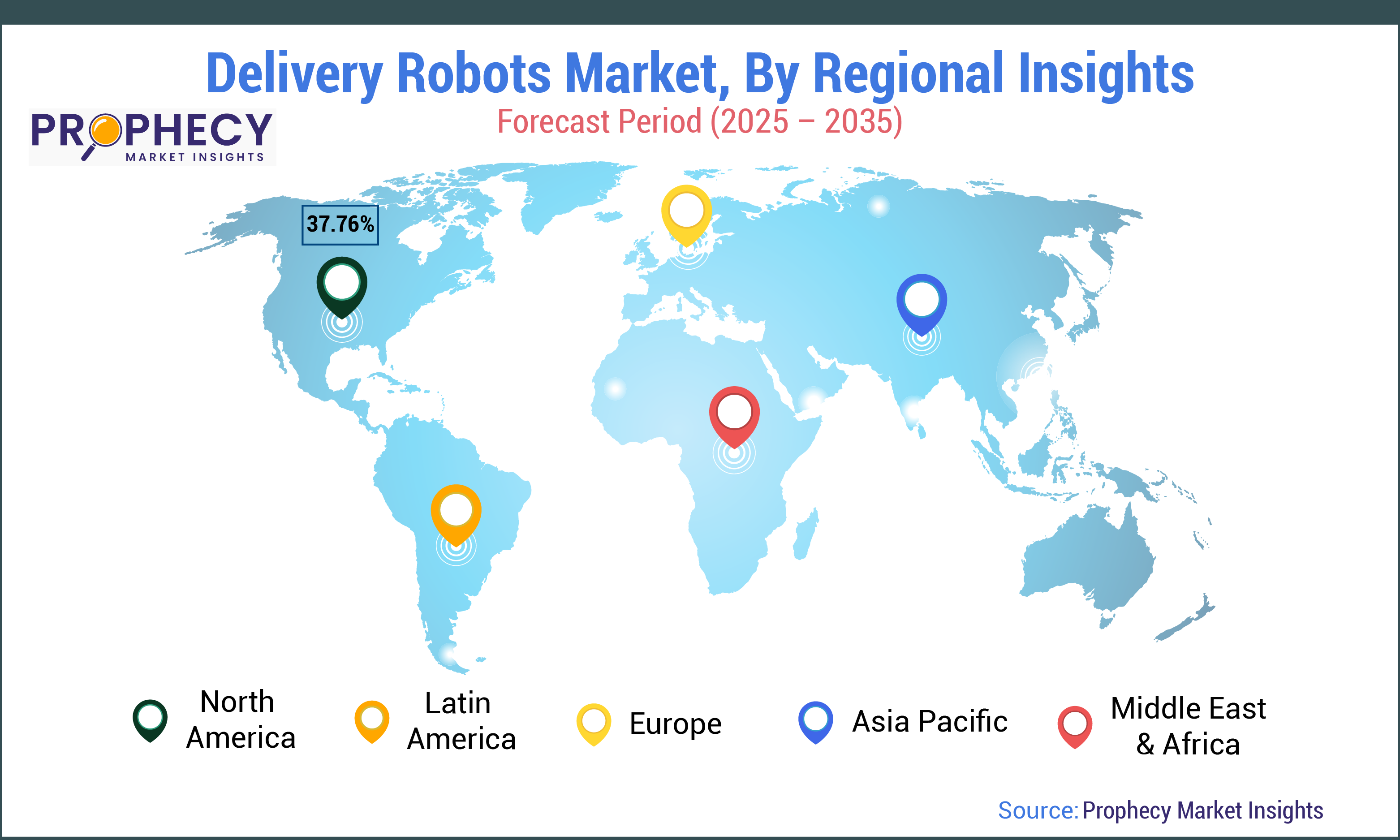
Geographically, the delivery robots market is studied across North America, Europe, Asia Pacific, Latin America, and the Middle East & Africa.
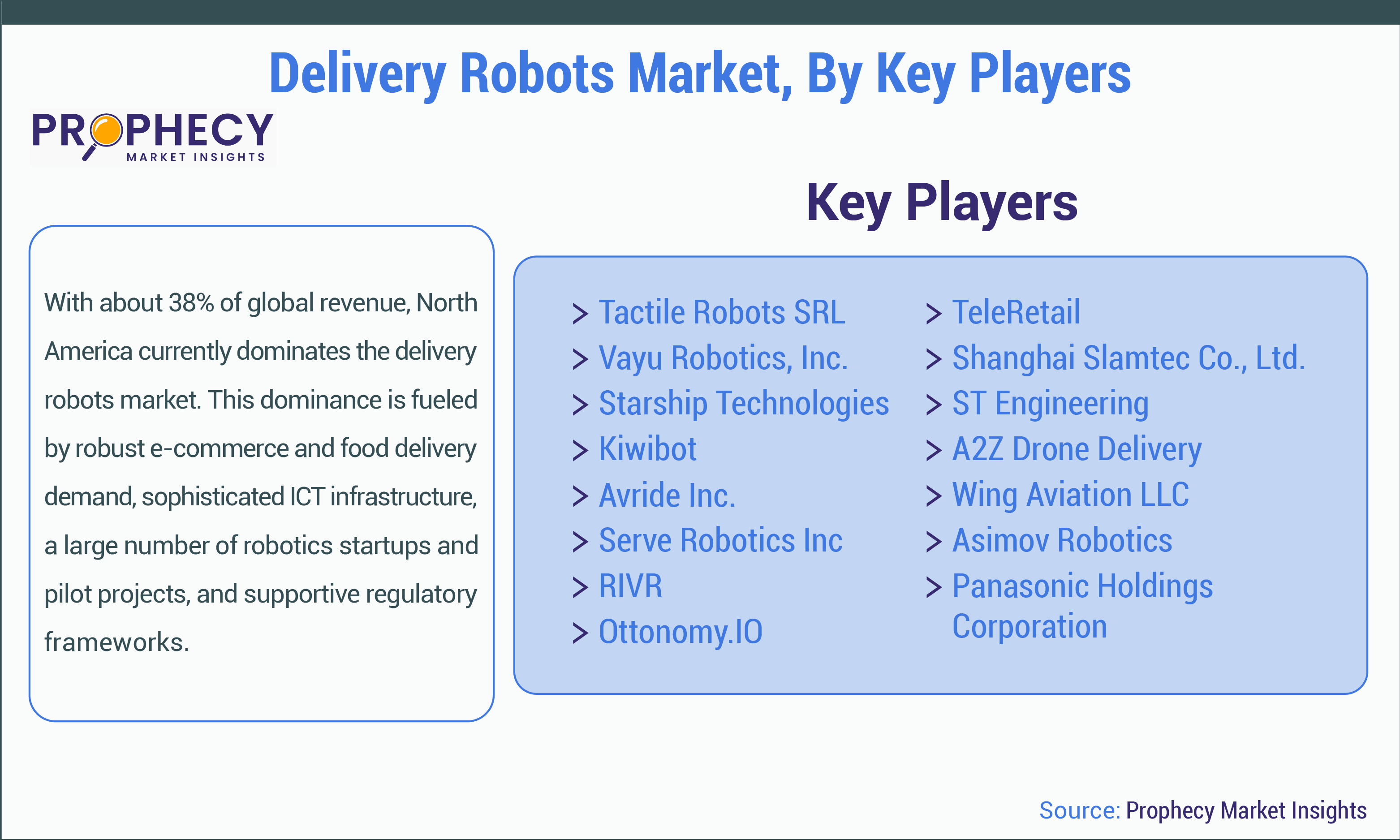
North America: With about 38% of global revenue, North America currently dominates the delivery robots market. This dominance is fueled by robust e-commerce and food delivery demand, sophisticated ICT infrastructure, a large number of robotics startups and pilot projects, and supportive regulatory frameworks.
- U.S. Delivery Robots Market Insights:
The U.S. leads the North American delivery robots market due to its robust technology environment, sizable food delivery and e-commerce sectors, and the existence of significant firms notably Amazon, Starship Technologies (U.S. operations), and Nuro.
Europe: With a market share of between 27–30%, Europe comes in second due to legislation that encourage sustainable, autonomous delivery systems, smart-logistics investments in nations including Germany, the UK, and France, and extensive urbanization.
- Germany Delivery Robots Market Insights:
Germany dominates the market due to its sophisticated robotics and automotive sectors, robust logistics network, and large investments in smart city projects.
Asia Pacific: Rapid urbanization, burgeoning e-commerce, workforce shortages (particularly in aging Japan), and supporting legislation such as Korea's revised Intelligent Robots Act and Japan's relaxing of traffic restrictions for autonomous systems are all contributing factors to Asia-Pacific's rise as the delivery robots market's fastest-growing area.
- China Delivery Robots Market Insights:
China is unique in the area, holding the most market share due to its substantial expenditures in automation, sophisticated IoT integration, reasonably priced parts, and vigorous R&D initiatives.
Delivery Robots Market Report Scope:
|
Attribute |
Details |
|
Market Size 2025 |
USD 9.7 Billion |
|
Projected Market Size 2035 |
USD 75.7 Billion |
|
CAGR Growth Rate |
25.3% (2025-2035) |
|
Base year for estimation |
2024 |
|
Forecast period |
2025 – 2035 |
|
Market representation |
Revenue in USD Billion & CAGR from 2025 to 2035 |
|
Regional scope |
North America - U.S. and Canada Europe – Germany, U.K., France, Russia, Italy, Spain, Netherlands, and Rest of Europe Asia Pacific – China, India, Japan, Australia, Indonesia, Malaysia, South Korea, and Rest of Asia-Pacific Latin America - Brazil, Mexico, Argentina, and Rest of Latin America Middle East & Africa – GCC, Israel, South Africa, and Rest of Middle East & Africa |
|
Report coverage |
Revenue forecast, company share, competitive landscape, growth factors, and trends |
Segmentation:
By Type:
- Indoor
- Outdoor
By Load-Carrying Capacity:
- Up to 10 kg
- 11 kg to 50 kg
- More Than 50 kg
By Number of Wheels:
- Three Wheels
- Four Wheels
- Six Wheels
By Speed Limit:
- Up to 3KPH
- 3 KPH-6KPH
- Higher than 6KPH
By End User:
- Food & Beverage
- Healthcare
- Retail & E-commerce
- Logistics
- Hospitality
- Others
By Region:
- North America
- U.S.
- Canada
- Europe
- Germany
- U.K.
- France
- Russia
- Italy
- Spain
- Netherlands
- Rest of Europe
- Asia Pacific
- China
- India
- Japan
- Australia
- Indonesia
- Malaysia
- South Korea
- Rest of Asia Pacific
- Latin America
- Brazil
- Mexico
- Argentina
- Rest of Latin America
- Middle East & Africa
- GCC
- Israel
- South Africa
- Rest of Middle East & Africa
Delivery Robots Market Competitive Landscape & Key Players
Investing in AI and autonomous navigation technologies, partnering with e-commerce and logistics companies, entering the urban and last-mile delivery markets, adapting robots to various payloads and terrains, and adhering to local laws are some of the main growth strategies for delivery robot companies. Pilot projects in academic institutions and smart cities also aid in technological advancement and public trust-building. The key players operating in the delivery robots market include, Tactile Robots SRL, Vayu Robotics, Inc., TeleRetail, Avride Inc., Serve Robotics Inc, and others.
Delivery Robots Market Companies:
- Tactile Robots SRL
- Vayu Robotics, Inc.
- Starship Technologies
- Kiwibot
- Avride Inc.
- Serve Robotics Inc
- RIVR
- Ottonomy.IO
- TeleRetail
- Shanghai Slamtec Co., Ltd.
- Panasonic Holdings Corporation
- ST Engineering
- A2Z Drone Delivery
- Wing Aviation LLC
- Asimov Robotics
View an Additional List of Companies in the Delivery Robots Market
Delivery Robots Market Recent News
- In June 2025, Amazon is developing artificial intelligence (AI) software to drive humanoid robots that may ultimately take the place of human delivery personnel. It's also said that the tech giant is constructing a 'humanoid park' in San Francisco to test these robots in indoor obstacle courses.
- In January 2025, Autonomous delivery business Serve Robotics reported that has obtained USD 86 million in additional investment in December. The additional funding increased the company's anticipated operational runway until the end of 2026, about, and increased the total amount raised in 2024 to USD 167 million. Since splitting out from Uber in 2021, Serve Robotics a firm that creates sidewalk delivery robots has raised over USD 220 million in total investment.
Analyst View:
The delivery robots market is expanding quickly since industries including e-commerce, healthcare, and food are seeing an increase in demand for frictionless, effective, and environmentally responsible delivery options. Driven by AI, sensors, GPS, and 5G, these self-driving robots save labor, fuel, and delivery time while providing round-the-clock service. The necessity for automation, a lack of workers, and advancements in technology including edge computing and Lidar are important factors. Especially in cities, hospitals, and business settings, adoption is speeding up as rules change and collaborations between digital companies, retailers, and cities grow.
More Related Reports
Surgical Robots Market
First and Last Mile Delivery Market
Delivery Drones Market
Delivery and Takeaway Food Market
Drone Package Delivery Market
Delivery Robots Market Company Profile
|
Company Name |
Tactile Robots SRL |
|
Headquarter |
Lecce, Italy |
|
CEO |
Riccardo Tornese |
|
Employee Count |
1-10 Employees |
Delivery Robots Market Highlights
FAQs
Delivery robots market size was valued at USD 9.7 Billion in 2025 and is expected to reach USD 75.7 Billion by 2035 growing at a CAGR of 25.3%.
Type, load-carrying capacity, number of wheels, speed limit, end user, and region are the segmentation for the target market.
North America, Asia Pacific, Europe, Latin America, and the Middle East & Africa. North America is expected to dominate the market.
The key players operating the delivery robots market include Tactile Robots SRL, Vayu Robotics, Inc., Starship Technologies, Kiwibot, Avride Inc., Serve Robotics Inc, RIVR, Ottonomy.IO, TeleRetail, Shanghai Slamtec Co., Ltd., Panasonic Holdings Corporation, ST Engineering, A2Z Drone Delivery, Wing Aviation LLC, and Asimov Robotics.