Computational Biology Market Overview
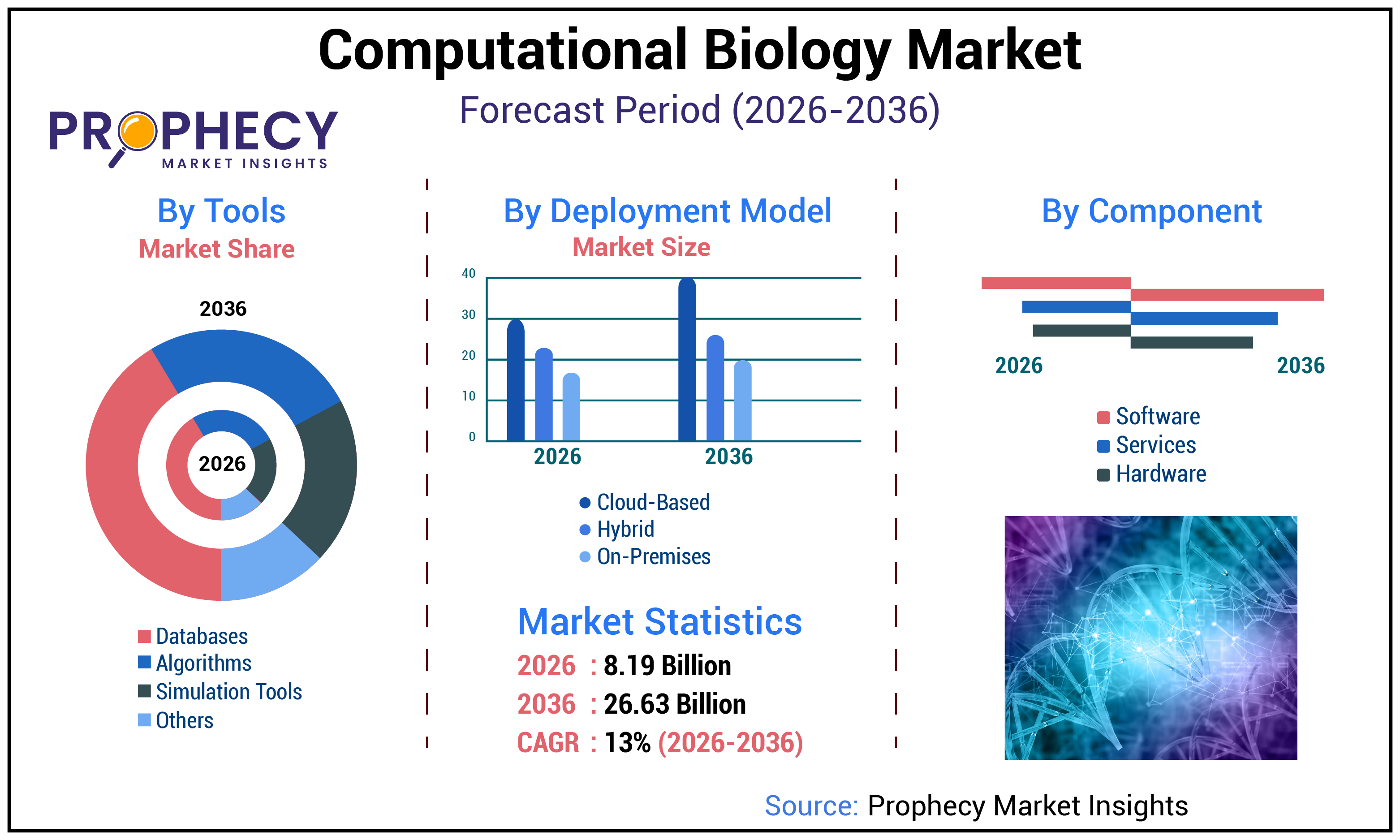
- 2025 Market Size: USD 7.18 Billion
- 2036 Projected Market Size: USD 26.63 Billion
- CAGR (2026-2036): 13%
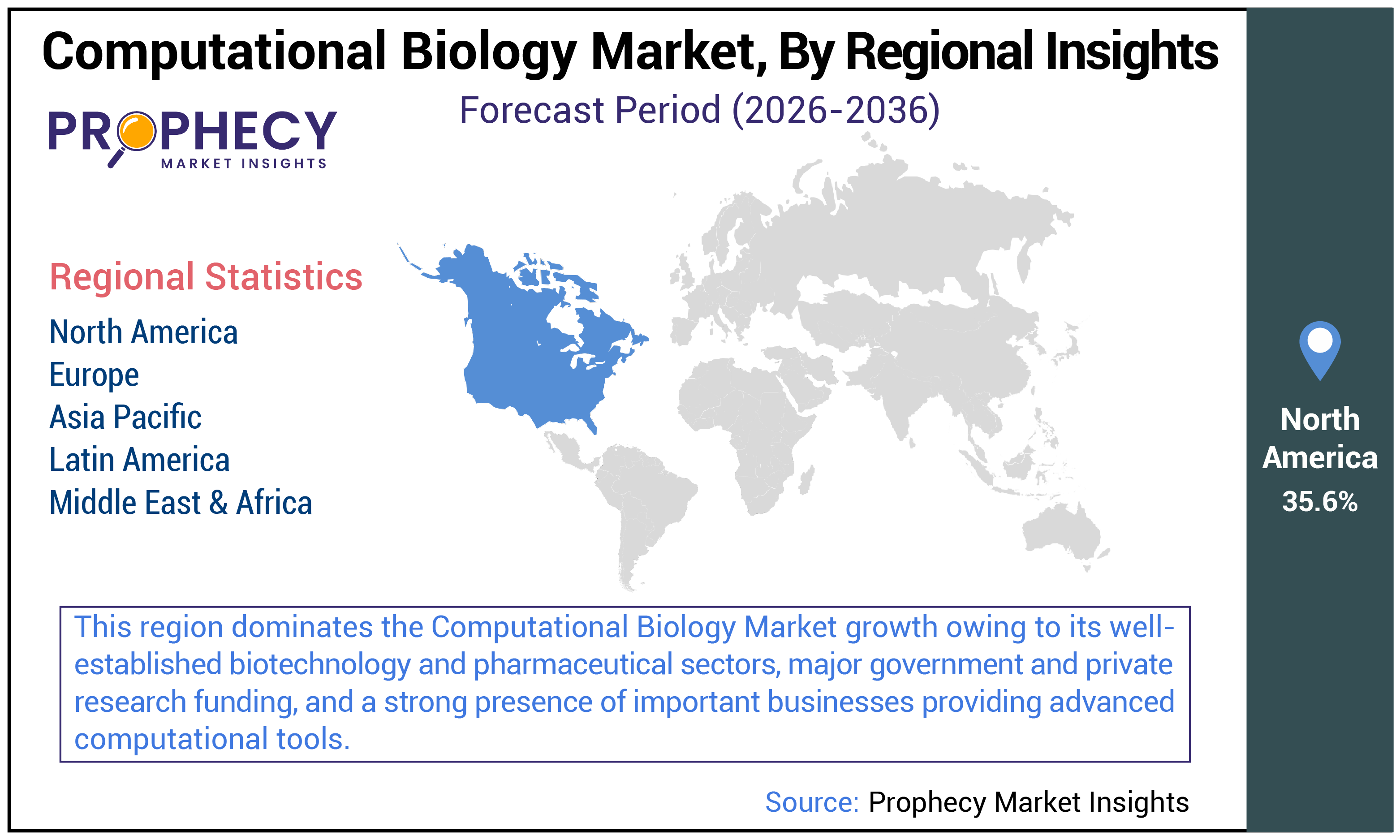
- North America: Largest Market in 2025
Computational Biology is a biologically focused interdisciplinary field which employs computer science, mathematics, and statistics to study the biological systems as genes, proteins, cells, and even entire organisms. In fact, it provides the means for scientists to reconstruct highly complex biological operations, deal with extensive genome sequencing data, and forecast the progression of diseases or reaction to drugs with remarkable precision.
Besides, the essential advantages are new drugs getting into the market at a much quicker and cheaper rate, the uncovering of the biological phenomena, better disease diagnosis, the birth of personalized medicine, and the facilitation of data-driven decision-making in life sciences and healthcare research.
The computational biology market expansion is majorly influenced by the need for precision medicine, quick changes in genomics and proteomics, and increased application of AI and machine learning in biological data analysis.
Moreover, the significant increase in drug discovery and development activities, the demand for affordable research solutions, and the proliferation of cloud-based computational platforms are some of the factors contributing to the market adoption. The rise in chronic diseases and the worldwide attention towards biotechnology and healthcare innovations are becoming major factors that are helping the market to expand further.
Trends in Computational Biology:
- Several core trends in the Computational Biology market revolve around the extensive use AI and machine learning for predictive modeling, adoption of cloud-based computational platforms for scalable data analysis, and integration of multi-omics data (genomics, proteomics, and metabolomics) for gaining deeper biological insight.
- A few of these trends are also quite evident in the transition to personalized and precision medicine, employment of high-performance computing (HPC) for intricate biological simulations, and upsurge of open-source bioinformatics tools aimed at facilitating collaboration and data sharing among research institutions and pharmaceutical companies.
Current Industry Dynamics & Insights:
- North America has the largest regional share in the market, with almost 35.6%.
- Europe is second dominating region in the target market.
- By component, software dominates the computational biology market share.
Computational Biology Market Drivers & Restraints
Drivers and Restraints:
|
Drivers |
Restraints |
Opportunities & Trends |
|
|
|
Key Drivers:
Rising Prevalence of Chronic and Genetic Diseases
One of the major factors leading to the growth of the computational biology market is the increase in the number of chronic and genetic diseases. With the rise in the number of such diseases, the need for advanced instruments that can facilitate the understanding of disease mechanisms and the development of targeted therapies also goes up.
Computational biology allows scientists to do complex genomic data analysis, find disease-causing mutations, and even simulate drug responses in a virtual setting, all in a much shorter time than before. As a result, this leads to the creation of personalized treatment protocols, the speeding up of drug discovery, and the lowering of research costs. Hence, the worldwide rise of cancer, diabetes, and genetic disorders has made the use of computational methods an absolute requirement for the prediction, prevention, and treatment of these diseases.
- For Instance, according to data published by WHO, In 2021, 18 million people died from an NCD before age 70 years; 82% of these premature deaths occur in low- and middle-income countries. Cardiovascular diseases account for most NCD deaths, or at least 19 million deaths in 2021, followed by cancers (10 million), chronic respiratory diseases (4 million), and diabetes (over 2 million including kidney disease deaths caused by diabetes).
Restraints:
Limited Interoperability among Bioinformatics Tools
Bioinformatics tools with limited interoperability can hinder the computational biology market growth as it becomes difficult to integrate and analyze diverse biological data obtained from different platforms. The absence of standardization in this case results in data silos, inefficiency of workflows, and difficulty in combining results from different studies, which in turn, slows down the pace of research and collaboration.
- Counterbalance Statements: An important step towards solving the problem is the use of open data standards, API-based tool integration, and unified bioinformatics frameworks that allow for easy sharing and compatibility of data. The development of interoperable, cloud-based platforms should be supported as they can facilitate collaboration, scalability, and overall efficiency in computational biology research.
Opportunities & Trends:
Development of Digital Twins for Biological Systems
The creation of digital twins of biological systems is becoming the next significant trend in the Computational Biology market. In effect, it makes it possible to have virtual replicas of organs, cells, or even the whole biological processes that can be used for accurate simulation and forecast. These digital twins give scientists the ability to simulate disease progression, drug testing, and treatment personalization without the need for extensive laboratory experiments.
By continuously integrating biological data with AI-powered analytics, these digital twins can speed up the process of drug development, make it less costly, and have a positive effect on the patients’ health. Eventually, as this technology gets further developed, it is anticipated to become a new standard in biomedical research and personalized medicine.
Computational Biology Market Segmentations & Regional Insights
Component, tools, deployment model, application, end user, and region are the divisions of the computational biology market.
By Component:
Hardware, software, and services are component on which computational biology market is segmented. The software sector dominates the computational biology market share mainly since it is central to the data processing, modeling, and simulation processes required for genomics, proteomics, and drug discovery research.
The services market comes in second, driven by rising demand for outsourced bioinformatics solutions, consultancy, and contract research services, particularly among small and medium-sized biotech and pharmaceutical enterprises that lack in-house computing capacity or experience.
By Tools:
From the perspective of tools, the computational biology market is divided into databases, algorithms, simulation tools, and others. Databases dominate the computational biology market share as they serve as the foundation for storing, managing, and accessing huge amounts of genomic, proteomic, and molecular data required for research and drug development. The ongoing accumulation of biological data from next-generation sequencing and public archives such as GenBank and the Protein Data Bank has rendered strong databases vital.
Algorithms are the second most popular tool sector, as powerful AI and machine learning algorithms are widely employed for data interpretation, pattern recognition, and predictive modeling, allowing for faster and more accurate biological insights and decisions in research and healthcare.
By Deployment Model:
Cloud-based, on-premises, and hybrid are deployment model of the computational biology market. The cloud-based deployment approach dominates the computational biology market share due to its scalability, cost-effectiveness, and capacity to handle big biological datasets without requiring costly on-site infrastructure.
The hybrid deployment option comes in second because it allows for the combination of on-premises data control and cloud scalability, which is especially useful for enterprises working with sensitive biological data that requires both confidentiality and computing efficiency.
By Application:
The computational biology market, on the account of application can categorized into drug discovery & development, disease modeling & drug simulation, bioinformatics Research, and others. Drug discovery and development dominates the computational biology market size, as pharmaceutical and biotech businesses increasingly rely on computational techniques to find drug targets, model molecular interactions, and cut clinical trial time and expense.
Bioinformatics research is the second most popular application, owing to an increase in genomics, proteomics, and metabolomics studies that necessitate advanced computational tools for data analysis, gene sequencing, and understanding complicated biological networks.
By End User:
Pharmaceutical & biotechnology companies, academic & research institutes, healthcare organizations, and others are end users of the computational biology market. Pharmaceutical and biotechnology businesses dominate the computational biology market share, investing substantially in computational tools for drug discovery, target identification, and clinical trial simulations to speed up product development and lower R&D expenses.
Academic and research institutes are the second-largest end users, owing to their growing emphasis on genomics, proteomics, and bioinformatics research, as well as collaborations with biotech corporations and government initiatives that promote advanced biological research and innovation.
Regional Insights:
Geographically, the computational biology market is studied across North America, Europe, Asia Pacific, Latin America, and the Middle East & Africa.
North America: This region dominates the computational biology market growth owing to its well-established biotechnology and pharmaceutical sectors, major government and private research funding, and a strong presence of important businesses providing advanced computational tools.
- U.S. Computational Biology Market Insights:
North America's computational biology market is dominated by the U.S. due to its advanced research infrastructure, strong presence of prominent pharmaceutical and biotechnology businesses, and high government funding for genomics and bioinformatics initiatives. The country's early adoption of AI, cloud computing, and high-performance computing in life sciences reinforces its leadership position.
Europe: This is the second-largest region, due to increased investments in genomics and precision medicine, expanded bioinformatics research networks, and supporting regulatory frameworks that encourage the use of computational tools in life sciences and drug development.
- U.K. Computational Biology Market Insights:
In Europe, the U.K. dominates the industry, owing to its strong academic research ecosystem, government precision medicine programs, and rising collaborations between universities, healthcare providers, and biotech enterprises concentrating on computational modeling and genomic data analysis.
Asia Pacific: This region computational biology market is expanding significantly as a result of increased biotechnology investments, expanded genomics research, and growing adoption of AI and cloud technologies for biological data analysis.
- China Computational Biology Market Insights:
China leads the APAC market due to strong government support for biotech research, significant funding in genomics and bioinformatics, rapid growth of pharmaceutical companies, and the establishment of advanced computational infrastructure that enables large-scale biological data processing and analysis.
Computational Biology Market Report Scope:
|
Attribute |
Details |
|
Market Size 2026 |
USD 8.19 Billion |
|
Projected Market Size 2036 |
USD 26.63 Billion |
|
CAGR Growth Rate |
13% (2026-2036) |
|
Base year for estimation |
2025 |
|
Forecast period |
2026- 2036 |
|
Market representation |
Revenue in USD Billion & CAGR from 2026 to 2036 |
|
Regional scope |
North America - U.S. and Canada Europe – Germany, U.K., France, Russia, Italy, Spain, Netherlands, and Rest of Europe Asia Pacific – China, India, Japan, Australia, Indonesia, Malaysia, South Korea, and Rest of Asia-Pacific Latin America - Brazil, Mexico, Argentina, and Rest of Latin America Middle East & Africa – GCC, Israel, South Africa, and Rest of Middle East & Africa |
|
Company Landscape |
Market Share Analysis of Companies Heat Map Analysis Company Overview, Products Overview Financial Information, Key Highlights Business Strategies Overview SWOT Analysis |
|
Report coverage |
Revenue forecast, company share, competitive landscape, growth factors, and trends |
|
Value Added Data Infosets |
Besides fundamental market insights such as the size of the market, growth rate, segmentation, regional study, and key players, our reports carry value-added data sets such as trade flow (import-export) analysis, production and consumption overview, price trend evaluation, supply and value chain mapping, and raw material availability. Moreover, we provide strategic tools as PESTLE and Porter’s Five Forces analysis, examination of the regulatory landscape, as well as monitoring of technology and innovation thereby providing a comprehensive overview which facilitates sensible and anticipatory decision-making. |
Segmentation:
By Component:
- Hardware
- High-Performance Computing (HPC) Systems
- Cloud Computing Infrastructure
- Others
- Software
- Simulation & Modeling Software
- Sequence Analysis Software
- Others
- Services
- Contract Research Services
- Consulting & Implementation
- Others
By Tools:
- Databases
- Algorithms
- Simulation Tools
- Others
By Deployment Model:
- Cloud-based
- On-premises
- Hybrid
By Application:
- Drug Discovery & Development
- Disease Modeling & Drug Simulation
- Bioinformatics Research
- Others
By End User:
- Pharmaceutical & Biotechnology Companies
- Academic & Research Institutes
- Healthcare Organizations
- Others
By Region:
- North America
- U.S.
- Canada
- Europe
- Germany
- U.K.
- France
- Russia
- Italy
- Spain
- Netherlands
- Rest of Europe
- Asia Pacific
- China
- India
- Japan
- Australia
- Indonesia
- Malaysia
- South Korea
- Rest of Asia Pacific
- Latin America
- Brazil
- Mexico
- Argentina
- Rest of Latin America
- Middle East & Africa
- GCC
- Israel
- South Africa
- Rest of Middle East & Africa
Computational Biology Market Competitive Landscape & Key Players
Key growth strategies for Computational Biology companies include expanding partnerships and collaborations with pharmaceutical, biotechnology, and academic institutions to accelerate innovation; investing in AI, machine learning, and cloud computing to improve data analysis and predictive modeling capabilities; and developing integrated, user-friendly software platforms to improve accessibility and scalability.
Computational Biology Market Companies:
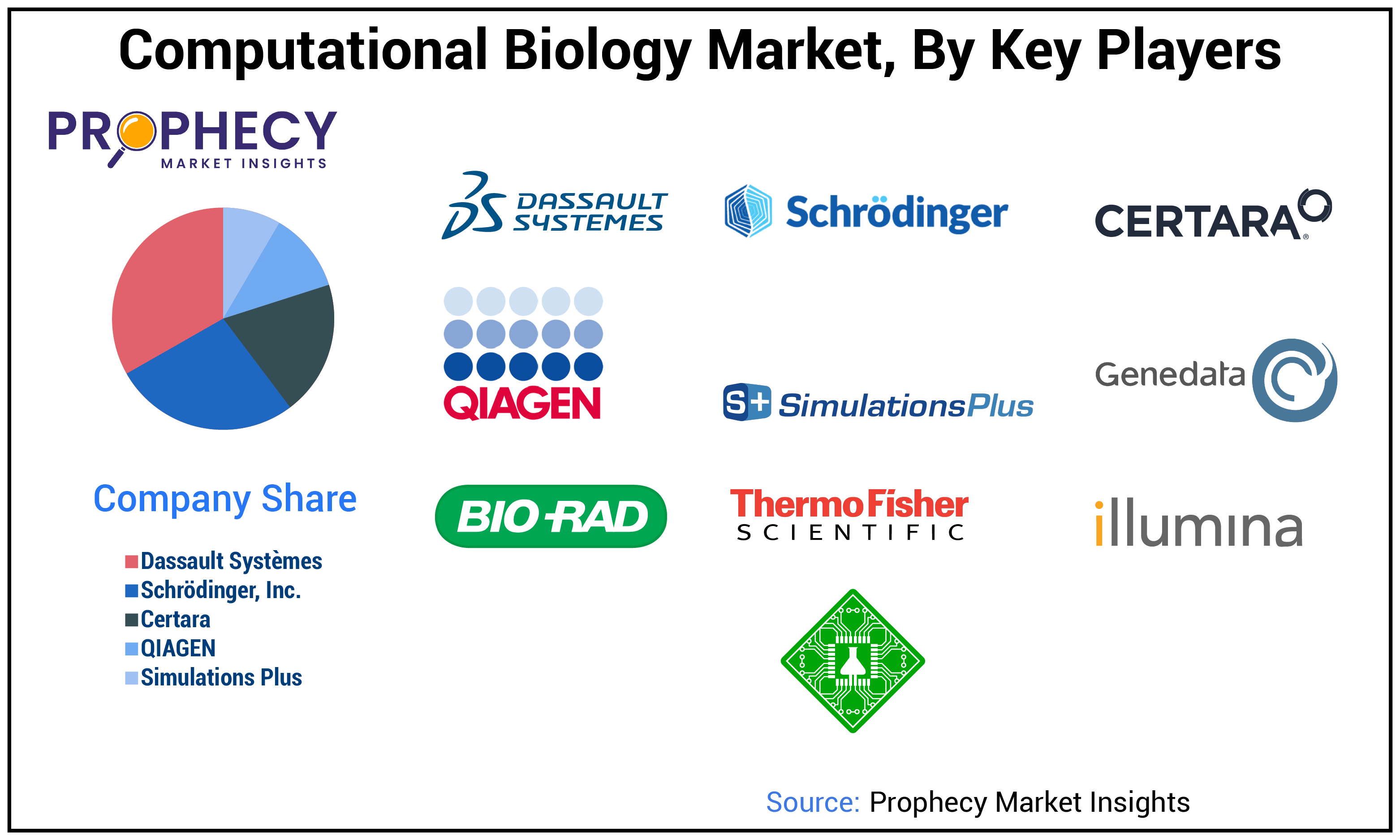
- Dassault Systèmes
- Schrödinger, Inc.
- Certara
- QIAGEN
- Simulations Plus
- Genedata AG
- Insilico Medicine
- Numerion Labs
- DNAnexus, Inc.
- Compugen
- Ginkgo Bioworks
- DEEP GENOMICS
- Thermo Fisher Scientific Inc.
- Illumina, Inc.
- Bio-Rad Laboratories, Inc.
View an Additional List of Companies in the Computational Biology Market
Computational Biology Market Recent News
- In November 2024, NVIDIA announced that worldwide pharmaceutical and techbio industry leaders, academic pioneers, and AI researchers will use the open-source NVIDIA BioNeMo Framework to improve drug discovery and molecule design. Researchers demand specialized biomolecular models and databases that allow them to collect large-scale insights in order to build treatments faster. The open-source BioNeMo Framework provides a set of accelerated computing tools for exponentially scaling AI models for biomolecular research, ushering in a new era of supercomputing in biopharma.
- In May 2024, MiLaboratories, a pioneer in producing world-class software for immunological data processing, has announced the official launch of Platforma.bio. This innovative computational biology platform, powered by AI massive language models, is intended to greatly speed and simplify biological analysis, making it more accessible to researchers from a variety of fields.
Analyst View:
Computational Biology is an interdisciplinary area that employs computer science, mathematics, and statistics to study and model complex biological processes, allowing for speedier drug development, better disease diagnostics, and tailored care.
The market is developing due to rising demand for precision medicine, breakthroughs in genomes and proteomics, increased use of AI and machine learning, increased drug development activities, and the adoption of low-cost, cloud-based computational platforms. Furthermore, the frequency of chronic diseases, as well as the global focus on biotechnology and healthcare innovation, are driving additional growth.
Analysis of Sources:
Primary Sources:
- In-depth interviews
- Company-specific data
- Surveys and questionnaires
- Focus group discussions (FGDs)
- Others
Secondary Sources:
- National Center for Biotechnology Information (NCBI)
- U.S. Department of Energy
- Others
More Related Reports
Industrial Microbiology Market
Rapid Microbiology Testing Market
Pharmaceutical Microbiology Quality Control Market
Synthetic Biology Market
Molecular Biology Enzymes Kits & Reagents Market
Computational Biology Market Company Profile
|
Company Name |
Product Portfolio |
|
Schrödinger, Inc. |
Computational Platform for Molecular Design and Discovery |
|
Certara |
Drug Development Solutions |
|
Dassault Systèmes- |
BioIntelligence |
|
Genedata AG |
Biopharma Discovery & Development |
Computational Biology Market Highlights
FAQs
Computational biology market size was valued at USD 8.19 Billion in 2026 and is expected to reach USD 26.63 Billion by 2036 growing at a CAGR of 13%.
Component, tools, deployment model, application, end user, and region are the segmentation for the computational biology market.
Advancements in genomics and bioinformatics, the increasing demand for personalized medicine and drug discovery, the integration of artificial intelligence and machine learning, and so on are some of the computational biology market growth drivers.
North America, Asia Pacific, Europe, Latin America, and the Middle East & Africa. North America is expected to dominate the computational biology Market.
The key players operating the computational biology market include Dassault Systèmes, Schrödinger, Inc., Certara, QIAGEN, Simulations Plus, Genedata AG, Insilico Medicine, Numerion Labs, SilexPro, Compugen, Ginkgo Bioworks, DEEP GENOMICS, Thermo Fisher Scientific Inc., Illumina, Inc., and Bio-Rad Laboratories, Inc.