Asia Pacific Hydrogen Ships Market Overview
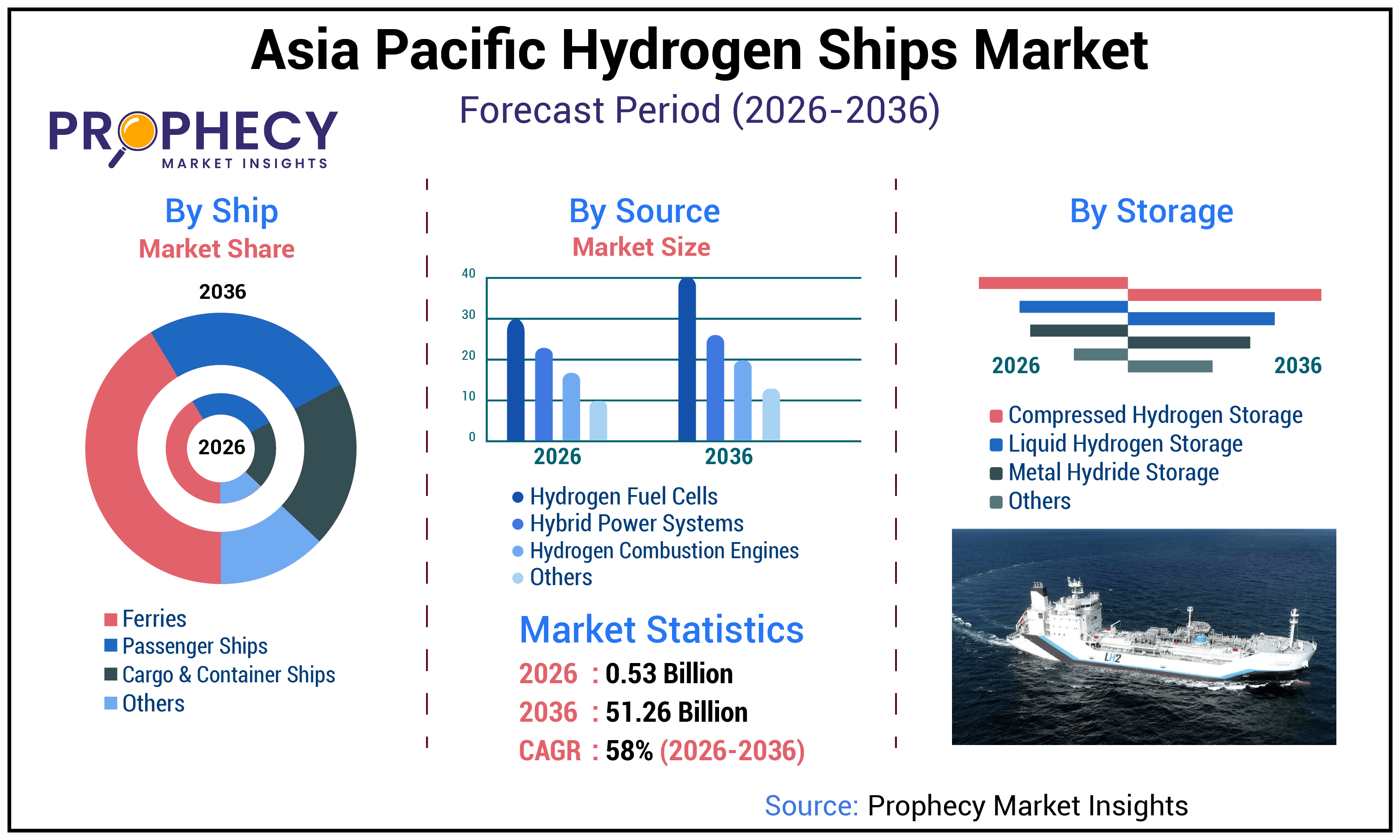
- 2026 Market Size: USD 0.53 Billion
- 2036 Projected Market Size: USD 51.26 Billion
- CAGR (2026-2036): 58%
Hydrogen-powered ships are vessels that use hydrogen fuel cells or hydrogen-based engines to produce power without releasing any harmful substances. Instead of using fossil fuels, hydrogen is employed to generate clean energy, hence making them an excellent green shipping solution. Some of their benefits are zero carbon dioxide emissions, less air and noise pollution, higher energy efficiency, and compliance with future environmental standards. Additionally, they help lessen the consumption of conventional marine fuels, thus facilitating the transition to a cleaner and more sustainable maritime industry.
Governmental decarbonization targets have been a main contributor to the growth of the Asia Pacific hydrogen ships market. There has also been an increase in investments for green hydrogen production and the rising maritime trade of the countries s China, Japan, South Korea, and Singapore collectively have been the major reasons for this market expansion.
These countries are implementing hydrogen-powered vessels as a part of their trials, creating green shipping corridors, and modifying port infrastructure to enable the use of alternative fuels. Moreover, the excellent shipbuilding facilities in Japan and South Korea and the growing demand for emission reduction from the congested regional shipping routes are two factors, which, together, are speeding up the process of the adoption of hydrogen-based maritime solutions.
Overview of Development of Green Hydrogen Roadmaps in the Asia-Pacific Region:
- Governments across the Asia-Pacific region have shifted from making only top-level statements to drafting detailed green hydrogen roadmaps and national strategies that establish production, electrolyzer and export targets, describe infrastructure and standards, and allocate money for pilot projects for scaling supply chains and port/transport uses.
- Policy, finance and technical standards coordination are facilitated by local (APEC/APERC) and global (IRENA) bodies that are also sharing best practices and tracking progress.
- The biggest economies in the world in particular Australia (export and electrolyser scale-up), Japan (demand targets and low-carbon standards) and South Korea (industrial and mobility deployment with fueling infrastructure targets) have released updated strategies or roadmaps that not only attract investment and regional cooperation but also highlight the reduction of carbon emissions in industry, shipping and power.
Asia Pacific Hydrogen Ships Market Drivers & Restraints
Drivers and Restraints:
|
Drivers |
Restraints |
Opportunities & Trends |
|
|
|
Key Drivers:
Growing Regional Trade Volume Demanding Cleaner Maritime Solutions
Ocean freight routes linking the Asia Pacific region have been experiencing an uptrend in trade volumes over the last few years. This has resulted in the countries along those routes being pressured to decarbonize such that those routes can continue to be used in a sustainable manner. Ports and ships are therefore switching over to cleaner power technologies such as hydrogen in order to reduce emissions on these shipping routes.
As the supply of goods continues to flow through important nodes such as China, Japan, South Korea, Singapore, and Australia, the regulators and the industry are taking the emissions from the ships as the top priority in order to meet the climate targets set and to keep reducing the air pollution in the coastal regions which are already heavily populated. The increasing use of greener solutions in logistics such as the one described here leads to the rising investment in hydrogen-driven vessels, infrastructure, and related technologies, thus stimulating overall market expansion.
Restraints:
Uncertain Regulations and Lack of Unified Regional Standards
The Asia Pacific hydrogen ships market is constrained by ambiguous regulations and the lack of unified regional standards, which result in confusion among shipbuilders, port authorities, and fuel suppliers, thereby slowing down investment and delaying the large-scale deployment of these ships. In the absence of harmonized regulations concerning hydrogen bunkering, safety protocols, vessel design, and fuel certification, companies encounter higher compliance risks and operational uncertainties in different countries.
- Counterbalance Statements: One of the best ways to address this issue is through the establishment of coordinated regional policy frameworks as a result of cooperation among APAC governments, maritime agencies, and classification societies. This cooperation can lead to the setting of consistent standards, the facilitation of approval processes, and the provision of clearer long-term guidance that allows for confident investment and faster commercialization.
Opportunities & Trends:
Expansion of Green Hydrogen Export Hubs in Australia, Japan, and South Korea.
The growth of green hydrogen export hubs in Australia, Japan, and South Korea is becoming a significant long-term trend for the Asia Pacific hydrogen ships market. This expansion essentially results in a stable and sustainable regional supply chain that facilitates the use of clean fuels in maritime transport.
Australia seeks to produce large-scale renewable hydrogen mainly for export, whereas Japan and South Korea are investing in import terminals and building hydrogen-ready port infrastructure to ensure a smooth cross-border hydrogen trade. Once these hubs get to the stage of full operation, they will have the effect of speeding up the fleet of hydrogen-powered vessels used for transport, bunkering, and cargo operations, thus making hydrogen shipping routes commercially viable to a greater extent and, therefore, encouraging the use of hydrogen ships to the rest of the region.
Asia Pacific Hydrogen Ships Market Segmentations & Regional Insights
Ship type, source, storage type, end user, and country are the divisions of the Asia Pacific hydrogen ships market.
By Ship Type:
Passenger ships, cargo & container ships, ferries, and others are type on which Asia Pacific Hydrogen Ships Market is segmented. Ferries currently hold the majority of the Asia Pacific hydrogen ships market share due to the operate on fixed, short-to-medium routes that make hydrogen fueling easier to manage, and many regional governments (Japan, South Korea, and China) are prioritizing ferry decarbonization through pilot projects and public funding.
Passenger ships are the second most important segment, driven by considerable demand in clean transportation for tourist and urban mobility, as well as early adoption of fuel-cell vessels for coastal and inland waterways, where zero-emission operation is highly valued. Cargo and container ships arrive later due to increased power requirements, longer itineraries, and increasing technological and infrastructure problems.
By Source:
Based on the source, the Asia Pacific hydrogen ships market is divided into hydrogen fuel cells, hydrogen combustion engines, hybrid power systems, and others. In the Asia Pacific hydrogen ships market share, hydrogen fuel cells have the biggest market share since they provide genuine zero-emission operations, high energy efficiency, and are heavily supported by government-funded demonstration projects in Japan, South Korea, China, and Singapore. Fuel cells are especially suited for ferries and passenger ships, which have dominated early usage in the region.
Hybrid power systems are the second-most popular market, as many shipbuilders and operators prefer to combine hydrogen and batteries to increase range, minimize fuel use, and lower operating risk while infrastructure is still being developed. Hydrogen combustion engines are still smaller due to lesser efficiency and fewer commercial installations.
By Storage Type:
The Asia Pacific hydrogen ships market is categorized into compressed hydrogen storage, liquid hydrogen storage, metal hydride storage, and others on the account of application. Compressed hydrogen storage dominates the Asia Pacific hydrogen ships market growth since it is the most commercially mature, cost-effective, and commonly employed technology in early pilot boats as ferries and small passenger ships. Its simpler handling requirements and compatibility with existing fuel-cell systems make it the best choice for short-term deployment.
Liquid hydrogen storage is the second-largest category, driven by increased R&D and interest from Japan and South Korea in longer-range vessels, since it provides higher energy density and lower storage volume while requiring advanced cryogenic infrastructure. Metal hydride storage is limited due to its high weight, cost, and slow refueling performance.
By End User:
The Asia Pacific hydrogen ships market on the account of end user is categorized shipping companies, port authorities, defense organizations, offshore energy operators, and others. Shipping companies dominate the Asia Pacific hydrogen ships market size considering that they are the primary operators of commercial vessels and are driving early adoption to meet decarbonization targets, comply with tightening emission standards, and upgrade their fleets with hydrogen-powered ferries and passenger ships.
Port authorities are the second-largest category, aggressively constructing hydrogen bunkering infrastructure, supporting pilot projects, and facilitating green shipping lanes through key ports in Japan, South Korea, China, Singapore, and Australia. Defense groups and offshore energy operators will come later due to lengthy regulatory periods, unique vessel requirements, and slower technological integration.
By Country:
On the virtue of country, the market is categorized into China, India, Japan, Australia, Indonesia, Malaysia, South Korea, and Rest of Asia Pacific. Japan dominates the Asia Pacific hydrogen ship market share with its early and aggressive investment in hydrogen technology, strong government-backed decarbonization initiatives, and well-established maritime innovation ecosystem. To commercialize hydrogen propulsion, the country has launched many hydrogen-powered ferries, established advanced liquid hydrogen infrastructure, and formed partnerships with shipbuilders, energy businesses, and port authorities.
Asia Pacific Hydrogen Ships Market Report Scope:
|
Attribute |
Details |
|
Market Size 2026 |
USD 0.53 Billion |
|
Projected Market Size 2036 |
USD 51.26 Billion |
|
CAGR Growth Rate |
58% (2026-2036) |
|
Base year for estimation |
2025 |
|
Forecast period |
2026 – 2036 |
|
Market representation |
Revenue in USD Billion & CAGR from 2026 to 2036 |
|
Regional scope |
Asia Pacific – China, India, Japan, Australia, Indonesia, Malaysia, South Korea, and Rest of Asia-Pacific |
|
Company Landscape |
Market Share Analysis of Companies Heat Map Analysis Company Overview, Products Overview Financial Information, Key Highlights Business Strategies Overview SWOT Analysis |
|
Report coverage |
Revenue forecast, company share, competitive landscape, growth factors, and trends |
|
Value Added Data Infosets |
Besides fundamental market insights such as the size of the market, growth rate, segmentation, regional study, and key players, our reports carry value-added data sets such as trade flow (import-export) analysis, production and consumption overview, price trend evaluation, supply and value chain mapping, and raw material availability. Moreover, we provide strategic tools as PESTLE and Porter’s Five Forces analysis, examination of the regulatory landscape, as well as monitoring of technology and innovation thereby providing a comprehensive overview which facilitates sensible and anticipatory decision-making. |
Segmentation:
By Ship Type:
- Passenger Ships
- Cargo & Container Ships
- Ferries
- Others
By Source:
- Hydrogen Fuel Cells
- Hydrogen Combustion Engines
- Hybrid Power Systems
- Others
By Storage Type:
- Compressed Hydrogen Storage
- Liquid Hydrogen Storage
- Metal Hydride Storage
- Others
By End User:
- Shipping Companies
- Port Authorities
- Defense Organizations
- Others
By Country:
- China
- India
- Japan
- Australia
- Indonesia
- Malaysia
- South Korea
- Rest of Asia Pacific
Asia Pacific Hydrogen Ships Market Competitive Landscape & Key Players
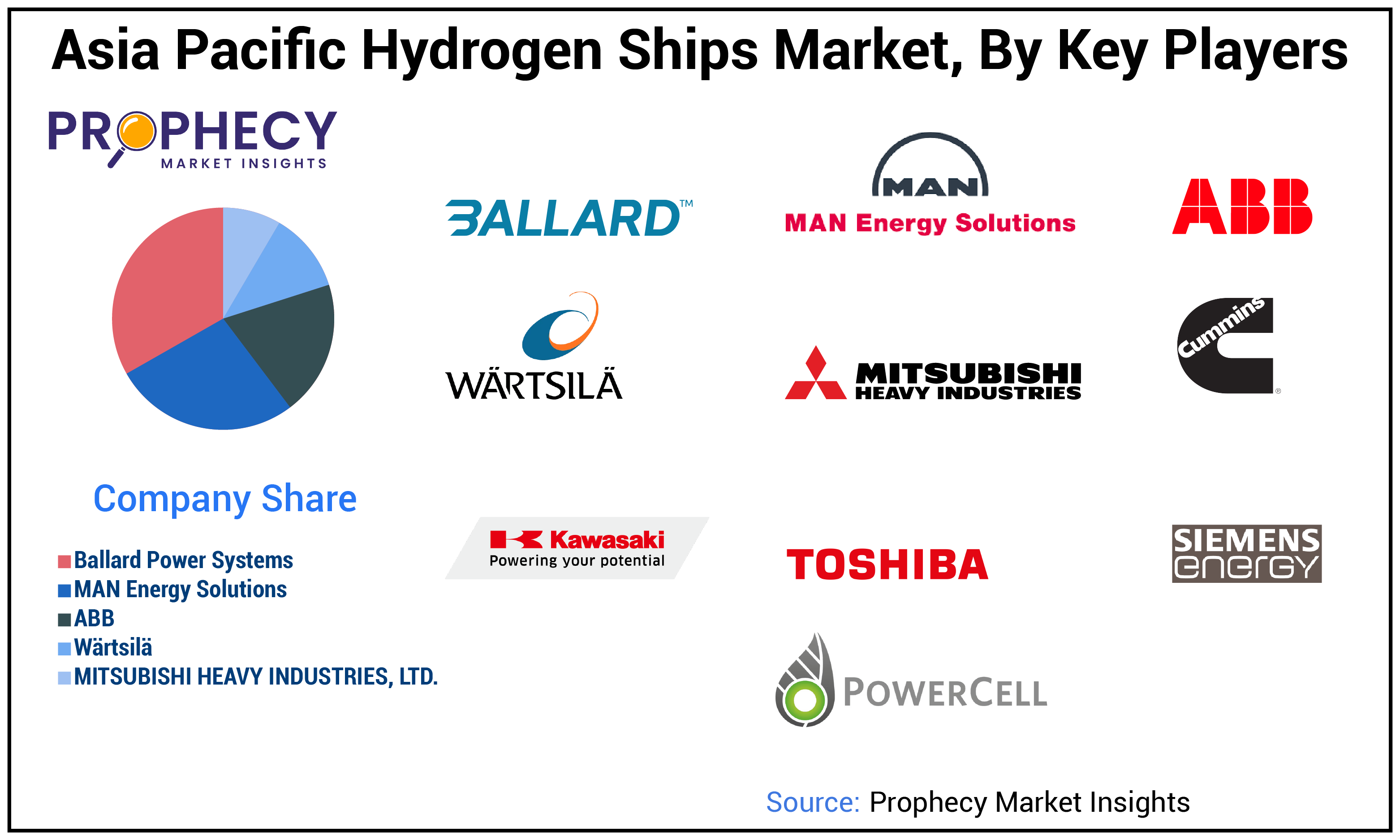
Hydrogen ship firms in APAC are focusing on expansion strategies that include expanding pilot-scale deployments into commercial fleets, creating strategic alliances with fuel suppliers and port authorities, and investing in advanced fuel-cell, hybrid, and liquid hydrogen storage technology. They are also working with governments to build regulatory frameworks, taking part in green shipping corridor efforts, and negotiating long-term hydrogen supply agreements to decrease fuel cost risk.
Asia Pacific Hydrogen Ships Market Companies:
- Ballard Power Systems
- MAN Energy Solutions
- ABB
- Wärtsilä
- MITSUBISHI HEAVY INDUSTRIES, LTD.
- Kawasaki Heavy Industries, Ltd.
- Gentari
- PowerCell Sweden AB
- Cummins Inc.
- Siemens Energy
- Toshiba America Inc
- CMB.TECH nv
- HYDROGENIOUS MARITIME
- Cochin Shipyard Limited
- Sydrogen Energy Pte. Ltd.
Asia Pacific Hydrogen Ships Market Recent News
- In October 2025, Three Japanese businesses have set a world record by operating hydrogen ship engines on land. Kawasaki Heavy Industries, Yanmar Power Solutions, and Japan Engine Corporation successfully completed the land-based trials.
Analyst View:
Hydrogen-powered ships employ fuel cells or engines to provide clean energy without harmful emissions. They offer advantages such as zero CO? production, decreased air and noise pollution, and improved energy efficiency, making them a strong choice for greener maritime operations. In Asia Pacific, the market is expanding significantly as a result of strong government decarbonization goals, increased investments in green hydrogen generation, and booming maritime trade in major nations such as China, Japan, South Korea, and Singapore. These countries are testing hydrogen vessels, creating green shipping lanes, and improving port infrastructure to support alternative fuels.
Furthermore, strong shipbuilding skills in Japan and South Korea, as well as the pressing need to cut emissions along heavily trafficked regional routes, are driving the development of hydrogen-based maritime technology.
Analysis of Sources:
Primary Sources:
- In-depth interviews
- Company-specific data
- Surveys and questionnaires
- Focus group discussions (FGDs)
- Others
Secondary Sources:
- International Maritime Organization (IMO)
- International Energy Agency (IEA)
- Others
More Related Reports
Clean Hydrogen Market
Hydrogen Generation Market
Hydrogen Fuel Cell Vehicle Market
Hydrogen Market
Hydrogen Trucks Market
Asia Pacific Hydrogen Ships Market Company Profile
|
Company Name |
Product Portfolio |
|
MITSUBISHI HEAVY INDUSTRIES, LTD. |
Ship & Ocean |
|
MAN Energy Solutions |
Hydrogen Power Solutions |
|
ABB |
Fuel Cell Systems for Ships |
|
Wärtsilä |
Hybrid Marine System |
|
Gentari |
Hydrogen Ferry |
FAQs
Asia Pacific hydrogen ships market size was valued at USD 0.53 Billion in 2026 and is expected to reach USD 51.26 Billion by 2036 growing at a CAGR of 58%.
Ship type, source, storage type, end user, and country are the segmentation for the Asia Pacific hydrogen ships market.
Government decarbonization goals, the need for energy security, strict emission regulations, and supportive policies and investments in hydrogen infrastructure, and so on are some of the Asia Pacific hydrogen ships market growth drivers.
The key players operating the Asia Pacific hydrogen ships market include Ballard Power Systems, MAN Energy Solutions, ABB, Wärtsilä, MITSUBISHI HEAVY INDUSTRIES, LTD., Kawasaki Heavy Industries, Ltd., Gentari, PowerCell Sweden AB, Siemens Energy, Toshiba America Inc, CMB.TECH nv, HYDROGENIOUS MARITIME, Cochin Shipyard Limited, and Sydrogen Energy Pte. Ltd.