Alternate Marine Power Market Overview
- 2025 Market Size: USD 2.81 Billion
- 2036 Projected Market Size: USD 7.89 Billion
- CAGR (2026-2036): 9.9%
- Europe: Largest Market in 2025
Alternate Marine Power (AMP), which can also be referred to as shore power or cold ironing, is the technology that enables vessels that are moored at a port to turn off their onboard diesel engines and get their power supply directly from the shore-based power grid. By doing so, the system drastically decreases the consumption of fuel and the release of carbon dioxide, nitrogen oxides, sulfur oxides, and particulate matter to the atmosphere during the stay of the ships.
The essential advantages of AMP are the elimination of harmful emissions in port areas, the reduction of noise levels, the saving of money through lower operating costs of the vessels, and the facilitation of the adherence to strict environmental regulations, which are among the factors that lead to less polluting and more sustainable maritime operations.
The expansion of the alternate marine power market is mainly influenced by worldwide efforts to minimize emissions at the portside, more stringent regulations at the international level imposed by organizations such as the IMO (International Maritime Organization), and the increased implementation of green port initiatives.
In fact, the increase in the price of fuel, the technological progress of shore power, and the government subsidies for the clean maritime infrastructure are some of the factors that are speeding up the adoption of AMP. Moreover, the growth of the cruise and container shipping industries, along with the increased concern for environmental sustainability, are among the factors that are facilitating the rapid installation of AMP systems in the major ports worldwide.
Positive Effects of Alternative Maritime Power (AMP) on Marine Industries:
- Alternative Maritime Power (AMP) use has been a huge positive change in the marine industry by making port operations that are cleaner, quieter, and more efficient.
- One of its significant contributions is the reduction of particulate matter, greenhouse gases, and noise that are released from ships that use their auxiliary engines in port areas, thus resulting in improved environmental sustainability and better public health conditions in port cities.
- Moreover, AMP gives ship operators the opportunity to lower fuel and maintenance costs, simplify emission regulations compliance, and upgrade the image of ports that are using clean technologies.
- In short, AMP is an essential component of the maritime ecosystem that is more sustainable, cost-effective, and environmentally friendly.
Current Industry Dynamics & Insights:
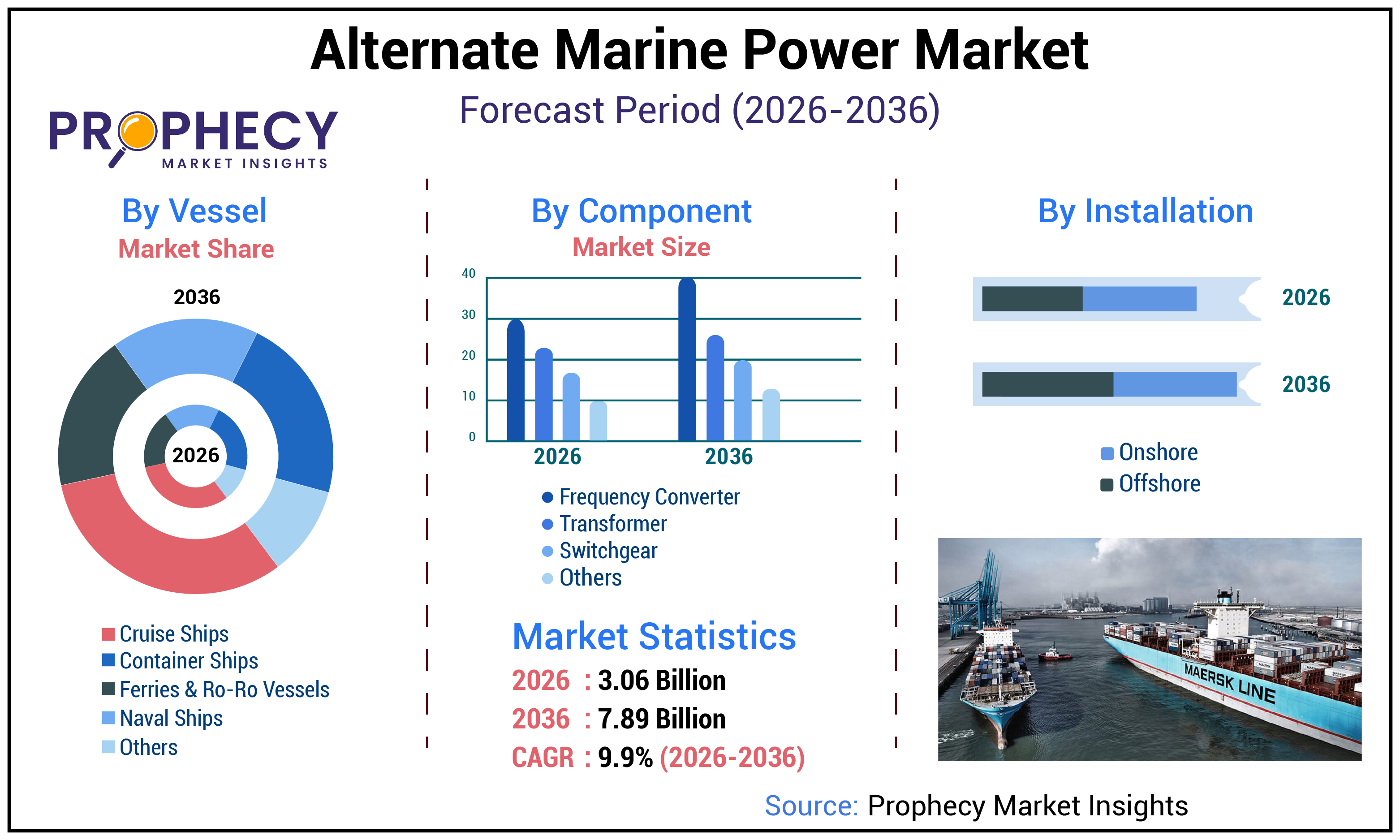
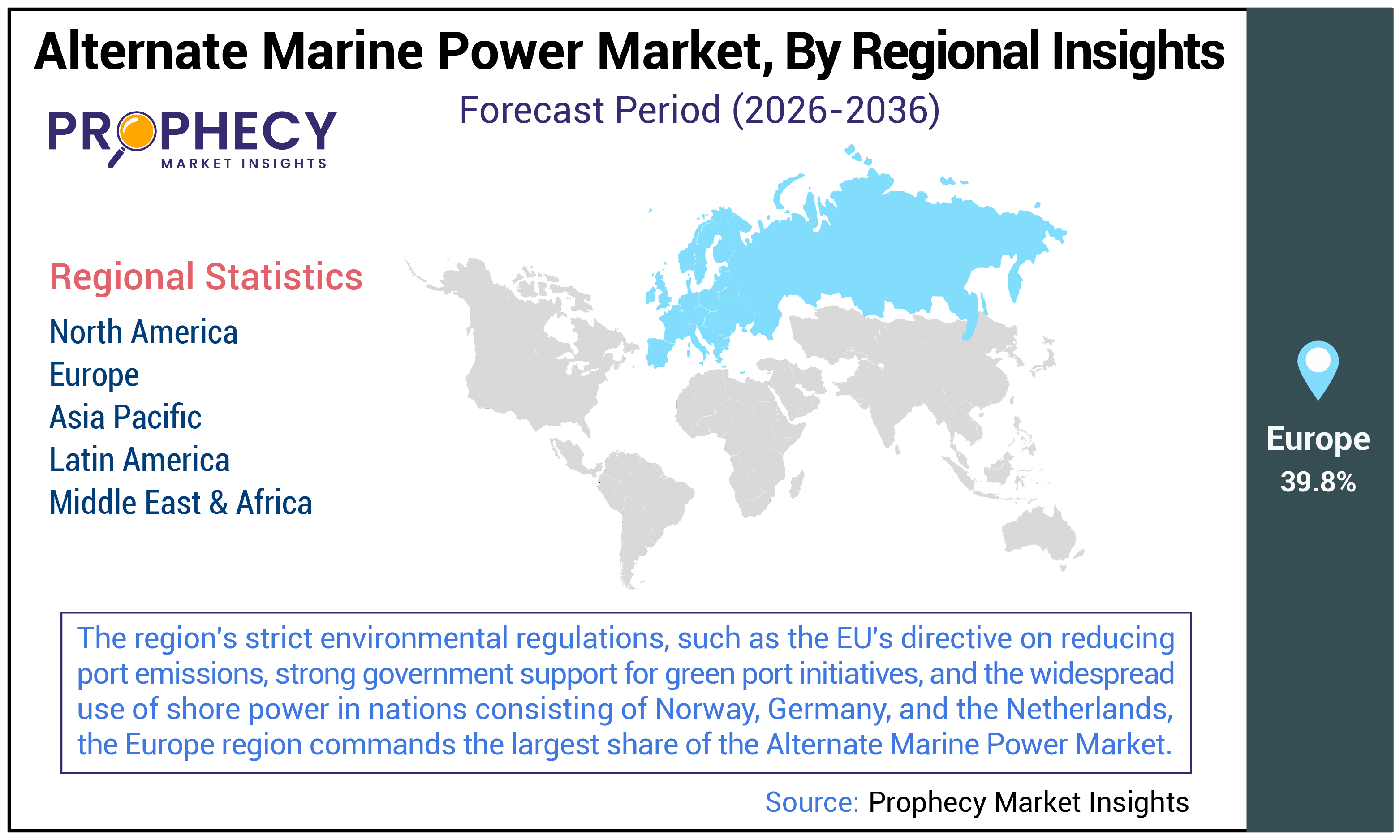
- Europe has the largest regional share in the market, with almost 39.8%.
- Asia Pacific is second dominating region in the market.
- By component, frequency converter dominate the alternate marine power market growth.
Alternate Marine Power Market Drivers & Restraints
Drivers and Restraints:
|
Drivers |
Restraints |
Opportunities & Trends |
|
|
|
Key Drivers:
Increasing Urbanizations
One of the main drivers of the growth of the alternate marine power market is the rise of cities surrounding coastal and port areas. The reason behind this is that these areas require the mitigation of air and noise pollution that ships at docks produce. As a result, local authorities and port management have to implement cleaner technologies to maintain good air quality and public health since more people live and work close to the docks. AMP is a technology that enables ships to use shore power and, therefore, they can turn off their onboard diesel generators.
This is a great reduction of pollutant emissions and noise. Such measures allow ports to become cleaner and in line with urban environmental standards, which, in turn, facilitates the market to grow further.
- For instance, according to the data published by World Bank Group, currently, 4.4 billion people, or more than half of the world's population, reside in urban areas. This trend is predicted to continue, with nearly seven out of ten people living in cities by 2050, when the urban population is predicted to more than quadruple.
Restraints:
Maintenance and Safety Challenges
Such issues as maintenance and safety concerns can be the root reasons for the limited expansion of the alternate marine power market. The systems feature high-voltage electrical connections between shore and ship, thus requiring strict safety protocols, skilled personnel, and regular inspections to avoid electrical faults, overheating, or accidents. All these factors elevate operational complexity and costs, hence a few ports and vessel operators may decide against adoption.
- Counterbalance Statements: It is a suitable measure to introduce automated monitoring systems, uniform safety procedures, and well-rounded training programs for the port staff. Additionally, the use of smart connectors and insulated cable systems that reduce the chance of human error and increase operational reliability is also a viable way.
Opportunities & Trends:
Port Electrification and High Voltage (Above 11 kV) AMP System Developments
One of the main future trends of the alternate marine power market is the development of port electrification and the hybrid AMP system as ports are going global for low-carbon operations. Electrified ports powered by renewable energy, energy storage and hybrid AMP systems - mixing grid power with solar, wind or battery backups - provide more reliability and sustainability.
These systems allow a continuous power supply even in the case of grid instability while at the same time reducing emissions and operational costs further. As a result of the green port initiatives and carbon-neutral goals enforced by governments, the use of hybrid AMP technology is probably to be a new feature of smart ports of the next generation.
Alternate Marine Power Market Segmentations & Regional Insights
Component, vessel type, power, installation type, end user, and region are the divisions of the alternate marine power market.
By Component:
Transformer, switchgear, frequency converter, and others are component on which alternate marine power market is segmented. The frequency converter segment has the most market alternate marine power market share since it is an essential part that makes the shore's electrical supply (50/60 Hz) compatible with the vessel's power system, guaranteeing steady and secure power transfer.
Due to its need to ensure effective power distribution across AMP systems and modify voltage levels to meet ship needs, the transformer segment is the second largest. Its market position is further strengthened by its extensive application in all shore power configurations.
By Vessel Type:
Based on the vessel type, the alternate marine power market is divided into container ships, cruise ships, ferries & Ro-Ro vessels, naval ships, and others. Cruise ships have the biggest alternate marine power market share since they spend a lot of time stopped at ports, where cutting emissions and noise is essential to adhering to strict environmental rules and preserving a favorable public image.
In light of the quick growth of international trade and the increasing use of AMP systems at large commercial ports to comply with pollution regulations and improve operational effectiveness during cargo loading and unloading operations, the container ships segment is ranked second.
By Power:
The alternate marine power market is categorized into low voltage (up to 1 kV), medium voltage (1–11 kV), and high voltage (above 11 kV) on the account of Power. Considering it is mostly utilized for big ships including cruise ships, container ships, and tankers that need a lot of power while moored, the high voltage (over 11 kV) segment of the alternate marine power market has the most market share.
The second-largest section is medium voltage (1–11 kV), which supports a variety of mid-sized ships and regional ports. By providing an affordable balance between installation complexity and power requirements, it promotes consistent adoption throughout emerging maritime regions.
By Installation Type:
Onshore, and offshore are installation type of the alternate marine power market. As a result most AMP systems are installed at ports and terminals, where shore-side electrical infrastructure provides power to docked vessels, the onshore installation sector has largest alternate marine power market share.
The necessity for ships to have appropriate onboard equipment in order to connect to shore power effectively drives the second-largest offshore (shipboard) installation segment, which is growing as more fleets are retrofitted to comply with emission regulations.
By End User:
The alternate marine power market on the account of end user is categorized commercial ports & terminals, naval / defense ports, private marinas, and others. Since commercial ports and terminals handle the majority of international maritime traffic, including container ships, tankers, and cargo boats that need high power while berthed, they have the highest alternate marine power market share.
Driven by government measures to modernize naval bases with quieter and cleaner power solutions, improve operational efficiency, and align defense operations with national sustainability and carbon-reduction goals, the navy and defense ports segment is the second largest.
Regional Insights:
Geographically, the alternate marine power market is studied across North America, Europe, Asia Pacific, Latin America, and the Middle East & Africa.
Europe: The region's strict environmental regulations, such as the EU's directive on reducing port emissions, strong government support for green port initiatives, and the widespread use of shore power in nations consisting of Norway, Germany, and the Netherlands, the Europe region commands the largest share of the alternate marine power market.
- Norway Alternate Marine Power Market Insights:
By virtue of its early installation of shore power infrastructure, strong dedication to environmental sustainability, and government-backed programs encouraging zero-emission ports and electric shipping, Norway leads the European alternate marine power market. Global standards for AMP adoption have been established by Norwegian ports including Oslo and Bergen.
Asia Pacific: The second-largest market is the Asia-Pacific (APAC) region, which is driven by increased investments in smart and sustainable port infrastructure to lower pollution in key coastal cities, growing marine trade, and rapid port construction in China, Japan, and South Korea.
- China Alternate Marine Power Market Insights:
China is the market leader in the Asia-Pacific (APAC) area attributable to significant government investments in green port technologies, stringent pollution laws in important coastal zones, and large port construction projects. Large-scale AMP implementation has accelerated due to China's focus on lowering pollution from its busy container terminals and international trade routes.
North America: The Environmental Protection Agency's (EPA) strict emission control laws, the increased emphasis on port decarbonization, and significant investments in clean energy infrastructure are all contributing to the growth of the Alternate Marine Power market in North America.
- U.S. Alternate Marine Power Market Insights:
Due to early adoption of AMP in major ports including Los Angeles, Long Beach, and Seattle, robust regulatory frameworks, and continuous federal and state programs targeted at achieving zero-emission maritime operations, the United States dominates the North American industry.
Alternate Marine Power Market Report Scope:
|
Attribute |
Details |
|
Market Size 2026 |
USD 3.06 Billion |
|
Projected Market Size 2036 |
USD 7.89 Billion |
|
CAGR Growth Rate |
9.9% (2026-2036) |
|
Base year for estimation |
2025 |
|
Forecast period |
2026 – 2036 |
|
Market representation |
Revenue in USD Billion & CAGR from 2026 to 2036 |
|
Regional scope |
North America - U.S. and Canada Europe – Germany, U.K., France, Russia, Italy, Spain, Netherlands, and Rest of Europe Asia Pacific – China, India, Japan, Australia, Indonesia, Malaysia, South Korea, and Rest of Asia-Pacific Latin America - Brazil, Mexico, Argentina, and Rest of Latin America Middle East & Africa – GCC, Israel, South Africa, and Rest of Middle East & Africa |
|
Company Landscape |
Market Share Analysis of Companies Heat Map Analysis Company Overview, Products Overview Financial Information, Key Highlights Business Strategies Overview SWOT Analysis |
|
Report coverage |
Revenue forecast, company share, competitive landscape, growth factors, and trends |
|
Value Added Data Infosets |
Besides fundamental market insights such as the size of the market, growth rate, segmentation, regional study, and key players, our reports carry value-added data sets such as trade flow (import-export) analysis, production and consumption overview, price trend evaluation, supply and value chain mapping, and raw material availability. Moreover, we provide strategic tools as PESTLE and Porter’s Five Forces analysis, examination of the regulatory landscape, as well as monitoring of technology and innovation thereby providing a comprehensive overview which facilitates sensible and anticipatory decision-making. |
Segmentation:
By Component:
- Transformer
- Switchgear
- Frequency Converter
- Others
By Vessel Type:
- Container Ships
- Cruise Ships
- Ferries & Ro-Ro Vessels
- Naval Ships
- Others
By Power:
- Low Voltage (Up to 1 kV)
- Medium Voltage (1–11 kV)
- High Voltage (Above 11 kV)
By Installation Type:
- Onshore
- Offshore
By End User:
- Commercial Ports & Terminals
- Naval / Defense Ports
- Private Marinas
- Others
By Region:
- North America
- U.S.
- Canada
- Europe
- Germany
- U.K.
- France
- Russia
- Italy
- Spain
- Netherlands
- Rest of Europe
- Asia Pacific
- China
- India
- Japan
- Australia
- Indonesia
- Malaysia
- South Korea
- Rest of Asia Pacific
- Latin America
- Brazil
- Mexico
- Argentina
- Rest of Latin America
- Middle East & Africa
- GCC
- Israel
- South Africa
- Rest of Middle East & Africa
Alternate Marine Power Market Competitive Landscape & Key Players
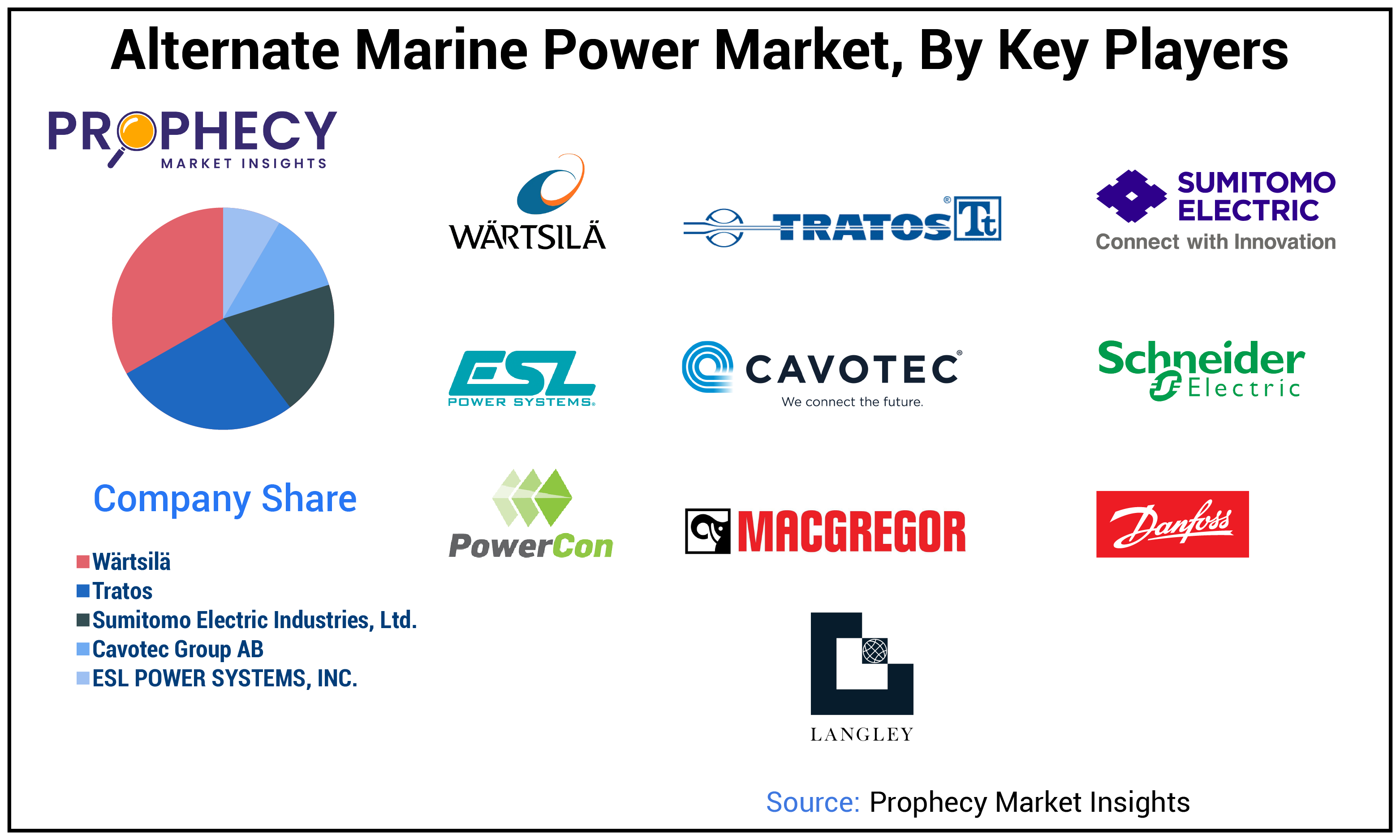
Forming public-private partnerships to create green port infrastructure, funding research and development for cutting-edge, economical AMP technologies, and incorporating renewable energy sources as solar and wind into shore power systems are important growth strategies for the alternate marine power market. Additionally, businesses are concentrating on strategic partnerships with port authorities and shipbuilders, modifying current ships for AMP compatibility, and entering developing markets through digital automation and standardization.
Alternate Marine Power Market Companies:
- Wärtsilä
- Tratos
- Sumitomo Electric Industries, Ltd.
- Cavotec Group AB
- ESL POWER SYSTEMS, INC.
- Schneider Electric
- Nidec ASI spa
- PowerCon A/S
- Langley Holdings plc
- Ratio Electric B.V.
- Danfoss
- MacGregor
- Eco Wave Power U.S.
- SINN Power GmbH
- CalWave
View an Additional List of Companies in the Alternate Marine Power Market
Alternate Marine Power Market Recent News
- In November 2025, The Memorandum of Understanding (MoU) between Neptunus Power Plant and the Indian Register of Shipping (IRS) to introduce the first domestic marine engine condition-monitoring system in history is a significant breakthrough. In support of the nation's objectives of Atmanirbhar Bharat and Viksit Bharat, the Memorandum of Understanding was signed at Maritime India Week 2025 in the presence of the Indian Prime Minister.
- In August 2022, BLUE CONNECT, a ground-breaking high-voltage shore power solution—also referred to as Alternate Marine Power (AMP) or Cold Ironing—was introduced by industry-leading ballast water treatment specialists ERMA FIRST. BLUE CONNECT makes it easy for a ship to connect to a port's electrical grid so that its systems and equipment may be powered at birth.
Analyst View:
Alternate Marine Power (AMP), sometimes referred to as shore power or cold ironing, and greatly reduces fuel usage, pollution, and noise by enabling docked ships to take electricity from the land rather than using diesel engines. Global attempts to reduce portside pollution, more stringent environmental laws from organizations as the IMO, and growing green port projects are driving its implementation. Burgeoning fuel prices, government subsidies, and improvements in shore power technology all contribute to the market's expansion, and the burgeoning cruise and container shipping sectors as well as rising environmental consciousness keep accelerating the implementation of AMPs in key ports across the globe.
Analysis of Sources:
Primary Sources:
- In-depth interviews
- Company-specific data
- Surveys and questionnaires
- Focus group discussions (FGDs)
- Others
Secondary Sources:
- International Maritime Organization (IMO)
- United Nations Conference on Trade and Development (UNCTAD)
- Organization for Economic Co-operation and Development (OECD)
- International Transport Forum (ITF)
- Others
More Related Reports
Marine Lubricants Market
Marine Freight Market
EV Charging Software Market
Marine Collagen Market
Marine VFD Market
Alternate Marine Power Market Company Profile
|
Company Name |
Product Portfolio |
|
Wärtsilä |
Alternative Maritime Power solutions |
|
Nidec ASI spa |
Alternative Power Systems |
|
Tratos |
Alternative Marine Power System |
|
Cavotec Group AB |
Alternative Maritime Power |
|
Schneider Electric |
EcoStruxure for Marine and Shore Power |
Alternate Marine Power Market Highlights
FAQs
Alternate marine power market size was valued at USD 3.06 Billion in 2026 and is expected to reach USD 7.89 Billion by 2036 growing at a CAGR of 9.9%.
Component, vessel type, power, installation type, end user, and region are the segmentation for the alternate marine power market.
Stricter environmental regulations, a focus on sustainability to cut greenhouse gas emissions, the long-term potential for fuel cost savings, and so on are some of the alternate marine power market growth drivers.
North America, Asia Pacific, Europe, Latin America, and the Middle East & Africa. Europe is expected to dominate the alternate marine power market.
The key players operating the alternate marine power market include Wärtsilä, Tratos, Sumitomo Electric Industries, Ltd., Cavotec Group AB, ESL POWER SYSTEMS, INC., Schneider Electric, Nidec ASI spa, PowerCon A/S, Ratio Electric B.V., Danfoss, MacGregor, Eco Wave Power U.S., SINN Power GmbH, and CalWave.