Ai In Drug Discovery And Clinical Trials Market Overview
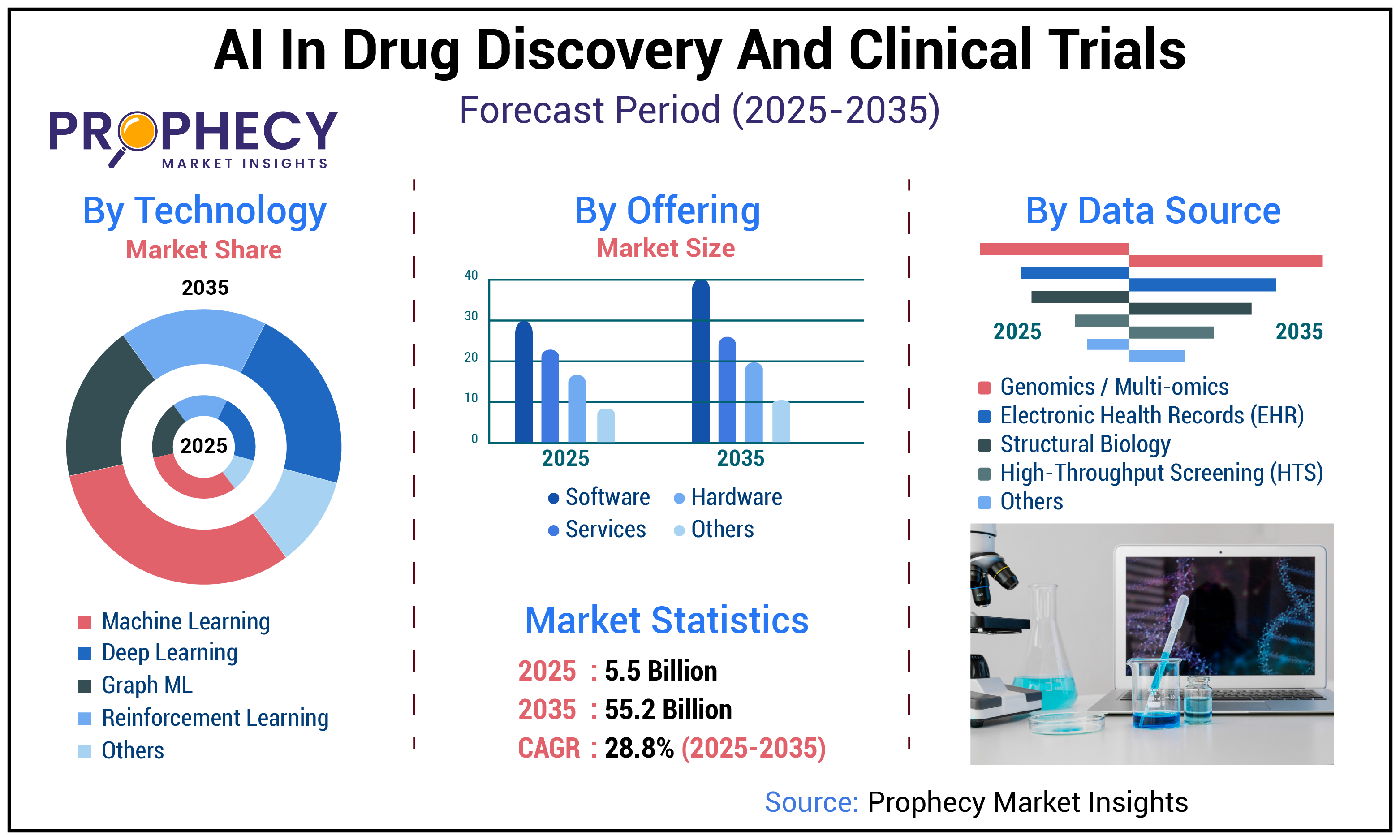
- By 2035, the AI in drug discovery and clinical trials market size is contemplated to enlarge at a valuation of USD 55.2 Billion.
- In 2024, the AI in drug discovery and clinical trials market valuation was USD 4.4 Billion.
- AI in drug discovery and clinical trials market is developing at a CAGR of 28.8%.
AI in drug discovery and clinical trials basically means leveraging advanced algorithms, machine learning, and data analytics to simplify and speed up the whole process of drug discovery, trial designing, and results analysis. It allows quick target identification, predictive modeling of drug safety and effectiveness, enhanced patient recruitment, flexible trial designs, and on-the-go monitoring. Among others, one of the main benefits is the possibility of reducing R&D costs, decreasing time for Software development, improving the chances of success for trials, facilitating the development of precision medicine, and revealing new therapeutic utilizations that are not detected by usual ways of treatment.
The rise in the use of AI in drug discovery and clinical trials market continues to be a major contributing factor to the growth of the said market. Besides this, there is an urgent need to drastically reduce the drug development timelines. In addition, more and more biomedical datasets of high quality and quantity are becoming available from genomics, electronic health records, and real-world evidence. Consequently, the application of machine learning, deep learning, and cloud computing has brought about the expansion of AI model accuracy and scale, thus enabling speedier target identification, the efficient design of clinical trials, and higher success rates.
One of the main factors that will shape the development of AI in drug discovery and clinical trials market is generative AI for new molecule design, multimodal models that combine genomics, imaging, and real-world data, as well as the employment of digital twins to foresee patient outcomes. The increasing utilization of the cloud will facilitate collaboration beyond borders and the use of blockchain technology will ensure data security as well as the transparency of the trial. The development of regulations to provide support and the formation of strong partnerships between pharmaceutical companies, Al startup businesses, and CROs will be the main factors that will considerably speed up drug development processes, which will not only be cheaper but also will have higher precision and lower failure rates.
Recession Risk & Tariff Analysis:
- The Al drug discovery and clinical trials market will be affected moderately by the risk of a recession. Although pharmaceutical R&D is still necessary, small players might postpone the implementation of Al.
- The reduction in costs resulting from the use of Al can alleviate the deceleration of the market to some extent.
- There is little impact from tariffs on software, but the cost of hardware such as GPUs and laboratory equipment that is imported may increase due to tariffs.
Impact of Generative AI on AI in Drug Discovery and Clinical Trials Market:
- Generative Al has been changing the Al in drug discovery and clinical trials industry by allowing fast de-novo molecule design, improving drug-target interactions, and predicting ADMET properties with high precision, hence time reductions in early-stage R&D have been substantial.
- eCTD helps to simulate clinical trial situations, customize clinical protocol, and find the most suitable patients, thus making clinical trial more efficient and successful. Consequently, the time for drug discovery is reduced, drug prices are also lowered, and the new treatment for complicated and rare diseases become possible.
Ai In Drug Discovery And Clinical Trials Market Drivers & Restraints
Key Drivers:
The Growth of the Market can be Rising Prevalence of Chronic and Rare Diseases
The increasing occurrence of long-lasting diseases such as cancer, heart problems, and diabetes, as well as rare genetic disorders, is pushing the need for quicker and better drug creation. These ailments usually call for medications targeting the exact cause and using a patient's own biology, which old R&D ways have trouble providing in a timely manner. AI in drug development and clinical trials is instrumental in meeting this demand, as it allows for the fast identification of potential drugs, the efficient designing of trials, and the facilitation of patient selection, thus making the process of drug discovery for complicated and neglected diseases much faster.
- For Instance, according to the data published by WHO, Noncommunicable diseases (NCDs) killed at least 43 million people in 2021, equivalent to 75% of non-pandemic-related deaths globally. In 2021, 18 million people died from an NCD before age 70 years; 82% of these premature deaths occur in low- and middle-income countries. Cardiovascular diseases account for most NCD deaths, or at least 19 million deaths in 2021, followed by cancers (10 million), chronic respiratory diseases (4 million), and diabetes (over 2 million including kidney disease deaths caused by diabetes).
Restraints:
Data Privacy and Security Concerns can Hampered the Growth of the Market
Data privacy and security issues related to the use of AI in drug discovery and clinical trials are caused by the collection and handling of sensitive patient information such as genomic data, medical history, and research results. These data are targeted by hackers or can be incorrectly used, and these risks may erode patients' trust in the AI system, at the same time they might be against laws such as HIPAA or GDPR, and may slow down the AI implementation.
- Counterbalance Statements: Rugged encryption, safe cloud environments, blockchain for data traceability, tight access controls, plus anonymization or federated learning methods that permit Al models to train on decentralized data without giving out raw patient information to guarantee compliance and keep privacy, are some of the solutions.
Opportunities & Trends:
Increased Adoption of Cloud-based AI platforms as a Catalyst for Future Growth in AI in Drug Discovery and Clinical Trials Market
One of the primary future patterns of Al in medication discovery and clinical trials is the increased use of cloud Al platforms. These platforms allow for easy and quick accessibility to powerful computing and large data processing from any part of the world, eliminating the need for substantial infrastructure locally. Furthermore, these platforms also aid in connecting researchers from different locations, thus facilitating worldwide partnerships. Cloud solutions allow researchers, pharmaceutical companies, and CROs to securely share and analyze vast multi-source datasets-from genomics to real-world evidence-while integrating advanced Al models seamlessly. The method lowers expenses, speeds up the time taken for development, as well as enables remote and decentralized trial operations. Consequently, these benefits imply that drug discovery and clinical research are more efficient, adaptable, and for the whole planet more accessible.
Ai In Drug Discovery And Clinical Trials Market Segmentations & Regional Insights
Offering, technology, clinical trial phase, data source, therapeutic area, application, end users, and region are the divisions of the AI in drug discovery and clinical trials market.
By Offering:
Software, services, and hardware are offerings on which AI in Drug Discovery and Clinical Trials Market is segmented. Target identification, molecule design, trial simulation, and patient recruitment optimization are all made possible by AI platforms, algorithms, and analytics tools, which is why software has the most AI in drug development and clinical trials market share.
Due to the increasing need for specialist knowledge in AI model creation, data curation, validation, and regulatory compliance support particularly for biotechs and pharmaceutical businesses without internal AI capabilities services come in second.
By Technology:
Based on the technology, the AI in drug discovery and clinical trials market is divided into machine learning, deep learning, graph ml, reinforcement learning, and others. Machine learning (ML), which supports the majority of predictive analytics, virtual screening, patient stratification, and trial optimization applications, has the largest AI in drug discovery and clinical trials market share. This is due to its demonstrated dependability and lower computational costs when compared to more complex models.
Though its adoption is constrained by higher computational demands and the requirement for large, high-quality datasets, deep learning (DL) is the second-dominant technology due to its superior ability to process complex biomedical data, including genomics, medical imaging, and molecular structures, enabling breakthroughs in de-novo drug design and biomarker discovery.
By Clinical Trial Phase:
Preclinical, phase I, phase II, phase III, and phase IV are clinical trial phase of the AI in drug discovery and clinical trials market. With large patient populations, intricate logistics, and high stakes for regulatory approval, Phase III is the most costly and time-consuming stage, accounting for the largest AI in drug discovery and clinical trials market share. AI is therefore essential for streamlining patient recruitment, site selection, and trial monitoring in order to cut down on delays and expenses.
Preclinical is the second-dominant phase since AI is widely utilized for lead optimization, toxicity prediction, target discovery, and virtual screening, which allows drug candidates to progress into clinical testing more quickly and affordably.
By Data Source:
On the Data Source, AI in drug discovery and clinical trials market is categorized into genomics / multi-omics, structural biology, high-throughput screening (HTS), electronic health records (EHR), and others. Due to the rise in precision medicine initiatives, declining sequencing costs, and the importance of genomic, transcriptomic, and proteomic data in identifying drug targets, forecasting patient responses, and enabling personalized therapies, genomics/multi-omics currently holds the largest AI in drug discovery and clinical trials market size.
Although interoperability and data privacy issues occasionally hinder their adoption, electronic health records (EHR) come in second as they offer a wealth of real-world patient data that is crucial for eligibility screening, cohort selection, and outcome tracking in clinical trials.
By Therapeutic Area:
The AI in drug discovery and clinical trials market on the account of therapeutic area are categorized into oncology, CNS (neurology/psychiatry), cardiovascular/metabolic, infectious diseases, rare & orphan disease, and others. Oncology has the largest AI in drug discovery and clinical trials market share in the AI in drug discovery and clinical trials market for the reason of the high global cancer burden, significant R&D investment, and complexity of cancer biology, all of which greatly benefit from AI-driven biomarker discovery, drug-target prediction, and patient stratification.
Since neurological and psychiatric disorders including Alzheimer's, Parkinson's, and depression require sophisticated AI models to analyze complex brain imaging, genomics, and behavioral data, the second-dominant field is CNS (neurology/psychiatry), which addresses the historically high failure rates in drug development for these conditions.
By Application:
On the account of application, the AI in drug discovery and clinical trials market is divided into Drug discovery and Clinical Trials. Drug discovery has the biggest AI in clinical trials and drug discovery market share for the reason AI is widely used for target identification, virtual screening, de-novo molecule design, and ADMET prediction, which greatly cuts down on early-stage R&D costs and timelines while increasing success rates.
Although its usage is relatively young, it is rising as digital trial infrastructure and regulatory acceptability improve. Clinical trials are the second most popular application, driven by AI's growing involvement in patient recruiting, site selection, trial monitoring, and adaptive trial design.
By End User:
Large pharmaceutical companies, biotech / small & mid pharma, contract research organizations (CROs), academic & translational research centers, and others of the AI in drug discovery and clinical trials market. Large pharmaceutical corporations dominate the market for AI in drug discovery and clinical trials market growth given that to their financial resources, broad R&D pipelines, and access to enormous datasets that enable them to implement AI at scale for both trial optimization and discovery.
As they increasingly employ AI to speed up candidate development and cut costs, biotech and small and mid-sized pharmaceutical companies are the second-dominant end users. They frequently collaborate with AI platform providers or CROs to gain cutting-edge capabilities without developing their own infrastructure.
Regional Insights:
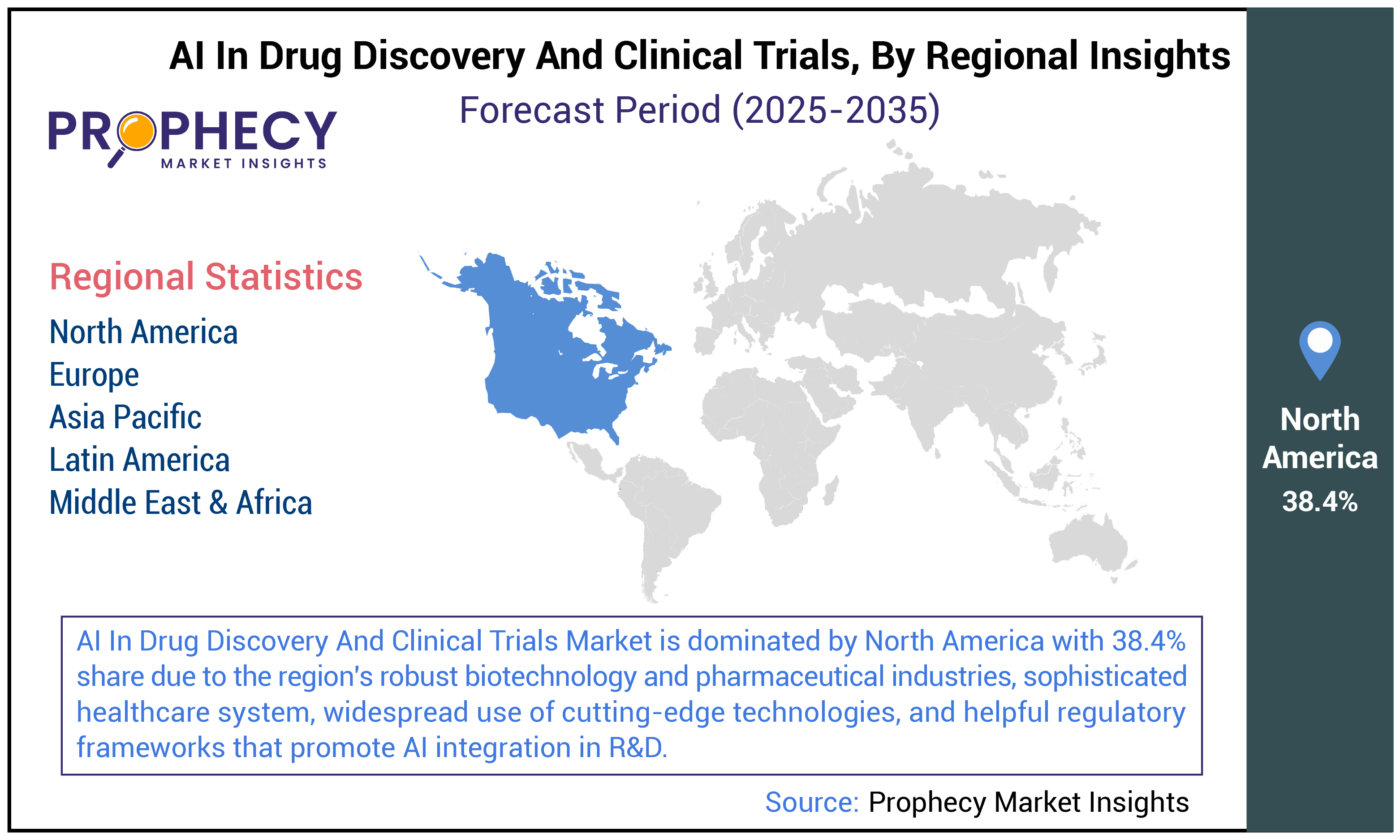
Geographically, the AI in drug discovery and clinical trials market is studied across North America, Europe, Asia Pacific, Latin America, and the Middle East & Africa.
North America: The AI in drug discovery and clinical trials market is dominated by North America with 38.4% share due to the region's robust biotechnology and pharmaceutical industries, sophisticated healthcare system, widespread use of cutting-edge technologies, and helpful regulatory frameworks that promote AI integration in R&D.
- U.S. AI in Drug Discovery and Clinical Trials Market Insights:
Due to its concentration of large pharmaceutical companies, biotech hubs, leaders in AI technology, a wealth of venture capital funding, and a thriving clinical trial activity backed by cutting-edge healthcare infrastructure, the U.S. leads the North America for AI in drug discovery and clinical trials market share.
Europe: With expanding biotech centers, a greater emphasis on personalized medicine, and supporting regulatory frameworks that promote advanced protein research and treatment development across nations including Germany, the U.K., and France, Europe is the second-dominant area.
- U.K. AI in Drug Discovery and Clinical Trials Market Insights:
With robust government funding in AI for life sciences, a booming biotech industry, top-notch research institutions, and programs including the U.K.'s AI in Health and Care Award program that encourage innovation and industry-academia collaboration, the U.K. dominates the European market.
Asia Pacific: This region is expanding quickly as a result of government programs encouraging the use of AI in the life sciences, improving healthcare infrastructure, rising chronic illness prevalence, and rising pharmaceutical R&D spending.
- China AI in Drug Discovery and Clinical Trials Market Insights:
Large government investments in biotech and AI, a robust network of pharmaceutical companies and research facilities, the rapid expansion of clinical trials, and national initiatives consisting of the "Next Generation Artificial Intelligence Development Plan" that support the use of AI in drug development are the main reasons why China leads the APAC market.
AI in Drug Discovery and Clinical Trials Market Report Scope:
|
Attribute |
Details |
|
Market Size 2025 |
USD 5.5 Billion |
|
Projected Market Size 2035 |
USD 55.2 Billion |
|
CAGR Growth Rate |
28.8% (2025-2035) |
|
Base year for estimation |
2024 |
|
Forecast period |
2025 – 2035 |
|
Market representation |
Revenue in USD Billion & CAGR from 2025 to 2035 |
|
Regional scope |
North America - U.S. and Canada Europe – Germany, U.K., France, Russia, Italy, Spain, Netherlands, and Rest of Europe Asia Pacific – China, India, Japan, Australia, Indonesia, Malaysia, South Korea, and Rest of Asia-Pacific Latin America - Brazil, Mexico, Argentina, and Rest of Latin America Middle East & Africa – GCC, Israel, South Africa, and Rest of Middle East & Africa |
|
Report coverage |
Revenue forecast, company share, competitive landscape, growth factors, and trends |
Segmentation:
By Offering:
- Software
- End-to-end Platforms
- Analytics Tools
- Others
- Services
- Consulting
- Model Development
- Others
- Hardware
- Specialized Compute
- On-prem Servers
- Others
By Technology:
- Machine Learning
- Deep Learning
- Graph ML
- Reinforcement Learning
- Others
By Clinical Trial Phase:
- Preclinical
- Phase I
- Phase II
- Phase III
- Phase IV
By Data Source:
- Genomics / Multi-omics
- Structural Biology
- High-throughput Screening (HTS)
- Electronic Health Records (EHR)
- Others
By Therapeutic Area:
- Oncology
- CNS (neurology/psychiatry)
- Cardiovascular/Metabolic
- Infectious Diseases
- Rare & Orphan Disease
- Others
By Application:
- Drug Discovery
- Target Identification & Validation
- Virtual Screening & Docking
- Others
- Clinical Trials
- Protocol Design & Power/Sample-Size Modeling
- Patient Identification & Eligibility Screening
- Others
By End User:
- Large Pharmaceutical Companies
- Biotech / Small & Mid Pharma
- Contract Research Organizations (CROs)
- Academic & Translational Research centers
- Others
By Region:
- North America
- U.S.
- Canada
- Europe
- Germany
- U.K.
- France
- Russia
- Italy
- Spain
- Netherlands
- Rest of Europe
- Asia Pacific
- China
- India
- Japan
- Australia
- Indonesia
- Malaysia
- South Korea
- Rest of Asia Pacific
- Latin America
- Brazil
- Mexico
- Argentina
- Rest of Latin America
- Middle East & Africa
- GCC
- Israel
- South Africa
- Rest of Middle East & Africa
Ai In Drug Discovery And Clinical Trials Market Competitive Landscape & Key Players
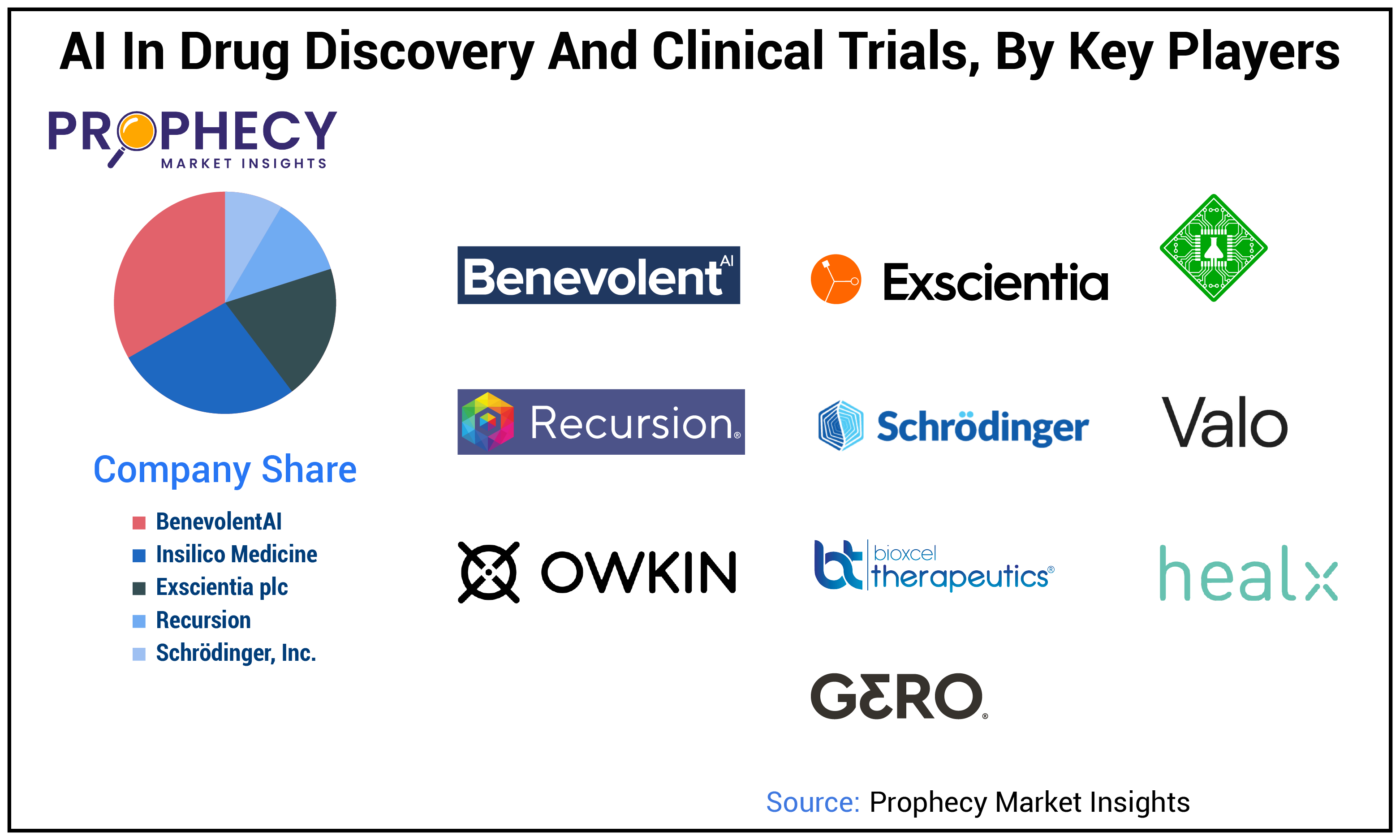
The key players operating in the AI in drug discovery and clinical trials market include, BenevolentAI, Insilico Medicine, BIOXCEL THERAPEUTICS INC., Schrödinger, Inc., Valo Health, and others. Partnerships with pharma and CROs, dataset and AI tool acquisitions, investments in cutting-edge technologies such as generative AI, providing scalable cloud-based platforms, concentrating on high-value therapeutic areas, and maintaining strict regulatory compliance to increase trust and adoption are some of the key growth strategies for AI in drug discovery and clinical trials companies.
AI in Drug Discovery and Clinical Trials Market Companies:
- BenevolentAI
- Insilico Medicine
- Exscientia plc
- Recursion
- Schrödinger, Inc.
- Valo Health
- Shenzhen Jingtai Technology Co., Ltd
- Owkin, Inc
- BioXcel Therapeutics Inc.
- Healx
- Gero.ai
- Verge Analytics, Inc.
- Syntekabio, Inc.
- Evaxion A/S
- Standigm Inc.
View an Additional List of Companies in the AI in Drug Discovery and Clinical Trials Market
Ai In Drug Discovery And Clinical Trials Market Recent News
- In July 2025, the goal of Isomorphic Labs, Alphabet's AI drug development business, is to start clinical trials for its AI-generated cancer medications. AlphaFold 3, an AI model that can precisely predict intricate protein structures and chemical interactions, was co-developed by Isomorphic and Google DeepMind. The 2024 Nobel Prize-winning team of John Jumper and Demis Hassabis created AlphaFold.
- In June 2025, The Council for Responsible Use of AI in Clinical Trials was established today, according to Advarra, the industry leader in clinical research and regulatory review technology. The Council, which consists of professionals from the life sciences sector, will work to promote the use of AI across the clinical trial lifecycle by establishing benchmarks, enhancing model governance, and establishing quantifiable results.
- In April 2025, The AI Small Molecule Drug Discovery Center, a daring initiative by the Icahn School of Medicine at Mount Sinai, aims to transform drug research by utilizing artificial intelligence (AI). With previously unheard-of speed and accuracy, the new Center will combine AI with conventional drug discovery techniques to find and create novel small-molecule treatments.
- In September 2023, in addition to its current range of bespoke solutions and services, Saama, a supplier of AI- and ML-based solutions that speed up clinical development and commercialization, announced the introduction of its unified platform of SaaS-based products. The new Saama platform uses its well-proven machine learning (ML) and artificial intelligence (AI)-enhanced technologies to automate important clinical development procedures and offer a comprehensive overview of patient progress and trial operations in one place.
Analyst View:
By facilitating quick target identification, predictive modeling, effective trial design, and real-time monitoring, artificial intelligence (AI) in drug discovery and clinical trials speeds up drug development while cutting costs and timeframes and increasing success rates. Future themes including generative AI, multimodal models, digital twins, cloud collaboration, blockchain security, and solid industry alliances, along with large biomedical datasets and cutting-edge AI technology, are driving growth.
More Related Reports
AI-Enabled Drug Discovery and Clinical Trials Market
Clinical Communication and Collaboration Market
Artificial Intelligence (AI) in Life Sciences Market
Air Conditioning Systems Market
AI in Healthcare Market
Ai In Drug Discovery And Clinical Trials Market Company Profile
|
Company Name |
BenevolentAI |
|
Headquarter |
London, England |
|
CEO |
Dr. Joerg Moeller |
|
Employee Count |
180 Employees |
Ai In Drug Discovery And Clinical Trials Market Highlights
FAQs
AI in drug discovery and clinical trials market size was valued at USD 5.5 Billion in 2025 and is expected to reach USD 55.2 Billion by 2035 growing at a CAGR of 28.8%.
Offering, technology, clinical trial phase, therapeutic area, application, end user, and region are the segmentation for the AI in drug discovery and clinical trials market.
North America, Asia Pacific, Europe, Latin America, and the Middle East & Africa. North America is expected to dominate the market.
The key players operating the AI in Drug Discovery and Clinical Trials Market include BenevolentAI, Insilico Medicine, Exscientia plc, Recursion, Schrödinger, Inc., Valo Health, Shenzhen Jingtai Technology Co., Ltd, Owkin, Inc, BioXcel Therapeutics Inc., HealX, Gero.ai, Verge Analytics, Inc., Syntekabio, Inc., Evaxion A/S, and Standigm Inc.