Transit Packaging Market Overview
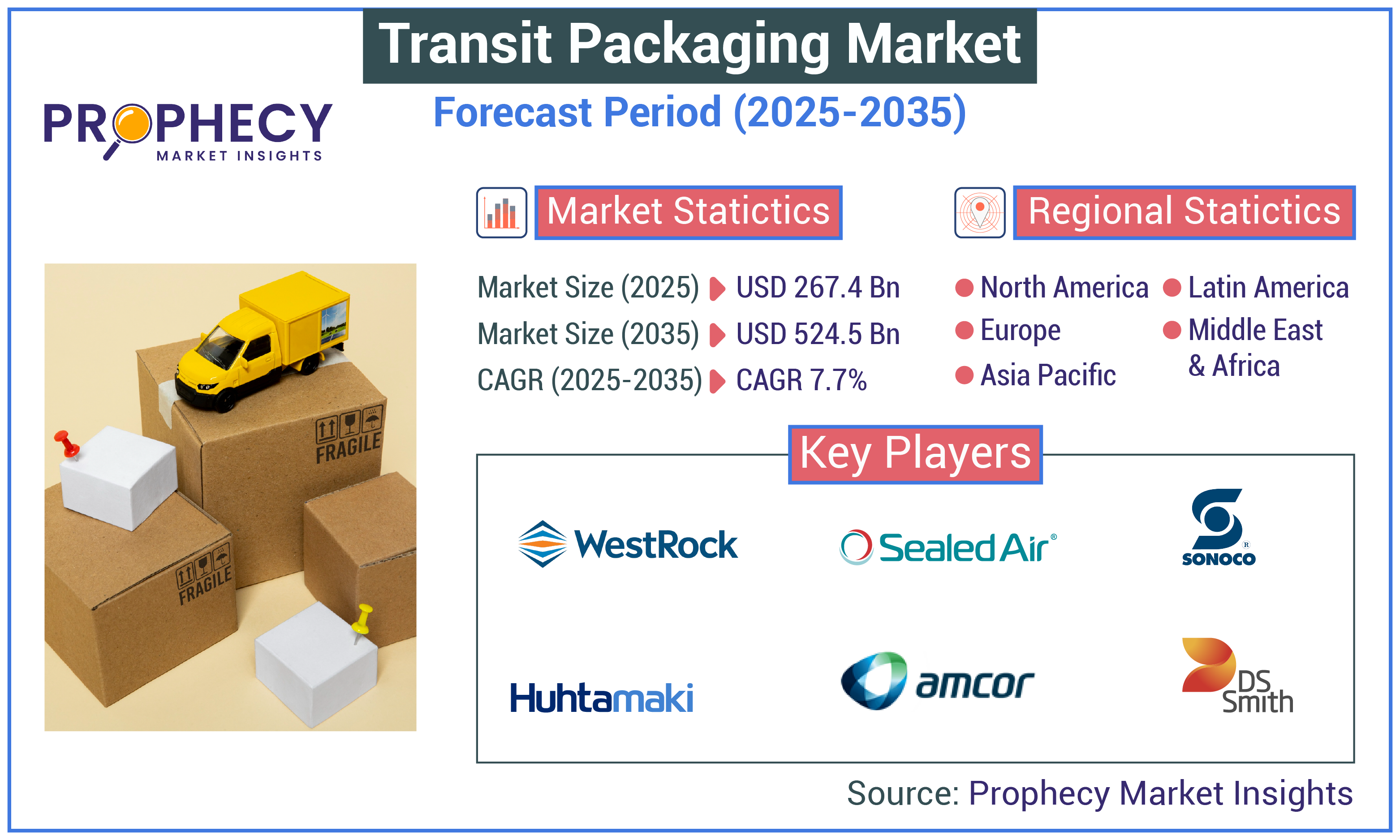
- By 2035, transit packaging market size is contemplated to enlarge at a valuation of USD 524.5 Billion.
- In 2024, the transit packaging market valuation was USD 251.4 Billion.
- Transit packaging market is developing at a CAGR of 7.7%.
Transit packaging refers to protective packaging during the transportation and distribution of goods. It protects product safety from the manufacturing plant to the customer delivery point, to avoid damage, loss, or contamination. Some of the most common materials of transit packaging include corrugated boxes, pallets, crates, and shrink wraps. Companies use transit packaging worldwide in a variety of industries such as e-commerce, automotive, food and beverage, and pharmaceuticals.
The transit packaging market will continue to grow as a result of the increasing levels of global trade, availability of e-commerce both regionally and internationally, the global demand for assurances about product safety during the entire transportation process, and overall supply chain complexities are making companies focus on efficient supply chains and cost-effective logistics, resulting in increased demand for reliable, trusted transit packaging. The growing demand from consumers for packaging that is sustainable or recyclable is also stimulating innovation in materials and technologies in transit packaging that simultaneously drives growth through change across heavily relied-on categories such as FMCG, electronics, and industrial goods.
The future of transit packaging in logistics is driven largely by smart packaging, automation, and sustainable materials. Some innovations, such as RFID tracking and biodegradable products, are going to disrupt the market and change the dynamics of packaging for businesses. Demand for cross-border trade or last-mile delivery services will help power continued growth in transit packaging as an important part of the modern logistics system.
Recession Risk & Tariff Analysis:
- Economic downturns, where consumers are purchasing less and factories are producing less, can have a major impact on the demand for transit packaging. It is common for companies to cut logistics and packaging budgets when during an economic downturn, and therefore they choose less cost prohibitive or minimal packaging. This causes a downward revenue effect on manufacturers and when this occurs it probably will slow investment in either sustainable or innovative packaging technology which negatively impacts the overall growth of the transit packaging market.
- Trade tariffs on raw materials including paper, plastics, and metals can increase transit packaging manufacturers' production costs. Trade tariffs, both across a border and placing a tariff on a domestic supply of materials, can disrupt a global supply chain and availability for these materials including prices which can lead to high costs for the end users which can force searches for regional suppliers and/or alternatives that are not tariffed.
Impact of Generative AI on Transit Packaging Market:
- Generative AI can speed up packaging design by identifying the performance, material, and logistical draw-factors, then generating efficient options. This helps improve prototyping, development cycles, and reduce waste; thus simplifying the manufacturing of customized, economical, and sustainable transit packaging for an array of products and shipping conditions.
- Generative AI utilizes trade data to predict demand, refine inventory and optimize the packaging logistics of the supply chain. Additionally, it can improve visibility of supply chains to enhance a company's predictive packaging capabilities, allowing for more precise supply, and reducing over production and storage costs. This establishes more responsive and adaptive transit packaging approaches to accommodate the tenuous fluctuations of market demand.
Transit Packaging Market Drivers & Restraints
Key Drivers:
Expansion of Global E-commerce and Trade is changing the dynamics of the market
The increasing popularity of global e-commerce and international trade is a prominent driver for the transit packaging market. As consumers increasingly shop online and complete transactions across borders, the value of durable and efficient packaging ergonomics to protect goods during transit becomes even clearer. The rapid emphasis on faster deliveries and enhancing customer experience only increases more demand for smart, sustainable, and cost-efficient solutions for transit packaging. Many sectors, but especially electronics, fashion and FMCG depend on transit packaging systems to reduce the risk of products being damaged while maintaining product integrity and customer satisfaction with products.
-
For instance, according to the International Trade Administration, worldwide ecommerce sales for B2B businesses have been increasing year over year for the last decade. In fact, by 2026 the global B2B ecommerce market is expected to grow to USD36 trillion. This is directly reflected in the transit packaging market's on-going growth to uphold industry's need for larger production across the international shipment processes.
Restraints:
Environmental Concerns and Regulatory Pressures to repel market growth:
A big limitation of the transit packaging industry is environmental pressure, about waste and sustainability, mainly related to packaging materials depending on plastic and things that are not biodegradable and environmentally-friendly. There is pressure from local and federal governments and governing bodies to upgrade to a level of sustainability that may hinder speed in designation for companies. Upgrading to comply with regulations often comes at a cost of re-designing and re-evaluating the packaging material that companies utilize. This may make it difficult for smaller groups and/or medium-sized companies, to comply and upgrade to green packaging, while meeting the demands of packaging functionality.
- Counterbalance Statements: That said, we also see, that innovation is ramping up for biodegradable, recyclable, and/or reusable sustainable packages. Complying with both the regulatory and market demands are sustainable packaging options that typically line up with consumer preferences and/or wants, therefore elevating a company brand through improved reputation and increases towards environmental sustainability and goal setting. So, clearly the constraint becomes the opportunity in the market.
Opportunities & Trends:
Smart and Sustainable Packaging Solutions is a growing opportunity
The increasing demand for environmentally friendly materials is a great opportunity in the transit packaging sector. In addition, the latest trend for smart packaging is also starting to gain attention, with the use of RFID tags, QR Codes, and sensors. The industry is moving, using these technologies creates traceability, reduces loss, and makes the supply chain more efficient on all levels. Therefore, businesses that are incorporating both sustainable and smart packaging solutions will be able to fulfill government regulations, reduce their environmental impacts, and add value to their customers, giving them a competitive advantage in an increasingly innovative and environmentally driven economy.
Transit Packaging Market Segmentations & Regional Insights
Product, material type, application, end-user and region are the divisions of the transit packaging market.
By Product:
Based on the Product, the transit packaging market is divided into corrugated boxes, pallets, crates, shrink wraps, barrels & drums, straps & strapping, and protective packaging. Corrugated boxes are the most popular form of transit packaging market share due to their flexibility and lightweight cost-effective nature, as well as, companies across e-commerce, FMCG, and electronics. Corrugated boxes provide enhanced protection, easy customization, and can be recycled. In addition, they are ideal for handling product of all shapes and sizes and therefore considered the best means of safe transportation.
Pallets are the second most common form of transit packaging, largely due to their importance in handling bulk products and storage. They are capable of being stacked, moved, loaded in a storage or freight situation more efficiently for a warehouse, and the product is more easily retrieved. Pallets are produced in wood, plastic, and metal. Pallets are ubiquitous in all industries, from food to pharmaceutical to manufacturing logistics.
By Material Type:
Based on material type, the market is segmented into plastic, paper & paperboard, wood, metal, and glass. Plastic is the dominant carrier in a transit packaging market share that is durable, flexible, and resistant to moisture and chemicals in nature. As a result, it is widely used in transit packaging pallets, shrink wrapping and protective packaging. Its lightweight properties and ability to be reused provides mounting overhead for industries looking for a cost-effective packaging solution that is durable and designed to last adult uses.
Paper & paperboard is second for packaging, as demand sufficient directed towards sustainable and environmentally friendly packaging solutions was and is an important domain. Treats such as corrugated boxes and wrapping are format which have considerable use given its high-quality printability and recyclability will ultimately be a driving legacy.
By Application:
Based on application, the market is segmented into product protection, storage optimization, handling & stacking, secure transportation. Product protection as an application dominates the transit packaging market growth, since protecting goods from transit damage is a requirement in every industry. Protecting goods with protective films, foam inserts, and sturdy boxes, is the first and foremost consideration for all packaging solutions to ensure goods reach end-users intact while minimizing product returns and maximizing satisfaction.
Secure transportation is the second largest market application, in which the focus is on transportation, stability, and containment of products during shipping. Pallets, strapping, and crates are commonly used to stabilize an item, containing its movement and spillage. Industries use some form of secure packaging to optimize the shipping process, particularly as it relates to long distances for customs operations and international shipping.
By End-user:
Food & beverage, pharmaceuticals & healthcare, electronics, automotive, industrial machinery, retail & e-commerce, and others are end-user of the transit packaging market. The explosive growth of e-commerce and direct-to-consumer shipping is driving the transit packaging market growth in the retail & e-commerce sector. With so much volume shipped, reliable, light-weight, customizable packaging is required from order fulfilment to safe, secure, & efficient delivery. Corrugated cartons, shrink-wrapping, and protective inserts are common applications to meet these needs.
The second industry of interest is food & beverage surrounded by the need for high levels of hygiene, moisture-proofing, and temperature control. Transit packaging helps protect fresh or perishable items with solutions that include insulated containers, pallets and shrink wraps that provide integrity across entire supply chains and distribution networks.
Regional Insights:
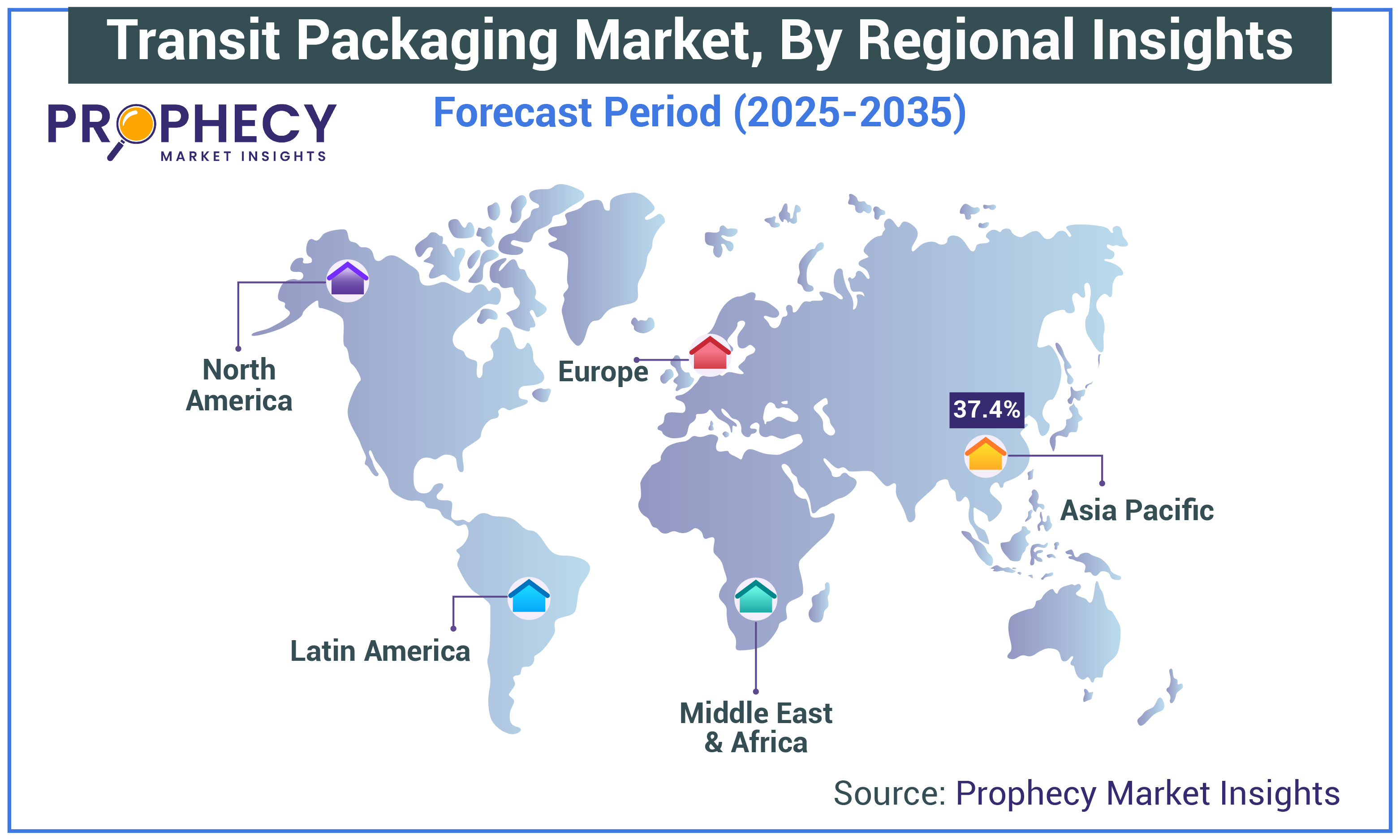
Geographically, the transit packaging market is studied across North America, Europe, Asia Pacific, Latin America, and the Middle East & Africa.
Asia Pacific: This region leads the transit packaging market size with 37.4% share, as a result of its growing manufacturing industry, urbanization, and e-commerce industry, among others. The key countries driving demand are China, India, and Japan, with their massive scale exports and level of industrial production and retail growth requiring an immense amount of low-cost, durable, and scalable transit packaging products.
- China Transit Packaging Market Insights:
China is the market leader in transit packaging in the Asia Pacific region due to its enormous manufacturing base, export economy, and large e-commerce, electronics, and consumer goods sector that demands large amounts of durable, economical, and helpful packaging for products. China’s government has also supported the rapid growth of its industrial base, which has increased transit packaging consumption and new product development activities.
North America: This region is second as a result of its advanced logistics infrastructure, high intensity of e-commerce, and demand for protective and smart packaging. The U.S. has firm footing in innovation of sustainable materials and automation supply, while the established manufacturing supply chains in numerous industries enhances demand for transit packaging.
- U.S. Transit Packaging Market Insights:
The U.S. is the market leader in North America's transit packaging market due to its vast logistics network and the growth of e-commerce. The growing demand for transit packaging spans many industries, including food, healthcare, electronics, and others, which create a continuous loop of innovation and development of specialized smart packaging and sustainable materials. The USA's sophisticated focus on automation and improving supply chain outcomes also helps maintain its market leadership.
Europe: This region is has third position in target market growth, serving as a result of the maturity of the retail sector that was bolstered by COVID-19, the environmental regulations surrounding businesses, and high levels of trade activities. Sustainable and recyclable packaging solutions is a large focus of the European region, with countries such as Germany, UK, and France focusing on reducing carbon footprint led by innovation in sustainable materials, and making packaging more efficient in logistics processes.
- Germany Transit Packaging Market Insights:
Germany is Europe's market leader in transit packaging due to its industrial strength and export-driven economy. As an automotive, machinery, and chemical exporter, Germany requires transit packaging that is robust and reliable while also meeting environmental guidelines that encourage the use of sustainable materials. Therefore, Germany defines a primary market driver that affects growth.
|
Attribute |
Details |
|
Market Size 2025 |
USD 267.4 Billion |
|
Projected Market Size 2035 |
USD 524.5 Billion |
|
CAGR Growth Rate |
7.7% (2025-2035) |
|
Base year for estimation |
2024 |
|
Forecast period |
2025 – 2035 |
|
Market representation |
Revenue in USD Billion & CAGR from 2025 to 2035 |
|
Regional scope |
North America - U.S. and Canada Europe – Germany, U.K., France, Russia, Italy, Spain, Netherlands, and Rest of Europe Asia Pacific – China, India, Japan, Australia, Indonesia, Malaysia, South Korea, and Rest of Asia-Pacific Latin America - Brazil, Mexico, Argentina, and Rest of Latin America Middle East & Africa – GCC, Israel, South Africa, and Rest of Middle East & Africa |
|
Report coverage |
Revenue forecast, company share, competitive landscape, growth factors, and trends |
Segmentation:
By Product:
- Corrugated Boxes
- Pallets
- Crates
- Shrink Wraps
- Barrels & Drums
- Straps & Strapping
- Protective Packaging
By Material Type:
- Plastic
- Paper & Paperboard
- Wood
- Metal
- Glass
By Application:
- Product Protection
- Storage Optimization
- Handling & Stacking
- Secure Transportation
By End-user:
- Food & Beverage
- Pharmaceuticals & Healthcare
- Electronics
- Automotive
- Industrial Machinery
- Retail & E-commerce
- Others
By Region:
- North America
- U.S.
- Canada
- Europe
- Germany
- U.K.
- France
- Russia
- Italy
- Spain
- Netherlands
- Rest of Europe
- Asia Pacific
- China
- India
- Japan
- Australia
- Indonesia
- Malaysia
- South Korea
- Rest of Asia Pacific
- Latin America
- Brazil
- Mexico
- Argentina
- Rest of Latin America
- Middle East & Africa
- GCC
- Israel
- South Africa
- Rest of Middle East & Africa
Transit Packaging Market Competitive Landscape & Key Players
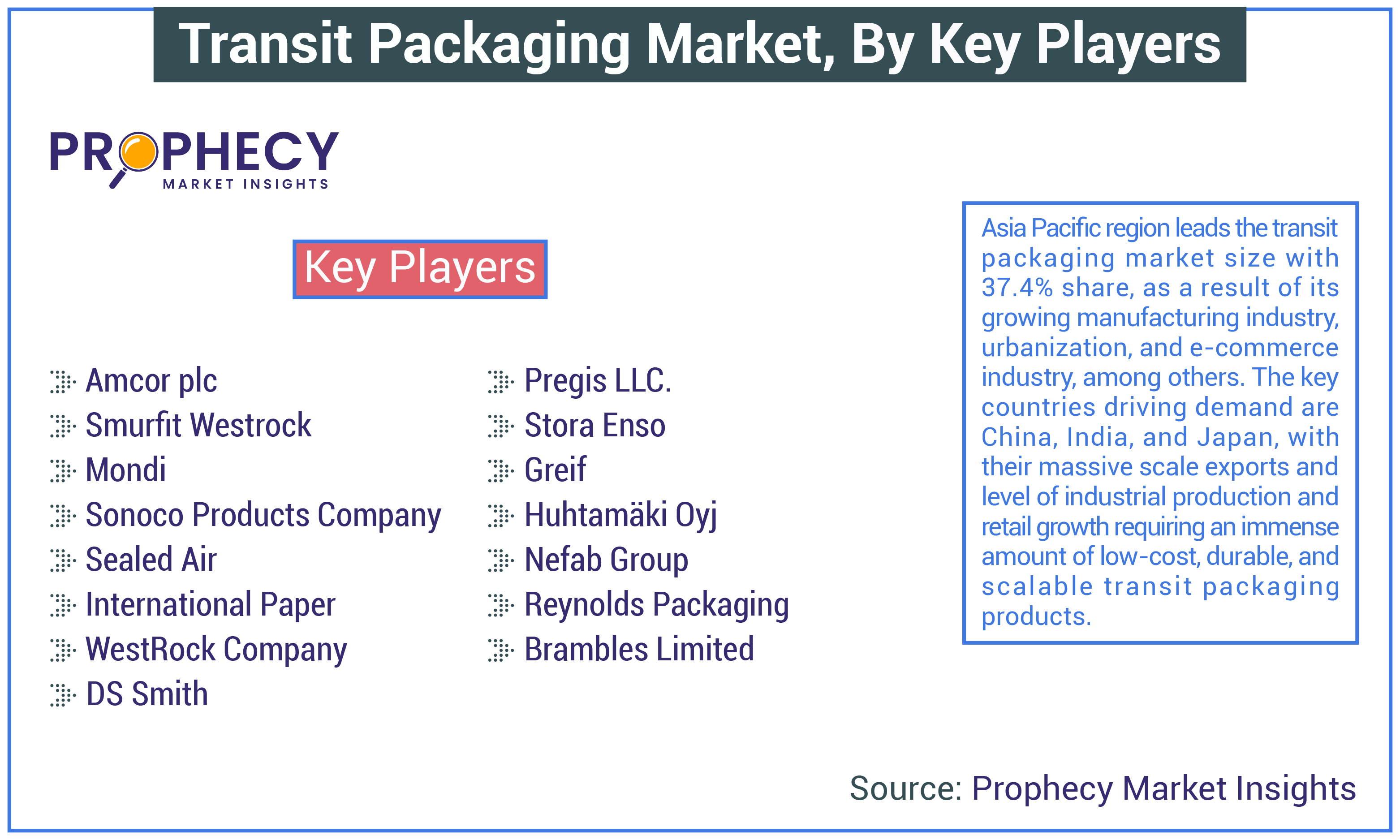
The prominent players operating in the market include, Amcor plc, Smurfit Westrock, Mondi, Sonoco Products Company, Sealed Air, International Paper, WestRock Company, and others. To build their technological know-how and expand their presence in the global market, companies are pursuing aggressive growth strategies such as capacity expansion, acquisitions and new product innovation. The introduction of recyclable mono-material films, and new lightweight packaging formats are important considerations. Companies are investing more money into automation systems, and advanced converting technologies to drive production flexibility, and meet evolving sustainability standards.
Transit Packaging Market Companies:
- Amcor plc
- Smurfit Westrock
- Mondi
- Sonoco Products Company
- Sealed Air
- International Paper
- WestRock Company
- DS Smith
- Pregis LLC.
- Stora Enso
- Greif
- Huhtamäki Oyj
- Nefab Group
- Reynolds Packaging
- Brambles Limited
View an Additional List of Companies in the Transit Packaging Market
Transit Packaging Market Recent News
- In September 2024, International Paper opened its newest state-of-the-art corrugated packaging facility in Atglen, PA. The facility is designed to manufacture corrugated packaging for processed food, produce, beverage, shipping, distribution, & e-commerce customers.
- In March 2024, Greif worked with CDF Corporation to launch a newly redesigned GCUBE intermediate bulk container (IBC) Flex, specifically for the transportation of sensitive, liquid products in sterile conditions.
Analyst View:
The transit packaging industry is progressing quickly for a multitude of reasons - e-commerce is expanding, there’s an increased demand for product safety, and environmental awareness is increasing. The key trends appear to be smart packaging integration and recyclable/biodegradable materials. New developments are related to automation innovations, lighter packaging, and better use of materials.
There are still opportunities in sustainable innovations and digital logistics, but obstacles in the sector may come from environmental regulations and the rising costs of raw materials. Regardless, transit packaging is evolving quickly as businesses will try to balance only performance, cost, and environmental efficiency to remain competitive.
More Related Reports
Suppository Packaging Market
Microwavable Polyethylene Coating Market
Nutraceutical Packaging Market
Sustainable Plastic Packaging
Flexible Paper Packaging Market
Transit Packaging Market Company Profile
|
Company Name |
Amcor plc |
|
Headquarter |
Zürich, Switzerland |
|
CEO |
Peter Konieczny |
|
Employee Count |
41,000 Employees |
Transit Packaging Market Highlights
FAQs
Transit packaging market size was valued at USD 267.4 Billion in 2025 and is expected to reach USD 524.5 Billion by 2035 growing at a CAGR of 7.7%.
Product, Material Type, Application, End-user, and region are the segmentation for the Transit Packaging market.
North America, Asia Pacific, Europe, Latin America, and the Middle East & Africa. Acia-Pacific is expected to dominate the market.
The prominent players operating in the market include, Amcor plc, Smurfit Westrock, Mondi, Sonoco Products Company, Sealed Air, International Paper, WestRock Company, DS Smith, Pregis LLC, Stora Enso, Greif, Huhtamäki Oyj, Nefab Group, Reynolds Packaging, and Brambles Limited.