Robotics And Automation Actuators Market Overview
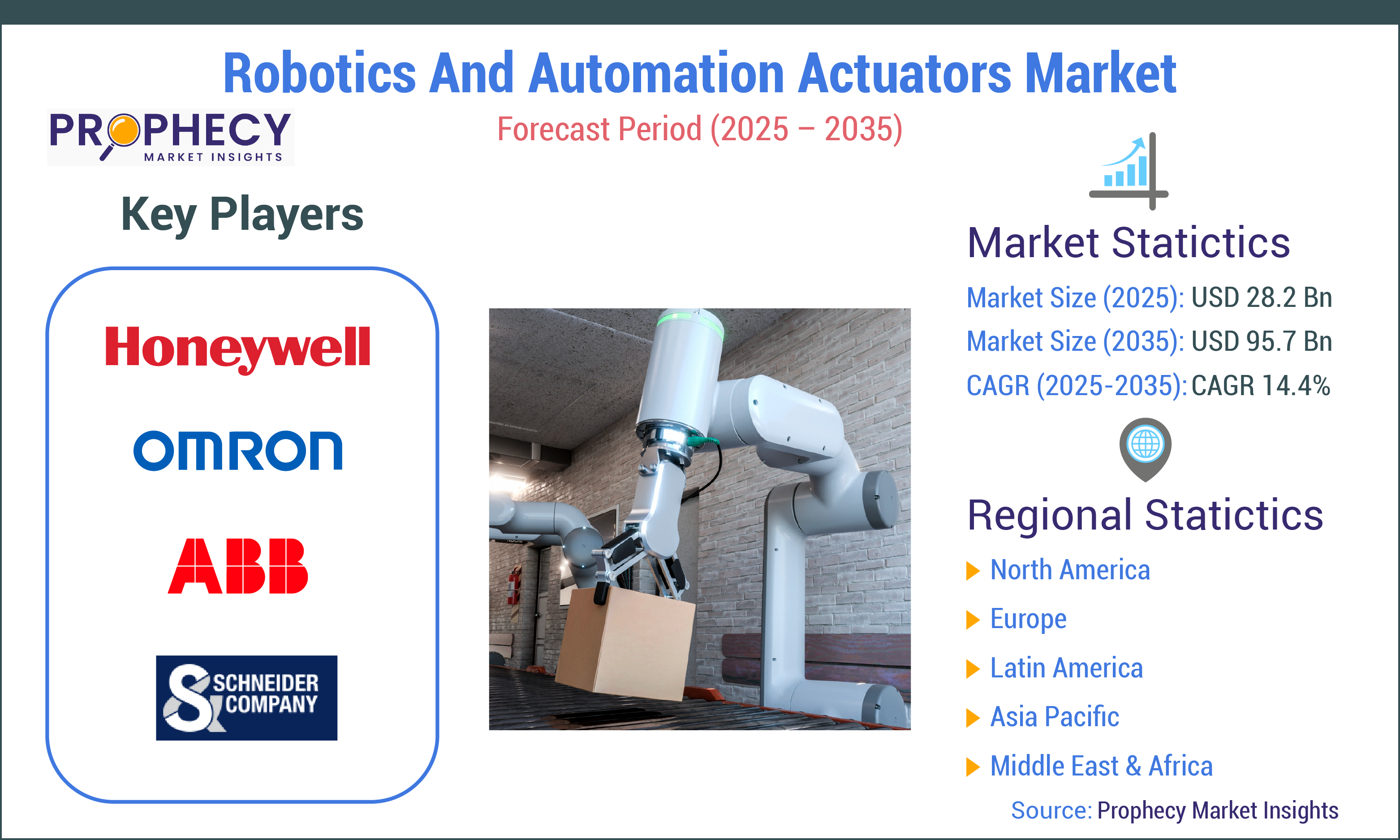
- By 2035, the robotics and automation actuators market size is anticipated to progress at a rate of USD 95.7 Billion.
- In 2024, the market valuation was USD 25.2 Billion.
- Robotics and automation actuators market is increasing at a CAGR 14.4%.
Robotics and automation actuators are critical components that enable motion and control within robotic systems and automated machinery. An actuator is a device that converts energy, such as electrical, hydraulic, or pneumatic into mechanical motion, which allows robots or machines to move or perform specific tasks such as lifting, gripping, rotating, or walking. As robotics evolves, actuators are becoming smaller, more efficient, and more intelligent, often integrated with sensors and feedback mechanisms to enable real-time motion control, adaptive behavior, and energy efficiency.
Growth in industrial automation to reduce labor costs, increase precision, enhance productivity, and rising adoption of cobots into automation industry, is anticipated to drive robotics and automation actuators market growth. Innovation in smart actuators, miniaturization, energy-efficient motors, and increased use of robots in healthcare, medical field, is expected to pitch robotics and automation actuators market growth.
Integration of AI, IoT with actuators to monitor their own performance, expansion into emerging economics, and development of soft robotics, represents future opportunities for robotics and automation actuators market growth. Growing adoption of actuators into aerospace & defense End-Users, and increasing focus on green manufacturing, is projected to fuel robotics and automation actuators market growth.
Recession Risk and Tarriff Analysis of Robotics and Automation Actuators Market:
- A global or regional economic recession could pose a significant risk to the robotics and automation actuators market. During downturns, industries reduce their capital expenditures, delaying or reducing investment in new automation systems and robotic infrastructure. Sectors such as automotive, manufacturing, and construction, which are major consumers of actuators, are particularly vulnerable to economic slowdown.
- Import tariffs on components such as motors, sensors, or raw materials can increase manufacturing costs, leading to higher prices for end-users. Countries such as the U.S. and China, which are major producers and consumers of robotic systems, have implemented tariffs during trade tensions, affecting the flow of actuators and related parts.
Impact of Generative AI on Robotics and Automation Actuators Market:
- By leveraging machine learning and deep learning algorithms, AI can help to design actuators that are more energy-efficient, lightweight, and cost-effective, tailored to specific robotic End-Users. It can also enable real-time adaptive control systems that adjust actuator performance based on environmental changes or task-specific demands.
- AI algorithms speeds up R&D cycles and enables the creation of high-performance actuators for specialized End-Users, such as medical robots, autonomous vehicles, and industrial automation systems.
Robotics And Automation Actuators Market Drivers & Restraints
Key Drivers:
Growing Adoption Cobot in Automation is to Skyrocket the Market Growth
Cobots are designed to collaborate safely and efficiently with humans, enabling them to perform tasks that require flexibility, dexterity, and adaptability. This ability is valuable in dynamic work environments in which human input and intervention are needed, such as in small-to-medium-sized manufacturing, assembly lines, and packaging operations. The robotic actuators used in cobots must be highly responsive and precise to ensure safe interaction with humans, encouraging innovation and driving demand for advanced actuators.
Cobots are highly programmed to perform various extensive downtime tasks, this can be achieved through advanced actuators that allow robots to change their movements and function for multi-purpose operations. Cobots are cost-effective and performs tasks such as sorting, picking, packaging, making them affordable to small and medium-sized enterprises, resulting to drive robotics and automation actuators market growth.
- For instance, the adoption of cobot automation is rapidly accelerating in industries such as, manufacturing, logistics, and packaging. These industries are increasingly focus on cobots to enhance efficiency and meet rising production demands. Cobots offer the ideal balance between affordability, adaptability, and safety, making them particularly appealing to small-to-medium enterprises (SMEs), hold automation without repairing their operations. The rising demand is responsible for adoption of cobot in automation, and it is projected to grow at 35% by 2030.
Restraints:
Market Hindered by Complexity in Integration
Actuators must often integrate with a variety of other technologies, such as sensors, controllers, and software systems which can be complicate to integrate into existing infrastructure. This is particularly true for small and medium-sized enterprises (SMEs) that lack in-house expertise.
- Counterbalance Statements: Modular and standardized components make it easier to integrate new actuators into existing systems without the need for major overhauls. AI and machine learning-driven platforms can automate much of the integration, configuration, reduces manual effort and errors.
Opportunities & Trends:
Advancement in Soft Robotics will Create Significant Opportunities
The continuous advancement in soft robotics is unlocking new and transformative opportunities in the robotics and automation actuators market, particularly in industries in which precision, adaptability, and human-safe interaction are essential. Advanced actuators are capable of natural muscle movements, enabling End-Users in biomedicine, agriculture, logistics, defense, and wearables. As industries shift toward collaborative robotics (cobots) and bioinspired machines, which rises demand for lightweight, energy-efficient, and highly flexible actuators.
Soft robotic actuators are increasingly used in minimally invasive surgical tools, prosthetics, and rehabilitation devices, to offer safe interaction with delicate tissues. In industrial automation, their adaptability allows for handling fragile goods, such as fruits or glassware, in which traditional robots are inflexible. Integration of AI and sensor technologies in soft robots can enhance their performance in complex environments, resulting to propel robotics and automation actuators market share.
- For instance, according to article published by MDPI, in April 2024, this article states that, soft robots mimic biological structures such as skin, muscles, or tendons, which are applied in agriculture (flower picking, fruit harvesting), medicine (targeted treatments and wearable devices), rescue missions, and consumer electronics. Actuation methods of soft robots highlight the way robots move, bend, stretch or contact, by advancing actuating methods, such as humidity, temperature, pH, and materials such as hydrogels, shape-memory materials. This advanced soft robot is applied in camouflage, medical devices, electrical equipment, and grippers field to improve quality of human life.
Robotics And Automation Actuators Market Segmentations & Regional Insights
The robotics and automation actuators market is segmented into type, actuation, design characteristic, application, end user, and region.
By Type:
Based on type, the robotics and automation actuators market is divided into linear actuators, rotary actuators. Linear actuators is first and most dominant segment. These actuators are widely used in End-Users that require straight-line motion, such as robotic arms, conveyors, pick-and-place systems, and material handling equipment. This are simple in design, cost-efficiency, high force output, and adaptability across various industrial sectors such as manufacturing, automotive, and packaging, is contributing to segment’s expansion in robotics and automation actuators market size.
The second-dominant segment is rotary actuators, as it is crucial for enabling rotational movement in robotic systems. These actuators are extensively used in jointed robotic arms, servo mechanisms, articulated robots, and collaborative robots (cobots) that require smooth and accurate angular motion, resulting to propel growth of segment in robotics and automation actuators market share.
By Actuation:
On the basis of actuation, the market is segmented into, electric, pneumatic, and hydraulic. The market is dominated by electric segment. Electric actuators are ideal due to their precision, energy efficiency, ease of integration with control systems, and lower maintenance requirements. It can be extensively used in a variety of robotic End-Users, including industrial automation, and medical robotics, in which accurate and programmable movement is critical, is propelling growth of segment in robotics and automation actuators market share.
Pneumatic actuators represent the second-superior segment, due to their widespread use in high-speed, repetitive tasks such as in pick-and-place operations, packaging, and material handling. It can be operated in environments in which low cost and fast cycle times are more important than precision, is expected to fuel segment’s development in robotics and automation actuators market size.
By Design Characteristic:
On the basis of design characteristic, the market is classified into load, torque. Torque is leading segment in the market. Torque is a critical factor in robotics, especially in rotational motion, joint control, and precise movement, such as in robotic arms, articulated robots, and collaborative robots (cobots). The growing demand for dexterous, multi-axis robots has significantly contributed to the dominance of torque-oriented actuators in the robotics and automation actuators market share.
Load is second leading segment in the market. It is designed to manage high linear or vertical forces, which are widely used in lifting, pushing, and pressing End-Users, such as in material handling systems and heavy-duty automation, resulting to boost robotics and automation actuators market size in following segment.
By Application:
By application market is segmented into, process automation and robotics. The process automation segment dominates by application, driven by the widespread adoption of actuators in manufacturing processes such as machinery operation, material handling, and flow control systems. Industries such as automotive, food and beverage, pharmaceuticals, and chemicals rely heavily on automation to enhance efficiency, precision, and safety in production lines, is expected to pitch segment’s expansion in robotics and automation actuators market share.
By End-User:
Under End-User, the market is categorized into food & beverages, metal mining & machinery, plastic & polymers, electronics, oil & gas, healthcare, automotive, aerospace & defense, logistics, maintenance & cleaning, and others. Automotive is most dominating segment in the market. The automotive industry extensively uses robotic actuators for tasks such as welding, assembly, painting, material handling, and quality inspection. As global automotive manufacturers move toward Industry 4.0, which are increasingly integrating automated and robotic systems to improve production efficiency, reduce human error, and meet high-volume demands, is assessed to boost robotics and automation actuators market share in given segment.
Regional Insights:
Geographically, the market is studied across North America, Europe, Asia Pacific, Latin America, and the Middle East & Africa.
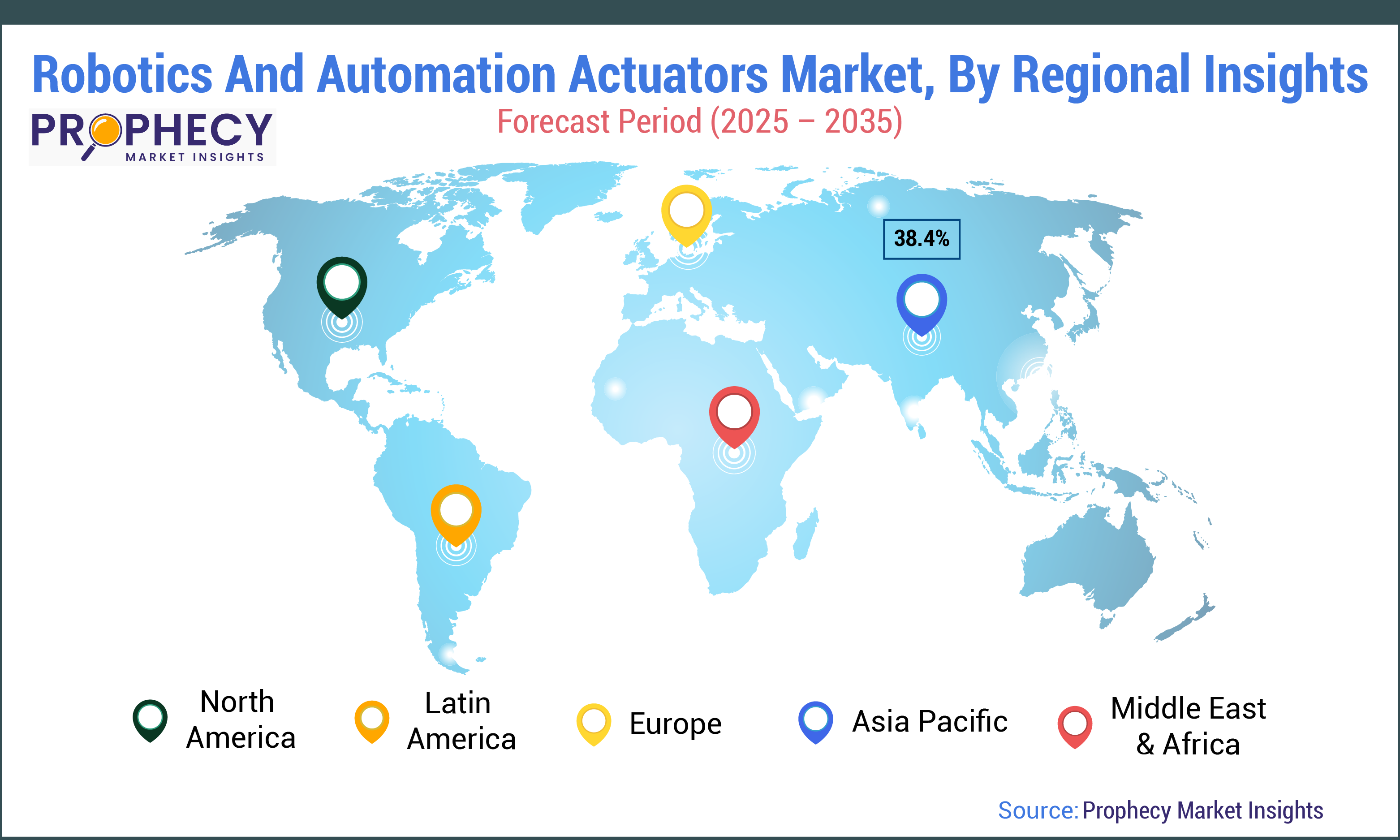
Asia Pacific: This region leads the market, accounting for approximately 38.4% of the market, due to the strong presence of manufacturing powerhouses such as China, Japan, South Korea, and India. These countries have made significant investments in industrial automation, robotics in automotive and electronics production, and smart manufacturing initiatives. Rapid urbanization, industrialization, and cost-effective production capabilities, is contributing to impel region’s development in robotics and automation actuators market share.
- China Robotics and Automation Actuators Market Insights:
China leads the Asia-Pacific region in the market. As the global largest manufacturing hub, China has heavily invested in industrial automation, especially under its government initiative. The country’s strong presence in automotive, electronics, and consumer goods production, combined with rapid deployment of industrial robots, is expected to pitch robotics and automation actuators market growth.
North America: This is the second-leading region due to its advanced technological ecosystem, strong presence of robotics OEMs, and high demand across automotive, aerospace, healthcare, and logistics sectors. The region is also a hub for AI-driven robotics and R&D innovation, fostering the development of high-performance actuator technologies, is estimated to propel region growth in robotics and automation actuators market share.
- U.S. Robotics and Automation Actuators Market Insights:
The market for robotics and automation actuators has experienced significant growth in recent years, and is expected to continuous growth. U.S. is the global leader in automation, robotics, and advanced manufacturing technologies. The growing use of cobot in industrial tasks, and lack of skilled labor, is making the U.S. a dominant player in the cobot market.
Europe: This region holds a significant position in the robotics and automation actuators market, driven by its strong industrial base and focus on advanced manufacturing. European countries are leading adopters of automation, particularly in the automotive, aerospace, and electronics sectors. Europe's emphasis on precision engineering, sustainability, and Industry 4.0 technologies supports the growth of high-performance actuator solutions, is predicted to fuel robotics and automation actuators market size.
- Germany Robotics and Automation Actuators Market Insights:
Germany is the dominant country in Europe’s robotics and automation actuators market, as it is known for its engineering excellence and advanced industrial automation, Germany is a global leader in sectors such as automotive manufacturing, industrial robotics, and machine tools. It is also a key player in Industry 4.0 initiatives, which heavily rely on smart actuators for robotics systems in production and logistics environments, is attributed to drive robotics and automation actuators market share.
Robotics and Automation Actuators Market Report Scope:
|
Attribute |
Details |
|
Market Size 2025 |
USD 28.2 Billion |
|
Projected Market Size 2035 |
USD 95.7 Billion |
|
CAGR Growth Rate |
14.4% (2025-2035) |
|
Base year for estimation |
2024 |
|
Forecast period |
2025 – 2035 |
|
Market representation |
Revenue in USD Billion & CAGR from 2025 to 2035 |
|
Regional scope |
North America - U.S. and Canada Europe – Germany, U.K., France, Russia, Italy, Spain, Netherlands, and Rest of Europe Asia Pacific – China, India, Japan, Australia, Indonesia, Malaysia, South Korea, and Rest of Asia-Pacific Latin America - Brazil, Mexico, Argentina, and Rest of Latin America Middle East & Africa – GCC, Israel, South Africa, and Rest of Middle East & Africa |
|
Report coverage |
Revenue forecast, company share, competitive landscape, growth factors, and trends |
Segmentation:
By Type:
- Linear Actuators
- Rotary Actuators
By Actuation:
- Electric
- Pneumatic
- Hydraulic
By Design Characteristic:
- Load
- Torque
By Application:
- Process Automation
- Machinery
- Material Handling
- Flow Control
- Others
- Robotics
- Industrial Robots
- Service Robots
By End-User:
- Food & Beverages
- Metal Mining & Machinery
- Plastic & Polymers
- Electronics
- Oil & Gas
- Healthcare
- Automotive
- Aerospace & Defense
- Maintenance & Cleaning
- Others
By Region:
- North America
- U.S.
- Canada
- Europe
- Germany
- U.K.
- France
- Russia
- Italy
- Spain
- Netherlands
- Rest of Europe
- Asia Pacific
- China
- India
- Japan
- Australia
- Indonesia
- Malaysia
- South Korea
- Rest of Asia Pacific
- Latin America
- Brazil
- Mexico
- Argentina
- Rest of Latin America
- Middle East & Africa
- GCC
- Israel
- South Africa
- Rest of Middle East & Africa
Robotics And Automation Actuators Market Competitive Landscape & Key Players
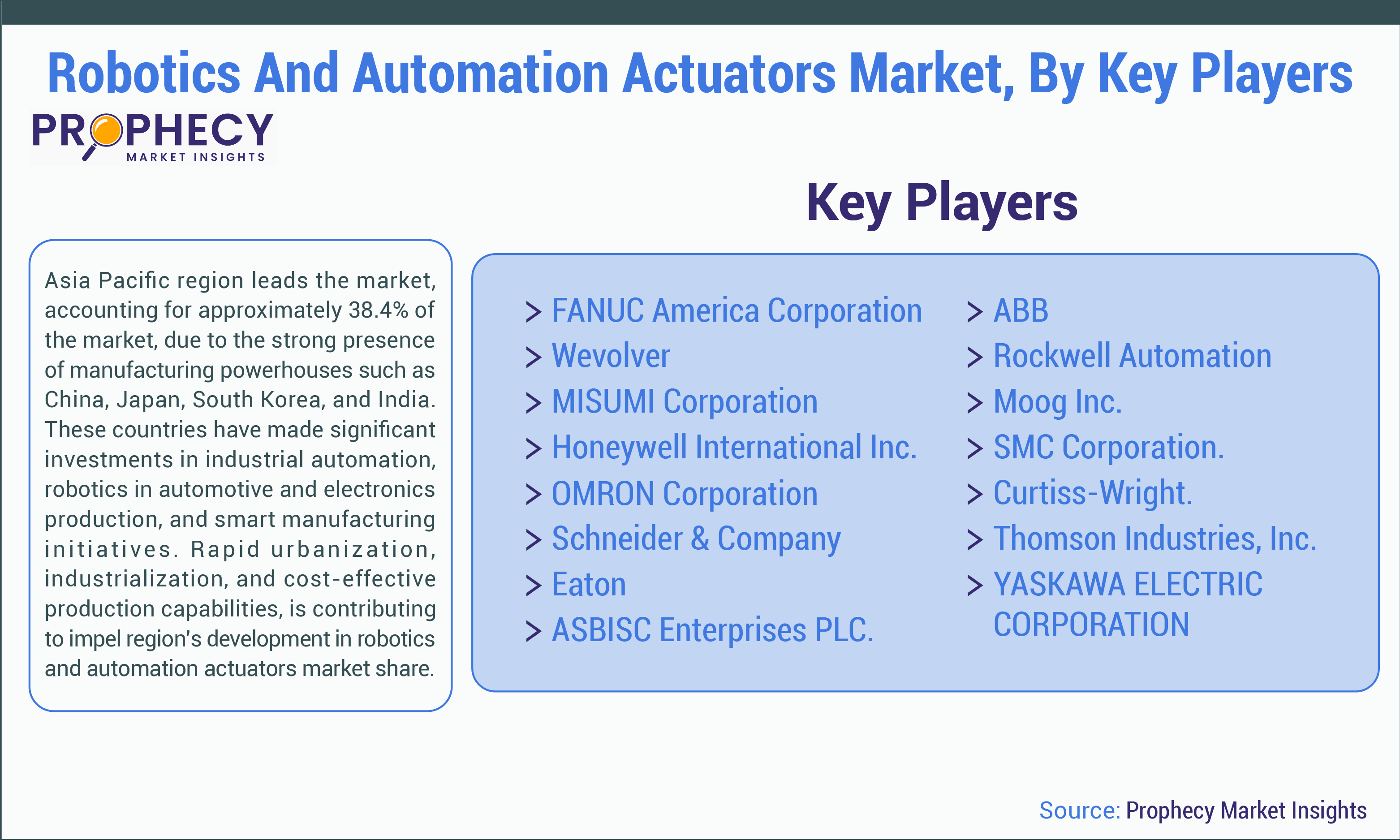
FANUC America Corporation, Wevolver, ASBISC Enterprises PLC., and among others, are the major key players are operating in robotics and automation actuators market. This companies are integrating robots in human tasks, to reduce labor cost, and manufacturing cost, is anticipated to drive target market growth. The major key players are focused to launching new cobot, with more affordable costs, with improved work operations, is projected to growth of market share in robotics and automation actuators.
Robotics and Automation Actuators Market Companies:
- FANUC America Corporation
- Wevolver
- MISUMI Corporation
- Honeywell International Inc.
- OMRON Corporation
- Schneider & Company
- Eaton
- ASBISC Enterprises PLC.
- ABB
- Rockwell Automation
- Moog Inc.
- SMC Corporation.
- Curtiss-Wright.
- Thomson Industries, Inc.
- YASKAWA ELECTRIC CORPORATION
View an Additional List of Companies in the Robotics and Automation Actuators Market
Robotics And Automation Actuators Market Recent News
- In March 2025, A team of MIT researcher created the first synthetic muscle actuator that can flex in multiple directions. This study aimed to create more capable soft robots and other advanced medical breakthroughs. Researchers utilized a new 3D printing method, specially made stamps, to grow synthetic muscles in the lab that can replicate the real thing. These soft biohybrid actuators designed to provide energy efficiency, adaptability, and can be set up to fit nearly any form factor.
- In March 2025, MagicLab launched its first self-developed dexterous hand, known as the MagicHand S01. This design allows it to perform precise and complex movements such as grasping, gripping, two-finger movement and other object manipulation operations. The MagicHand S01 aimed to provide reliability, and it was built with MagicLab’s proprietary technology, incorporates key components such as the six-axis electric actuator, encoder, and tactile sensors, offering stability and reducing production costs.
- In August 2024, Researchers at Jiangnan University introduced a new textile engineering approach to fabricate woven and soft actuators for health care technologies and robotic systems. Researchers utilized two-system weaving technology, integrate sensing capabilities and actuation methods into soft robotic garments. This woven actuator effective for rehabilitation wearables End-Users.
- In May 2024, Festo introduced its newest generation of Cartesian-handling-system mechanical axes, known as the ELGD-TB, tooth belt actuators, and ELGD-BS, ball screw actuators, based on a new Festo design. This ELGD series was applied in pick & place solutions for small part handling, handling system for top loaders, and automation of 3D printing, additive manufacturing, dosing, picking with virtually vibration-free movement.
Analyst View:
The robotics and automation actuators market is experiencing significant growth and transformation, driven by advancements in automation, robotics technology, and the increasing need for efficiency in industrial and manufacturing processes. The rise of industry 4.0 and the increasing integration of artificial intelligence (AI) and machine learning algorithms, which help cobot to operate in suitable environment, resulting to growth of robotics and automation actuators market size.
More Related Reports
Robotics Paint Booth Market
Soft Robotics Market
Industrial Robotics Market
Smart Retail Market
Robotics Market
Robotics And Automation Actuators Market Company Profile
|
Company Name |
OMRON Corporation |
|
Headquarter |
Kyoto, Japan |
|
CEO |
Junta Tsujinaga |
|
Employee Count (2024) |
28,000 Employees |
Robotics And Automation Actuators Market Highlights
FAQs
Robotics and automation actuators market size was valued at USD 28.2 Billion in 2025 and is expected to reach USD 95.7 Billion by 2035 growing at a CAGR of 14.4%.
Type, actuation, design characteristic, application, End-User, and region are the segmentation for the target market.
North America, Asia Pacific, Europe, Latin America, and the Middle East & Africa. Asia Pacific is expected to dominate the market.
The key players operating in the robotics and automation actuators market include FANUC America Corporation, Wevolver, MISUMI Corporation, Honeywell International Inc., OMRON Corporation, Schneider & Company, Eaton, ASBISC Enterprises PLC., ABB, Rockwell Automation, Moog Inc., SMC Corporation, Curtiss-Wright, Thomson Industries, Inc., and YASKAWA ELECTRIC CORPORATION