Recreational Vehicle Market Overview
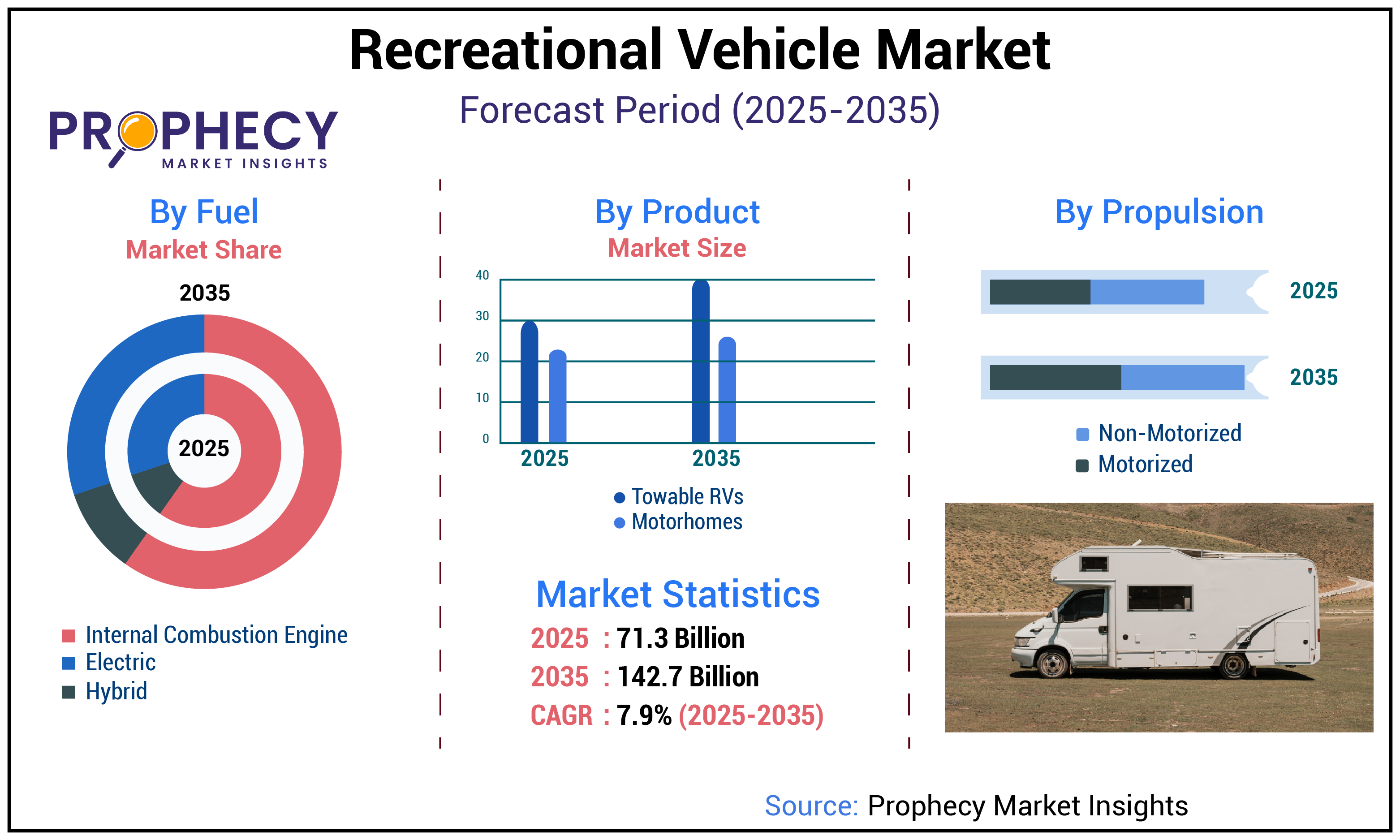
- Recreational vehicle market size is anticipated to grow at a rate of USD 142.7 Billion, by 2035.
- In 2024, the market valuation was USD 66.9 Billion.
- Recreational vehicle market is increasing at a CAGR 7.9%.
Recreational vehicle (RV) is a motorized or towable vehicle designed to provide both transportation and temporary living accommodations, making it ideal for travel, leisure, and outdoor recreation. These vehicles are equipped with essential living amenities such as beds, kitchenettes, bathrooms, seating areas, and in many cases, climate control systems, allowing users to live comfortably during traveling or camping. Recreational vehicle is typically two type, towable RVs, and motorhomes, this are popular in families, and adventure seekers that enjoy road trips, camping without relying on traditional lodging.
Increasing interest in outdoor recreation, road trips, and rise of remote work has created RVs as mobile offices, is expected to pitch recreational vehicle market growth. Increased disposable incomes, driving demand for luxury, long-distance travel recreational vehicle, and expansion of RV rental services, peer-to-peer sharing platforms, is anticipated to drive recreational vehicle market growth.
Integration of smart features, such as solar power, Wi-Fi connectivity, and shift towards electric vehicle is opening opportunities for electric RVs, is projected to impel recreational vehicle market growth. Growth in tourism sector, demand for customized, luxury RVs, and eco-conscious travelers are driving demand for sustainable RVs, is estimated to impel recreational vehicle market growth.
Recession Risk and Tariff Analysis of Recreational Vehicle Market:
- The recreational vehicle (RV) market is highly sensitive to economic cycles, making it vulnerable during recessions. In times of economic downturn, consumer flexible spending declines, and big-ticket items such as RVs are often postponed or avoided altogether. The growing popularity of RV rentals and the use of RVs as affordable vacation alternatives can provide some resilience during mild recessions, especially among budget-conscious travelers.
- Tariff policies can significantly impact the recreational vehicle (RV) market, especially in regions that rely on imported components such as steel, aluminum, electronics, and vehicle chassis. Higher import tariffs on these materials or on fully assembled RVs can increase manufacturing costs, leading to increasing price for consumers and reduced profit margins for producers.
Impact of Generative AI on Recreational Vehicle Market:
- The integration of AI into the recreational vehicle (RV) market is influencing vehicle design, manufacturing to customer experience and after-sales service. Manufacturers can use AI models to create tailored layouts and interior configurations based on individual customer preferences, space utilization data, and ergonomic standards. This allows for faster prototyping, more efficient use of materials and highly customized recreational vehicle models.
- AI algorithms can enhance predictive maintenance and fleet management, by analyzing historical usage, sensor data, and environmental factors to predict component failures, optimize service schedules, and reduce downtime.
Recreational Vehicle Market Drivers & Restraints
Key Drivers:
Rising Disposable Incomes in Emerging Markets Propels Market Expansion
As economies in countries such as China, India, Brazil, and Southeast Asian nations is continuous growing, thus the middle- and upper-middle-class consumers is emerging with greater purchasing power and a heightened interest in leisure, travel, and quality of life. Families and individuals are increasingly distributing income toward non-essential goods and lifestyle experiences, such as domestic travel and outdoor recreation, in which recreational vehicle play a dominant role.
Younger generations are prioritizing experiences over possessions, and RV ownership or rental offers the freedom and flexibility to explore scenic routes, rural destinations, and national parks at their own pace. The high incomes lead to invest in lifestyle-enhancing products, such as motorhomes and towable RVs for weekend getaways, domestic travel, or long-term mobile living, resulting to fuel recreational vehicle market growth.
- For instance, according to article published by Euromonitor is privately owned & trademarked, in November 2024, this article states that, global disposable income rise by 3.4% in 2023, driven by growth in Asia Pacific and North America. By 2040, disposable income growth is projected by 2.6% with emerging and developing regions leading the expansion. In Asia Pacific, real growth of 49.8% in consumer spending over 2023-2040, which is higher than North America. Developed Asian nations such as Japan and South Korea are expected to drive a significant increase in spending, though still covering behind China. In 2023, the global wealthy population expanded by 6.4%, driven by an addition of 2.4 billion individuals, mainly from the U.S., Germany, the U.K. and France.
Restraints:
High Initial Cost of RVs Impede Market Growth
Motorhomes and luxury models have high upfront cost while purchasing RVs. These vehicles often require a substantial financial investment, with prices ranging from tens of thousands to over a hundred thousand dollars. This cost barrier can discourage potential buyers, especially younger consumers or those with limited disposable income, to enter in the market. The RVs ownership involves ongoing expanses such as maintenance, insurance, storage and fuel, resulting to limits recreational vehicle market growth.
- Counterbalance Statements: the market is adapting through the expansion of RV rental services, peer-to-peer sharing platforms, and flexible financing options. Rental platforms allow consumers to experience recreational vehicle travel without the commitment of ownership, making RVs accessible for short-term vacations or trial use.
Opportunities & Trends:
Growing Global Tourism Sector Fuels Market Expansion
The booming global tourism industry presents a major opportunity for the recreational vehicle (RV) market, particularly as travel preferences shift toward more flexible, self-directed, and experiential forms of tourism. Governments are increasingly supporting domestic tourism through infrastructure improvement, such as development of RV parks, rest areas, and scenic road networks.
The significant rise in road trips, nature-based tourism, and domestic travel are increases the demand for recreational vehicle for the freedom, mobility, and comfort. Recreational vehicle offers travelers to explore multiple destinations without the need for hotel stays or fixed journeys, making them ideal for adventure seekers, families, and retirees. After the post-pandemic the consumer is necessarily demanding safe, socially distanced travel, help to RVs acceptance. Expansion of recreational vehicle rental platforms, and sharing economy model allows users to enjoy RVs experience, is projected to boost recreational vehicle market share.
- For instance, according to article published by UN Tourism 2025, 1.4 billion international tourists were recorded around the world in 2024, an increase of 11% over 2023, or 140 billion more in 2024. The growing tourism were driven by post-pandemic demand, robust performance from large source markets globally and ongoing destinations recover in the Asia and the Pacific.
- The Middle East remained strongest-performing region, with international arrivals climbing 32% above pre-pandemic levels in 2024. Total export revenues from tourism are estimated at a record USD 1.9 trillion in 2024, about 3% higher than before the pandemic and 4% more than in 2019. International tourist arrivals are expected to grow 3% to 5% in 2025 compared to 2024, according to preliminary estimates.
Recreational Vehicle Market Segmentations & Regional Insights
The recreational vehicle market is segmented into product type, end-user, and region.
By Product Type:
Based on product type, the market is classified into, towable RVs and motorhomes. Towable RVs hold the largest market share globally. Their dominance is due to their lower cost, easier maintenance, and flexibility, as it can be separate while the towing vehicle is used independently. This makes them especially attractive to families and occasional users, which have already owned a suitable tow vehicle, is anticipated to fuel growth of segment in recreational vehicle market share.
Motorhomes are the second-largest segment, driven by their all-in-one convenience, luxury features, and suitability for long-distance travel. It can be applied in full-time RVers, retirees, and those looking for a continuous driving and living experience. Motorhomes offer a high level of comfort and autonomy, is contributing to segment’s development in recreational vehicle market size.
By Fuel Type:
Internal combustion engine, electric, hybrid is classified by fuel type in the market. The internal combustion engine (ICE) segment currently dominates the market by fuel type. This dominance is largely attributed to the well-established infrastructure for gasoline and diesel fueling, widespread consumer familiarity, and the relatively lower upfront cost compared to electric or hybrid RVs, is anticipated to drive segment’s expansion in recreational vehicle market size.
By Propulsion Type:
By propulsion type market is divided into, motorized and non-motorized. The non-motorized segment holds a dominant share by propulsion type. This segment includes towable RVs such as travel trailers, fifth-wheel trailers, and pop-up campers, which are designed to be towed by another vehicle. The dominance of non-motorized RVs is primarily due to their affordability, flexibility, and lower maintenance costs compared to motorized RVs, is estimated to impel growth of segment in recreational vehicle market share.
By End-User:
On the basis of end-user, the market is divided into, domestic and commercial. The market is dominated by domestic segment. Rising interest in road trips, outdoor recreation, and self-contained travel has driven strong demand, especially after post-pandemic. Retirees, digital nomads, and adventure-seeking families continue to fuel this segment through purchases of both towable RVs and motorhomes, is propelling recreational vehicle market growth.
Commercial is rapid growing segment in the market, due to the expansion of RV rental services, tourism companies, and mobile business concepts such as food trucks or mobile offices. The commercial use of RVs helps to make them more accessible and mainstream, to attract new users and boosting market visibility, is assessed to boost recreational vehicle market size.
Regional Insights:
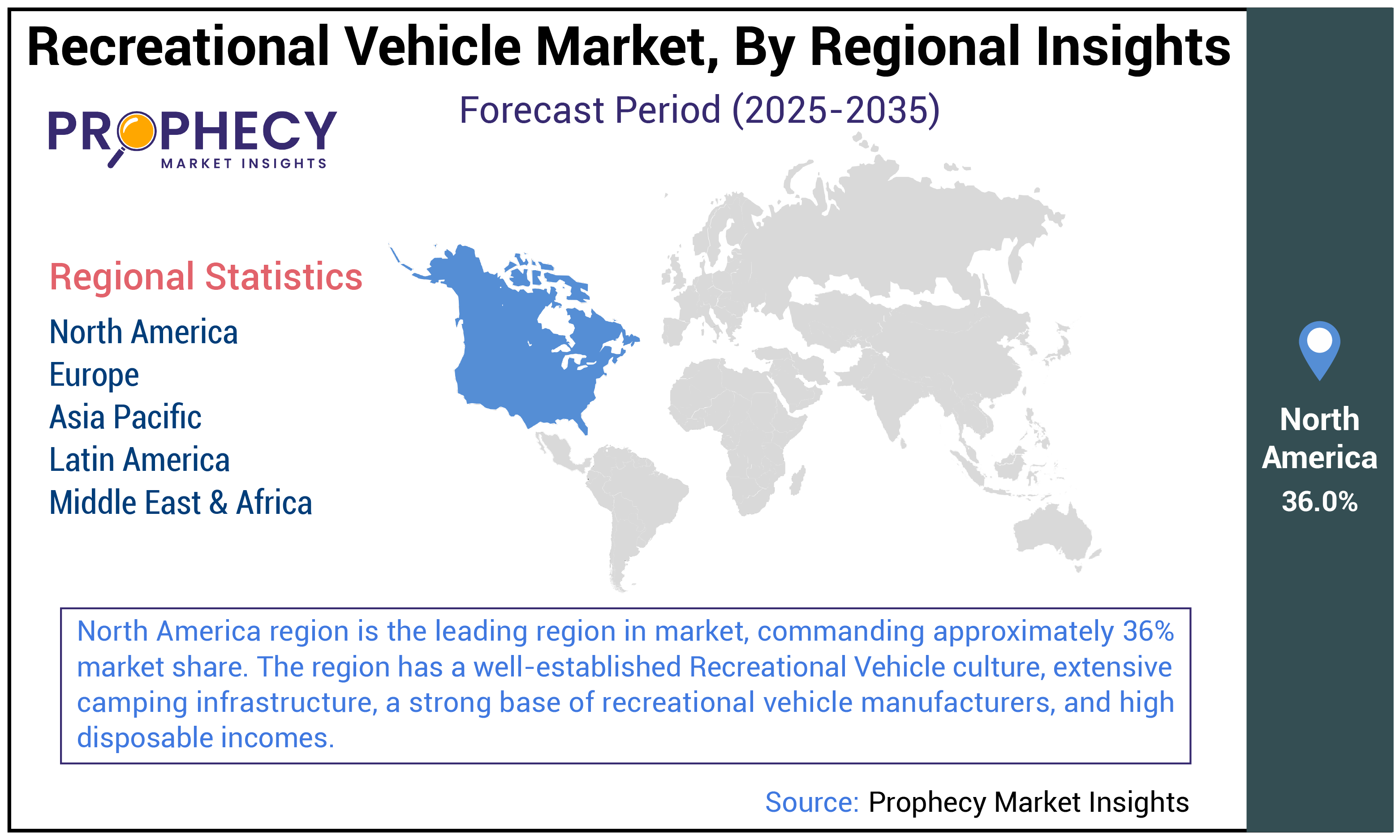
Geographically, the market is studied across North America, Europe, Asia Pacific, Latin America, and the Middle East & Africa.
North America: This region is the leading region in market, commanding approximately 36% market share. The region has a well-established recreational vehicle culture, extensive camping infrastructure, a strong base of recreational vehicle manufacturers, and high disposable incomes. Full-time RV living and seasonal travel across all age groups, especially among retirees and millennials, fuel the demand for RV, is attributed to impel recreational vehicle market share in following region.
- U.S. Recreational Vehicle Market Insights:
The U.S. is the dominant country globally in the market, with a deeply rooted RV culture, widespread campgrounds, and a large consumer across all age groups. The U.S. accounts for the majority of recreational vehicles sales and rentals, supported by strong manufacturing hubs, a thriving resale and rental ecosystem, is predicated to fuel recreational vehicle market growth.
Europe: This region holds the second-largest share in the market. The region has a strong tradition of camping tourism, a growing preference for sustainable and independent travel. The rise in motorhome registrations, the availability of compact and fuel-efficient models tailored for narrow roads, support to recreation market growth in given region.
- Germany Recreational Vehicle Market Insights:
In Europe, Germany leads the RV market both in production and ownership. It is home to several major RV manufacturers and has a mature camping infrastructure. It represents one of the most active RV-using populations in Europe, with strong demand for both domestic and cross-border travel, resulting to impel recreational vehicle market share.
Asia Pacific: This region is an emerging market, showing steady growth driven by rising disposable incomes, expanding tourism infrastructure, and increasing interest in road travel. Asia Pacific is witnessing a gradual cultural shift toward recreational vehicle use, supported by government initiatives to boost domestic tourism and outdoor recreation, is projected to boost recreational vehicle market size.
- China Recreational Vehicle Market Insights:
The recreational vehicle market in China has experienced significant growth in recent years and is expected to continuous growth. China is rapidly expanding its RV infrastructure, campgrounds, and domestic tourism campaigns. The government’s push for rural tourism and mobile travel experiences is accelerating recreational vehicle adoption across the country, is assessed to fuel recreational vehicle market share.
Recreational Vehicle Market Report Scope:
|
Attribute |
Details |
|
Market Size 2025 |
USD 71.3 Billion |
|
Projected Market Size 2035 |
USD 142.7 Billion |
|
CAGR Growth Rate |
7.9% (2025-2035) |
|
Base year for estimation |
2024 |
|
Forecast period |
2025 – 2035 |
|
Market representation |
Revenue in USD Billion & CAGR from 2025 to 2035 |
|
Regional scope |
North America - U.S. and Canada Europe – Germany, U.K., France, Russia, Italy, Spain, Netherlands, and Rest of Europe Asia Pacific – China, India, Japan, Australia, Indonesia, Malaysia, South Korea, and Rest of Asia-Pacific Latin America - Brazil, Mexico, Argentina, and Rest of Latin America Middle East & Africa – GCC, Israel, South Africa, and Rest of Middle East & Africa |
|
Report coverage |
Revenue forecast, company share, competitive landscape, growth factors, and trends |
Segmentation:
By Product Type:
- Towable RVs
- Travel Trailers
- Fifth-Wheel Trailers
- Folding Camp Trailers
- Truck Campers
- Motorhomes
- Type A
- Type B
- Type C
By Fuel Type:
- Internal Combustion Engine
- Electric
- Hybrid
By Propulsion Type:
- Motorized
- Non-motorized
By End-User:
- Domestic
- Commercial
By Region:
- North America
- U.S.
- Canada
- Europe
- Germany
- U.K.
- France
- Russia
- Italy
- Spain
- Netherlands
- Rest of Europe
- Asia Pacific
- China
- India
- Japan
- Australia
- Indonesia
- Malaysia
- South Korea
- Rest of Asia Pacific
- Latin America
- Brazil
- Mexico
- Argentina
- Rest of Latin America
- Middle East & Africa
- GCC
- Israel
- South Africa
- Rest of Middle East & Africa
Recreational Vehicle Market Competitive Landscape & Key Players
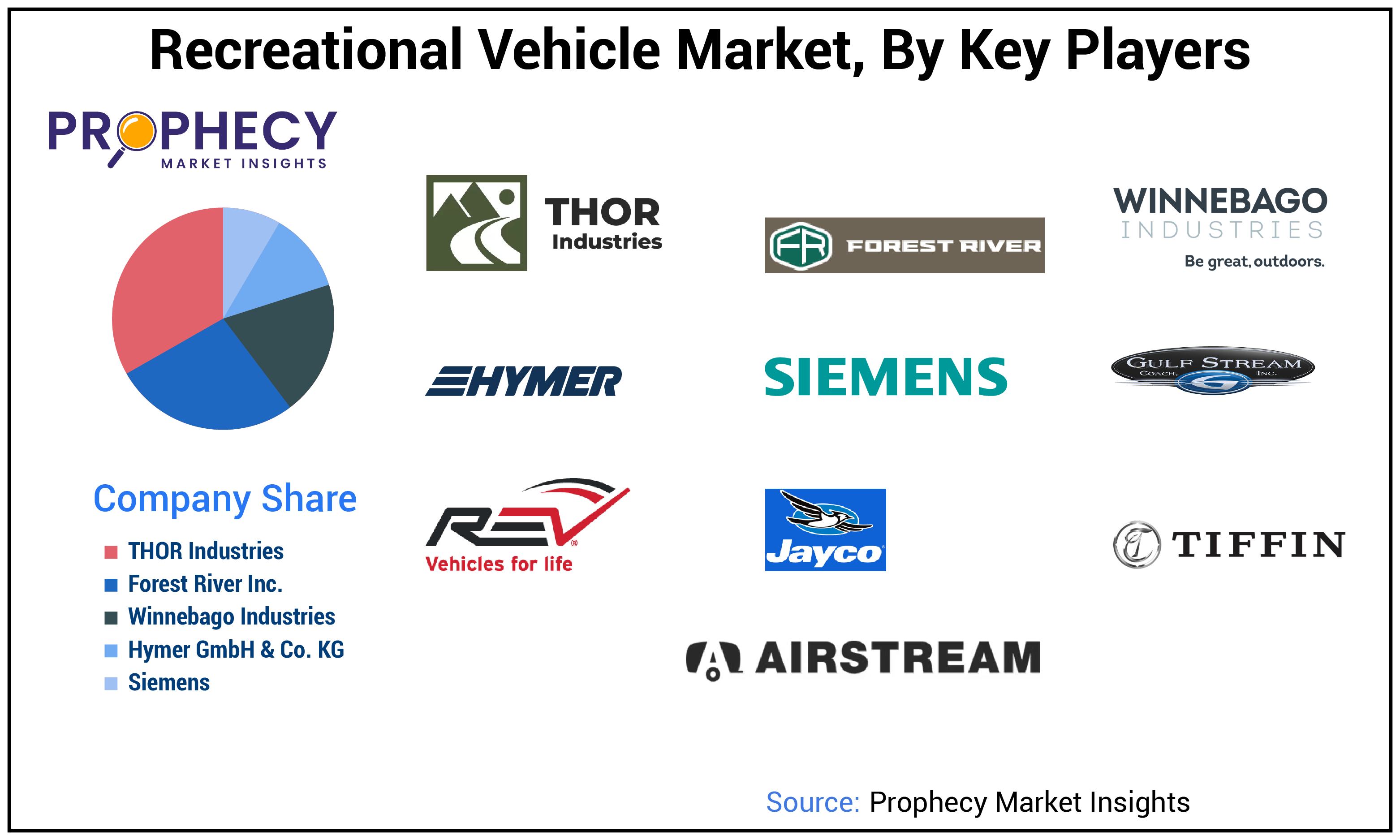
The major companies are active in the recreational vehicle market are THOR Industries, Forest River Inc., Winnebago Industries, and others. Key companies compete on innovation, customization, price, fuel efficiency, and integration of smart technologies, through their collaboration with other manufacturing companies. The companies are focusing on enhance fleet management, reduce fuel consumption, and enhance portfolio through acquisition, is anticipated to drive recreational vehicle market growth.
Recreational Vehicle Market Companies:
- THOR Industries
- Forest River Inc.
- Winnebago Industries
- Hymer GmbH & Co. KG
- Siemens
- Gulf Stream Coach
- REV Group, INC.
- Jayco
- Tiffin Motorhomes Inc.
- Airstream, Inc.
- Heartland Recreational Vehicles
- K. Z., Inc.
- Cruiser RV
- Trader Interactive
- Entegra Coach
View an Additional List of Companies in the Recreational Vehicle Market
Recreational Vehicle Market Recent News
- In April 2025, Winnebago Industries announced partnership with Leave No Trace, to promote environmental stewardship in boating and recreational vehicle activities. Through this partnership, Leave No Trace adapted first-of-their-kind guidelines to help RVers and boaters protect the outdoors by enjoying all the benefits of their country’s parks, campgrounds, roads and waterways.
- In February 2025, Repay Holdings Corporation collaborated with Lightspeed DMS, the leading recreational dealer management software (DMS) provider. This collaboration aimed to offer dealerships in the Powersport, Marine, RV, Trailer, Outdoor Power Equipment, and Golf Car industries to integrate their operations through Lightspeed’s comprehensive Dealer Management Solution (DMS).
- In September 2022, Siemens Digital Industries Software acquired Hymer, to develop VisionVenture, a convention smashing recreational vehicle using the comprehensive digital twin. VisionVenture combined advanced design, new production methods and material technologies to redefine the recreational vehicle concept. Hymer’s digital twin approach combined with state-of-the-art immersive VR technology, which aimed to reduce 80% of physical prototypes and 65% of variant derivation time.
Analyst View:
Rising disposable incomes and growing global tourism sector, fuel rises the demands for recreational vehicle to explore multiple destination, is anticipated to drive recreational vehicle market growth. Significant rise in road trips, nature-based tourism, domestic travel, rise of remote work, and government are significantly investing in road infrastructure, RV parks, tourism campaigns, is expected to pitch recreational vehicle market share. Integration of smart features, such as solar power, Wi-Fi connectivity, and shift towards electric vehicle is opening opportunities for electric RVs, is projected to impel recreational vehicle market growth.
More Related Reports
Electric Motor for Electric Vehicle Market
Silicone in Electric Vehicles Market
Electric Vehicle Battery Market
Electric Commercial Vehicle Market
Electric Vehicle Fast Charging System Market
Recreational Vehicle Market Company Profile
|
Company Name |
THOR Industries. |
|
Headquarter |
Elkhart, Indiana, U.S. |
|
CEO |
Robert W. Martin |
|
Employee Count (2024) |
22,300 Employees |
Recreational Vehicle Market Highlights
FAQs
Recreational vehicle market size was valued at USD 71.3 Billion in 2025 and is expected to reach USD 142.7 Billion by 2035 growing at a CAGR of 7.9%.
Product type, fuel type, propulsion type, end-user, and region are the segmentation for the recreational vehicle market.
North America, Asia Pacific, Europe, Latin America, and the Middle East & Africa. North America is expected to dominate the market.
The key players operating in the recreational vehicle market include THOR Industries, Forest River Inc., Winnebago Industries, Hymer GmbH & Co. KG, Siemens, Gulf Stream Coach, REV Group, INC., Jayco, Tiffin Motorhomes Inc., Airstream, Inc., Heartland Recreational Vehicles, K. Z., Inc., Cruiser RV, Trader Interactive, and Entegra Coach.