Petrochemical Feedstock Market Overview
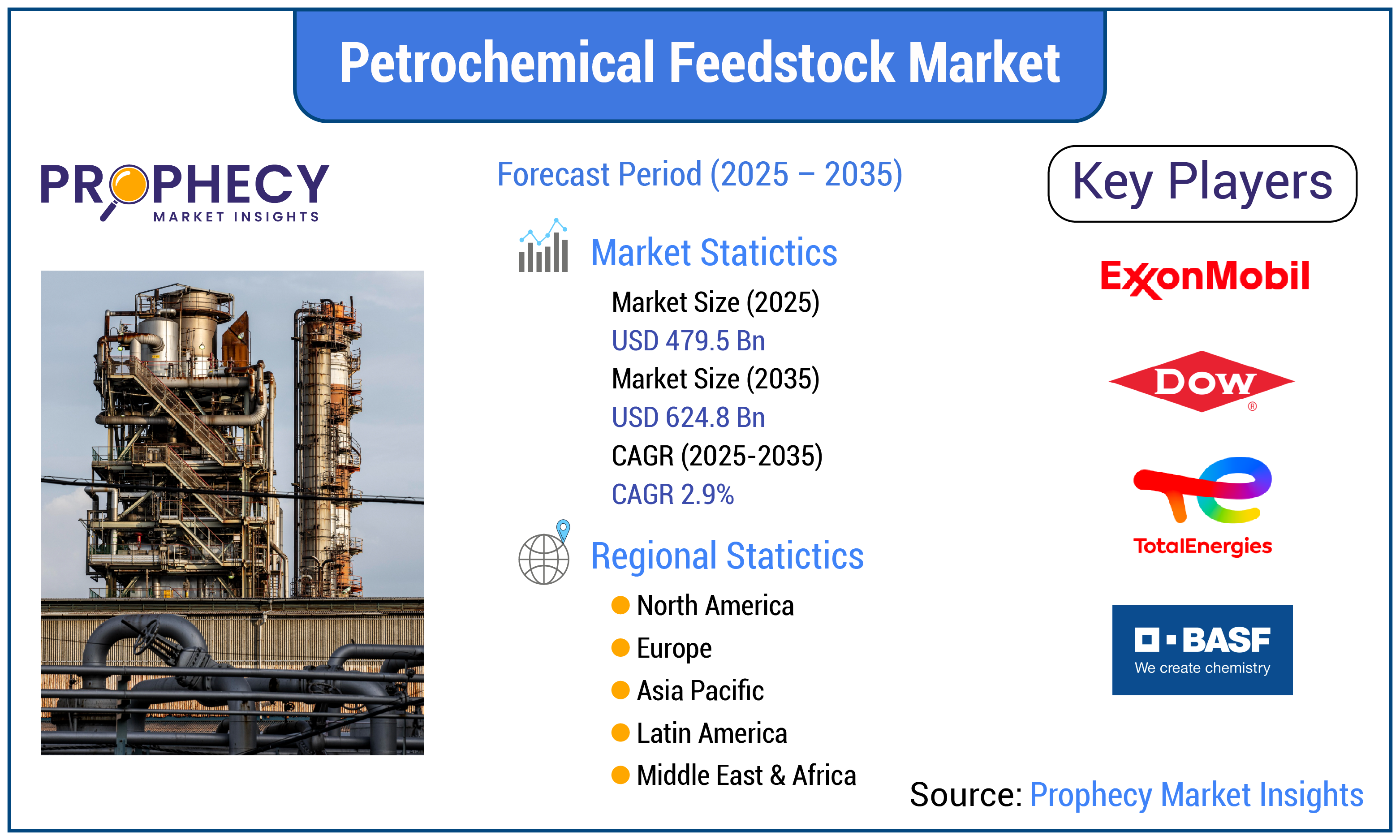
- By 2035, the petrochemical feedstock market size is probable to advance at a rate of USD 624.8 Billion.
- In 2024, the target market valuation was USD 468.1 Billion.
- Petrochemical feedstock market is escalating at a CAGR 2.9%.
Petrochemical feedstock is a raw material derived from crude oil and natural gas, which are used as the base inputs in the production of petrochemicals. These feedstocks are crucial for manufacturing a wide range of chemical products, including plastics, synthetic rubber, solvents, fertilizers, pharmaceuticals, and industrial chemicals. There are two main types of petrochemical feedstock, such as naphtha, and natural gas liquids. These feedstocks are processed in steam crackers or reformers to produce basic building blocks such as ethylene, propylene, butadiene, benzene, toluene, and xylene, which serve as the foundation for downstream chemical production.
The rising global demand for petrochemicals in plastics, packaging, textiles, automotive industries, and abundant validity of natural gas liquids, is anticipated to drive petrochemical feedstock market growth. The expansion of refining, petrochemical complexes and shift towards lightweight, versatile materials to improve fuel efficiency, is projected to boost petrochemical feedstock market growth.
Increasing environmental concerns, thus growing demand for development of bio-based, renewable feedstocks, and technological advancement in cracking, reefing, is significantly create opportunities for petrochemical feedstock market growth. Rapid urbanization, industrialization, rise of middle-class population are creating new demand for petrochemical-based products, and growing investment in integrated petrochemical hubs, is expected to pitch petrochemical feedstock market growth.
Recession Risk & Tariff Analysis of Petrochemical Feedstock Market:
- A global economic recession gives a significant risk to the petrochemical feedstock market, by reducing industrial output and consumer demand for end-use products such as plastics, packaging, automotive components, and construction materials. During economic downturns, refineries and petrochemical plants may operate at reduced capacity, leading to decreased demand for feedstocks such as naphtha and natural gas liquids (NGLs). This can result in price volatility, oversupply, and margin pressure for producers.
- Trade tariffs and import/export restrictions can heavily influence the global flow of petrochemical feedstocks. Countries may impose tariffs on imported feedstocks or downstream petrochemicals to protect domestic industries, affecting pricing, supply chains, and competitiveness.
Impact of Generative AI on Petrochemical Feedstock Market:
- AI can model complex chemical reactions and suggest ideal process conditions for cracking naphtha or natural gas liquids into key petrochemicals such as ethylene and propylene. AI supports predictive maintenance by analyzing operational data from refining and petrochemical units.
- It can estimate equipment failures or performance drops, allowing facilities to schedule maintenance before costly breakdowns occur, which aim to enhance plant reliability. AI can simulate different market and pricing scenarios, helping producers and traders make smarter obtaining, pricing, and inventory decisions.
Petrochemical Feedstock Market Drivers & Restraints
Key Drivers:
Expansion of Plastic Industry is Expected to Pitch Target market Growth
Plastics, primarily derived from petrochemical products such as ethylene, propylene, benzene, and styrene, which are essential materials used across a wide array of industries, including packaging, automotive, construction, electronics, textiles, and healthcare. As global demand for plastic-based products increases, the need for the raw materials used to produce naphtha, ethane, propane, and other feedstocks is also rises correspondingly. The packaging sector, particularly for food and beverages, consumer goods, and e-commerce, which heavily relies on lightweight, durable, and cost-efficient plastic materials.
The increasing consumption of plastic in infrastructure, household goods, which fuels demand for feedstock needed for production of polymers such as polyethylene (PE), polypropylene (PP), and polyvinyl chloride (PVC). As the expansion of plastic industry stimulates the demand for petrochemical feedstocks, resulting to propel petrochemical feedstock market growth.
- For instance, according to data published by, UNI Trade & Development, in November 2022, the global exports of plastics or goods from plastic have doubled from 2005, which passed USD 1 trillion benchmark in 20218 and reached USD 1.2 trillion in 2021. This upsurge of plastics in global trade includes products made from plastic, many children’s toys, products with plastic components, such as electronic gadgets and products wrapped in plastic. About 75% of all plastic produced since 1950. It would take 18.4 million trucks, each carrying 20 tons, to deliver the 369 million metric tons of plastics exported in 2021.
Restraints:
Environmental Regulations and Emission Controls can Hinder Market Growth
Stringent environmental policies and global climate agreements are pressuring petrochemical producers to reduce greenhouse gas emissions and manage pollution from feedstock processing. This includes restrictions on flaring, carbon emissions, and hazardous waste handling, which can increase operational costs and limit expansion, which results in delay market growth.
- Counterbalance Statements: many companies are investing in cleaner technologies, carbon capture systems, and bio-based feedstocks, which shifting regulatory pressure into an opportunity to innovate and future-proof operations. The shift toward sustainability is also unlocking new markets and funding opportunities.
Opportunities & Trends:
Advancements in Chemical Processing Technologies can Stimulate Market Augmentation
Traditional refining methods are replaced by innovative catalytic processes, advanced cracking techniques, and modular system designs that improve efficiency, flexibility, and product yields. These technologies allow refineries to maximize the production of high-demand petrochemical feedstocks such as ethylene, propylene, benzene, toluene, xylene (BTX), and naphtha, which are the building blocks of plastics, synthetic fibers, packaging, and specialty chemicals. Development of high-severity fluid catalytic cracking (FCC) units and advanced steam crackers, which significantly boost the yield of light olefins and aromatics from heavy feedstocks.
Advanced process intensification techniques, such as the integration of membrane separation, plasma reactors, and microchannel reactors allow for more efficient feedstock conversion, reduced energy use, and lower greenhouse gas emissions. The advanced chemical processing systems unlock new capabilities to produce higher-value petrochemicals, is projected to boost petrochemical feedstock market share.
- For Instance, according to the article published by McKinsey & Company, in June 2022, this article states that, the global push towards energy transition and decarbonization focused on extracting higher value of crude oil through the production of petrochemical feedstocks such as olefins, aromatics, and naphtha. This focused-on Fluid Catalytic Cracker (FCC) technology, in which refiners covert vacuum gas oil into lighter and more valuable products, such as gasoline. FCC contributes to 40-50% of the total gasoline production, and produce valuable petrochemical feedstocks such as light olefines and aromatics. Refiners are developing and adopting new catalyst technologies and operational modifications to increase olefin production with some new configurations achieving 10–15% olefin yield. High-Sensity FCC allowed for enhance propylene recovery by modifying unit design and operating conditions.
Petrochemical Feedstock Market Segmentations & Regional Insights
The petrochemical feedstock market is segmented into type, application, end-user, and region.
By Type:
Based on type, the market is divided into natural gas, naphtha, ethane, propane, butane, and others. Naphtha is the largest and most widely used feedstock in the global petrochemical industry, in which access to cheap natural gas is limited. It is a versatile input used in steam cracking to produce ethylene, propylene, benzene, and toluene, which are core building blocks for plastics, resins, and synthetic fibers. Its dominance is supported by the extensive infrastructure and refining integration in large chemical complexes, is projected to boost petrochemical feedstock market size.
Ethane is rapidly growing segment in the market. It is preferred for its high ethylene yield and lower cost relative to naphtha. Many petrochemical producers have invested in ethane crackers, is anticipated to drive growth of segment in petrochemical feedstock market share.
By Process Technology:
By process technology market is segmented into, steam cracking, catalytic cracking, hydrocracking, gas-to-liquids. Steam cracking is leading segment in the market. Steam cracking is the most widely used and dominant process for converting petrochemical feedstocks, such as naphtha, ethane, and propane into olefins, which are the primary building blocks for plastics, synthetic rubber, and other chemicals, is estimated to impel segment’s growth in petrochemical feedstock market share.
By Application:
On the basis of application, the market is divided into, plastics, synthetic fibers, rubber, industrial chemicals, fertilizers, and others. Plastics are the largest and most significant application for petrochemical feedstocks, driving the majority of demand in the market. Plastics production uses feedstocks such as ethylene, propylene, and butadiene to create products such as packaging, consumer goods, automotive parts, and medical devices. The rapid growth of single-use plastics and high-demand consumer products, is responsible for the segment’s expansion in petrochemical feedstock market size.
Synthetic fibers is second leading segment in the market, as it evolves nylon, polyester, and acrylic. The demand for synthetic fibers, driven by the growing fashion industry, home textiles, and automotive material, has led to consistent growth in this segment. Synthetic fibers are used due to their durability, cost-effectiveness, and versatility, is estimated to impel segment’s growth in petrochemical feedstock market share.
By End-User:
By end-user, the market is categorized into automotive, construction, consumer goods, textiles, and others. The automotive industry is the largest end-user segment for petrochemical feedstocks. Petrochemical derivatives such as plastics, synthetic rubber, and resins are integral to the production of vehicle parts, interiors, exteriors, electronics, and fuel systems. The rise of lightweight materials and electric vehicles (EVs) is boosting the demand for advanced materials derived from petrochemicals, is anticipated to fuel petrochemical feedstock market share in given segment.
The construction segment is the second-largest consumer of petrochemical feedstocks. Petrochemicals are critical in the production of paints, coatings, adhesives, and insulation materials that are used extensively in residential, commercial, and infrastructure construction projects. The growing need for sustainable building materials and the increasing global urbanization, is contributing to drive petrochemical feedstock market growth.
Regional Insights:
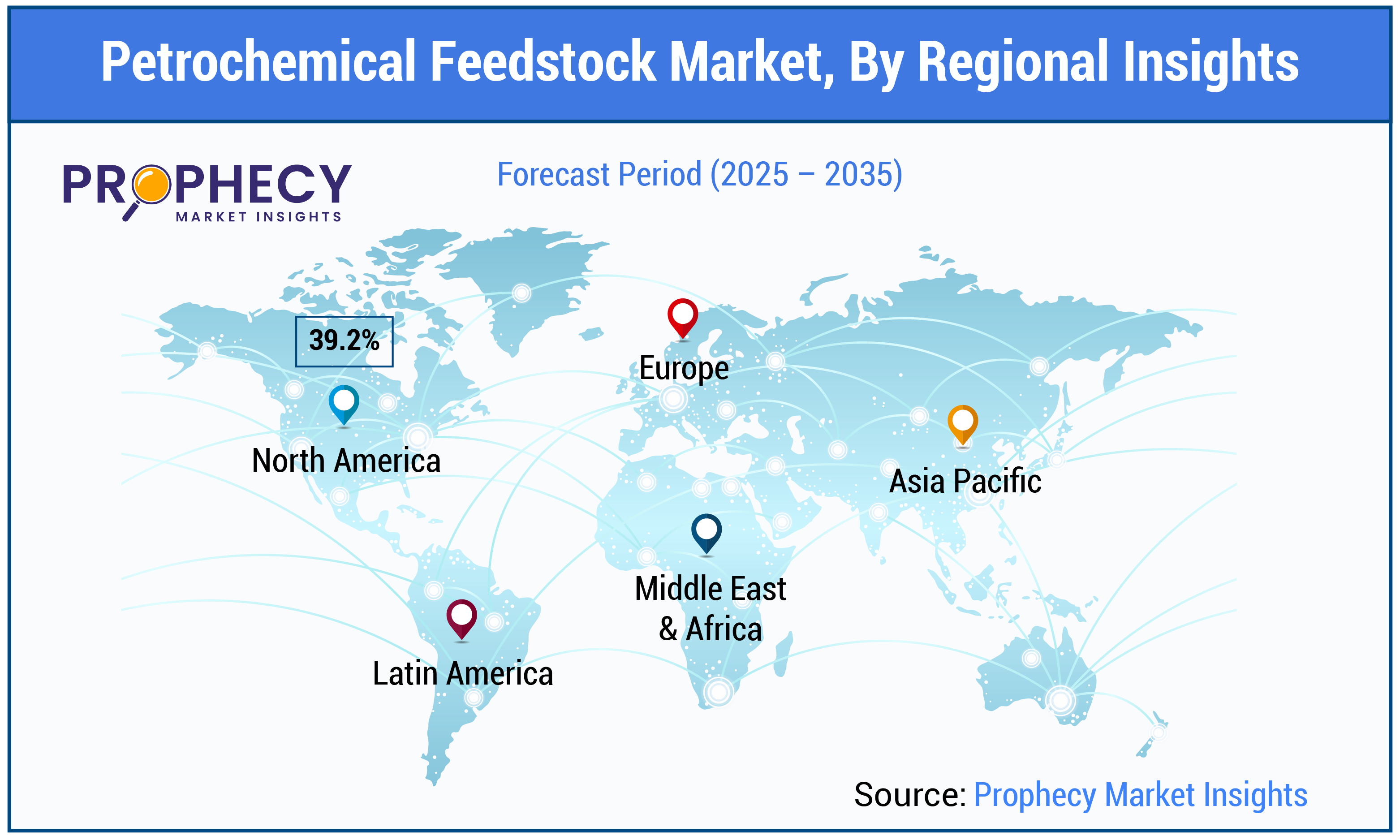
Geographically, the market is studied across North America, Europe, Asia Pacific, Latin America, and the Middle East & Africa.
North America: This is the dominant region in the market, accounted for 39.2% share, driven by the global largest producer of shale gas. This provides an abundant and cost-effective supply of ethane, a key feedstock used in ethylene production. The region has advanced infrastructure, a strong chemical industry base, and a favorable business environment. The U.S. has some of the largest petrochemical complexes, with significant investment in both natural gas and naphtha feedstock production, is contributing to propel region expansion in petrochemical feedstock market size.
- U.S. Petrochemical Feedstock Market Insights:
The U.S. is the dominant country in North America for the petrochemical feedstock market. This is largely due to the country's abundant shale gas reserves, which provide a cost-effective source of ethane, a primary feedstock for ethylene production. The U.S. has a highly developed petrochemical industry with extensive refining capabilities and infrastructure. The country’s strong demand for plastics, chemicals, and synthetic materials further drives the petrochemical feedstock market growth.
Asia Pacific: This region is the second-largest and fastest-growing market for petrochemical feedstocks. The demand for feedstocks such as naphtha and ethane is driven by a robust manufacturing base, high demand for plastics, synthetic fibers, and other petrochemical products, and ongoing urbanization, is projected to boost region’s development in petrochemical feedstock market size.
- China Petrochemical Feedstock Market Insights:
The petrochemical feedstock market in China has experienced significant growth in recent years and is expected to continuous growth. As the global largest producer and consumer of petrochemicals, China drives demand for naphtha, ethane, and propane feedstocks. The country's large manufacturing base, strong automotive textile industries, and rapid urbanization contribute significantly to the growth of the petrochemical feedstock market.
Europe: This region plays a significant role in the market. The region’s feedstock demand is driven by presence of industries such as automotive, construction, and consumer goods. Europe relies heavily on naphtha and natural gas liquids for its petrochemical production, with a strong focus on sustainability and eco-friendly initiatives, resulting to drive petrochemical feedstock market share.
- Germany Petrochemical Feedstock Market Insights:
In Europe, Germany leads the petrochemical feedstock market, driven by its strong industrial base and advanced chemical sector. The country is a major producer of naphtha, propane, and butane feedstocks, with key petrochemical hubs. Germany’s petrochemical feedstock market is also attributed to its focus on sustainability and innovation in green chemistry.
Petrochemical Feedstock Market Report Scope:
|
Attribute |
Details |
|
Market Size 2025 |
USD 479.5 Billion |
|
Projected Market Size 2035 |
USD 624.8 Billion |
|
CAGR Growth Rate |
2.9% (2025-2035) |
|
Base year for estimation |
2024 |
|
Forecast period |
2025 – 2035 |
|
Market representation |
Revenue in USD Billion & CAGR from 2025 to 2035 |
|
Regional scope |
North America - U.S. and Canada Europe – Germany, U.K., France, Russia, Italy, Spain, Netherlands, and Rest of Europe Asia Pacific – China, India, Japan, Australia, Indonesia, Malaysia, South Korea, and Rest of Asia-Pacific Latin America - Brazil, Mexico, Argentina, and Rest of Latin America Middle East & Africa – GCC, Israel, South Africa, and Rest of Middle East & Africa |
|
Report coverage |
Revenue forecast, company share, competitive landscape, growth factors, and trends |
Segmentation:
By Type:
- Natural Gas
- Naphtha
- Ethane
- Propane
- Butane
- Others
By Process Technology:
- Steam Cracking
- Catalytic Cracking
- Hydrocracking
- Gas-to-Liquids
By Application:
- Plastics
- Synthetic Fibers
- Rubber
- Industrial Chemicals
- Fertilizers
- Others
By End-User:
- Automotive
- Construction
- Consumer Goods
- Textiles
- Others
By Region:
- North America
- U.S.
- Canada
- Europe
- Germany
- U.K.
- France
- Russia
- Italy
- Spain
- Netherlands
- Rest of Europe
- Asia Pacific
- China
- India
- Japan
- Australia
- Indonesia
- Malaysia
- South Korea
- Rest of Asia Pacific
- Latin America
- Brazil
- Mexico
- Argentina
- Rest of Latin America
- Middle East & Africa
- GCC
- Israel
- South Africa
- Rest of Middle East & Africa
Petrochemical Feedstock Market Competitive Landscape & Key Players
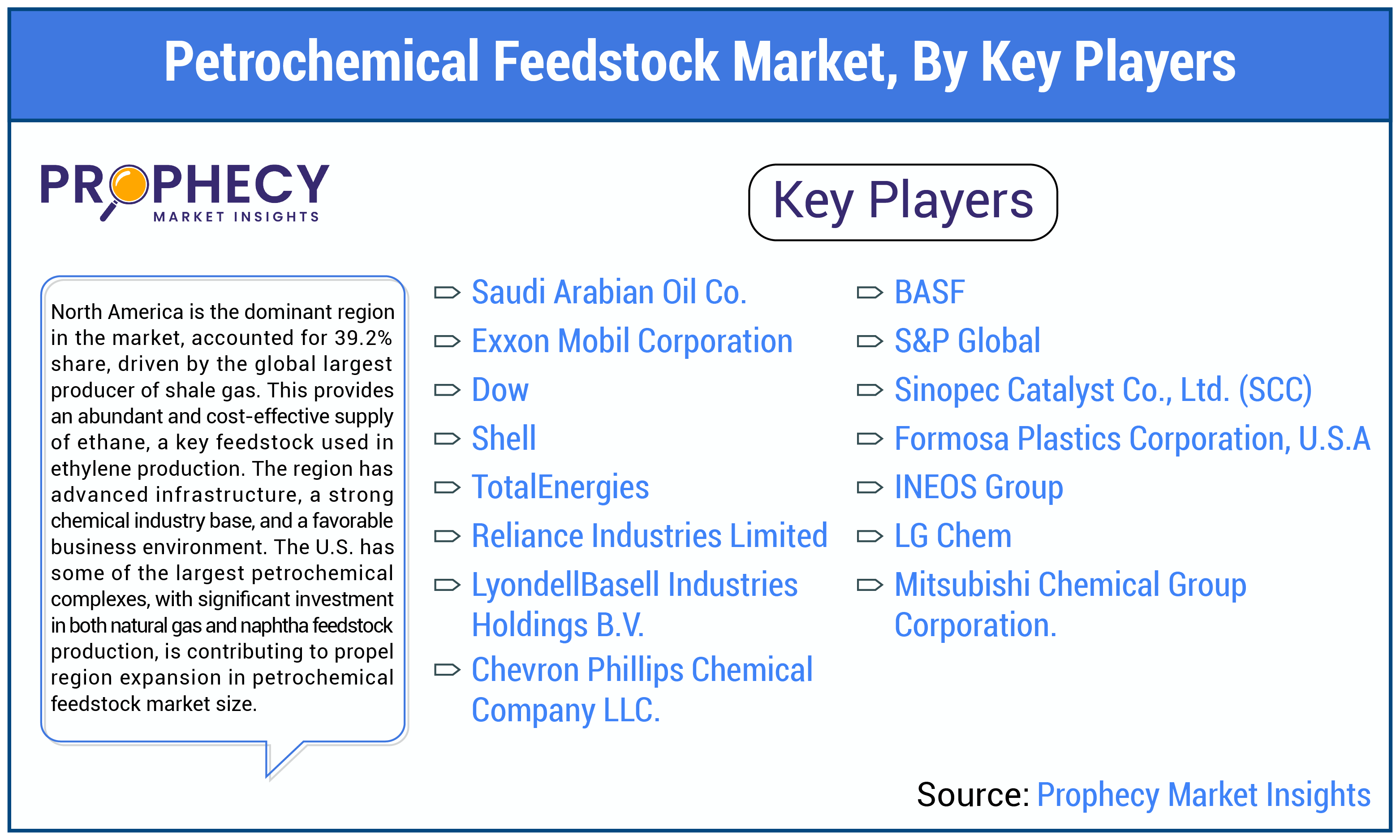
The major companies operating in the petrochemical feedstock market are, Saudi Arabian Oil Co., Exxon Mobil Corporation, Dow, and others. These companies leverage their vertical integration, global logistics, and access to low-cost raw materials, such as shale gas or crude oil to maintain a competitive edge. Strategic partnerships, capacity expansions, and investments in digital optimization tools, is projected to boost petrochemical feedstock market share.
Petrochemical Feedstock Market Companies:
- Saudi Arabian Oil Co.
- Exxon Mobil Corporation
- Dow
- Chevron Phillips Chemical Company LLC.
- LyondellBasell Industries Holdings B.V.
- Shell
- TotalEnergies
- Reliance Industries Limited
- BASF
- S&P Global
- Sinopec Catalyst Co., Ltd. (SCC)
- Formosa Plastics Corporation, U.S.A
- INEOS Group
- Mitsubishi Chemical Group Corporation.
- LG Chem
View an Additional List of Companies in the Petrochemical Feedstock Market
Petrochemical Feedstock Market Recent News
- In April 2025, Iran and Iraq signed a memorandum of understanding (MoU) to supply NGL 3100 feedstock to Dehloran Petrochemical Plant, in western Iranian border province of Ilam. This agreement aimed to development and operation of the Dehloran Petro-Refinery Project, which emphasize the daily requirement of 240 million cubic feet of NGL 3100. This agreement plays significant role in addressing Iran’s energy imbalances and resolve environmental challenges in Ilam Province.
- In February 2025, Saudi Arabia’s Ministry of Energy awarded feedstock allocation to the Sipchem and LyondellBasell, which support joint feasibility study for global mixed feed cracker complex. This joint projected aimed to manufacture petrochemical products and derivatives to serve customers in Saudi Arabia and global export market. This project focused to create cost-effective feedstock, global scale assets, leading technologies and strengths their position in petrochemical market globally and locally.
- In February 2025, Mexican polyester and plastics producer Alpek has expressed strong support for President Claudia Sheinbaum’s Plan Mexico initiative, which includes a targeted revival of the petrochemical industry. The government was aimed to invest in state-owned petrochemical facilities to increase the supply of raw materials used by the industry.
- In January 2024, TotalEnergies converted feedstocks from plastic waste into circular polymers at its polypropylene plant in La Porte, Texas. The petrochemical feedstock was provided by New Hope Energy's ISCC+ certified advanced recycling facility in Tyler, Texas, and this feedstock was converted into monomers at the BASF TotalEnergies Petrochemicals (BTP) facility. Also, TotalEnergies and New Hope Energy signed a multi-year agreement, in which New Hope Energy supply petrochemical feedstock made from plastics to produce recycled polymers to TotalEnergies.
Analyst View:
The petrochemical feedstock market is poised for steady long-term growth, driven by increasing global demand for plastics, synthetic fibers, and industrial chemicals, particularly in emerging economies. The availability of cost-effective feedstocks such as ethane from shale gas is supporting to industrialization. Innovation in process efficiency, circular economy practices and integration of digital technologies, such as AI, IoT, is contributing to the petrochemical feedstock market growth.
More Related Reports
Cryogenic Gas Market
Petrochemicals Market
Oil and Gas Accumulators Market
Medical Gases Market
Liquefied Petroleum Gas Market
Petrochemical Feedstock Market Company Profile
|
Company Name |
BASF SE |
|
Headquarter |
Ludwigshafen, Germany |
|
CEO |
Dr. Markus Kamieth |
|
Employee Count (2024) |
111,822 employees |
Petrochemical Feedstock Market Highlights
FAQs
Petrochemical feedstock market size was valued at USD 479.5 Billion in 2025 and is expected to reach USD 624.8 Billion by 2035 growing at a CAGR of 2.9%.
Type, process technology, application, end-user, and region are the segmentation for the target market.
North America, Asia Pacific, Europe, Latin America, and the Middle East & Africa. North America is expected to dominate the market.
The key players operating in the petrochemical feedstock market include Saudi Arabian Oil Co., Exxon Mobil Corporation, Dow, Chevron Phillips Chemical Company LLC, LyondellBasell Industries Holdings B.V., Shell, TotalEnergies, Reliance Industries Limited, BASF, S&P Global, Sinopec Catalyst Co., Ltd. (SCC), Formosa Plastics Corporation, U.S.A, INEOS Group, Mitsubishi Chemical Group Corporation, and LG Chem