Global Wireless Telecom Infrastructure Industry Overview
- Wireless telecom infrastructure industry market size is estimated to develop at a rate of USD 551.2 Billion, by 2035.
- In 2024, the wireless telecom infrastructure industry market valuation was USD 208.3 Billion.
- Wireless telecom infrastructure industry market is growing at a CAGR of 10.3%.
The Wireless Telecom Infrastructure Industry refers to the businesses and activities involved in creating and maintaining the physical and virtual infrastructure necessary for wireless communication. This includes everything from cell towers and antennas to the software and hardware that manages network traffic. In essence, it's the foundation upon which wireless services such as mobile phone calls, data transfer, and internet access operate. It provides the network backbone for mobile and wireless communication, offering numerous advantages including mobility, flexibility, cost savings, and scalability. This industry supports various technologies such as 4G/LTE and 5G, enabling high-speed data transmission and wide coverage.
The wireless telecom infrastructure industry market is experiencing strong growth due to several key factors, including the expansion of urban areas and the development of smart cities are increasing the demand for robust wireless networks to support public safety, smart lighting, traffic control, and other smart city initiatives, rise of smartphones, streaming services, online gaming, and remote work has fueled the demand for faster and more reliable internet access, and the rapid growth of the industrial sector.
The market’s augmentation is also stimulated by the rollout of 5G networks, with its promise of higher speeds, lower latency, and increased capacity, and the growth of the Internet of Things (IoT) is creating a massive need for wireless infrastructure to connect billions of devices and support data-intensive applications.
Recession Risk and Tariff Analysis:
- Project delays, labour cutbacks, and lower capital expenditures all increase the danger of a recession for the wireless communication infrastructure sector. Infrastructure providers see a loss in revenue as a result of operators pausing investments during economic downturns. Rising interest rates and high debt levels put additional burden on financial stability and make it more susceptible to market downturns.
- Supply chains and equipment costs are greatly impacted by tariff changes in the wireless cellular infrastructure sector. Capital budgets are being strained and 5G deployments are being delayed as a result of recent U.S. tariffs on Chinese telecom imports that have increased hardware costs. On the other hand, India's component tariff cuts are intended to encourage domestic production and draw in international value chains.
Impact of Generative AI on Wireless Telecom Infrastructure Industry Market:
- By improving resource allocation, network design, and predictive maintenance, generative AI is revolutionizing the wireless communication infrastructure sector. By enabling automated network configuration construction, it lowers deployment time and human error. AI-generated simulations improve 5G and future network planning.
- Furthermore, generative AI helps create virtual twins of telecom networks, which enhances productivity and defect finding. Growth and competition in the telecom infrastructure sector are fueled by the simplification of operations and innovation, which lowers costs and improves service quality.
Global Wireless Telecom Infrastructure Industry Drivers & Restraints
Key Drivers:
Rising Urbanization is Skyrocketing the Market Expansion
An important factor driving the expansion of the wireless communication infrastructure sector is growing urbanization. The need for dependable, fast communication is growing as cities grow and people move closer to one another. To handle the increasing data flow and guarantee smooth communication, this calls for the implementation of cutting-edge infrastructure such as 5G networks, tiny cells, and distributed antenna systems. Furthermore, strong wireless networks are necessary for the growth of smart cities and the spread of IoT devices. As a result, telecom companies must upgrade and invest in infrastructure to satisfy the changing demands of metropolitan settings.
- For instance, according to the data published by World Bank Group, in order to fulfill the World Bank's purpose of eradicating poverty and promoting shared prosperity on a habitable world, more livable cities must be built. Currently, 4.4 billion people, or more than half of the world's population, reside in urban areas. This trend is predicted to continue, with nearly seven out of ten people living in cities by 2050, when the urban population is predicted to more than quadruple.
Restraints:
The Challenge of Spectrum Availability and Interference is Limiting the Market Expansion
Spectrum availability and interference issues are two significant drawbacks for the wireless communication infrastructure sector. Limited and fragmented spectrum bands cause signal congestion, worse quality of service, and operational inefficiencies as the demand for wireless communication rises. Furthermore, a higher device density in cities exacerbates interference, making network performance more difficult. The adoption of cutting-edge technology such as 5G is further delayed by regulatory obstacles in spectrum allocation. These restrictions make it difficult to provide regular service, particularly in areas with a high population density or volume of traffic.
- Counterbalance Statements: Governments can use auctions and shared-access arrangements to more effectively distribute spectrum and simplify regulatory frameworks in order to address spectrum issues. Advanced technology such as interference mitigation tools and dynamic frequency sharing should be adopted by telecom operators. Additionally, spending money on AI-driven network optimization can increase spectrum efficiency and boost service quality in crowded locations.
Opportunities & Trends:
Rollout of 5G Networks is Unlocking Growth Opportunities for the Impending Years
The deployment of 5G networks is expected to stimulate significant investments in new infrastructure, such as fibre backhaul, edge computing facilities, and tiny cells, which will in turn drive the wireless telecom infrastructure sector. The high-speed, low-latency capabilities of 5G necessitate a sophisticated and dense network design, which is why telecom companies are upgrading its current systems. The technology also increases the requirement for infrastructure by supporting new applications such as the Internet of Things, driverless cars, and smart cities. Long-term industrial growth and innovation will be greatly accelerated by 5G rollout as the need for faster, more dependable connection increases.
- For instance, according to the data published by Telefonaktiebolaget LM Ericsson, there are around 831 4G networks in use worldwide, 346 of which have been upgraded to LTE-Advanced, and 161 of which have been activated for gigabit. By 2024, 4G is predicted to reach over 85% of the population, and by 2030, it will reach over 95%. With 5G population coverage predicted to reach 55% by 2024 and rise from 45% in 2024 to 85% by 2030 outside of China, the rollout of 5G networks is still ongoing. 5G mid-band provides broad coverage and great capacity.
Global Wireless Telecom Infrastructure Industry Segmentations & Regional Insights
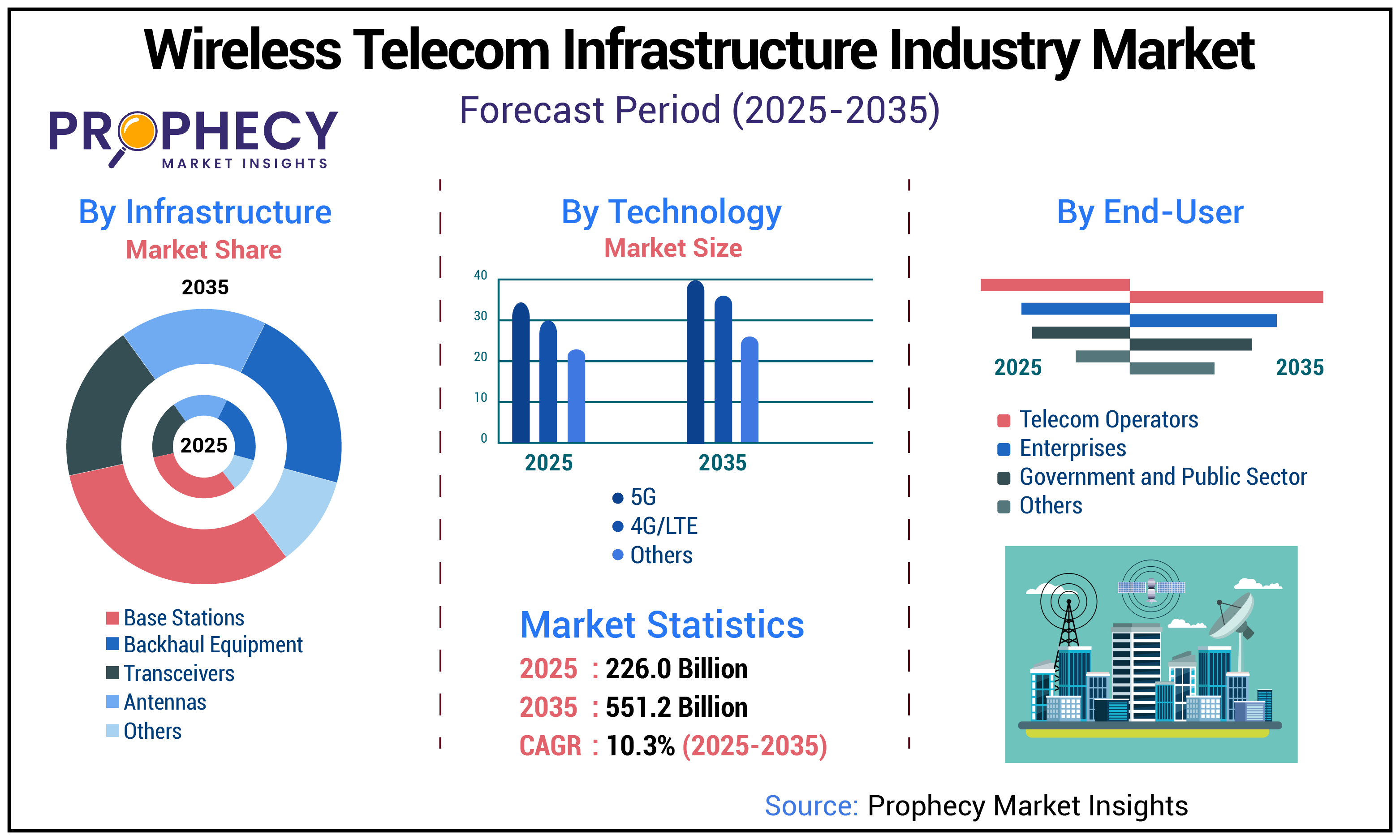
The wireless telecom infrastructure industry market is segmented into infrastructure type, technology, end-user, and region.
By Infrastructure Type:
Stemming from infrastructure type, the market is divided into base stations, antennas, transceivers, backhaul equipment, and others. The base stations segment is holding the superior position, in the wireless telecom infrastructure industry market share. This is due to its crucial role in establishing and maintaining wireless communication networks, especially as demand for wireless services and advanced technologies such as 5G increases. While other infrastructure types such as antennas, transceivers, and backhaul equipment are also essential, base stations form the foundational element of the network, enabling wireless communication.
The backhaul equipment segment is the second superior infrastructure type, in the Wireless telecom infrastructure industry market. This is due to its importance for connecting base stations to the core network, enabling data transmission.
By Technology:
On the foundation of technology, the market is categorized into 4G/LTE, 5G, and others. The 5G segment is the dominating technology, in the Wireless telecom infrastructure industry market. This is due to the increasing demand for high-speed connectivity, low latency, and broader global 5G deployments, particularly for applications such as VR, AR, autonomous vehicles, and smart manufacturing. While 4G/LTE was previously dominant, 5G's superior capabilities and the emergence of new applications are driving its rapid growth and market share.
The 4G/LTE segment is the second dominating technology, in the wireless telecom infrastructure industry market. This is due to the fact that it is a well-established technology with widespread deployment, providing high-speed data services and robust coverage.
By End-User:
Contingent to end-user, the market is catalogued into telecom operators, enterprises, government and public sector, and others. The telecom operators segment is leading the wireless telecom infrastructure industry market. This is due to its core role in deploying and managing wireless networks for providing services to consumers and businesses. These require significant infrastructure investment for base stations, towers, and network equipment to support mobile communications.
The enterprises segment is the second leading end-user, in the Wireless telecom infrastructure industry market. This is due to the increasing business demand, data and internet services, and neutral host solutions.
Regional Insights:
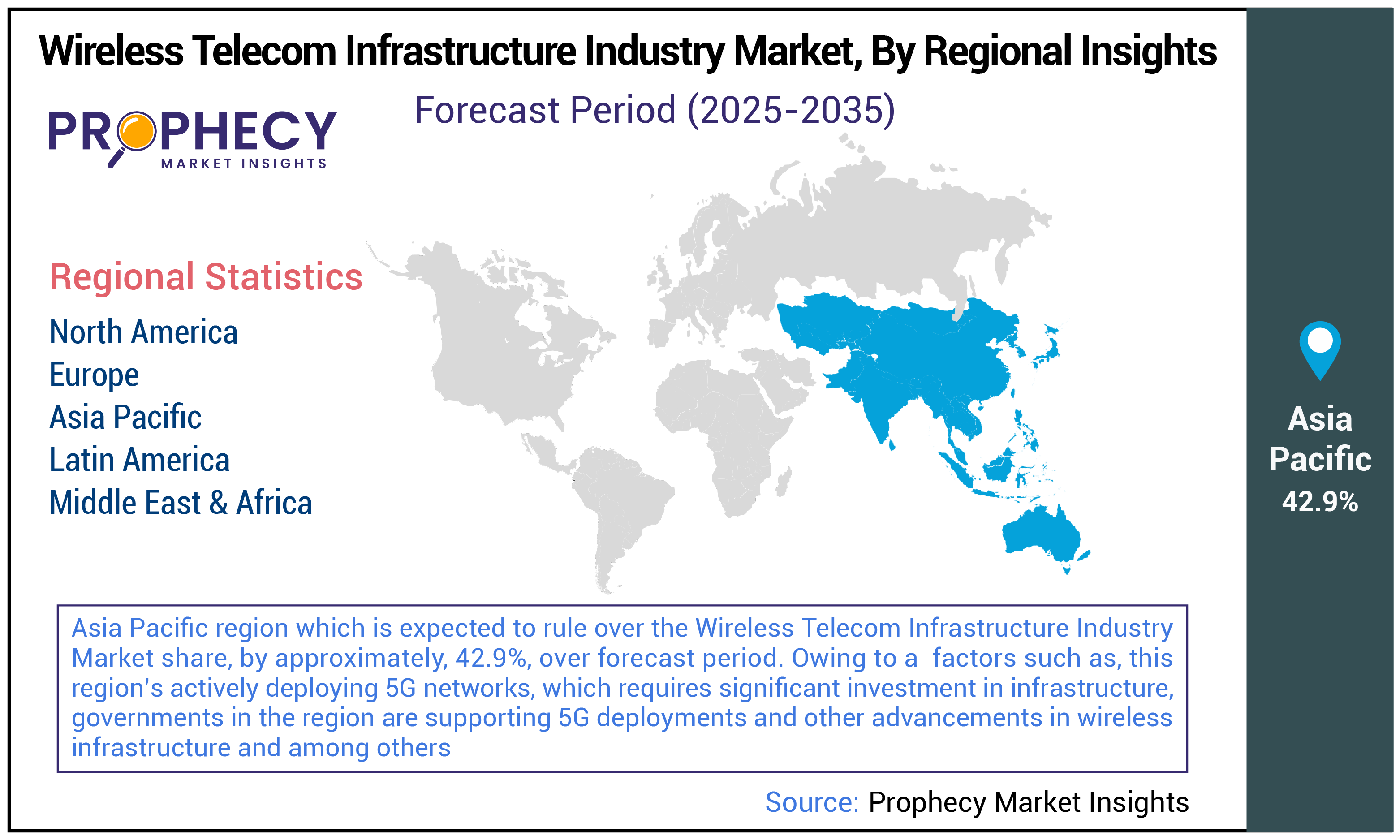
Geographically, the market is analyzed across North America, Europe, Asia Pacific, Latin America, and the Middle East & Africa.
Asia Pacific: This is the region which is attributed to rule over the wireless telecom infrastructure industry market share, by approximately, 42.9%, in the recent years. This is due to a number of factors, such as, this region’s actively deploying 5G networks, which requires significant investment in infrastructure, governments in the region are supporting 5G deployments and other advancements in wireless infrastructure, providing a strong impetus for growth, rapid adoption of technology and digitalization across various industries is increasing the need for reliable and fast wireless connectivity, and a large and growing number of smartphone users are driving the demand for wireless infrastructure to support mobile internet access and data usage.
- U.S. Wireless Telecom Infrastructure Industry Market Insights:
The wireless telecom infrastructure industry market in China is the most influential market. This is due to this country’s aggressive deployed 5G technology, becoming a global leader in its adoption, Chinese government actively supports the development of the telecom industry, providing financial incentives and promoting technological innovation, it boasts a large number of mobile phone subscribers, significantly increasing the need for robust wireless infrastructure, and the presence of leading telecom companies.
Europe: This is the region which has the wireless telecom infrastructure industry market, growing with the highest CAGR, during the forecast period, in the recent years. This is due to a combination of factors, such as, this region’s strong presence of technology leaders and key manufacturers, European companies are actively developing and implementing Internet of Things (IoT) applications, which require robust wireless infrastructure for seamless communication and data exchange, supportive regulatory environment, sustainability and green initiatives, and digital transformation and smart city projects.
- Germany Wireless Telecom Infrastructure Industry Market Insights:
The wireless telecom infrastructure industry market in Germany is the fastest growing market, in the recent years. This is due to this country’s largest telecom markets in Europe, with a large population and a high level of mobile device penetration, largest telecom provider in Europe, has a strong presence in Germany, along with other major players such as freenet, Vodafone Germany, and Telefónica Germany, a leader in the deployment of 5G technology, driving infrastructure investment and the demand for high-speed connectivity, and Germany's data center market.
North America: The region which has the wireless telecom infrastructure industry market, experiencing considerate amount of growth, in the recent years, is North America. This is due to the confluence of factors, such as, this region’s leader in 5G deployment and the subsequent demand for new infrastructure to support these networks, U.S. government is actively promoting digital infrastructure development, large telecom companies are investing heavily in network upgrades to enhance connectivity and capacity, high penetration of smartphones and internet services, and rapid urbanization.
- U.S. Wireless Telecom Infrastructure Industry Market Insights:
The wireless telecom infrastructure industry market in the U.S., is experiencing subsequent amount of growth, in the recent years. This is due to this country’s a large and tech-savvy consumer base with high smartphone adoption, significant investments in network upgrades (especially 5G deployment), and a favorable regulatory environment that supports digital infrastructure development. Major U.S. carriers are investing heavily in expanding and upgrading its networks.
Wireless Telecom Infrastructure Industry Market Report Scope:
|
Attribute |
Details |
|
Market Size 2025 |
USD 226.0 Billion |
|
Projected Market Size 2035 |
USD 551.2 Billion |
|
CAGR Growth Rate |
10.3% (2025-2035) |
|
Base year for estimation |
2024 |
|
Forecast period |
2025 – 2035 |
|
Market representation |
Revenue in USD Billion & CAGR from 2025 to 2035 |
|
Regional scope |
North America - U.S. and Canada Europe – Germany, U.K., France, Russia, Italy, Spain, Netherlands, and Rest of Europe Asia Pacific – China, India, Japan, Australia, Indonesia, Malaysia, South Korea, and Rest of Asia-Pacific Latin America - Brazil, Mexico, Argentina, and Rest of Latin America Middle East & Africa – GCC, Israel, South Africa, and Rest of Middle East & Africa |
|
Report coverage |
Revenue forecast, company share, competitive landscape, growth factors, and trends |
Segmentation:
By Infrastructure Type:
- Base Stations
- Antennas
- Transceivers
- Backhaul Equipment
- Others
By Technology:
- 4G/LTE
- 5G
- Others
By End-User:
- Telecom Operators
- Enterprises
- Government and Public Sector
- Others
By Region:
- North America
- U.S.
- Canada
- Europe
- Germany
- U.K.
- France
- Russia
- Italy
- Spain
- Netherlands
- Rest of Europe
- Asia Pacific
- China
- India
- Japan
- Australia
- Indonesia
- Malaysia
- South Korea
- Rest of Asia Pacific
- Latin America
- Brazil
- Mexico
- Argentina
- Rest of Latin America
- Middle East & Africa
- GCC
- Israel
- South Africa
- Rest of Middle East & Africa
Global Wireless Telecom Infrastructure Industry Competitive Landscape & Key Players
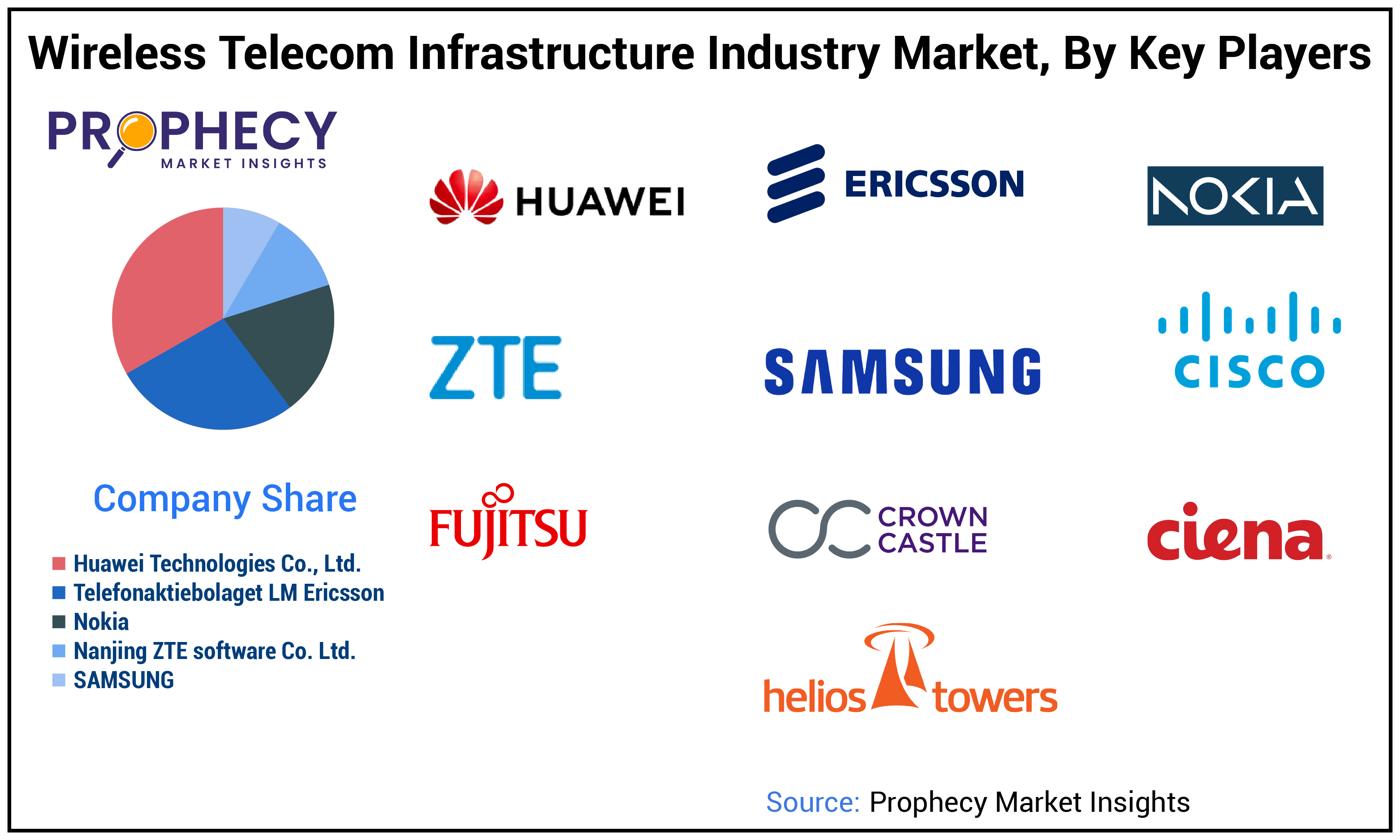
The key players operating in the market include, Huawei Technologies Co., Ltd., Telefonaktiebolaget LM Ericsson, Nokia, and others. These key players are focusing on investing in 5G infrastructure, leveraging Open RAN technology, and focusing on cost-effective solutions for different market segments. These also prioritize network densification and coverage enhancement, spectrum innovations, and cloud integration to meet the growing demand for high-speed and reliable connectivity, for driving wireless telecom infrastructure industry market growth.
Wireless Telecom Infrastructure Industry Market Companies:
- Huawei Technologies Co., Ltd.
- Telefonaktiebolaget LM Ericsson
- Nokia
- Nanjing ZTE software Co. Ltd.
- SAMSUNG
- Cisco Systems, Inc.
- Juniper Networks, Inc.
- Ciena Corporation
- FUJITSU
- ATC TRS V LLC
- Crown Castle
- SBA Communications Corporation
- Helios Towers plc
- IHS Holding Limited
- Phoenix Tower International
View an Additional List of Companies in the Wireless Telecom Infrastructure Industry Market
Global Wireless Telecom Infrastructure Industry Recent News
- In March 2025, Air Wireless declared its partnership with QuadGen Wireless Solutions, PVT Ltd. In addition to offering a one-stop shop for end-to-end network design, maintenance, and added-value solutions for operators seeking to provide dependable ubiquitous networks rich with innovative solutions and differentiated services, the strategic technology partnership was anticipated to enable quick and affordable network expansions. The business also said that QuadGen, the company's founder and worldwide CEO, Mallik Vagvala, has joined its advisory board and will help Air Wireless' production in international markets.
- In February 2025, in comparison to traditional approaches, NEC Corporation's innovative solution, which aims to modernize telecom infrastructure planning, design, and construction, reduces deployment time by about 60%. By assisting telcos in streamlining its migrations to 5G virtualization technologies such as vRAN and O-RAN, NEC's solution seeks to improve automation, productivity, and efficiency in the development of mobile networks.
- In January 2025, Union Minister of Communications Jyotiraditya M. Scindia announced a number of initiatives, such as the Sanchar Saathi Mobile App, the National Broadband Mission (NBM) 2.0, and the launch of the Intra Circle Roaming (ICR) facility at 4G mobile sites funded by Digital Bharat Nidhi (DBN), in a major move to improve India's telecom infrastructure and accessibility.
- In January 2025, The Mobile Infrastructure Engineering Consortium (MIEC) was launched by telecom structural engineering firms Paul J. Ford & Company, Kimley-Horn, Congruex, and Colliers Engineering & Design. The goal of this innovative collaboration is to promote best practices and international standards for wireless engineering. It would enable digital infrastructure stakeholders, tower firms, and mobile network operators to expedite installations, attain cost savings, and maintain strict safety and compliance requirements.
- In September 2024, the first tokenized telecom asset platform in the world, Liquid Infrastructure, was unveiled by Hawk Networks. Liquid infrastructure provides a revolutionary option for communities and network operators by enabling programmable income sharing amongst numerous groups. Liquid Infrastructure facilitates programmable revenue sharing, which not only simplifies network operations but also creates new financing opportunities for underfunded communities, local governments, and commercial organizations, opening the door for scalable expansion.
Analyst View:
The wireless telecom infrastructure industry market is expanding rapidly due to a number of factors, such as the growth of smart cities and urban areas, which raise the need for strong wireless networks to support smart city initiatives such as traffic control, smart lighting, and public safety; the rise of smartphones, streaming services, online gaming, and remote work, which fuels the need for faster and more dependable internet access; and the industrial sector's explosive expansion.
The introduction of 5G networks, which promise faster speeds, reduced latency, and more capacity, is also driving the market's expansion. Additionally, the expansion of the Internet of Things (IoT) is generating a huge demand for wireless infrastructure in order to connect billions of devices and support data-intensive applications.
More Related Reports
Wireless Phone Charging Market
Stand-Alone Wireless Content Sharing Market
Wireless Communication Chipset Market
Wireless Sensor Network Market
Cloud Infrastructure in Chemical Market
Global Wireless Telecom Infrastructure Industry Company Profile
|
Company Name |
Huawei Technologies Co., Ltd. |
|
Headquarter |
Shenzhen, China |
|
CEO |
Mr. Ren Zhengfei |
|
Employee Count (2024) |
208,000 Employees |
Global Wireless Telecom Infrastructure Industry Highlights
FAQs
Wireless telecom infrastructure industry market size was valued at USD 226.0 Billion in 2025 and is expected to reach USD 551.2 Billion by 2035 growing at a CAGR of 10.3%.
Infrastructure type, technology, end-user, and region are the segmentation for the Wireless telecom infrastructure industry market.
North America, Asia Pacific, Europe, Latin America, and the Middle East & Africa. Asia Pacific is expected to dominate the market.
The key players operating in the Wireless Telecom Infrastructure Industry Market include Huawei Technologies Co., Ltd., Telefonaktiebolaget LM Ericsson, Nokia, FUJITSU, Nanjing ZTE software Co. Ltd., SAMSUNG, Cisco Systems, Inc., Juniper Networks, Inc., Ciena Corporation, ATC TRS V LLC, Crown Castle, SBA Communications Corporation, Helios Towers plc, IHS Holding Limited, and Phoenix Tower International