Global Web Content Management Market Overview
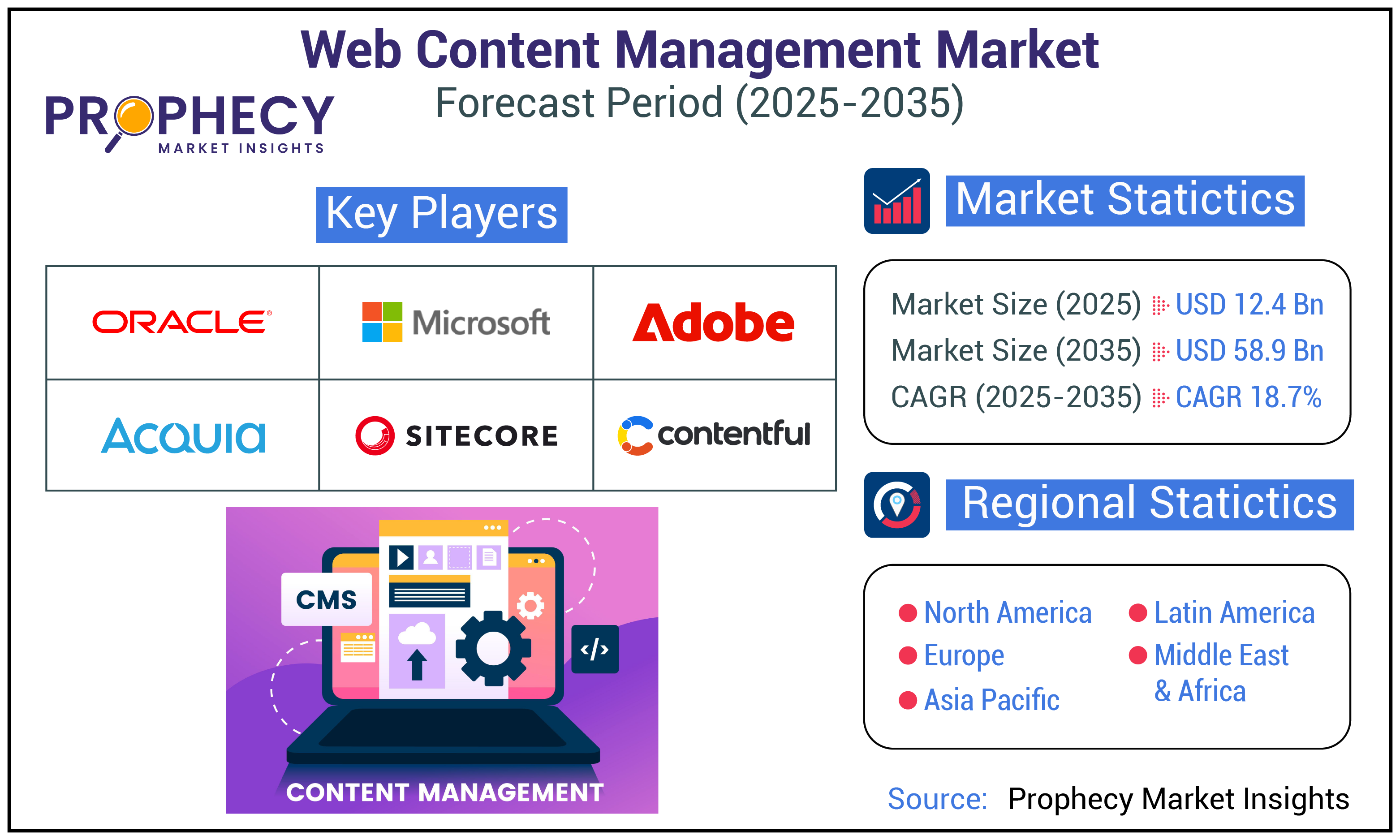
- Web content management market size is expected to develop at a valuation of USD 58.9 Billion, by 2035.
- In 2024, the target market valuation was USD 10.72 Billion.
- Web content management market is growing at a CAGR of 18.7%.
Web content management (WCM) is the process of creating, managing, and publishing content for websites and other online channels. It involves using software and tools to control the content, layout, and design of a website, and managing the overall digital experience. These offer numerous advantages, including ease of use, customization, content organization, and SEO optimization. WCMS allows non-technical users to create and manage content without coding, enabling faster updates and streamlined workflows. These also facilitate collaboration, SEO optimization, and efficient content delivery.
The web content management (WCM) market is experiencing growth due to several key factors, including, the increasing use of multiple channels by businesses, expectation of consumers for tailored experiences, and WCM solutions allow businesses to create and manage personalized content, growing importance of social media and digital marketing strategies, and the rising need for efficiency and productivity.
The market’s expansion is also pitched the embracing digital transformation, leading to increased adoption of automation technologies in content creation and management, including AI-powered tools for content optimization and personalization, and shift to cloud-based WCM solutions offers scalability, flexibility, and cost-effectiveness, making it easier for businesses to manage content regardless of size or location.
Recession Risk and Tariff Analysis:
- The web content management (WCM) market is at risk of a recession as a result of delayed digital initiatives and tighter IT resources. However, as companies place a higher priority on digital interaction, there is still a constant need for affordable, scalable content solutions. Despite economic challenges, cloud-based and hybrid CMS solutions that provide flexibility and compliance assistance are anticipated to maintain growing.
- Although direct tariffs on digital services are uncommon, non-tariff obstacles such as data localization requirements, digital service levies, and limits on cross-border data flow have a big influence on international operations, according to a tariff study of the web content management (WCM) sector. These actions reduce market access and raise compliance costs, which hurts the competitiveness of WCM suppliers.
Impact of Generative AI on Web Content Management Market:
- Through the automation of content production, personalization, and SEO optimization, generative AI is transforming the Web Content Management (WCM) industry. It makes it possible to create dynamic, real-time content based on user behavior, which improves efficiency and engagement. Better content strategy decisions are supported by AI-driven insights, and automation expedites publication and lessens human labor. Additionally, the user experience is improved by interaction with chatbots and virtual assistants. These advancements are driving innovation, reducing operational costs, and giving businesses a competitive edge, thereby fueling growth in the WCM market.
Global Web Content Management Market Drivers & Restraints
Key Drivers:
The Rising Shift towards Digital Marketing is Fostering the Market Expansion
The web content management (WCM) market is expanding at a substantial rate due to the growing trend towards digital marketing. The need for effective, scalable, and user-friendly WCM solutions is growing as more and more companies turn to online channels to interact with its consumers. WCM systems provide the timely, individualized, and consistent delivery of material that is essential to digital marketing efforts. Additionally, marketers may efficiently optimize campaigns through connectivity with analytics tools. Organizations are forced to implement cutting-edge WCM systems by this industry-wide emphasis on digitalization, which fosters innovation and market development.
- For instance, according to the data published by WordStream, in recent years, 63% of companies have already raised its spending for digital marketing. Furthermore, 94% of small firms want to spend more on marketing in 2024. The amount that firms spent on digital marketing increased by 10% between 2023 and 2024. More than 20% of companies claim that its main criterion for evaluating the effectiveness of its marketing channels is the quantity of leads these produce.
Restraints:
The Complexity of Integration is Hindering the Market Expansion
The difficulty of integrating with current corporate systems is a major drawback of the web content management (WCM) sector. Many businesses have trouble integrating WCM platforms with old databases, CRM, or ERP, which results in data silos and inefficiencies. The automation of workflows, the distribution of material, and general productivity can all be negatively impacted by this lack of smooth integration. Furthermore, it frequently calls for specialized IT assistance, which not all companies, particularly smaller ones, can easily provide. As a result, its efficacy and broad adoption may be constrained.
- Counterbalance Statements: Vendors should provide pre-built connections for well-known corporate systems and flexible APIs to get around integration issues. Implementation can be made easier by encouraging open standards and offering copious documentation. Integration will be further streamlined by providing specialised technical assistance and training IT professionals, guaranteeing seamless deployment and efficient usage of WCM platforms.
Opportunities & Trends:
Integration of Artificial Intelligence with Content Management is Unlocking Growth Opportunities for the Future Generations
The web content management (WCM) industry is expected to increase rapidly as a result of the integration of artificial intelligence (AI) with content management. Faster, more relevant digital experiences are made possible by AI's improved automation of content generation, duration, and personalization. While machine learning enhances search, tagging, and content suggestions, intelligent analytics offers useful insights for content strategy. These developments increase engagement, decrease manual labor, and optimize workflows. AI-integrated WCM systems become crucial as companies prioritize data-driven marketing, propelling future demand and innovation across a range of sectors.
- For instance, according to the data published by Contentstack Inc., the use of artificial intelligence (AI) in content management systems can be advantageous as AI is excellent at processing and comprehending large data sets and automating repetitive tasks. This leads to advantages such as, better digital experiences, better user and consumer experiences, higher return on investment, the discovery of new opportunities, and the formation of wise business decisions.
Global Web Content Management Market Segmentations & Regional Insights
The web content management market is segmented into component, deployment type, organization size, application, vertical, and region.
By Component:
On the basis of component, the market is divided into solutions/platform, and services. The solutions/platform segment is holding the superior position in the web content management market share. This is due to the popularity of CMS platforms such as WordPress. CMS platforms provide the core infrastructure for managing website content, making it essential for businesses of all sizes.
The services segment is the second superior component, in the target market. This is due to the increasing demand for professional support and expertise in implementing, customizing, and maintaining these solutions, especially in complex enterprise environments.
By Deployment Type:
Based on deployment type, the market is trifurcated into cloud-based, on-premises, and hybrid. The cloud-based segment is the dominating deployment type, in the target market. This is due to its inherent benefits such as scalability, accessibility, and cost-effectiveness, which are attractive to a wide range of organizations.
The hybrid segment is the second dominating deployment type, in the web content management market. This is due to the fact that it allows businesses to leverage the benefits of both Cloud-Based and On-Premises solutions, offering flexibility, security, and control in managing its content.
By Organization Size:
Depending upon organization size, the market is bifurcated into large enterprises, and small and medium enterprises. The large enterprises segment is the leading organization size in the web content management market share. This is due to the fact that it has a greater need for robust, scalable solutions to manage the vast amounts of content and complex user interactions associated with its often global presence and diverse digital channels.
The small and medium enterprises segment is the second leading organization size, in the target market. This is due to the growing online presence and digital transformation initiatives of these businesses, making it a significant part of the WCM market.
By Application:
Contingent to application, the market is sub-segmented into content creation & lifecycle management, personalized CX & marketing automation, multi-channel / omnichannel delivery, digital asset management (dam), analytics & compliance integration, and others. The personalized CX & marketing automation segment is attributed to rule over the web content management market share. This is due to the fact that it offers significant benefits to businesses, including increased efficiency, enhanced personalization, and improved customer engagement. These technologies empower marketers to deliver highly targeted messages and experiences across various channels, leading to better results than traditional, mass-market approaches.
The content creation and lifecycle management segment is the fastest growing application, in the target market. This is due to the increasing demand for dynamic, personalized, and high-quality content, coupled with the need to manage content across diverse digital channels and platforms.
By Vertical:
Appertaining from vertical, the market is categorized into BFSI, IT and telecom, retail, education, government, healthcare, media and entertainment, travel and hospitality, and others. The BFSI segment is the governing vertical, in the web content management market. This is due to several factors, including the need for real-time document access, secure data management, and regulatory compliance, particularly with shifting to remote work and digital banking, and ensuring a cohesive digital ecosystem within financial institutions.
The IT and telecom segment is the second largest vertical in the target market. This is due to its extensive use of digital technologies and the critical role these play in delivering content across various platforms. The demand for efficient and robust web content management systems is particularly strong within these sectors, as these need to manage large volumes of data, ensure seamless user experiences, and adapt to rapidly evolving technologies.
Regional Insights:
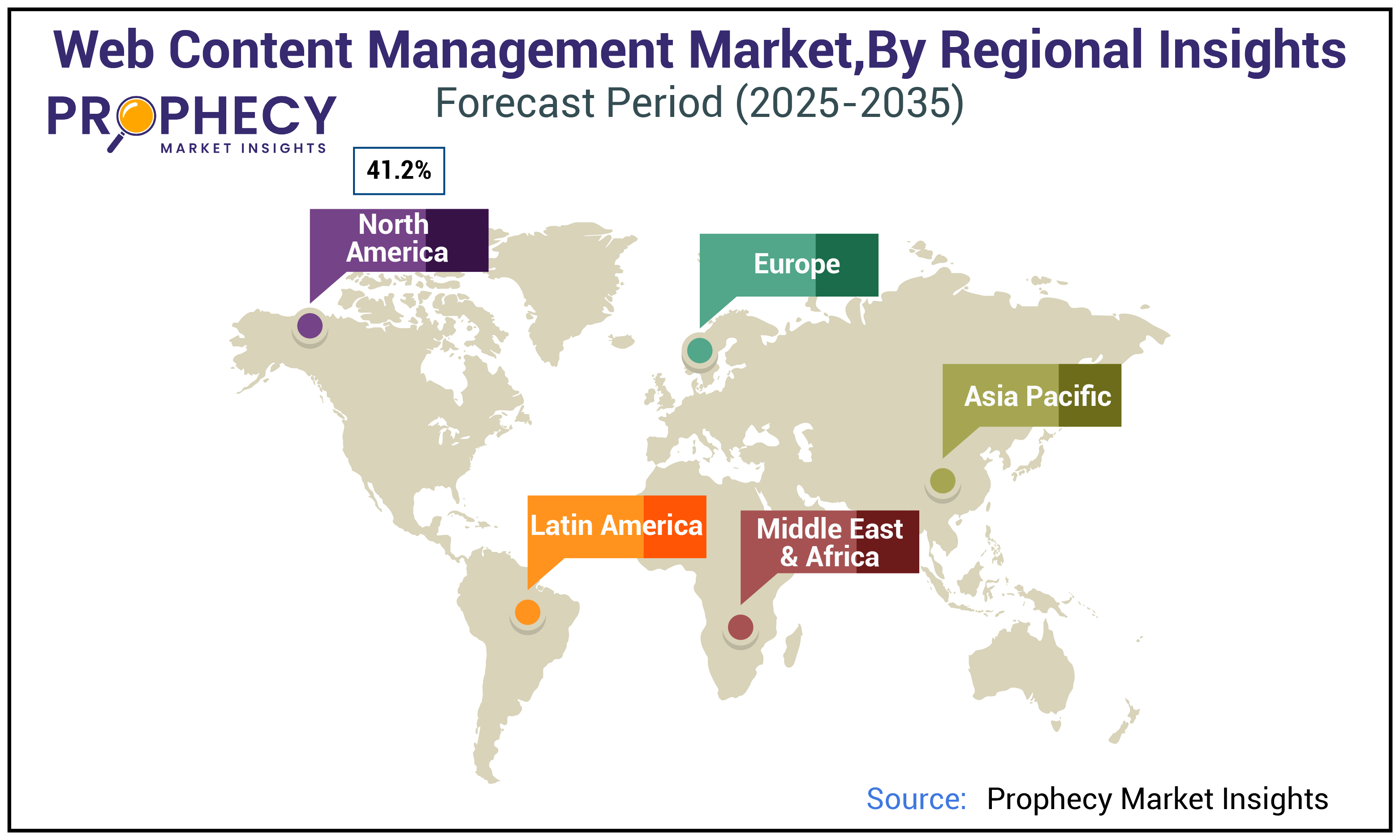
Geographically, the market is studied across North America, Europe, Asia Pacific, Latin America, and the Middle East & Africa.
North America: This is the region which is in charge of the web content management market, with an estimated share if approximately, 41.2%, in the recent years. This is due to a number of factors, such as, this region’s robust IT infrastructure, facilitating the development and deployment of advanced WCM solutions, active adopting WCM solutions, a strong presence in North America, offering a wide range of solutions and services, many North American businesses are undergoing digital transformation efforts, including upgrading its websites and digital platforms, and the heavy investment in AI and automation technologies.
- U.S. Web Content Management Market Insights:
The web content management market in the U.S. is the most influential market, in the recent years. This is due to this country’s robust software industry, which directly impacts the development and adoption of WCM technologies, high demand for web content management by various businesses, U.S. is at the forefront of adopting advanced technologies such as AI, ML, and cloud computing, and the adoption of digital-first approach, making WCM systems essential for managing and distributing content efficiently in a digital-first world.
Europe: This is the region which has the web content management market growing with the highest CAGR, during the forecast period, in the recent years. This is due to a confluence of factors, such as, this region’s increasing seeking ways to personalize content and engagement, leading to a higher demand for WCM solutions that can manage and deliver customized content across various channels, rise of social media platforms and its impact on purchasing decisions, growing emphasis on creating positive customer experiences, and the increasing digitization of businesses and the growing importance of digital content in marketing and customer engagement.
- Germany Web Content Management Market Insights:
The web content management market in Germany is growing with the fastest growth rate, during the forecast period, in the recent years. This is due to this country’s robust economy and a highly skilled workforce, particularly in the technology sector, its strict data privacy regulations, leading to a strong demand for content management software that complies with these regulations and ensures data security, increasing adoption of digital strategies, and the rising popularity of SMAC technology (Social, Mobile, Analytics, and Cloud).
Asia Pacific: This is the region which has the web content management market experiencing significant amount of growth, in the recent years, is Asia Pacific. This is due to a combination of factors, such as, this region’s rapid digital transformation, expanding IT infrastructure, and increasing demand for personalized content. Specifically, the region is experiencing high growth in emerging economies such as India and China, driven by factors such as the rising number of internet-connected users, the adoption of cloud technologies, and the increasing use of mobile devices.
- China Web Content Management Market Insights:
The web content management market in China is experiencing considerate amount of growth, in the recent years. This is due to this country’s significant digital transformation, increasing focus on maintaining a consistent brand image and experience across all online channels, the active promotion of digital infrastructure and innovation, and the expanding IT infrastructure in China supports the widespread adoption of web content management platforms and related services.
Web Content Management Market Report Scope:
|
Attribute |
Details |
|
Market Size 2025 |
USD 12.4 Billion |
|
Projected Market Size 2035 |
USD 58.9 Billion |
|
CAGR Growth Rate |
18.7% (2025-2035) |
|
Base year for estimation |
2024 |
|
Forecast period |
2025 – 2035 |
|
Market representation |
Revenue in USD Billion & CAGR from 2025 to 2035 |
|
Regional scope |
North America - U.S. and Canada Europe – Germany, U.K., France, Russia, Italy, Spain, Netherlands, and Rest of Europe Asia Pacific – China, India, Japan, Australia, Indonesia, Malaysia, South Korea, and Rest of Asia-Pacific Latin America - Brazil, Mexico, Argentina, and Rest of Latin America Middle East & Africa – GCC, Israel, South Africa, and Rest of Middle East & Africa |
|
Report coverage |
Revenue forecast, company share, competitive landscape, growth factors, and trends |
Segmentation:
By Component:
- Solutions/Platform
- Services
By Deployment Type:
- Cloud-Based
- On-Premises
- Hybrid
By Organization Size:
- Large Enterprises
- Small and Medium Enterprises
By Application:
- Content Creation & Lifecycle Management
- Personalized CX & Marketing Automation
- Multi-channel / Omnichannel Delivery
- Digital Asset Management (DAM)
- Analytics & Compliance Integration
- Others
By Vertical:
- BFSI
- IT and Telecom
- Retail
- Education
- Government
- Healthcare
- Media and Entertainment
- Travel and Hospitality
- Others
By Region:
- North America
- U.S.
- Canada
- Europe
- Germany
- U.K.
- France
- Russia
- Italy
- Spain
- Netherlands
- Rest of Europe
- Asia Pacific
- China
- India
- Japan
- Australia
- Indonesia
- Malaysia
- South Korea
- Rest of Asia Pacific
- Latin America
- Brazil
- Mexico
- Argentina
- Rest of Latin America
- Middle East & Africa
- GCC
- Israel
- South Africa
- Rest of Middle East & Africa
Global Web Content Management Market Competitive Landscape & Key Players
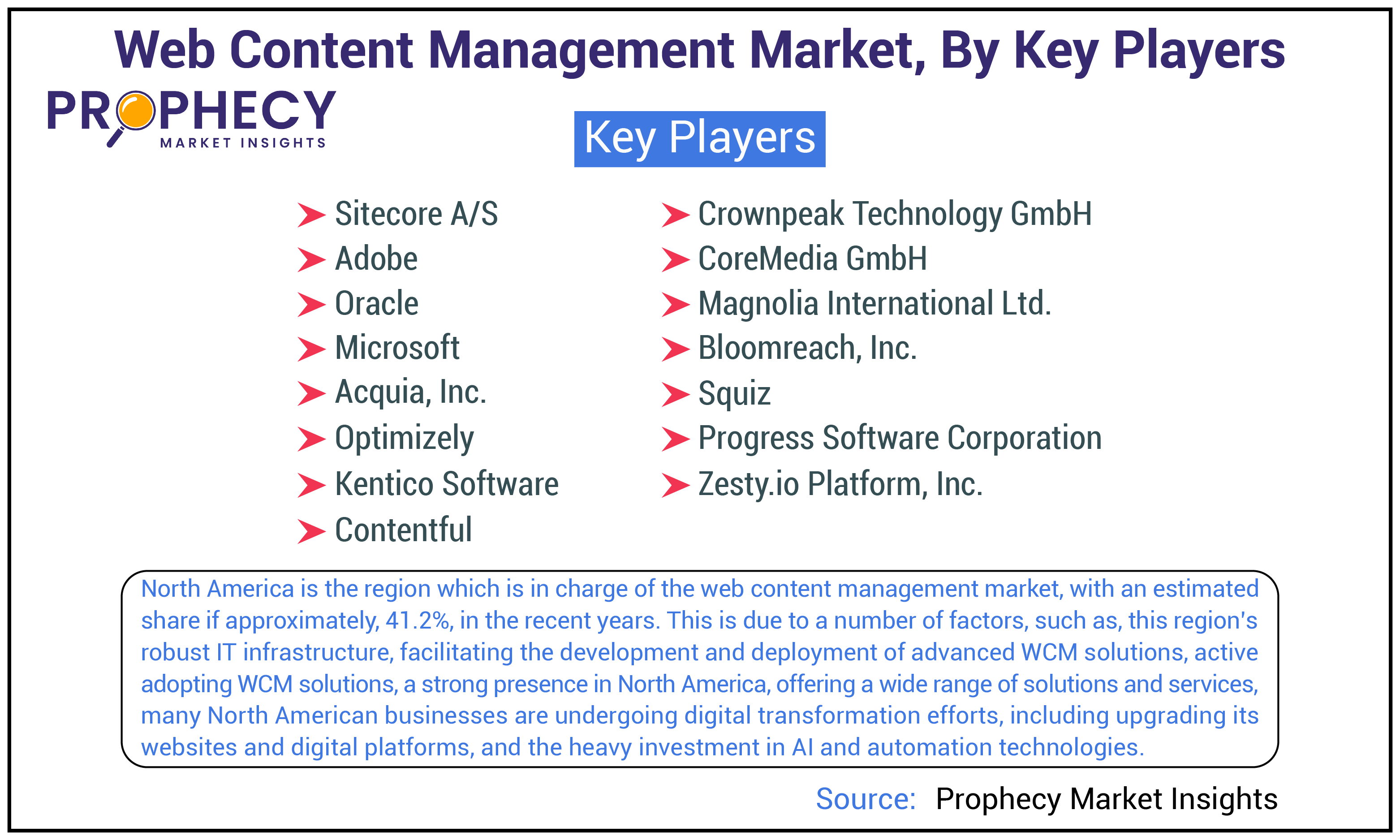
The companies operating in the market include, Sitecore A/S, Adobe, Oracle, and others. These key players are focusing on cloud-based offerings, integration of AI and automation, headless content management system architecture, strategic partnership and ecosystem expansion, mergers and acquisitions, focus on personalized and customer experience, and enhanced security and compliance, for driving web content management market growth.
Web Content Management Market Companies:
- Sitecore A/S
- Adobe
- Oracle
- Microsoft
- Acquia, Inc.
- Optimizely
- Kentico Software
- Contentful
- Crownpeak Technology GmbH
- CoreMedia GmbH
- Magnolia International Ltd.
- Bloomreach, Inc.
- Squiz
- Progress Software Corporation
- Zesty.io Platform, Inc.
View an Additional List of Companies in the Web Content Management Market
Global Web Content Management Market Recent News
- In January 2025, Drupal introduced Drupal CMS, a cutting-edge platform that enables content teams and marketers to produce outstanding digital experiences. In keeping with its dedication to open source principles, Drupal's goal to democratize enterprise-grade web development has reached a major milestone with its inaugural release. Built on Drupal's strong basis, Drupal CMS brought an easy-to-use, marketer-friendly interface that drastically reduced the learning curve, adoption barrier, and maintenance costs for Drupal websites.
- In October 2024, Adobe Content Authenticity, a new free online application, was unveiled by Adobe to assist artists in safeguarding and obtaining credit for the work using Content Credentials. Similar to a "nutrition label" for digital material, content credentials are safe metadata that anybody may affix to the work to provide personal details and give background information on the creation and editing process.
- In March 2023, The Answers Company, Yext, Inc., announced that its Knowledge Graph solution now includes Content Generation. The Knowledge Graph, according to Yext, is the only content management system available that actively and automatically creates its own material. With Yext's Spring 2023 Release, the firm will formally launch Content Generation in March after a year-long experiment with a number of clients.
Analyst View:
The web content management (WCM) market is expanding as a result of a number of important factors, such as the growing demand for efficiency and productivity, the growing use of multiple channels by businesses, the expectation of consumers for customized experiences, and the ability of WCM solutions to enable businesses to create and manage personalized content. Embracing digital transformation is another factor driving the market's growth. Automation technologies in content creation and management, such as AI-powered tools for personalization and optimization, are being adopted more frequently, and cloud-based WCM solutions are becoming more popular as these are scalable, flexible, and affordable, which makes it simpler for businesses to manage content regardless of size or location.
More Related Reports
High Content Screening Market
Web Conferencing Market
Web 3.0 Blockchain Market
Web to Print Software Market
Website Builders Market
Global Web Content Management Market Company Profile
|
Company Name |
Microsoft |
|
Headquarter |
Redmond, Washington, United States |
|
CEO |
Mr. Satya Nadella |
|
Employee Count (2024) |
228,000 Employees |
Global Web Content Management Market Highlights
FAQs
Web content management market size was valued at USD 12.4 Billion in 2025 and is expected to reach USD 58.9 Billion by 2035 growing at a CAGR of 18.7%.
Component, deployment type, organization size, application, vertical, and region are the segmentation for the target market.
North America, Asia Pacific, Europe, Latin America, and the Middle East & Africa. North America is expected to dominate the market.
The key players operating in the web content management market include Sitecore A/S, Adobe, Oracle, Crownpeak Technology GmbH, Microsoft, Acquia, Inc., Optimizely, Kentico Software, Contentful, CoreMedia GmbH, Magnolia International Ltd., Bloomreach, Inc., Squiz, Progress Software Corporation, and Zesty.io Platform, Inc.