Global Seaweed Extract Market Overview
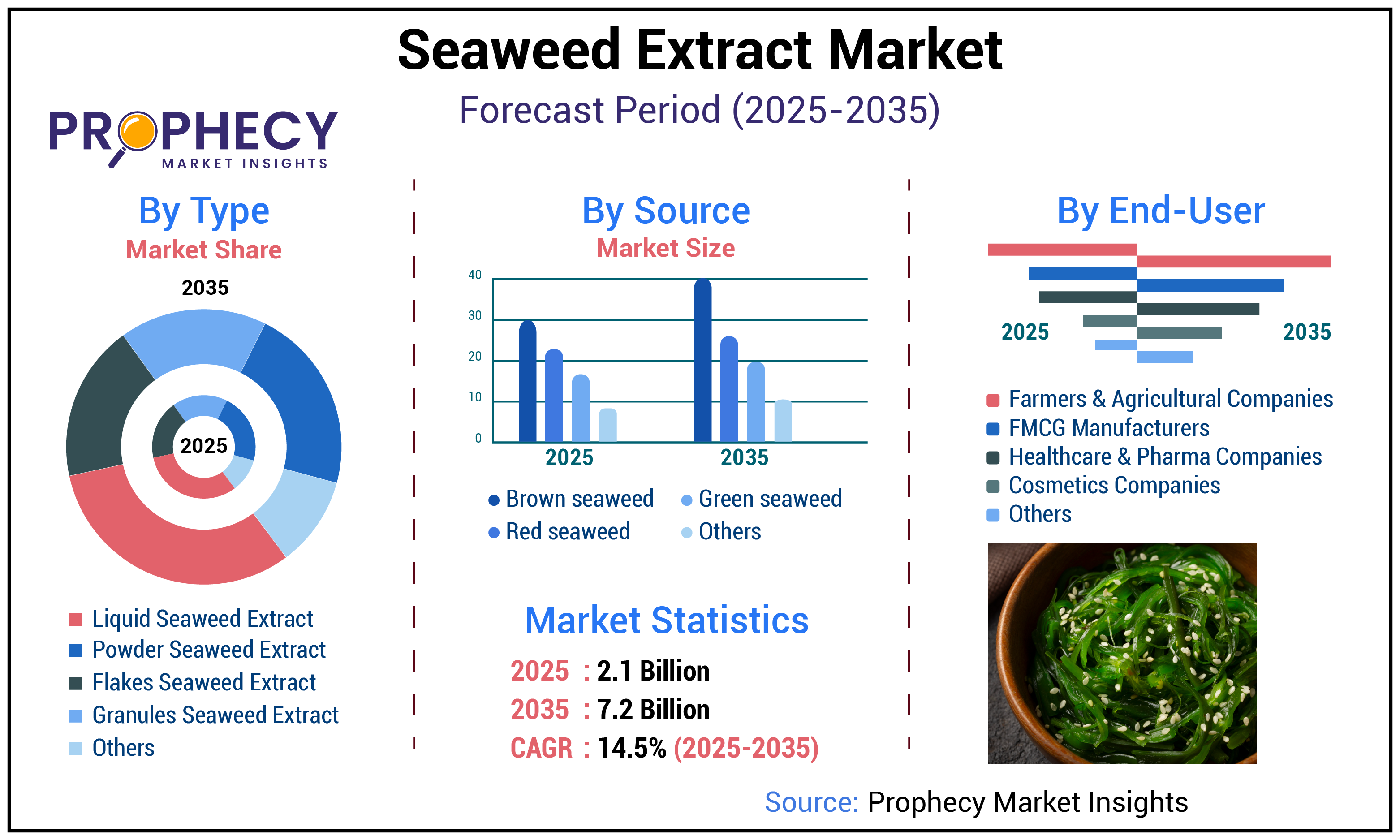
- By 2035, seaweed extract market size is contemplated to enlarge at a valuation of USD 7.2 Billion.
- In 2024, the seaweed extract market valuation was USD 1.4 Billion.
- Seaweed extract market is developing at a CAGR of 14.5%.
Seaweed extract is a natural marine algae-based substance that has found use in many industries, including agriculture, cosmetics, and food, due to an array of bioactive compounds. Seaweed extract includes nutrients and growth hormones that promote plant productivity, plant health by improving growth, and environmental benefits while being more eco-friendly means of plant enhancements as opposed to synthetic means of production use.
The seaweed extract market is experiencing growth, which is driven by increased demand for natural organic farming inputs, increased awareness of sustainable organic farming inputs, and the expanded use of the extract in cosmetics and food. The consumers are increasingly conscious of the negative environmental impact synthetic products have on their health and well-being while governments are increasingly supportive of eco-friendly practices and products. Seaweed extract has demonstrated the capabilities of many growth enhancing inputs hence this functional ingredient will continue to see individuals throughout multiple industries explore the use of this natural input that has very low environmental impact.
The future for this market is looking bright with contemporary innovation in extraction technologies expanding the use of seaweed extracts in pharmaceuticals, personal care, and nutraceuticals. The market is projected to see rapid global growth as the demand for natural ingredients increases and global environmental issues become more pressing.
Recession Risk & Tariff Analysis:
- The seaweed extract industry's market is subject to an indirect threat during potential economic declines since agribusiness, food, and cosmetics sectors may want to cut budgets as their product demand falls, directly impacting seaweed extract revenue, especially for non-essential products, and bearing costs of seaweed extract.
- Increases or extensions in tariff on imported seaweed, or on goods produced with seaweed extract can add to manufacturer's direct production. If trade restrictions take place between an exporting and importing country, or the FDA or CFIA raises new regulations, that could drastically change the available supply. Trade agreements or tariffs that maintain, or reduce, prices of goods and services using seaweed extract can be valuable to an opportunity for growing the seaweed extract market internationally and maintaining industry unit prices at parity to other extracts.
Impact of Generative AI on Seaweed Extract Market:
- Generative AI can accelerate advancements in innovation in the manufacture of new products concerning the seaweed extract market by leveraging the vast stores of data available to identify the best possible extraction methods and potential new products / formulations of seaweed extracts. Generative AI allows producers to better create improved, customized formulations that correspond to each of the market sectors (agriculture, cosmetics, food and beverages) while also improving performance and reducing time-to-market for new products.
- Frustrations can also be avoided by using Generative AI to allow users to create perfect demand forecasts by utilizing data from market trends, degraded climatic conditions, and consumer engagement behaviors. This will enable producers and other stakeholders within the supply chain for seaweed extracts to create demand-driven demand, reduce waste for production, and condition their production for the industry need, improving overall efficient operations and strategic decision making in the global market.
Global Seaweed Extract Market Drivers & Restraints
Key Drivers:
Rising Demand for Sustainable Agricultural Inputs is changing the dynamics of the market
The market for seaweed extract is growing due to increasing global attention on sustainable and organic cultivation. Seaweed-based bio-stimulants provide natural support for crop yield, soil health and plant resistance to environmental stressors and lessen the use of chemical fertilizers. Farmers' interest in seaweed extracts is being driven by growing consumer awareness and regulatory pressures for sustainable agricultural inputs.
As customers of agricultural inputs become more knowledgeable and consumers of products from these businesses demand more eco-friendly practices, farmers are searching for effective bio-stimulants and agriculture solutions with reduced ecological impacts. Seaweed as semi-refined products are highly innovative and functional as bio-stimulants have significance across multiple industries allowing for the increased acceptance and use worldwide.
- For instance, according to a European Bio-stimulants Industry Council (EBIC), bio-stimulants such as seaweed extracts represent an opportunity to increase yield by 5% - 10% and are becoming an increasingly accepted solution for sustainable farming that are gaining demand for organic or natural alternatives in international marketplace.
Restraints:
High Production and Processing Costs to repel market growth:
A major limitation in the seaweed extract market are the costs associated with harvesting, drying, and extraction of bioactive compounds. The costs associated with production are high due to the equipment, labor, and the quality of raw material which is often inconsistent. Meeting requirements for product consistency as brand owners and regulatory compliance add costs since suppliers usually must comply with multiple regulations in each of several geographic regions.
Thus, the production costs are high, for many producers, affordability of seaweed extracts by smallholder farmers, or producers or manufacturers is limited, and this presents an impediment for mass market uptake, particularly in developing economies that are geographically constrained into cost-sensitive practices.
- Counterbalance Statements: As costs remain high, on the other hand, advances in technology have sustained continuous development in extraction which, in combination with strong government support for sustainable agriculture, has allowed producers to reduce production costs contingent on the benefits developed through sustained extraction efforts. In the long-term, these developments will allow seaweed extracts to become more affordable which will increase new uptake in a wider variety of markets and contribute positively for lasting growth in the industry.
Opportunities & Trends:
Expansion in Functional Foods and Natural Cosmetics is a growing opportunity
- An emerging opportunity in the seaweed extract market is the growing market for functional foods and cosmetics. Seaweed extracts abound in vitamins, minerals, and antioxidants. Seaweed extracts are used in food supplements, skin care products, and hair products. The market trend associated with these developments can be traced to a consumer preference for clean-label ingredients, plant-based products, and nutrient-rich formulations. The increase in awareness surrounding wellness and sustainability at a global level has many companies' reporting an increase in investment in R&D and new product development to develop seaweed-sourced products for increasingly health, and environmentally conscious, consumers.
Global Seaweed Extract Market Segmentations & Regional Insights
Type, source, end-user and region are the divisions of the seaweed extract market.
By Type:
Based on the type, the seaweed extract market is divided into liquid seaweed extract, powder seaweed extract, flakes seaweed extract, and granules seaweed extract. Liquid seaweed extract dominates the seaweed extract market share as farmers and horticulturists can quickly apply liquid seaweed extracts as foliar sprays, or soil drenches, and plants quickly absorb and utilize the high efficacy of seaweed extracts by promoting plant growth and faster uptake of nutrients. Liquid seaweed extract is, therefore, the preferred choice among farmers and horticulturists on a worldwide scale.
Powder seaweed extract ranks second due to its extended shelf life, ease of storage, and ability to transport powder more easily. While powder seaweed extract is also used in agriculture, it is primarily used in cosmetics products since users can reconstitute the free-flowing powder into a liquid format as needed and apply the diluted solution. Another reason why commercial users and exporters prefer powder is that it is more concentrated and stable.
By Source:
Based on source, the market is segmented into brown seaweed, red seaweed, and green seaweed. Brown seaweed has the largest seaweed extract market share as it is abundant in alginates, fucoidan, and mannitol for agricultural, cosmetics and food applications. Species such as Ascophyllum nodosum can provide excellent bio-stimulant properties and are grown in large numbers, making it easy to acquire in both developed and developing markets.
Second, red seaweed ranks next in being the product of choice as a result of its high content of carrageenan, and agar, two ingredients that are widely utilized in food thickeners and stabilizers, as well as for use in pharmaceuticals. Carrageenan and agar have considerable commercial value and an increasing presence in plant-based and vegan products, helping advance its market share across global regions.
By End-User:
Farmers & agricultural companies, fmcg manufacturers, healthcare & pharma companies, cosmetics companies, others are end-user of the seaweed extract market. The farmers and agriculture companies are the largest end-user segment in the seaweed extract market share, owing to a growing need for organic and sustainable solutions to farming. The extracts are all-natural bio-stimulants that improve plant growth, enhancing yield and stress tolerance. They are clearly environmentally associated with reducing chemical fertilizers across the crop production cycle, an international objective.
FMCG Manufacturers is the next largest segment, due to the increasing worldwide popularity of seaweed ingredients derived primarily from the hydrocolloids (carrageenan and alginate) acting as natural thickeners, emulsifiers and stabilizers in products. There is a clear consumer preference for plant-based, "clean label" products driving the development of their dietary needs from seaweed in functional foods, dairy alternatives and all processed food products.
Regional Insights:
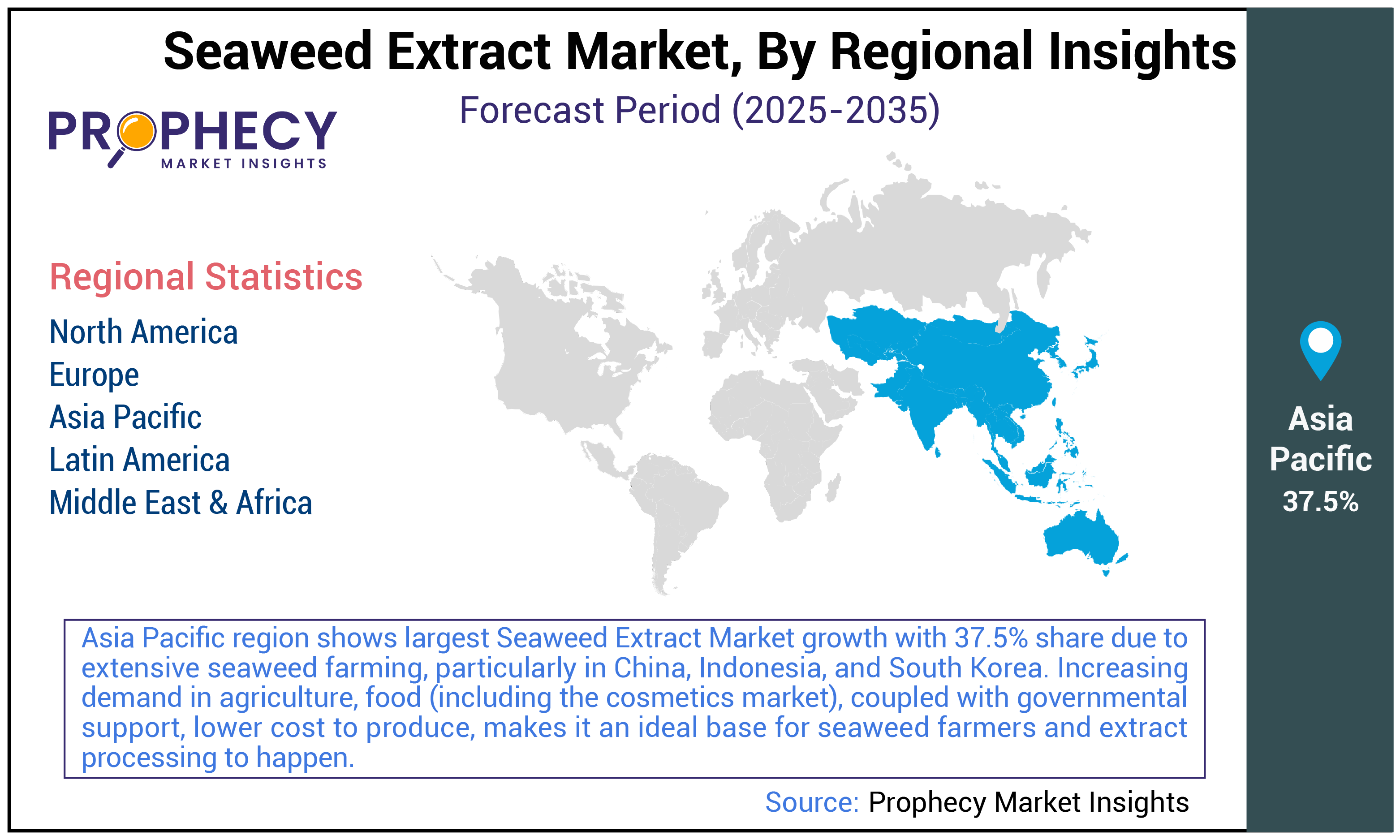
Geographically, the seaweed extract market is studied across North America, Europe, Asia Pacific, Latin America, and the Middle East & Africa.
Asia Pacific: This region shows largest seaweed extract market growth with 37.5% share due to extensive seaweed farming, particularly in China, Indonesia, and South Korea. Increasing demand in agriculture, food (including the cosmetics market), coupled with governmental support, lower cost to produce, makes it an ideal base for seaweed farmers and extract processing to happen.
- China Seaweed Extract Market Insights:
China is the largest market for seaweed extracts in the Asia Pacific region since it has the largest seaweed cultivation and processing capabilities. China is the top producer of both brown and red seaweeds, the main raw materials used for food, and cosmetics. With strong government backing and production geared toward exports, China is firmly established in the seaweed industry.
Europe: This region is second, with the right, strict regulation making it conducive to sustainable agriculture and natural ingredients. The region has a strong demand for organic bio-stimulants, as well as clean-label food and cosmetic products. Particular countries such as France and Norway are investing in the research and innovation spaces, which will support the development across multiple application areas.
- France Seaweed Extract Market Insights:
France is at the forefront of the market on seaweed extracts in Europe. France's advanced marine biotechnology capabilities and market focus on sustainable agriculture continue to allow for strong molecular validation and establishing high-quality extracts for use in cosmetics, food, and farming applications. French companies are heavily investing in high-quality research and an expectation of high-value product commercialization within any sector.
North America: This region ranks third, led by rising demand for organic farming and plant-based food. Notably, seaweed extracts are being increasingly incorporated in agricultural products in the U.S. and Canada, as well as nutraceuticals. However, with very little local seaweed production, there is some reliance on imports, which could be limiting further and more rapid market development.
- U.S. Seaweed Extract Market Insights:
U.S. is at the forefront of the market on seaweed extracts due to advanced marine biotechnology capabilities and market focus on sustainable agriculture continue to allow for strong molecular validation and establishing high-quality extracts for use in cosmetics, food, and farming applications.
Seaweed Extract Market Report Scope:
|
Attribute |
Details |
|
Market Size 2025 |
USD 2.1 Billion |
|
Projected Market Size 2035 |
USD 7.2 Billion |
|
CAGR Growth Rate |
14.5% (2025-2035) |
|
Base year for estimation |
2024 |
|
Forecast period |
2025 – 2035 |
|
Market representation |
Revenue in USD Billion & CAGR from 2025 to 2035 |
|
Regional scope |
North America - U.S. and Canada Europe – Germany, U.K., France, Russia, Italy, Spain, Netherlands, and Rest of Europe Asia Pacific – China, India, Japan, Australia, Indonesia, Malaysia, South Korea, and Rest of Asia-Pacific Latin America - Brazil, Mexico, Argentina, and Rest of Latin America Middle East & Africa – GCC, Israel, South Africa, and Rest of Middle East & Africa |
|
Report coverage |
Revenue forecast, company share, competitive landscape, growth factors, and trends |
Segmentation:
By Type:
- Liquid Seaweed Extract
- Powder Seaweed Extract
- Flakes Seaweed Extract
- Granules Seaweed Extract
By Source:
- Brown Seaweed
- Red Seaweed
- Green Seaweed
By End-User:
- Farmers & Agricultural Companies
- FMCG Manufacturers
- Healthcare & Pharma Companies
- Cosmetics Companies
- Others
By Region:
- North America
- U.S.
- Canada
- Europe
- Germany
- U.K.
- France
- Russia
- Italy
- Spain
- Netherlands
- Rest of Europe
- Asia Pacific
- China
- India
- Japan
- Australia
- Indonesia
- Malaysia
- South Korea
- Rest of Asia Pacific
- Latin America
- Brazil
- Mexico
- Argentina
- Rest of Latin America
- Middle East & Africa
- GCC
- Israel
- South Africa
- Rest of Middle East & Africa
Global Seaweed Extract Market Competitive Landscape & Key Players
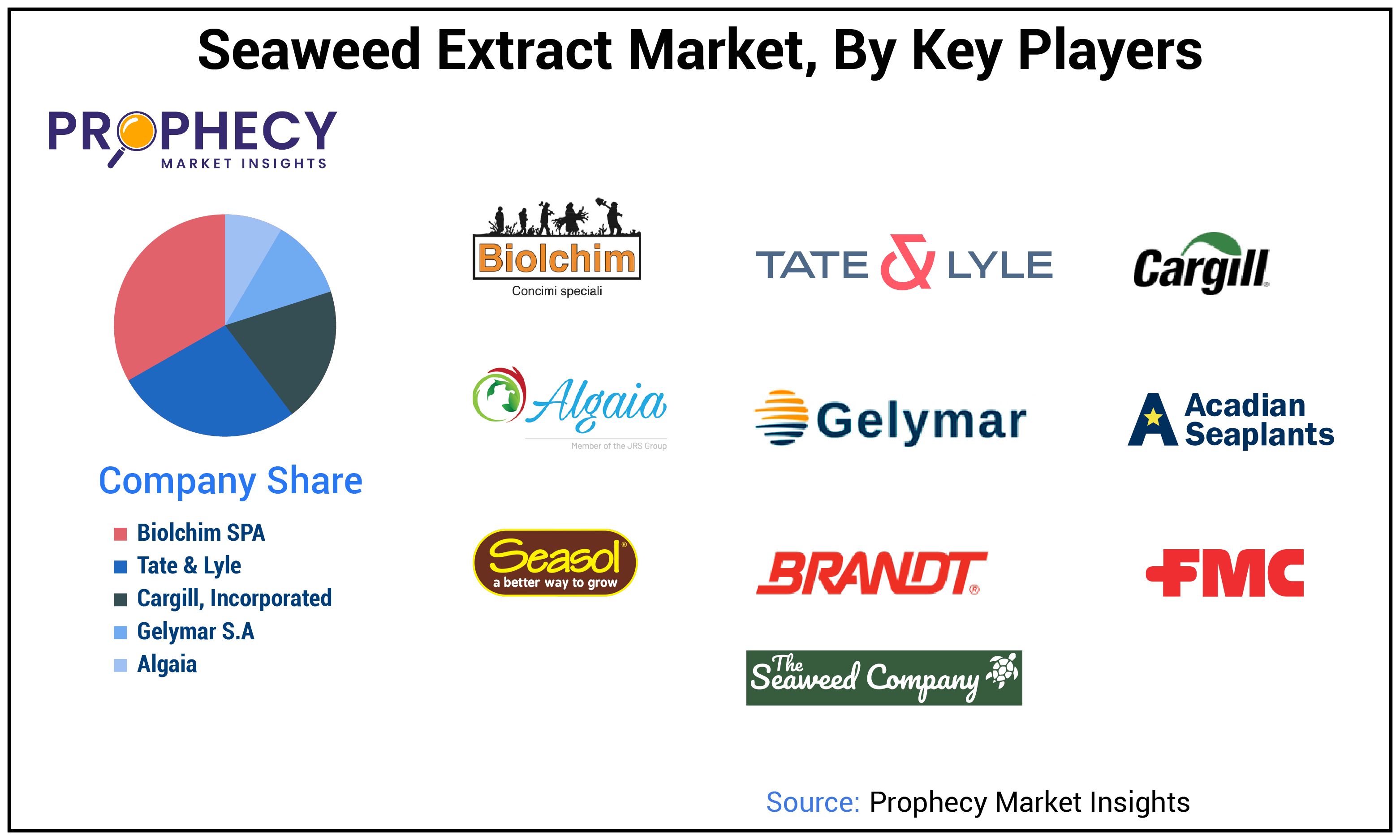
The prominent players operating in the market include, Biolchim SPA, Tate & Lyle, Cargill, Incorporated, Gelymar S.A, Algaia, Acadian Seaplants Limited, Seasol, BRANDT, and others. Key companies in the moderately fragmented seaweed extract market compete on the basis of sustainability, product quality, and innovation. Companies focus on expanding their global footprint through joint ventures and research development spending. New competitors are concentrating on niche applications such as organic farming for market penetration and differentiation, while established players are operating with advanced technology and wide distribution.
Seaweed Extract Market Companies:
- Biolchim SPA
- Tate & Lyle
- Cargill, Incorporated
- Gelymar S.A
- Algaia
- Acadian Seaplants Limited
- Seasol
- BRANDT
- FMC Corporation
- Lallemand Inc.
- Indigrow Ltd
- The Seaweed Company
- Kelpak
- OCEAN HARVEST TECHNOLOGY Group plc
- Ceamsa
View an Additional List of Companies in the Seaweed Extract Market
Global Seaweed Extract Market Recent News
- In June 2025, Acadian Seaplants reaffirmed its commitment to the United Nations Global Compact by submitting its 2025 Communication on Progress, highlighting sustainability and accountability in seaweed sourcing.
- In April 2025, Bayer officially launched its first high-activity seaweed bio-stimulant product, An Hai Long, at the Bayer Innovation Hub in Danyang, Jiangsu, China. This bio-stimulant is new and designed to mitigate many agricultural planting challenges, such as soil degradation, barriers to nutrient absorption, and extreme climates.
Analyst View:
The growth of the market for seaweed extracts is driven by audiences seeking sustainable inputs to agriculture, functional foods and natural cosmetics. The main drivers for change are the conversion to organic products, clean label products and advances in extraction technologies. The chance for seaweed extracts is to expand beyond agriculture and into the pharmaceutical, nutraceutical and personal care markets.
The challenges existing in the market are expensive production methods, the variability of raw material quality and regulatory barriers. However, with more and more realization of the advantages of utilizing green solutions combined with increasing support from governments, the seaweed extracts market will continue to realize greater investment and innovation through support of the manufacture, supply, and distribution of seaweed extracts.
More Related Reports
Ginseng Extract Market
Yeast Extract Market
Cannabis Extract Market
Seaweed Farming Market
Seaweed Protein Market
Global Seaweed Extract Market Company Profile
|
Company Name |
Cargill, Incorporated |
|
Headquarter |
Minnesota, U.S. |
|
CEO |
Brian Sikes |
|
Employee Count |
160,000 Employees |
Global Seaweed Extract Market Highlights
FAQs
Seaweed extract market size was valued at USD 2.1 Billion in 2025 and is expected to reach USD 7.2 Billion by 2035 growing at a CAGR of 14.5%.
Type, source, application, and region are the segmentation for the seaweed extract market.
North America, Asia Pacific, Europe, Latin America, and the Middle East & Africa. Asia Pacific is expected to dominate the market.
The prominent players operating in the market include, Biolchim SPA, Tate & Lyle, Cargill, Incorporated, Gelymar S.A, Algaia, Acadian Seaplants Limited, Seasol, BRANDT, FMC Corporation, Lallemand Inc., Indigrow Ltd, The Seaweed Company, Kelpak, OCEAN HARVEST TECHNOLOGY Group plc, and Ceamsa.