Global Seasonal Candy Market By Overview
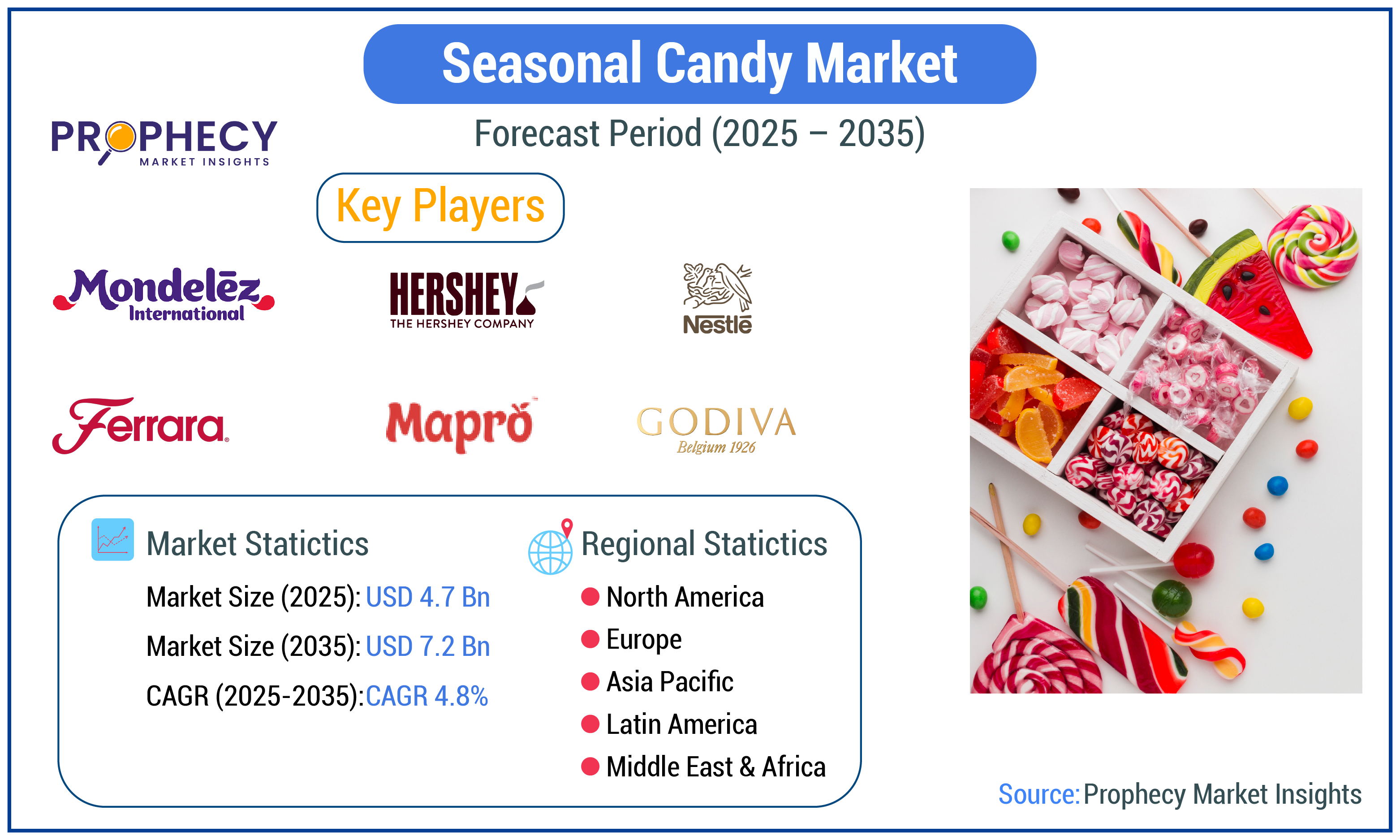
- By 2035, the seasonal candy market size is contemplated to enlarge at a valuation of USD 7.2 Billion.
- In 2024, the seasonal candy market valuation was USD 4.5 Billion.
- Seasonal candy market is developing at a CAGR of 4.8%.
Sweets and confections that are specially made, promoted, and sold during certain festivals or festive seasons such as Halloween, Christmas, Easter, Diwali, or Valentine's Day are referred to as seasonal candy. These candies frequently include occasion-related themed forms, colors, packaging, and flavors. More benefits of seasonal candies are Increased festive appeal, gift and sharing value, boosts brand sales, market innovation and creates consumer nostalgia. It builds the emotional connection through tradition and seasonal anticipation.
Key driving factors of seasonal candies are festive celebrations and cultural tradition, rising disposable income, marketing, and limited-time offers, gift-giving culture, product innovation, retail and E-commerce expansion, and emotional and nostalgic appeal. Seasonal occasions offer a powerful emotional and social backdrop that motivates customers to actively interact with themed goods, particularly candies that capture the essence of the occasion.
The Future of seasonal candy is poised for exciting transformation, driven by evolving consumer preferences, health awareness, and sustainability trends. As people become more health-conscious, there is growing demand for sugar-free, low-sugar, and vegan seasonal candies that acter to dietary needs without compromising on taste. Eco-friendly packaging is also becoming a priority, with biodegradable and recyclable materials replacing traditional plastics. Additionally, the rise of premium and artisanal products is reshaping the market, as consumers seek high-quality, limited-edition treats with unique.
Recession Risk & Tariff Analysis:
- The seasonal candy market faces moderate recession risk as consumers cut back on non-essential spending during downturns. Premium or decorative holiday treats may see reduced demand, with shoppers opting for smaller quantities or budget-friendly brands. However, seasonal candy remains relatively stable due to its emotional value and role in traditions. Affordable and nostalgic options tend to perform better, offering comfort at lower costs.
- The seasonal candy products market can be greatly impacted by tariffs since they raise the price of imported materials such as sugar, chocolate, and unique packaging. Manufacturer profit margins may be lowered or retail prices may rise a result of these additional expenses. Seasonal sweets are particularly at risk since they frequently use imported ingredients to create limited-edition goods. In reaction, businesses may change product formulations, use locally obtained components, or lessen seasonal variation to keep costs down and maintain market competitiveness.
Impact of Generative AI on Seasonal Candy Market:
- Growing impact on the seasonal candy market by enhancing innovation, personalization, and operational efficiency. It enables brands to develop new flavors, festive packaging designs, and limited-edition concepts by analyzing consumer preferences and market trends.
- In marketing, AI allows for hyper-personalized campaigns tailored to specific holidays and target audiences, increasing engagement and emotional connection. It also improves demand forecasting by analyzing historical data and shopping behavior, helping companies reduce waste and optimize inventory.
Global Seasonal Candy Market By Drivers & Restraints
Key Drivers:
Aggressive Marketing and Themed Packaging can Drive the Seasonal Candy Market
Aggressive marketing and themed packaging play an important role in attracting the consumer's attention and affecting the impulse procurement during the festive season. The brands invested heavy in the eye-catching displays, limited-edition designs and emotional messages that resonate with a holiday feeling. This approach creates a sense of urgency, apathy, and uniqueness - to buy consumers before the weather ends. Themed packaging also helps to stand on crowded shelves, increase visibility and remember. E-Commerce feature increase in expansion of online retail platforms. This growth is given more fuel by Covid-19 epidemic, which intensified changes towards online shopping for various products including candy. Manufacturers adopt their digital appearance and offer direct-consumer options, including promotion and personal candy selection.
- For instance, According to SellersCommerce, there are 2.77 billion global online shoppers. In 2025, 21% of retail purchases are expected to take place online, and this share will rise to 22.6% by 2027. Ecommerce sales will surpass USD 6.8 trillion in 2025. There are over 28 million eCommerce stores globally. 52% of online shoppers look for products internationally. 34% of shoppers shop online at least once a week. 99% of customers look for reviews when they shop online.
Restraints:
Economic Sensitivity Concern Could Affect Market Development
Economic sensitivity describes how shifts in the economy, such as inflation or recessions, can have a detrimental effect on how much money consumers spend on seasonal candies. Customers may make budget cuts during lean financial times because these items are regarded as non-essential and are frequently bought for special occasions. Due to families prioritizing necessities over holiday pleasures, premium or novelty candy sales may suffer.
- Counterbalance Statements: Despite economic restraints, the seasonal candy market often shows resilience due to its emotional and cultural significance. Even in times of financial stress, consumers tend to make small indulgent purchases to maintain holiday traditions and bring joy to celebrations. Affordable price points and nostalgic appeal make seasonal candy a low-cost luxury that many are still willing to buy, helping sustain demand.
Opportunities & Trends:
Innovation and Novel Flavors can Drive Growth of the Seasonal Candy Market in Future
Innovation and Novel Flavors have strong future opportunities in the seasonal candy market because today’s consumers especially younger generations Gen Z and Millennials actively seek new, exciting, and shareable experiences. Seasonal candies with unique flavors tap into this desire for discovery and personalization, making them ideal for social media buzz and limited-time promotions. Additionally, as global tastes influence local markets, there's growing openness to international flavors and fusion trends.
Global Seasonal Candy Market By Segmentations & Regional Insights
Product, consumer demographics, occasion, packaging type, price range, ingredients preferences, distribution channels, and region are the divisions of the seasonal candy market.
By Product:
Based on product type, the market is divided into chocolate-based candies, gummy based candies, hard candies, caramel candies, and others. Chocolate Candies are the most dominant product type in the seasonal candy market share. Chocolate candies are most popular and enduring confectionery candy, loved across all age groups. Chocolate candies include various types of candies such as Milk Chocolate, Dark Chocolate, White Chocolate, and others.
Gummy candies are second most dominating in seasonal candy market size. Gummy candies are major subcategory of sugar candies, these are made from gelatin and plant-based alternatives, sugar, and others. These candies are known for their chewing texture, fun shapes, and bright colors. In market various types of Gummy candies are available such as Classic gummies, Vegan Gummies, Fruit Snacks Gummies, Sour Gummies, Filled or Center-Filled Gummies and others.
By Consumer Demographics:
Based on consumer demographic, the market is divided into children and teenagers, adults, and senior. Children and teenagers age are one of the most dominating in seasonal candy market share. The fun shapes, bright colors and flavors and their chewy texture are highly attracting the children’s palates. Ads, packaging, and characters are often directly targeting the children’s attention and influencing their preferences and brand loyalty.
The second dominating group is young adults. Their interest in growing due to their childhood Nostalgia. Some of this takes as supplement basis such as vitamins and CBD. Nowadays peoples are concern about their health that’s why people choose the vegan or plant-based candies.
By Occasion:
Based on occasions, the market is divided into holiday-specific, birthday parties, weddings, packaging type, and others. Halloween is the one of the most dominating occasions in seasonal candy market size. In the period of Halloween massive candy consumption is driven by traditions such as trick-treating, parties, and festive celebration, leading to a significant surge in demand for a wide variety of candies. All age group peoples are widely consuming the various types of candies. Due to high consumption retailers are stock large seasonal candies.
The Christmas is the second most dominating in seasonal candy market size. During Christmas the candies consumption is spikes due to gifting tradition, festive treats, holiday parties, and for the decorative purposes.
By Packaging type:
Based on packaging type, the market is divided into individual packs, multi-pack or assorted packs, and others. The one of the most dominating packaging types in the seasonal candy market share is pouches and bags. These are cheaper to produce and transport. Easy to print and festive graphics according to seasonal themes. Reduces shipping costs and shelf space.
The second most dominating packaging type is gift boxes in seasonal candy market. Gift Boxes are a popular and growing packaging type in the seasonal candy market, especially for the premium festive, and occasion-based purchases. Gift Boxes has attractive presentation such as it designed with ribbons, or custom prints, and festive themes. Gift Boxes are available in various shapes, sizes, and designs.
By Price range:
Based on price range, the market is divided premium/artisanal candies, mid-range pack candies. The most dominating price range is low to mid-range in seasonal candy market share. Affordable for most consumers who are purchases during holidays such as Halloween, Christmas, or Diwali. Fits well within budgets for party, gifting, and sharing.
The second most dominating price range in the seasonal candy market is the premium range. This range is driven by the growing demand for high quality, artisanal, and gift- worthy confections. Consumers are increasingly willing to spend more on unique, ethically sourced, or luxury treats packaged in attractive gift boxes or festive hampers.
By Ingredients Preferences:
Based on ingredients preferences, the market is divided organic candies, vegan candies, gluten-free candies, sugar-free candies, halal/cosher candies. Sugar-free Candies are one of the most dominating in ingredients preferences in seasonal candy market share. These candies are more popular among diabetics, health-conscious peoples. Growing concern about sugar intake, obesity, and dental health it drives the strong demand in market.
The second dominating ingredient preference is vegan candies in seasonal candy market size. Vegan Candies are Fastly gaining ground due to the plant-based movement, with more seasonal products now made gelatin-free, dairy-free, and cruelty-free.
By Distribution channels:
Based on distribution channels, the market is divided supermarkets and hypermarkets, convenience stores, online retailers, wholesale/bulk retailers. Supermarkets and hypermarkets are one of the most dominating in seasonal candy market share. These sizable retail establishments are perfect for advertising and selling seasonal sweets since they draw plenty of foot traffic, particularly during festive times. With their extensive product selections, themed displays, and bulk packaging choices, they serve a wide range of customers seeking convenience and diversity.
Convenience stores are the second most important distribution channel in the market for seasonal candies. These stores are crucial in encouraging impulsive purchases, particularly during the busiest holiday seasons when people are searching for easy-to-get-to treats. Convenience stores are perfect for last-minute candy purchases for occasions such as Halloween, Easter, and Valentine's Day since they are frequently positioned in advantageous locations in neighbourhoods, close to schools, and on highways. Popular seasonal items that are convenient for on-the-go consumption, party favours, or impromptu gifting are usually kept in compact packets.
Regional Insights:
Geographically, the seasonal candy market is studied across North America, Europe, Asia Pacific, Latin America, and the Middle East & Africa.
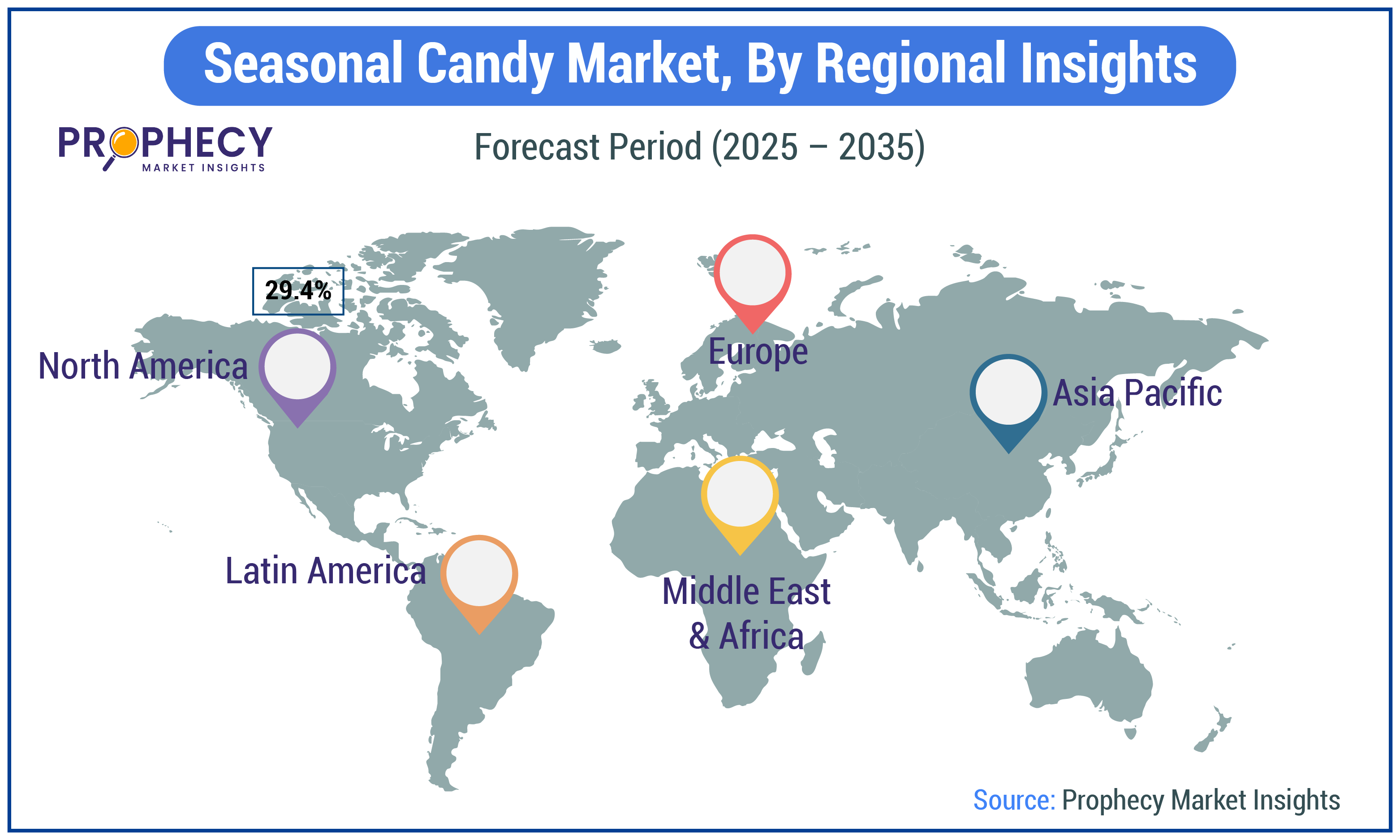
North America: Due to its robust manufacturing base in the candies production, candies have high demand during the festive season, candies are highly influenced by major holidays, festivals, parties, Weddings, and others. Health-conscious costumer demands the sugar-free candies.
- U.S. Seasonal Candy Market Insights:
In North America, the U.S. dominates the seasonal candy market, accounting for approximately 83% of the regional market share. U.S is the largest market for seasonal candy market. The south and Midwest regions of the US show the highest candy consumption, due to traditional events and strong brand loyalty.
Asia Pacific: The second-largest and fastest-growing region is Asia-Pacific, driven the growth due to increasing Western holiday celebrations such as Halloween, Christmas, and Valentine’s Day this may leads to increased demand for seasonal candies.
- China Seasonal Candy Market Insights:
China dominates the Asia-Pacific market on account of its enormous industrial base, fast urbanization, government backing for the expansion of production, and rising demand for seasonal candies and various types of seasonal candies such as chocolate candy, gummy candy, sugar-free candy, and others.
Europe: This region stands as a formidable force in the global seasonal candy market share, accounting for around 30% of total regional sales and ranking second behind North America Its strong performance is fuelled by deeply embedded holiday traditions—particularly Christmas, Easter, and Halloween which consistently drive market peaks through culturally rooted confectionery consumption. European consumers increasingly demand premium, artisanal, and health-conscious candies.
- Germany Seasonal Candy Market Insights:
Germany’s seasonal candy sector thrives on its deeply rooted festive traditions, strong manufacturing base, and sophisticated retail landscape. While chocolate remains a mainstay, sugar confectioneries especially gummies continue to grow, accounting for a notable share of seasonal launches. Future growth will be propelled by health and sustainability trends, premiumization, and digital channels.
Seasonal Candy Market Report Scope:
|
Attribute |
Details |
|
Market Size 2025 |
USD 4.7 Billion |
|
Projected Market Size 2035 |
USD 7.2 Billion |
|
CAGR Growth Rate |
4.8 % (2025-2035) |
|
Base year for estimation |
2024 |
|
Forecast period |
2025 – 2035 |
|
Market representation |
Revenue in USD Billion & CAGR from 2025 to 2035 |
|
Regional scope |
North America - U.S. and Canada Europe – Germany, U.K., France, Russia, Italy, Spain, Netherlands, and Rest of Europe Asia Pacific – China, India, Japan, Australia, Indonesia, Malaysia, South Korea, and Rest of Asia-Pacific Latin America - Brazil, Mexico, Argentina, and Rest of Latin America Middle East & Africa – GCC, Israel, South Africa, and Rest of Middle East & Africa |
|
Report coverage |
Revenue forecast, company share, competitive landscape, growth factors, and trends |
Segmentation:
By Product:
- Chocolate Candies
- Gummy Candies
- Hard Candies
- Caramel Candies
- Others
By Consumer demographics:
- Children Teenagers
- Adults
- Senior
- Others
By Occasion:
- Holidays (Christmas, Easter, Halloween)
- Birthdays
- Weddings
- Others
By Packaging type:
- Individual packs
- Multi-pack or assorted packs
- Others
By Price range:
- Premium/Artisanal Candies
- Mid-range pack Candies
- Others
By Ingredients preference:
- Organic candies
- Vegan candies
- Gluten-free candies
- Sugar-free candies
- Halal/Cosher candies
- Others
By Distribution Channels:
- Supermarkets
- Convenience stores
- Online retailers
- Wholesale/ Bulk retailers
By Region:
- North America
- U.S.
- Canada
- Europe
- Germany
- U.K.
- France
- Russia
- Italy
- Spain
- Netherlands
- Rest of Europe
- Asia Pacific
- China
- India
- Japan
- Australia
- Indonesia
- Malaysia
- South Korea
- Rest of Asia Pacific
- Latin America
- Brazil
- Mexico
- Argentina
- Rest of Latin America
- Middle East & Africa
- GCC
- Israel
- South Africa
- Rest of Middle East & Africa
Global Seasonal Candy Market By Competitive Landscape & Key Players
The seasonal candy market is shaped by the major confectionery giants who take advantage of taste innovation, targeted packaging, and multi-block offerings. Premium and artisan players catch top consumers, while the tendency of health and stability runs the product improvement. The success rests on raw-contemporary instability, developing consumer preferences and in response to weather-powered impulses through strategic marketing and limited time launch.
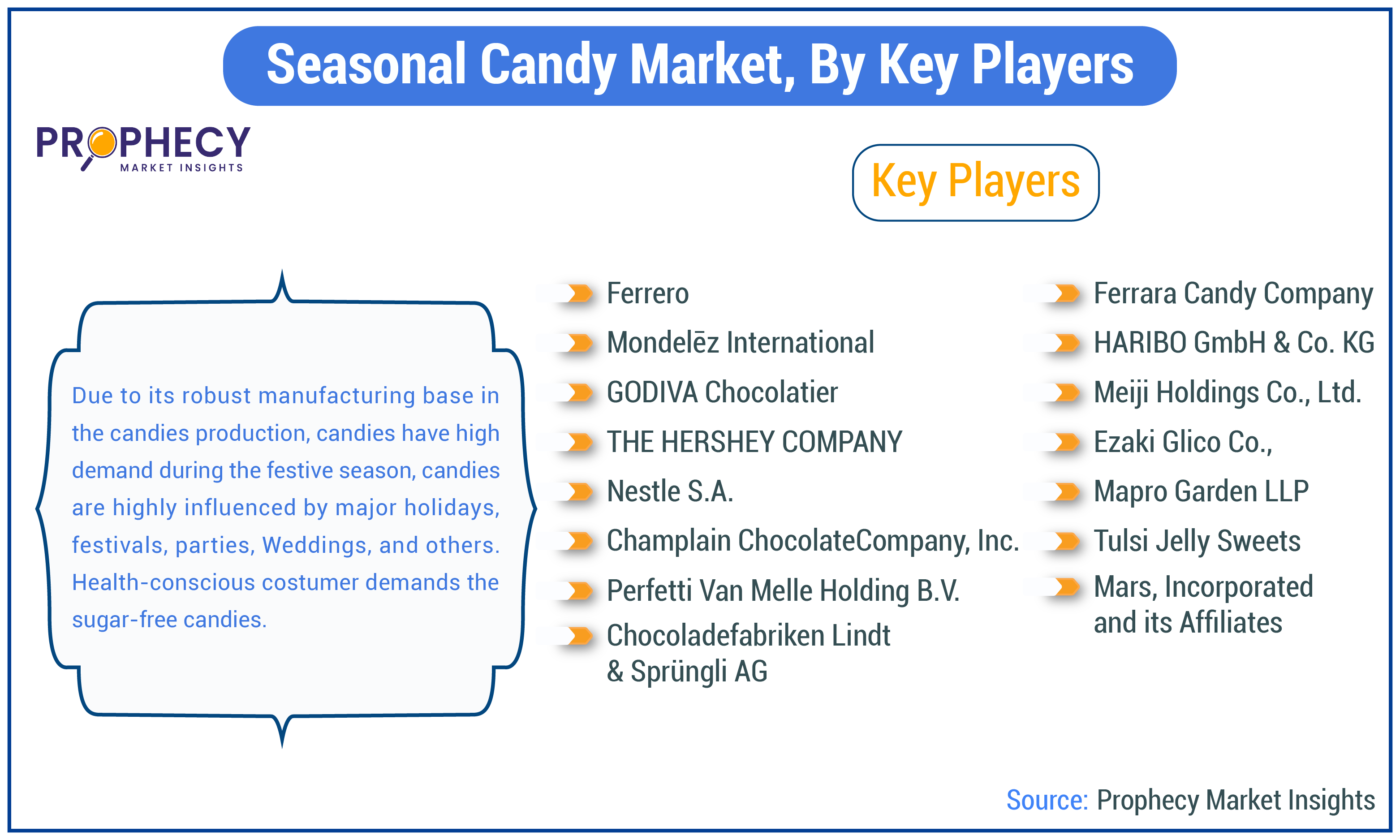
The key players operating in the seasonal candy market include, Chocoladefabriken Lindt & Sprüngli AG, Ferrero, GODIVA Chocolatier, THE HERSHEY COMPANY, and others.
Seasonal Candy Market Companies:
- Chocoladefabriken Lindt & Sprüngli AG
- Ferrero
- Mars, Incorporated and its Affiliates
- Mondel?z International
- GODIVA Chocolatier
- THE HERSHEY COMPANY
- Nestle S.A.
- Champlain ChocolateCompany, Inc.
- Ferrara Candy Company
- Perfetti Van Melle Holding B.V.
- HARIBO GmbH & Co. KG
- Meiji Holdings Co., Ltd.
- Ezaki Glico Co.,
- Mapro Garden LLP
- Tulsi Jelly Sweets
View an Additional List of Companies in the Seasonal Candy Market
Global Seasonal Candy Market By Recent News
- In February 2025, Gummi candy brand Haribo was introduced a new line-up of seasonal products aimed at capturing consumer attention during the Easter holiday. The company aims to provide innovative alternatives for traditional Easter treats, especially considering soaring egg prices. Haribo's Easter collection features several new products designed to appeal to both children and adults.
- In January 2024, Endangered Species Chocolate, the purpose-driven brand, has announced its first venture into seasonal confections, the Be Mine Mix, is hitting shelves in time for Valentine’s Day. The product consists of a 48% milk chocolate version and a 60% dark chocolate iteration. Each 3.5-oz pouch will contain 14 pieces in three shapes: hearts, koalas, and grizzly bears
Analyst View:
Seasonal candy market is viewed by analysts as a stable yet highly cyclical sector, driven by strong cultural traditions and predictable demand around key holidays such as Halloween, Christmas, Easter, and Valentine’s Day. Despite broader economic fluctuations, the market remains resilient due to the emotional and festive value consumers place on candy during celebrations. Opportunities for growth lie in the rising demand for premium, artisanal, and personalized candies, health-conscious options such as sugar-free and vegan products. The shift toward digital and direct-to-consumer sales also enhances market reach and customization. However, challenges such as short selling windows, inventory risks, and increasing pressure for sustainable packaging require strategic planning. Overall, analysts forecast steady growth, emphasizing that brands embracing innovation, inclusivity, and consumer experience will be best positioned for long-term success in the evolving seasonal candy landscape.
More Related Reports
Industrial Chocolate Market
Candy Market
Chocolate Market
Chocolate Confectionary market
India Industrial Chocolate Market
Global Seasonal Candy Market By Company Profile
|
Company Name |
Chocoladefabriken Lindt & Sprüngli AG |
|
Headquarter |
Kilchberg, Switzerland |
|
CEO |
Adalbert Lechner |
|
Employee Count |
14,973 Employees |
Global Seasonal Candy Market By Highlights
FAQs
Seasonal candy market size was valued at USD 4.7 Billion in 2025 and is expected to reach USD 7.2 Billion by 2035 growing at a CAGR of 4.8%.
Product, demographic consumer, occasion, ingredients preferences, packaging type, price range, distribution channels, and region are the segmentation for the seasonal candy market.
North America, Asia Pacific, Europe, Latin America, and the Middle East & Africa. North America is expected to dominate the market.
The key players operating the seasonal candy market include Chocoladefabriken Lindt & Sprüngli AG, Ferrero, Mars, Incorporated and its Affiliates, Mondel?z International, GODIVA Chocolatier, THE HERSHEY COMPANY, Nestle S.A., Champlain ChocolateCompany, Inc.., Ferrara Candy Company, Perfetti Van Melle Holding B.V., HARIBO GmbH & Co. KG, Meiji Holdings Co., Ltd., Ezaki Glico Co., Mapro Garden LLP, and Tulsi Jelly Sweets