Global Real Estate Tokenization Market Overview
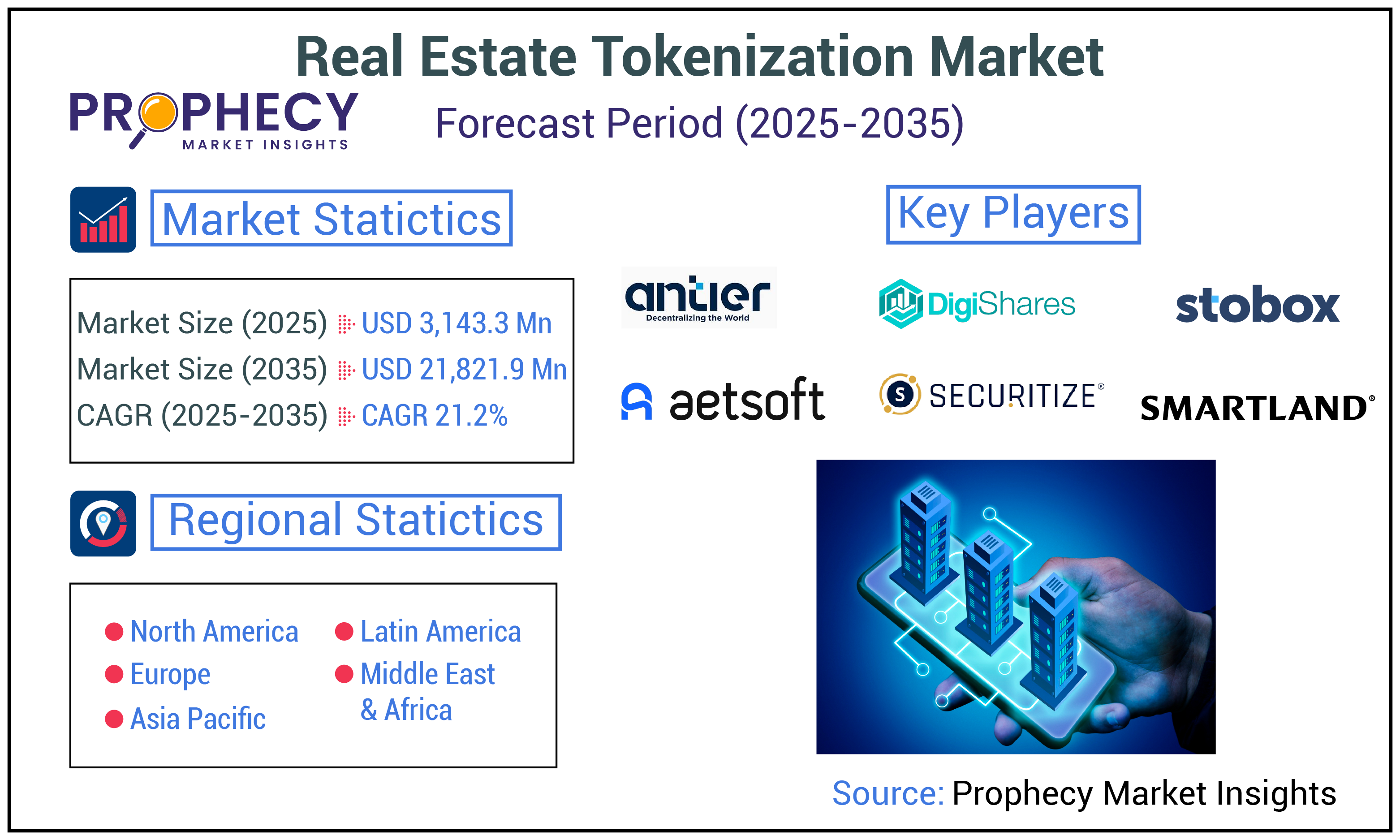
- By 2035, real estate tokenization market size is contemplated to enlarge at a valuation of USD 21,821.9 Million.
- In 2024, the real estate tokenization market valuation was USD 2,632.2 Million.
- Real estate tokenization market is developing at a CAGR of 21.2%.
Tokenization of real estate converts property ownership into tokens on the blockchain. Tokens can be considered fractional shares of real assets, bringing liquidity, clarity, and access to real estate investments. Essentially, the property market is linked to the decentralized or financial markets and has the potential to revolutionize how we buy, sell and manage real estate.
In the interest in fractional ownership in assets providing a positive growth trajectory, the blockchain continues to grow in adoption and for good reason, liquidity in traditionally illiquid markets, are a few who all share the growing market potential for real estate tokenization. There is clear support for more liquidity and easier ownership of real estate through tokenized real estate assets in the various regulatory frameworks being approved, interest from institutional and retail investors, cross-border capital flows and globalization of property. Additionally, reduced cost of transactions, access to transparency, and developing a trusted and efficient market can all support consideration of a widespread adoption of tokenized property asset.
Real estate tokenization is in place for future growth potential with opportunities to develop smart contracts, global investor’s ability, and the combined use with decentralized finance, DeFi. Real estate tokenization will emerge in a more mainstream capacity to take market share away from traditional real estate investments.
Recession Risk & Tariff Analysis:
- A recession could potentially decelerate the acceptance of real estate tokenization diminishing investor confidence and ability to obtain capital. Market volatility could also deter participation to some extent, particularly in the case of fractional investments. Furthermore, the performance of a token could be affected by declines in property values, making it even harder to attract buyers and increasing the perception of risk in tokenized real estate portfolios.
- Real estate tokenization is proven to be less directly linked to tariffs, but the cross-border transactions and supporting platform services are often susceptible to higher day-to-day operating costs. Tariffs on tech components or data services could potentially increase start-up costs of operating from an infrastructural perspective. Additionally, international investors may be hindered in access to their funds or face increased costs even further impacting the global scaling of tokenized property markets.
Impact of Generative AI on Real Estate Tokenization Market:
- Generative AI allows the near real-time creation of virtual property tours, automated staging, and personalized marketing content, revolutionizing the means by which real estate investment is introduced in the market. This means more engagement on the buy side, shorter transaction timelines, and better global outreach to investment populations via the timely, and successful showcasing of tokenized assets before the asset can be developed or built. This all serves to provide better confidence to investors.
- Generative AI has the ability to automate the process of creating smart contracts in real estate tokenization by generating code and performing compliance checks, which reduces the risks of error from legal documentation, lessens the time delay from an in-person verification required in the transaction process, provides a legal agreement to individuals that is enforceable and negotiable, and, by making the documentation scalable, provides a more economical solution to transacting on the blockchain.
Global Real Estate Tokenization Market Drivers & Restraints
Key Drivers:
Increased Demand for Fractional Ownership Drive the Market Growth:
The increasing demand for fractional ownership is a key driver of growth for the real estate tokenization market. With tokenization, investors can divide properties into smaller digital shares that let investors have a broader pool of investors to invest with lower capital, democratizing access to high value assets, as well as liquidity and diversification benefits for retail and institutional investors. Ultimately, this combination of liquidity and being able to gain access to fractionalized high value investment instruments is attractive to both retail and institutional investors since we tend to see increased interest in blockchain in the investing community as it's a technological advancement, and it's an innovative way to invest in an illiquid market as real estate, while maximizing tax efficiencies.
- For instance, according to new filing with the U.S. Securities and Exchange Commission (SEC), traditional fractional ownership such as clubs often requires a minimum investment of up to USD 400,000, which provide significant and prohibitive barriers of entry. This points to how tokenization, which can lower these thresholds by allowing owners to convert real estate into smaller and tradable digital tokens, pulls down and disrupts high capital requirements, allowing a much larger addressable investor base.
Restraints:
Regulatory Uncertainty Across Jurisdictions to Repel Market Growth:
A primary restrictive element within the real estate tokenization marketplace is not having one regulatory framework between countries. As interpretation of securities laws, tax treatment and legal recognition of tokenized assets vary significantly among countries, it creates compliance regime difficulties for issuers and investors. This uncertainty could limit institutional participation, mitigate successful project launches or further increase legal risk. Until there are accepted global templates, growth in the marketplace will be patchy and will not create scalable widespread adoption of tokenized real estate platforms to accommodate the differing cross-border investment landscape.
- Counterbalance Statements: While there continues to be numerous regulatory challenges, governments are moving to more defined frameworks for digital assets across the globe. While there are standalone examples of positive government positions on pro-tokenization regulation, in countries such as Switzerland, Singapore and the UAE, these frameworks are increasing investor confidence, and creating regulatory frameworks for other jurisdictions to eventually follow-on by resolving uncertainty, thereby increasing markets.
Opportunities & Trends:
Rise of Global Real Estate Investment Platforms Transforming the Real Estate Tokenization Industry
An emerging opportunity in the real estate tokenization marketplace is developing worldwide investing platforms to facilitate cross-border ownership of properties. This conforms to the sustainability principle of democratized investing due to users from various geographies can hold fractional ownership interests in the global real estate asset class, with investments from other geographically based Users. These platforms are engaging blockchain speed, transparency, and security to automate and simplify the whole transaction process. Investors can have low barriers to entry and with blockchain, they will have real- time transactions. This trajectory is re-defining access to global property ownership, expanding our potential investor base, and democratizing the marketplace to create an inclusive global investing ecosystem from all corners of the world.
Global Real Estate Tokenization Market Segmentations & Regional Insights
Token type, component, deployment mode, real estate type, end-user and region are the divisions of the real estate tokenization market.
By Token Type:
Based on token type, the market is segmented into equity tokens, debt tokens, utility tokens, and others. Equity tokens lead the real estate tokenization market share since they really represent ownership in property assets. They confer rights to an investor's share of income and appreciation of the asset, and exhibit almost all characteristics of an equity investment structure. Their consistency with legal frameworks, as well as being most familiar to investors, makes them far more preferred for tokenized real estate deals worldwide.
Debt tokens are lagging in second place since they represent tokenized loans or mortgages on real estate, which provides predictable returns that come thorough interest rates. They are appealing to income focused investors and institutions looking for lower risk exposure to the real estate market. Their structurally predictable format, adaptability to all forms of compliance and regulation requirements in the respective jurisdictions, and growing acceptance for use in real estate financing is fueling their adoption in the market.
By Component:
Based on Component, the market is segmented into Platform, Services. Platform solutions has the majority of the real estate tokenization market share, since they enable secure token creation, smart contracts, investor transaction, and asset ownership on their protocols. Platform solutions provide end-to-end infrastructure for tokenized real estate and support compliance, ownership, and liquidity issues. The scalability and interoperable aspects of platform solutions make them absolutely essential for supporting the operationalization of tokenized real estate at scale.
Services represent the second largest segment as they support platform solutions by providing legal advice, compliance reviews, smart contract development, etc. The capitalization of tokenization is still new and those use cases are still evolving, and service providers allow their clients to understand the many legal challenges tokenized real estate represents and ensure a secure implementation of the tokenization offering. Their importance to the adoption of tokenized real estate is paramount especially for first-time issuers and more traditional real estate companies.
By Deployment Mode:
Based on deployment mode, the market is segmented into on-premise, cloud-based. Cloud-based deployment ranks as the leading position in the real estate tokenization market share, due to scalability, cost-efficiency and the ability to access the software remotely. As tokenization platforms enable local investors in different global markets, they are dependent on cloud infrastructure, allowing their service to be deployed quickly, and allowing integration with a blockchain network.
On-premise deployment is the second dominating, although it is largely preferred by institutions with strict data control and security protocols. It allows organizations to have greater customization and flexibility in compliant solutions to organizations that handle personal property and investor information. While on-premise deployments are not as scalable as cloud-hosted solutions, it is still an option for enterprises that want to govern how their service operates and manage the infrastructure of the tokenization process locally.
By Real Estate Type:
Based on real estate type, the market is segmented into residential properties, commercial properties, industrial properties, and others. Residential properties are the dominant segment of the t real estate tokenization market share. Since they are the most liquid in the market, investors are familiar with residential rental properties, and the demand is consistent. In addition, residential assets are very simple and scale well, making them a good option for the early-stage adoption of tokenization.
Commercial properties come in second with increased emphasis on income potential and long-term leases. Utility buildings and mixed-use developments are all starting to be tokenized to draw institutional and accredited investors into the market. Although commercial real estate requires a larger up-front capital investment and demand will always make it a segment of the tokenization market.
By End-User:
Property owners, investors, real estate developers, property management companies, and others are end-user of the real estate tokenization market. The vast majority of real estate tokenization end -users are investors, who were able to expand their fractional ownership assets, enjoy a larger asset class diversification, and provide liquidity options. Investors appreciated the ability to buy tokens on the open marketplace globally and have ownership in high dollar value real estate assets with reduced capital. Retail and institutional investors are the primary sources of demand and usage of tokenization and real estate tokens.
The second-most linear end-user of real estate asset tokenization is the real estate developer. Developers have an immediate upside using tokenization to access cash and raise capital, in addition to expanding project reach. Residential or mixed-use developers can provide fractional ownership of their asset using digital tokens. Tokenization enables developers to expand the potential pool of investors, eliminate exclusive reliance on traditional financing and lengthy bank processes, and reduce time and management to issue securities and raise money. In terms of usage and performance, tokenization is the first and valuable uses for many real estate developers using tokenization.
Regional Insights:
Geographically, the real estate tokenization market is studied across North America, Europe, Asia Pacific, Latin America, and the Middle East & Africa.
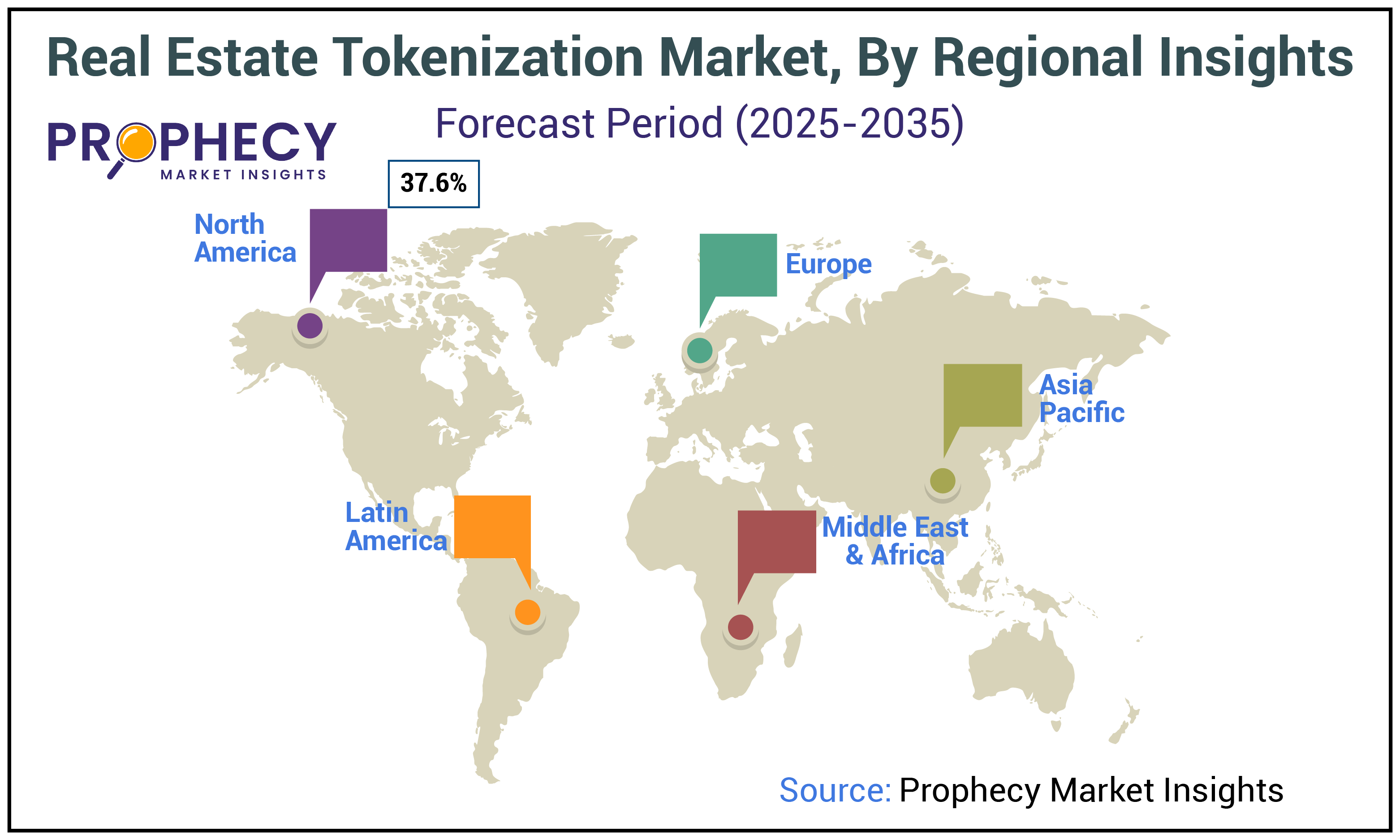
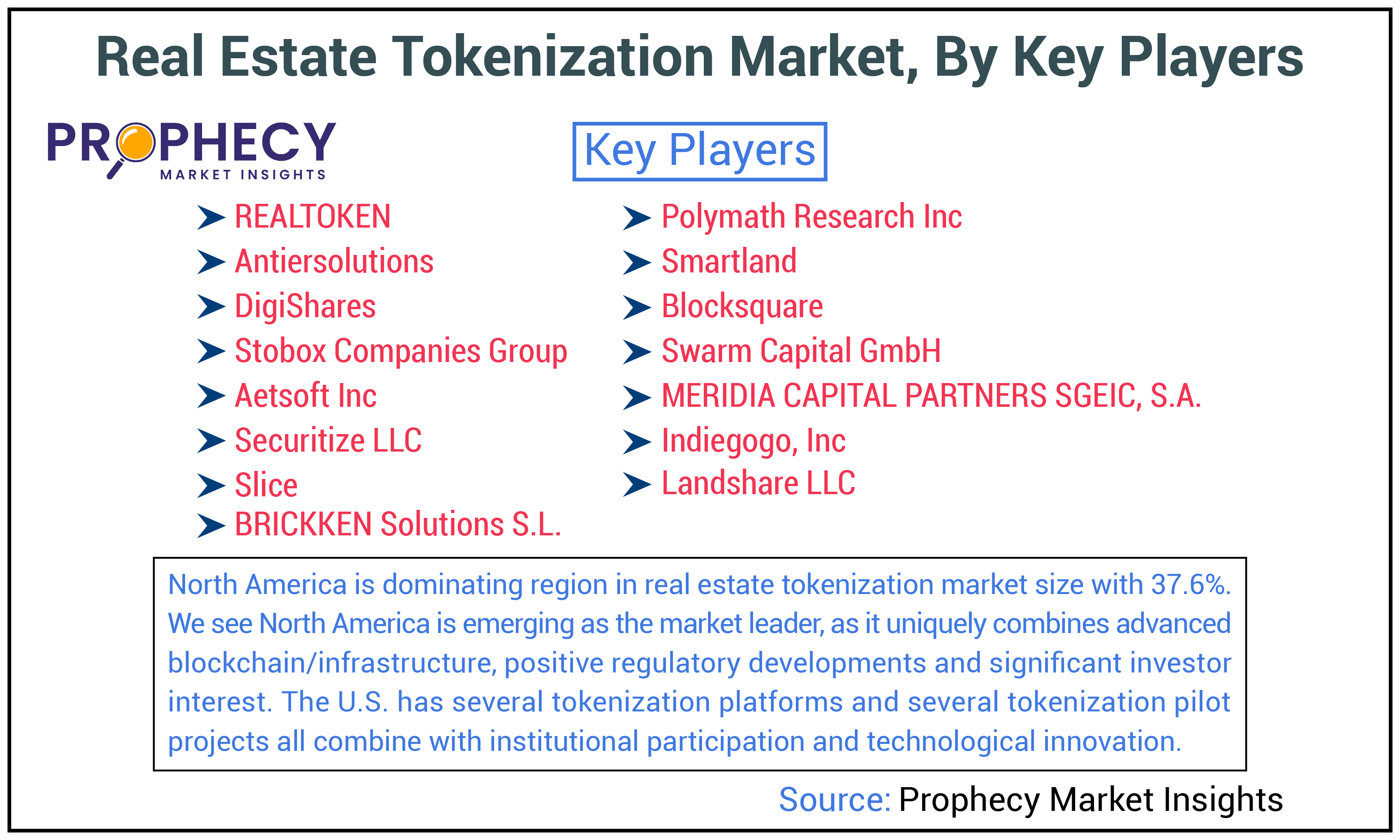
North America: This is dominating region in real estate tokenization market size with 37.6%. We see North America is emerging as the market leader, as it uniquely combines advanced blockchain/infrastructure, positive regulatory developments and significant investor interest. The U.S. has several tokenization platforms and several tokenization pilot projects all combine with institutional participation and technological innovation.
- U.S. Real Estate Tokenization Market Insights:
The North American real estate tokenization market is dominated by the U.S. to date due to a strong Blockchain ecosystem for venture funding and the positive U.S. securities regulatory environment attracting a substantial number of investors. Many platforms and pilot projects relating to real estate tokenization originate from the U.S. supporting high levels of venture capital and institutional investor interest.
Europe: This is in second place due to the progressive regulations within countries such as Switzerland, Germany and the U.K. Maketspaces in those countries offer clear legal definitiveness as to how security tokens operate, attracting startups and institutional investors. Through financial innovation and cross-border investment of digital assets, Europe is creating a growing nation in terms of leadership to ensure real estate tokenization development and leadership.
- Switzerland Real Estate Tokenization Market Insights:
Switzerland is taking leadership in Europe as a major legal jurisdiction and it is evident why in promoting its clear legal structure regarding digital assets and security tokens. With its developing crypto-friendly regulatory framework and established Blockchain hubs, especially Zug, it is an attractive destination for tokenization start-ups and institutional funding.
Asia Pacific: This is in third place, with the rise of improved blockchain and tokenization perception and adoption in countries such as Singapore and Japan. Urbanization and real estate development are rapidly moving. Positive fintech environments are emerging that aid to accelerate the maturation period of real estate tokenization markets. Government-sponsored blockchain experiments have attracted renewed interest by investors and companies for fractional ownership of more than other ownership statutes associated with property investment.
- Singapore Real Estate Tokenization Market Insights:
Singapore is one of the top economies in the Asia Pacific region due to its progressive and innovative regulatory environment and robust fintech ecosystem. The Monetary Authority of Singapore (MAS) is also regarded as a leader in promoting further uses of blockchain technology. Its status as a global finance and tokenization hub attracts start-ups and venture funding in and around Blockchain and property and asset management.
Real Estate Tokenization Market Report Scope:
|
Attribute |
Details |
|
Market Size 2025 |
USD 3,143.3 Million |
|
Projected Market Size 2035 |
USD 21,821.9 Million |
|
CAGR Growth Rate |
21.2% (2025-2035) |
|
Base year for estimation |
2024 |
|
Forecast period |
2025 – 2035 |
|
Market representation |
Revenue in USD Million & CAGR from 2025 to 2035 |
|
Regional scope |
North America - U.S. and Canada Europe – Germany, U.K., France, Russia, Italy, Spain, Netherlands, and Rest of Europe Asia Pacific – China, India, Japan, Australia, Indonesia, Malaysia, South Korea, and Rest of Asia-Pacific Latin America - Brazil, Mexico, Argentina, and Rest of Latin America Middle East & Africa – GCC, Israel, South Africa, and Rest of Middle East & Africa |
|
Report coverage |
Revenue forecast, company share, competitive landscape, growth factors, and trends |
Segmentation:
By Token Type:
- Equity Tokens
- Debt Tokens
- Utility Tokens
- Others
By Component:
- Platform
- Services
By Deployment Mode:
- On-Premise
- Cloud-Based
By Real Estate Type:
- Residential Properties
- Commercial Properties
- Industrial Properties
- Others
By End-User:
- Property owners
- Investors
- Real estate developers
- Property management companies
- Others
By Region:
- North America
- U.S.
- Canada
- Europe
- Germany
- U.K.
- France
- Russia
- Italy
- Spain
- Netherlands
- Rest of Europe
- Asia Pacific
- China
- India
- Japan
- Australia
- Indonesia
- Malaysia
- South Korea
- Rest of Asia Pacific
- Latin America
- Brazil
- Mexico
- Argentina
- Rest of Latin America
- Middle East & Africa
- GCC
- Israel
- South Africa
- Rest of Middle East & Africa
Global Real Estate Tokenization Market Competitive Landscape & Key Players
The prominent players operating in the market include, REALTOKEN, Antiersolutions, DigiShares, Stobox Companies Group, Aetsoft Inc, Securitize LLC, Slice, BRICKKEN Solutions S.L., Polymath Research Inc, and others. The real estate tokenization market is characterized by competition in terms of innovation, regulatory flexibility and its global scale. Competition exists around the integration and use of blockchains, accessibility to investors, security of integrated wallets, stable coins, processes and platforms, and geography. Each company is innovating and differentiating in terms of real estate asset classes, compliant wealth creation processes, and effective user experience. Strategic partnerships, alliances and dealing in multiple geographic regions will be important for market share.
Real Estate Tokenization Market Companies:
- REALTOKEN
- Antiersolutions
- DigiShares
- Stobox Companies Group
- Aetsoft Inc
- Securitize LLC
- Slice
- BRICKKEN Solutions S.L.
- Polymath Research Inc
- Smartland
- Blocksquare
- Swarm Capital GmbH
- MERIDIA CAPITAL PARTNERS SGEIC, S.A.
- Indiegogo, Inc
- Landshare LLC
View an Additional List of Companies in the Real Estate Tokenization Market
Global Real Estate Tokenization Market Recent News
- July 2025, the City of Detroit brought a lawsuit against tokenization platform RealT, claiming property mismanagement and neglect across rental units without concern for operational governance. That mismanagement caused massive code violations with vacant and blighted properties, criminal behavior, and putting Real Token tenants’ health and safety in jeopardy.
- In May 2025, DigiShares, leading provider of white-label infrastructure for real estate tokenization, announced a strategic investment by Valereum PLC, a progressive user of real-world asset (RWA) tokenization. This investment is a big boost to DigiShares and access to the global real estate market using blockchain technology.
Analyst View:
The real estate tokenization space is undergoing rapid change due to the adoption of blockchains, growth in fractional ownership and global access to investors. The key trends are DeFi integration, tokenized REITs, and smart contracts enhanced by AI technology. Supportive regulations in many of the areas that have established themselves as leader in this area (i.e., Switzerland, Singapore) have benefitted the market as well. Regulatory and market fragmentation and complexity in technology and risk perceptions remain significant limiting factors. Yet, we see continued platform innovations and significant investor demand for transparent, low-barrier access to real estate investment, which affords significant opportunities and points to tokenization as an investment and liquidity enhancement strategy that is ready for the future.
More Related Reports
Europe Real Estate Tokenization Market
Real Estate Market
China Commercial Real Estate Market
Tokenization Market
Asia Pacific Real Estate Tokenization Market
Global Real Estate Tokenization Market Company Profile
|
Company Name |
Antiersolutions |
|
Headquarter |
Punjab, India |
|
CEO |
Vikram R Singh |
|
Employee Count |
1,000 Employees |
Global Real Estate Tokenization Market Highlights
FAQs
Real estate tokenization market size was valued at USD 3,143.3 Million in 2025 and is expected to reach USD 21,821.9 Million by 2035 growing at a CAGR of 21.2%.
Token type, component, deployment mode, real estate type, end-user, and region are the segmentation for the real estate tokenization market.
North America, Asia Pacific, Europe, Latin America, and the Middle East & Africa. North America is expected to dominate the market.
The prominent players operating in the market include, REALTOKEN, Antiersolutions, DigiShares, Stobox Companies Group, Aetsoft Inc, Securitize LLC, Slice, BRICKKEN Solutions S.L., Polymath Research Inc, Smartland, Blocksquare, Swarm Capital GmbH, MERIDIA CAPITAL PARTNERS SGEIC, S.A., Indiegogo, Inc, and Landshare LLC.