Global Platelet Aggregation Devices Market Overview
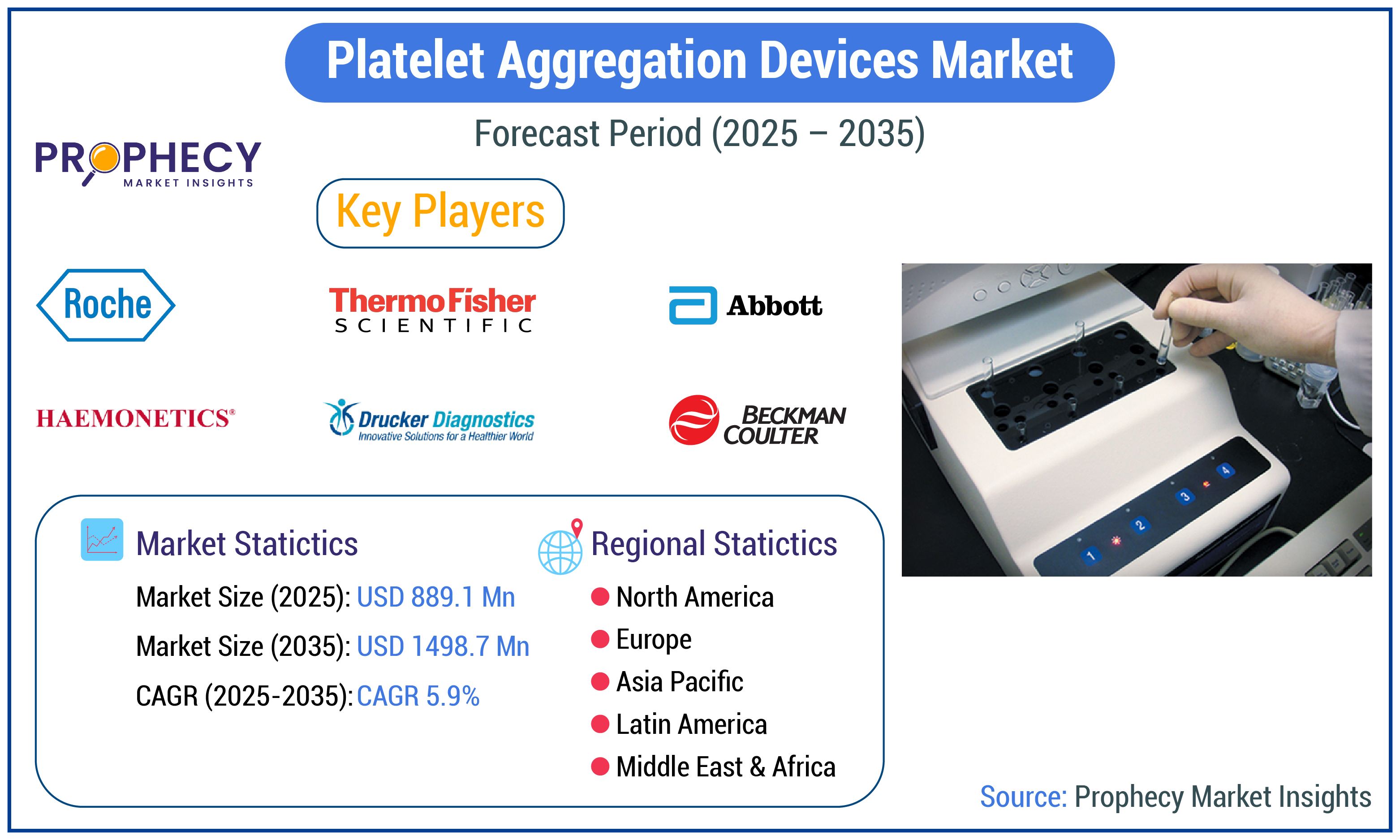
- Platelet aggregation devices market size is anticipated to reach a valuation of USD 1498.7 Million, by 2035.
- In 2024, the valuation for platelet aggregation devices market was USD 847.6 Million.
- The market is expanding at a CAGR 5.9%.
Platelet aggregation devices used to measure the ability of platelet in blood to clump together or aggregate together. Platelet aggregation is a crucial process in blood clotting, where platelets stick together to the site of injury, forming a clot to stop bleeding. Platelet aggregation is a critical device which is used in blood clotting processes, and help to evaluate blood function, for the diagnosis, or managing various bleeding and clotting disorders. This devices work by monitoring changes in the electrical or optical properties of blood samples as platelets aggregate.
The rising incidence of cardiovascular disease, such as heart attacks, and strokes, rises the demand for diagnostic tools to access platelet function and guide treatment. The rising incidence of bleeding, and clotting disorders, such as hemophilia, von Willebrance diseases, contributes to the need for platelet aggregation devices, resulting to drive target market growth. The increasing awareness of antiplatelet therapy, and technological advancement to provide quicker results, is expected to drive platelet aggregation devices market share.
The growing demand for Point-of-Care testing devices for more rapid diagnostic tests, and growing trend of personalized medicine, which rises the demand for more precise and individualized treatment, is fueled the expansion of target market share. The technological innovation in non-invasive testing, rising research & development in hematology, platelet-related disorders progresses, and regulatory approvals for new platelet aggregation devices, resulting to create significant opportunity in platelet aggregation devise market in upcoming years.
Impact of Generative AI on Platelet Aggregation Devices Market:
- Artificial Intelligence (AI) can significantly improve the platelet aggregation test, and interpret complex datasets, faster than traditional methods. AI provide personalized insights, particular for bleeding and clotting disorders patients. AI powered decision support system, provide real-time suggestions or alerts during clinical trials, by providing faster, accurate, and data-driven decision for healthcare professionals.
Global Platelet Aggregation Devices Market Drivers & Restraints
Key Drivers of Target Market:
Rising Prevalence of Hemophilia and Other Bleeding Disorders
Hemophilia A & B and other bleeding disorder such as Von Willebrand, and platelet function disorder are driving the demand for platelet aggregation devices market growth. This bleeding disorders require precise diagnosis to assess platelet function and coagulation capacity, to evaluate functions of platelet in the clotting process. Platelet aggregation devices help to determine, patient’s platelets respond to therapy, especially for the personalized medicine that tailors treatments based on individual platelet behavior. Thus, rising prevalence of bleeding disorders, is driving the demand for more advanced and accessible platelet aggregation testing devices. This devices play a crucial role in monitoring, diagnosis, and managing platelet function, resulting to drive platelet aggregation devices market growth.
- For instance, in November 2023, according to data published by National Library of Medicine, the prevalence of hemophilia is estimated to be 1 in 5000 males, and the incidence is estimated to be 1 in 1333 live male births. Disease severity is determined by the residual factor activity in the patient’s blood. People with mild hemophilia retain 5% to 40% of normal factor activity in their blood, and bleeding will mostly occur after major trauma or surgery.
Restraints:
High Costs of Devices Disrupt the Target Market Growth
The cost of platelet aggregation devices, particularly light transmission aggregometry and whole blood aggregometry, is high as compared to traditional methods. These devices often require advanced technology, specialized health care professionals for operating devices, and regular maintenance, making it less accessible, for initial setup for small resource healthcare settings, resulting to limits target market growth.
- Counterbalance Statements: The increasing adoption of point-of-care devices and AI-driven technologies, is projected to reduce cost of platelet testing devices. Many manufacturer are focusing on developing more affordable, portable, and easy-to-use devices, which aim to deliver accurate results, in affordable costs, results to make platelet aggregation testing more accessible to large scale healthcare providers.
Opportunities & Market Trends:
Technological Advancement in Blood Coagulation System is Surge Market Growth
Technological advancements in blood coagulation testing, and platelet aggregation devices, create a significant opportunity for target market growth. These advancement transform coagulation disorder diagnosis, monitoring and treatment, which leads to improve patient outcomes, with more efficient testing. Advancements in Point-of-Care testing devices leads to the development of portable, user-friendly platelet aggregation devices, which help to monitor platelet function and adjust treatments, resulting to drive target market growth. These advanced platelet aggregation testing, provide better diagnosis and monitor complex conditions, such as hemophilia, bleeding disorders, and thrombotic diseases, is expected to boost market share in platelet aggregation devices market.
- For instance, according to article published by, Frontiers in Bioengineering and Biotechnology, this article states that, recent developments in blood coagulation monitoring, with enhanced diagnosis, treatment, and management. The advanced technologies such as microfluidics, fluorescent microscopy, electrochemical sensing, photo acoustic detection, and micro/nano electromechanical systems (MEMS/NEMS), were employed to develop Point-of-Care (POC) devices with highly accurate, robust and cost-effective system. These devices aimed to measure electrochemical, optical, and mechanical parameters of clotting blood.
Global Platelet Aggregation Devices Market Segmentations & Regional Insights
The platelet aggregation devices market is distributed into product, application, end-user and region.
By Product:
Based on product, platelet aggregation devices market is divided into system, consumables, and accessories. The target market is dominates by system segment, as it contains platelet aggregation testing devices, which are core of the market. This system include, advanced platelet function analyzer, that provide accurate and reliable platelet aggregation resulting, is expected to propel the segment’s growth in market for platelet aggregation devices.
Consumables second dominating segment in platelet aggregation devices, as it includes reagents, test kits, cartridges, and other consumables are required to run the platelet aggregation tests. This are crucial for ensuring function of platelet aggregation system, is anticipated to drive segment’s growth in target market share.
By Application:
On the basis of application, platelet aggregation devices market is segmented into clinical applications and research applications. clinical applications segment hold the largest platelet aggregation devices market share the target market, due to this devices are commonly used in treatment of cardiovascular diseases, such as coronary artery diseases, stroke, and heart attacks. The increasing prevalence of cardiovascular diseases and growing use of antiplatelet therapy, is projected to segment’s growth in platelet aggregation devices market share.
Research applications hold the second largest segment in platelet aggregation devices market share. These devices are widely used to identify various bleeding disorders, and play crucial role in bleeding or clotting disorders, is expected to boost segment’s growth in target market.
By End-user:
Hospitals, diagnostic laboratories, research and academic institute, are the categorized by the end-user for platelet aggregation devices market. Hospitals segment dominates in target market size, as it provide wide range of medical services, such as diagnosis, monitoring, treatment and surgeries. Hospitals are equipped with advanced healthcare infrastructure, and skilled healthcare professionals, to handle and monitor bleeding disorder and antiplatelet therapy, through platelet aggregation devices, resulting to drive growth of segment in target market size.
Regional Insights:
Geographically, the market is studied across North America, Europe, Asia Pacific, Latin America, and the Middle East & Africa.
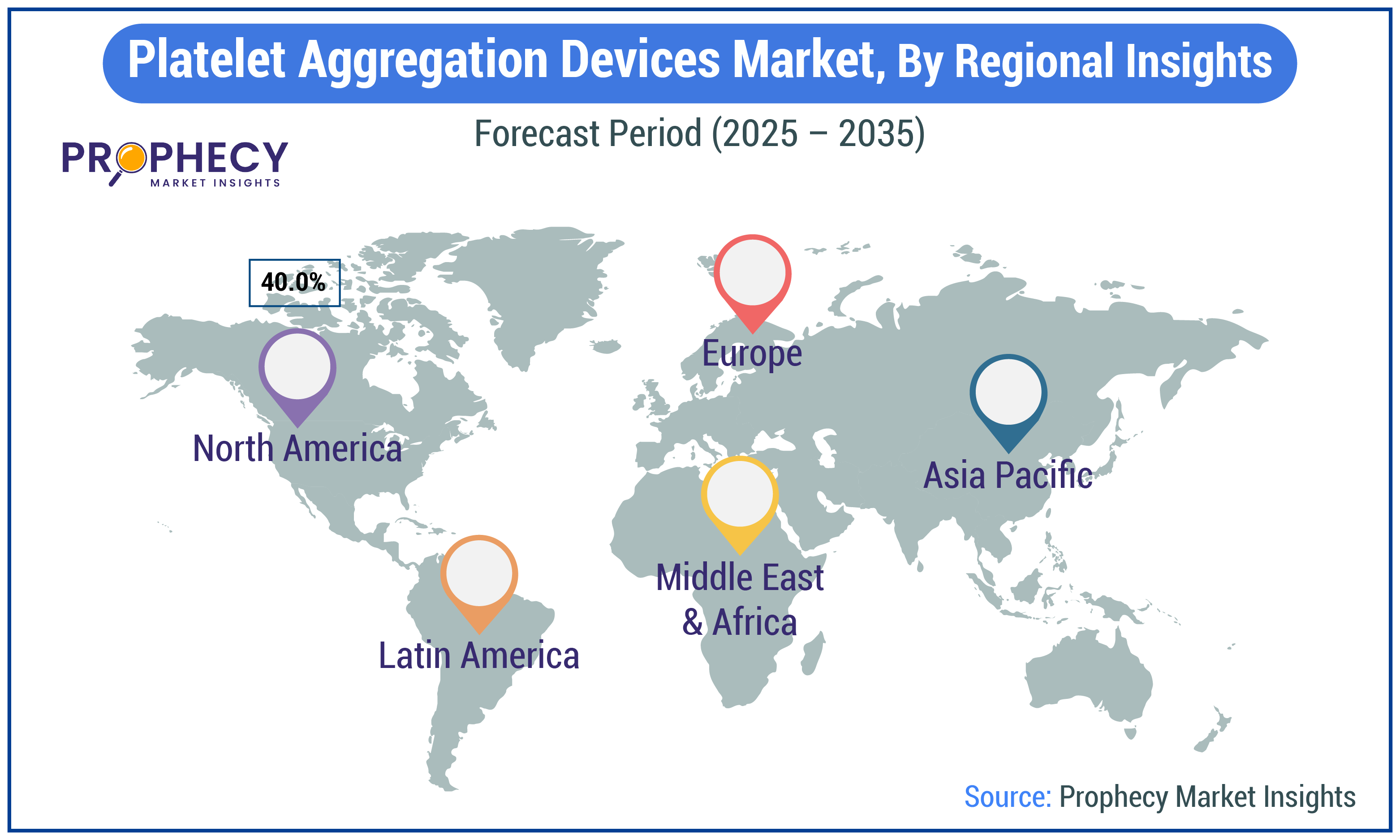
North America: This region holds the major share at a 40% revenue in platelet aggregation devices market due to advanced healthcare system, presence of major key players to produce innovate treatment for blood disorders. The growing awareness of hemophilia & other bleeding disorders, and strong adoption of advanced diagnostic tools, are resulting to drive region growth in platelet aggregation devices market share.
- U.S. Platelet Aggregation Devices Market Insights:
U.S. is the dominating country in North America for the platelet aggregation devices market. The high prevalence of cardiovascular diseases, presence of advanced healthcare system, growing adoption of advanced diagnostic technologies, and increasing focus on precision medicine, personalized therapies, is attributed to region growth platelet aggregation devices market size.
Asia Pacific: This region is expected to experience highest growth rate during the forecast period, due to leading countries such as China, India and Japan are investing in healthcare infrastructure. The increasing access to recombinant therapies and awareness of bleeding disorders, is expected to drive region growth. The improvement in diagnostics process, and adoption of advanced platelet aggregation devices, is estimated to growth of region in upcoming years.
- Japan Platelet Aggregation Devices Market Insights:
In platelet aggregation devices Japan is dominant country in Asia Pacific region. Japan has a highly developed healthcare system, high adoption of diagnostic tools, rising prevalence of cardiovascular, bleeding disorder, continuous support for the development of advanced platelet aggregation systems, is expected to propel platelet aggregation devices market size.
Europe: This is significantly growing region in platelet aggregation devices market, due to its advanced healthcare infrastructure, and growing geriatric population. The growing prevalence of cardiovascular diseases, and growing research focus on hematology, is expected to propel region expansion in target market size.
- Germany Platelet Aggregation Devices Market Insights:
Germany hold the highest share for platelet aggregation devices market in Europe region. The market growth is drive by several factors, such as largest and most advanced healthcare system, high prevalence of cardiovascular devices, which rises the demand for platelet aggregation testing, and growing focus on research & development in medical technology.
Platelet Aggregation Devices Market Report Scope:
|
Attribute |
Details |
|
Market Size 2025 |
USD 889.1 Million |
|
Projected Market Size 2035 |
USD 1498.7 Million |
|
CAGR Growth Rate |
5.9% (2025-2035) |
|
Base year for estimation |
2024 |
|
Forecast period |
2025 – 2035 |
|
Market representation |
Revenue in USD Million & CAGR from 2025 to 2035 |
|
Regional scope |
North America - U.S., and Canada Europe – Germany, U.K., France, Russia, Italy, Spain, Netherlands, and Rest of Europe Asia Pacific – China, India Japan, Australia Indonesia Malaysia, South Korea, and Rest of Asia-Pacific Latin America - Brazil, Mexico, Argentina, Rest of Latin America Middle East & Africa – GCC, Israel South Africa, and Rest of Middle East & Africa |
|
Report coverage |
Revenue forecast, company share, competitive landscape, growth factors, and trends |
Segmentation:
By Product:
- System
- Consumables
- Accessories
By Application:
- Clinical Applications
- Research Applications
By End-user:
- Hospitals
- Diagnostic Laboratories
- Research and Academic Institute
By Region:
- North America
- U.S.
- Canada
- Europe
- Germany
- U.K.
- France
- Russia
- Italy
- Spain
- Netherlands
- Rest of Europe
- Asia Pacific
- China
- India
- Japan
- Australia
- Indonesia
- Malaysia
- South Korea
- Rest of Asia Pacific
- Latin America
- Brazil
- Mexico
- Argentina
- Rest of Latin America
- Middle East & Africa
- GCC
- Israel
- South Africa
- Rest of Middle East & Africa
Global Platelet Aggregation Devices Market Competitive Landscape & Key Players
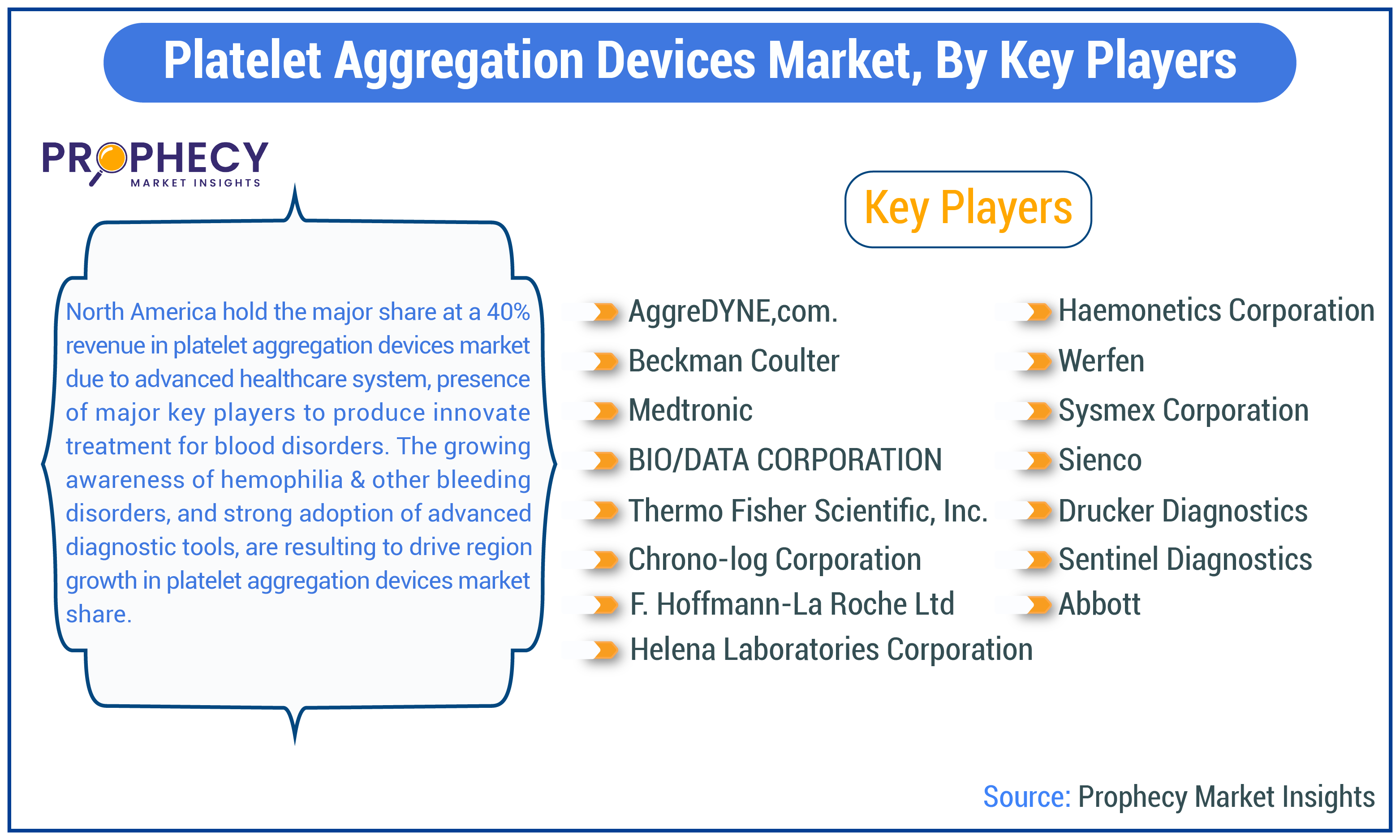
The key players operating in the platelet aggregation devices market include AggreDYNE,com., Beckman Coulter, Medtronic, and others. The growing demand for advanced medical solutions, and companies are adopting strategies, such as new product launches, partnerships, agreement, higher investments and collaboration with other organization, is projected to drive platelet aggregation devices market growth.
Platelet Aggregation Devices Market Companies:
- AggreDYNE,com.
- Beckman Coulter
- Medtronic
- BIO/DATA CORPORATION
- Thermo Fisher Scientific, Inc.
- Chrono-log Corporation
- F. Hoffmann-La Roche Ltd
- Haemonetics Corporation
- Werfen
- Sysmex Corporation
- Sienco
- Drucker Diagnostics
- Sentinel Diagnostics
- Abbott
- Helena Laboratories Corporation
View an Additional List of Companies in the Platelet Aggregation Devices Market
Global Platelet Aggregation Devices Market Recent News
- In October 2024, Abbott, announced a new, first-of-its-kind clinical trial designed to improve patient outcomes for heart failure patients. The TEAM-HF trial, enrolled up to 850 patients across 75 sites globally, that which measure pulmonary artery pressures (PAP) using Abbott's CardioMEMS HF System to identify advanced heart failure patients at high risk of mortality. This aimed to offer improvement in diagnosis of advanced heart failure and implementation of advanced therapies.
- In November 2022, Cerus Corporation received approval from Health Canada to extend the storage duration of platelets treated with the INTERCEPT Blood System from five days to seven days. This extension allowed Canadian blood centers to store treated platelets for a longer period, enhancing the flexibility and efficiency of blood supply management. INTERCEPT Blood System for Platelets was an important tool for the transfusion medicine community for safeguarding the blood supply and ensured availability with minimizing waste.
- In May 2022, Precision BioLogic, Inc., launched its new CRYOcheck Chromogenic Factor IX assay in Canada, the European Union, United Kingdom, Australia, and New Zealand followed market authorization by Health Canada and respective in-country regulatory authorities. It was aimed to determine of Factor IX activity in human plasma and give the management of hemophilia B, the assay which was validated for use on automated coagulation analyzers, which focused to increase efficiency, reduce wastage, and ensure accuracy of results.
- In July 2021, Baxter International Inc., completed the acquisition of PerClot Polysaccharide Hemostatic System from CryoLife, Inc. This acquisition aimed to address intraoperative bleeding to prevent complications for blood transfusions. PertClot used in gynecologic, general, cardiovascular, and urology surgeries, which was focused to manage bleeding from capillary, venous, or arteriolar vessels.
- In June 2021, Sysmex Europe GmbH, launched a new CN-3500 and CN-6500 automated blood coagulation analyzers in hemostasis testing field. These new instruments from Sysmex contain a measuring unit that uses the chemiluminescence enzyme immunoassay (CLEIA) methodology. CN-3500/CN-6500 incorporated all the unique feature of automated blood coagulation analyzers, which make possible to measure blood coagulation testing parameters including molecular markers for blood coagulation with a single device.
Analyst View:
The market for platelet aggregation device is driven by, increasing prevalence rate of clotting or bleeding disorder globally, and cardiovascular diseases, such as heart failure, heart attack, and platelet related disorders. Technological advancement in aggregation device, and blood coagulation system, is expected to boost target market share.
More Related Reports
Platelet Rich Plasma Market
Carrier Aggregation Solutions Market
Implantable Drug Device Market
Diabetes Monitoring Device Market
Personal Mobility Devices Market
Global Platelet Aggregation Devices Market Company Profile
|
Company Name |
Thermo Fisher Scientific Inc. |
|
Headquarter |
Waltham, Massachusetts |
|
CEO |
Marc N. Casper |
|
Employee Count (2024) |
125,000 employees |
Global Platelet Aggregation Devices Market Highlights
FAQs
Platelet aggregation devices market size was valued at USD 889.1 Million in 2025 and is expected to reach USD 1498.7 Million by 2035 growing at a CAGR of 5.9%.
Product, application, end-user and region are the segmentation for the target market.
North America, Asia Pacific, Europe, Latin America, the Middle East, and Africa. North America is expected to dominate the Market.
The key players operating the platelet aggregation devices market include AggreDYNE,com., Beckman Coulter, Medtronic, BIO/DATA CORPORATION, Thermo Fisher Scientific, Inc., Chrono-log Corporation, F. Hoffmann-La Roche Ltd., Haemonetics Corporation, Werfen, Sysmex Corporation, Sienco, Drucker Diagnostics, Sentinel Diagnostics, Abbott, and Helena Laboratories Corporation