Global Plasma Fractionation Market By Overview
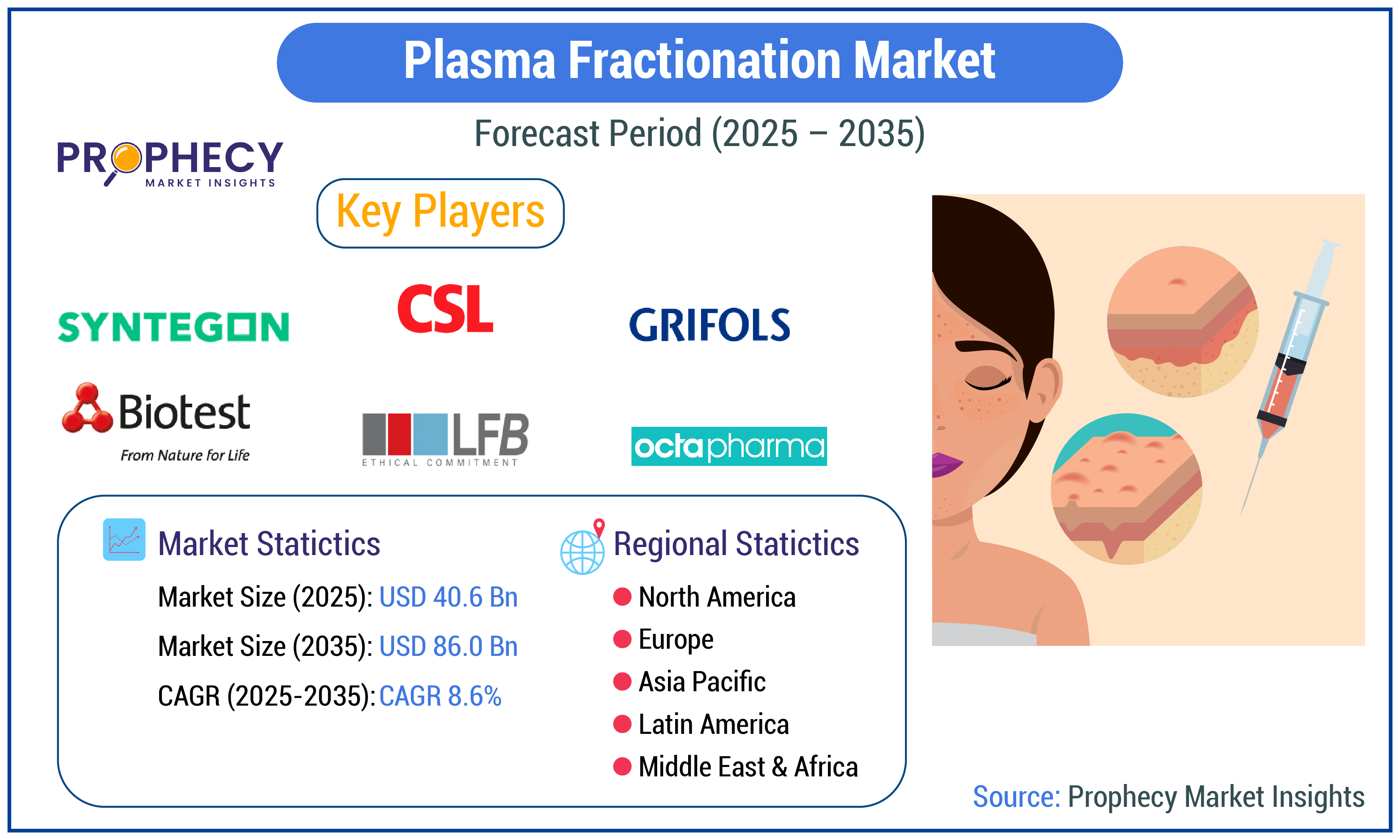
- Till 2035, the plasma fractionation market size is projected to reach USD 86 Billion.
- The market was calculated at USD 36 Billion in 2024.
- The target market is developing at a CAGR of 8.6%.
The technique of plasma fractionation is responsible for dividing the blood plasma into its constituent parts, which are then refined and condensed to create medicinal goods. The rising aging population, increased awareness about blood donation, growing use of plasma-derived products, increased number of plasma collection centers, surging government support, new therapeutic plasma products, improved production efficiency, and increased demand for clotting factors are contributing to boosting the plasma fractionation market growth.
In addition, the plasma fractionation technique provides highly targeted treatment options with high purity and improved safety due to viral inactivation procedures. It also has the ability to treat conditions where no other therapeutic alternatives exist, further contributing to market augmentation.
Impact of AI on the Plasma Fractionation Market:
- AI (artificial intelligence) has the potential to greatly influence plasma fractionation by improving the separation and purification of plasma proteins, boosting quality control, identifying possible contaminants, and forecasting the best collection and processing parameters. These improvements are expected to result in more effective and efficient production of therapeutics derived from plasma.
Global Plasma Fractionation Market By Drivers & Restraints
Key Drivers of Target Market:
Surge in Aging Population is Skyrocketing the Market Growth
As the aging population grows, the need for plasma-based treatments to manage age-related health issues also increases. Specifically, older adults are more prone to develop rare disorders and chronic diseases that frequently require treatment with plasma-derived therapies such as coagulation factors and immunoglobulins, which are obtained through plasma fractionation. This is the main factor driving the growth of the plasma fractionation market.
- For instance, in October 2024, according to an article published by WHO, by 2030, 1 in 6 people in the world will be aged 60 years or over. At this time the share of the population aged 60 years and over will increase from 1 billion in 2020 to 1.4 billion. By 2050, the world’s population of people aged 60 years and older will double (2.1 billion). The number of persons aged 80 years or older is expected to triple between 2020 and 2050 to reach 426 million.
Restraints:
Market Growth is Hampered by the Complex Regulatory Approval Process of Plasma Fractionation
The lengthy and intricate regulatory clearance procedure presents difficulties for the plasma fractionation sector. Product availability is delayed by stringent safety and efficacy compliance requirements. Regional variations in these laws make it challenging to enter international markets. Innovation and the launch of novel treatments are slowed down as a result.
- Counterbalance Statements: Delays can be decreased by implementing fast-track approval processes and simplifying regulatory harmonization between nations. Efficiency may be ensured without sacrificing safety through cooperation between industry players and regulatory agencies.
Opportunities:
Surging Use of New Therapeutic Plasma Products Can Unlock New Growth Opportunities in the Future
The introduction of novel treatments made from human plasma that can fill unmet medical needs, broaden the range of applications for therapies derived from plasma, and ultimately raise demand for plasma fractionation processes to create these new products fueling the plasma fractionation market expansion globally. This, in turn, increases market expansion and revenue for companies engaged in plasma fractionation.
- For instance, in September 2022, CSL Behring K.K. received manufacturing and marketing approval from the Ministry of Health, Labour and Welfare for Berinert S.C. Injection 2000, a lyophilized human C1-esterase inhibitor concentrate for subcutaneous (SC) injection in plasma derivative, for the prevention of acute HAE attacks, which ultimately raised the demand for plasma fractionation.
Global Plasma Fractionation Market By Segmentations & Regional Insights
Product, method, application, end-user, and region are the segmentations of the plasma fractionation market.
By Product
Based on product, the market is sub-segmented into albumin, immunoglobulins, coagulation factors, protease inhibitors, and others. The immunoglobulins segment is attributed to lead the market due to the high demand of immunoglobulins to treat immune deficiencies, autoimmune diseases, and neurological disorders.
- For instance, in October 2021, Plasma Technologies LLC, a plasma biologics technology company, announced that its novel human plasma fractionation process had been shown to achieve a yield of highly purified immunoglobulin G (IgG) in excess of 74% of the starting IgG content in donor plasma. This IgG yield was significantly higher than yields attainable using existing manufacturing processes that rely on older protein separation chemistries.
By Method
On the basis of method, the market is segmented into centrifugation, depth filtration, chromatography, and others. The centrifugation segment is holding the largest plasma fractionation market share. The segment is leading as it is considered a crucial step in the process, providing high-quality blood supernatant and enabling reliable blood separation, further resulting in better patient outcomes.
By Application
Application-wise, the market is classified into neurology, hematology, oncology, immunology, pulmonology, and others. The neurology segment is projected to lead the market during the projected period as plasma-derived therapies, such as IVIg and plasmapheresis are increasingly accepted for neurological conditions such as multiple sclerosis, Guillain-Barré syndrome, and chronic inflammatory demyelinating polyneuropathy.
- For instance, in April 2021, NHS Blood and Transplant (NHSBT) took donations at 14 donor centers around England, for an initial three months. People donated blood plasma and this plasma was fractioned and used to make antibody-based medications, called immunoglobulins, for people with rare immune diseases, such as, neurological disorders, immune disorders, hematological disorders, and dermatological disorders.
By End-User
By end-user, the market is categorized into hospitals and clinics, clinical research laboratories, research institutions, and others. The hospitals and clinics segment is ruling over the market as it is the primary healthcare facility where plasma-derived therapies are administered to patients, benefitting from the infrastructure to store these products, high patient volume, and the need to treat a wide range of conditions that require plasma-based treatments.
Regional Insights:
Geographically, the market is pigeonholed into North America, Europe, Asia Pacific, Latin America, and the Middle East & Africa.
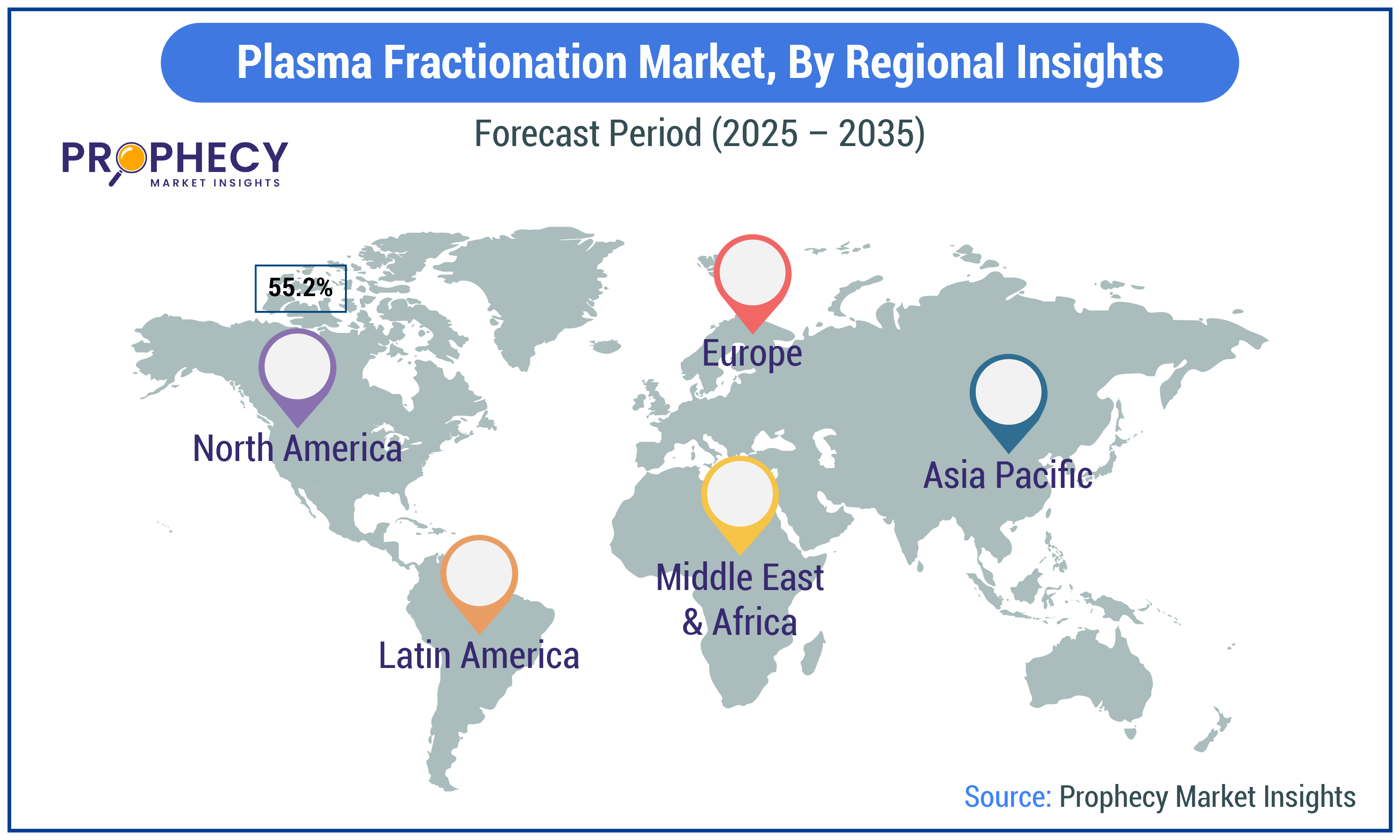
North America: North America is expected to have the dominating plasma fractionation market share of 55.2%. This dominance is attributed to the increased awareness in the region, growing geriatric population, presence of major companies, a large number of plasma collection facilities, high prevalence of respiratory disorders, and increased research and development activities.
- For instance, in July 2020, Grifols, a global healthcare company and one of world's top producers of plasma-derived medicines, announced that it had executed purchase arrangements with the South Korean-based GC Pharma (Group) whereby Grifols would acquire the Montreal-based plasma fractionation facility and two purification facilities, along with 11 U.S.-based plasma collection centers for a total amount of USD 460 million.
Asia Pacific: Asia Pacific is expected to have the fastest growth rate during the forecast period. Rising healthcare expenditure, increased awareness of plasma-derived therapies, growing aging population, increasing cancer prevalence, rising lifestyle-related disorders, and increased disposable incomes are the factors due to which the market is burgeoning in Asia Pacific.
- For instance, in December 2023, GC Biopharma, a South Korean biopharmaceutical company, announced its participation in the groundbreaking ceremony of a plasma fractionation plant held at Jababeka Industrial Estate in Indonesia, one of the company's overseas plant construction projects. The plant will be built on a 40-thousand-m2 land within the Jababeka Industrial Estate located 35km east from the nation's capital city of Jakarta.
Plasma Fractionation Market Report Scope:
|
Attribute |
Details |
|
Market Size 2025 |
USD 40.6 Billion |
|
Projected Market Size 2035 |
USD 86 Billion |
|
CAGR Growth Rate |
8.6% (2025-2035) |
|
Base year for estimation |
2024 |
|
Forecast period |
2025 – 2035 |
|
Market representation |
Revenue in USD Billion & CAGR from 2025 to 2035 |
|
Regional scope |
North America - U.S. and Canada Europe – Germany, U.K., France, Russia, Italy, Spain, Netherlands, and Rest of Europe Asia Pacific – China, India, Japan, Australia, Indonesia Malaysia, South Korea, and Rest of Asia Pacific Latin America - Brazil, Mexico, Argentina, and Rest of Latin America Middle East & Africa – GCC, Israel, South Africa, and Rest of the Middle East & Africa |
|
Report coverage |
Revenue forecast, company share, competitive landscape, growth factors, and trends |
Segmentation:
By Product:
- Albumin
- Immunoglobulins
- Intravenous immunoglobulins
- Subcutaneous immunoglobulins
- Others
- Coagulation Factors
- Factor VIII
- Factor IX
- VON WILLEBRAND factor
- Prothrombin complex concentrates
- Fibrinogen concentrates
- Others
- Protease Inhibitors
- Others
By Method:
- Centrifugation
- Depth Filtration
- Chromatography
- Others
By Application:
- Neurology
- Hematology
- Oncology
- Immunology
- Pulmonology
- Others
By End User:
- Hospitals and Clinics
- Clinical Research Laboratories
- Research Institutes
- Others
By Region:
- North America
- U.S.
- Canada
- Europe
- Germany
- U.K.
- France
- Russia
- Italy
- Spain
- Netherlands
- Rest of Europe
- Asia Pacific
- China
- India
- Japan
- Australia
- Indonesia
- Malaysia
- South Korea
- Rest of Asia Pacific
- Latin America
- Brazil
- Mexico
- Argentina
- Rest of Latin America
- Middle East & Africa
- GCC
- Israel
- South Africa
- Rest of the Middle East & Africa
Global Plasma Fractionation Market By Competitive Landscape & Key Players
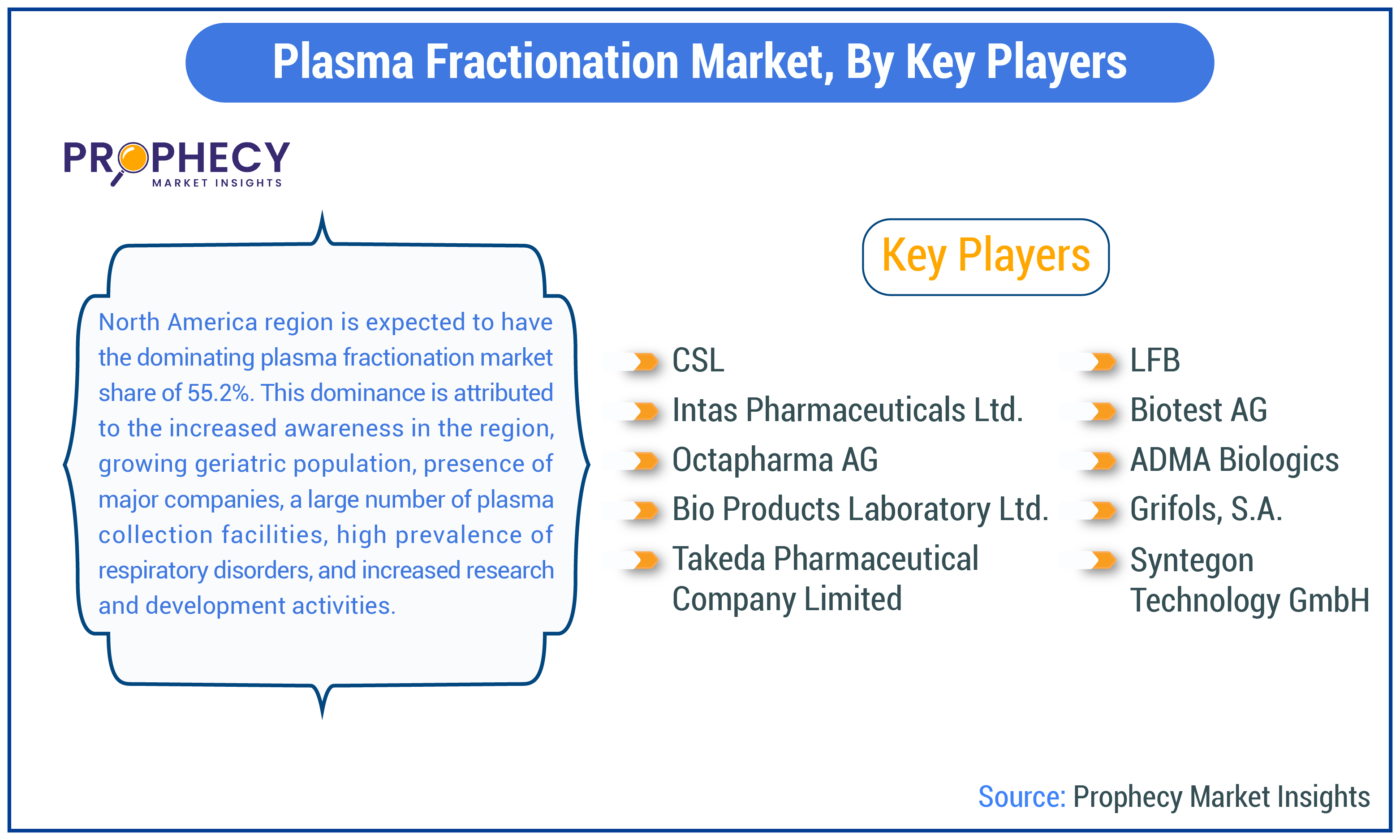
The companies operating in the plasma fractionation market are CSL, Grifols, S.A., Takeda Pharmaceutical Company Limited, Octapharma AG, Bio Products Laboratory Ltd., and others. The key players are adopting strategies including new product launches, investing in research and development, partnerships, regional expansion, and developing new technologies to maintain their dominance in the market among other competitors.
Plasma Fractionation Market Companies:
- CSL
- Grifols, S.A.
- Takeda Pharmaceutical Company Limited
- Octapharma AG
- Bio Products Laboratory Ltd.
- LFB
- Biotest AG
- Syntegon Technology GmbH
- ADMA Biologics
- Intas Pharmaceuticals Ltd.
View an Additional List of Companies in the Plasma Fractionation Market
Global Plasma Fractionation Market By Recent News
- In January 2022, Permira, the global private equity firm, announced its collaboration with Kedrion’s existing shareholders (the Marcucci family and FSI) to jointly acquire and combine Kedrion and BPL. This collaboration created a global player for medicines derived from human blood plasma, leading to plasma fractionation, which helped in treating patients with rare and life threatening conditions
- In August 2024, The Vice President of Indonesia, encouraged the Indonesian Red Cross (PMI) and relevant parties to develop a local plasma fractionation program to reduce the importation of plasma-derived medicinal products. The vice president expressed hope that the innovation would ensure sustainable access to safer and more reliable blood and blood products in Indonesia.
Analyst View:
The plasma fractionation market is expected to grow as a result of a number of factors, including aging population, increased awareness of blood donation, the growing use of products derived from plasma, the expansion of plasma collection facilities, increased government support, new therapeutic plasma products, improved production efficiency, and a rise in the demand for clotting factors.
More Related Reports
Immune Thrombocytopenia ITP Market
Mycoplasma Testing Market
Plasma Fractionation Market
CNC Plasma Cutting Machine Market
Platelet Rich Plasma Market
Global Plasma Fractionation Market By Company Profile
|
Company Name |
CSL |
|
Headquarter |
Melbourne, Australia |
|
CEO |
Mr. Paul McKenzie |
|
Employee Count (2024) |
32,000 Employees |
Global Plasma Fractionation Market By Highlights
FAQs
Plasma fractionation market size was valued at USD 40.6 Billion in 2025 and is expected to reach USD 86 Billion by 2035 growing at a CAGR of 8.6%.
The plasma fractionation market is segmented into product, method, application, end-user, and region.
The market is segmented by region North America, Asia Pacific, Europe, Latin America, and the Middle East & Africa. North America is expected to dominate the market.
The key players operating in the plasma fractionation market include CSL, Grifols, S.A., Takeda Pharmaceutical Company Limited, Octapharma AG, Bio Products Laboratory Ltd., LFB, Biotest AG, Syntegon Technology GmbH, ADMA Biologics, and Intas Pharmaceuticals Ltd.