Global Pharmaceutical Packaging Equipment Market Overview
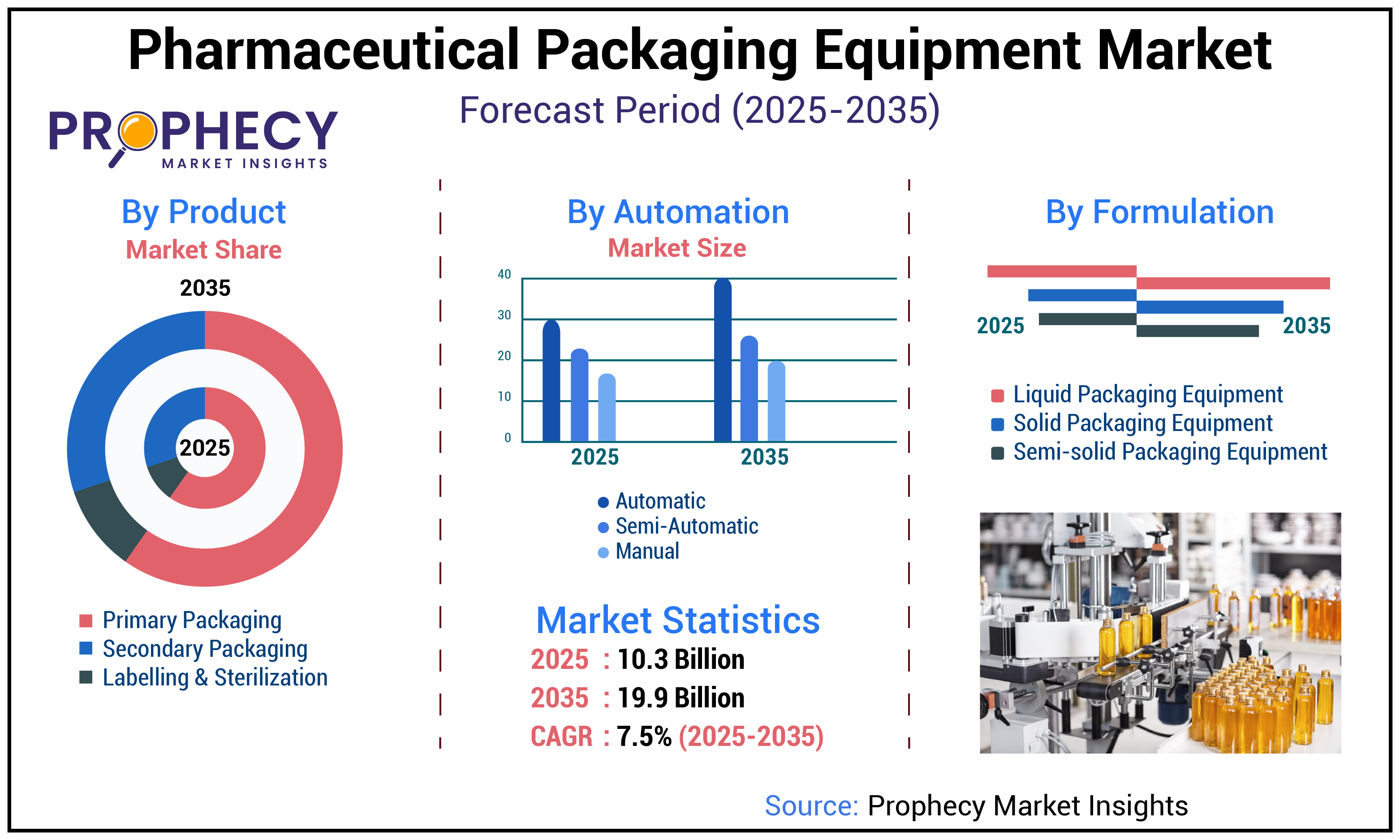
- Pharmaceutical packaging equipment market size is expected to expand at a rate of USD 19.9 Billion, by 2035.
- In 2024, the pharmaceutical packaging equipment market valuation was USD 9.7 Billion.
- Pharmaceutical packaging equipment market is growing at a CAGR 7.5%.
Pharmaceutical packaging equipment are machinery and systems used to package pharmaceutical products such as tablets, capsules, powders, liquids, ointments, and injectable drugs. This equipment plays a crucial role in medications are securely enclosed, protected from contamination, accurately labeled, and ready for safe distribution and use.
It covers a wide range of machines, including blister packing machines, strip packing machines, bottle filling & capping machines, labeling machines, and aseptic packaging systems for sterile products. The primary goal of pharmaceutical packaging equipment to maintain the integrity, safety, and efficacy of drugs throughout their shelf life.
The increasing prevalence of chronic diseases, aging population, expansion of healthcare access, drives the demand for pharmaceutical products, resulting to drive pharmaceutical packaging equipment market growth. Stringent regulatory requirements in drug packaging to ensure product safety, technological advancement in automation, and growing focus on protection of drugs from contamination, moisture, is anticipate to drive pharmaceutical packaging equipment market growth.
Growth in biopharmaceuticals, personalized medicine, and incorporation of RFIR, QR codes, smart sensors technologies, represents future opportunity for pharmaceutical packaging equipment market growth. Expansion in emerging market and growing environmental concerns, drives demand for sustainable packaging equipment, is expected to pitch pharmaceutical packaging equipment market growth.
Recession Risk and Tariff Analysis for Pharmaceutical Packaging Equipment Market:
- The pharmaceutical packaging equipment market faces limited recession risk compared to other industrial sectors, as demand for pharmaceuticals remains relatively stable during economic downturns due to the essential nature of healthcare. Global recession could still slow capital investments by pharmaceutical companies, delay expansion projects, or affect procurement of high-cost automated equipment, which impacts demand.
- Tariff structures for the pharmaceutical packaging equipment market contrast by region and can influence the cost and accessibility of machinery, especially in import-dependent countries. Developed markets such as the U.S. and EU impose low to moderate tariffs on high-tech equipment to encourage advanced manufacturing, and emerging economies may apply higher import duties to protect local industries.
Impact of Generative AI on Pharmaceutical Packaging Equipment Market:
- AI algorithms can create and test thousands of packaging equipment designs in virtual environments, identifying the most efficient, cost-effective, and regulatory-compliant configurations. This accelerates product development cycles and reduces prototyping costs for manufacturers.
- In predictive maintenance, AI algorithms can enhance factory system by analyzing machine performance before any failures occur. AI models can support personalized packaging workflows in biologics and patient-specific treatments. AI-driven data modeling helps manufacturers navigate complex regulatory landscapes, ensuring packaging equipment meets diverse global compliance standards.
Global Pharmaceutical Packaging Equipment Market Drivers & Restraints
Key Drivers:
Rising Chronic Diseases Burden Predicted to Market Amplification
The global rise in chronic diseases such as diabetes, cardiovascular disorders, cancer, asthma, and neurological conditions is fueling the growth of the pharmaceutical packaging equipment market. As the number of chronic patients increases, the need of wide range pharmaceutical products, such as oral medication, biologics, injectables, inhalers increase. This rises the need for safe, accurate, and efficient packaging solutions to ensure product integrity, dosage accuracy, and compliance with strict regulatory standards.
Chronic diseases often require long-term or lifelong medication, which places pressure on pharmaceutical manufacturers to produce and package drugs in large volumes, by maintaining quality, sterility, and traceability. As a result, pharmaceutical companies are investing in automated and high-speed packaging equipment that can handle these volumes efficiently and cost-effectively. As the chronic disease burden rises, the need for innovative packaging formats, such as prefilled syringes, unit-dose packs, and tamper-evident packaging, shifts the demand for advanced packing machinery. Thus, rising chronic disease prevalence, increases the need for high-performance, regulatory-compliant, and scalable pharmaceutical packaging equipment, resulting to drive pharmaceutical packaging equipment market growth.
- For instance, according to data published by VOX MEDIA, LLC, in September 2025, chronic disease cause 75% of all death globally. In 2019, 41 million people died by chronic diseases, and it was increase about 10 million since 2000. Almost 80% of death caused by chronic disease in low-and middle-income countries.
- Each year about 19.9 million people die from cardiovascular diseases, 9 million from cancers, 4 million from chronic respiratory diseases, and 2 million from diabetes. Cancer incidence is highest in Australia and New Zealand, where more than 400 people per 100,000 have some form of cancer. 537 million adults living with diabetes in 2021, and 75% of them lived in a low- or middle-income country.
Restraints
Market Growth Delayed by Supply Chain Disruptions
Supply chain disruptions caused by several factors, including global trade tensions, raw material shortages, transportation delays, geopolitical issues, and pandemics. The pharmaceutical packaging sector relies heavily on a global supply network for sourcing critical components such as plastics, glass containers, and specialized machinery parts. Supply chain interpretation lead to delays in production, increased costs and lowered availability of packaging system.
- Counterbalance Statements: many companies in the pharmaceutical packaging equipment market are increasingly adopting strategies such as localization of production and diversification of suppliers. By sourcing materials from multiple regions and developing alternative supply chains, it can mitigate the risks associated with dependence on a single source. Some companies are investing in inventory management system and digital tools to enhance supply chain visibility.
Opportunities & Trends:
Integration of Smart Packaging Technology Fuels Market Expansion
Smart packaging, such as temperature, humidity sensors, RFID/NFC chips, data loggers, and interactive indicators is essential in preserving product integrity throughout the supply chain. This integration helps to equipment manufacturers for producing or adapting machinery to handle such technologically advanced packaging components. Pharmaceutical companies are rapidly adopting smart packaging to monitor product conditions in real time, prevent spoilage, and enable digital traceability in compliance with GMP, GDP, and serialization requirements. The integration of electronic tags, sensors and smart labels can create opportunity for automated, IoT-enabled packaging machinery to support customization, data integration and connectivity with digital platforms.
The rising cold chain logistics, biologics, and temperature sensitive therapies, increases the need for smart, insulated and monitored packaging formats. As the smart packaging technologies evolves, it can transform innovation in packing equipment design, is projected to boost pharmaceutical packaging equipment market share.
- For instance, according to article published by ResearchGate, in November 2024, this article states that, integration of smart packaging technologies in packaging system ensures product safety, regulatory adherence and provide transparent access to product information. Smart indicators, such as Temptime LIMITMarker and 3M MonitorMark represent low-cost, disposable solutions for simple threshold-based temperature monitoring.
- RFID and NFC technologies play a crucial role in enabling automated, contactless tracking. RFID allows logistics teams to gather environmental data wirelessly during transit, and NFC enables end-users, such as pharmacists or patients, to scan packaging using a smartphone to verify the product's condition and authenticity. Bluetooth Low Energy (BLE) provides short range transmission to mobile or cloud-based system, which improves supply chain visibility and traceability.
Global Pharmaceutical Packaging Equipment Market Segmentations & Regional Insights
The pharmaceutical packaging equipment market is categorized into product, formulation type, automation type, end-user, and region.
By Product:
Primary packaging, secondary packaging, and labelling & sterilization, are classified by product in the market. Primary packaging is most leading segment in the market, as it is the immediate packaging that comes into direct contact with the pharmaceutical product. This includes bottles, vials, blister packs, syringes, and other containers that hold the drug product. Constant demand for diverse packaging solutions that ensure the protection, containment, and easy administration of pharmaceutical products, contributing to segment’s development in pharmaceutical packaging equipment market size.
Secondary packaging is second leading segment in the market, as it is outer packaging that serves multiple primary packages together for distribution, storage, and sale. This includes cartons, boxes, and labels. Though secondary packaging doesn't directly touch the pharmaceutical product, it plays an essential role in protecting primary packaging, branding, and traceability, resulting to impel growth of segment in pharmaceutical packaging equipment market share.
By Formulation Types:
Based on formulation types, the market is classified into, liquid packaging equipment, solid packaging equipment, and semi-solid packaging equipment. Liquid packaging equipment is the dominant segment in the market. This equipment is designed to handle the packaging of pharmaceutical products in liquid form, such as syrups, injectables, suspensions, and vaccines. The demand for liquid formulations is substantial due to the growing demand for injectables, biologics, and liquid medications across various therapeutic areas such as oncology, immunology, and vaccines, expected to boost segment’s extension in pharmaceutical packaging equipment market size.
Solid packaging equipment is the second-largest segment and includes machines used for packaging solid pharmaceutical forms such as tablets, capsules, powders, and granules. Solid dosage forms are the most commonly used pharmaceutical products globally, and increasing consumption of oral medication, is anticipated to drive pharmaceutical packaging equipment market share in given segment.
By Automation Type:
manual, automatic, and semi-automatic, are segmented by automation type for market. The market is dominated by automatic segment. These systems are fully automated, requiring minimal human intervention, and are designed for high-speed, large-scale production. It is widely used in pharmaceutical manufacturing plants that require high throughput, precision, and efficiency. Automatic packaging lines are liquid medications, solid dosage forms, and injectables industries, in which speed and accuracy are paramount, resulting to propel segment’s growth in pharmaceutical packaging equipment market size.
Semi-automatic packaging equipment occupies the second-largest position in the market. These systems offer a balance between automation and manual operation, with certain tasks such as filling, capping, or labeling being automated, while others require human intervention, is estimated to boost evolution of segment in pharmaceutical packaging equipment market share.
By End-User:
By end-user, pharmaceutical packaging equipment market is divided into pharmaceutical companies, and contract manufacturing companies. Pharmaceutical companies are the largest end-users of packaging equipment in the pharmaceutical industry. These companies are responsible for manufacturing and packaging their own branded products, which require high-volume, efficient, and regulatory-compliant packaging solutions. Pharmaceutical companies dominate the pharmaceutical packaging equipment market due to its large-scale production facilities and require advanced automated packaging systems to handle various dosage forms, including tablets, liquids, and injectables.
Regional Insights:
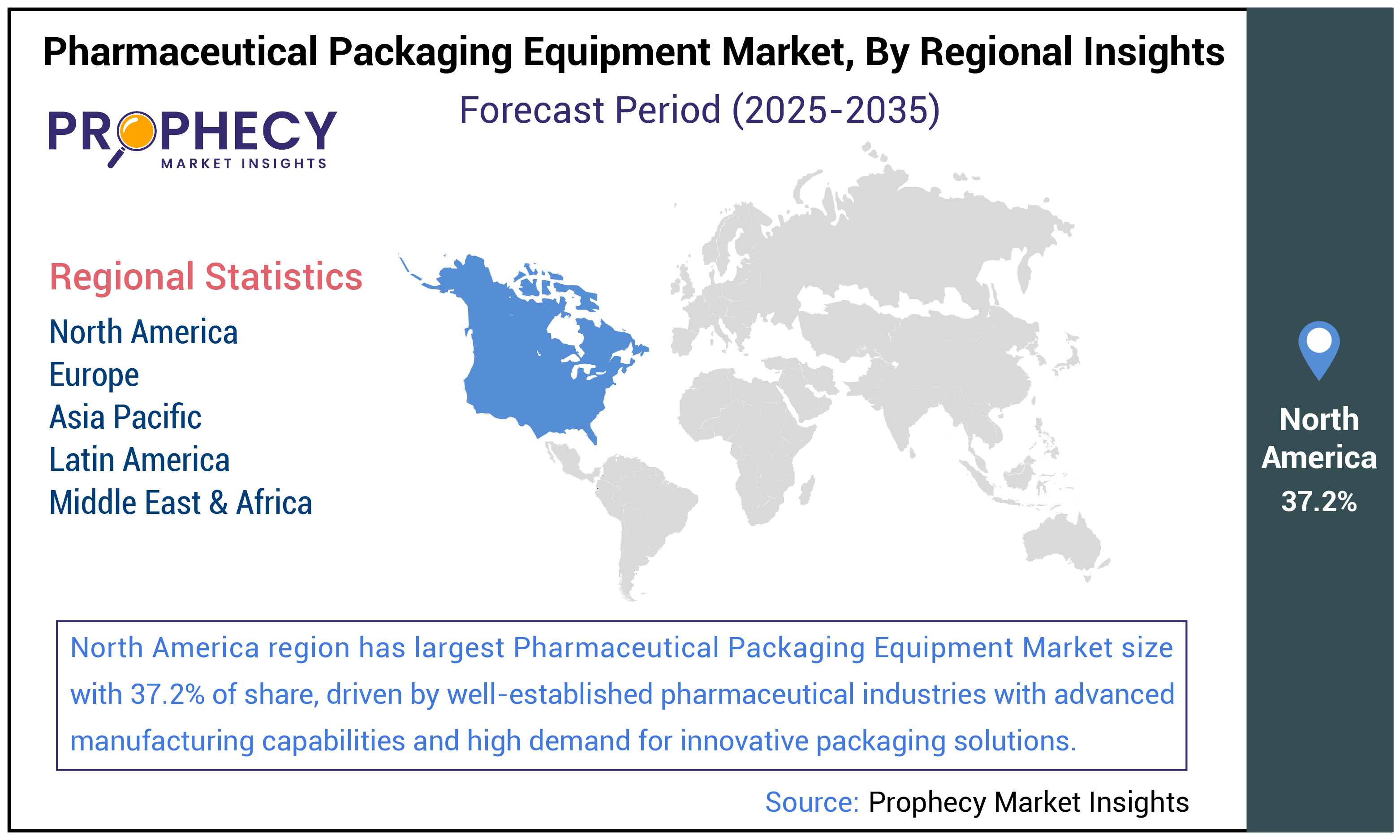
Geographically, the market is studied across North America, Europe, Asia Pacific, Latin America, and the Middle East & Africa.
North America: This region has largest pharmaceutical packaging equipment market size with 37.2% of share, driven by well-established pharmaceutical industries with advanced manufacturing capabilities and high demand for innovative packaging solutions. The presence of major pharmaceutical companies, with stringent regulatory requirements from agencies such as the FDA, drives significant investments in packaging technology. The growing demand for biopharmaceuticals, injectables, and personalized medicines has fueled the demand for high-precision packaging equipment in North America, contributing to pharmaceutical packaging equipment market growth.
- U.S. Pharmaceutical Packaging Equipment Market Insights:
The U.S. is the dominant country in the North America for the pharmaceutical packaging equipment market. As the global largest pharmaceutical market, the U.S. has a high demand for advanced packaging solutions due to its well-established pharmaceutical industry, stringent regulatory standards from the FDA, and a significant number of biopharmaceuticals, generic drug manufacturers. The U.S. leads in the adoption of automated packaging systems, and the growing demand for smart packaging propels the pharmaceutical packaging equipment market growth.
Europe: This is the second-largest region in the market. It contains several large pharmaceutical manufacturers and contract packaging companies, contributing to the demand for advanced packaging solutions. The high focus on regulatory compliance, the increasing demand for packaging solutions for biologics and injectables, growing adoption of smart packaging technologies, is anticipated to fuel region expansion in pharmaceutical packaging equipment market size.
- Germany Pharmaceutical Packaging Equipment Market Insights:
Germany is the dominant country in Europe for pharmaceutical packaging equipment. As a major hub for pharmaceutical manufacturing, Germany is home to large pharmaceutical companies and contract manufacturers. The country’s strong regulatory framework, supported by EMA (European Medicines Agency), drives demand for highly specialized packaging solutions, especially in biopharmaceuticals and injectables, predicted to boost pharmaceutical packaging equipment market share.
Asia Pacific: This region is experiencing rapid growth in the market. The expanding pharmaceutical industries in countries, the high demand for packaging solutions due to increasing drug production, a growing focus on generic drugs, and higher healthcare access, rise of biopharmaceutical, personalized medicine, is attributed to drive pharmaceutical packaging equipment market growth.
- China Pharmaceutical Packaging Equipment Market Insights:
In the Asia-Pacific region, China is the leading country in the pharmaceutical packaging equipment market. China’s rapidly expanding pharmaceutical sector, driven by increasing healthcare demand, government investment, and an aging population, contributes to a significant need for advanced packaging technologies.
Pharmaceutical Packaging Equipment Market Report Scope:
|
Attribute |
Details |
|
Market Size 2025 |
USD 10.3 Billion |
|
Projected Market Size 2035 |
USD 19.9 Billion |
|
CAGR Growth Rate |
7.5% (2025-2035) |
|
Base year for estimation |
2024 |
|
Forecast period |
2025 – 2035 |
|
Market representation |
Revenue in USD Billion & CAGR from 2025 to 2035 |
|
Regional scope |
North America - U.S. and Canada Europe – Germany, U.K., France, Russia, Italy, Spain, Netherlands, and Rest of Europe Asia Pacific – China, India, Japan, Australia, Indonesia, Malaysia, South Korea, and Rest of Asia-Pacific Latin America - Brazil, Mexico, Argentina, and Rest of Latin America Middle East & Africa – GCC, Israel, South Africa, and Rest of Middle East & Africa |
|
Report coverage |
Revenue forecast, company share, competitive landscape, growth factors, and trends |
Segmentation:
By Product:
- Primary Packaging
- Aseptic Filling & Sealing Equipment
- Bottle Filling & Capping Equipment
- Blister Packaging Equipment
- Secondary Packaging
- Cartooning Equipment
- Case Packaging Equipment
- Wrapping Equipment
- Tray Packing Equipment
- Labelling & Sterilization
- Bottle & Ampule Labelling
- Carton Labelling & Serialization Equipment
By Formulation Type:
- Liquid Packaging Equipment
- Solid Packaging Equipment
- Semi-solid Packaging Equipment
By Automation Type
- Manual
- Automatic
- Semi-automatic
By End-User:
- Pharmaceutical Companies
- Contract Manufacturing Companies
By Region:
- North America
- U.S.
- Canada
- Europe
- Germany
- U.K.
- France
- Russia
- Italy
- Spain
- Netherlands
- Rest of Europe
- Asia Pacific
- China
- India
- Japan
- Australia
- Indonesia
- Malaysia
- South Korea
- Rest of Asia Pacific
- Latin America
- Brazil
- Mexico
- Argentina
- Rest of Latin America
- Middle East & Africa
- GCC
- Israel
- South Africa
- Rest of Middle East & Africa
Global Pharmaceutical Packaging Equipment Market Competitive Landscape & Key Players
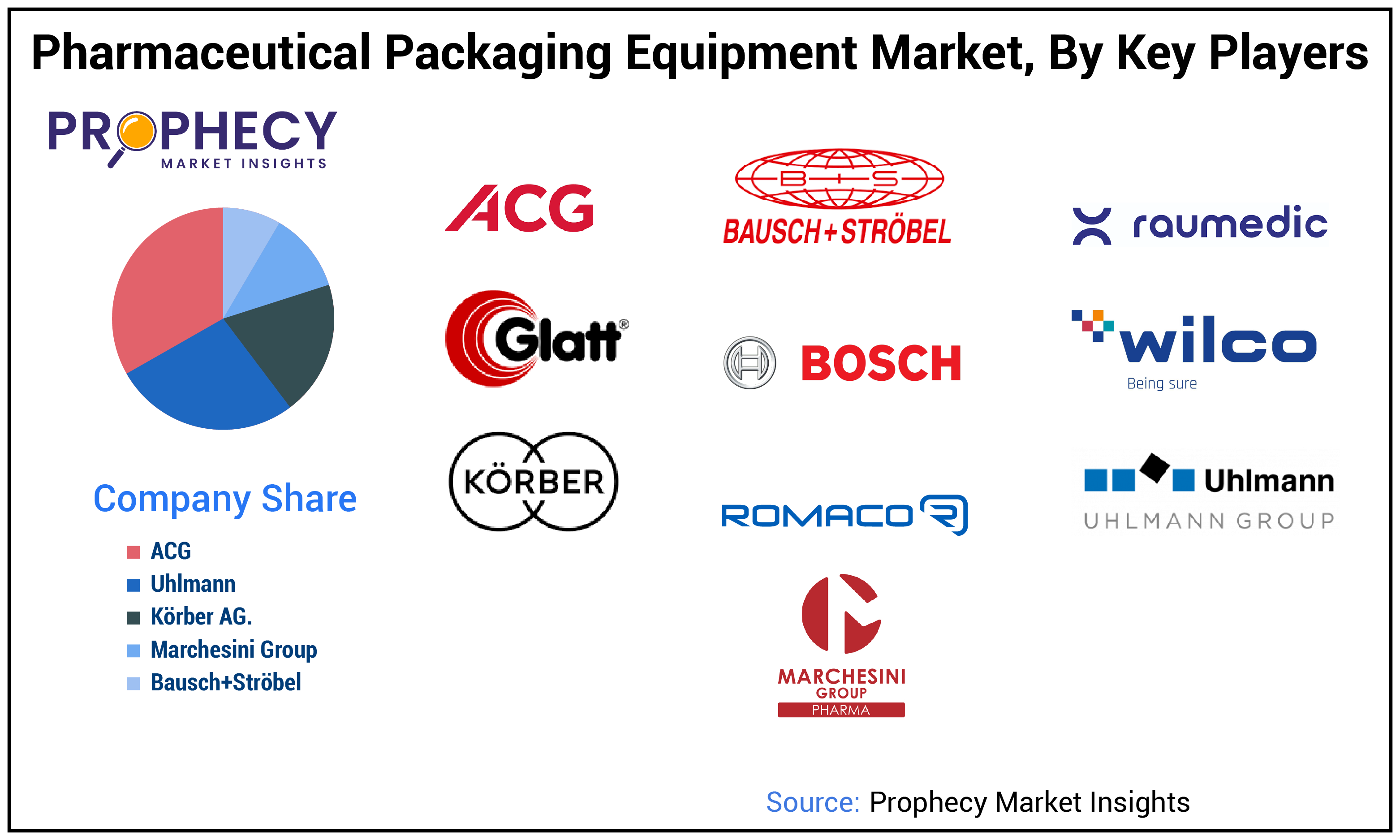
ACG, Uhlmann, Körber AG., and others are the significant players functioning in the pharmaceutical packaging equipment market. Companies are heavily investing in automated packaging solutions to increase throughput, reduce human error, and comply with regulatory standards. Companies are advancing smart packaging and sustainability, to meet growing demand for eco-friendly solution, through their partnerships or collaboration, is anticipated to drive pharmaceutical packaging equipment market share.
Pharmaceutical Packaging Equipment Market Companies:
- ACG
- Uhlmann
- Körber AG.
- Marchesini Group
- Bausch+Ströbel
- WILCO AG
- Glatt GmbH, Binzen
- Robert Bosch UK Holdings Ltd.
- IMA
- Romaco Group
- RAUMEDIC
- Huizhou Pingfang pharmaceutical machinery Co.,Ltd.
- Erweka GmbH
- MAQUINARIA INDUSTRIAL DARA, SL
- Accutek Packaging Compny, Inc.
View an Additional List of Companies in the Pharmaceutical Packaging Equipment Market
Global Pharmaceutical Packaging Equipment Market Recent News
- In March 2025, MG America, the US subsidiary of MG2 of Bologna, Italy and a supplier of processing and packaging equipment, has become the exclusive North American distributor for two Italy-based manufacturers of pharmaceutical packaging equipment solutions. MG America represented Last Technology for clean pharma production, and FamarTec equipment for both primary and secondary packaging. For primary packaging applications, FamarTec is best known for its blister packaging and thermoforming machines.
- In February 2025, Harpak-ULMA introduced the ARTIC SS Chevron, an advanced horizontal flow wrap machine designed for medical and pharmaceutical packaging applications. This innovative system aimed to minimizes film usage, with highly efficient sterility or easy-open features to redefine packaging industry. This equipment designed to eliminated use of premade bags, reduced costs and gives greater control over manufacturer packaging process.
- In August 2024, IMA Group acquired Sarong’s Packaging Machinery and Packaging Materials division, to target pharma and consumer goods. Sarong’s Packaging Machinery division was responsible for designing, manufacturing, and selling automatic thermoforming Form, Fill & Seal (FFS) and Fill & Seal (FS) packaging machines. Their packaging materials converts and sells suppositories/ovules film and foils, and converts rigid thermoforming films for liquid, semi-liquid pharmaceutical applications.
- In May 2024, ATS Corporation acquired Paxiom Group, a provider of primary, secondary, and end-of-line packaging machines in the food and beverage, cannabis, and pharmaceutical industries. Paxiom has its automated packaging solutions, including weigh filling, bagging, labeling, robotic case packing, and palletizing. By integrating Paxiom’s operational efficienct with ATS’s existing brands such as CFT, Raytec, Marco, IWK, and NCC, this acquisition aimed to strengthens ATS’ position to offer comprehensive, scalable, and customizable packaging systems, especially valuable in pharmaceutical and nutraceutical sectors.
Analyst View:
The pharmaceutical packaging equipment market is experiencing steady growth in the coming years, driven by increasing demand for advanced packaging technologies, rising healthcare needs, and stringent regulatory requirements. Market is expanding due to the continuous innovation in packaging solutions, particularly in automation, smart packaging, and sustainability. The increase chronic disease burden, rising demand for biopharmaceuticals, injectables, personalized medicine, and shift towards automated, high-efficiency packaging lines, is anticipated to drive pharmaceutical packaging equipment market share.
More Related Reports
Online Pharmaceuticals Market
Sustainable Plastic Packaging Market
Returnable Packaging Market
Beverage Carton Packaging Machinery Market
Thin Wall Packaging Market
Global Pharmaceutical Packaging Equipment Market Company Profile
|
Company Name |
Uhlmann Group |
|
Headquarter |
Laupheim, Germany |
|
CEO |
Prof. Dr.-Ing. Matthias Niemeyer |
|
Employee Count |
2,600 employees |
Global Pharmaceutical Packaging Equipment Market Highlights
FAQs
Pharmaceutical packaging equipment market size was valued at USD 10.3 Billion in 2025 and is expected to reach USD 19.9 Billion by 2035 growing at a CAGR of 7.5%.
Product, formulation type, automation type, end-user, and region are the segmentation for the pharmaceutical packaging equipment market.
North America, Asia Pacific, Europe, Latin America, and the Middle East & Africa. North America is expected to dominate the market.
The key players operating in the pharmaceutical packaging equipment market include ACG, Uhlmann, Körber AG, Marchesini Group, Bausch+Ströbel, WILCO AG, Glatt GmbH, Binzen, Robert Bosch UK Holdings Ltd., IMA, Romaco Group, RAUMEDIC, Huizhou Pingfang pharmaceutical machinery Co.,Ltd., Erweka GmbH, MAQUINARIA INDUSTRIAL DARA, SL, and Accutek Packaging Compny, Inc.