Global Operating Table Fixation Straps Overview
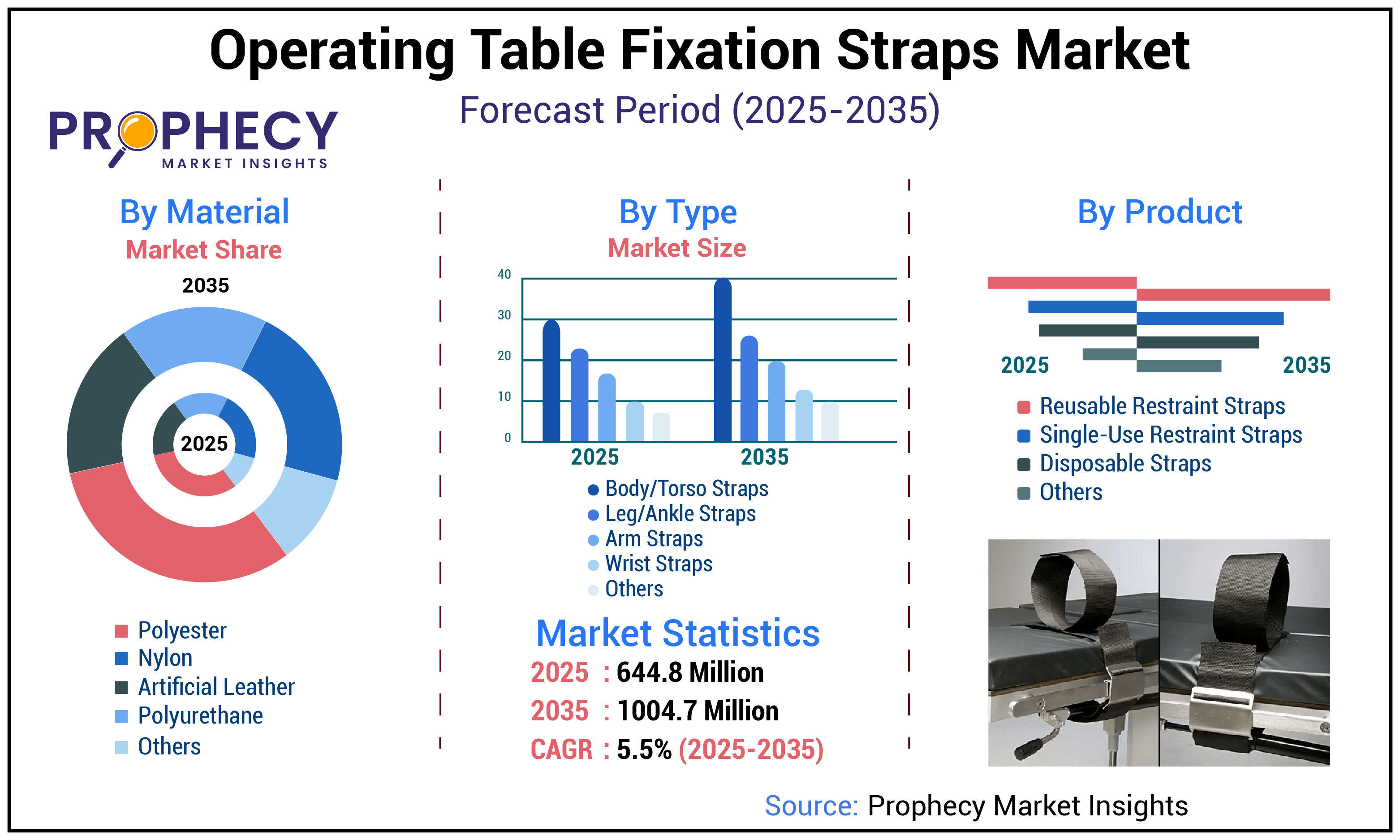
- By 2035, the operating table fixation straps market size is contemplated to enlarge at a valuation of USD 1004.7 Million.
- In 2024, the operating table fixation straps market valuation was USD 616.7 Million.
- Operating table fixation straps market is developing at a CAGR of 5.5%.
Operating table fixation straps are medical equipment used to hold/fasten the body of a patient in an operating table during a surgical process. Its main aim is to make sure that patients are safe by eliminating any possibility of unintentional movement, which can affect accuracy of surgery or may bring about harm to the patient. Depending on the type of clothing to be used, these straps are available in body, leg, arm and wrist straps and are constructed of hygienic and durable materials such as polyester or nylon to ensure comfort and fixation.
The future of operating table fixation straps market looks bright with a profitable rise. As economies grow and with development going on, various countries have developed their own health care facilities that include hospitals, clinics, and specialty centers. This development has increased the need to acquire more medical devices and accessories. Fixation straps are needed to make sure patients are immobile during the surgeries. As per the regulatory requirements, during the surgical procedures, secure fixation must be obtained.
In the future, the operating table fixation straps market shows substantial growth potential. There is increasing demand for disposable, sterile straps to minimize infection risks, which also aligns with sustainability trends, as the medical field generates a significant amount of waste.
Global Operating Table Fixation Straps Drivers & Restraints
Key Drivers:
Global Surge in Surgical Volumes Drives Demand for Operating Table Fixation Straps
The global increase in surgical procedures in a decade as revealed by the Eurostat and other global health statistics has stimulated the growth of the Operating Table Fixation Straps market. The rising surgical volume across the world has put pressure on patient safety and accuracy in the process. Over the past 10 years, there is an expansion in surgical procedures by 20-25 percent worldwide; over 300 million surgical procedures take place annually. The growth is being propelled by the change in demography including aging population, increasing prevalence of chronic illnesses, and increased technologies in minimally invasive and specialty surgery.
- For Instance, according to a study published in The Lancet major surgeries at world level are almost 310million every year with rise being observed within the past decade. The trend highlights the increased requirement of surgical equipment, such as operating table fixation straps, in order to provide patient safety and precision during the surgical procedures.
Restraints:
Limited Accommodation for Diverse Patient Needs
Although operating table fixation straps are critical to the stability and security of patients undergoing surgery, most products on the market are only designed to fit the standard patient body type. This restricts the potential to fit people with specific requirements, example people with a very large or small body proportions, musculoskeletal deformities and also those with neurological conditions very severe tremor or spasticity. Under this situation, healthcare professionals will require tailored or special straps, which are not usually available and commonly costlier.
- Counterbalance Statements: Manufacturers are developing more intelligent designs with broader straps, less rigid padding, adjustable fastenings systems which can accommodate more patients. The new advances promise to place patients of every size and condition in safer, more comfortable operating room positions, and partially due to this they can fill a gap that no conventionally designed strapping system could adequately serve.
Opportunities & Trends:
Tech Innovations and Disposable Demand Drive Operating Table Fixation Straps Market Growth
The market for operating table fixation straps seems to be growing at a steady pace, this might be due to the ongoing tech improvements and a rising push toward disposable, sterile options. Advanced newer materials and more ergonomic designs are considered to make these straps safer, more durable, and generally more comfortable for patients. Additionally, the newer modular and adjustable types seem to fit a wider range of patient needs. At the same time, many hospitals and surgical centers seem to be leaning toward single-use straps to cut down infection risks and stick to strict hygiene rules which could be opening the door for more affordable, high-volume products.
- For Instance, Manufacturers such as Reison Medical which manufactures, adjustable, washable and padded fixation straps, which enhance improved patient placement and comfort during surgery. Such contemporary designs have innovations that focus on ease of use, flexibility, and safety to the patients. Simultaneously, many manufacturers (e.g., Reison and STERIS) are responding to increased demand between disposable and sterile straps that help to minimize infection risks during surgical operations.
Global Operating Table Fixation Straps Segmentations & Regional Insights
Product type, material, type, application, end users, and region are the divisions of the operating table fixation straps market.
By Product Type:
Single-use restraint straps, reusable restraint straps, disposable straps, and others. are product type on which operating table fixation straps market is segmented. The reusable restraint strap has the highest operating table fixation straps market share due to their long-term cost-effectiveness, particularly in healthcare facilities with high surgical volumes. They are often manufactured of long-lasting materials that can be washed and disinfected frequently, making them ideal for frequent usage in hospitals and surgical facilities.
Second are single use restraint straps, which disposable straps offer convenience, reduce sterilization costs, and appeal to healthcare providers focusing on safety and regulatory compliance.
By Material:
Based on the material, the operating table fixation straps market is divided into polyester, artificial leather, nylon, polyurethane, and others. Polyester holds the largest operating table fixation straps market share when it comes to material for its strength and durability. Additionally, they can also be sterilized and reused.
Nylon material is the second-largest category, mostly due to its high tensile strength and flexibility. It can be used regularly in surgery as it is lightweight and can be washed with ease. This necessitates patient safety as well as organizational efficiency.
By Type:
Body/Torso straps, leg/ankle straps, arm straps, wrist straps and others are type of the operating table fixation straps market. Body/torso straps hold the largest operating table fixation straps market share since they play a significant role in keeping the patient secure during the surgical process and enhancing overall safety. Their adaptability of surgical fields makes them a necessary part in any modern operating theatre.
Leg/Ankle are the second most dominant as it is necessary in the lower part of the body, in especially during orthopedic, gynecologic, and urologic procedures to help stabilize the body while enhancing patient positioning in addition to the surgeons precision.
By Application:
On the application, operating table fixation straps market is categorized into orthopedics, general surgery, neurosurgery/spinal, cardiothoracic, obstetrics &gynecology, pediatric surgery and others. General surgery holds the largest operating table fixation straps market size as operating tables are most frequently used for those procedures. Orthopedics surgery ranks as the second most dominant due to their need for special fixation, as these surgeries involves bone, joints and muscles.
By End Users:
Hospitals, private clinics / ambulatory surgical centers, outpatient surgical centers, emergency medical services, and others are end users of the operating table fixation straps market. Hospitals dominate this segment of end users, as most surgeries takes place in hospitals, where larger number of doctors, surgeons and medical staff is involved.
Private clinics / ambulatory surgical centers are the second most dominant for this segment as they offer more convenient, efficient, and often lower-cost alternatives to traditional hospital surgeries.
Regional Insights:
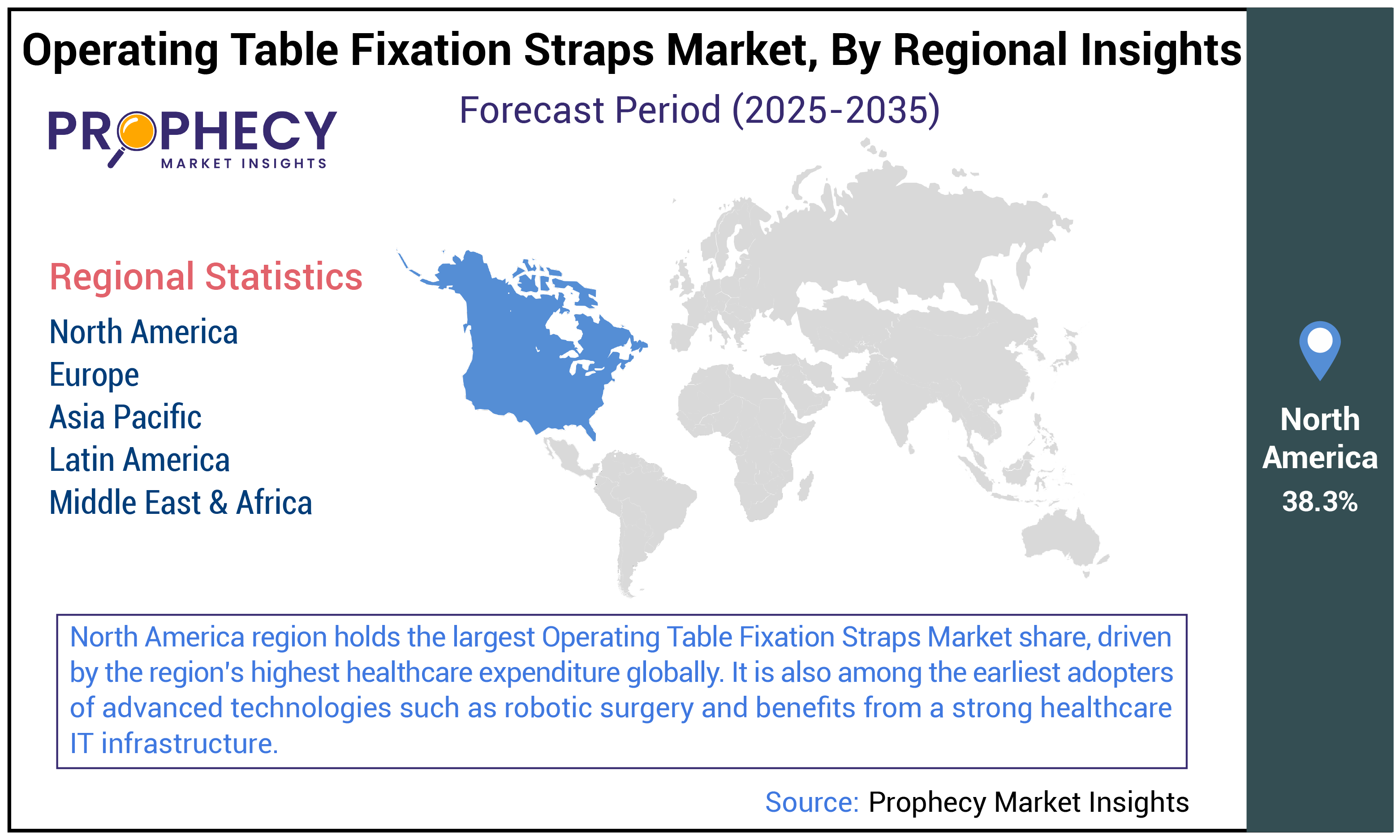
Geographically, the operating table fixation straps market is studied across North America, Europe, Asia Pacific, Latin America, and the Middle East & Africa.
North America: This region holds the largest operating table fixation straps market share, driven by the region’s highest healthcare expenditure globally. It is also among the earliest adopters of advanced technologies such as robotic surgery and benefits from a strong healthcare IT infrastructure. Additionally, the high concentration of hospitals offering complex surgical procedures further fuels the demand for advanced fixation straps.
- U.S. Operating Table Fixation Straps Market Insights:
According to the World Health Organization (WHO) and the American Medical Association, the United States seems to lead in global healthcare spending. Due to that, they probably also carry out a large share of the surgeries that need fixation straps. There are also pretty strong rules around patient safety and medical device quality, which kind of push hospitals and surgical centers toward using more advanced straps. The U.S. could also be among the first to adopt things such as minimally invasive surgeries, which adds to the demand for more specialized fixation solutions.
Europe: This region holds a significant portion of the market due to its healthcare systems, their healthcare system is known for being a well-developed and optimized system that efficiently and effectively provides high-quality healthcare services to its population. There are also know for their high-quality standards and strict sterilization requirements, fueling demand for both reusable and disposable fixation straps. Additionally, Europe's aging population results in increased surgical procedures, especially in orthopedics and other chronic condition-related surgeries.
- Germany Operating Table Fixation Straps Market Insights:
Germany is known for having a pretty advanced healthcare system, especially when it comes to modern surgical facilities, such as in orthopedics and surgeries related to chronic diseases. The U.K. seems to benefit from strong regulations and an increasing focus on patient comfort and safety. Both countries have pretty strict rules around sterilization and hygiene, which probably supports demand for both reusable and disposable fixation straps. With their aging populations and ongoing investments in healthcare, they continue to hold a strong position in the market.
Asia Pacific: This is one of the fastest developing regions in the world, and that growth is showing up in healthcare too. There’s been a rise in modern hospitals and, possibly, a growing number of highly skilled surgeons. India, for example, has become quite a popular spot for medical tourism, with patients from western countries coming here for surgery as it’s often cheaper and still done by experienced specialists. This could be one reason why all kinds of surgeries are increasing in the region. And since operating table fixation straps are generally required under regulatory standards, the demand here is also possibly on the higher side.
- China Operating Table Fixation Straps Market Insights:
China probably leads due to its rapidly growing healthcare infrastructure. Also, due toits large and aging population, hence there is a high demand for surgeries, which helps China dominate the region’s industry.
Operating Table Fixation Straps Market Report Scope:
|
Attribute |
Details |
|
Market Size 2025 |
USD 644.8 Million |
|
Projected Market Size 2035 |
USD 1004.7 Million |
|
CAGR Growth Rate |
5.5% (2025-2035) |
|
Base year for estimation |
2024 |
|
Forecast period |
2025 – 2035 |
|
Market representation |
Revenue in USD Million & CAGR from 2025 to 2035 |
|
Regional scope |
North America - U.S. and Canada Europe – Germany, U.K., France, Russia, Italy, Spain, Netherlands, and Rest of Europe Asia Pacific – China, India, Japan, Australia, Indonesia, Malaysia, South Korea, and Rest of Asia-Pacific Latin America - Brazil, Mexico, Argentina, and Rest of Latin America Middle East & Africa – GCC, Israel, South Africa, and Rest of Middle East & Africa |
|
Report coverage |
Revenue forecast, company share, competitive landscape, growth factors, and trends |
Segmentation:
By Product Type:
- Single-Use Restraint Straps
- Reusable Restraint Straps
- Disposable Straps
- Others
By Material:
- Polyester
- Artificial Leather
- Nylon
- Polyurethane
- Others
By Type:
- Body/Torso Straps
- Leg/Ankle Straps
- Arm Straps
- Wrist Straps
- Others
By Application:
- Orthopedic
- General Surgery
- Neurosurgery / Spinal
- Cardiothoracic
- Obstetrics & Gynecology
- Pediatric Surgery
- Others
By End Users:
- Hospitals
- Private Clinics / Ambulatory Surgical Centers
- Outpatient Surgical Centers
- Emergency Medical Services
- Others
By Region:
- North America
- U.S.
- Canada
- Europe
- Germany
- U.K.
- France
- Russia
- Italy
- Spain
- Netherlands
- Rest of Europe
- Asia Pacific
- China
- India
- Japan
- Australia
- Indonesia
- Malaysia
- South Korea
- Rest of Asia Pacific
- Latin America
- Brazil
- Mexico
- Argentina
- Rest of Latin America
- Middle East & Africa
- GCC
- Israel
- South Africa
- Rest of Middle East & Africa
Global Operating Table Fixation Straps Competitive Landscape & Key Players
Manufactures should focus on developing a customizable fixation straps that could be used for patients who suffer from essential tremor, which causes involuntary, rhythmic shaking most often in the hands, arms, and head, making them necessary for patient safety. Additionally they can also make for people who have extreme body proportions, musculoskeletal deformities, or neurological problems such severe tremors or spasticity.
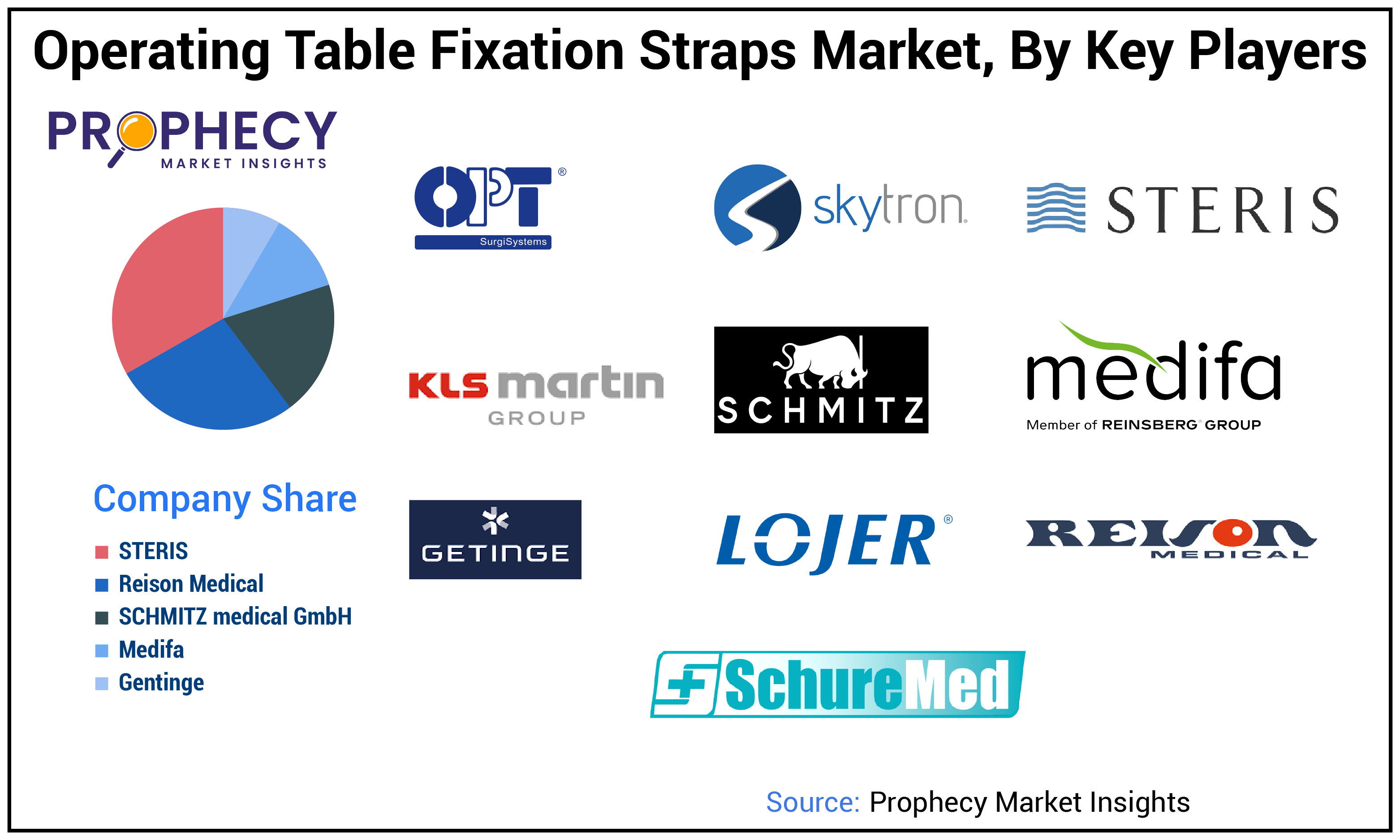
To further enhance this innovation, manufacturers could focus on biocompatible materials that are gentle on patients’ skin and minimize allergic reactions or irritation during surgery. The key players operating in the operating table fixation straps market include STERIS, Reison Medical, KLS Martin Group, Gentinge, Lojer Oy., and others.
Operating Table Fixation Straps Market Companies:
- STERIS
- Reison Medical
- SCHMITZ medical GmbH
- Medifa
- Gentinge
- Lojer Oy.
- OPT SURGISYSTEMS S.R.L.
- SchureMed
- KLS Martin Group
- SKYTRON, LLC
- Avante
- AneticAid
- AliMed
- NARESH BROTHERS
View an Additional List of Companies in the Operating Table Fixation Straps Market
Global Operating Table Fixation Straps Recent News
- In 2022, STERIS has introduced advanced body restraint accessories for surgical tables, designed to enhance patient safety and comfort during complex table articulations, prevent unwanted movement, and support surgical teams in maintaining patient positioning during high-risk surgeries.
- In 2025, Reison Medical rolled out an updated Two-Piece Leg/Body Strap that comes with adjustable Velcro, which is meant to fit patients of different sizes and mattress thicknesses comfortably and securely. The strap lets surgical teams customize the fit pretty precisely based on the patient’s anatomy and the procedure’s needs, which can help reduce movement and improve safety.
Analyst View:
The operating table fixation straps market continues to grow quickly as a result of growing demand for all kinds of surgeries. Companies such as Reison Medical and OPT Surgi Systems have been updating their adjustable, padded, and washable strap designs as recently as 2025, focusing on keeping patients secure and comfortable while also controlling infections. Then there’s STERIS, which back in 2022 introduced some advanced body restraint accessories to handle more complex surgical positions. With the rise of more adjustable and versatile fixation straps, the market could grow substantially.
More Related Reports
BioSurgery Market
Disposable Cups Market
Disposable Gloves Market
Operating Room Management Solution Market
Operating Room Equipment Market
Global Operating Table Fixation Straps Company Profile
|
Company Name |
STERIS |
|
Headquarter |
Jacksonville, Florida |
|
CEO |
Joaquin Duato |
|
Employee Count |
4,500Employees |
Global Operating Table Fixation Straps Highlights
FAQs
Operating table fixation straps market size was valued at USD 644.8 Million in 2025 and is expected to reach USD 1004.7 Million by 2035 growing at a CAGR of 5.5%.
Product type, material, type, application, end Users, and region are the segmentation for the operating table fixation straps market.
North America, Asia Pacific, Europe, Latin America, and the Middle East& Africa. North America is expected to dominate the market.
The key players operating the operating table fixation straps market include STERIS, Reison Medical, SCHMITZ medical GmbH, Medifa, Gentinge, Lojer Oy., OPT SURGISYSTEMS S.R.L., SchureMed, KLS Martin Group, SKYTRON, LLC, Avante, AneticAid, AliMed, and NARESH BROTHERS.