Global Non Alcoholic Beverage Market Overview
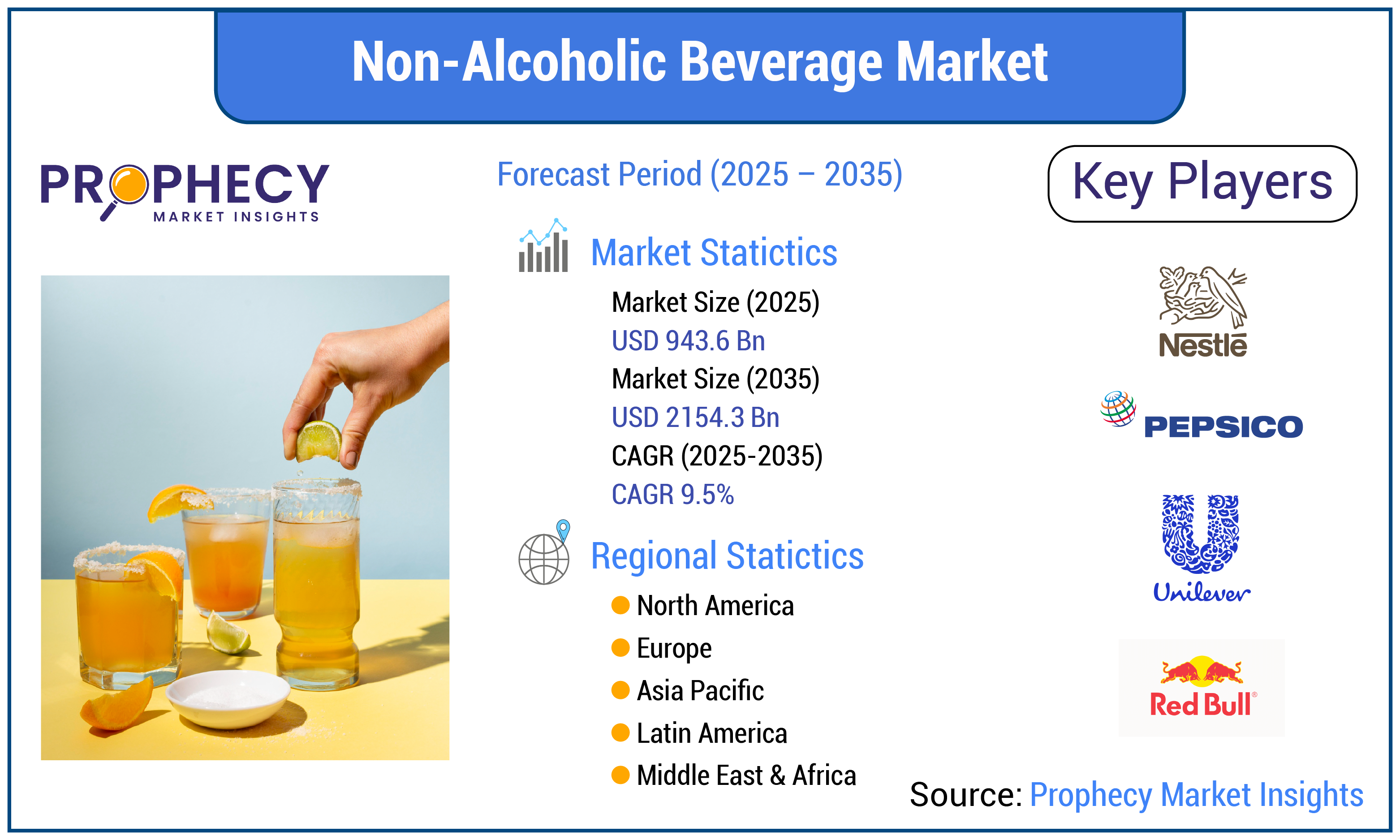
- By 2035, the non-alcoholic beverage market size is contemplated to enlarge at a valuation of USD 2154.3 Billion.
- In 2024, the non-alcoholic beverage market valuation was USD 875 Billion.
- Non-alcoholic beverage market is developing at a CAGR of 9.5%.
A beverage with little or no alcohol (usually less than 0.5% ABV) is regarded as non-alcoholic. Soft drinks, juices, tea, coffee, and alcohol-free variants of wine or beer are examples of these drinks. Non-alcoholic drinks are often consumed as refreshers at meals, parties, or during workouts. They are also used as substitutes for alcoholic beverages by those who refrain from alcohol for personal, religious, or nutritional reasons.
Non-alcoholic beverages market grows due to a global shift toward wellness-oriented way of life, growing consumer health consciousness, and increased demand for low-calorie and functional drinks. The market keeps growing as a result of urbanization, shifting nutritional habits, and the increasing need for ready-to-drink a beverage. Eco-friendly consumers have concerns about their health and the environment which shift to products with new tastes, natural ingredients, and sustainable packaging. Moreover, the growth of organic and plant-based beverage choices is satisfying specialized preferences of consumers. Access of products and exposure on global scale have been influenced by the e-commerce growth and marketing.
Non-Alcoholic Beverage Market is witnessing several key opportunities and trends with the market for non-alcoholic beverages is growing due to the emergence of the "sober curious" movement and health-conscious life. Zero-proof drinks, functional beverages with extra nutrients, and modern choices like fluid teas, prebiotic sodas, and sodas with cocktail flavors have grown more and more popular among consumers.
Key Indicators:
- According to the International Wines and Spirits Record (IWSR), non-alcoholic brands will showcase significant growth in such markets as the consumers are exploring ways to reduce their alcohol intake.
Recession Risk & Tariff Analysis:
- The non-alcoholic beverage market counters moderate recession risks as the changing trade regulations and growing inflation might pose challenges for the non-alcoholic beverage industry. Consumers might spend less during economic downturns, especially on elite or functional beverage items, as they prioritize necessity.
- Overall, even while demand is still robust, further expansion will require handling fiscal risks and shifting tariff policy impacting the global trade. Companies could have to change and modify their pricing regulations, look into local sourcing, or diversify their markets, in order to stay profitable.
Impact of Generative AI on Non-Alcoholic Beverage Market:
- The non-alcoholic beverage market is being impacted by generative AI with enhancing product innovation, marketing, and interactions with consumers. AI is being used by companies to evaluate buyer habits and provide customized tastes, useful calculations, and packaging designs to promote efficient operations and boost sales.
- Moreover, for demand forecasting and chatbot-driven support are also enabled by predictive analytics. Thus, companies may enhance customer service, accelerate their manufacturing cycles, and obtain a competitive edge in an ever-shifting marketplace having a lead in such global competitive landscape.
Global Non Alcoholic Beverage Market Drivers & Restraints
Key Drivers:
Rise of Nutritious Beverages Fuels Growth in the Non-Alcoholic Drink Market
The non-alcoholic beverage market is growing significantly for non-alcoholic drinks due in large part to the introduction of rich in nutrients beverages. Demand for beverages that provide practical advantages including immune support, digestive health, energy improvement, and mental well-being increases as consumers become more health-conscious. The need has prompted producers to reconsider how they manufacture their products, and it has affected new ideas in manufacturing by drawing focus to how millennial consumers' tastes are shifting.
- For Instance, according to the Key National Health and Nutrition Organizations 2019, adequate intake of healthy beverages in early childhood is an important factor required to meet the nutritional needs of millennials and young children to support their healthy development.
Restraints:
Supply Chain Strains Intensify as Natural Resource Volatility Hits Non-Alcoholic Beverage Industry
The major challenge consist of supply chain for non-alcoholic beverages is facing major challenges due to fluctuations in the price and accessibility of natural resources. Climate change, geopolitical conflicts, and unplanned harvesting are having a greater effect on ingredients including fruits, herbs, and plant extracts, as well as essential packaging materials such glass and aluminum. To maintain constant supply and pricing is a difficult challenge that major companies have to face.
- Counterbalance Statements: With adopting sustainable agriculture methods, enhancing their supply chains, and investing in local sourcing, several beverage companies are taking steps to tackle these issues. Innovations in packaging that is recyclable and ingredient replacement are helping in reducing dependency on limited resources, guaranteeing consistent manufacturing and long-term cost savings.
Opportunities & Trends:
E-Commerce and Organized Retail Drive Non-Alcoholic Beverage Demand in Emerging Cities
Rising consumption to non-alcoholic drinks is being substantially expanded for a variety of consumer sectors, including those in Tier-II and Tier-III cities, due to the expanding reach of organized retail networks and e-commerce platforms. Internet-based marketplaces give consumers a practical method to look through a variety of beverage options. The manufacturers get the opportunity to reach new markets and meet shifting regional customer preferences due to this increased accessibility, demand grows beyond cities driving market growth globally.
Global Non Alcoholic Beverage Market Segmentations & Regional Insights
Product, category, flavor, functionality, packaging, distribution channel, and region are the divisions of the non-alcoholic beverage market.
By Product:
Bottled water, RTD tea & coffee, functional beverages, juices, dairy-based beverages, others are product on which non-alcoholic beverage market is segmented. Bottled water continues to be the most popular product categories in non-alcoholic beverage market share for non-alcoholic drinks due to their wide availability, strong trademark recognition, and high demand from consumers.
In the non-alcoholic beverage sector, ready-to-drink (RTD) tea and coffee, together with functional beverages, are currently the second most popular category, behind bottled water. These segments of the market will probably further solidify their position in years to come due to their rapid expansion, especially in metropolitan areas.
By Category:
The category segment is divided into carbonated beverages, non-carbonated beverages. The category split of the market gives the non-carbonated beverages sector a leading position. Influence is mostly due to consumers' rising health awareness, their desire for more natural and low-sugar beverage alternatives, and their growing demand for functional and nutritional beverages.
Carbonated drinks stand second dominant segment in non-alcoholic beverage market share as they are gaining traction due to their broad adoption, widespread consumption ratio specifically within young demographic.
By Flavor:
The fruits, herbal/botanical, sweetened & unsweetened, customized, others are flavor segments of non-alcoholic beverage market. Fruit-flavored drinks, such as those with orange, apple, mango, and mixed fruit flavors, gain popularity and is dominating the segment due to their renowned flavor, supposed benefits for health, and compliance with clean-label practices. Fruit flavor is used in both carbonated and non-carbonated beverages making them consumed at larger scale.
The herbal/botanical flavor is second-highest in segment with growing consumer preference in natural and wellness ingredients in beverages. This market is very appreciated by consumers who are health-conscious and purchase premium items due to the concept of additional health benefits including stress reduction, digestive assistance, and immunity enhancement.
By Functionality:
The segment is divided into hydration, nutritional support, energy boost, weight management, immunity support / wellness, others in non-alcoholic beverage market. The hydration segment leads in functionality in non-alcoholic beverage market share with its widespread demand for beverage consumed for daily fluid intake and wellness. A greater awareness of the need of maintaining proper hydration for both mental and physical performance has driven the segment.
A rising need for beverages that offer greater health benefits than just simple hydration has propelled the Nutritional Support sector to the second-dominant functionality category. Market is witnessing consumer shift to support health benefits, manage nutritional deficiencies and aging lifestyles.
By Packaging:
The packaging category is segmented into bottles, cans, cartons, pouches, others regarding the non-alcoholic beverage market. The bottle segment dominates the non-alcoholic beverage market share with large scale usage in packaging industry and its portability in various beverage types. For both carbonated and non-carbonated drinks, such as water, juices, functional beverages, and teas that are ready to drink, bottled packaging is highly advised.
Cans segment is second highest packaging usage after bottles with its popularity for carbonated soft drinks, energy drinks and alcoholic alternatives. Cans are favored for their lightweight building, superior barrier qualities, and effective cooling, all of which improve the beverage's flavor and extend its shelf life.
By Distribution Channel:
The non-alcoholic beverage market on the account of distribution channel is categorized into online retail, convenience stores, supermarkets, specialty stores, others. Supermarkets dominate this segment having large shelf space, wide range of products, and capacity to meet a range of consumer requirements in one place contribute to them being the most prominent distribution segment in the non-alcoholic beverage industry.
Advantage of home delivery, wide range of products, and personal shopping experiences have made online retail the second-most prevalent distribution channel in the non-alcoholic beverage sector. Healthy beverage alternatives that can't always be easily found in stores nearby, particularly in Tier-II and Tier-III cities, due to the growth of e-commerce thus consumers now have better access to premium products.
Regional Insights:
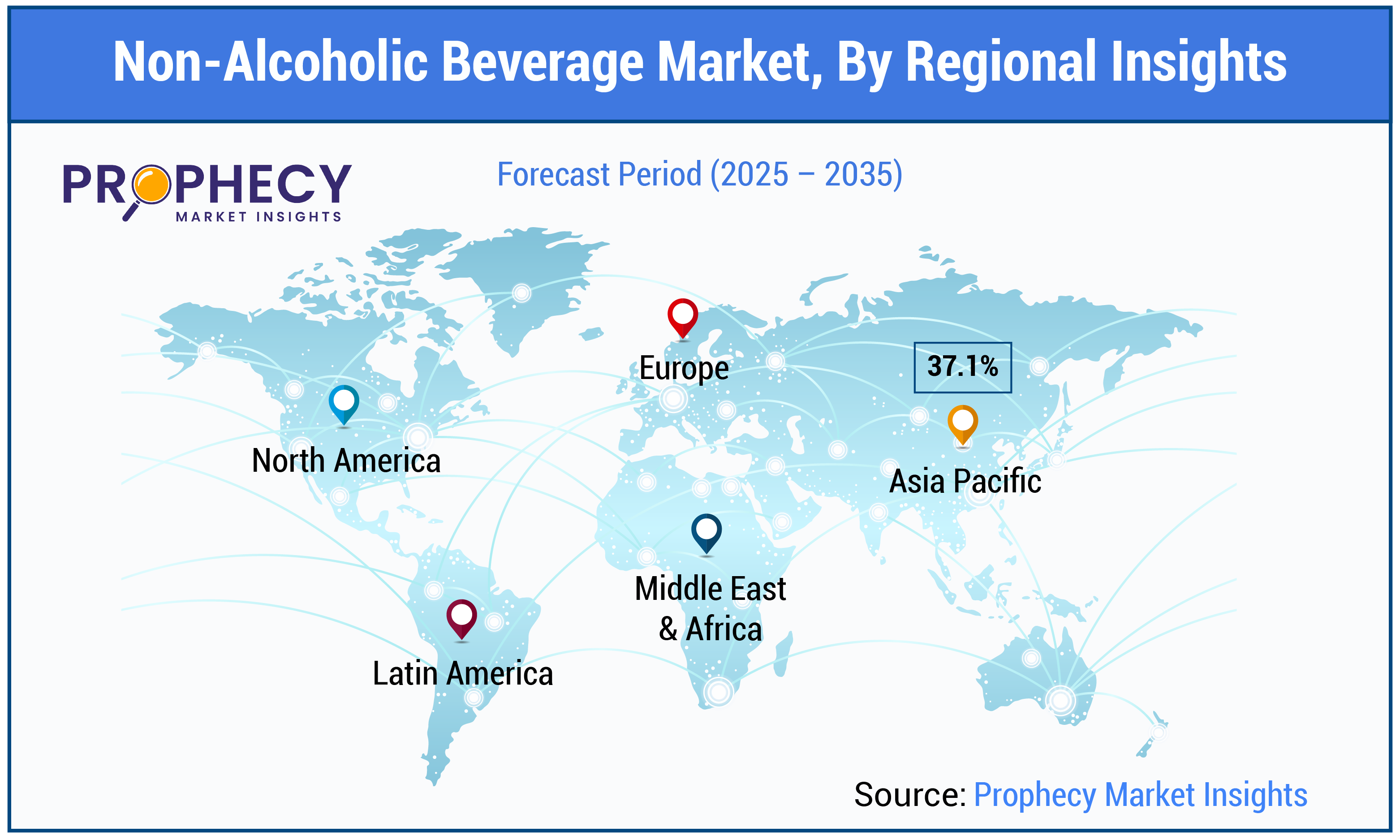
Geographically, the non-alcoholic beverage market is studied across North America, Europe, Asia Pacific, Latin America, and the Middle East & Africa.
Asia Pacific: The non-alcoholic beverage market in Asia-Pacific is largest market globally with due to a consistent growth in consumers' disposable income and way of life. Furthermore, regional innovations and local flavor preferences are helping companies in establishing their position in this active and rapidly expanding market. The market for ready-to-drink beverages, functional drinks, and bottled water is growing in countries including China, India, and Indonesia.
- China Non-Alcoholic Beverage Market Insights:
China is the market leader for non-alcoholic beverages in the Asia-Pacific region due to its massive population, shift in consumer preferences, and rapid economic growth. Purchase for premium, functional, and healthier beverage substitutes is growing among the country's expanding urban middle class, driving demand for products which includes RTD tea, juices, and bottled water.
North America: Due to a strong demand for functional and health-conscious beverages, a well-established retail and e-commerce ecosystem, and high consumer awareness, North America is currently leading the non-alcoholic beverage industry as the second-largest area. Current product innovation, and advanced manufacturing facilities can lead to sustained growth by a solid customer base in boosting the purchase scale.
- U.S. Non-Alcoholic Beverage Market Insights:
U.S. is the dominant region in the non-alcoholic beverage market. Given its broad customer base, substantial amount of disposable income, and robust demand for innovative and health-conscious goods, the United States leads the North American non-alcoholic beverage industry.
Europe: Regarding the non-alcoholic beverages market, Europe is an important region owing to the high demand for high-end, organic, and health-conscious beverages. Consumers in countries such as Germany, the U.K., France, and Italy are increasingly shifting toward natural ingredients, low-sugar options, and functional drinks that support wellness, hydration, and energy trying to implement the healthier alternatives in daily consumption.
- Germany Non-Alcoholic Beverage Market Insights:
Germany is the non-alcoholic beverage market leader in Europe due having a substantial population, robust economy, and established beverage sector. German consumers highly prefer fruit juices, bottled water, and functional drinks especially those made with natural and organic ingredients adapting a health-conscious lifestyle.
Non-Alcoholic Beverage Market Report Scope:
|
Attribute |
Details |
|
Market Size 2025 |
USD 943.6 Billion |
|
Projected Market Size 2035 |
USD 2154.3 Billion |
|
CAGR Growth Rate |
9.5% (2025-2035) |
|
Base year for estimation |
2024 |
|
Forecast period |
2025 – 2035 |
|
Market representation |
Revenue in USD Billion & CAGR from 2025 to 2035 |
|
Regional scope |
North America - U.S. and Canada Europe – Germany, U.K., France, Russia, Italy, Spain, Netherlands, and Rest of Europe Asia Pacific – China, India, Japan, Australia, Indonesia, Malaysia, South Korea, and Rest of Asia-Pacific Latin America - Brazil, Mexico, Argentina, and Rest of Latin America Middle East & Africa – GCC, Israel, South Africa, and Rest of Middle East & Africa |
|
Report coverage |
Revenue forecast, company share, competitive landscape, growth factors, and trends |
Segmentation:
By Method Type:
- Bottled Water
- RTD Tea & Coffee
- Functional Beverages
- Juices
- Dairy-based Beverages
- Others
By Category:
- Carbonated Beverages
- Non-carbonated Beverages
By Flavor:
- Fruits
- Herbal/Botanical
- Sweetened & Unsweetened
- Customized
- Others
By Functionality:
- Hydration
- Nutritional Support
- Energy Boost
- Weight Management
- Immunity Support / Wellness
- Others
By Packaging:
- Bottles
- Cans
- Cartons
- Pouches
- Others
By Distribution Channel:
- Retail Stores
- Online Retail
- Convenience Stores
- Supermarkets
- Specialty Stores
- Others
By Region:
- North America
- U.S.
- Canada
- Europe
- Germany
- U.K.
- France
- Russia
- Italy
- Spain
- Netherlands
- Rest of Europe
- Asia Pacific
- China
- India
- Japan
- Australia
- Indonesia
- Malaysia
- South Korea
- Rest of Asia Pacific
- Latin America
- Brazil
- Mexico
- Argentina
- Rest of Latin America
- Middle East & Africa
- GCC
- Israel
- South Africa
- Rest of Middle East & Africa
Global Non Alcoholic Beverage Market Competitive Landscape & Key Players
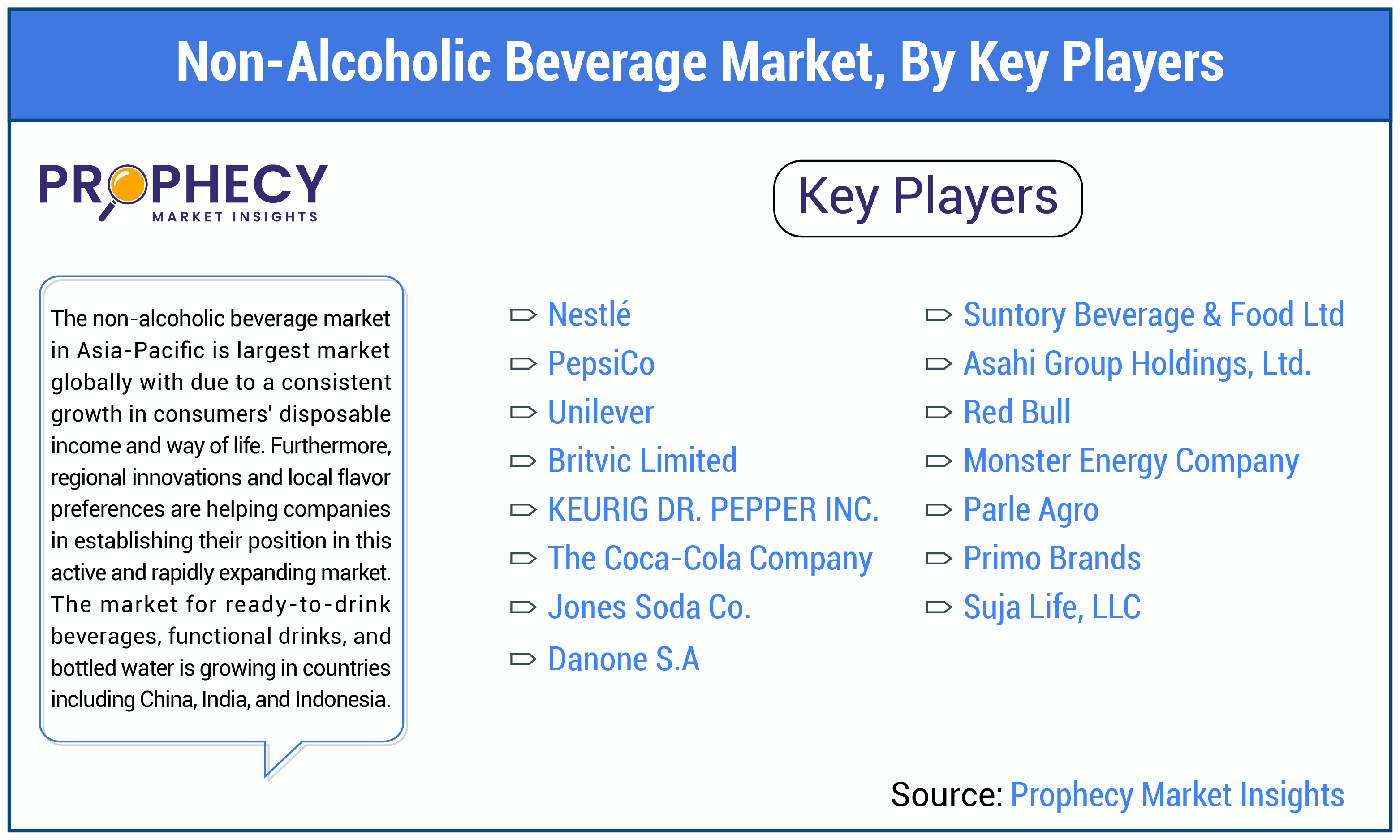
The key players operating in the non-alcoholic beverage market include, Nestlé, PepsiCo, Suntory Beverage & Food Ltd, KEURIG DR. PEPPER INC., The Coca-Cola Company, and others. Companies in the non-alcoholic beverage sector aim to provide original, sustainable, and nutritious drink alternatives that meet changing preferences of consumers. Many are additionally making a commitment to sustainable practices, such cutting back on use of plastic and improving supply chain transparency.
Nonalcoholic Beverages Market Companies:
- Nestlé
- PepsiCo
- Unilever
- Britvic Limited
- KEURIG DR. PEPPER INC.
- The Coca-Cola Company
- Jones Soda Co.
- Danone S.A
- Suntory Beverage & Food Ltd
- Asahi Group Holdings, Ltd.
- Red Bull
- Monster Energy Company
- Parle Agro
- Primo Brands
- Suja Life, LLC
View an Additional List of Companies in the Nonalcoholic Beverages Market
Global Non Alcoholic Beverage Market Recent News
- In September 2023, Red Bull Winter Edition Spiced Pear was introduced by Red Bull which is an inaugural limited in the UK, featuring a complete range that comprises 250ml, 250ml PMP (Price Marked Pack), and 355ml Sugarfree variants. The product features a combination of pear infused with a hint of cinnamon.
- In July 2022, PepsiCo, Inc. cleared an agreement to buy land near Denver International Airport, where it will build a 1.2 billion sq. ft. manufacturing facility. Denver is funding PepsiCo USD 1 Billion from its Business Incentive Fund to build the plant, which will turn out to be the company’s largest soda manufacturing facility in the U.S.
- In February 2022, a new plant-based version of Milo was introduced by Nestlé in Thailand. The new Ready-To-Drink (RTD) product is soy-based and combines the unique Milo malt flavor to provide a nutritious plant-based alternative.
Analyst View:
Analyst highlight the non-alcoholic beverage market as steadily growing with increasing consumer awareness of natural and health beneficial products. The market has ideal long-term potential due to increasing demand for honey and chemicals produced by bees in the food and beverage pharmaceutical, and cosmetic industries. Although there is competition from other sweeteners, analysts point out that honey has an edge in the market due to its versatility and clean-label appeal.
More Related Reports
Beverage Packaging Market
Beverage Flavoring Systems Market
Non-alcoholic Steatohepatitis Biomarkers Market
Non-alcoholic Steatohepatitis (NASH) Therapeutics and Diagnostics Market
Food and Beverage Processing Membrane Market
Global Non Alcoholic Beverage Market Company Profile
|
Company Name |
Unilever |
|
Headquarter |
London, U.K |
|
CEO |
Fernando Fernandez |
|
Employee Count |
128,000 Employees |
Global Non Alcoholic Beverage Market Highlights
FAQs
Non-alcoholic beverage market size was valued at USD 943.6 Billion in 2025 and is expected to reach USD 2154.3 Billion by 2035 growing at a CAGR of 9.5%.
Product, category, flavor, functionality, packaging, distribution channel, and region are the divisions of the non-alcoholic beverage market.
North America, Asia Pacific, Europe, Latin America, and the Middle East & Africa. North America is expected to dominate the market.
The key players operating the non-alcoholic beverage market include Nestlé, PepsiCo, Dabur India Ltd., BRITVIC LIMITED, KEURIG DR. PEPPER INC., The Coca-Cola Company, Jones Soda Co., Danone S.A, Suntory Beverage & Food Ltd, Asahi Group Holdings, Ltd., Red Bull, Monster Energy Company, Parle Agro, Primo Brands, and Suja Life, LLC.