Global Neutral Alternative Proteins Market Overview
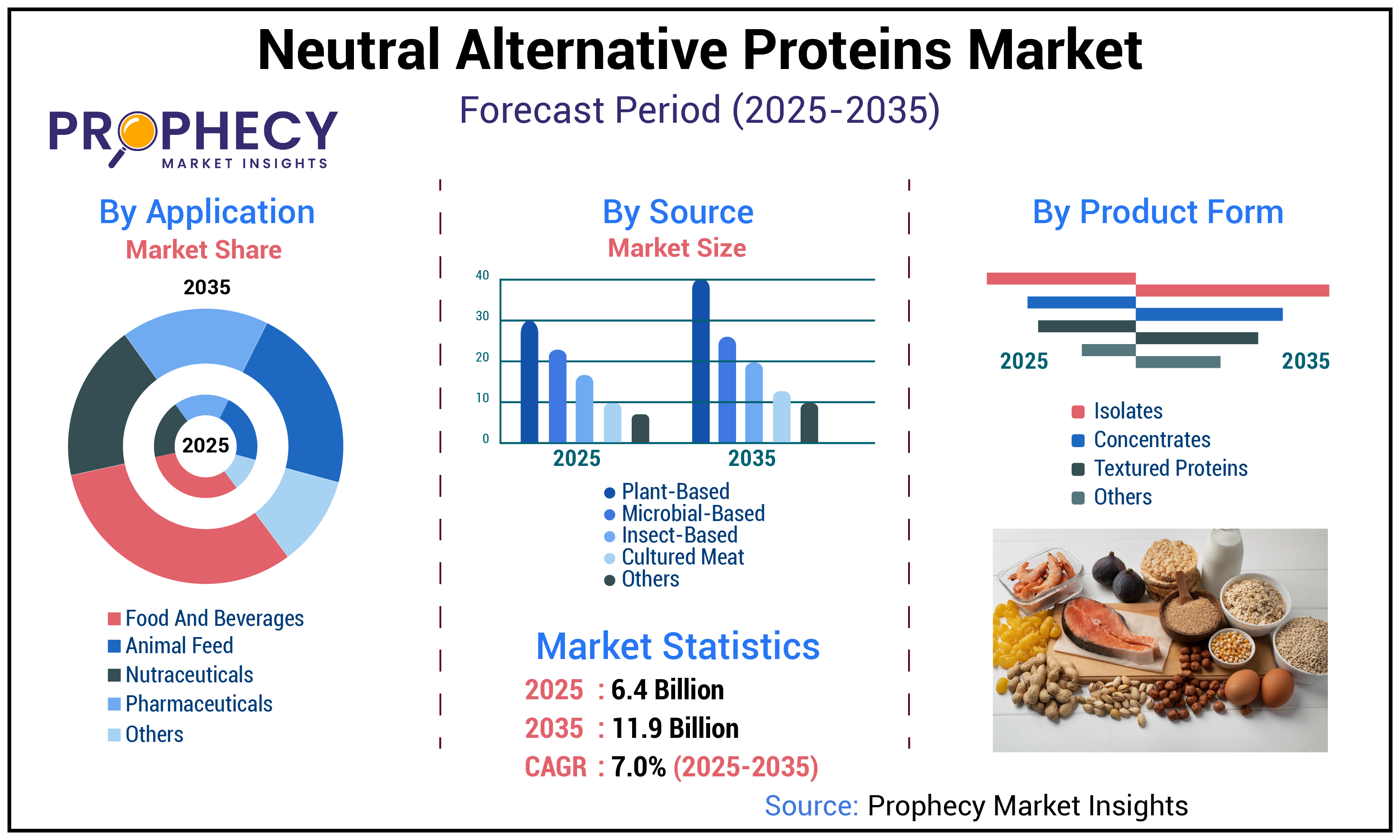
- Neutral alternative proteins market size is expected to develop at a rate of USD 11.9 Billion, by 2035.
- In 2024, the market valuation was USD 6.2 Billion.
- Neutral alternative proteins market is growing at a CAGR of 7.0%.
"Neutral alternative proteins" refers to alternative proteins that don't carry strong flavor profiles and can be used as a base for various culinary creations. These proteins are often plant-based and are designed to be versatile, mimicking the texture and structure of animal proteins without impacting the final dish's flavor. Essentially, these are a blank canvas for chefs and home cooks to create a wide range of dishes. These provide advantages such as, reduced environmental impact, potential health benefits, and ethical considerations.
The neutral alternative proteins market growth is driven by several factors, including, increasing consumer demand for sustainable, health-conscious, and ethically produced food options, growing awareness of the environmental impact of traditional animal agriculture, including greenhouse gas emissions and deforestation, increasing health benefits, and the rising aging population.
The market’s diversification is also skyrocketed by innovations in food technologies, such as cellular agriculture and fermentation, are enabling the development of more sustainable and palatable alternative proteins, increased venture investments in the alternative protein industry, rising global population and the need to produce more food sustainably, and increased venture investments in the alternative protein industry.
Recession Risk and Tariff Analysis:
- The neutral alternative proteins market may be slowed by recession risk as consumers turn to more affordable, conventional protein sources. Spending on high-quality, sustainable food alternatives may be restricted by a decrease in disposable money. Additionally, during recessions, financing for innovation and startups in this sector may decrease, which would impede the creation of new products and the growth of existing markets.
- Tariffs on neutral alternative proteins vary globally, impacting trade and market accessibility. High import duties can hinder cross-border sales, limiting consumer access to innovative products. Conversely, tariff reductions and free trade agreements promote global expansion. Harmonizing regulations and lowering trade barriers are essential for market growth and international competitiveness.
Impact of Generative AI on Neutral Alternative Proteins Market:
- The neutral alternative proteins market is undergoing a transformation due to generative AI, which speeds up product development. By mimicking molecular interactions, it makes it possible to precisely formulate protein mixes for nutrition, taste, and texture. AI aids with personalized nutrition as well, enabling businesses to customize goods for certain populations and health requirements.
- Additionally, by anticipating demand and cutting waste, it improves supply chain sustainability and optimization. Generative AI enables businesses to effectively expand sustainable food solutions and adapt to changing customer tastes through data-driven insights and quick prototyping.
Global Neutral Alternative Proteins Market Drivers & Restraints
Key Drivers:
Rising Aging Population is Stimulating the Market Augmentation
The neutral alternative proteins market is growing as a result of the ageing population and seniors' growing knowledge of nutrition and health. Higher protein consumption is necessary for older persons to maintain its general vitality, bone strength, and muscular mass. As it is low in allergens and easy to digest, neutral alternative proteins meet the nutritional demands of aging people. Furthermore, functional foods and supplements intended for senior health frequently contain it. There is a growing need for sustainable, nutrient-dense, and readily accessible protein sources as people live longer.
- For instance, in October 2024, according to the data published by WHO, by 2030, 1 in 6 people in the world will be aged 60 years or over. At this time the share of the population aged 60 years and over will increase from 1 billion in 2020 to 1.4 billion. By 2050, the world’s population of people aged 60 years and older will double (2.1 billion). The number of persons aged 80 years or older is expected to triple between 2020 and 2050 to reach 426 million.
Restraints:
Limited Consumer Acceptance is Obstructing the Market Expansion
Limited consumer acceptability as a result of novel flavor, texture, and ingredient origin is a major drawback of the market for neutral replacement proteins. Alternative proteins might not be as enticing or reliable to many customers, particularly those accustomed to conventional animal proteins. This reluctance frequently stems from doubts about the long-term health advantages and dietary sufficiency. Furthermore, despite the rising desire for sustainable and health-conscious food alternatives, the novelty of components such as algae or microbial proteins may discourage uptake and hinder market penetration.
- Counterbalance Statements: Businesses should make investments in flavor-masking technology and product compositions that replicate conventional protein textures in order to increase adoption. Consumer trust can be increased by health experts' endorsements, education initiatives, and transparent labelling. The adjustment to these new components may be made easier by providing samples and incorporating alternative proteins into well-known meal forms.
Opportunities & Trends:
Innovation in Food Technology is Unlocking Growth Opportunities in the Future Generations
The neutral alternative proteins market is growing mostly due to advancements in food technology. Protein sources that closely resemble the flavor, texture, and nutritional content of conventional animal proteins may be produced due to cutting-edge methods including protein texturization, cellular agriculture, and precision fermentation.
Customers find things more enticing and adaptable as a result of these advances. Food technology also uses bioengineering to improve nutritional profiles, increase shelf life, and speed up manufacturing efficiency. As a result, food technology promotes sustainable, scalable solutions that satisfy the growing need for protein worldwide, increasing the accessibility, acceptability, and environmental friendliness of alternative proteins for markets in the future.
Global Neutral Alternative Proteins Market Segmentations & Regional Insights
The neutral alternative proteins market is segmented into source, product form, application, distribution channel, and region.
By Source:
Appertaining from source, the market is trifurcated into plant-based, insect-based, microbial-based, and cultured meat. The plant-based alternative proteins segment is expected to dominate the neutral alternative proteins market share. This is due to its established supply chains, ease of availability, and broad consumer preference. While other alternative protein sources are growing, plant-based options remain the dominant choice in the market.
The microbial-based segment is the second dominating source in the Neutral alternative proteins market. This is due to the growing demand for sustainable protein sources, technological advancements, potential for high protein yields, and its versatile applications.
By Product Form:
Based on product form, the market is branched into isolates, concentrates, and textured proteins. The protein isolates segment is holding the superior position in the neutral alternative proteins market share. This is due to its high protein content, purity, and versatility, making it suitable for various applications, particularly in supplements and food formulations.
The concentrates segment is the second superior product source in the neutral alternative proteins market. This is due to its capability to offer a high protein content, concentrates have a lower protein concentration compared to isolates. These are still versatile and can be used in various food and beverage applications.
By Application:
On the basis of application, the market is divided into food and beverages, animal feed, nutraceuticals, pharmaceuticals, and others. The food and beverages segment is leading the neutral alternative proteins market growth. This is due to the growing demand for plant-based and vegetarian/vegan options, the functional properties and versatility of neutral proteins such as pea protein, and the increasing use of plant-based proteins in various food and beverage product enhancements.
The animal feed segment is the second leading application in the Neutral alternative proteins market. This is due to the increase in livestock production and the demand for sustainable animal feed solutions drive the growth of animal feed applications of alternative proteins.
By Distribution Channel:
Dependent on distribution channel, the market is categorized into online retail, supermarkets/hypermarkets, specialty stores, and others. The supermarket/hypermarket segment is attributed to govern the neutral alternative proteins market. This is due to factors, such as, high foot traffic, wide product variety, and consumer trust in physical retail for food items.
The online retail segment is distribution channel which is experiencing steady growth, in the Neutral alternative proteins market. This is due to the convenience and accessibility offered by online platforms, allowing consumers to easily compare products and make purchases from the comfort of its homes.
Regional Insights:
Geographically, the market is analyzed across North America, Europe, Asia Pacific, Latin America, and the Middle East & Africa.
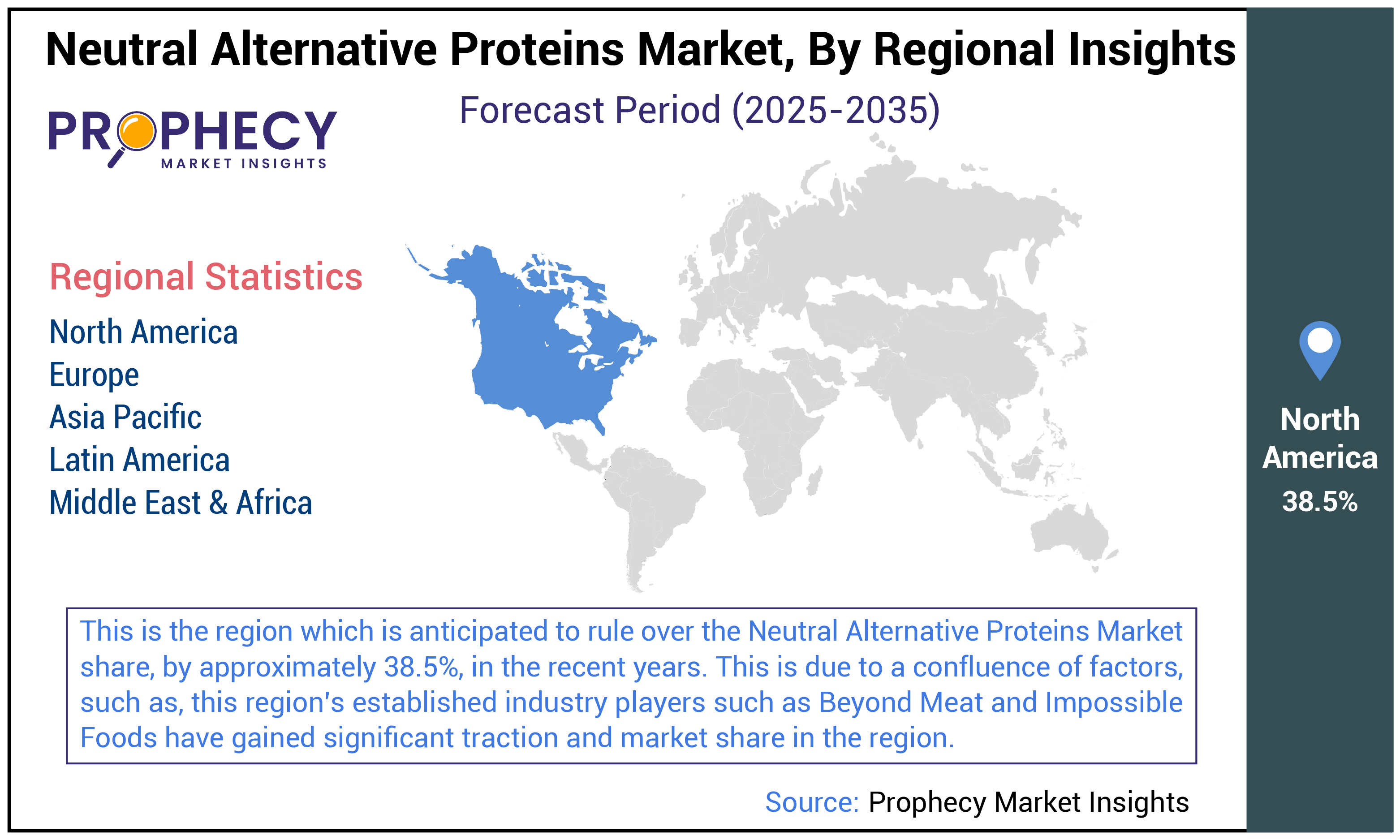
North America: This is the region which is anticipated to rule over the neutral alternative proteins market share, by approximately 38.5%, in the recent years. This is due to a confluence of factors, such as, this region’s established industry players such as Beyond Meat and Impossible Foods have gained significant traction and market share in the region, government initiatives that promote research and development of alternative proteins, particularly in the areas of plant-based and cell-cultured meat products, increasing vegan and vegetarian trends, and an advanced food and beverage industry.
- U.S. Neutral Alternative Proteins Market Insights:
The neutral alternative proteins market U.S., is the most influential market, in the recent years. This is due to this country’s growing consumer preference for alternative protein sources, increased awareness about food safety and environmental sustainability, and a rapidly adapting food processing industry. Additionally, government policies supporting food industry modernization and sustainability initiatives are also contributing to the market's growth in U.S.
Asia Pacific: This is the region which has the neutral alternative proteins market growing with the fastest growth rate, during the forecast period, in the recent years. This is due to a combination of factors, such as, this region’s increasing health consciousness among consumers, growing environmental concerns, rapid economic growth, leading to a larger middle class with increased disposable incomes and more opportunities for diverse food choices, increasing investment in research and development of alternative proteins, strong technological innovations, and existing cultural acceptance of plant-based foods.
- China Neutral Alternative Proteins Market Insights:
The neutral alternative proteins market in China is the fastest growing market, during the forecast period, in the recent years. This is due to this country’s large population, a growing demand for sustainable and healthy food options, and a thriving plant-based food industry. China also has a rich history of incorporating plant-based ingredients into its cuisine, which has fostered a positive acceptance of plant-based protein products. Moreover, major large population, a growing demand for sustainable and healthy food options, and a thriving plant-based food industry. China also has a rich history of incorporating plant-based ingredients into its cuisine, which has fostered a positive acceptance of plant-based protein products.
Europe: The region which has the neutral alternative proteins market growing at a considerable amount, in the recent years, is Europe. This is due to a number of factors, such as, this region’s significant flexitarian population, meaning people who are reducing or eliminating meat consumption, increasing aware of the health and environmental benefits of alternative proteins, development of new plant-based protein sources such as pea protein, environmental and ethical concerns, and increasing investment and innovation.
- U.K. Neutral Alternative Proteins Market Insights:
The neutral alternative proteins market in the U.K. is experiencing significant amount of growth, in the recent years. This is due to this country’s strong retail presence, with major supermarket chains building dedicated vegan butcher counters and expanding its meat substitute offerings, a higher proportion of vegans, flexitarians, and "conscious meat eaters, continuous innovation and product development in the meat substitutes sector, fast-food chains and restaurants are also playing a role in the market growth, and increasing focus on health and sustainability.
Neutral Alternative Proteins Market Report Scope:
|
Attribute |
Details |
|
Market Size 2025 |
USD 6.4 Billion |
|
Projected Market Size 2035 |
USD 11.9 Billion |
|
CAGR Growth Rate |
7.0% (2025-2035) |
|
Base year for estimation |
2024 |
|
Forecast period |
2025 – 2035 |
|
Market representation |
Revenue in USD Billion & CAGR from 2025 to 2035 |
|
Regional scope |
North America - U.S. and Canada Europe – Germany, U.K., France, Russia, Italy, Spain, Netherlands, and Rest of Europe Asia Pacific – China, India, Japan, Australia, Indonesia, Malaysia, South Korea, and Rest of Asia-Pacific Latin America - Brazil, Mexico, Argentina, and Rest of Latin America Middle East & Africa – GCC, Israel, South Africa, and Rest of Middle East & Africa |
|
Report coverage |
Revenue forecast, company share, competitive landscape, growth factors, and trends |
Segmentation:
By Source:
- Plant-Based
- Insect-Based
- Microbial-Based
- Cultured Meat
- Others
By Product Form:
- Isolates
- Concentrates
- Textured Proteins
By Application:
- Food and Beverages
- Animal Feed
- Nutraceuticals
- Pharmaceuticals
- Others
By Distribution Channel:
- Online Retail
- Supermarkets/Hypermarkets
- Specialty Stores
- Others
By Region:
- North America
- U.S.
- Canada
- Europe
- Germany
- U.K.
- France
- Russia
- Italy
- Spain
- Netherlands
- Rest of Europe
- Asia Pacific
- China
- India
- Japan
- Australia
- Indonesia
- Malaysia
- South Korea
- Rest of Asia Pacific
- Latin America
- Brazil
- Mexico
- Argentina
- Rest of Latin America
- Middle East & Africa
- GCC
- Israel
- South Africa
- Rest of Middle East & Africa
Global Neutral Alternative Proteins Market Competitive Landscape & Key Players
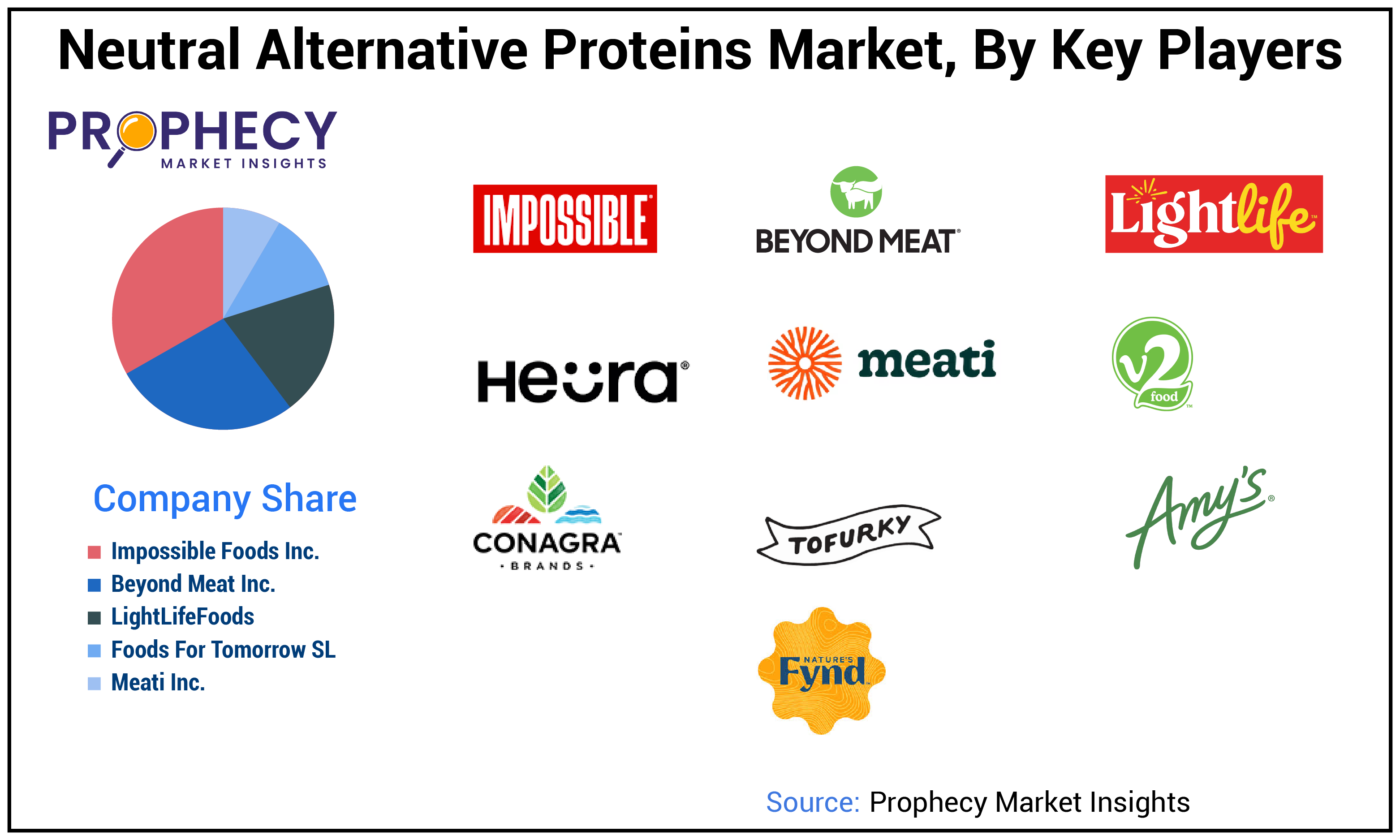
The key players operating in the market include, Impossible Foods Inc., Beyond Meat Inc., LightLifeFoods, and others. These key players are focusing on several key strategies, including innovation in food technology, collaboration with industry partners, and highlighting the sustainability and health benefits of its products, for driving neutral alternative proteins market growth.
Neutral Alternative Proteins Market Companies:
- Impossible Foods Inc.
- Beyond Meat Inc.
- LightLifeFoods
- Foods For Tomorrow SL
- Meati Inc.
- V2food Pty Ltd
- Conagra, Inc.
- Tofurky
- Amy’s Kitchen, Inc.
- Perfect Day, Inc.
- Nature’s Fynd
- Air Protein Inc.
- Novozymes A/S
- Unibio
- CALYSTA INC.
View an Additional List of Companies in the Neutral Alternative Proteins Market
Global Neutral Alternative Proteins Market Recent News
- In January 2025, a high-purity sunflower protein isolate called Solatein was created by Burcon NutraScience Corporation in response to shifting market demands. With over 90% protein purity, this product provided a substitute protein supply, bolstering the increasing need for sustainable and plant-based dietary solutions. Functionality and adaptability were the main goals while developing solatein. It is appropriate for a variety of food and beverage applications, including goods with sensitive flavour profiles, due to its neutral flavour, off-white colour, and simplicity of formulation. Additionally, it was non-GMO, hypoallergenic, and high in amino acids that include sulphur, which improved its nutritional value and compatibility with current formulas.
- In January 2025, the introduction of Oryzatein 2.0 was announced by Axiom Foods. This was not only an advancement; rather, it was a revolutionary discovery that marked the beginning of a new era for plant-based proteins. Following over 15 years of intense research and development, this ground-breaking product was expected to boost the 3.90 CAGR for rice protein forecast by opening up previously unheard-of possibilities for the natural goods sector without sacrificing the non-GMO, hexane-free method.
- In December 2024, Global product development partner Griffith Foods, which specialises in food ingredients, has introduced its first Alternative Proteins Portfolio. In line with the company's 2030 goals to promote sustainability and innovation in the food chain, this effort represented a major step in its ambition to make alternative proteins a key component of its operations.
- In May 2024, the most recent addition to Roquette's Nutralys plant protein line is the company's first fava bean protein isolate in North America and Europe. Products such as meat replacements, non-dairy alternatives, and baked items may contain 90% protein thanks to the Nutralys Fava S900M isolate. Roquette claims that the isolate's pale colour and bland flavour might improve its usefulness.
- In February 2024, The EVERY Company, which invented the technology to produce egg proteins through precision fermentation, announced that it would be partnering with global food companies as it increases production capacity to satisfy demand. Founded as Clara Foods in late 2014, the startup has raised USD 233 million so far, which is a pretty impressive amount but far less than the astounding USD 840 million Perfect Day raised to try and launch its animal-free dairy business.
Analyst View:
A number of factors are propelling the market for neutral alternative proteins, such as the growing demand from consumers for ethically, health-conscious, and sustainable food options; growing awareness of the negative environmental effects of traditional animal agriculture, such as deforestation and greenhouse gas emissions; growing health benefits; and the ageing population. The development of more sustainable and palatable alternative proteins, the need to produce more food sustainably due to the growing global population, and more venture investments in the alternative protein industry are all contributing factors to the market's explosive diversification. Examples of these innovations include cellular agriculture and fermentation.
More Related Reports
Liqueur Market
Europe Liqueur Market
Coconut Milk Yogurt Alternatives Market
Cocoa Butter Alternative Market
Alternative Tourism Market
Global Neutral Alternative Proteins Market Company Profile
|
Company Name |
Impossible Foods Inc. |
|
Headquarter |
Redwood City, California |
|
CEO |
Mr. Peter McGuinness |
|
Employee Count (2024) |
610 Employees |
Global Neutral Alternative Proteins Market Highlights
FAQs
Neutral alternative proteins market size was valued at USD 6.4 Billion in 2025 and is expected to reach USD 11.9 Billion by 2035 growing at a CAGR of 7.0%.
Source, product form, application, distribution channel, and region are the segmentation for the Neutral alternative proteins market.
North America, Asia Pacific, Europe, Latin America, and the Middle East & Africa. North America is expected to dominate the market.
The key players operating in the neutral alternative proteins market include Impossible Foods Inc., Beyond Meat Inc., LightLifeFoods, Amy’s Kitchen, Inc., Foods For Tomorrow SL, Meati Inc., V2food Pty Ltd, Conagra, Inc., Tofurky, Perfect Day, Inc., Nature’s Fynd, Air Protein Inc., Novozymes A/S, Unibio, and CALYSTA INC.