Global Medical Image Sensor Market Overview
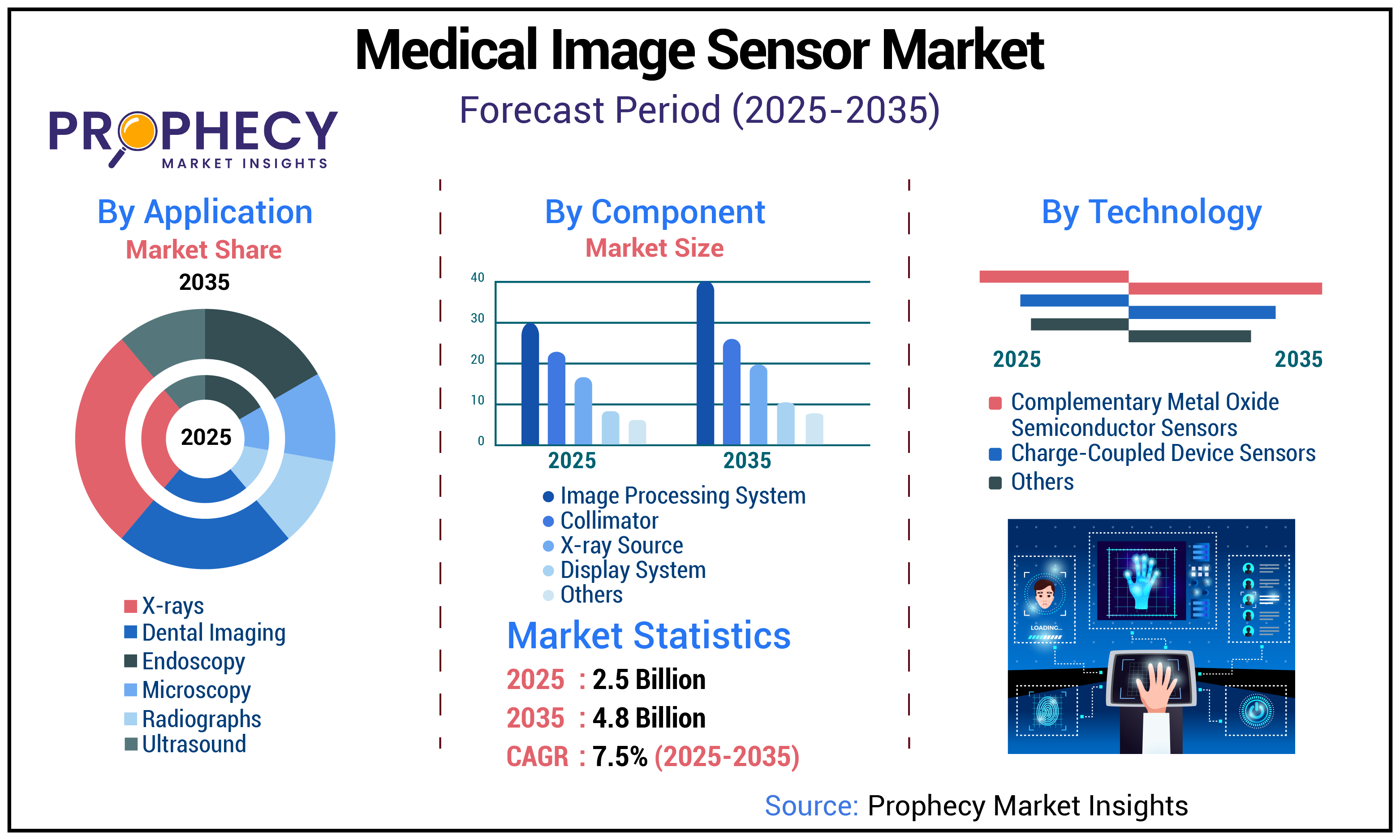
- Medical image sensor market is expected to increase at a rate of USD 4.8 Billion, by 2035.
- The market for medical image sensor market was worth at USD 2.4 Billion, in 2024.
- Medical image sensor market is growing at a 7.5% CAGR.
Medical image sensor is an electronic device used to capture images in medical imaging system. These sensors convert the light or radiation emitted from the object being imaged into digital data which can be processed, analyzed, and displayed. Medical image sensors are used in imaging technologies, such as x-rays, MRI, CT scans, ultrasound and endoscopy to create detailed internal images.
The increases demand for healthcare needs, and innovations in image sensor technology, such as CMOS sensors, CCD sensors to enabling more accurate, faster, and cost-effective imaging solutions, is anticipated to drive medical image sensor market growth. The growing investment in healthcare infrastructure, and rising prevalence of cancer, cardiovascular diseases, is projected to growth of medical image sensor market share.
Impact of Generative AI in Medical Image Sensor Market:
- Artificial Intelligence (AI) integrated into medical imaging systems to assist radiologists and clinicians to interpret images more accurately, which enhances both technology and its application in various diagnostics fields. AI algorithms analyze the medical images captured by sensors, and recognize patterns in images that might suitable for human eyes to detect.
- AI powered tools can automatically detect and classify abnormalities in medical images, such as cancer detection, cardiac imaging and neurological disorders, aimed to reduce burden on radiologist and healthcare providers.
Global Medical Image Sensor Market Drivers & Restraints
Key Drivers of Target Market:
Growing Prevalence of Chronic Diseases Propelling the market
Chronic diseases, such as cardiovascular diseases, cancer, diabetes, respiratory conditions, and neurological disorders, require ongoing monitoring, early diagnosis, and effective treatment plans. Medical imaging plays a crucial role in diagnosing, monitoring, and managing these conditions, which rises the demand for medical image sensor.
High-quality imaging sensors provide detailed insights, which help healthcare professionals to create personalized treatment plans for chronic disease patients. Medical image sensor are specially used in CT scans, MRIs, PET scans to detect tumors, monitor their size, and help for early detection of cancer, is anticipated to drive medical image sensors market growth.
- For instance, according to article published by National Library of Medicine, in January 2024, in 2020, globally, an estimated 523 million people suffered from cardiovascular diseases, and approximately 19 million deaths were attributed due to cardiovascular disease. Cancer remains one of the leading causes of death both in the global and U.S. In the U.S., cancer is responsible for 1 in every 5 reported deaths, or about 600,000 deaths in a year. Diabetes was responsible for over 103,000 deaths in the U.S. in 2021, and globally total of 1.5 million deaths due to diabetes.
Restraints:
High Cost of Medical Image Sensor Interrupt the Target Market Growth
Medical image sensor are come with high implementation costs, which become significant barrier for smaller healthcare providers, clinics, and hospitals. Medical image sensor often requires advanced technology such as, high-resolution screens and 3D features, which limits the adoption of technology.
- Counterbalance Statements: Many government and international organizations are proving subsidies and financial support to healthcare institutions for the implementation of advanced technology. As technology advances, the manufacturing costs of medical displays are gradually decreasing, help to growth of medical image sensor market size.
Opportunities & Market Trends:
Technological Advancement in Imagining Sensor Boost the Market Opportunity
Technological advancements in imaging sensors are significantly create market opportunity in the medical imaging industry by improving diagnostic accuracy, efficiency, and accessibility. Advancement in imaging sensors provide better resolution, and greater sensitivity to detect more detailed and accurate images. Advanced imaging sensor offer 3D capture, more detailed analysis of tissues, and improves diagnostic capabilities, resulting to drive medical imaging sensor market growth.
- For instance, in December 2024, Structure launched Structure Sensor 3, its next-generation precision 3S scanning platform. Structure Sensor 3 enabled the higher quality scans for customized 3D printed products, focused on creating 3D capture, analysis and diagnosis solutions in healthcare industry. The company aimed to create opportunities for 3D workflows to transform healthcare with advanced imaging sensor.
Global Medical Image Sensor Market Segmentations & Regional Insights
The medical image sensor market is classified into technology, component, application, and region.
Technology:
Based on technology, medical imaging sensor market segmented into CMOS, and CCD. CMOS segment dominate in medical image sensor market, as it has highly efficient power usage, which is crucial for medical imaging devices and battery-powered equipment such as ultrasound devices and x-ray machines. It is cost effectives, low power consumption and ability to integrate with modern technologies, leading to growth of medical imaging sensor market share.
- For instance, in November 2024, Sony Semiconductor Solutions Corporation (SSS), launched industrial CMOS image sensor, known as IMX925 with black-illuminated pixel structure and global shutter. This new CMOS image sensor aimed to deliver compact design with minimal noise and high quality imaging industrial equipment.
Component:
By component, medical imaging sensor market is divided into x-ray source, collimator, image processing system, display system, and others. The image processing system segment dominates in medical imaging sensor market share, as it convert raw data captured by the imaging sensor such as CMOS and CCD sensor, converted into clear images. The growing demand for real-time image analysis, is anticipated to segment’s growth in medical image sensor market share to improve image quality.
- For instance, in November 2023, OMNIVISION, launched OVMed OHO131 image single processor (ISP), an easy-to-implement solution for reusable and disposable endoscopes connected to handheld tablet consoles or camera control units (CCUs). OHO131 ISP was based on ASIC system-on-chip for the highest image quality, reliability and cost-effectiveness for the medical imaging solution.
Application:
On the basis of application, medical imaging sensor market is segmented into dental imaging, x-rays, endoscopy, microscopy, radiographs, ultrasound, MRI, and others. X-rays segment dominates in medical imaging sensor market share, as it is used for detecting bone, fractures, infections, tumors, and dental issues in patients. As the increasing application in healthcare sectors, and clinical use, is projected to drive medical image sensor market growth.
End-User:
By end-user, medical image sensor market is categorized into, Hospitals, Medical device Manufacturers, Research Institutions, and others.
Region:
Geographically, the market is studied across North America, Europe, Asia Pacific, Latin America, and the Middle East & Africa.
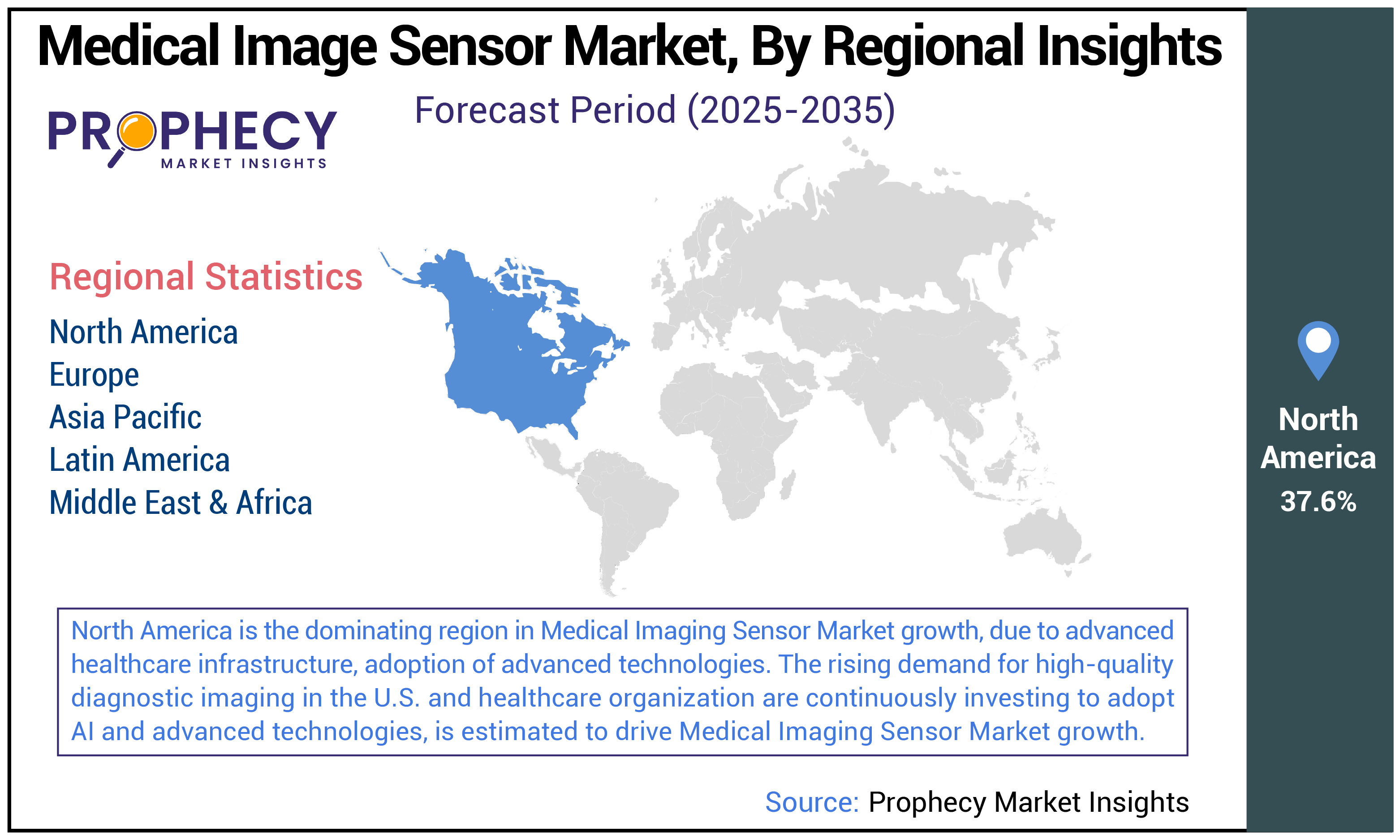
North America: This is the dominating region in medical imaging sensor market growth, due to advanced healthcare infrastructure, adoption of advanced technologies. The rising demand for high-quality diagnostic imaging in the U.S. and healthcare organization are continuously investing to adopt AI and advanced technologies, is estimated to drive medical imaging sensor market growth.
- For instance, in November 2024, Photonics Management Crop. and Hamamatsu Photonics K.K. acquired BAE Systems Imaging Solutions, Inc., which was known, as Fairchild Imaging, aimed to change into Hamamatsu’s North America design for 2D, low noise image sensors center. The Fairchild Imaging products such as CMOS image sensor, and x-rays CMOS image sensors for medical and dental diagnostics application, through this acquisition Hamamatsu Photonics’ strengthen, focused on expand its position in the dental market.
Asia Pacific: This is the fastest growing region over the estimated period, due to rising healthcare needs, increasing healthcare spending and growing infrastructure in countries such as China, India and Japan. The increasing burden of diseases such as cancer, cardiovascular diseases, and many countries are adopting healthcare facilities, leading to growth of medical image sensor market size in upcoming years.
Medical Image Sensor Market Report Scope:
|
Attribute |
Details |
|
Market Size 2025 |
USD 2.5 Billion |
|
Projected Market Size 2035 |
USD 4.8 Billion |
|
CAGR Growth Rate |
7.5%(2025-2035) |
|
Base year for estimation |
2024 |
|
Forecast period |
2025 – 2035 |
|
Market representation |
Revenue in USD Billion & CAGR from 2025 to 2035 |
|
Regional scope |
North America - U.S., and Canada Europe – Germany, U.K., France, Russia, Italy, Spain, Netherlands, and Rest of Europe Asia Pacific – China, India Japan, Australia Indonesia Malaysia, South Korea, and Rest of Asia-Pacific Latin America - Brazil, Mexico, Argentina, Rest of Latin America Middle East & Africa – GCC, Israel South Africa, and Rest of Middle East & Africa |
|
Report coverage |
Revenue forecast, company share, competitive landscape, growth factors, and trends |
Segmentation:
By Technology Type:
- CMOS [Complementary Metal Oxide Semiconductor] Sensors
- CCD [Charge-Coupled Device] Sensors
- Others
By Component:
- X-ray Source
- Collimator
- Image Processing System
- Display System
- Others
By Application:
- Dental Imaging
- X-rays
- Endoscopy
- Microscopy
- Radiographs
- Ultrasound
- Others
By End User:
- Hospitals
- Medical device Manufacturers
- Research Institutions
- others
By Region:
- North America
- U.S.
- Canada
- Europe
- Germany
- U.K.
- France
- Russia
- Italy
- Spain
- Netherlands
- Rest of Europe
- Asia Pacific
- China
- India
- Japan
- Australia
- Indonesia
- Malaysia
- South Korea
- Rest of Asia Pacific
- Latin America
- Brazil
- Mexico
- Argentina
- Rest of Latin America
- Middle East & Africa
- GCC
- Israel
- South Africa
- Rest of Middle East & Africa
Global Medical Image Sensor Market Competitive Landscape & Key Players
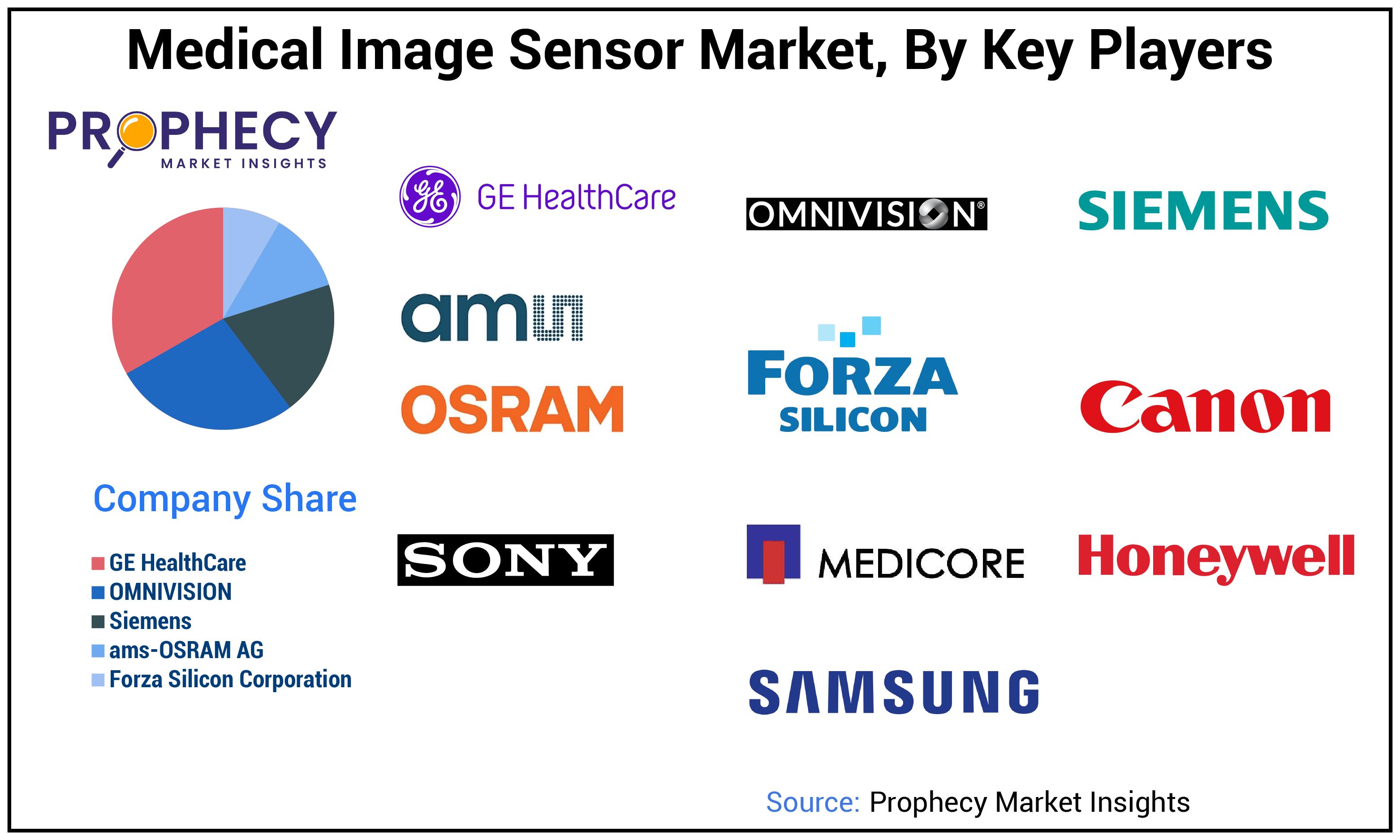
The key players operating in the medical image sensor market include GE HealthCare, OMNIVISION, Siemens, and others. The major key companies are adopting strategies, such as new product launches, partnerships, agreement, higher investments and collaboration with other organization, is projected to drive medical image sensor market growth.
Medical Image Sensor Market Companies:
- GE HealthCare
- OMNIVISION
- Siemens
- ams-OSRAM AG
- Forza Silicon Corporation
- Canon U.S.A., Inc.
- Sony Semiconductor Solutions Corporation
- MEDICORE Co., LTD.
- StarFish Product Engineering Inc.
- Honeywell International Inc.
- Access Healthcare
- SAMSUNG
- Hamamatsu Photonics K.K.
- BAE Systems
- OMRON Corporation
View an Additional List of Companies in the Medical Image Sensor Market
Global Medical Image Sensor Market Recent News
- In July 2024, LG Company launched their 5MP diagnostic monitor, known as 21HQ613D-B display. The 21HQ613D-B display was a 21.3-inch 5-megapixel (MP) IPS diagnostic monitor designed to deliver high-definition radiological images and maintains consistent image quality through internal front calibration sensor and calibration software. It was used in breast MRIs, CT scans, and ultrasound, to monitor features with internal sensors to remove external calibration device.
- In September 2020, OMNIVISION Technologies, Inc., launched world’s first RGB-IR medical image sensor, known as, OHO2A1S sensor. It was aimed to provide simultaneous white-light RGB captures and infrared monochrome captures in a single CMOS sensor. The new OH02A1S enabled designers of chip-on-tip endoscopes for cancer detection to eliminate a second image sensor, by overcoming the drawbacks of a two imager design.
Analyst View:
Medical imaging display market is significantly driven by increasing healthcare infrastructure and rising healthcare investment for improved access to medical technology and increasing diagnostic imaging requirements. The technological advancements in imaging sensor, to create accurate, high quality 3D capture for detailed diagnostics analysis of tissues, is projected to drive medical image sensor market growth.
More Related Reports
Disposable Medical Sensors Market
Medical Writing Market
Medical Equipment Financing Market
AI in Medical Diagnostics Market
Food as Medicine Market
Global Medical Image Sensor Market Company Profile
|
Company Name |
GE HealthCare |
|
Headquarter |
Chicago, Illinois |
|
CEO |
Peter J. Arduini |
|
Employee Count (2024) |
51,000 employees |
Global Medical Image Sensor Market Highlights
FAQs
Medical image sensor market size was valued at USD 2.5 Billion in 2025 and is expected to reach USD 4.8 Billion by 2035 growing at a CAGR of 7.5%.
Technology, component, application, and region are the segmentation for the medical image sensor market.
North America, Asia Pacific, Europe, Latin America, the Middle East, and Africa. North America is predictable to dominate the target market.
The key players operating the medical image sensor market include GE HealthCare, OMNIVISION, Siemens, ams-OSRAM AG, Forza Silicon Corporation, Canon U.S.A., Inc., Sony Semiconductor Solutions Corporation, MEDICORE Co., LTD., StarFish Product Engineering Inc., Honeywell International Inc., Access Healthcare, SAMSUNG, Hamamatsu Photonics K.K., BAE Systems, and OMRON Corporation