Global Medical Cooling Systems Market Overview
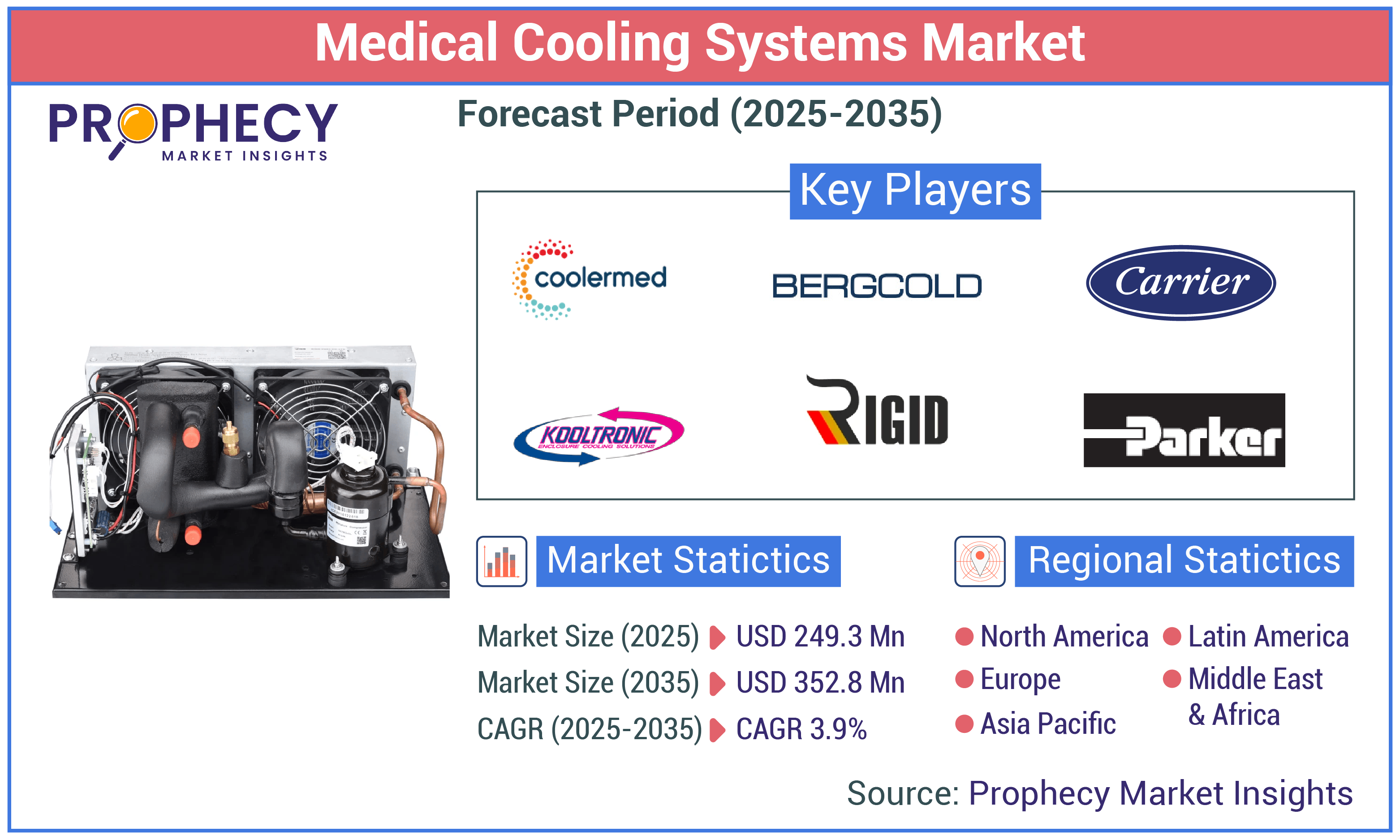
- The medical cooling systems market size is anticipated to reach a valuation of USD 352.8 Million, by 2035.
- The valuation of the market was USD 233.5 Million in 2024.
- Target market is projected to rise at a CAGR of 3.9%.
In order to maintain accurate temperature management for therapeutic purposes, medical cooling systems are specialized devices used in healthcare settings to regulate or reduce a patient's body temperature. These systems are frequently employed during crucial conditions such as surgery or cardiac arrest. Medical cooling systems are environmental friendly, are easy maintenance, reliable, controls temperature, manages humidity, provide balanced cooling, and prevents unauthorized access further contributing in the market expansion.
The increasing prevalence of chronic diseases, such as, cancer, rising healthcare spending, growing demand for temperature control for various medical procedures and equipment, rising adoption of minimally invasive surgical techniques to ensure the proper functioning of instruments, increasing aging population, and the increased number of hospitals are factors driving the medical cooling systems market growth.
The market diversification is also caused due to the sophisticated diagnostic imaging modalities, such as MRI and CT scans, which generate significant amounts of heat, making robust medical cooling systems essential for optimal performance and equipment longevity. In addition to this, integrating these systems with artificial intelligence (AI), robotics, and Internet of Things (IoT) can also further contribute in the market augmentation.
Impact of Generative AI on Medical Cooling Systems Market:
- Medical cooling systems stand to benefit greatly from generative AI's ability to enable predictive maintenance, optimized designs, individualized patient care through data analysis, and increased energy efficiency by using massive datasets to spot trends and anticipate possible problems in cooling systems. This will ultimately result in more proactive maintenance and less downtime in vital healthcare settings.
Global Medical Cooling Systems Market Drivers & Restraints
Key Drivers of Target Market:
The Rising Healthcare Spending is Influencing the Market Expansion
Rising healthcare spending directly drives the medical cooling systems market growth by increasing the purchase of advanced medical equipment, which in turn necessitates reliable cooling systems to maintain optimal performance and functionality, thus creating a higher demand for specialized cooling solutions within the healthcare sector; essentially, as more sophisticated medical devices are acquired due to increased healthcare budgets, the need for robust cooling systems to support it also rises.
- For Instance, in January 2024, according to the data published by WHO, during the second year of the pandemic in 2021, worldwide health spending reached USD 9.8 trillion, or 10.3% of global GDP. Higher government and out-of-pocket expenditures were the main causes of the spending increase. External health assistance was crucial in bolstering government expenditures in low-income nations.
The Increasing Prevalence of Chronic Diseases is Boosting the Market Growth
The rising prevalence of chronic diseases boosts the growth of the medical cooling systems market as these diseases often necessitate advanced diagnostic and treatment procedures, requiring sophisticated medical equipment that relies on cooling systems for optimal performance and patient safety. In addition to this, effective medical cooling systems are vital for the safety and well-being of patients undergoing treatments and procedures.
- For instance, in December 2024, according to the data published by WHO, in 2021, non-communicable diseases (NCDs) or chronic diseases, accounted for at least 43 million deaths worldwide, or 75% of mortality not attributable to pandemics. 18 million persons died from an NCD before turning 70 in 2021; low- and middle-income nations account for 82% of these premature fatalities. 73% of fatalities from NCDs occur in low- and middle-income nations.
Restrains:
The High Operational Cost of Medical Cooling Systems is limiting the Market Expansion
The high operating costs of medical cooling systems, which include both the original investment and continuing maintenance costs, are one drawback. Medical facilities' resources may be strained as a result. These systems' intricacy necessitates specialist maintenance, which raises the price. It could also have strict installation specifications.
- Counterbalance Statements: To solve these challenges, energy-efficient designs and regular maintenance schedules may assist cut costs and assure maximum performance. Implementing modular systems can also simplify installation and maintenance operations.
Opportunities:
Incorporating Technological Advancements with Medical Cooling Systems will Fuel the Market Growth in the Upcoming Years
Medical systems market growth can be fueled by advanced technologies such as artificial intelligence (AI), the Internet of Things (IoT), and robotics, which can improve patient care, increase diagnostic accuracy, and streamline healthcare delivery. The demand for cutting-edge medical devices and solutions is being driven by these innovations, which make personalized medicine, remote monitoring, and more effective surgical procedures possible.
Global Medical Cooling Systems Market Segmentations & Regional Insights
The medical cooling systems market is segmented into type, compressor, configuration, application, end user, and region.
Type
Based on type, the market is pigeonholed into water cooled chillers, and air cooled chillers. The water cooled chillers segment is ruling over the medical cooling systems market share. This is due to its high energy efficiency, compact size, ling shelf life, good option for limited space, and good for small to medium-sized facilities.
The air cooled chillers segment is the second-most dominating segment in the target market. This is due to its low maintenance, cost-effectiveness, flexibility in installation, and suitability for regions with water scarcity or limited space.
Compressor
Dependent on compressor, the market is branched into scroll, screw, centrifugal, and reciprocating. The scroll compressors are projected to govern the market due to its high energy efficiency, low vibration levels, and minimal noise compared to other compressor types, making it ideal for sensitive medical equipment that requires precise temperature control with minimal disruption to operations.
The screw compressors are the fastest growing segment in the medical cooling systems market. This is due to its high efficiency, compact size, and reliability, making it a strong contender for applications requiring continuous operation and space constraints.
Configuration
On the foundation of configuration, the market is trifurcated into packaged, modular, and split. The packaged systems holds the largest medical cooling systems market share as it offers a convenient, pre-assembled solution with readily available components, eliminating the need for extensive on-site design and installation, which translates to lower costs and faster deployment for healthcare facilities compared to modular or split systems.
The modular systems are the segment growing with the highest CAGR, in the medical cooling systems market. This is due to its compact size, multiple operational modes, and technological advancements.
Application
Application-wise, the market is grouped into medical imaging, medical lasers, medical cold storage and testing, and others. The medical imaging application is attributed to influence the medical cooling systems market share, due to the increased use of medical imaging systems such as CT scans and MRIs.
End User
By end user, the market is classified into OEMS, hospitals, diagnostic treatment centers and laboratories, and others. The original equipment manufacturers (OEMs) segment is dominating the market as it is the primary producers of medical equipment, meaning it directly integrates cooling systems into the devices it manufactures, leading to a high demand for cooling solutions to ensure optimal performance and lifespan of its medical machinery.
Regional Insights:
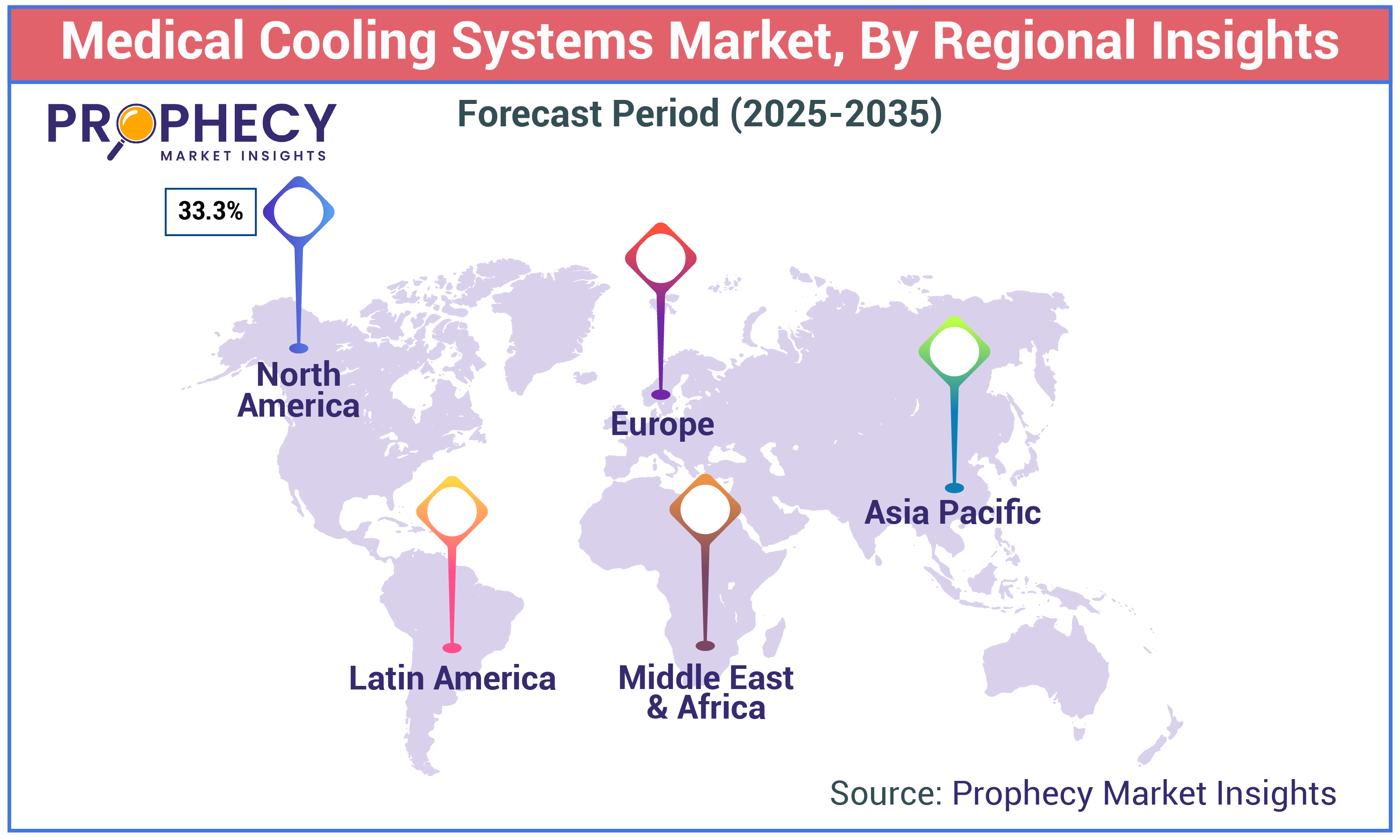
Geographically, the market is studied across North America, Europe, Asia Pacific, Latin America, and the Middle East & Africa.
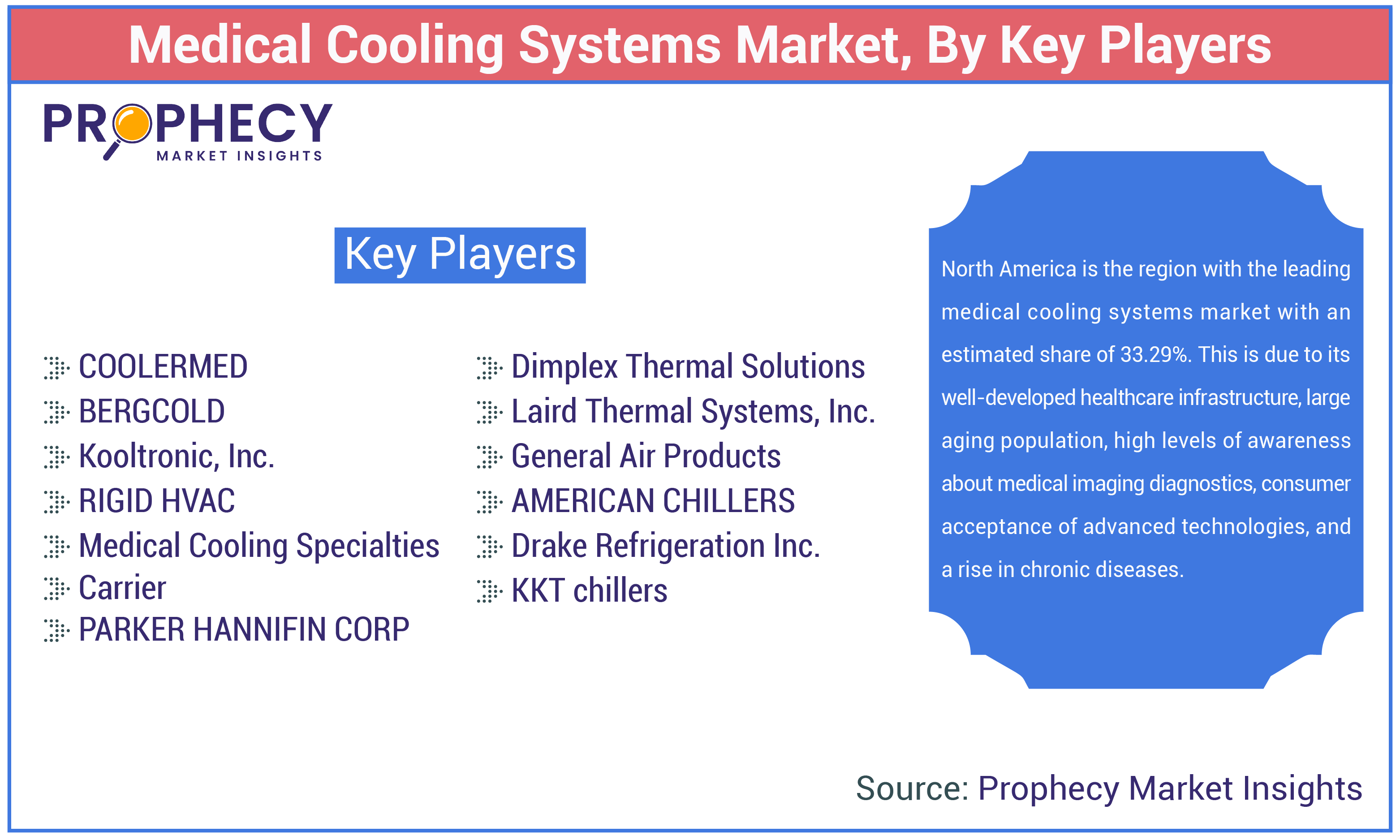
North America: This is the region with the leading medical cooling systems market with an estimated share of 33.3%. This is due to its well-developed healthcare infrastructure, large aging population, high levels of awareness about medical imaging diagnostics, consumer acceptance of advanced technologies, and a rise in chronic diseases.
- U.S. Medical Cooling Systems Market Insights:
The medical cooling systems market in United States is leading the target market, in the recent years. This is due to a variety of factors, such as, it’s robust and advanced healthcare systems, leading to higher demand for sophisticated equipment, adoption of advanced technologies resulting in a greater need for medical cooling solutions to manage the heat generated by these devices, presence of key market players in this region, and the growing prevalence of non-contagious diseases.
Europe: This is the region where the medical cooling systems market grows with the highest CAGR, during the forecast period. This is due to its robust healthcare infrastructure, high prevalence of chronic diseases, technological advancements and consumer acceptance for these advance technologies, and a large geriatric population.
- Germany Medical Cooling Systems Market Insights:
The country which has the fastest growing medical cooling systems market in the recent years, during the forecast period, is Germany. This is due to this country’s well-established healthcare infrastructure, which contributed to the demand for advanced medical technologies, the country’s embrace of cutting-edge technologies, including those used in medical equipment and cooling solutions, and a presence of significant manufacturing base, including companies involved in medical technology and cooling systems.
Asia Pacific: The region which is experiencing subsequent medical cooling systems market growth, in the recent years, during the forecast period, is Asia Pacific. This is due to various factors, which includes, increasing healthcare infrastructure, rising awareness of thermal management in medical equipment, and the growth of key countries such as China, India, and Japan.
- China Medical Cooling Systems Market Insights:
The Chinese medical cooling systems market is anticipated to experience rapid growth in the recent years. This is due to this country’s rapid industrialization and urbanization which creates a need for efficient medical cooling systems, increased healthcare spending and a rise in the geriatric population, growing understanding of the importance of optimal thermal management for medical equipment, and favorable government initiatives.
Medical Cooling Systems Market Report Scope:
|
Attribute |
Details |
|
Market Size 2025 |
USD 249.3 Million |
|
Projected Market Size 2035 |
USD 352.8 Million |
|
CAGR Growth Rate |
3.9% (2025-2035) |
|
Base year for estimation |
2024 |
|
Forecast period |
2025 – 2035 |
|
Market representation |
Revenue in USD Million & CAGR from 2025 to 2035 |
|
Regional scope |
North America - U.S., and Canada Europe – Germany, U.K., France, Russia, Italy, Spain, Netherlands, and Rest of Europe Asia Pacific – China, India, Japan, Australia, Indonesia Malaysia, South Korea, and Rest of Asia Pacific Latin America - Brazil, Mexico, Argentina, Rest of Latin America Middle East & Africa – GCC, Israel, South Africa, and Rest of the Middle East & Africa |
|
Report coverage |
Revenue forecast, company share, competitive landscape, growth factors, and trends |
Segmentation:
By Type:
- Water Cooled Chillers
- Air Cooled Chillers
By Compressor:
- Scroll
- Screw
- Centrifugal
- Reciprocating
By Configuration:
- Packaged
- Modular
- Split
By Application:
- Medical Imaging
- Medical Lasers
- Medical Cold Storage and Testing
- Others
By End User:
- OEMS
- Hospitals
- Diagnostic Treatment Centers and Laboratories
- Others
By Region:
- North America
- U.S.
- Canada
- Europe
- Germany
- U.K.
- France
- Russia
- Italy
- Spain
- Netherlands
- Rest of Europe
- Asia Pacific
- China
- India
- Japan
- Australia
- Indonesia
- Malaysia
- South Korea
- Rest of Asia Pacific
- Latin America
- Brazil
- Mexico
- Argentina
- Rest of Latin America
- Middle East & Africa
- GCC
- Israel
- South Africa
- Rest of the Middle East & Africa
Global Medical Cooling Systems Market Competitive Landscape & Key Players
The companies operating in the medical cooling systems market are COOLERMED, BERGCOLD, Kooltronic, Inc., RIGID HVAC, Medical Cooling Specialties, and others. The key players are adopting strategies such as innovations in medical cooling systems, adopting new technologies, mergers and acquisitions, and collaborations between each other, for the diversification of the market.
Medical Cooling Systems MarketCompanies:
- COOLERMED
- BERGCOLD
- Kooltronic, Inc.
- RIGID HVAC
- Medical Cooling Specialties
- Carrier
- PARKER HANNIFIN CORP
- Dimplex Thermal Solutions
- Laird Thermal Systems, Inc.
- General Air Products
- AMERICAN CHILLERS
- Drake Refrigeration Inc.
- KKT chillers
View an Additional List of Companies in the Medical Cooling Systems Market
Global Medical Cooling Systems Market Recent News
- In May 2024, The Philips 5300 MRI scanner, which used no helium, had saved about 2 million liters of liquid helium. The "helium free" MRI system was this one. It consumed just 7 liters of helium instead of the 1,500 liters that were typically used in traditional MRI systems since it had a sealed cooling system.
- In May 2024, Siemens Healthineers announced plans to build a new factory in North Oxfordshire to design and produce superconducting magnets for use in MRI cooling technologies and systems. The complex would house cutting-edge equipment that reduced the usage of helium, making scanners lighter, simpler to install, and more environmentally friendly with an expenditure of USD 314 million.
- In March 2024, the improved Navigator WWV water-cooled screw chiller with reduced global warming potential (GWP) R-513A refrigerant was launched by Daikin Applied. In addition to offering performance that lead the industry, users could combine the new chiller with an optional Templifier TWV water heater for a heat recovery solution that was both economical and energy-efficient.
- In October 2023, Together with Dober, ChemTreat enhanced the monitoring and management of the cooling system of the Major Hospital System using second-generation solid treatment technology called Smart Release (SRG2). In addition to an automation panel for control and monitoring, an SRG2 skid with three solid product feeds was fitted. Key performance indicators, including conductivity, PTSA, pH, and ORP, may be monitored by the panel.
- In April 2022, the next-generation Revolution Aspire CT (Computerized Tomography) scanner from Wipro GE Healthcare was introduced. The recently opened Wipro GE Medical Devices Manufacturing facility in India designed and produced Revolution Aspire, a sophisticated imaging system, from start to finish. This CT scanner enabled a greater rate of continuous scanning and enhanced the device's cooling rate.
Analyst View:
The medical cooling systems market is expanding due to a number of factors, including the growing number of hospitals, the aging population, the rising prevalence of chronic diseases such as cancer, the rising cost of healthcare, the growing need for temperature control for various medical procedures and equipment, the growing use of minimally invasive surgical techniques to ensure the proper functioning of instruments, and the growing number of hospitals. Strong medical cooling systems are necessary for optimum performance and equipment lifetime since advanced diagnostic imaging modalities, such MRI and CT scans, produce large amounts of heat, contributing to the market diversification. Furthermore, combining these systems with robots, artificial intelligence (AI), and the Internet of Things (IoT) might help to further enhance the market.
More Related Reports
Heater and Cooler Devices Market
Immersion Cooling Technology Market
Medical Imaging Information System Market
Medical Devices Loner & Consignment Market
Medical Writing Market
Global Medical Cooling Systems Market Company Profile
|
Company Name |
PARKER HANNIFIN CORP |
|
Headquarter |
Cleveland, Ohio, United States |
|
CEO |
Mrs. Jennifer A. Parmentier |
|
Employee Count (2024) |
61,120 Employees |
Global Medical Cooling Systems Market Highlights
FAQs
Medical cooling systems market size was valued at USD 249.3 Million in 2025 and is expected to reach USD 352.8 Million by 2035 growing at a CAGR of 3.9%.
The market is segmented into type, compressor, configuration, application, end user, and region.
The market is segmented by region North America, Asia Pacific, Europe, Latin America, and the Middle East & Africa. North America is expected to dominate the Market.
The key players operating in the medical cooling systems market include COOLERMED, BERGCOLD, Kooltronic, Inc., RIGID HVAC, Medical Cooling Specialties, Carrier, PARKER HANNIFIN CORP, Dimplex Thermal Solutions, Laird Thermal Systems, Inc., General Air Products, AMERICAN CHILLERS, Drake Refrigeration Inc., and KKT chillers.