Global Malt Ingredients Market By Overview
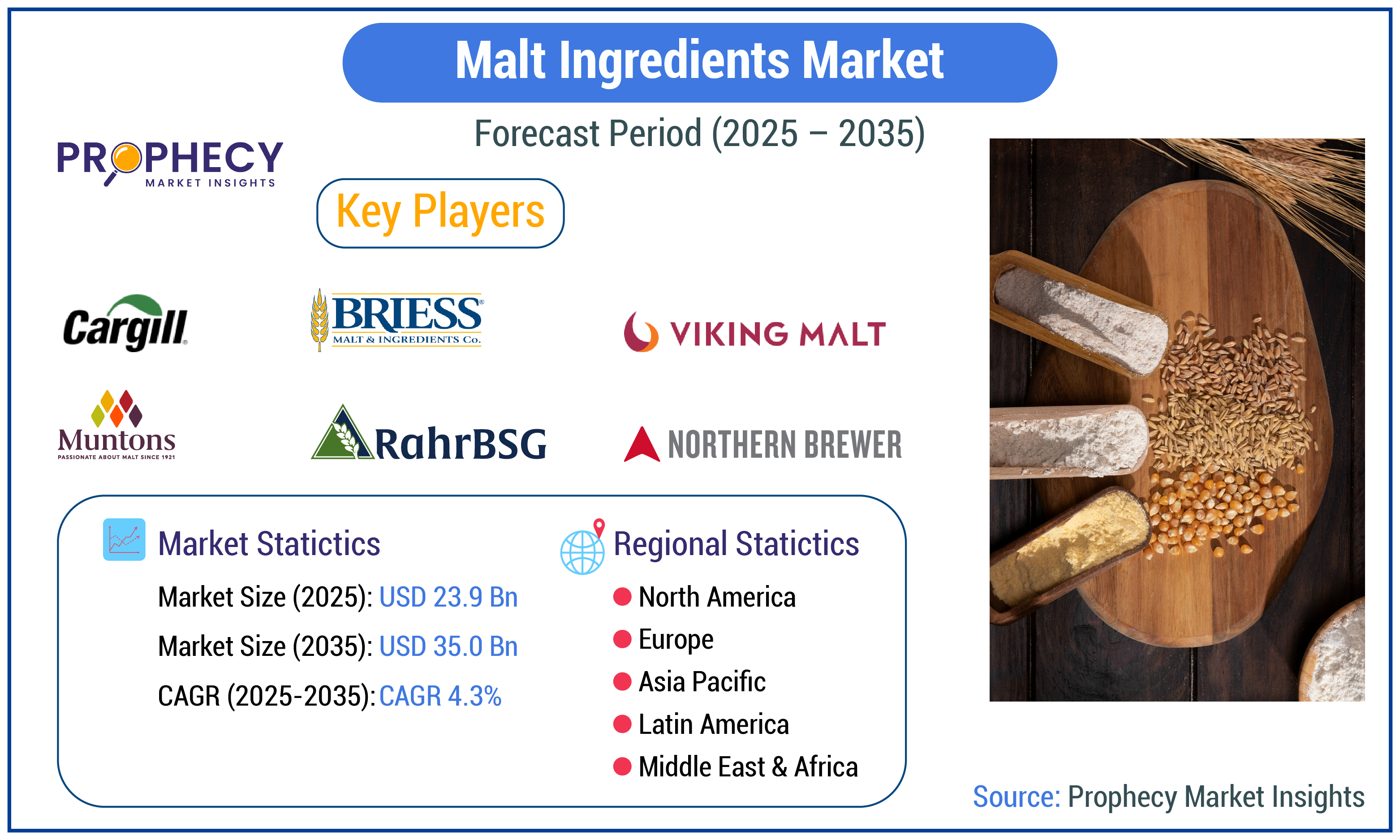
- Malt ingredients market size is approximated to develop at a valuation of USD 35.0 Billion, by 2035.
- In 2024, the target market valuation was USD 23.1 Billion.
- Malt ingredients market is expanding at a CAGR of 4.3%.
Malt, in general terms, refers to the substance created when grains, such as barley, are soaked, sprouted, and then dried. This process modifies the grain's natural food substances, creating a product used in various food and beverage applications. These are typically derived from grains, particularly barley, which is soaked to start germination, then dried to stop the process. The key ingredient in malt is the grain itself, and the process enhances its nutritional content and flavor. Malt extract, a common form, is a sweetener made from sprouted barley and offers various benefits such as improved digestion, heart health, and a boost in antioxidants.
The global malt ingredients market is experiencing growth primarily due to increasing popularity of beer, including craft beer and social gatherings, rising use of malt ingredients in food and beverage industries, such as, blended flour, bakery products, and non-alcoholic beverages, and the growing demand for natural sweeteners, plant-based ingredients, and functional food additives, where malt ingredients offer benefits such as antioxidants and fiber.
The market’s augmentation is also stimulated by the introduction of new malt varieties, including, dark malts, and the development of malt-based products with unique functionalities, increasing preference for sustainable and versatile ingredients among brewers and food manufacturers, and the companies in the malt ingredients market are adopting strategies such as mergers and acquisitions to expand its reach and market growth.
Recession Risk and Tariff Analysis:
- The malt ingredients market is at risk of a recession as customers turn to less expensive options, which would affect luxury markets such as organic barley malt. Price volatility and oversupply can result from economic downturns that lower demand for specialty foods and breweries. Furthermore, the need for conventional malt-based products is being further challenged by shifting beverage preferences, such as the emergence of hard seltzers.
- Import taxes on barley and malt can increase manufacturing costs, which affects the price of food and beer, according to a tariff study of the market for malt components. Global supply networks may be disrupted by these taxes, forcing producers to change formulas or look for alternate sources. As a result, consumer prices and market dynamics are impacted.
Impact of Generative AI on Malt Ingredients Market:
- Through better quality control, supply chain optimization, and product creation, generative AI has the potential to have a big influence on the market for malt ingredients. By predicting malt extract levels, AI-driven analytics can guarantee constant quality and cut down on waste. AI may help brewers develop new recipes by examining large databases of beer formulas that have already been made. This can result in distinctive flavor profiles and effective component use. AI can also improve operations by controlling inventory, predicting demand, and customizing customer experiences, which will spur innovation and growth in the malt sector.
Global Malt Ingredients Market By Drivers & Restraints
Key Drivers:
Rising Beer Consumption is Skyrocketing the Market Expansion
The malt ingredients market is expanding due to rising beer consumption, as malt is a key ingredient used to make beer. Diverse malt varieties, including base and specialty malts, are in high demand due to the growing demand for craft and specialty beers globally. Urbanization, evolving markets, and shifting lifestyles all lead to increased beer consumption, which in turn increases malt consumption. Furthermore, customer desire for locally brewed, flavored, and premium beers increases demand for premium malt, fostering innovation and growth in the malt ingredients sector.
- For instance, according to the data published by Kirin Holdings Company, Limited., in 2023, the total amount of beer consumed worldwide rose by about 200,000 kl, or about 300 million 633ml bottles, compared to about 187.9 million kl, or roughly 296.9 billion 633ml bottles equivalent, up 0.1% from the year before. This would be the same as filling around 152 Tokyo Dome, which is equivalent to 1.24 million kl.
Restraints:
The Dependency of Malt Ingredients on Agricultural Variables is limiting the Market Expansion
The malt ingredients market reliance on agricultural factors including climate, soil quality, and seasonal fluctuations is one of its main drawbacks. Climate change and unpredictable weather patterns can have a negative influence on barley yields, which in turn can affect the quality and availability of malt. Particularly for brewers that depend on certain malt characteristics, this unpredictability impacts product homogeneity, interferes with production schedules, and makes it difficult to maintain a steady supply. Furthermore, supply chain instability brought on by disease outbreaks or natural disasters in significant barley-producing regions might raise long-term reliability issues for producers.
- Counterbalance Statements: Businesses may support controlled-environment agriculture and invest in climate-resilient barley strains to combat agricultural reliance. Risk is decreased by establishing diverse sources from several locations. Furthermore, putting in place reliable forecasting techniques and working with farmers on sustainable farming methods may aid in supply stabilization, guaranteeing year-round availability and consistent quality of malt components.
Opportunities & Trends:
Introduction of New Malt Varieties is expected to open up Growth Opportunities for the Impending Years
The malt ingredients market is growing due to the development of new malt varieties, which improve product quality, diversity, and application potential. New cultivars are frequently created to provide superior qualities including increased extract yields, greater enzyme activity, improved flavor profiles, and flexibility to meet various brewing requirements. The growing demand for craft, specialty, and functional beers where distinctive malt qualities are essential is met by these advancements. Furthermore, contemporary malt varieties frequently exhibit greater resistance to environmental stressors, guaranteeing consistent output and availability. Personalized malt choices for usage in dairy, confections, and baked goods are advantageous to food producers as well. The emergence of new malt types enables producers to satisfy consumers' demands for high-end, distinctive goods, which propels market growth overall.
Global Malt Ingredients Market By Segmentations & Regional Insights
The malt ingredients market is segmented into product type, source, grade, form, application, and region.
By Product Type:
Dependent on product type, the market is bifurcated into extracts, and ingredients. The extracts segment is expected to dominate the malt ingredients market share. This s due to its widespread use in beer production, particularly in the craft brewing industry. The increasing demand for craft beers, which often use malt extract to simplify and speed up the brewing process, is a significant driver of the market. Additionally, malt extract is a versatile ingredient used in various food and beverage applications, including as a natural sweetener and flavor enhancer.
The ingredients segment is the second dominating product type, in the target market. This is due to the rising beer demand, ingredient versatility, health-conscious consumer trends, and technological advancements.
By Source:
On the foundation of source, the market is divided into barley, wheat, rye, and others. The barley segment is expected to lead the malt ingredients market share. This is due to its favorable characteristics for malting, including high enzyme content and starch composition. Barley's high protein content and ease of malting also contribute to its popularity.
Wheat is the second leading source, in the malt ingredients market. This is due to the widespread use of wheat in various food and beverage products, including certain types of malted beverages and baked goods.
By Grade:
Appertaining from grade, the market is catalogued into standard and specialty. The specialty segment is holding the superior position, in the malt ingredients market share. This is due to the rising demand for flavor enhancement, color, and functionality in various food and beverage applications. Specialty malt is used to create unique flavor profiles and can be used in baked goods, bars, cereals, cookies, and other products.
The standard segment is the second superior grade, in the target market. This is due to the rising demand in the food and beverage industry, particularly for artisanal beers and innovative flavors.
By Form:
Stemming from form, the market is branched into dry and liquid. The dry segment is expected to govern the malt ingredients market share. This is due to factors such as cost-effectiveness, longer shelf life, and the role dry ingredients play in refining the texture, color, and mouth feel of products, which are crucial in the brewing and baking industries.
The liquid segment is the fastest growing form, in the target market. This is due to its versatility and ease of use in various applications, especially brewing and food production. These extracts provide a concentrated source of fermentable sugars, making it highly desirable for brewing beer.
By Application:
According to application, the market is classified into food, beverage, pharmaceutical, and others. The beverage segment is ruling over the malt ingredients market share. This is due to the essential role malt plays in the production of beer and other alcoholic beverages such as whiskey. Malt provides the necessary carbohydrates and sugars for fermentation, which are crucial for the flavor and alcohol content of these beverages. Furthermore, malt ingredients are also used in non-alcoholic beverages such as malted milk drinks and energy drinks.
The food segment is the application that is experiencing steady growth, in the recent years. This is due to its wide range of applications and the increasing demand for natural ingredients. Malt ingredients, particularly barley, are used in diverse food products, including bakery items, snacks, and even in the dairy industry for flavoring milk.
Regional Insights:
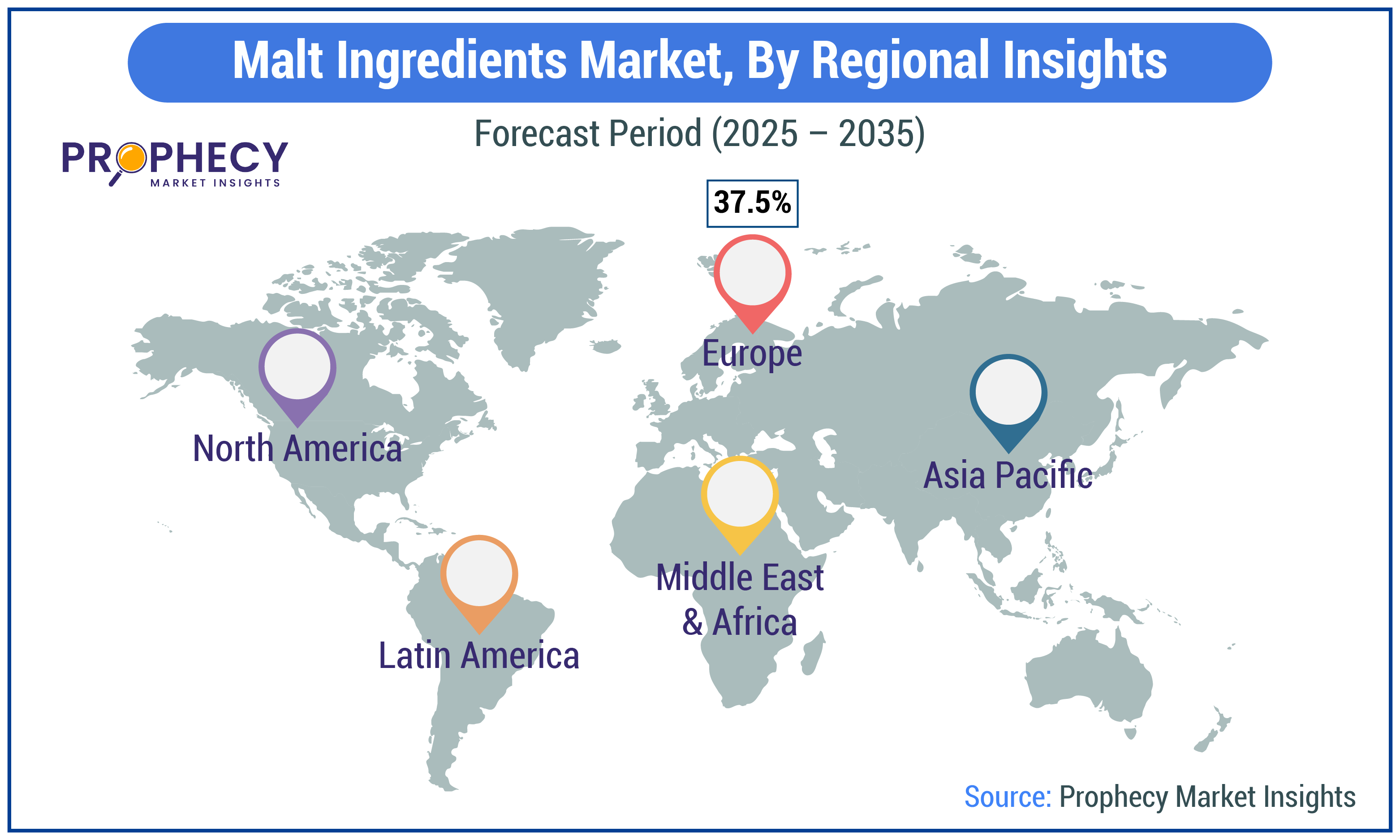
Geographically, the market is studied across North America, Europe, Asia Pacific, Latin America, and the Middle East & Africa.
Europe: This is the region which has the most influential malt ingredients market, with an estimated share of approximately 37.5%, in the recent years. This is due to a combination of factors, such as, this region’s high per capita consumption of alcoholic beverages, particularly beer, and the increasing popularity of craft breweries, diverse applications of malt ingredients, established brewing traditions in the countries of this region, and increasing awareness about the health benefits of malt ingredients and its use in various applications is also driving growth in the region.
- U.K. Malt Ingredients Market Insights:
The malt ingredients market in the U.K. is the market which is in charge, in the recent years. This is due to this country’s a strong beer and non-alcoholic malt beverage market, diverse applications in the food and beverage industry, and a rising trend in using organic malt in breweries. The U.K. also has a growing number of craft breweries, contributing to the overall demand for malt ingredients.
North America: This is the region which has the malt ingredients market, growing with the highest CAGR, during the forecast period, in the recent years. This is due to a confluence of factors, such as, this region’s strong and growing craft beer industry, the demand for natural sweeteners, and the region's suitability for barley cultivation. The craft brewing sector's expansion, coupled with consumers seeking unique and flavorful beers, has driven the need for a diverse range of malted ingredients. Furthermore, barley, the main ingredient for malt, is readily cultivated in North America, contributing to the region's market leadership.
- U.S. Malt Ingredients Market Insights:
The malt ingredients market in the U.S. is the market growing with the fastest growth rate, during the forecast period, in the recent years. This is due to this country’s significant increase in the number of craft breweries, robust brewing industry, a strong barley growing region, providing a readily available supply of raw materials for malt production, and a well-established and diverse brewing industry, including large commercial breweries and a growing number of smaller craft breweries, all of which contribute to the demand for malt ingredients.
Asia Pacific: This is region which has the malt ingredients market experiencing subsequent amount of growth, in the recent years. This is due to a number of factors, such as, this region’s surge in the consumption of beer, which relies heavily on malt as a key ingredient, its expanding food and beverage industry leading to increased demand for malt ingredients in various applications, rising health awareness among consumers, its significant market share, and the rise of craft beer and microbreweries is further boosting demand for specialty malts.
- China Malt Ingredients Market Insights:
The malt ingredients market in China is experiencing considerate amount of growth, in the recent years. This is due to this country’s vast population, coupled with the rising middle class and disposable incomes, fuels strong demand for both alcoholic beverages (particularly beer) and functional foods, established and thriving brewing industry is a significant consumer of malt ingredients, significant domestic malt production capacity and also imports a considerable amount of malt, and its growing awareness of the benefits of functional foods.
Malt Ingredients Market Report Scope:
|
Attribute |
Details |
|
Market Size 2025 |
USD 23.9 Billion |
|
Projected Market Size 2035 |
USD 35.0 Billion |
|
CAGR Growth Rate |
4.3% (2025-2035) |
|
Base year for estimation |
2024 |
|
Forecast period |
2025 – 2035 |
|
Market representation |
Revenue in USD Billion & CAGR from 2025 to 2035 |
|
Regional scope |
North America - U.S. and Canada Europe – Germany, U.K., France, Russia, Italy, Spain, Netherlands, and Rest of Europe Asia Pacific – China, India, Japan, Australia, Indonesia, Malaysia, South Korea, and Rest of Asia-Pacific Latin America - Brazil, Mexico, Argentina, and Rest of Latin America Middle East & Africa – GCC, Israel, South Africa, and Rest of Middle East & Africa |
|
Report coverage |
Revenue forecast, company share, competitive landscape, growth factors, and trends |
Segmentation:
By Product Type:
- Extracts
- Ingredients
By Source:
- Barley
- Wheat
- Rye
- Others
By Grade:
- Standard
- Specialty
By Form:
- Dry
- Liquid
By Application:
- Food
- Beverage
- Pharmaceutical
- Others
By Region:
- North America
- U.S.
- Canada
- Europe
- Germany
- U.K.
- France
- Russia
- Italy
- Spain
- Netherlands
- Rest of Europe
- Asia Pacific
- China
- India
- Japan
- Australia
- Indonesia
- Malaysia
- South Korea
- Rest of Asia Pacific
- Latin America
- Brazil
- Mexico
- Argentina
- Rest of Latin America
- Middle East & Africa
- GCC
- Israel
- South Africa
- Rest of Middle East & Africa
Global Malt Ingredients Market By Competitive Landscape & Key Players
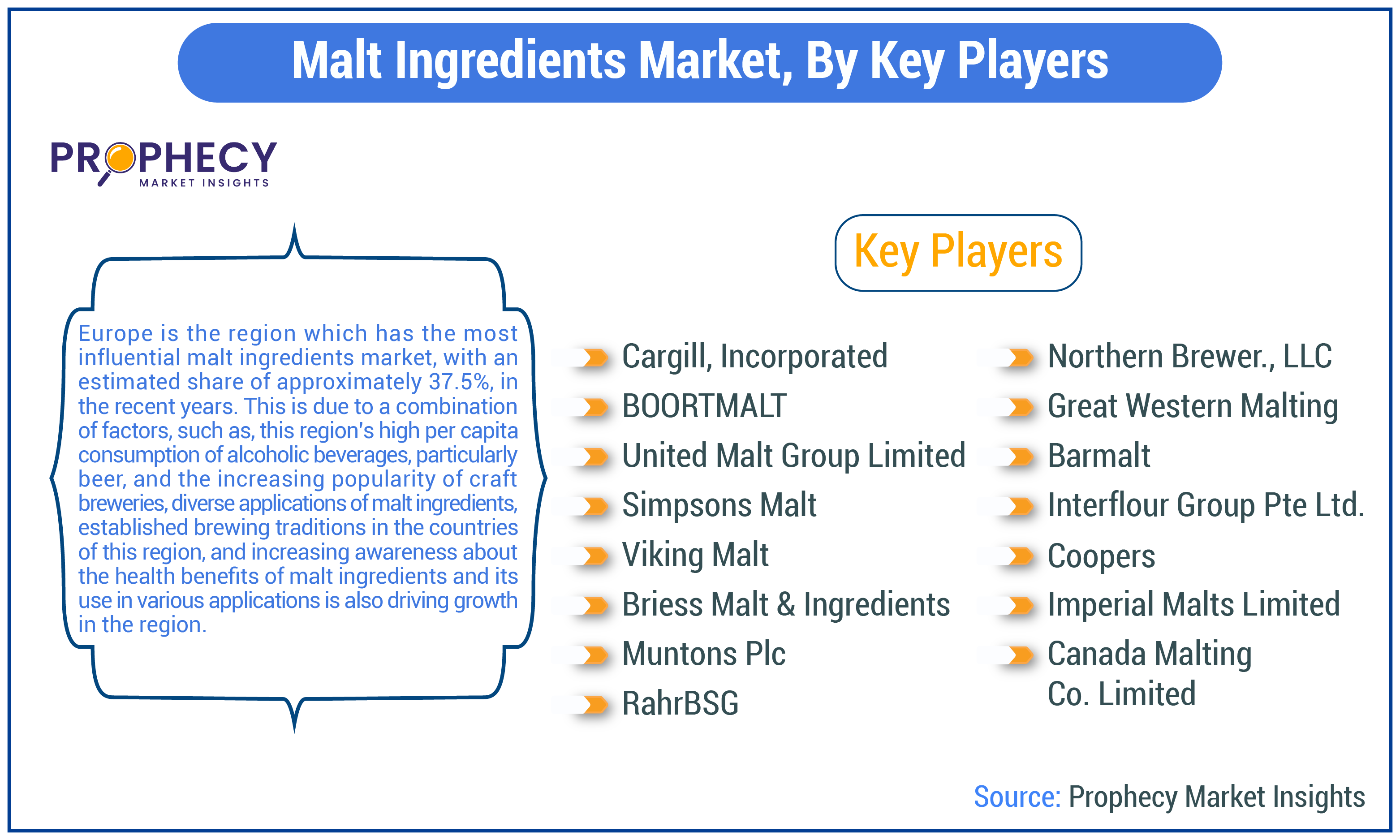
The prominent players operating in the market include, Cargill, Incorporated, BOORTMALT, United Malt Group Limited, and others. These key players are focusing on product diversification, sustainable sourcing, strategic partnerships, global expansion, investment in R&D, digital transformation, marketing and branding, and vertical integration, for driving malt ingredients market growth.
Malt Ingredients Market Companies:
- Cargill, Incorporated
- BOORTMALT
- United Malt Group Limited
- Simpsons Malt
- Viking Malt
- Briess Malt & Ingredients
- Muntons Plc
- RahrBSG
- Northern Brewer., LLC
- Canada Malting Co. Limited
- Great Western Malting
- Barmalt
- Interflour Group Pte Ltd.
- Coopers
- Imperial Malts Limited
View an Additional List of Companies in the Malt Ingredients Market
Global Malt Ingredients Market By Recent News
- In May 2025, The Catalysts Group of India and Joe White Maltings, a prominent Australian malting provider, have signed an agreement that will give Indian craft brewers its first taste of Australian barley. According to the Australian commercial and Investment Commission, the introduction of Australia's premium malting barley into the Indian market for the first time strengthened agricultural commercial relations between the two countries.
- In April 2025, Low Colour Wheat Malt and Chit Malt, two brewer-driven goods, have been introduced by Great Western Malting, the oldest maltster in the Western United States and a member of the Soufflet Malt family of brands. As one of the top suppliers of malt in North America since 1934, Great Western Malting (GWM) receives its grain from farms throughout the Pacific Northwest, an area known for its rich terroir, dry soils, and pure mountain water that are perfect for producing ingredients of the highest calibre. GWM is able to provide premium products that are suited to the demands of modern brewers and distillers due to this geographic advantage and decades of malting experience.
- In March 2025, In order to provide uniform standards for Indian single malt whiskies, the Indian Malt Whisky Association (IMWA) was formally established. In addition to placing India alongside international whisky heavyweights such as the Scotch whisky Association (SWA), Irish Whisky Association (IWA), and Japan Spirits & Liqueurs Makers Association (JSLMA), the new trade organization seeks to conserve, promote, and safeguard India's malt whisky history.
- In September 2022, One of the biggest producers of malt and malted products in the world, Muntons, has announced the release of PlantMalt, a new range of grain, liquid, and powdered malt extracts that may be used to improve meat substitutes in plant-based diets. Muntons claims that PlantMalt was created to assist producers in creating meat substitutes with mouthfeel, texture, colour, and delicious flavours.Muntons' vast expertise of malts was combined with the advice of alternative protein specialists to produce PlantMalt's range.
Analyst View:
The growing popularity of beer, including craft beer and social gatherings, the growing use of malt ingredients in the food and beverage industries, such as in blended flour, bakery goods, and non-alcoholic beverages, and the growing demand for plant-based ingredients, natural sweeteners, and functional food additives where malt ingredients provide benefits such as fiber and antioxidants are the main factors driving the growth of the global market for malt ingredients. Additional factors driving the market's expansion include the introduction of new malt varieties, such as dark malts, the creation of malt-based products with distinctive features, the growing demand from food manufacturers and brewers for sustainable and adaptable ingredients, and the adoption of mergers and acquisitions by companies in the malt ingredients market to broaden its customer base and boost market expansion.
More Related Reports
Nutraceutical Ingredients Market
Aroma Ingredients Market
Moringa Ingredients Market
Bioactive Ingredients Market
Omega 3 Ingredients Market
Global Malt Ingredients Market By Company Profile
|
Company Name |
Cargill, Incorporated |
|
Headquarter |
Wayzata, Minnesota, United States |
|
CEO |
Mr. Brian Sikes |
|
Employee Count (2024) |
160,000 Employees |
Global Malt Ingredients Market By Highlights
FAQs
Malt ingredients market size was valued at USD 23.9 Billion in 2025 and is expected to reach USD 35.0 Billion by 2035 growing at a CAGR of 4.3%.
Product type, source, grade, form, application, and region are the segmentation for the target market.
North America, Asia Pacific, Europe, Latin America, and the Middle East & Africa. Asia Pacific is expected to dominate the market.
The key players operating in the malt ingredients market include Cargill, Incorporated, BOORTMALT, United Malt Group Limited, Northern Brewer., LLC, Simpsons Malt, Viking Malt, Briess Malt & Ingredients, Muntons Plc, RahrBSG, Canada Malting Co. Limited, Great Western Malting, Barmalt, Interflour Group Pte Ltd., Coopers, and Imperial Malts Limited.