Global Luxury Jewellery Market By Overview
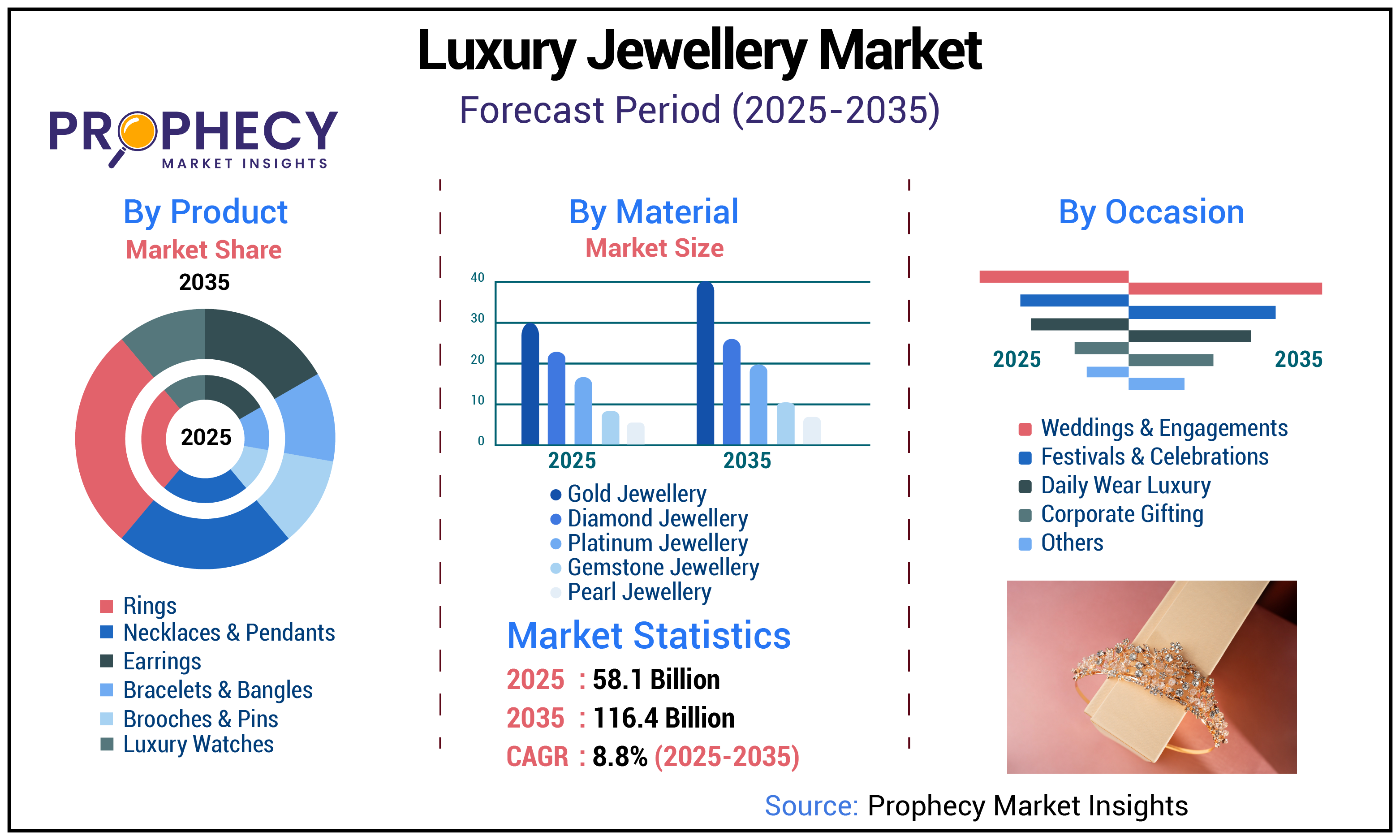
- 2024 Market Size: USD 54.2 Billion
- 2035 Projected Market Size: USD 116.4 Billion
- CAGR (2025-2035): 8.8%
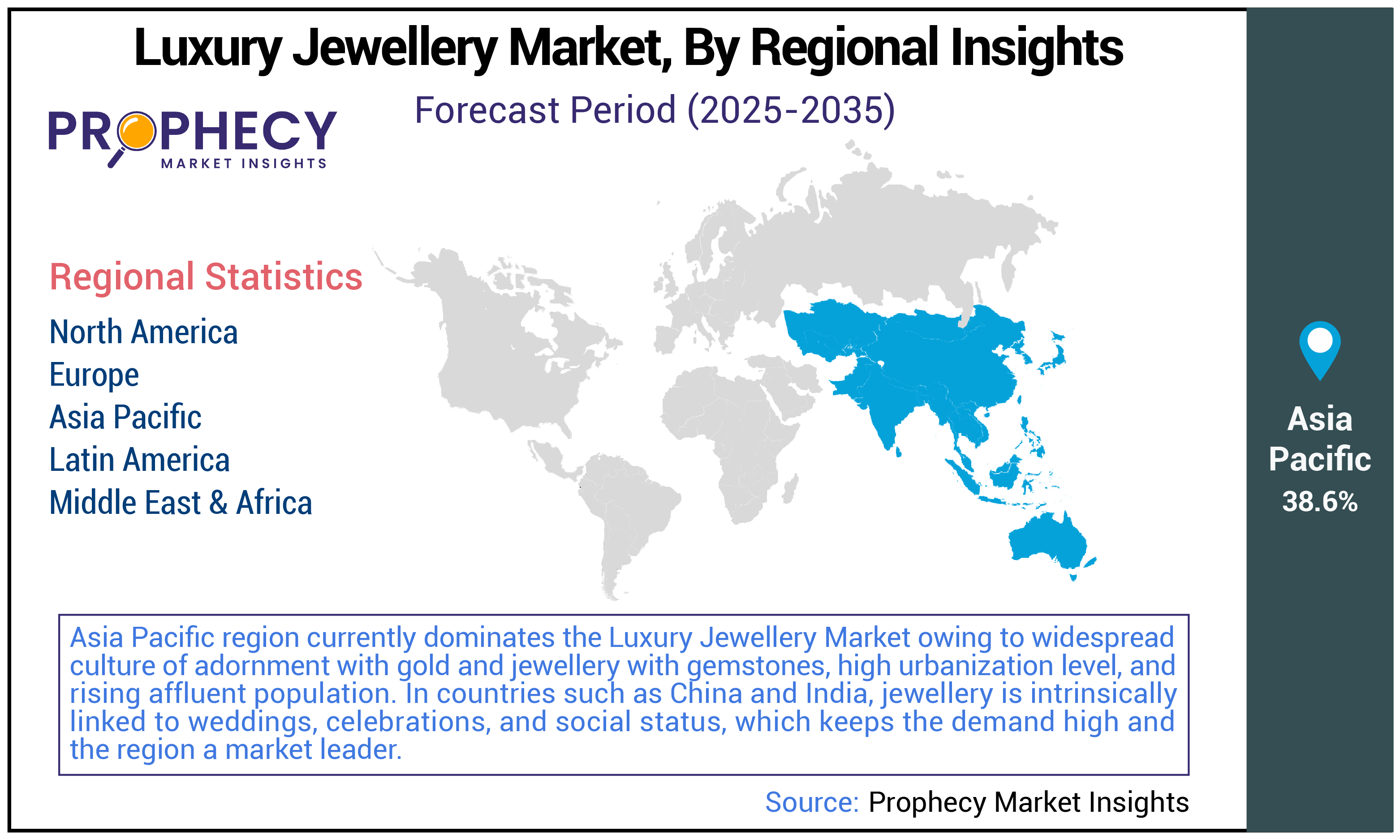
- Asia Pacific: Largest Market in 2024
Luxury jewellery is considered to be designer jewellery made of precious metals, rare gemstones, and fine workmanship. In essence, these pieces are crafted to represent exclusivity, elegance, and timeless allure. Luxury jewellery featuring diamond rings, gold necklaces, platinum bracelets, high-end earrings, and rare watches, these pieces capture the attention of those who appreciate artistry and heritage.
The luxury jewellery market is expanding as a result of increasing disposable income, increased demand for personalized and custom designed products, and increasing demand for quality investments by the consumers. This is being driven by the growth of international luxury retail, increased acceptance of online shopping and the role of the celebrity brand and fashion trends. Moreover, the emerging markets in Asia-Pacific and the Middle East are witnessing a surge in sales since the affluent consumers are looking for premium designs that are exclusive to them.
Luxury Jewellery Import Data:
|
HSN Code |
Product Description |
Origin |
Destination |
Qty. |
Price |
|
71131913 |
125206B NECKLACE RG-18K ROSE GOLD WITHDIAMONDGOLD W.44.23 GR.1 PCSB02400654271125206B NECKLACE RG-18K ROSE GOLD |
France |
India |
0 KGS |
USD 23,355.23 |
|
|
B7219500 SN.845ELI LOVE NECKLACE YELLOW GOLD DIAMONDS GOLDWGT.6.45 G 2 JEWELLERY18KTCARTIER JEWELLERY |
Switzerland |
India |
1 PCS |
USD 1,339.48 |
|
71131913 |
GOLD JEWELRY STUDDED WITH DIAMONDS 14K YEL |
India |
Germany |
2 GMS |
USD 154.64 |
|
71162000 |
Jewellery material: Artificial pearl, size 8 mm. Brand: Swarovski - Glass Stone-58188MMC. 100% new |
Austria |
Vietnam |
1500 PCE |
USD 183 |
Luxury Jewellery Export Data:
|
HSN Code |
Product Description |
Origin |
Destination |
Qty. |
Price |
|
71131142 |
92.5% SILVER EARRING,NECKLACE WITH FWPSTONE WITH GOLD PLATED APPL |
India |
United Kingdom |
10 PCS |
USD 77.08 |
|
71131929 |
950PT Platinum Stud. Jewellery Diamonds,Lab Grown Diamond,Precious Stones,Synthetic Stones RNG-4 Pieces |
India |
United Kingdom |
17 GMS |
USD 1,275.44 |
|
|
9K GOLD JEWELRY STUDDED WITH DIAMONDS. |
India |
Germany |
42 GMS |
USD 5,416.35 |
|
71162000 |
JEWELRY,Bracelet of ,CULTURED FRESH WATER PEARL 24%,CUBIC ZIRCONIA 1%,BRASS 2%,POLYESTER |
China |
Indonesia |
22 NOS |
USD 863.28 |
Current Industry Dynamics & Insights:
- Asia Pacific has the largest regional share luxury jewellery market, with almost 38.6%.
- The second-largest and fastest-growing area is North America, by accounting for 27.2%.
- By product type, holds the largest market share for the luxury jewellery market.
- On the account of material, gold jewellery is the most widely used for the luxury jewellery market.
Global Luxury Jewellery Market By Drivers & Restraints
Drivers and Restraints:
|
Drivers |
Restraints |
Opportunities & Trends |
|
|
|
Key Drivers:
Precious Metals and Gemstones Drive Jewellery as a Reliable Investment
The high investment value of precious metals and gemstones is a big impetus for the luxury jewellery market. Gold, platinum and quality diamonds are not only a symbol of wealth and prestige but are also long-term financial assets that hold or increase in value. Luxury jewellery is also viewed as a portable form of assets, particularly in times of economic uncertainty, when many investors and high net worth consumers are looking for a safer way to store wealth. This dual-purpose fashion statement and financial protection mechanism continues to drive demand everywhere.
- For instance, in the year 2023, as per the World Gold Council, 132 tonnes of gold jewellery was purchased by Chinese consumers in the second quarter of the year, a 28% year-on-year increase. This surge highlights the fact that in a time of economic uncertainty, buyers are increasingly looking at gold not only as an emblem of luxury, but also as a safe financial asset. The trend underscores the dual nature of luxury jewellery-a blend of prestige and style with the steadiness of a long-term store of value.
Restraints:
Volatile Raw Material Prices Restrain Luxury Jewellery Market Growth
Rising and falling prices of gold, platinum, and rare gemstones are the biggest challenge for the luxury jewellery market. A surge in raw material prices will add costs to manufacturing, which affects profit margins for manufacturers and retailers. Price volatility also makes it challenging to keep pricing consistent for your products, which dissuades some buyers and delays purchase decisions. The fluctuation is often the reason brands switch sourcing strategies or redesign collections to control costs.
- Counterbalance Statements: Despite price variations, luxury jewellery remains appealing to affluent consumers who prioritize exclusivity and long-term value accumulation. Premium buyers: These customers are less price-sensitive and are willing to pay a premium for quality designs and craftsmanship. Many brands also reduce this risk through dynamic pricing strategies and by diversifying their supply chains.
Opportunities & Trends:
Increasing Adoption of Ethical Gemstones and Lab-Crafted Diamonds
With the growing demand for sustainable and ethical jewellery, lab-grown diamonds and ethical sourcing of gemstones are becoming more popular within the luxury jewellery industry. These alternatives combine the same brilliance and craftsmanship of mined stones while still respecting ethical sourcing practices. The transition is allowing jewelers to appeal to millennial and Gen Z consumers who care about both quality and conscious consumption while enhancing brand credibility and expanding opportunity into markets where regulatory and cultural support for ethical luxury is growing.
- For instance, According to Forbes, in 2025 lab-grown diamonds were being priced at 70% to 90% the cost of mined diamonds, depending on size, cut, and clarity. A two-carat VS1 lab-grown diamond was worth about USD 2,800, while that same grade of mined diamond fetched USD 29,500. The stark difference in price serves as a testament to the fact that ethical and sustainable options are not just ecologically responsible but financially viable, enabling millennials and Gen Z to indulge in luxury jewellery that marries craftsmanship with conscious consumption.
Global Luxury Jewellery Market By Segmentations & Regional Insights
Product type, material, design & style, price range, production method, occasion, end user and region are the divisions of the luxury jewellery market.
By Product Type:
Necklaces & pendants, rings, earrings, bracelets & bangles, brooches & pins, luxury watches, and others are product type on which luxury jewellery market is segmented. The largest segment of the luxury jewellery market includes rings as they have a symbolic significance in engagements, weddings, and fashion statements. They are viewed as collectible and personalized, which makes them always in demand.
The second position is given to necklaces & pendants as they are acceptable to give as a gift, during celebrations or as normal luxury wear. The fact that they are able to display both gemstones and elaborate designs makes them most attractive cuts across the board.
By Material:
Based on the material, the luxury jewellery market is divided into gold jewellery, platinum jewellery, diamond jewellery, gemstone jewellery, pearl jewellery, and others. Gold jewellery is the market leader due to its universal acceptance, investment and cultural meaning in offering and ceremonial. The fact that gold also comes in yellow, white, and rose also adds to its superiority.
Diamond jewellery is at the second position as it is the most desired item in terms of luxury gifting, engagement rings, high-status appeal, which is a compulsory item in high-end collections.
By Design & Style:
Classic designs, modern designs, vintage & heritage-inspired, custom-designed jewellery, limited edition & collectible pieces, high-fashion statement jewellery, and others are design & style of the luxury jewellery market. The most prevalent ones are classics designs since ancient beauty is always attractive to a broad range of consumers and can withstand the test of time. They specialize in engagement rings, heirloom jewellery purchases and traditional jewellery.
In second place, there are modern designs, which attract younger and more fashion-conscious consumers who appreciate contemporary designs that are neither too costly nor too stylish.
By Price Range:
On the price range, luxury jewellery market is categorized into entry-level luxury, mid-tier luxury, high-end luxury, and ultra-Luxury. Mid-tier luxury is a prevailing category in the market since it strikes a balance between affordable prices and high-end quality and attracts a large proportion of aspiration customers without sacrificing exclusivity.
High-end luxury comes in second, as it is pushed by affluent consumers, who want exclusive, rare, and high-carat jewellery as a status symbol and investment.
- For instance, in 2024, The Knot Jewellery and Engagement Study survey found that more than half of the engagement rings in the U.S. contained lab-grown diamonds, as consumers shift their preferences toward affordable and ethically-sourced products. The average cost that couples paid on diamond rings grown in laboratories was 4,900 USD diamond rings versus 7,600 USD counterparts mined. This price disconnect shows how once-in-a-life events such as weddings are also making sustainable options more sought after without having to sacrifice quality or emotion.
By Production Method:
Handcrafted luxury jewellery, semi-handcrafted jewellery, fully industrial / precision made luxury are production method of the luxury jewellery market. Handcrafted luxury jewellery leads as it focuses on the craftsmanship, one-of-a-kind design, and high finishing that luxury buyers find very attractive.
Semi-handcrafted jewellery comes second, a balance between high quality finishing and more scalable production is offered and is popular in slightly larger markets.
- For instance, according to artisan jeweler Silveringdom, in 2023, the handcrafted jewellery market was experiencing an unmistakable premium. What it would take eight hours to make in sterling silver was a ring that could sell at approximately 150 dollars, in comparison to a machine made item of the same sort that would cost 40-60 dollars. The value added is through the intensive operations such as hand-soldering, engraving, and stone setting. This art and workmanship is what makes the artisan jewellery worth the high price tag.
By Occasion:
The luxury jewellery market on the account of occasion are categorized into weddings & engagements, festivals & celebrations, daily wear luxury, corporate gifting, and others. Weddings & engagements take the lead, as they are important events in life where luxury jewellery is said to be necessary, particularly rings, necklaces, and bangles.
Second are festivals & celebrations as gifting and ritual purchases during cultural festivals contribute to high seasonal sales in various regions.
By End User:
The luxury jewellery markets on the account of end user are categorized into women, men, children, and unisex. The main consumers are women as most of the luxury jeweler designs, collections and marketing campaigns are directed to female customers.
Men are ranked second due to the growing interest in watches, rings and bracelets as fashion accessories and presents, which are widening the male jewellery luxury market.
Regional Insights:
Geographically, the luxury jewellery market is studied across North America, Europe, Asia Pacific, Latin America, and the Middle East & Africa.
Asia Pacific: This region currently dominates the luxury jewellery market owing to widespread culture of adornment with gold and jewellery with gemstones, high urbanization level, and rising affluent population. In countries such as China and India, jewellery is intrinsically linked to weddings, celebrations, and social status, which keeps the demand high and the region a market leader.
In spite of its dominance, Asia-Pacific is being challenged by factors such as declining economic growth in certain countries, increasing competition from local brands, and changing consumer sentiment-especially in the post-pandemic period. Such circumstances have given rise to a more reserved approach to luxury spending on the part of certain demographic groups, encouraging brands to make adjustments to marketing strategies and product offers.
- China Luxury Jewellery Market Insights:
China's fast-expanding high net worth population, robust gifting culture, and cultural affinity for gold and gemstones make it the anchor of the jewellery market in the Asia-Pacific. Healthy e-commerce ecosystems worldwide and on the domestic level, governmental support of luxury consumption, and increasing demand from younger consumers seeking fine jewellery as both a status symbol and a source of investment power the sector.
North America: The second-largest and fastest-growing area is North America, driven by high disposable incomes, high brand loyalty, and advanced retail infrastructure. Cities such as New York, Los Angeles, and Toronto act as influential hubs where consumer preferences are slowly being shaped by customization, ethical sourcing, and a digital cross-channel presence experience.
Nevertheless, North America is not insular from larger economic forces: consumer confidence may rise or fall in response to inflation, geopolitical tensions, or market turbulence. Since luxury goods are more discretionary, such uncertainties reduce spending in the higher end of the jewellery spectrum, contributing to slowing growth.
- U.S. Luxury Jewellery Market Insights:
The U.S. is a leader in the region, driven by a tech-savvy and affluent consumer base that appreciates personalized pieces and seamless digital interactions. Innovation and cross-platform luxury distribution U.S. brands are leading the way with innovative experiences and reliable cross-platform luxury distribution, solidifying the country's dominance in the North American luxury jewellery market.
Europe: This region continues to be an important player due to its rich heritage of craftsmanship, high-end design houses and ancient luxury culture. In the higher end of the jewellery market, countries such as France, Italy, and Switzerland continue to be the backbone of the region, with their renowned luxury jewellery manufacturing and strong brand legacy, especially in the field of high jewellery.
The region is also affected by factors such as the decrease in tourism, which was a major source of sales. Consumer behavior has also been affected by economic uncertainty in the European Union and pressures on inflation. This slower pace has fueled activity around online growth with an increased focus on value-added experiences that can continue to support regional demand.
- France Luxury Jewellery Market Insights:
France retains its position as Europe's most important luxury jewellery market, supported by its brand strength and fashion leadership all around the world. French maisons are harnessing the power of storytelling, traditional craftsmanship, and immersive experiences both in-store and online to stay relevant and grow in an evolving market landscape.
Luxury Jewellery Market Report Scope:
|
Attribute |
Details |
|
Market Size 2025 |
USD 58.1 Billion |
|
Projected Market Size 2035 |
USD 116.4 Billion |
|
CAGR Growth Rate |
8.8% (2025-2035) |
|
Base year for estimation |
2024 |
|
Forecast period |
2025 – 2035 |
|
Market representation |
Revenue in USD Billion& CAGR from 2025 to 2035 |
|
Regional scope |
North America - U.S. and Canada Europe – Germany, U.K., France, Russia, Italy, Spain, Netherlands, and Rest of Europe Asia Pacific – China, India, Japan, Australia, Indonesia, Malaysia, South Korea, and Rest of Asia-Pacific Latin America - Brazil, Mexico, Argentina, and Rest of Latin America Middle East & Africa – GCC, Israel, South Africa, and Rest of Middle East & Africa |
|
Company Landscape |
Market Share Analysis of Companies Heat Map Analysis Company Overview, Product Types Overview Financial Information, Key Highlights Business Strategies Overview SWOT Analysis |
|
Report coverage |
Revenue forecast, company share, competitive landscape, growth factors, and trends |
|
Value Added Data Infosets |
Besides fundamental market insights such as the size of the market, growth rate, segmentation, regional study, and key players, our reports carry value-added data sets such as trade flow (import-export) analysis, production and consumption overview, price trend evaluation, supply and value chain mapping, and raw material availability. Moreover, we provide strategic tools as PESTLE and Porter’s Five Forces analysis, examination of the regulatory landscape, as well as monitoring of technology and innovation thereby providing a comprehensive overview which facilitates sensible and anticipatory decision-making. |
Segmentation:
By Product Type:
- Necklaces & Pendants
- Rings
- Earrings
- Bracelets & Bangles
- Brooches & Pins
- Luxury Watches
- Others
By Material:
- Gold Jewellery
- Yellow Gold
- White Gold
- Rose Gold
- Platinum Jewellery
- Diamond Jewellery
- Solitaire
- Multi-stone
- Pave
- Gemstone Jewellery
- Sapphire
- Emerald
- Ruby
- Others
- Pearl Jewellery
- Natural
- Cultured
- Others
By Design & Style:
- Classic Designs
- Modern Designs
- Vintage & Heritage-Inspired
- Custom-Designed Jewellery
- Limited Edition & Collectible Pieces
- High-Fashion Statement Jewellery
- Others
By Price Range:
- Entry-Level Luxury
- Mid-Tier Luxury
- High-End Luxury
- Ultra-Luxury
By Production Method:
- Handcrafted Luxury Jewellery
- Semi-Handcrafted Jewellery
- Fully Industrial / Precision Made Luxury Jewellery
By Occasion:
- Weddings & Engagements
- Festivals & Celebrations
- Daily Wear Luxury
- Corporate Gifting
- Others
By End User:
- Women
- Men
- Children
- Unisex
By Region:
- North America
- U.S.
- Canada
- Europe
- Germany
- U.K.
- France
- Russia
- Italy
- Spain
- Netherlands
- Rest of Europe
- Asia Pacific
- China
- India
- Japan
- Australia
- Indonesia
- Malaysia
- South Korea
- Rest of Asia Pacific
- Latin America
- Brazil
- Mexico
- Argentina
- Rest of Latin America
- Middle East & Africa
- GCC
- Israel
- South Africa
- Rest of Middle East & Africa
Global Luxury Jewellery Market By Competitive Landscape & Key Players
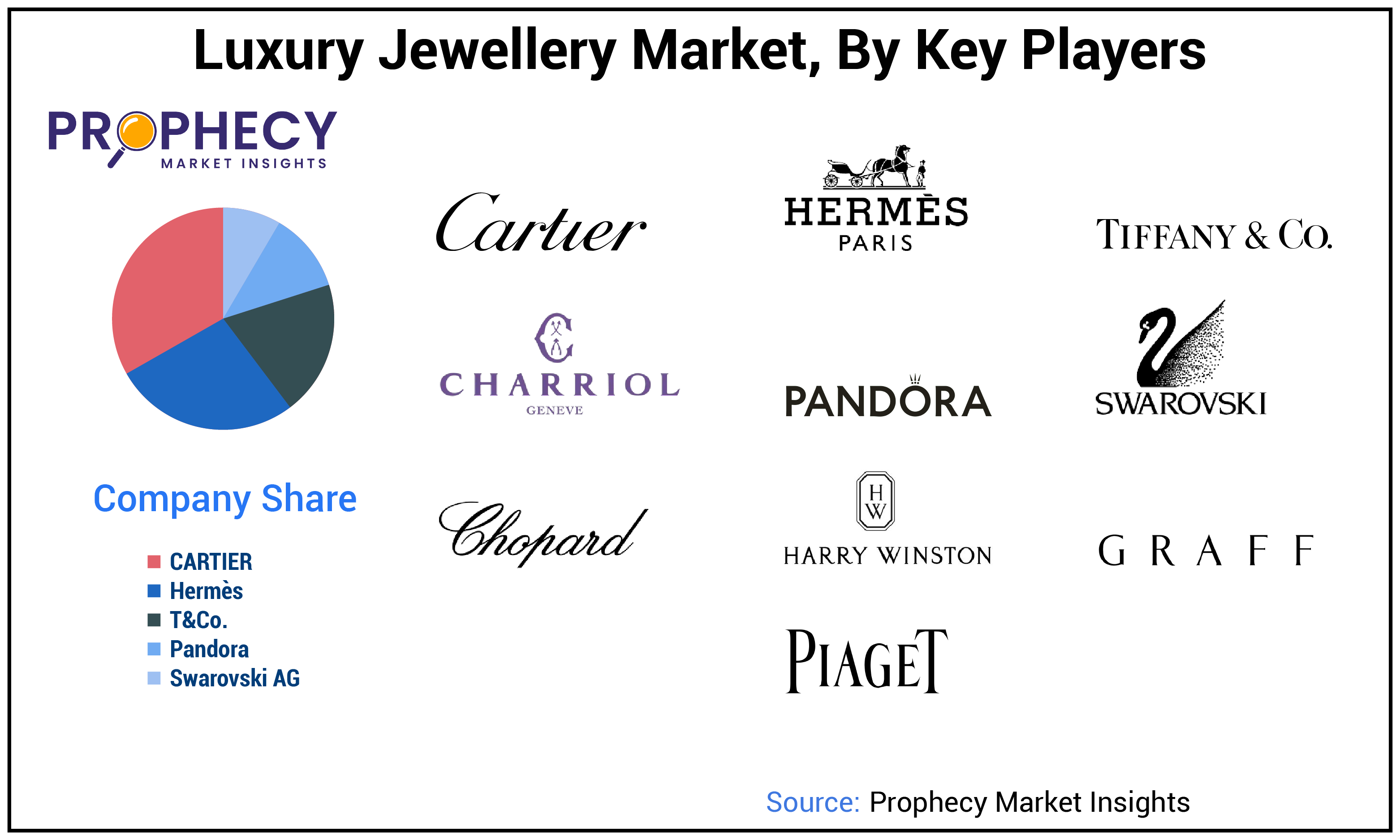
By prioritizing innovation, ethical sourcing, and quality craftsmanship, manufacturing companies can tap into the potential of the luxury jewellery market and propel their business growth. Harnessing digital platforms and immersive shopping experiences enables you to cater to a younger, tech-savvy consumer base, across the globe. Limited-edition collections and personalized experiences can add layers of exclusivity, while sustainability practices reinforce brand reputation. Influencer and designer collaborations, partnering with influencers and designers continues to broaden market exposure and foster consumer engagement. The key players operating in the luxury jewellery market include, Hermès, Bulgari S.p.A., Pandora, and others.
Luxury Jewellery Market Companies:
- CARTIER
- Hermès
- T&Co.
- Pandora
- Swarovski AG
- Philippe Charriol International Ltd.
- Bulgari S.p.A.
- Van Cleef & Arpels
- CHOPARD
- Harry Winston, Inc.
- Piaget
- Graff Diamonds Limited
- David Yurman Enterprises LLC
- Boucheron
- K. Mikimoto & Co., Ltd.
View an Additional List of Companies in the Luxury Jewellery Market
Global Luxury Jewellery Market By Recent News
- In August 2025, Pandora launched the Talisman collection, an 12-piece range based on the ancient amulets which were thought to have a good omen and spiritual quality. The range also includes symbolic Latin calligraphy and uses such materials as 14k gold plating, artificial inlays made of man-made mother-of-pearl, and synthetic diamonds. This introduction indicates the sentiment and the modernity that Pandora aims to incorporate in its design.
- In May 2024, Cartier rolled out its high jewellery line called Nature Sauvage in Vienna displaying eight unique events in five historic locations. The line has wildlife-themed motifs, such as the "Panthere Jaillissante" bracelet-ring set, which has an 8.63-carat Zambian emerald. In this launch, Cartier has stressed its desire to be able to blend nature and extraordinary craftsmanship.
Analyst View:
The luxury jewellery market is expected to continue its growth trajectory, fueled by increasing affluence, digitalization, and the growing demand for sustainable and ethical products. The trend toward special edition and limited collections is creating loyalty within the brand. Demand is also expected to be driven further by newer consumer segments and emerging markets. The reason for this is that businesses that combine innovation and heritage crafting skills are possibly to stay competitive.
Analysis of Sources:
Primary Sources:
- In-depth interviews
- Company-specific data
- Surveys and questionnaires
- Focus group discussions (FGDs)
- Others
Secondary Sources:
- Journal of Consumer Research
- International Journal of Retail & Distribution Management
- United States Geological Survey (USGS)
- Gemological Institute of America (GIA)
- Others
More Related Reports
China Luxury Car Market
Luxury Hotels Market
Luxury Vinyl Tile Floor Covering Market
Hard Luxury Goods Market
Luxury Pet Accessories Market
Global Luxury Jewellery Market By Company Profile
|
Company Name |
Product Portfolio |
|
CARTIER |
Yellow gold bracelets, White gold ring, Yellow gold and diamond necklace, and Others |
|
Hermès |
Rose gold earrings, Rose gold and sterling silver necklace, Sterling silver bracelets, and Others |
|
T&Co. |
Yellow gold pendant, Rose gold earrings, White gold with diamond rings, and Others |
|
Pandora |
Sterling silver bracelets, Rose gold plating bangle and Others |
|
Swarovski AG |
Rose gold plated necklace, gold plated earrings, and Others |
Global Luxury Jewellery Market By Highlights
FAQs
Luxury jewellery market size was valued at USD5 8.1 Billion in 2025 and is expected to reach USD 116.4 Billion by 2035 growing at a CAGR of 8.8%.
Product type, material, design & style, price range, production method, occasion, end user, and region are the segmentation for the luxury jewellery market.
Increasing gifting culture, rising disposable incomes, celebrity endorsements and fashion collaborations, and so on are some of the luxury jewellery market growth drivers.
North America, Asia Pacific, Europe, Latin America, and the Middle East & Africa. Asia Pacific is expected to dominate the luxury jewellery market.
The development of luxury jewellery products is being changed by generative AI and new technologies that allow designers to produce the most complex, customized and unique jewellery products with accuracy. Virtual prototyping and 3D modeling speed up the design cycle and save production cost and time. Trend analysis with AI assists the brand in predicting consumer preferences and developing collections that appeal to target customers. In general, technology innovation brings greater creativity, efficiency, and customization to the luxury jewellery industry.
The key players operating the luxury jewellery market include CARTIER, Hermès, T&Co., Pandora, Swarovski AG, Philippe Charriol International Ltd., Bulgari S.p.A., Van Cleef & Arpels, CHOPARD, Harry Winston, Inc., Piaget, Graff Diamonds Limited, David Yurman Enterprises LLC, Boucheron, and K. Mikimoto & Co., Ltd.