Global Kidney Cancer Treatment Drugs Overview
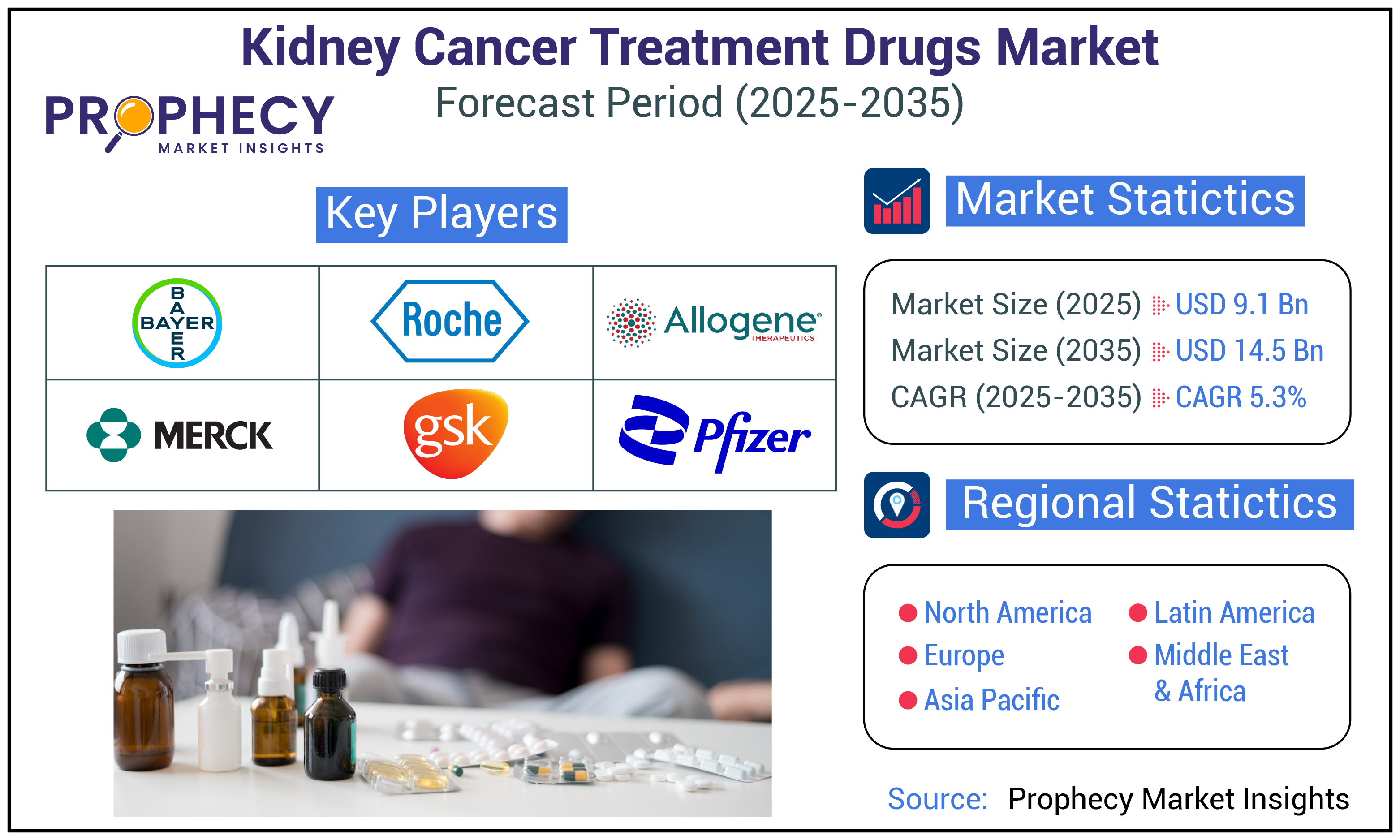
- The kidney cancer treatment market size to reach a valuation of USD 14.5 Billion by 2035.
- USD 8.7 Billion was the calculated valuation of the market in 2024.
- The target market is developing at a CAGR of 5.3%.
Kidney cancer treatment drugs include tyrosine kinase inhibitors (TKIs), mTOR inhibitors, and immunotherapy drugs. These drugs are used in targeted therapies, immunotherapies, and biological therapies. The rising incidence of kidney cancer, increased healthcare spending, new drug and therapies developments, increasing investments of governments in kidney disorders, advanced medical facilities in various countries, and rising research and development investment by drug developers, are factors fostering the kidney cancer treatment drugs market growth.
Additionally, the kidney cancer treatment drugs help in shrinking or controlling kidney cancer, and some of these can even make tumors disappear, thus, further contributing in the market diversification.
Impact of AI on Kidney Cancer Treatment Drugs Market:
Surgery is still the primary treatment option for kidney cancer, but AI (artificial intelligence) is significantly improving diagnosis, risk stratification, treatment selection, and monitoring by analyzing large datasets to identify potential drug targets, predict treatment responses, and personalize treatment plans for individual patients. Currently available kidney cancer treatment drugs often include targeted therapies, such as tyrosine kinase inhibitors (TKIs) including sunitinib, pazopanib, and axitinib, depending on the genetic profile of the tumor.
Global Kidney Cancer Treatment Drugs Drivers & Restraints
Key Drivers of Target Market:
Market is Expanding Owing to the Rising Prevalence of Kidney Cancer
In essence, more diagnosed cases of kidney cancer translate into a larger patient pool needing treatment options, which fuels the growth of the kidney cancer treatment drugs market. As the number of people with kidney cancer rises globally, there is a burgeoning demand for effective treatment drugs, further propelling the growth of the kidney cancer treatment drugs market.
- For instance, in February 2024, according to an article published by Oxford University Press, kidney cancer (KC) is a disease with a rising worldwide incidence estimated at 400,000 new cases annually, and a worldwide mortality rate approaching 175,000 deaths per year. Current projections suggest incidence will continue to increase over the next decade, emphasizing the urgency of addressing this significant global health trend.
Restraints:
Side Effects Caused by Kidney Cancer Treatment Drugs is Obstructing the Market Growth
Kidney cancer treatment drugs, such as immunotherapies and targeted treatments, can have serious side effects including tiredness, gastrointestinal problems, and high blood pressure. Over time, these medications may potentially cause resistance, which would decrease their efficacy. Furthermore, many patients cannot afford the exorbitant expense of therapy. Certain medications have the potential to harm healthy cells as well, which might result in further trouble.
- Counterbalance Statements: Regular monitoring, lifestyle changes, and supportive drugs can help manage side effects. Accessibility can be increased by lowering treatment costs through financial aid programs, insurance, and generic substitutes, thereby preventing the downfall of the market for kidney cancer treatment drugs.
Opportunities:
Future Market Opportunities can Increase Due to the Incorporation of Personalized Kidney Cancer Treatment Drugs
The market for kidney cancer treatment drugs is driven by personalized cancer therapies, also referred to as precision medicine, which enable physicians to customize treatment regimens based on the unique genetic profile of each patient's tumor. This results in more targeted and efficient drug therapies with potentially better outcomes and fewer side effects, further increasing the adoption and market expansion for new and customized treatment options.
- For instance, in February 2025, Dana-Farber Cancer Institute researchers reported that all nine patients in a clinical trial being treated for stage III or IV clear cell renal cell carcinoma (a form of kidney cancer), generated a successful anti-cancer immune response after initiation of a personalized cancer vaccine. The vaccines were administered after surgery to remove the tumor and are designed to train the body’s immune system to recognize and eliminate any remaining tumor cells.
Global Kidney Cancer Treatment Drugs Segmentations & Regional Insights
The kidney cancer treatment drugs market is segmented into type, drug type, therapy, drug class, route of administration, end-user, and region.
By Type
Based on type, the market is sub-segmented into renal cell carcinoma, transitional cell cancer, Wilms tumor, and renal sarcoma. The renal cell carcinoma segment is attributed to lead the market. The segment’s expansion is attributed to the high prevalence of renal cell carcinoma, improved advancements in diagnostics, and the development and adoption of targeted therapies.
- For instance, in February 2023, Merck announced that the U.S. Food and Drug Administration (FDA) had approved WELIREG, an oral hypoxia-inducible factor-2 alpha (HIF-2α) inhibitor, for the treatment of adult patients with advanced renal cell carcinoma (RCC) following a programmed death receptor-1 (PD-1) or programmed death-ligand 1 (PD-L1) inhibitor and a vascular endothelial growth factor tyrosine kinase inhibitor (VEGF-TKI).
By Drug Type
On the basis of drug type, the market is bifurcated into generic and branded. The branded drugs segment is dominating the market due to extensive investments on research and development by pharmaceutical companies, strong brand recognition, higher quality and efficacy as compared to generic drugs, and aggressive marketing campaigns.
By Therapy
Under therapy, the market is divided into targeted therapy, immunotherapy, chemotherapy, and others. The immunotherapy segment is holding the largest kidney cancer treatment drugs market share. The expanding advancements in immunotherapy resulting in increasing the range of available treatments, which further improves patient outcomes, drive the segment’s expansion.
- For instance, in April 2024, Dana-Farber Cancer Institute announced that treatment with pembrolizumab, an immunotherapy drug, after surgery significantly prolonged overall survival in patients with clear-cell renal-cell carcinoma (ccRCC), a type of kidney cancer at high risk for recurrence. Pembrolizumab was associated with a 38% reduction in risk of death compared with placebo.
By Drug Class
By drug class, the market is branched into angiogenesis inhibitors, monoclonal antibodies, mTOR inhibitors, cytokine immunotherapy, and others. The angiogenesis inhibitors segment is projected to govern the market as it is effective at starving tumors of oxygen and nutrients, which can lead to the destruction of kidney cancers.
- For instance, in December 2024, Exelixis, Inc. and Arcus Biosciences announced that the companies had entered into a clinical trial collaboration for STELLAR-009, a phase 1b/2 trial evaluating zanzalintinib, Exelixis’ next-generation tyrosine kinase inhibitor (TKI), in combination with AB521, an angiogenesis inhibitor of the transcription factor HIF-2?, in patients with advanced solid tumors, including clear cell renal cell carcinoma (ccRCC).
By Route of Administration
According to the route of administration, the market is trifurcated into oral, intravenous, and subcutaneous. The oral administration segment is ruling over the market as it is preferred by consumers due to its convenience, less invasiveness, and wide variety. Thus improving the patient’s quality of life and finding the perfect fitting treatment.
- For instance, in February 2021, Glenmark Pharmaceuticals, a research-led, global integrated pharmaceutical company, launched SUTIB, the generic version of Sunitinib oral capsules to treat kidney cancer in India. The drug was launched at an MRP that was approximately 96% lower than the MRP compared to the innovator brand, priced at Rs. 7000 (50 mg), Rs. 3600 (25 mg) and Rs. 1840 (12.5 mg) per month. Sunitinib was also approved by the US Food and Drug Administration (US FDA).
By End-User
By end-user, the market is classified into hospital pharmacies, retail pharmacies, and others. The hospital pharmacies segment is the leading segment in the market as it provides specialized treatments, ensures timely access to medications, monitors drug interactions, provides patient education, optimizes treatment outcomes, and controls the dispensing of many expensive kidney cancer drugs.
Regional Insights
Geographically, the market is catalogued into North America, Europe, Asia Pacific, Latin America, and the Middle East & Africa.
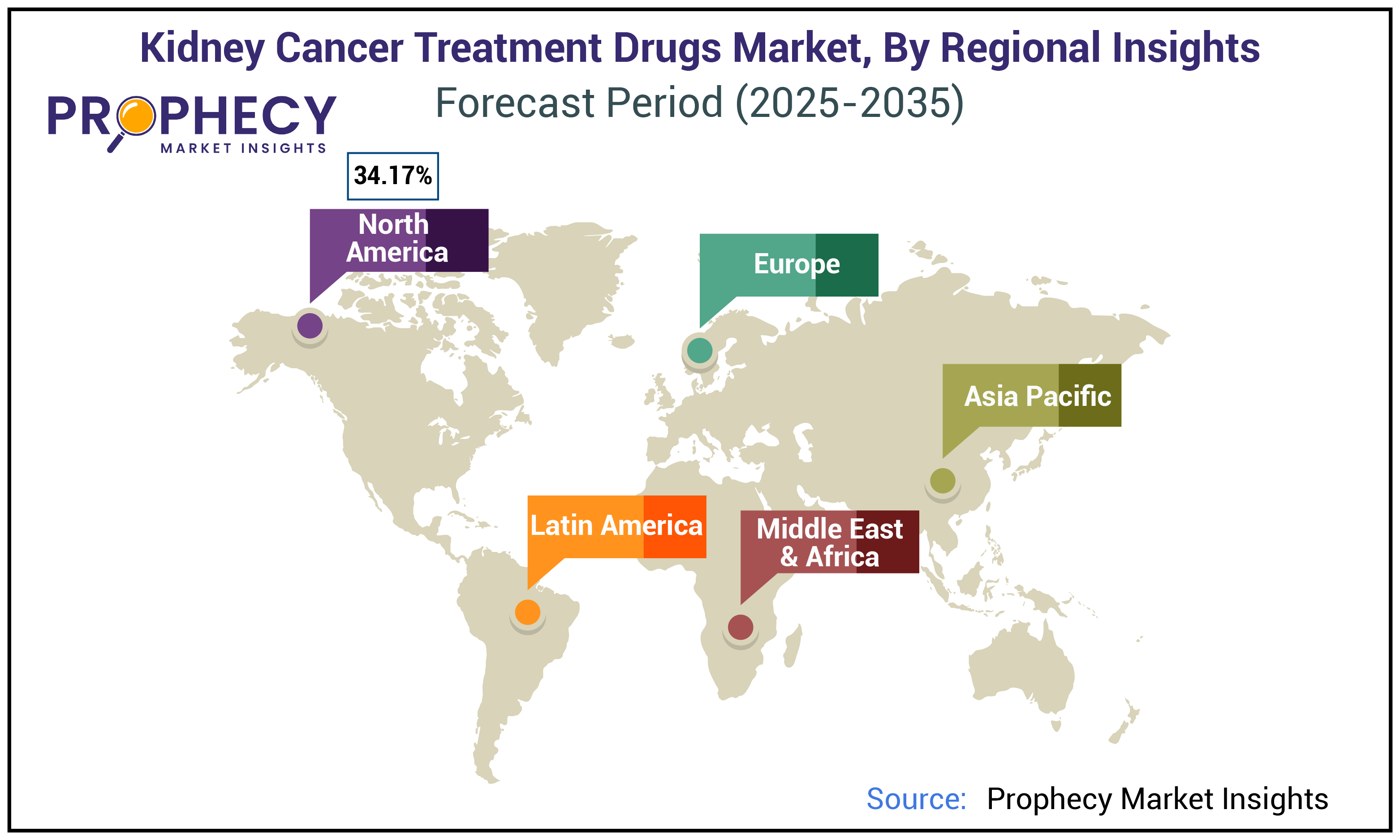
North America: North America holds the biggest kidney cancer treatment drugs market with an estimated share of 34.17%. The growth is attributed to the advanced healthcare infrastructure, rising research and development by pharmaceutical industries, its major center for clinical trials and cancer research, early adoption of new treatment, and high prevalence of kidney cancer.
- For instance, in February 2025, Telix announced that the United States (U.S.) Food and Drug Administration (FDA) had accepted the Biologics License Application (BLA) for its breakthrough investigational kidney cancer PET imaging agent TLX250-CDx (Zircaix, 89Zr-DFO-girentuximab), granted a Priority Review and provided a date for its launch in the U.S. commercial in 2025.
Europe: Europe is expected to grow with the highest CAGR during the forecast period. The region’s expansion is driven by the presence of robust healthcare infrastructure, substantial investment in research and development, a high prevalence of kidney cancer within the population, particularly among older demographics, and a strong focus on adopting innovative therapies.
- For instance, in November 2021, Merck & Co., Inc., announced that the European Commission had approved the combination of LENVIMA (KISPLYX in the European Union [EU] for the treatment of advanced renal cell carcinoma [RCC]), the orally available multiple receptor tyrosine kinase inhibitor discovered by Eisai, plus, KEYTRUDA, the anti-PD-1 therapy from Merck & Co., Inc., for the first-line treatment of adult patients with advanced RCC, a type of kidney cancer.
Kidney Cancer Treatment Drugs Market Report Scope:
|
Attribute |
Details |
|
Market Size 2025 |
USD 9.1 Billion |
|
Projected Market Size 2035 |
USD 14.5 Billion |
|
CAGR Growth Rate |
5.3% (2025-2035) |
|
Base year for estimation |
2024 |
|
Forecast period |
2025 – 2035 |
|
Market representation |
Revenue in USD Billion & CAGR from 2025 to 2035 |
|
Regional scope |
North America - U.S. and Canada Europe – Germany, U.K., France, Russia, Italy, Spain, Netherlands, and Rest of Europe Asia Pacific – China, India, Japan, Australia, Indonesia Malaysia, South Korea, and Rest of Asia Pacific Latin America - Brazil, Mexico, Argentina, and Rest of Latin America Middle East & Africa – GCC, Israel, South Africa, and Rest of the Middle East & Africa |
|
Report coverage |
Revenue forecast, company share, competitive landscape, growth factors, and trends |
Segmentation:
By Type:
- Renal Cell Carcinoma (RCC)
- Transitional Cell Cancer
- Wilms Tumor
- Renal Sarcoma
By Type:
- Generic
- Branded
By Therapy:
- Targeted Therapy
- Immunotherapy
- Chemotherapy
- Others
By Drug Class:
- Angiogenesis inhibitors
- Monoclonal antibodies
- mTOR inhibitors
- Cytokine immunotherapy (IL-2)
- Others
By Route of Administration:
- Oral
- Intravenous
- Subcutaneous
By End User:
- Hospital Pharmacies
- Retail Pharmacies
- Others
By Region:
- North America
- U.S.
- Canada
- Europe
- Germany
- U.K.
- France
- Russia
- Italy
- Spain
- Netherlands
- Rest of Europe
- Asia Pacific
- China
- India
- Japan
- Australia
- Indonesia
- Malaysia
- South Korea
- Rest of Asia Pacific
- Latin America
- Brazil
- Mexico
- Argentina
- Rest of Latin America
- Middle East & Africa
- GCC
- Israel
- South Africa
- Rest of the Middle East & Africa
Global Kidney Cancer Treatment Drugs Competitive Landscape & Key Players
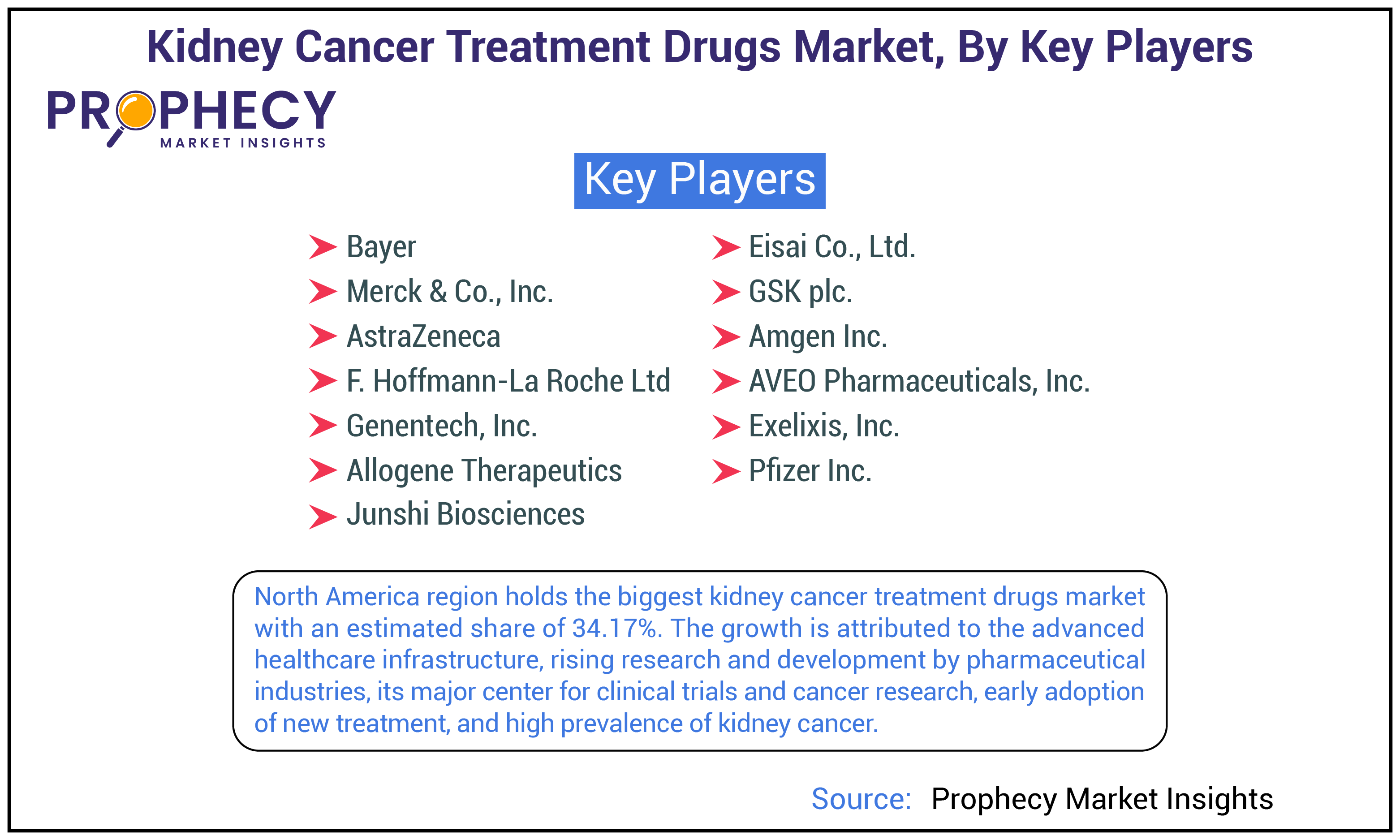
The companies operating in the kidney cancer treatment drugs market are Bayer, Merck & Co., Inc., AstraZeneca, F. Hoffmann-La Roche Ltd, Genentech, Inc., and others. The key players are adopting strategies such as drug developments, new product launches, partnerships, and focusing on combination therapy, for the diversification of the market.
Kidney Cancer Treatment Drugs Market Companies:
- Bayer
- Merck & Co., Inc.
- AstraZeneca
- F. Hoffmann-La Roche Ltd
- Genentech, Inc.
- Allogene Therapeutics
- Junshi Biosciences
- Eisai Co., Ltd.
- GSK plc.
- Amgen Inc.
- AVEO Pharmaceuticals, Inc.
- Exelixis, Inc.
- Pfizer Inc.
View an Additional List of Companies in the Kidney Cancer Treatment Drugs Market
Global Kidney Cancer Treatment Drugs Recent News
- In December 2023, Merck, announced that the U.S. Food and Drug Administration (FDA) had approved WELIREG, an oral hypoxia-inducible factor-2 alpha (HIF-2α) inhibitor, for the treatment of adult patients with advanced renal cell carcinoma (RCC) following a programmed death receptor-1 (PD-1) or programmed death-ligand 1 (PD-L1) inhibitor and a vascular endothelial growth factor tyrosine kinase inhibitor (VEGF-TKI).
- In March 2021, AVEO Oncology announced that FOTIVDA (tivozanib) was commercially available in the United States (U.S.) ahead after its approval by the U.S. Food and Drug Administration (FDA) for the treatment of adults with relapsed or refractory advanced renal cell carcinoma (RCC) following two or more prior systemic therapies. FOTIVDA was an oral, next-generation vascular endothelial growth factor (VEGF) tyrosine kinase inhibitor (TKI).
Analyst View:
The market for kidney cancer treatment drugs is growing due to a number of factors including the rising incidence of kidney cancer, rising healthcare spending, the development of new drugs and therapies, increased government investments in kidney disorders, advanced medical facilities across the globe, and rising research and development expenditures by drug developers.
More Related Reports
Cancer Diagnostics Market
Chronic Kidney Disease Drug Market
Kidney Cancer Drugs Market
Polycystic Kidney Disease Market
Kidney Stones Management Market
Global Kidney Cancer Treatment Drugs Company Profile
|
Company Name |
Bayer |
|
Headquarter |
Leverkusen, Germany |
|
CEO |
Mr. Bill Anderson |
|
Employee Count (2024) |
99,723 Employees |
Global Kidney Cancer Treatment Drugs Highlights
FAQs
Kidney cancer treatment drugs market size was valued at USD 9.1 Billion in 2025 and is expected to reach USD 14.5 Billion by 2035 growing at a CAGR of 5.3%.
The market for kidney cancer treatment drugs is segmented into type, drug type, therapy, drug class, route of administration, end-user, and region.
The market is segmented by region North America, Asia Pacific, Europe, Latin America, and the Middle East & Africa. North America is expected to dominate the market.
The key players operating in the kidney cancer treatment drugs market include Bayer, Merck & Co., Inc., AstraZeneca, F. Hoffmann-La Roche Ltd, Genentech, Inc., Allogene Therapeutics, Junshi Biosciences, Eisai Co., Ltd., GSK plc., Amgen Inc., AVEO Pharmaceuticals, Inc., Exelixis, Inc., and Pfizer Inc.