Global Jojoba Oil Market By Overview
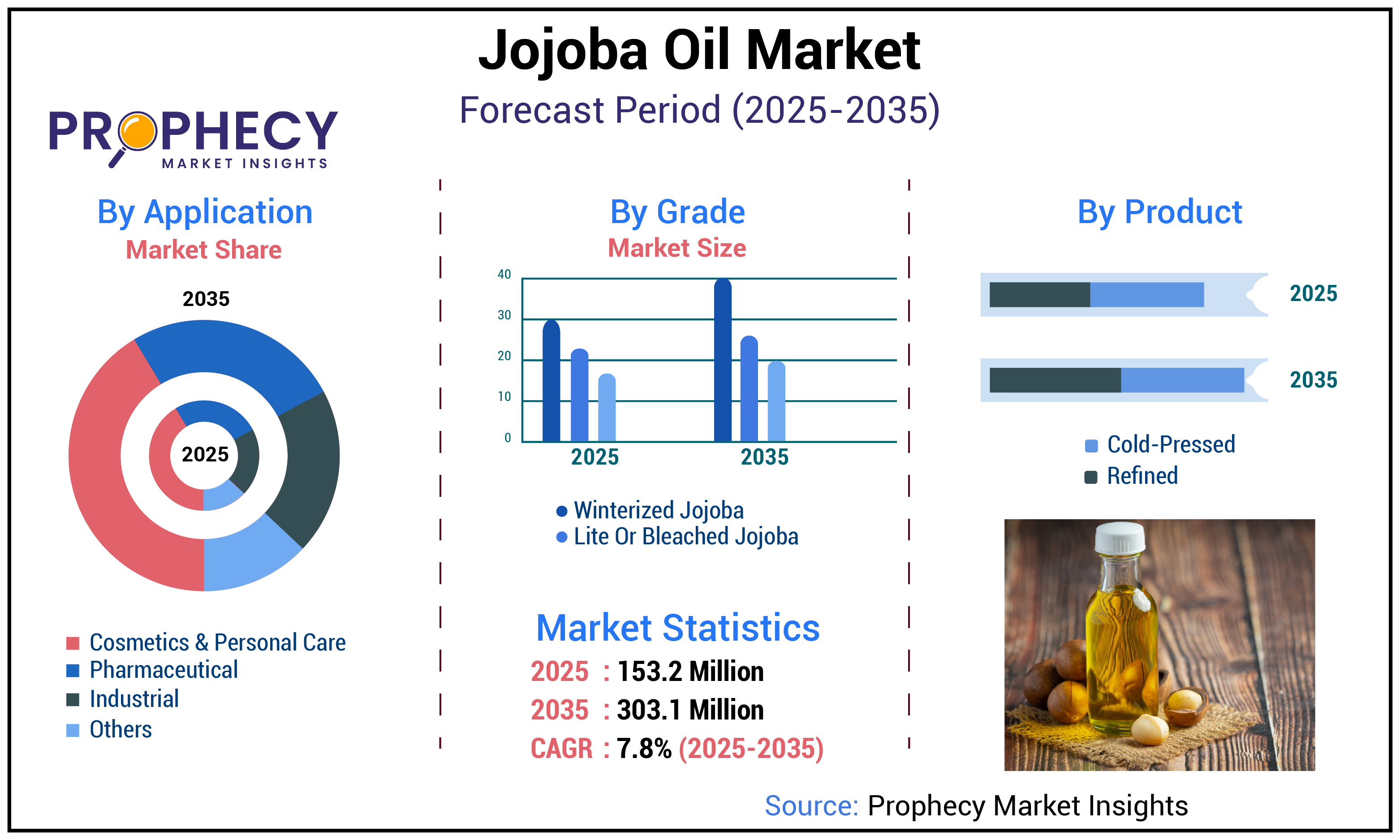
- Jojoba oil market size is expected to grow at a valuation of USD 303.1 Million, by 2035.
- In 2024, the market valuation was USD 145.4 Million.
- Jojoba oil market is developing at a CAGR of 7.8%.
Jojoba oil is a liquid wax, not an oil, derived from the seeds of the jojoba plant (Simmondsia chinensis). It's a golden, odorless liquid that's been used for centuries by Native Americans and is now a popular ingredient in cosmetics, skincare, and hair care due to its unique properties. It offers numerous benefits for skin and hair, including moisturizing, soothing sunburn, reducing acne, and promoting hair growth. Its non-comedogenic and hypoallergenic properties make it suitable for all skin types, even sensitive skin.
The global jojoba oil market size is growing due to increased demand for natural and organic products in cosmetics, personal care, and pharmaceutical industries, rising consumer awareness of its benefits, its use extends to industrial applications as well, making it a versatile ingredient, rapidly aging population, and increased urbanization and industrialization.
The market’s augmentation is also stimulated by advancements in extraction techniques and sustainable cultivation practices are enhancing the efficiency and eco-friendliness of jojoba oil production, and increasing accessibility and affordability of jojoba oil by various industries and consumers. Moreover, the rapid industrial growth of emerging economies also contributes to the overall market expansion.
Recession Risk and Tariff Analysis:
- Recession risk is a consequence of consumers spending less on high-end personal care items. Customers may choose to less expensive options during recessions, which might affect sales. Supply chain interruptions and variations in the availability of raw materials can also put pressure on production, which restricts suppliers' and manufacturers' capacity to grow and make money.
- Import-export taxes on both raw and processed jojoba oil are examined in the tariff study of the jojoba oil market. Different nations' tariffs have an impact on price, competitiveness, and international trade flow. While high tariffs may impede market development and have an impact on producers' profit margins, lower tariffs stimulate exports and facilitate access to global markets.
Impact of Generative AI on Jojoba Oil Market:
- The jojoba oil market is impacted by generative AI since it speeds up consumer interaction, market research, and product development. It assists companies in developing customized skincare products and advertising material according to customer trends and preferences. Supply chain logistics can be optimized, demand may be predicted, and product performance can be simulated using AI models.
- Furthermore, generative AI improves R&D by employing jojoba oil to create novel product concepts and formulas. These developments boost productivity, shorten time-to-market, and allow businesses to react swiftly to changing customer needs, which boosts market expansion and competitiveness.
Global Jojoba Oil Market By Drivers & Restraints
Key Drivers:
Rising Aging Population is Stimulating the Market Augmentation
The jojoba oil market is expanding as a result of the growing demand for natural skincare and anti-aging products brought on by the ageing population. Since of its high vitamin and antioxidant content, jojoba oil is well-approved by senior citizens since it hydrates skin, reduces wrinkles, and increases suppleness. Manufacturers are adding jojoba oil to cosmetics, moisturizers, and hair care products as older consumers look for mild, plant-based substitutes for goods made with chemicals. This demographic shift boosts product innovation and expands market opportunities for natural oil-based solutions.
- For instance, in October 2024, according to the data published by WHO, by 2030, 1 in 6 people in the world will be aged 60 years or over. At this time the share of the population aged 60 years and over will increase from 1 Million in 2020 to 1.4 Million. By 2050, the world’s population of people aged 60 years and older will double (2.1 Million). The number of persons aged 80 years or older is expected to triple between 2020 and 2050 to reach 426 million.
Restraints:
The Limited Global Cultivation is Obstructing the Market Expansion
One disadvantage of the jojoba oil market is its limited global cultivation due to specific climate and soil requirements. Jojoba plants thrive mainly in arid and semi-arid regions, restricting large-scale production to select areas such as parts of the U.S., Mexico, and Israel. This geographic limitation can create supply chain vulnerabilities, reduce market responsiveness to growing demand, and lead to inconsistent product availability. Such constraints hinder the ability to scale operations and meet the increasing global demand for natural personal care products.
- Counterbalance Statements: Invest in agricultural research to create climate-resilient jojoba plant types in order to get over geographic restrictions. Encourage farming in newly dry areas by providing government assistance and farmer training. To increase production areas, enhance output consistency, and guarantee a steady supply chain, employ controlled-environment agriculture (such as greenhouses) and promote sustainable agricultural methods.
Opportunities & Trends:
Amalgamating Advanced Technologies with Jojoba Oil is Opening Up Growth Opportunities in the Upcoming Years
Future jojoba oil market expansion is anticipated to be greatly aided by the integration of cutting-edge technology with the manufacturing of jojoba oil. By maximizing water consumption and continuously monitoring plant health, precision agriculture and intelligent irrigation systems improve agricultural output and quality. Supercritical CO extraction is one example of an advanced extraction technique that increases oil efficiency and purity, satisfying the growing demand for premium, natural components.
The production of improved jojoba plant strains with increased oil content and disease resistance is made possible via biotechnology. Additionally, businesses may better understand customer preferences, customize goods, and optimize supply chains with the use of digital marketing and AI-driven data. Jojoba oil is now positioned as a high-end, sustainable component in international markets thanks to technical developments that boost production, lessen its negative effects on the environment, and encourage innovation in personal care, cosmetics, and medicines.
Global Jojoba Oil Market By Segmentations & Regional Insights
The jojoba oil market is segmented into product type, grade, application, distribution channel, and region.
By Product Type:
Appertaining from product type, the market is bifurcated into cold-pressed, and refined. The cold-pressed segment is the dominating product type in the jojoba oil market share. This is due to its premium quality and widespread use in the cosmetics and personal care industry. While refined jojoba oil also holds a share, particularly for applications requiring high stability and longer shelf life, the market is largely led by cold-pressed varieties.
The refined segment is the second dominating product type, in the jojoba oil market. This is due to its preference for manufacturing applications where high stability and longer shelf life are crucial.
By Grade:
On the foundation of grade, the market is branched into winterized jojoba, and lite or bleached jojoba. The winterized jojoba segment is leading the Jojoba oil market share. This is due to its higher purity and quality, its ability to restore natural flavor, aroma, and nutritional value, increasingly seeking chemical-free and naturally sourced products, its versatility and benefits, and eco-friendliness.
The lite or bleached segment is the second leading grade in the jojoba oil market. This is due to its suitability for a wider range of applications, particularly in cosmetics and pharmaceuticals, where its lighter color and purity are valued.
By Application:
Stemming from application, the market is sub-segmented into cosmetics & personal care, pharmaceutical, industrial, and others. The cosmetics & personal care segment is holding the superior position in the jojoba oil market. This is due to the increasing demand for natural and organic skincare and cosmetic products, where jojoba oil's properties are highly valued. Jojoba oil's non-comedogenic nature, ability to regulate sebum production, and moisturizing effects make it a popular ingredient in various cosmetic products.
The pharmaceutical segment is the second superior application, in the jojoba oil market. This is due to its hypoallergenic and healing properties used in B2B formulations for skin conditions.
By Distribution Channel:
According to distribution channel, the market is divided into B2B and B2C. The B2B (Business-to-Business) channel is attributed to govern the jojoba oil market share. This is due the fact that jojoba oil is primarily used as a raw material or ingredient in larger-scale production, such as cosmetics, personal care products, and industrial applications.
The B2C (Business-to-Consumer) channel segment is experiencing steady growth, in the jojoba oil market. This is due to the increasing consumer awareness of jojoba oil's benefits in beauty and skin care, leading to direct purchases through stores and online.
Regional Insights:
Geographically, the market is studied across North America, Europe, Asia Pacific, Latin America, and the Middle East & Africa.
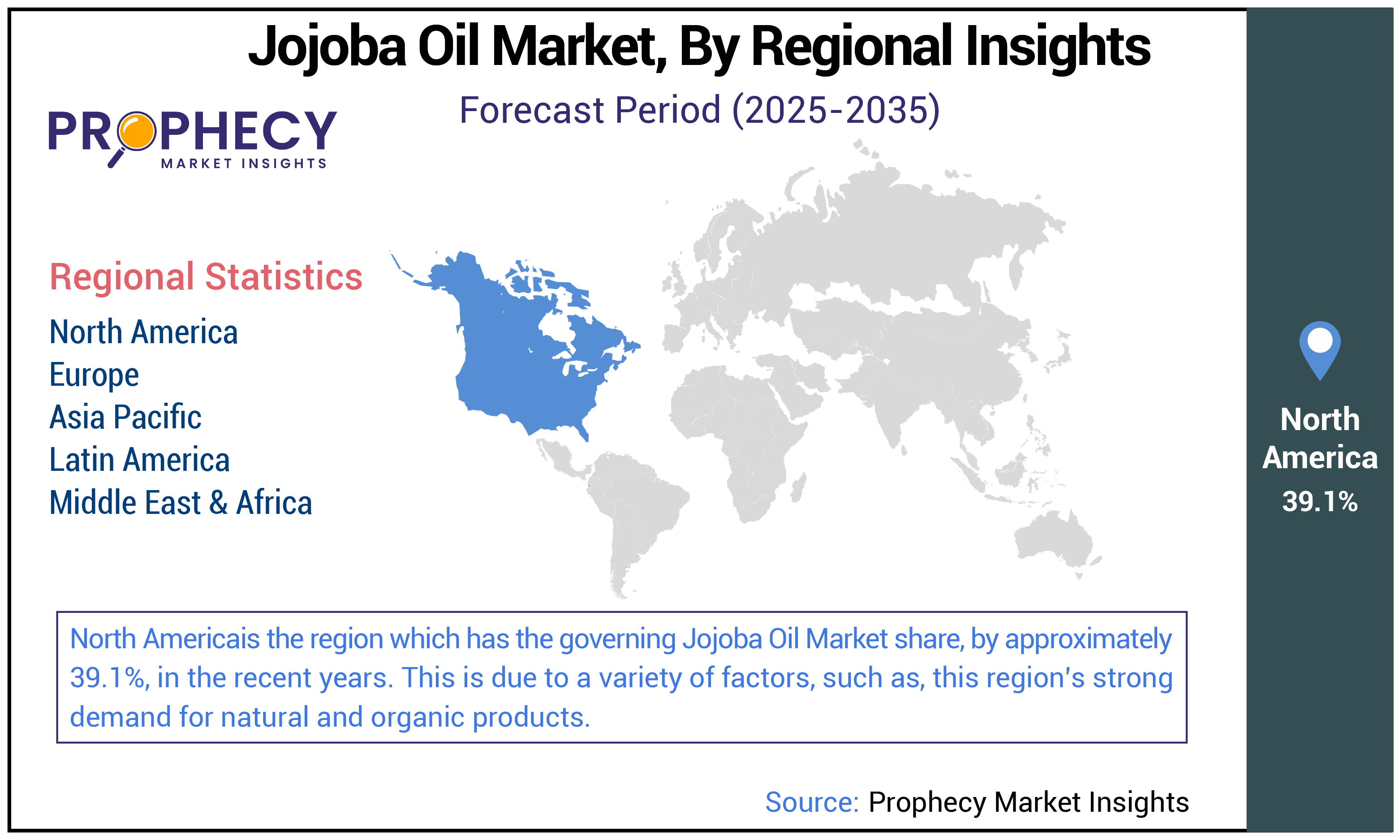
North America: This is the region which has the governing jojoba oil market share, by approximately 39.1%, in the recent years. This is due to a variety of factors, such as, this region’s strong demand for natural and organic products, home to some of the world's largest cosmetic and personal care markets, favorable climate particularly in areas such as southern Arizona, southern California, and northwestern Mexico, advanced technologies for jojoba oil extraction, and a well-established distribution network, facilitating the flow of jojoba oil to consumers.
- U.S. Jojoba Oil Market Insights:
The jojoba oil market in the U.S. is holding the upper hand, in the recent years. This is due to this country’s favorable climatic conditions for jojoba cultivation in states such as Arizona, California, and Nevada, large and growing cosmetics and personal care industry, increasing consumer awareness of natural and organic ingredients, growing awareness in the health benefits of jojoba oil such as its moisturizing, anti-inflammatory, and healing properties, and its use in pharmaceuticals for B2B treatments and drug delivery systems due to its stability and non-irritating properties.
Europe: This is the region which has the jojoba oil market, growing with the highest CAGR, during the forecast period, in the recent years. This is due to a combination of factors, such as, this region’s growing demand for natural and organic personal care products, a large cosmetics industry, and favorable regulations. The rising popularity of natural beauty and wellness products, coupled with consumer preference for organic, plant-based cosmetics, contributes to the demand for jojoba oil. The European cosmetics industry is also a major consumer of jojoba oil, particularly in skincare and hair care products.
- Germany Jojoba Oil Market Insights:
The jojoba oil market in Germany is the fastest growing market, in the recent years, during the forecast period. This is due to this country’s significant consumer base that actively seeks out natural and organic ingredients in its skincare and cosmetics, the growing cosmetics and personal care industry, increased awareness of the benefits of jojoba oil, leader in the development and adoption of natural and organic cosmetic standards, such as COSMOS and NATRUE, presence of major market players, and higher availability of certified products, indicating a strong commitment to quality and sustainability, which can further drive demand for jojoba oil.
Asia Pacific: The region which is experiencing subsequent amount of jojoba oil market growth, in the recent years, is Asia Pacific. This is due to numerous factors, such as, this region’s rapid urbanization, rising disposable incomes, increasing consumer awareness of natural products, and the growing popularity of natural beauty and skincare in countries including China, India, and Japan. The region's cosmetics and personal care industries are also experiencing significant growth, particularly in areas such as Korean skincare, which heavily utilizes jojoba oil derivatives.
- China Jojoba Oil Market Insights:
The jojoba oil market in China is experiencing considerate amount of market growth, in the recent years. This is due to several factors, such as, a growing demand for natural and organic beauty products, rising disposable incomes, and the expansion of the e-commerce market. China's large and increasingly affluent population is also driving demand for personal care and beauty products, which often incorporate jojoba oil. Additionally, the increased awareness of the benefits of natural alternatives to synthetic chemicals is further boosting the demand for jojoba oil in China.
Jojoba Oil Market Report Scope:
|
Attribute |
Details |
|
Market Size 2025 |
USD 153.2 Million |
|
Projected Market Size 2035 |
USD 303.1 Million |
|
CAGR Growth Rate |
7.8% (2025-2035) |
|
Base year for estimation |
2024 |
|
Forecast period |
2025 – 2035 |
|
Market representation |
Revenue in USD Million & CAGR from 2025 to 2035 |
|
Regional scope |
North America - U.S. and Canada Europe – Germany, U.K., France, Russia, Italy, Spain, Netherlands, and Rest of Europe Asia Pacific – China, India, Japan, Australia, Indonesia, Malaysia, South Korea, and Rest of Asia-Pacific Latin America - Brazil, Mexico, Argentina, and Rest of Latin America Middle East & Africa – GCC, Israel, South Africa, and Rest of Middle East & Africa |
|
Report coverage |
Revenue forecast, company share, competitive landscape, growth factors, and trends |
Segmentation:
By Product Type:
- Cold-Pressed
- Refined
By Grade:
- Winterized Jojoba
- Lite or Bleached Jojoba
By Application:
- Cosmetics & Personal Care
- Pharmaceutical
- Industrial
- Others
By Distribution Channel:
- B2B
- B2C
By Region:
- North America
- U.S.
- Canada
- Europe
- Germany
- U.K.
- France
- Russia
- Italy
- Spain
- Netherlands
- Rest of Europe
- Asia Pacific
- China
- India
- Japan
- Australia
- Indonesia
- Malaysia
- South Korea
- Rest of Asia Pacific
- Latin America
- Brazil
- Mexico
- Argentina
- Rest of Latin America
- Middle East & Africa
- GCC
- Israel
- South Africa
- Rest of Middle East & Africa
Global Jojoba Oil Market By Competitive Landscape & Key Players
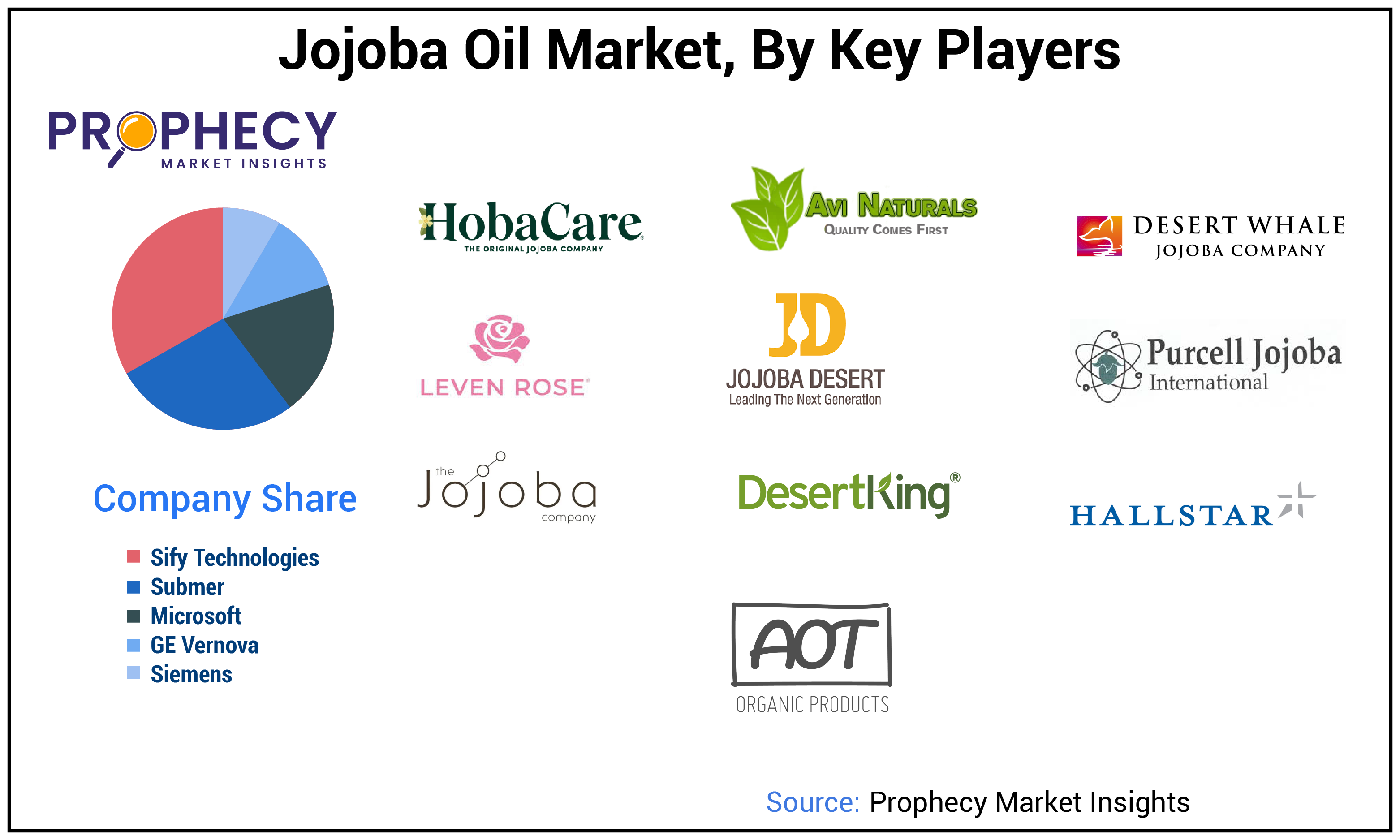
The key players operating in the market include, Jojoba Desert, Desert Whale Jojoba Co., Purcell Jojoba, and others. These key players are focusing on developing innovative skincare and haircare formulations. This includes leveraging jojoba oil's versatility and natural properties in products such as anti-aging serums, moisturizing creams, and hair masks. Additionally, these are emphasizing sustainability and ethical sourcing, aligning with growing consumer preferences for natural and eco-friendly products, for driving jojoba oil market growth.
Jojoba Oil Market Companies:
- Jojoba Desert
- Desert Whale Jojoba Co.
- Purcell Jojoba
- The Jojoba Company Pty Ltd
- The Original Jojoba Company
- Hallstar
- Leven Rose
- Desert King
- Natural Sourcing, LLC
- Shaanxi Rebecca Bio-Tech Co.,LTD
- newdirectionsaromatics
- Chempri
- AVI NATURALS
- ALL ORGANIC TREASURES
- AOS Products Pvt. Ltd.
View an Additional List of Companies in the Jojoba Oil Market
Global Jojoba Oil Market By Recent News
- In April 2025, Jojoba Desert launches additional product categories under the JD esters brand. With the introduction, JD's innovation portfolio grew to include high-performance, sustainable solutions for formulators based on hydrogenated jojoba oil that doesn't include oil. In keeping with JD's dedication to clean, traceable, and skin-friendly formulation techniques, the two lines—JD Esteris Plus and JD Beads—address both sensory performance and textural functioning.
- In April 2025, In order to produce jojoba oil and stop the spread of desert regions, which make up more than 90% of Egypt's territory, SARAYA has been working with regional businesses to grow jojoba, a fruitful plant that can withstand the harshness of the desert. Date palms in the Nile Delta and olives in the dry regions surrounding the oasis are the most widely grown trees in Egypt for commodity crops.
- In April 2022, Jojoba oil and concentrated phytoene were used in Jojoba Desert's natural JD Phyto-Or 1% (INCI: Simmondsia Chinensis (Jojoba) Seed Oil (and) 15 Cis-Phytoene/Blakeslea Trispora Mycelium Extract) to provide natural active skin healing, increased skin elasticity, better skin tone, and healthy hair. The supplier and Lycored worked together to develop JD Phyto-Or 1%, which uses a non-GMO fungus made through a regulated fermentation process to capture biosynthesised phytoene.
Analyst View:
The jojoba oil market is expanding globally as a result of factors such as the ageing population, growing urbanization and industrialization, growing consumer awareness of its advantages, the need for natural and organic products in the pharmaceutical, cosmetic, and personal care sectors, and its use in industrial settings. The market is also growing as a result of improvements in extraction methods and environmentally friendly farming methods that make jojoba oil production more efficient and environmentally friendly while also making it more accessible and reasonably priced for individuals and businesses. Furthermore, the total market rise is aided by emerging nations' quick industrial growth.
More Related Reports
Oil and Gas Accumulators Market
Very Low Sulfur Fuel Oil (VLSFO) Market
White Oil Market
Palm Oil Market
Enhanced Oil Recovery Market
Global Jojoba Oil Market By Company Profile
|
Company Name |
Jojoba Desert |
|
Headquarter |
Hatzerim, Israel |
|
CEO |
Mr. Roni Rot |
|
Employee Count (2024) |
11-50 Employees |
Global Jojoba Oil Market By Highlights
FAQs
Jojoba oil market size was valued at USD 153.2 Million in 2025 and is expected to reach USD 303.1 Million by 2035 growing at a CAGR of 7.8%.
Product type, grade, application, distribution channel, and region are the segmentation for the jojoba oil market.
North America, Asia Pacific, Europe, Latin America, and the Middle East & Africa. North America is expected to dominate the market.
The key players operating in the jojoba oil market include Jojoba Desert, Desert Whale Jojoba Co., Purcell Jojoba, Natural Sourcing, LLC, The Jojoba Company Pty Ltd, The Original Jojoba Company, Hallstar, Leven Rose, Desert King, Shaanxi Rebecca Bio-Tech Co.,LTD, newdirectionsaromatics, Chempri, AVI NATURALS, ALL ORGANIC TREASURES, and AOS Products Pvt. Ltd.