Global Infrared Gas Detector Market Overview
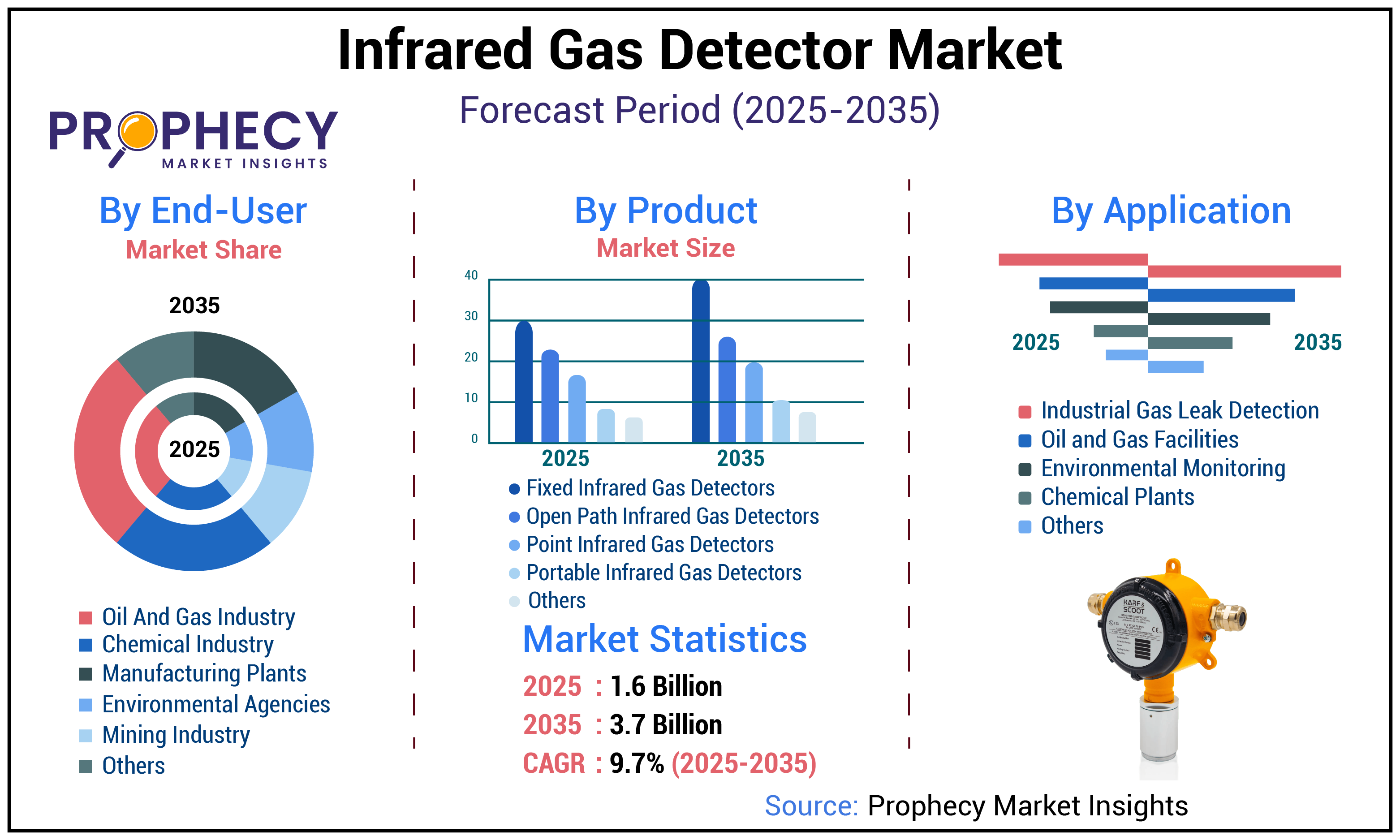
- Infrared gas detector market size is expected to expand at USD 3.7 Billion, by 2035.
- In 2024, the market valuation was USD 1.5 Billion.
- Infrared gas detector market is growing at a registered CAGR of 9.7%.
An infrared (IR) gas detector is a device that uses infrared light to detect the presence and concentration of various gases, particularly hydrocarbons. It works by measuring the absorption of specific infrared wavelengths by the target gas. The amount of light absorbed is directly proportional to the gas concentration. It offers advantages such as, high sensitivity and selectivity, long lifespan, low maintenance, and fast response times. It can detect a wide range of gases, including toxic and combustible ones, even at low concentrations.
The stringent workplace safety standards and growing environmental concerns, need for environmental monitoring for detecting and measuring harmful gases such as carbon monoxide, nitrogen oxides, and sulfur dioxide, increasing demand for security and surveillance solutions, and the integration of infrared gas detectors various applications, including HVAC systems, smart city projects, and industrial automation, are factors contributing in the infrared gas detector market growth.
Infrared gas detector market expansion is also stimulated by technological advancements, such as miniaturization, improved sensitivity, and lower power consumption, are enhancing the performance and affordability of infrared gas sensors. Moreover, integrating infrared gas detectors with IoT and AI allows for real-time data collection, remote monitoring, predictive maintenance, and faster response to potential hazards, enhancing safety and efficiency.
Impact of Generative AI on Infrared Gas Detector Market:
- By improving sensor design, predictive maintenance, and real-time data processing, generative AI is revolutionizing the infrared gas detector market. It decreases false alarms, increases the accuracy of gas identification, and facilitates the quicker development of detection algorithms.
- By simulating intricate gas leak situations, AI-driven models can optimize detector performance and location. Furthermore, generative AI promotes industrial safety system automation, increasing operational effectiveness. These developments are drawing in capital and encouraging creativity, which is speeding up market expansion and increasing the range of applications in many sectors.
Global Infrared Gas Detector Market Drivers & Restraints
Key Drivers:
Growing Environmental Concern is Stimulating the Market Augmentation
The infrared gas detector market growth is being driven primarily by growing environmental concerns, which are raising the need for efficient greenhouse gas emission monitoring and management. Stricter environmental laws are being enforced by governments and regulatory agencies, which is prompting businesses to use cutting-edge gas detection technology. For compliance and sustainability initiatives, infrared gas detectors are crucial as it provides precise, real-time monitoring of dangerous gases such as CO? and CH?. The use of infrared gas detectors is expanding across a number of industries due to increased environmental consciousness and dedication.
- For instance, the annual Global Attitudes poll from the Pew Research Center showed that people all throughout the world now considered climate change to be a "major threat." The average impression increased from 54% in 2014 to 62% in 2017 and seventy-one percent in 2022. More than 50% of respondents worldwide expressed concerns about climate change. Thus, there is a growing number of people concerned about environment and climate change, further driving the infrared gas detector market growth.
Restraints:
The Infrared Gas Detectors cannot Detect Certain Gases Thus Obstructing the Market Expansion
The limited capacity of the infrared gas detector to detect some gases, particularly those that do not absorb infrared light, such hydrogen or noble gases, is one of its main drawbacks. The detector's use in settings where a variety of gases need to be monitored is limited by this constraint. In these situations, depending just on infrared technology may result in leaks that go unnoticed, which might pose major operational and safety problems to sectors that deal with a variety of gas kinds.
- Counterbalance Statements: Industries can use hybrid detection systems, which combine infrared sensors with complementing technologies such as electrochemical or catalytic bead sensors, to overcome this constraint. While preserving the benefits of infrared technology for detecting IR-absorbent gases, this multi-sensor technique guarantees wider gas detection coverage, enhancing safety and compliance.
Opportunities & Trends:
Integration of Artificial Intelligence with Infrared Gas Detection is Unlocking Growth Opportunities for the Impending Years
AI-enabled infrared gas detection is poised to transform the market by making gas monitoring systems more intelligent, effective, and predictive. Real-time detection, pattern identification, and early warning of possible gas leaks are made possible by AI's enhancement of data analysis. By using previous data to inform its decisions, it increases decision accuracy and decreases false alarms. Additionally, AI-powered solutions provide predictive maintenance, which lowers operating expenses and downtime. This clever automation is in line with Industry 4.0 trends and is drawing investments from industries such as environmental monitoring, chemicals, and oil and gas. Integration of AI is therefore anticipated to greatly increase market expansion and innovation.
Global Infrared Gas Detector Market Segmentations & Regional Insights
The infrared gas detector market is segmented into product type, application, end-user, and region.
By Product Type:
Contingent to product type, the market is pigeonholed into point infrared gas detectors, open path infrared gas detectors, portable infrared gas detectors, fixed infrared gas detectors, and others. The fixed infrared gas detectors are the product type which is dominating the infrared gas detector market share. This is due to its continuous monitoring capabilities, reliability, and widespread use in various industrial settings where safety is paramount. While portable detectors offer flexibility, fixed detectors are often the preferred choice for continuous, real-time monitoring in specific locations.
The open path infrared gas detectors are the second dominating product type in the infrared gas detector market. This is due to its larger, open areas and are designed to detect gas leaks along a path, making it suitable for monitoring potential leak sources in industrial settings.
By Application:
On the foundation of application, the market is sub-segmented into industrial gas leak detection, environmental monitoring, oil and gas facilities, chemical plants, and others. The industrial gas leak detection segment is expected to lead the infrared gas detector market share. This is due to the stringent safety regulations and the need for comprehensive gas leak monitoring in these industries, where the presence of toxic and flammable gases poses significant risks.
The oil and gas leak detection segment is the second leading application in the infrared gas detector market size. This is due to the widespread use of gas detection in oil and gas facilities, including leak detection, safety monitoring, and environmental compliance, particularly in applications like confined space entry and emergency response.
By End-User:
Stemming from end-user, the market is catalogued into oil and gas industry, chemical industry, manufacturing plants, environmental agencies, mining industry, and others. The oil and gas industry is the end-user which is ruling over the infrared gas detector market growth. This is due to the fact that the industry's activities, including exploration, production, refining, and transportation, involve handling highly combustible and toxic gases, increasing the need for gas detection systems for safety and compliance. The inherent risk of flammable gas leaks in these operations, coupled with stringent safety regulations, drives the demand for reliable and sensitive gas detectors.
Chemical industry is the fastest growing end-user in the infrared gas detector market. This is due to the fact that chemical plants and refineries require constant gas monitoring to ensure worker safety and prevent accidents related to hazardous gases used in chemical processes.
Regional Insights:
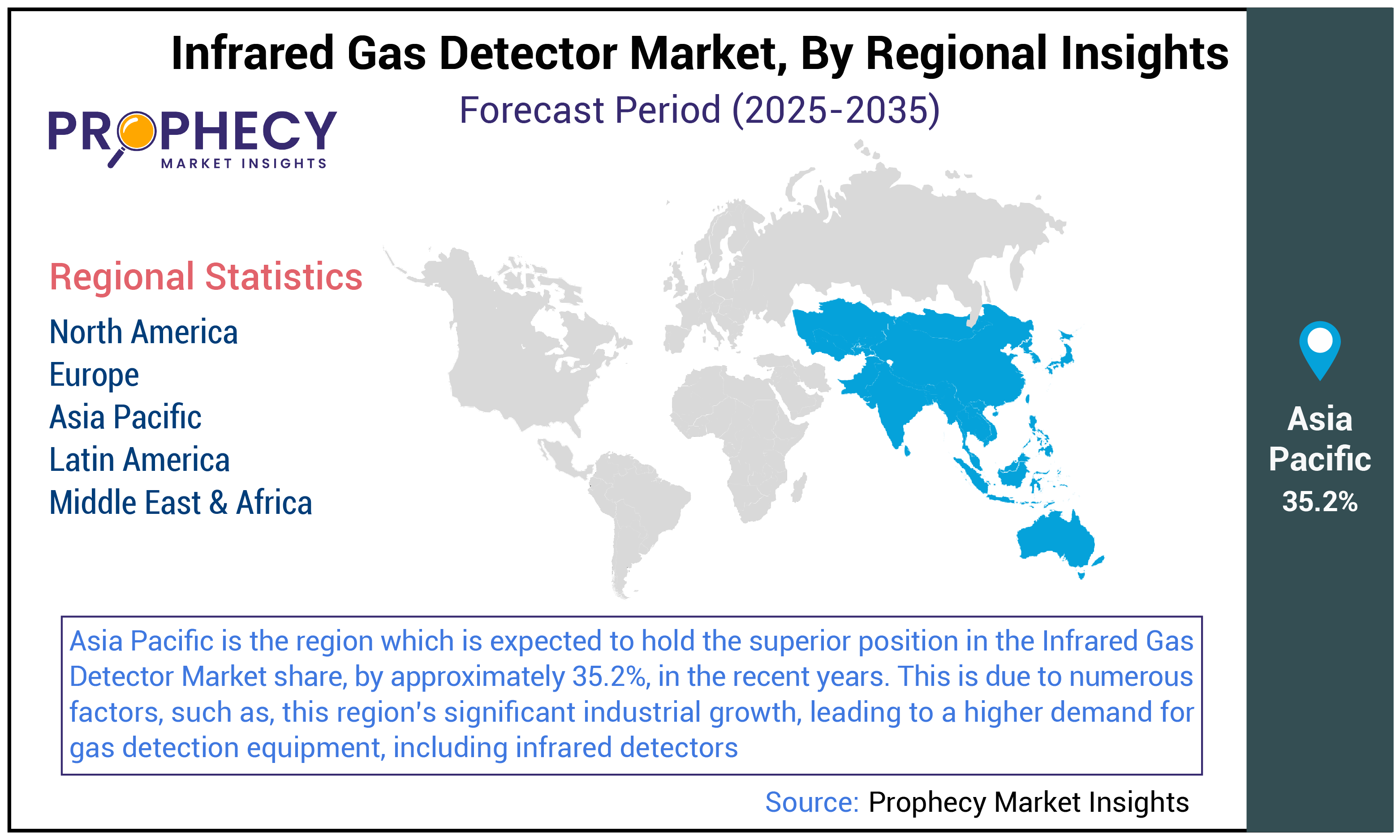
Geographically, the market is analyzed across North America, Europe, Asia Pacific, Latin America, and the Middle East & Africa.
Asia Pacific: This is the region which is expected to hold the superior position in the infrared gas detector market share, by approximately 35.2%, in the recent years. This is due to numerous factors, such as, this region’s significant industrial growth, leading to a higher demand for gas detection equipment, including infrared detectors, to ensure safety and compliance in manufacturing plants and other industrial facilities, ongoing infrastructure projects, such as construction and transportation networks, Increasing environmental regulations and safety standards in Asia Pacific are further driving the adoption of infrared gas detectors, and the presence of key market players in this region.
- China Infrared Gas Detector Market Insights:
The infrared gas detector market in China is the most governing market, in the recent years. This is due to a confluence of factors, including rapid industrialization, stringent safety regulations, and a growing focus on environmental protection. The country's burgeoning petrochemical and semiconductor industries, along with the increasing number of hospitals, drive the demand for gas detection equipment. Furthermore, the growing awareness of workplace safety and potential gas leak risks, coupled with the implementation of strict safety standards, fuels the adoption of gas leak detectors.
North America: This is the region which has the infrared gas detector market, growing with the highest CAGR, during the forecast period, in the recent years. This is due to a combination of factors including a strong, well-established industrial sector, stringent safety regulations, and the presence of leading manufacturers and suppliers. The region's advanced industrial infrastructure, particularly in oil and gas, chemicals, manufacturing, and mining, necessitates robust gas detection systems to ensure worker safety and compliance. Additionally, North America is a hub for technological innovation and development in gas detection, contributing to the region's dominance in the market.
- U.S. Infrared Gas Detector Market Insights:
The infrared gas detector market in the U.S. is growing with the fastest growth rate, in the recent years. This is due to a variety of factors, such as, this country’s stringent OSHA and EPA regulations, coupled with the demands of industries such as oil & gas, manufacturing, and mining, the U.S. is home to many established players in the gas detection equipment market, and the infrared (IR) gas detection technology segment holds a significant market share, further emphasizing the U.S.'s dominance in this area.
Europe: The region which has the infrared gas detector market experiencing significant amount of growth, in the recent years, is Europe. This is due to a variety of factors, such as, this region’s strong demand for security and surveillance, regulatory support, and technological advancements. The region's robust industrial sector, particularly in industries like oil & gas, chemicals, and manufacturing, drives the need for gas detection systems to ensure safety and compliance with stringent regulations. Furthermore, Europe is a significant producer of petroleum products, further increasing the need for gas detection equipment.
- Germany Infrared Gas Detector Market Insights:
The infrared gas detector market in Germany is experiencing considerate amount of growth, in the recent years. This is due to a combination of factors, including a strong industrial base, stringent safety regulations, and a growing focus on environmental monitoring. The country's thriving manufacturing, automotive, and chemical sectors necessitate robust gas detection systems to ensure workplace safety and regulatory compliance. Additionally, the European Union's push for stricter environmental standards further fuels the demand for advanced gas detection technologies like infrared sensors, which are crucial for monitoring emissions and ensuring compliance with air quality regulations.
Infrared Gas Detector Market Report Scope:
|
Attribute |
Details |
|
Market Size 2025 |
USD 1.6 Billion |
|
Projected Market Size 2035 |
USD 3.7 Billion |
|
CAGR Growth Rate |
9.7% (2025-2035) |
|
Base year for estimation |
2024 |
|
Forecast period |
2025 – 2035 |
|
Market representation |
Revenue in USD Billion & CAGR from 2025 to 2035 |
|
Regional scope |
North America - U.S. and Canada Europe – Germany, U.K., France, Russia, Italy, Spain, Netherlands, and Rest of Europe Asia Pacific – China, India, Japan, Australia, Indonesia, Malaysia, South Korea, and Rest of Asia-Pacific Latin America - Brazil, Mexico, Argentina, and Rest of Latin America Middle East & Africa – GCC, Israel, South Africa, and Rest of Middle East & Africa |
|
Report coverage |
Revenue forecast, company share, competitive landscape, growth factors, and trends |
Segmentation:
By Product Type:
- Point Infrared Gas Detectors
- Open Path Infrared Gas Detectors
- Portable Infrared Gas Detectors
- Fixed Infrared Gas Detectors
- Others
By Application:
- Industrial Gas Leak Detection
- Environmental Monitoring
- Oil and Gas Facilities
- Chemical Plants
- Others
By End-User:
- Oil and Gas Industry
- Chemical Industry
- Manufacturing Plants
- Environmental Agencies
- Mining Industry
- Others
By Distribution Channel:
- Hospital Pharmacies
- Online Pharmacies
- Independent Pharmacies
- Others
By Region:
- North America
- U.S.
- Canada
- Europe
- Germany
- U.K.
- France
- Russia
- Italy
- Spain
- Netherlands
- Rest of Europe
- Asia Pacific
- China
- India
- Japan
- Australia
- Indonesia
- Malaysia
- South Korea
- Rest of Asia Pacific
- Latin America
- Brazil
- Mexico
- Argentina
- Rest of Latin America
- Middle East & Africa
- GCC
- Israel
- South Africa
- Rest of Middle East & Africa
Global Infrared Gas Detector Market Competitive Landscape & Key Players
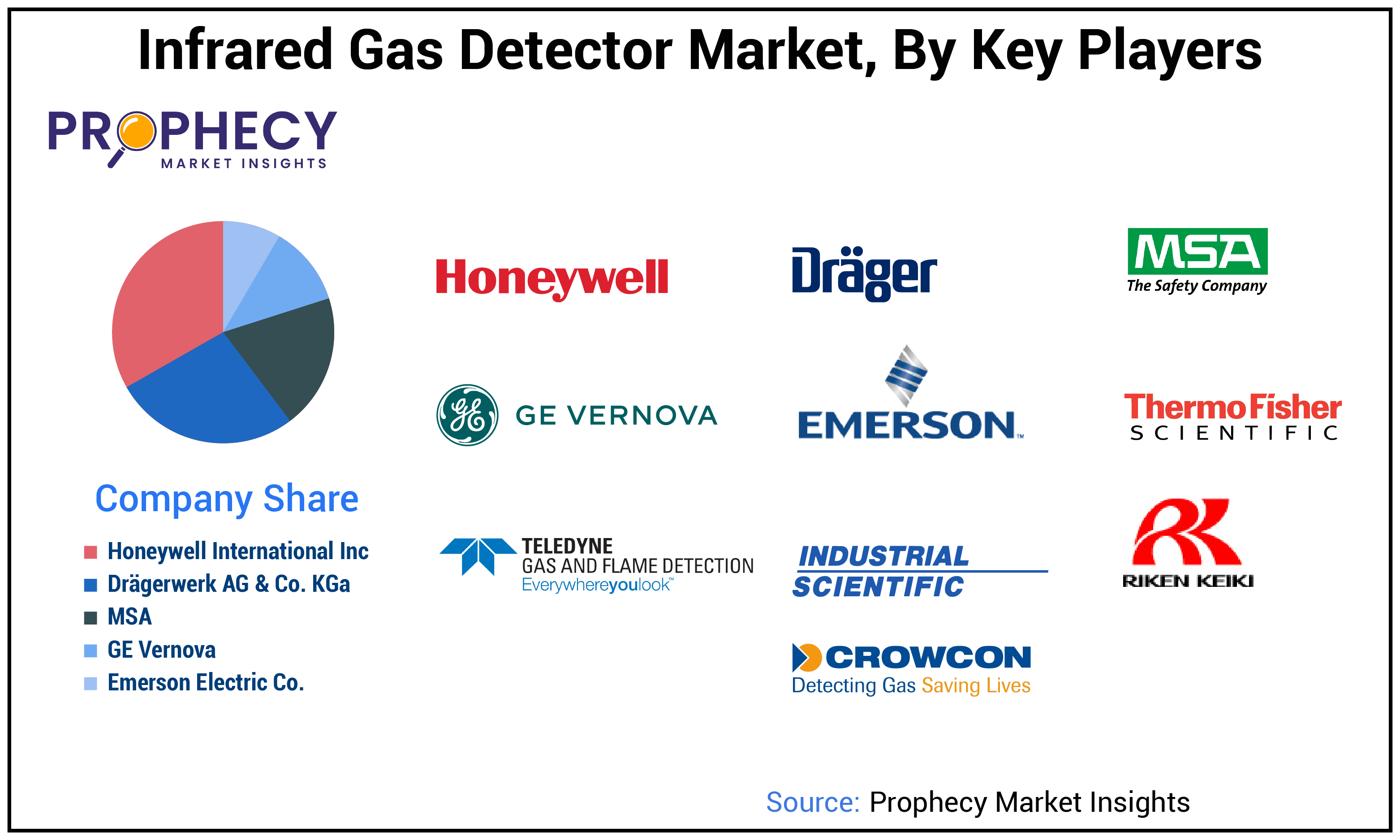
The key players operating in the market include, Honeywell International Inc, Drägerwerk AG & Co. KGa, MSA, and others. These key players are focusing on leveraging strategies, such as, miniaturization, integration with IoT, and focusing on specific applications such as security and surveillance, for driving infrared gas detector market growth. Moreover, these companies prioritize advancements in sensor technology and cater to stringent safety regulations and compliance standards.
Infrared Gas Detector Market Companies:
- Honeywell International Inc
- Drägerwerk AG & Co. KGa
- MSA
- GE Vernova
- Emerson Electric Co.
- Thermo Fisher Scientific Inc.
- Teledyne Gas and Flame Detection
- Industrial Scientific
- Teledyne FLIR LLC
- Crowcon Detection Instruments Ltd.
- Weatherall Equipment & Instruments Ltd
- RIKEN KEIKI CO., LTD.
- Detector Electronics, LLC
- Sensidyne, LP
- DOD Technologies, Inc.
View an Additional List of Companies in the Infrared Gas Detector Market
Global Infrared Gas Detector Market Recent News
- In December 2024, the SensAlert IR, a state-of-the-art fixed point infrared gas detector intended for high-priority applications, was recently introduced by Sensidyne, a reputable pioneer in industrial health and safety solutions. With its sophisticated dual-wavelength, Non-Dispersive Infrared (NDIR) technology, the SensAlert IR was designed to perform well in tough settings, guaranteeing accurate and dependable gas detection even under the most trying circumstances.
- In November 2024, The IR Plus is a new infrared (IR) hydrocarbon detector that Crowcon Detection Instruments, a world pioneer in gas safety solutions, has introduced to expand its wide range of stationary gas detection products. With more than 50 years of experience in gas detection, Crowcon created the device that provided fail-safe detection and real-time measurement of methane, propane, and other hydrocarbon gases and vapors to protect workers and property in extremely flammable and explosive environments.
- In May 2024, the world's first portable high-sensitivity remote infrared gas detector was created by JFE Steel Corporation, Tokyo Gas Engineering Solutions Corporation (TGES), and Gastar Co., Ltd. Together, it were able to detect 100 ppm-m of carbon monoxide instantly from up to 16 meters away. Now, the device's mass production feasibility will be investigated with the aim of introducing a commercial product by 2025.
- In February 2024, a new infrared (IR) sensor for methane detection has been released by Teledyne Gas & Flame Detection in response to the growing need for sophisticated measuring capabilities in the utility, industrial, and laboratory sectors. The novel infrared sensor, which was made to work with the company's OLCT 100 XPIR fixed gas detector, provided a reliable and cost-effective methane monitoring solution, outperforming conventional catalytic oxidation techniques in terms of total cost of ownership (TCO).
- In October 2021, In order to help facilities keep its petrochemical, chemical, oil and gas, and other workers and industrial sites safe, Honeywell announced the release of two new Bluetooth-connected infrared gas detectors that could provide continuous monitoring for hazardous gases even in fog, rain, snow, and other bad weather conditions.
Analyst View:
The infrared gas detector market growth is influenced by a number of factors, including the need for environmental monitoring to detect and measure harmful gases such as carbon monoxide, nitrogen oxides, and sulfur dioxide; the need for security and surveillance solutions; the need for stricter workplace safety regulations and growing environmental concerns; and the integration of infrared gas detectors into a variety of applications, such as HVAC systems, smart city projects, and industrial automation.
Technological developments that are improving the performance and cost of infrared gas sensors, such as downsizing, increased sensitivity, and reduced power consumption, are also driving the market's growth. Additionally, real-time data gathering, remote monitoring, predictive maintenance, and a quicker reaction to any threats are made possible by combining infrared gas detectors with IoT and AI, which improves efficiency and safety.
More Related Reports
Fire and Gas Detection System Market
Infrared Night Vision Scope Market
Oil and Gas Accumulators Market
Medical Gases Market
Cryogenic Gas Market
Global Infrared Gas Detector Market Company Profile
|
Company Name |
Honeywell International Inc |
|
Headquarter |
Charlotte, North Carolina, United States |
|
CEO |
Mr. Vimal Kapur |
|
Employee Count (2024) |
102,000 Employees |
Global Infrared Gas Detector Market Highlights
FAQs
Infrared gas detector market size is valued at USD 1.6 Billion in 2025 and is expected to reach a USD 3.7 Billion by 2035, growing at a registered CAGR of 9.7%.
Product type, application, end-user, and region are the segmentation for the infrared gas detector market.
North America, Asia Pacific, Europe, Latin America, and the Middle East & Africa. North America is expected to dominate the market.
The key players operating in the infrared gas detector market include Honeywell International Inc, Drägerwerk AG & Co. KGa, MSA, Teledyne FLIR LLC, GE Vernova, Emerson Electric Co., Thermo Fisher Scientific Inc., Teledyne Gas and Flame Detection, Industrial Scientific, Crowcon Detection Instruments Ltd., Weatherall Equipment & Instruments Ltd, RIKEN KEIKI CO., LTD., Detector Electronics, LLC, Sensidyne, LP, and DOD Technologies, Inc.