Global Industrial And Collaborative Robots Overview
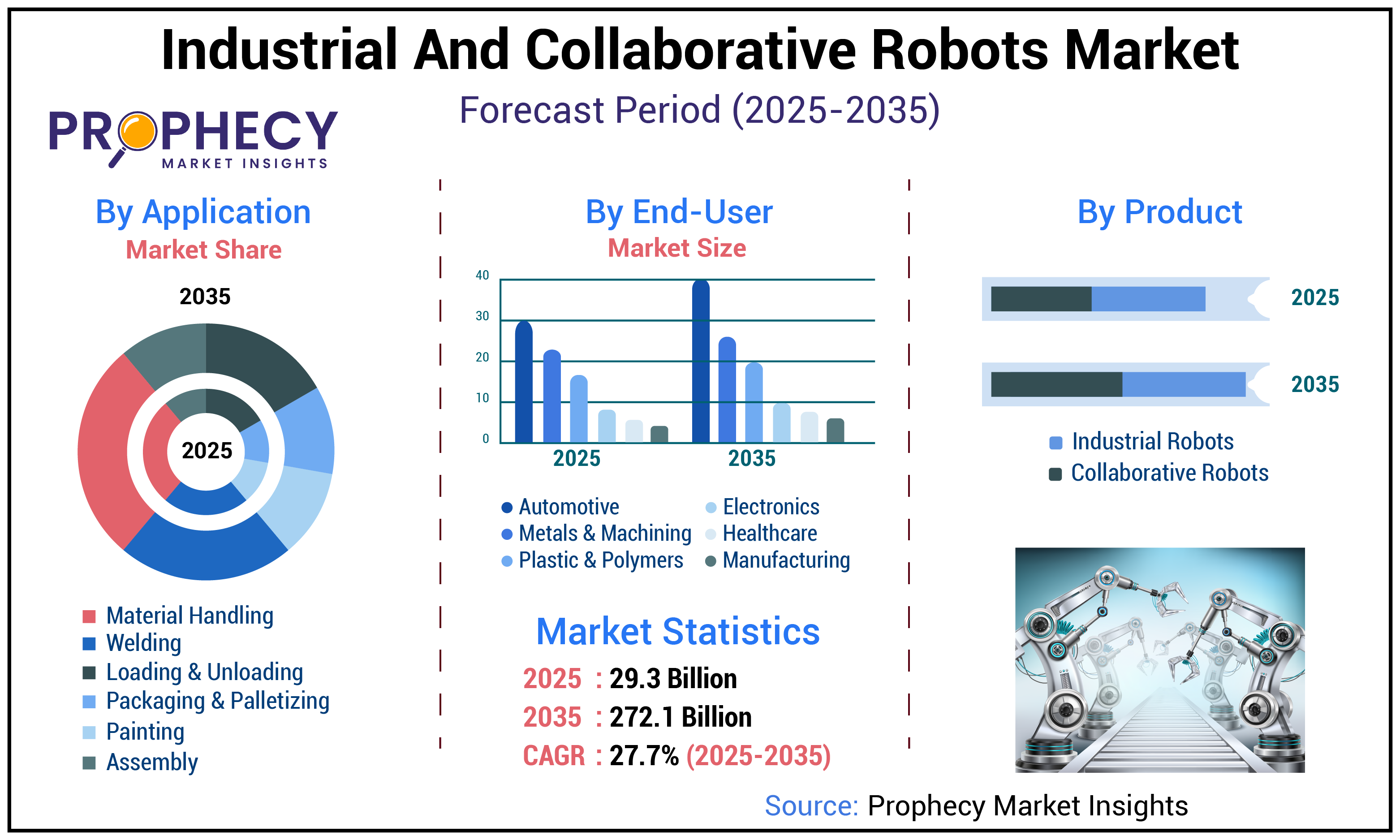
- By 2035, the industrial and collaborative robots market size is projected to develop at a rate of USD 272.1 Billion.
- In 2024, the market valuation was USD 23.9 Billion.
- Industrial and collaborative robots market is mounting at a CAGR 27.7%.
Industrial and collaborative robots are both type of robots used in various manufacturing and production process, but they serve different purposes, and designed with different capabilities. Industrial robots are usually automated machines used in industrial process to perform tasks that are repetitive, dangerous, or require high precision. It can often use in manufacturing processes such as assembly, welding, painting, material handling, and packaging. Collaborative robots, or cobots, are designed to work with human workers in a shared workspace, these robots are built with more flexible and safer for direct human interaction.
Rising demand for automation, shortage of skilled labor, and growing investment to reduce operational costs, is anticipated to drive industrial and collaboration robots market growth. The improvement in robotic technology, increasing demand for precision, quality manufacturing process, global manufacturing shift towards automated solutions, and growing industry 4.0 adoption, resulting to fuel industrial and collaborative robots market growth.
Growing demand for flexibility, growing adoption of cobots in small & medium-sized business, and integration of IoT, data analytics to improve operational efficiency, is expected to create significant opportunities for market. The integration of artificial intelligence & machine learning algorithms, to make real time decision, and growing human-robot collaboration to distribute tasks between human and robots, is projected to growth of industrial and collaborative market size.
Impact of Generative AI on Industrial and Collaborative Robots Market:
- Generative AI is significantly influence the industrial and collaborative robots market by driving innovation, enhancing performance, and providing new capabilities. AI can help generate optimal robot designs as per specific tasks or environments, by analyzing extensive datasets of existing designs. AI algorithms can enable the autonomous programming of robots by generating task-specific programs, and improves robot’s ability to learn from its environment.
Global Industrial And Collaborative Robots Drivers & Restraints
Key Drivers:
Growing Human-Robot Collaboration can Stimulate Market Augmentation
The growing human-robot collaboration is a significant driver for the industrial robot and collaborative robot (cobot) market. Collaboration between humans and robots allows for influence their unique strengths. Robots are designed for performing repetitive, precise, and physically demanding tasks, while humans bring creativity, decision-making, problem-solving, and flexibility.
Human-robot collaboration offers flexibility in dynamic and fast-changing environments, cobots are highly versatile and can be quickly reprogrammed to assist in different processes. Collaborative robots (cobots) are specifically designed with built-in safety features such as force sensors, soft materials, and proximity sensors to ensure that it can work alongside humans without posing a risk. Cobot are designed to work side by side with humans, by enhancing overall productivity rate in industries, such as manufacturing, industries, and healthcare. This focuses on safety and encourages more businesses to implement robots in their industrial application, resulting to drive industrial and collaborative robots market growth.
- For instance, according to article published by Association for Advancing Automation, in November 2024, this article state that, humanoid robots are rapidly expanding, and driven by significant reduction in production cost of high-specification humanoid robots. It was more affordable, with improved manufacturing efficiencies, which reduced 40% costs associated with developing and deploying of these robots. Humanoid robots are rapidly shaping the future of industry, with Boston Dynamic launched Atlas, Agility Robotics launched Digit, and Tesla launched Tesla optimus. This robotics can create significant opportunities, making it ideal for industries such as logistics and manufacturing or labor-intensive tasks.
Rising demand for Automation is Expected to Pitch Market Growth
The rising demand for automation is one of the most significant drivers of growth in the industrial robot and collaborative robot (cobot) markets. As industrial business is evolving, the demand for automation solution increases to improve efficiency, and reduce costs. This is especially important in industries that require high-volume production, such as automotive manufacturing, electronics assembly, and consumer goods production, where operational efficiency is important. The global labor shortage, particularly in aging population regions, has driven the demand for automation in various industries. Industrial robots can perform tasks such as welding, painting, assembly, and inspection with more precision than human workers.
In high-precision environments, such as semiconductor fabrication or medical device manufacturing, the smallest error can lead to defects, product failure, or loss of customer trust. Thus, automation meets these needs by ensuring consistent quality, maintain tolerances, and reduces variability, is projected to fuel industrial and collaborative robots market growth.
Restraints:
Lack of Skilled Workforce to Program and Maintain Robots Can Limits Market Growth
Industrial robots often require specialized knowledge and technical skills in programing, operation, and maintenance. Many small companies are not able to find or train skilled workforce to handle these tasks. The integration of AI and ML into robotics system requires expertise, and lack of skilled workers in program and maintain robots could delay or complicate adoption.
- Counterbalance Statements: Many robots are designing with intuitive, easy-to-use interfaces that allow operators with limited technical knowledge t set up and program robots. More educational institutions, online platforms, and robotics companies are providing training programs and certification for workers and technicians, which increases the availability of skilled labor robotics.
Opportunities & Trends:
Integration of Cobots into Industry 4.0 can Create Significant Opportunity for Market
The integration of cobots into industry 4.0 can enhance manufacturing processes, improve efficiency, and enables greater flexibility in production. The traditional mass production model can more personalized and smaller-batch manufacturing, while cobots offer the flexibility and adaptability based on manufacturer’s needs.
The integration of Cobots into Industry 4.0 is deeply tied to the use of IoT (Internet of Things), big data, and cloud computing. Cobots can collect real-time data about the manufacturing process, such as production speed, error rates, and product quality, and send that data to a central system for analysis and optimization. The data generated by cobot used for predictive maintenance, process optimization, leading to more efficient manufacturing system, resulting to fuel industrial and collaborative robots market share.
- For instance, according to article published by IntechOpen, in July 2021, this article states that rise of cobots and their integration into industry 4.0 focused on redcing challenged during automation. Industry 4.0 introduces cyber-physical systems (CPS) and the Internet of Things (IoT), allowing physical manufacturing processes to be controlled, monitored, and optimized through digital technologies. These systems enable machines and devices to communicate with each other and humans, by offering real-time monitoring, decision-making, and adaptability in manufacturing environments. Industry 4.0 aims to create smart factories where manufacturing is highly automated, and flexible to meet the demand of mass customization.
Global Industrial And Collaborative Robots Segmentations & Regional Insights
The industrial and collaborative robots market is segmented into product, payload capacity, application, end-user, and region.
By Product:
Industrial robots and collaborative robots are divided by product in industrial and collaborative robots market. Industrial robots are the leading segment in market, as these robots are widely used in welding, painting, assembly, material handling and others. The growing adoption of robots in traditional manufacturing, and significant investment from large manufacturers, fuel the demand for industrial robots, is expected to pitch growth of segment in industrial and collaborative robots market size.
The cobots are second dominating segment in market. The increase in human-robot collaboration, flexibility in small & medium enterprises, and easier programming, making automation more accessible to non-experts, is predicated to segment’s growth in industrial and collaborative robots market share.
By Payload Capacity:
Based on payload capacity, the industrial and collaborative robots market is divided into 5-10 kg, 10-25 kg, and above 25 kg. The 5-10 kg is the most dominate segment in market. This payload capacity robots are versatile, handle a variety of components, it is ideal for automate production, and perform tasks, such as pick-and-place, machine tending, and assembly, is anticipated to impel growth of segment in industrial and collaborative robots market size.
10-25 kg is the fastest growing segment in market. Robots in this category are capable of handling more demanding tasks, making them suitable for applications in industries such as automotive manufacturing, material handling, and packaging, contributes to segment’s expansion in industrial and collaborative robots market share.
By Application:
On the basis of application, the market is classified into welding, loading & unloading, material handling, packaging & palletizing, and others. Material handling segment hold the largest share in industrial and collaborative robots market, as the robots are widely applicable in electronics, automotive, and others industries. Robots are used for tasks such as unloading, loading, sorting, transporting materials, is expected to fuel segment’s growth in industrial and collaborative robots market size.
By End-User:
Under end-user, the market is categorized into automotive, metals & machining, and plastic & polymers, electronics, furniture & equipment, healthcare, and others. The market is dominated by the automotive segment, due to industrial and collaborative robots are playing significant role in assembly, welding, material handling, and painting. Robots can help to performing repetitive tasks, by reduces human errors and improve operational efficiency, resulting to drive segment’s growth in industrial and collaborative robots market share.
Regional Insights:
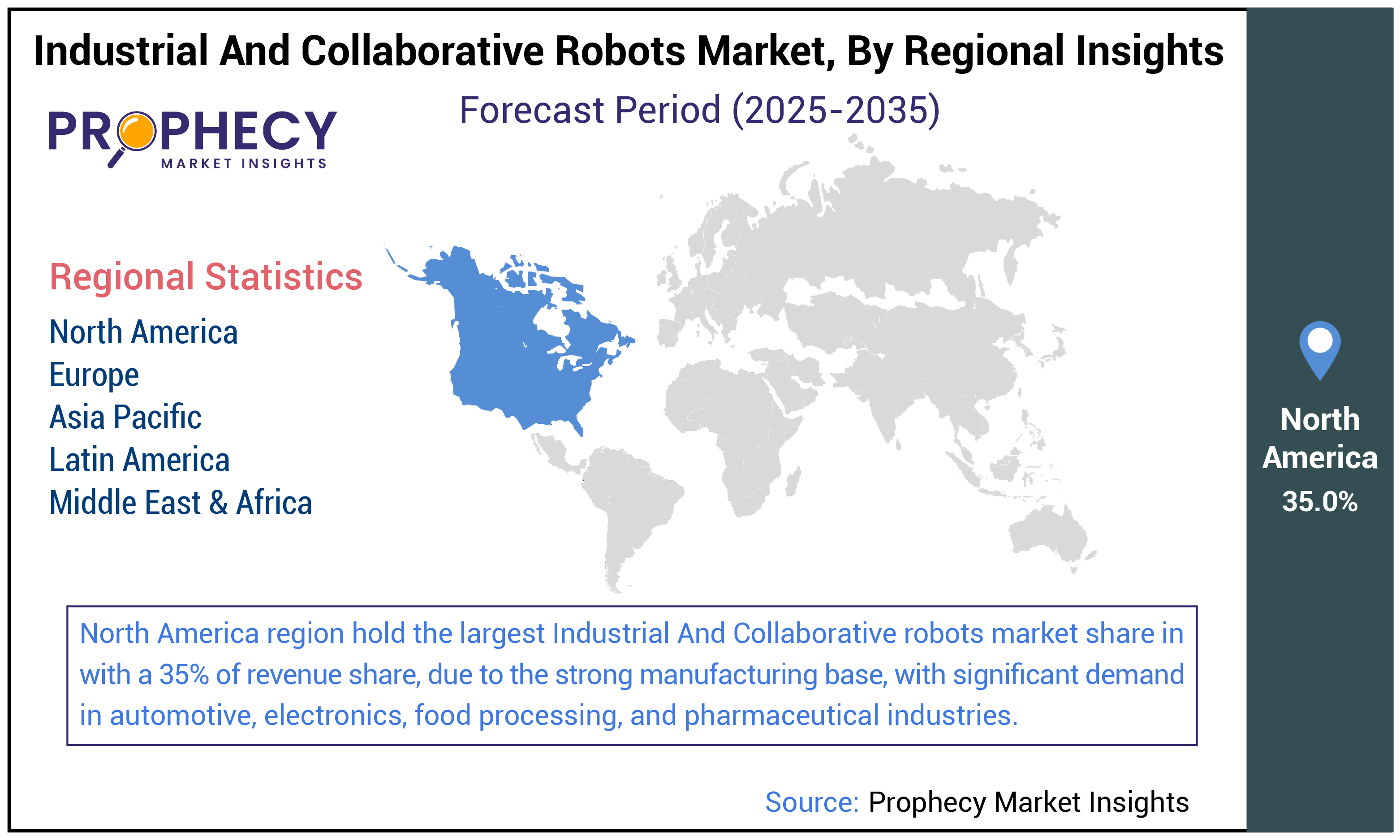
Geographically, the market is studied across North America, Europe, Asia Pacific, Latin America, and the Middle East & Africa.
North America: This region hold the largest industrial and collaborative robots market share in with a 35% of revenue share, due to the strong manufacturing base, with significant demand in automotive, electronics, food processing, and pharmaceutical industries. The technological advancement in robotic system, labor shortage in manufacturing, warehousing sectors, and strong focus on safety standards, regulation, resulting to fuel region growth in industrial and collaborative robots market share.
- U.S. Industrial and Collaborative Robots Market Insights:
The market for industrial and collaborative robots has experienced significant growth in recent years, and is expected to continuous growth. U.S. is the global leader in automation, robotics, and advanced manufacturing technologies. The growing use of cobot in industrial tasks, and lack of skilled labor, is making the U.S. a dominant player in the cobot market.
Asia Pacific: This region is the fastest growing region in the market, driven by rapid industrialization in emerging countries. It contains largest manufacturing hubs, increasing demand for industrial robots in automotive, electronics, textile industries, presence of major key payers, and growing adoption of robotic solutions, is expected to propel industrial and collaborative robots market size in this region.
- China Industrial and Collaborative Robots Market Insights:
China is the most leading country in Asia Pacific region for industrial and collaborative robots market. The industrial and collaborative market share is accredited due to, China contain largest manufacturing hub, especially for electronics, automotive, consumer goods, and textiles industries. The growing manufacturing industries, rises the demand for cobot to reduce labor cost, and improve operational costs, is anticipated to drive industrial and collaborative robots market growth.
Europe: This region is witnesses as steady growth in market. The well-established industries, with the increasing focus on automation, and growing adoption of industry 4.0, rises the demand for industrial and collaborative robots, particularly in the automotive, metals & machining, and electronic industries, is projected to region growth in industrial and collaborative robots market size.
- Germany Industrial and Collaborative Robots Market Insights:
Germany is dominant country in the Europe region, for the industrial and collaborative robots market. The increasing demand for industrial and collaborative robots is particularly high in automotive manufacturing, precision engineering, and the growing adoption of robots in automation improving efficiency and ensuring high-quality production, leading to growth of industrial and collaborative robots market share in this country.
Industrial and Collaborative Robots Market Report Scope:
|
Attribute |
Details |
|
Market Size 2025 |
USD 29.3 Billion |
|
Projected Market Size 2035 |
USD 272.1 Billion |
|
CAGR Growth Rate |
27.7% (2025-2035) |
|
Base year for estimation |
2024 |
|
Forecast period |
2025 – 2035 |
|
Market representation |
Revenue in USD Billion & CAGR from 2025 to 2035 |
|
Regional scope |
North America - U.S. and Canada Europe – Germany, U.K., France, Russia, Italy, Spain, Netherlands, and Rest of Europe Asia Pacific – China, India, Japan, Australia, Indonesia, Malaysia, South Korea, and Rest of Asia-Pacific Latin America - Brazil, Mexico, Argentina, and Rest of Latin America Middle East & Africa – GCC, Israel, South Africa, and Rest of Middle East & Africa |
|
Report coverage |
Revenue forecast, company share, competitive landscape, growth factors, and trends |
Segmentation:
By Product:
- Industrial Robots
- SCARA Robots
- Parallel Robots
- Articulated Robots
- Cylindrical Robots
- Delta Robots
- Others
- Collaborative Robots
- Fixed Collaborative Robots
- Hand Guiding Robots
- Mobile Collaborative Robots
- Others
By Payload Capacity:
- 5-10 Kg
- 10-25 Kg
- Above 25 Kg
By Application:
- Welding
- Loading & Unloading
- Material Handling
- Packaging & Palletizing
- Painting
- Assembly
- Others
By End-User:
- Automotive
- Metals & Machining
- Plastic & Polymers
- Electronics
- Healthcare
- Manufacturing
- Others
By Region:
- North America
- U.S.
- Canada
- Europe
- Germany
- U.K.
- France
- Russia
- Italy
- Spain
- Netherlands
- Rest of Europe
- Asia Pacific
- China
- India
- Japan
- Australia
- Indonesia
- Malaysia
- South Korea
- Rest of Asia Pacific
- Latin America
- Brazil
- Mexico
- Argentina
- Rest of Latin America
- Middle East & Africa
- GCC
- Israel
- South Africa
- Rest of Middle East & Africa
Global Industrial And Collaborative Robots Competitive Landscape & Key Players
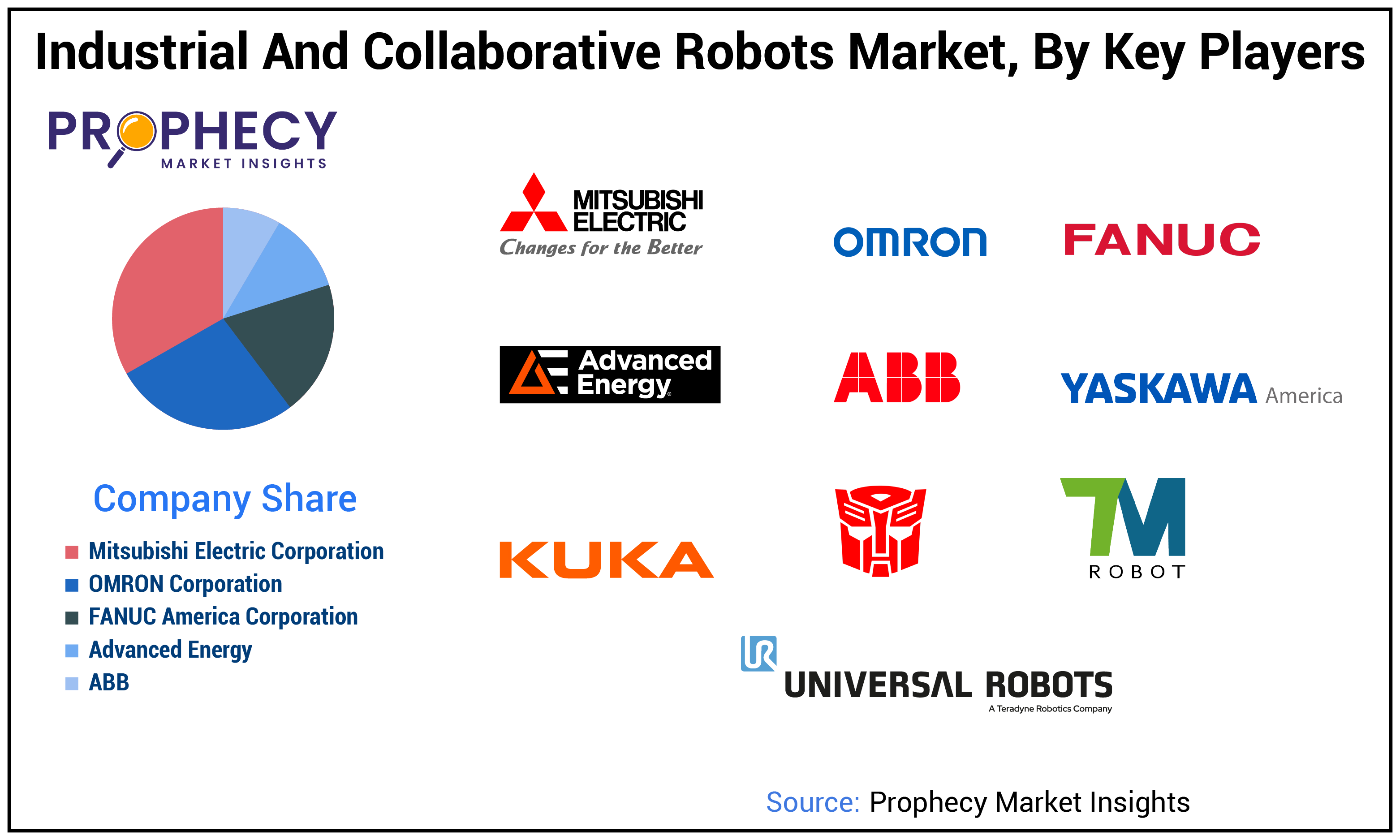
Mitsubishi Electric Corporation, OMRON Corporation, FANUC America Corporation, and among others, are the major companies functioning in the industrial and collaborative robots market. This companies are focusing on incorporation of robots into industrial application, and human tasks, through their new product offering. The companies are emphasis on strategic partnership and collaboration, to reduce labor cost, and improve work operation, through acquisition, resulting to drive industrial and collaborative market growth.
Industrial and Collaborative Robots Market Companies:
- Mitsubishi Electric Corporation
- OMRON Corporation
- FANUC America Corporation
- Advanced Energy
- ABB
- Yaskawa America, Inc.
- KUKA AG
- Autobots
- Universal Robots A/S
- Arcsecond Drive
- TECHMAN ROBOT INC.
- Kawasaki Heavy Industries, Ltd.
- Rethink Robotics
- Stäubli International AG
- Automate UK
View an Additional List of Companies in the Industrial and Collaborative Robots Market
Global Industrial And Collaborative Robots Recent News
- In April 2025, Accenture announced collaboration with Schaeffler AG, to reinvent industrial automation with physical AI and robotics. At Hannover Messe 2025, companies presents a various work scenarios, such as human-centric, human/robot collaboration and full automation, with AI and data technologies from NVIDIA and Microsoft. These development include industrial automation systems, autonomous mobile robots (AMRs), Schaeffler’s mobile manipulator cobot EMMA, and general-purpose humanoid robots such as Agility Robotics’ Digit and Sanctuary AI’s Phoenix.
- In November 2024, Dobot introduced SafeSkin, a revolutionary contactless pre-collision safety technology, was redefining safety standards in human-robot collaboration. This innovation enhances cobot safety by providing real-time responses to potential obstacles, allowing manufacturers to increase production speed without compromising the safety of operators. SafeSkin employed Dobot’s proprietary pre-collision sensing technology, which detects obstacles within 10–20 cm and stops the robot before contact occurs. This system aimed to empowers manufacturers to accelerate automation safely with improved efficiency solution for Industry 4.0.
- In November 2024, Collaborative Robotics launched their new robot, known as Proxie. The first highly adaptable Industrial and Collaborative Robots, aimed to meet increasing demand for material handling tasks. Proxie aimed to represent as the future of automation, combination of advanced AI, mobility and modular manipulation system, which was designed to support human-robot collaboration.
- In September 2024, KawaskiRobot launched advanced collaborative robots and new industrial robots at IMTS2024 in Chicago. These contains CL Series cobots, which was designed to various application, such as welding, machine trending and material removal. This aimed to offer manufacturers greater flexibility and advanced capabilities to meet the growing demand for automation.
Analyst View:
The advancement in automation technologies, shift towards greater productivity, and increases the demand for flexible manufacturing system. The rise of industry 4.0, the increasing integration of artificial intelligence (AI) and machine learning algorithms, which help robots to operate in suitable environment, is anticipated to drive industrial and collaborative robots market growth. The growing human-robot collaboration, increasing demand for robots in automation, and integration of cobots in Industry 4.0, is expected to pitch industrial and collaborative market growth.
More Related Reports
Industrial Boiler Market
Industrial Lubricants Market
Industrial Sugar Market
Industrial Microwave Heating Equipment Market
Industrial Internet of Things Market
Global Industrial And Collaborative Robots Company Profile
|
Company Name |
OMRON Corporation |
|
Headquarter |
Kyoto, Japan |
|
CEO |
Junta Tsujinaga |
|
Employee Count (2024) |
28,000 Employees |
Global Industrial And Collaborative Robots Highlights
FAQs
Industrial and collaborative robots market size was valued at USD 29.3 Billion in 2025 and is expected to reach USD 272.1 Billion by 2035 growing at a CAGR of 27.7%.
Product, payload capacity, application, end-user, and region are the segmentation for the industrial and collaborative robots market.
North America, Asia Pacific, Europe, Latin America, and the Middle East & Africa. North America is expected to dominate the market.
The key players operating in the industrial and collaborative robots market include Mitsubishi Electric Corporation, OMRON Corporation, FANUC America Corporation, Advanced Energy, ABB, Yaskawa America, Inc , KUKA AG, Autobots, Universal Robots A/S, Arcsecond Drive, TECHMAN ROBOT INC., Kawasaki Heavy Industries, Ltd., Rethink Robotics, Stäubli International AG, and Automated UK