Global Industrial Protective Clothing Market Overview
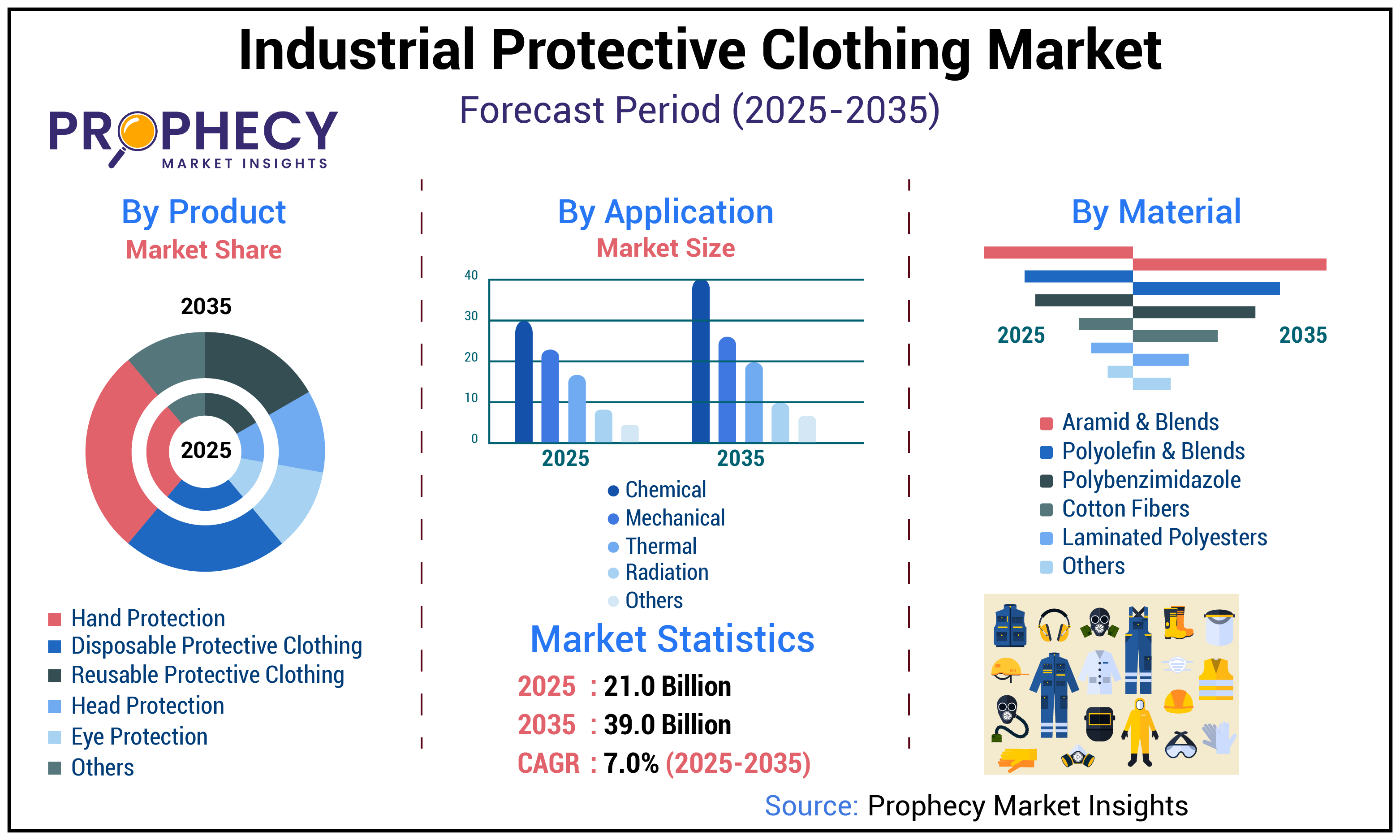
- Industrial protective clothing market size is expected to expand at a rate of USD 39.0 Billion, by 2035.
- In 2024, the market valuation was USD 20.3 Billion.
- Industrial protective clothing market is growing at a CAGR of 7.0 %.
Industrial protective clothing, often referred to as PPE (Personal Protective Equipment), is specialized clothing designed to shield workers from various hazards in the workplace, including heat, fire, chemicals, and biological agents. It goes beyond everyday clothing, focusing on specific needs for safety and protection in hazardous environments. These significantly reduces workplace accidents and injuries by providing a barrier between workers and hazards. It helps prevent injuries from various sources, including harmful chemicals, bacteria, extreme temperatures, and impacts, while also contributing to a safer work environment, increased productivity, and reduced costs.
The industrial protective clothing market is growing due to the increasing number of workplace accidents, injuries, and fatalities which directly correlates with higher demand for protective clothing to mitigate risk, implementation of stricter laws and regulations, increased awareness among workers and employers, rising urbanization and industrialization, and the growing awareness of health and hygiene, particularly regarding infection control
The market’s augmentation is also stimulated by development of new fabrics and designs with enhanced features such as flame resistance, chemical resistance, and comfort by manufacturers, integration of smart textiles, which can monitor vital signs or detect hazards, is a growing trend in the market, offering more advanced protection, and increased focus on sustainable materials and production processes is driving the development of environmentally friendly protective clothing.
Recession Risk and Tariff Analysis:
- By lowering expenditures in manufacturing, infrastructure, and building projects, recession risk can reduce the demand for industrial protective apparel. Budgetary restrictions during recessions may cause businesses to postpone or reduce its purchases of safety equipment, which would affect demand. Nevertheless, despite budgetary constraints, adherence to safety requirements maintains a fundamental market necessity.
- Regional differences in industrial protective gear tariffs have an impact on international trade flows and prices. While tariff relaxations under free trade agreements promote global supply chains, high import taxes in particular nations can limit foreign enterprises' access to markets. Cross-border competitiveness and market stability can both be improved by harmonized tariff structures.
Impact of Generative AI on Industrial Protective Clothing Market:
- Through improved material innovation, predictive safety features, and product design, generative AI is revolutionizing the market for industrial protective apparel. It makes it possible to quickly prototype clothing that is suited to certain work settings and has the best possible fit, comfort, and protection. Artificial intelligence (AI)-powered simulations enhance durability and safety requirements by forecasting wear and tear.
- AI also helps anticipate the supply chain, which lowers manufacturing delays and wasteful inventory. As the market for intelligent, personalized protective gear expands, generative AI enables producers to effectively develop and satisfy changing safety standards.
Global Industrial Protective Clothing Market Drivers & Restraints
Key Drivers:
Rising Urbanization is Fostering the Market Expansion
Growing urbanization stimulates the growth of manufacturing, infrastructure development, and building in urban areas, which in turn propels the market for industrial protective apparel. As cities expand, more people are working in hazardous conditions that call for protective clothing in order to comply with safety regulations. Furthermore, occupational health and safety laws are frequently enforced more strictly in metropolitan areas, which forces firms to purchase premium protective equipment. The need for long-lasting, specialized industrial protective gear is greatly raised by this trend and growing awareness of workplace safety.
- For instance, according to the data published by World Bank Group, in order to fulfill the World Bank's purpose of eradicating poverty and promoting shared prosperity on a habitable world, more livable cities must be built. Currently, 4.4 billion people, or more than half of the world's population, reside in urban areas. This trend is predicted to continue, with nearly seven out of ten people living in cities by 2050, when the urban population is predicted to more than quadruple.
Restraints:
Lack of Comfort and Breathability is Obstructing the Market Expansion
The lack of comfort and breathability in many protective garments is a major drawback in the market for industrial protective apparel. During prolonged usage, employees frequently suffer pain, overheating, or limited mobility, which can result in lower productivity and even non-compliance with safety regulations. In hot or muggy conditions, where heat stress becomes a serious worry, this problem is very common. It is difficult to achieve uniform usage and uphold worker safety requirements across different sectors when protection and wear ability are not balanced.
- Counterbalance Statements: Manufacturers should put an emphasis on ergonomic designs that use textiles that are lightweight, breathable, and moisture-wicking without sacrificing protection in order to alleviate pain. Comfort may be improved by using adaptable materials, smart fabrics, and ventilation panels. By including end users in product testing, clothing may be customized to fit certain work environments, promoting regular usage and increased worker compliance.
Opportunities & Trends:
Amalgamating Smart Textiles with Industrial Protective Clothing is Unlocking Growth Opportunities for the Upcoming Years
Industrial protective apparel that incorporates smart textiles improves user experience, functionality, and safety, which drives market expansion. By monitoring vital signs, detecting dangerous gases, or controlling temperature, these cutting-edge textiles may provide real-time data to reduce the risk of accidents and health problems. Additionally, smart fabrics increase comfort and versatility, promoting regular use by employees. Intelligent, high-performance protective gear is becoming more and more in demand as companies embrace digital transformation and put worker well-being first. Smart fabrics are positioned as a potential business engine by this invention, which also complies with changing safety laws.
- For instance, according to the data published by Fibre2Fashion, Smart textiles, often referred to as e-textiles or intelligent textiles, are a revolutionary development in the textile sector that combine conventional materials with technology. With its ability to perceive, react, and adjust to environmental cues, these fabrics provide functionality that traditional materials cannot match. Thus, integrating smart textiles with industrial protective clothing is fueling the market growth.
Global Industrial Protective Clothing Market Segmentations & Regional Insights
The industrial protective clothing market is segmented into product type, material, application, end-use industry, and region.
By Product Type:
Dependent on product type, the market is divided into disposable protective clothing, reusable protective clothing, head protection, eye protection, hearing protection, respiratory protection, foot protection, hand protection, and others. The hand protection segment is holding the superior position in the industrial protective clothing market share. This is due to the increasing demand for safety gloves in various industries such as mining, construction, and manufacturing, where these are essential for safeguarding workers' hands from hazardous conditions.
The disposable protective clothing segment is the second superior product type, in the target market. This is due to its increasing demand in various sectors, especially healthcare, and its suitability for use in situations where contamination risk is high and reusable clothing is not practical.
By Material Type:
Stemming from material type, the market is categorized into aramid & blends, polyolefin & blends, polybenzimidazole, cotton fibers, laminated polyesters, and others. The aramid & blends segment is expected to dominate the industrial protective clothing market. This is due to its exceptional heat and flame resistance, durability, and ability to maintain performance under extreme conditions, making it ideal for hazardous environments.
The polyolefin & blends segment is the second dominating material type in the target market. This is due to its ability to offer a balance of cost and protection, making it a popular choice for general-purpose protective clothing.
By Application:
Contingent to application, the market is classified into thermal, mechanical, chemical, radiation, and others. The chemical segment is expected to lead the target market. This is due to the high demand for specialized protective clothing in industries such as oil & gas, chemical manufacturing, and healthcare, where workers are exposed to hazardous chemicals. These garments must provide a high level of protection against a wide range of chemicals while also ensuring breathability and comfort for the wearer.
The mechanical segment is the second leading application, in the industrial protective clothing market. This is due to the need for protection against impacts, abrasions, cuts, and other mechanical hazards in various industries.
By End-Use Industry:
On the basis of end-use industry, the market is pigeonholed into oil & gas, construction & manufacturing, pharmaceuticals, law enforcement & military, firefighting, and others. The construction & manufacturing segment is the governing end-use industry in the industrial protective clothing market share. This is due to the high risk exposure, stringent regulations, and extensive use of protective gear in these industries.
The oil & gas segment is the end-use industry which is experiencing steady growth, in the target market. This is due to the inherent hazards present in oil and gas operations, including exposure to dangerous chemicals, high-temperature environments, and potential explosions, necessitating specialized protective gear.
Regional Insights:
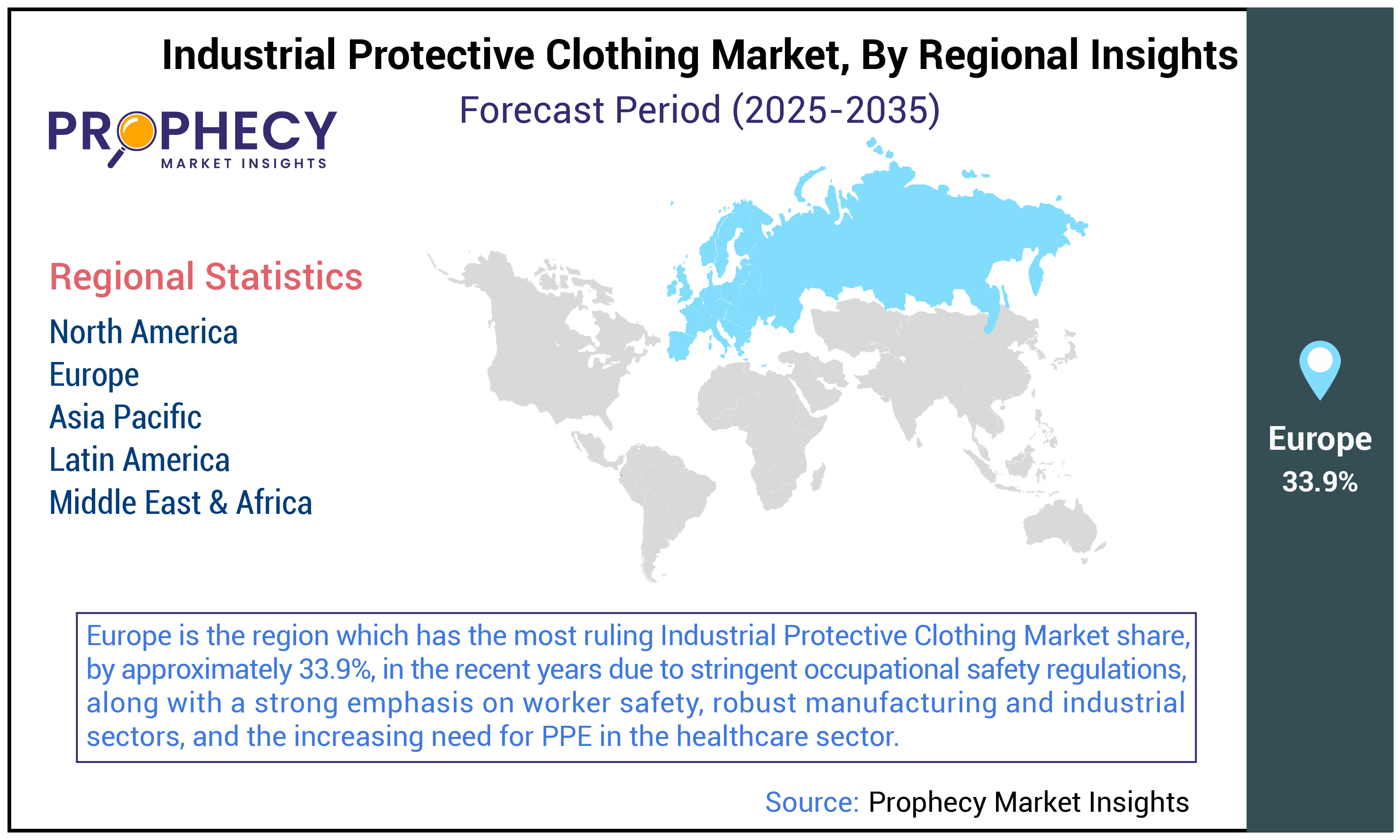
Geographically, the market is analyzed across North America, Europe, Asia Pacific, Latin America, and the Middle East & Africa.
Europe: This is the region which has the most ruling industrial protective clothing market share, by approximately 33.9%, in the recent years. This is due to a combination of factors, such as, this region’s stringent occupational safety regulations, along with a strong emphasis on worker safety, robust manufacturing and industrial sectors, increased awareness of workplace hazards and the importance of PPE, presence of the chemical and pharmaceutical industries in Europe, and the rising construction activities and the increasing need for PPE in the healthcare sector.
- Germany Industrial Protective Clothing Market Insights:
The industrial protective clothing market in Germany is the market which has the most influential market, in the recent years. This is due to this country’s significant manufacturing sector, including automotive and construction, robust safety standards and regulations, such as those from BAuA, that mandate the use of PPE in certain industries, a significant presence in the industrial protective clothing sector, and a developed supply chain and high quality control.
North America: This is the region which has the industrial protective clothing market, growing with the highest CAGR, during the forecast period, in the recent years. This is due to confluence of factors, such as, a strong regulation, a robust industrial sector, and increasing awareness of workplace safety. Specifically, stringent safety standards such as those enforced by the National Institute for Occupational Safety and Health (NIOSH) and OSHA, coupled with the presence of major industries such as chemical manufacturing and oil & gas, contribute to the high demand for protective clothing. Furthermore, the healthcare sector's growing needs for infection control, particularly after the COVID-19 pandemic, also drive demand for protective gear.
- U.S. Industrial Protective Clothing Market Insights:
The industrial protective clothing market in the U.S., is the fastest growing market, in the recent years, during the forecast period. This is due to this country’s substantial manufacturing sector, and its oil & gas production, mining, and chemical industries require extensive use of protective clothing to mitigate occupational hazards, stringent regulations enforced by organizations such as NIOSH and OSHA mandate the use of protective apparel to reduce workplace accidents and fatalities, and increasing awareness of workplace safety standards.
Asia Pacific: This is the region which has the industrial protective clothing market growing significantly, in the recent years. This is due to a confluence of factors, such as, this region’s robust industrial growth, increasing awareness of workplace safety, and the implementation of stringent safety regulations. Additionally, major global manufacturers have established a strong presence in the region, catering to the growing demand across various sectors such as manufacturing, construction, and healthcare.
- Japan Industrial Protective Clothing Market Insights:
The industrial protective clothing market in China is experiencing considerate amount of growth, in the recent years. This is due to this country’s largest manufacturing hub, resulting in a high demand for protective clothing to safeguard workers in various industries, rapid industrial growth in China drives the need for PPE to protect workers from hazards in factories and construction sites, implementation of strict labor safety regulations, and it is also a global supply chain for PPE.
Industrial Protective Clothing Market Report Scope:
|
Attribute |
Details |
|
Market Size 2025 |
USD 21.0 Billion |
|
Projected Market Size 2035 |
USD 39.0 Billion |
|
CAGR Growth Rate |
7.0 % (2025-2035) |
|
Base year for estimation |
2024 |
|
Forecast period |
2025 – 2035 |
|
Market representation |
Revenue in USD Billion & CAGR from 2025 to 2035 |
|
Regional scope |
North America - U.S. and Canada Europe – Germany, U.K., France, Russia, Italy, Spain, Netherlands, and Rest of Europe Asia Pacific – China, India, Japan, Australia, Indonesia, Malaysia, South Korea, and Rest of Asia-Pacific Latin America - Brazil, Mexico, Argentina, and Rest of Latin America Middle East & Africa – GCC, Israel, South Africa, and Rest of Middle East & Africa |
|
Report coverage |
Revenue forecast, company share, competitive landscape, growth factors, and trends |
Segmentation:
By Product Type:
- Disposable Protective Clothing
- Reusable Protective Clothing
- Head Protection
- Eye Protection
- Hearing Protection
- Respiratory Protection
- Foot Protection
- Hand Protection
- Others
By Material Type:
- Aramid & Blends
- Polyolefin & Blends
- Polybenzimidazole
- Cotton Fibers
- Laminated Polyesters
- Others
By Application:
- Thermal
- Mechanical
- Chemical
- Radiation
- Others
By End-Use Industry:
- Oil & Gas
- Construction & Manufacturing
- Pharmaceuticals
- Law Enforcement & Military
- Firefighting
- Others
By Region:
- North America
- U.S.
- Canada
- Europe
- Germany
- U.K.
- France
- Russia
- Italy
- Spain
- Netherlands
- Rest of Europe
- Asia Pacific
- China
- India
- Japan
- Australia
- Indonesia
- Malaysia
- South Korea
- Rest of Asia Pacific
- Latin America
- Brazil
- Mexico
- Argentina
- Rest of Latin America
- Middle East & Africa
- GCC
- Israel
- South Africa
- Rest of Middle East & Africa
Global Industrial Protective Clothing Market Competitive Landscape & Key Players
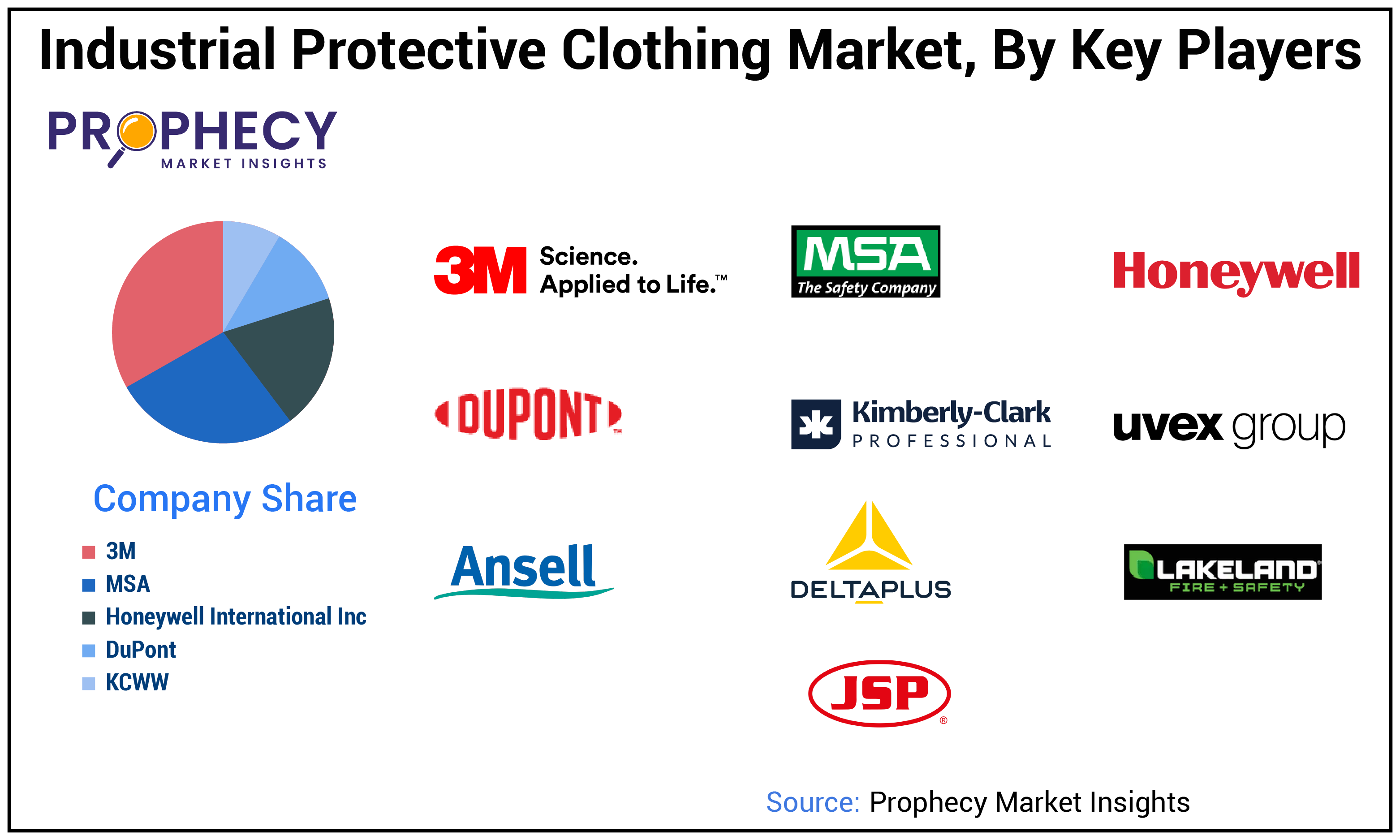
The key players operating in the market include, 3M, MSA, Honeywell International Inc, and others. These key players are focusing on innovation and technological advancements, strategic partnerships and collaborations, and a focus on safety and regulatory compliance. Companies are also leveraging new product development, geographic expansion, and mergers and acquisitions to increase market penetration, for driving industrial protective clothing market growth.
Industrial Protective Clothing Market Companies:
- 3M
- MSA
- Honeywell International Inc
- DuPont
- KCWW
- uvex group
- ANSELL LTD.
- Company Delta Plus Services
- LAKELAND INC.
- JSP Ltd.
- MCR SAFETY
- Sioen Industries NV
- Towa Corporation
- Bullard
- Drägerwerk AG & Co. KGaA
View an Additional List of Companies in the Industrial Protective Clothing Market
Global Industrial Protective Clothing Market Recent News
- In November 2024, Protective Industrial Products, Inc. ("PIP"), a portfolio company of Odyssey Investment Partners, agreed to purchase Honeywell's Personal Protective Equipment (PPE) division for USD 1.325 billion in an all-cash deal. In line with three compelling megatrends—automation, the future of aviation, and the energy transition—the deal would allow Honeywell to further streamline its portfolio and accelerate value generation.
- In April 2022, the development of LIVMOA 4500AS disposable personal protective equipment was announced by Toray Industries, Inc. The JIS T 8115 Type 4 standard for "Spray-tight" chemical protection apparel is met by the new product. Additionally, the use of seam tape provides exceptional water resistance, breathability, and dust protection. It set sales goals of 500,000 pieces in 2025 and 50,000 units this year.
- In July 2020, Viral Shield, a line of COVID-19 antiviral, reusable masks, protective fashion wear and personal protective equipment (PPE), was introduced by Loyal Textile Mills Limited. HeiQ from Switzerland and Reliance Industries India worked together to launch the series. After passing the SBPR, synthetic blood, and viral penetration tests, this PPE becomes the first reusable PPE in the world.
- In January 2020, the user-friendly and incredibly comfortable LIVMOA line of single-use protective apparel will soon be expanded, according to Toray Industries, Inc. The LIVMOA 4000 was intended to be introduced for high-pressure water applications. In addition to being breathable, LIVMOA 4000 meets JIS Type 5 and 6 requirements for chemical protection apparel. It used a nonwoven fabric that was unique to SMS.
Analyst View:
The industrial protective clothing market is expanding as a result of rising workplace accidents, injuries, and fatalities, which are directly linked to a greater need for protective gear to reduce risk; stricter laws and regulations; heightened awareness among employers and employees; increased urbanization and industrialization; and growing health and hygiene awareness, particularly with regard to infection control. Increased focus on sustainable materials and production processes is driving the development of environmentally friendly protective clothing. Manufacturers are also developing new fabrics and designs with improved features such as comfort, chemical resistance, and flame resistance. Another trend in the market is the integration of smart textiles, which can monitor vital signs or detect hazards and offer more advanced protection.
More Related Reports
Industrial Lubricants Market
Industrial Sugar Market
Industrial Microwave Heating Equipment Market
Industrial Internet of Things Market
Industrial Boiler Market
Global Industrial Protective Clothing Market Company Profile
|
Company Name |
3M |
|
Headquarter |
Saint Paul, Minnesota, United States |
|
CEO |
Mr. William M. Brown |
|
Employee Count (2024) |
85,000 Employees |
Global Industrial Protective Clothing Market Highlights
FAQs
Industrial protective clothing market size was valued at USD 21.0 Billion in 2025 and is expected to reach USD 39.0 Billion by 2035 growing at a CAGR of 7.0 %.
Product type, material type, application, end-use industry, and region are the segmentation for the Industrial Protective Clothing Market.
North America, Asia Pacific, Europe, Latin America, and the Middle East & Africa. Europe is expected to dominate the industrial protective clothing market.
The key players operating in the industrial protective clothing market include 3M, MSA, Honeywell International Inc, LAKELAND INC., DuPont, KCWW, uvex group, ANSELL LTD., Company Delta Plus Services, JSP Ltd., MCR SAFETY, Sioen Industries NV, Towa Corporation, Bullard, and Drägerwerk AG & Co. KGaA