Global Industrial Gases Market By Overview
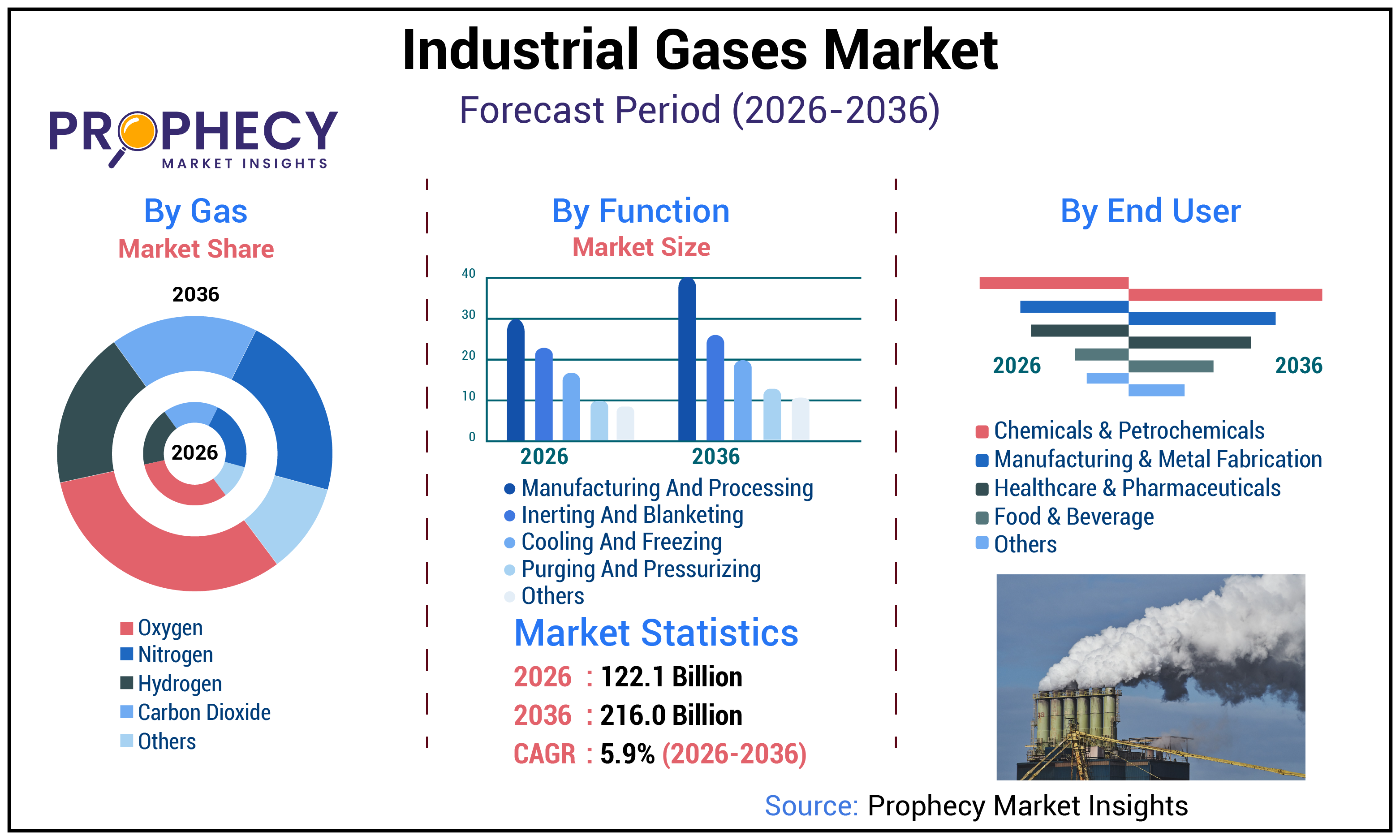
- 2025 Market Size: USD 122.1 Billion
- 2036 Projected Market Size: USD 205.1 Billion
- CAGR (2026-2036): 5.9%
- Asia Pacific: Largest Market in 2025
Industrial gases are chemical gases specifically made for different industrial operations like manufacturing, healthcare, energy, and food production. These are commonly oxygen, nitrogen, hydrogen, carbon dioxide, argon, and others, which are provided either in gaseous or liquid form. They are indispensable in welding, cutting, cooling, chemical synthesis, and packaging. Some of the chief advantages of industrial gases are increased production efficiency, better product quality, safer operations, less contamination, and facilitation of cleaner and more environmentally friendly industrial processes in various sectors.
The industrial gases market has expanded as a result of the rising need for different industrial gases that are used in the manufacturing, healthcare, chemical, food and beverage, and electronics sectors. As a result of industrialization, urbanization, and large-scale infrastructure development, the demand for gases used in welding, cutting, and metal processing has been increasing.
In addition, the growth of the healthcare sector, the increased use of clean energy technologies such as hydrogen fuel, and the demand for advanced food preservation and packaging solutions are some of the factors that have contributed to the market's growth. In addition, the use of environmental regulations to improve cleaner production processes is also contributing to the increase in the use of industrial gases worldwide.
Value Chain Analysis of Industrial Gases:
- The industrial gases market value chain includes various stages starting with the production of gases by means of different methods such as air separation, steam methane reforming, or electrolysis.
- After that comes the storage and transportation stage, where gases are compressed, liquefied, and made available to consumers through pipelines, cylinders, or cryogenic tankers.
- Next in line is distribution and supply, carried out by gas companies or distributors who keep the delivery to industrial users going without interruptions. The last stage is end-use application where the gases become a tool in the different industries as manufacturing, healthcare, chemicals, food processing, and energy.
- The integration and optimization at every stage along this value chain lead to more reliability, safety, and lower costs for the end users.
Current Industry Dynamics & Insights:
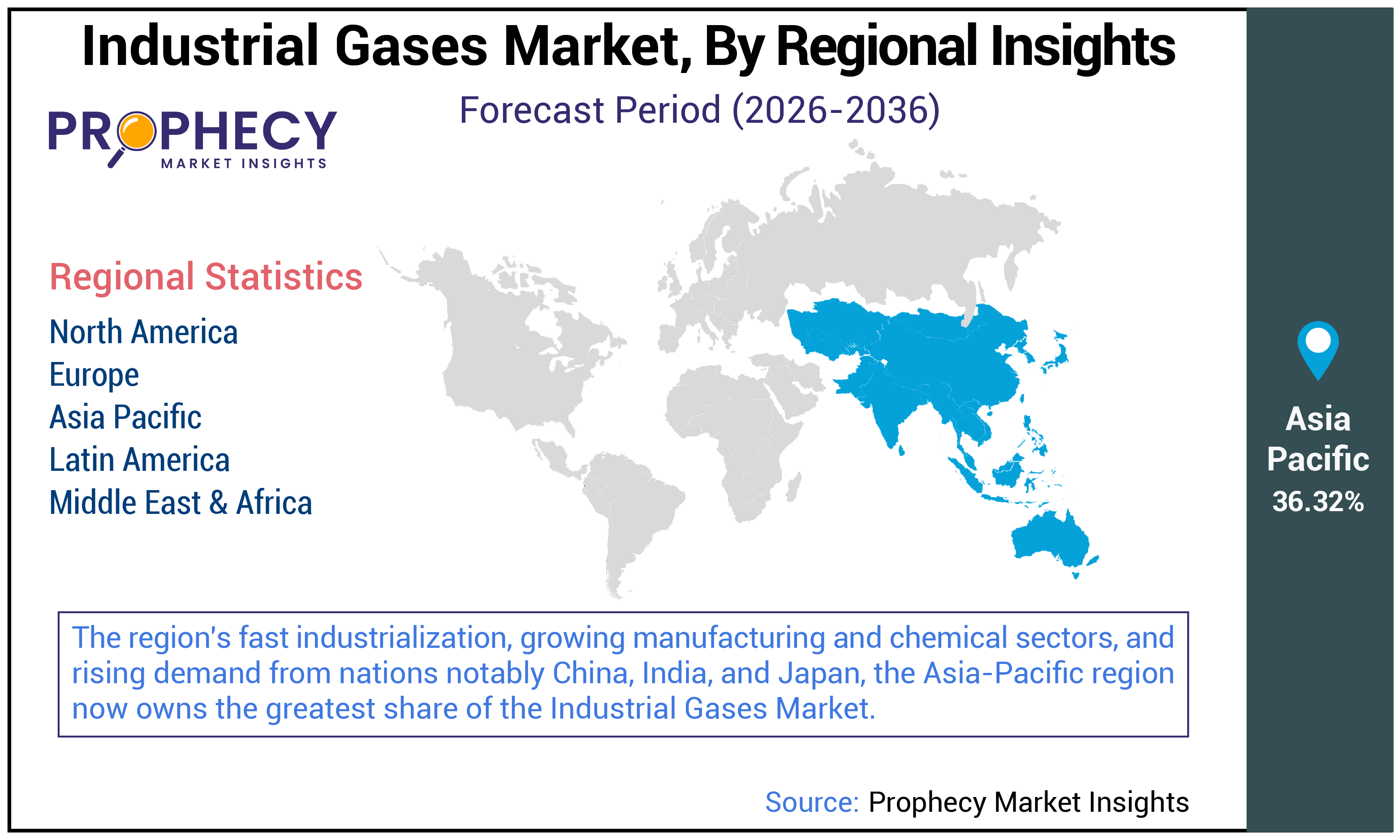
- Asia Pacific has the largest regional share in the market, with almost 36.32%.
- North America is second dominating region in the target market growth.
- By type, oxygen dominates the industrial gases market share.
Global Industrial Gases Market By Drivers & Restraints
Drivers and Restraints:
|
Drivers |
Restraints |
Opportunities & Trends |
|
|
|
Key Drivers:
Rapid Industrialization and Infrastructure Development
Rapid industrialization and consequent infrastructural development are one of the major factors that have brought about a significant change in the industrial gases market. These factors have increased the demand for this industry in different sectors such as manufacturing, construction, energy, and chemicals.
As industries expand, they need more gases as oxygen, nitrogen, and hydrogen for use in various applications that include welding, metal cutting, cooling, and process enhancement. Besides, infrastructure projects such as refineries, power plants, and steel manufacturing facilities require a huge quantity of industrial gases to carry out these operations efficiently and safely.
- For Instance, according to the data published by United Nations Industrial Development Organization, Globally, there was a 2.3% growth in industrial sectors, encompassing manufacturing, mining, electricity, water supply, waste management, and other utilities, signaling a post-pandemic recovery.
Restraints:
Supply Chain Disruptions
Interruptions to the supply chain can adversely influence the expansion of the industrial gases sector through delayed delivery of raw materials, production stoppages, and difficulties in transportation, all of which result in late delivery of gases to the final customers. Various stressors such as political conflicts, lack of energy, or logistics bottlenecks might result in shortage of gases and their price increase.
- Counterbalance Statements: In order to prevail over these challenges, firms are spending money on on-site gas manufacture facilities, local production centers, and digital supply chain tracking to be more mobile and stronger. Besides preparing local sourcing better and utilizing advanced inventory management, companies can also guarantee steady supply and lower the risk of global distribution networks.
Opportunities & Trends:
Growing Adoption of Green Hydrogen and Low-Carbon Gases
These days the whole world is moving towards clean energy and setting carbon neutrality as a goal. As a result, green hydrogen and low-carbon gases are becoming the hottest trends in the industrial gas market of tomorrow. For example, one of the main roles of green hydrogen is in such sectors as transportation, power generation, and refining, where it is used instead of fossil fuels as a sustainable solution.
In addition to that, low-carbon gases are enabling the reduction of emissions in manufacturing and chemical processes. Their demand is being realized as a result of the massive investments made by governments and companies in hydrogen infrastructure and carbon capture technologies. Therefore, this moment is opening up new possibilities for gas producers to grow in different parts of the world.
Global Industrial Gases Market By Segmentations & Regional Insights
Gas type, function, end user, and region are the divisions of the industrial gases market.
By Gas Type:
Based on the gas type, the industrial gases market is divided into oxygen, nitrogen, hydrogen, carbon dioxide, and others. Due to its widespread use in a variety of industries, including chemical processing, steel manufacturing, and metal fabrication, and healthcare, oxygen has the biggest industrial gases market share. It is the most used industrial gas in the world since it is necessary for oxidation, combustion, and medical purposes.
Due to its extensive use as an inert gas for blanketing, cooling, and preservation in sectors including electronics, food and beverage, and medicines, nitrogen is the second most common gas type. Its high market position is a result of its non-reactive nature and function in preserving product quality and safety.
By Function:
On the account of function, the industrial gases market can be categorized into manufacturing and processing, cooling and freezing, inerting and blanketing, purging and pressurizing, and others. Considering gases notably oxygen, hydrogen, and acetylene are widely used for welding, cutting, refining, and chemical synthesis in industries such as metals, petrochemicals, and energy, manufacturing and processing functions have the most industrial gases market share.
Being that nitrogen and argon are widely used in the chemical, pharmaceutical, and food sectors to prevent oxidation, contamination, and explosions, as well as to ensure product safety and extend shelf life, the inerting and blanketing function comes in second.
By End User:
Manufacturing & metal fabrication, chemicals & petrochemicals, healthcare & pharmaceuticals, food & beverage, and others are end users of the industrial gases market. Considering gases comprising hydrogen, oxygen, and nitrogen are necessary for chemical synthesis, refining, and process optimization, the chemicals and petrochemicals sector has the most industrial gases market share.
Due to the significant consumption of oxygen, acetylene, and argon for welding, cutting, and heat treatment operations all of which are essential for the automotive, construction, and heavy machinery industries the manufacturing and metal fabrication sector comes in second.
Regional Insights:
Geographically, the industrial gases market is studied across North America, Europe, Asia Pacific, Latin America, and the Middle East & Africa.
Asia Pacific: The region's fast industrialization, growing manufacturing and chemical sectors, and rising demand from nations notably China, India, and Japan, the Asia-Pacific region now owns the greatest share of the industrial gases market.
- China Industrial Gases Market Insights:
The combination of its extensive manufacturing base, large-scale production of chemicals and steel, and expanding investments in the clean energy and electronics sectors, China leads the Asia-Pacific industrial gases market. The nation's market position is further strengthened by its ongoing industrial growth and government emphasis on green hydrogen initiatives.
North America: With its sophisticated industrial infrastructure, substantial oil and gas refining operations, and expanding use of industrial gases in the food processing, electronics, and healthcare sectors, North America is the second most powerful area.
- U.S. Industrial Gases Market Insights:
Due to its sophisticated industrial infrastructure, robust chemical and energy sectors, and significant demand for gases in semiconductor manufacturing, food processing, and healthcare, the United States leads the market in North America.
Europe: This region industrial gases market is expanding as a result of the region's strong emphasis on sustainability and the shift to clean energy, as well as rising demand from the chemical, healthcare, and food and beverage industries.
- Germany Industrial Gases Market Insights:
Due to its extensive industrial base, cutting-edge manufacturing techniques, and leadership in the manufacture of chemicals and automobiles, Germany dominates the European market. The nation's position in the regional industrial gases market is further strengthened by its investments in renewable energy projects and hydrogen infrastructure.
Industrial Gases Market Report Scope:
|
Attribute |
Details |
|
Market Size 2026 |
USD 121.7 Billion |
|
Projected Market Size 2036 |
USD 205.1 Billion |
|
CAGR Growth Rate |
5.9% (2026-2036) |
|
Base year for estimation |
2025 |
|
Forecast period |
2026 – 2036 |
|
Market representation |
Revenue in USD Billion & CAGR from 2026 to 2036 |
|
Regional scope |
North America - U.S. and Canada Europe – Germany, U.K., France, Russia, Italy, Spain, Netherlands, and Rest of Europe Asia Pacific – China, India, Japan, Australia, Indonesia, Malaysia, South Korea, and Rest of Asia-Pacific Latin America - Brazil, Mexico, Argentina, and Rest of Latin America Middle East & Africa – GCC, Israel, South Africa, and Rest of Middle East & Africa |
|
Company Landscape |
Market Share Analysis of Companies Heat Map Analysis Company Overview, Products Overview Financial Information, Key Highlights Business Strategies Overview SWOT Analysis |
|
Report coverage |
Revenue forecast, company share, competitive landscape, growth factors, and trends |
|
Value Added Data Infosets |
Besides fundamental market insights such as the size of the market, growth rate, segmentation, regional study, and key players, our reports carry value-added data sets such as trade flow (import-export) analysis, production and consumption overview, price trend evaluation, supply and value chain mapping, and raw material availability. Moreover, we provide strategic tools as PESTLE and Porter’s Five Forces analysis, examination of the regulatory landscape, as well as monitoring of technology and innovation thereby providing a comprehensive overview which facilitates sensible and anticipatory decision-making. |
Segmentation:
By Gas Type:
- Oxygen
- Nitrogen
- Hydrogen
- Carbon Dioxide
- Others
By Function:
- Manufacturing and Processing
- Cooling and Freezing
- Inerting and Blanketing
- Purging and Pressurizing
- Others
By End User:
- Manufacturing & Metal Fabrication
- Chemicals & Petrochemicals
- Healthcare & Pharmaceuticals
- Food & Beverage
- Others
By Region:
- North America
- U.S.
- Canada
- Europe
- Germany
- U.K.
- France
- Russia
- Italy
- Spain
- Netherlands
- Rest of Europe
- Asia Pacific
- China
- India
- Japan
- Australia
- Indonesia
- Malaysia
- South Korea
- Rest of Asia Pacific
- Latin America
- Brazil
- Mexico
- Argentina
- Rest of Latin America
- Middle East & Africa
- GCC
- Israel
- South Africa
- Rest of Middle East & Africa
Global Industrial Gases Market By Competitive Landscape & Key Players
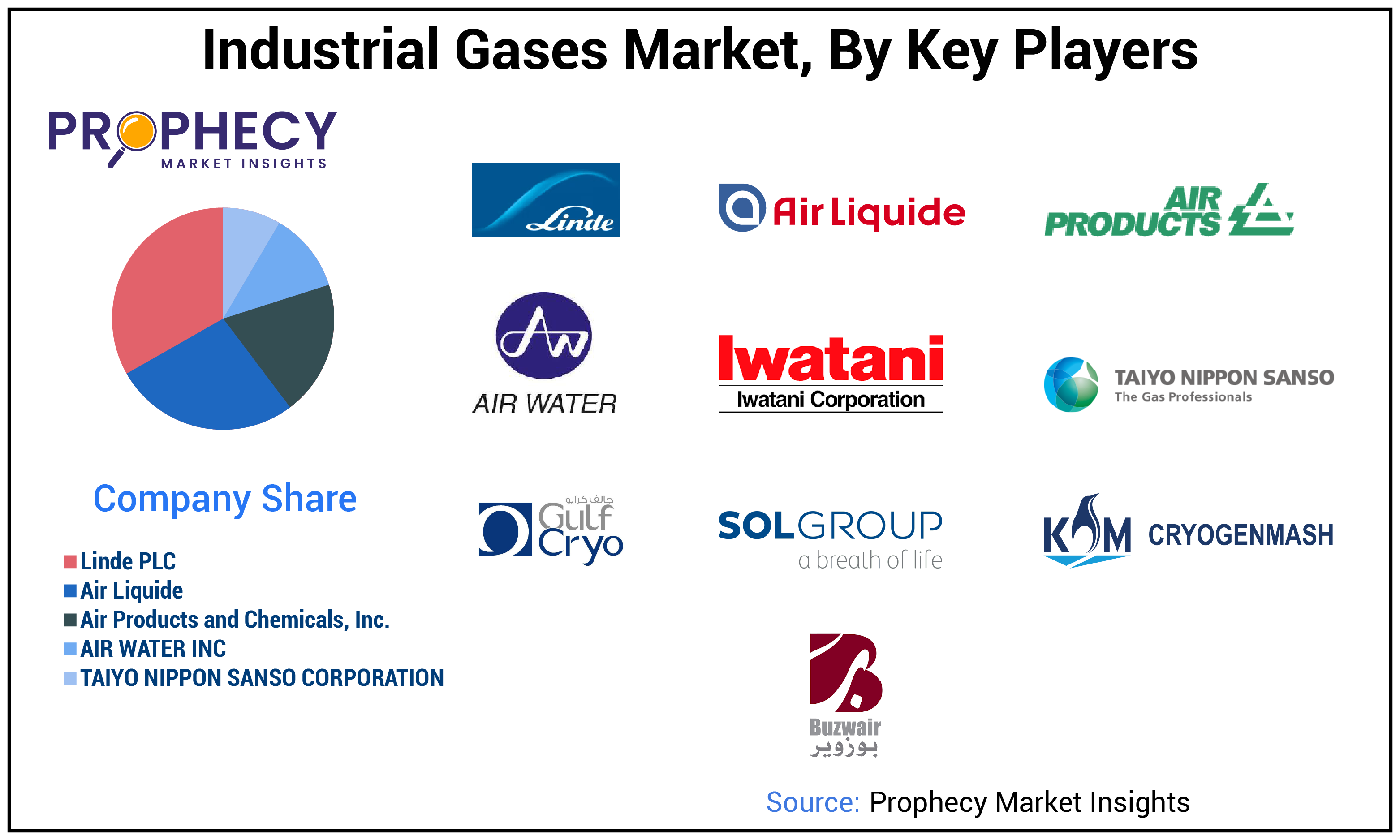
Increasing production capacity and geographic presence to fulfill growing worldwide demand, especially in emerging areas, are important growth strategies for industrial gas companies. In order to comply with regulatory trends and sustainability goals, businesses are investing more in low-carbon technology and green hydrogen. Technological capabilities and market presence are strengthened through strategic alliances, mergers, and acquisitions.
Industrial Gases Market Companies:
- Linde PLC
- Air Liquide
- Air Products and Chemicals, Inc.
- AIR WATER INC
- TAIYO NIPPON SANSO CORPORATION
- MESA Specialty Gases & Equipment
- Iwatani Corporation
- Ellenbarrie Industrial Gases Limited
- Gulfcryo
- SOL GROUP
- Gruppo SIAD
- MATHESON TRI-GAS, INC.
- Buzwair Holding
- Cryogenmash
- INOX-Air Products Inc.
View an Additional List of Companies in the Industrial Gases Market
Global Industrial Gases Market By Recent News
- In July 2025, In order to support the next frontier of space exploration, Linde announced bold new investments. Linde is bolstering its position in the quickly growing U.S. space industry with two new long-term contracts to provide bulk industrial gases for rocket launches.
- In September 2023, Westfalen Group (Westfalen), an expert in industrial gases, has opened a new filling plant in Arzal on Brittany's Atlantic coast. The new facility increases the company's footprint in France, which is now Westfalen's biggest overseas market. The business will be able to secure an extra capacity of over 130,000 cylinders annually thanks to the increased investment.
Analyst View:
Due to increased demand from a variety of industries, including manufacturing, healthcare, chemicals, food and beverage, and electronics, the market for industrial gases is expanding quickly. For operations including welding, cooling, chemical synthesis, and packing, gases as oxygen, nitrogen, hydrogen, and carbon dioxide are essential.
Industrialization, infrastructure development, and the growing usage of clean energy technologies as hydrogen fuel are the main drivers of market expansion. The demand for industrial gases is also rising globally due to tighter environmental laws and developments in food preservation and medical uses.
Analysis of Sources:
Primary Sources:
- In-depth interviews
- Company-specific data
- Surveys and questionnaires
- Focus group discussions (FGDs)
- Others
Secondary Sources:
- International Energy Agency (IEA)
- United Nations Industrial Development Organization (UNIDO)
- International Organization for Standardization (ISO)
- Organization for Economic Co-operation and Development (OECD)
- Others
More Related Reports
Industrial Lubricants Market
Industrial Sugar Market
Industrial Microwave Heating Equipment Market
Industrial Internet of Things Market
Industrial Boiler Market
Global Industrial Gases Market By Company Profile
|
Company Name |
Product Portfolio |
|
Air Liquide |
Industry Gases |
|
Linde PLC |
Industrial Gases |
|
Air Products and Chemicals, Inc. |
Oxygen, Nitrogen, Argon, Helium, and Hydrogen |
|
MESA Specialty Gases & Equipment |
Industrial Gas |
|
TAIYO NIPPON SANSO CORPORATION |
Industrial Gases |
Global Industrial Gases Market By Highlights
FAQs
Industrial gases market size was valued at USD 121.7 Billion in 2026 and is expected to reach USD 205.1 Billion by 2036 growing at a CAGR of 5.9%.
Gas type, function, end user, and region are the segmentation for the industrial gases market.
Healthcare, manufacturing, electronics, and energy sectors, along with the increasing adoption of clean energy solutions as hydrogen fuel cells, strong demand from developing economies, the rising need for medical-grade gases, and so on are some of the industrial gases market growth drivers.
North America, Asia Pacific, Europe, Latin America, and the Middle East & Africa. Asia Pacific is expected to dominate the industrial gases market.
The key players operating the industrial gases market include Linde PLC, BYD Europe B.V., Air Products and Chemicals, Inc., AIR WATER INC, TAIYO NIPPON SANSO CORPORATION, MESA Specialty Gases & Equipment, Iwatani Corporation, Ellenbarrie Industrial Gases Limited, SilexPro, SOL GROUP, Gruppo SIAD, MATHESON TRI-GAS, INC., Buzwair Holding, Cryogenmash, and INOX-Air Products Inc.