Global Industrial DeNOx Systems Market Overview
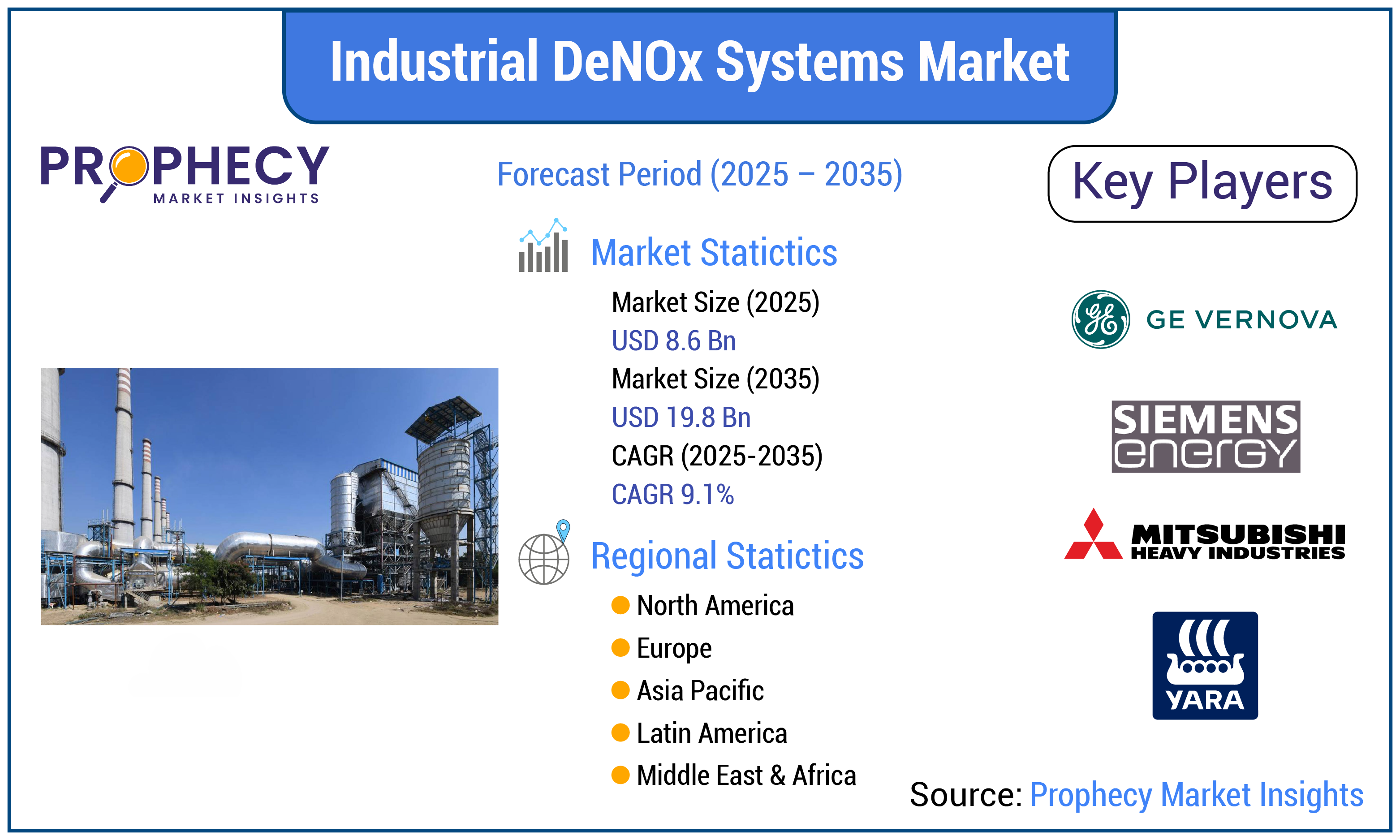
- Industrial DeNOx systems market size is approximated to expand at a rate of USD 19.8 Billion, by 2035.
- In 2024, the market valuation was USD 7.9 Billion.
- Industrial DeNOx systems market is growing at a CAGR of 9.1%.
Industrial DeNOx systems are technologies that remove nitrogen oxides (NOx) from industrial emissions. These helps reduce harmful NOx pollutants, such as nitric oxide and nitrogen dioxide, which can contribute to smog, acid rain, and respiratory problems. DeNOx systems are crucial for complying with environmental regulations and reducing the impact of industrial processes on air quality. These systems have a high efficiency by reduction of nitrogen oxides by 90% or more in a single stage and up to 99.5% in double stage DeNOx, and flexibility by adapting to various industrial processes such as power plants, chemical plants, burner installations, thermal oxidation plants and other high emission sources.
The industrial DeNOx systems market is experiencing growth due to a combination of factors, primarily driven by, stringent environmental regulations, such as those under the Clean Air Act in the U.S., are prompting businesses to adopt DeNOx technologies to reduce NOx emissions, rising demand for energy, especially in developing countries, leads to the expansion of power plants and other industrial facilities, and the availability of funds and the cost of raw materials.
The market’s diversification is also pitched by the development of more efficient and cost-effective DeNOx technologies, particularly selective catalytic reduction (SCR), and the use of DeNOx systems is not limited to power plants; these are also being implemented in various other industries, including waste incineration, gas turbines, cement plants, and FCC units.
Recession Risk and Tariff Analysis:
- Recession risk might impede the demand for industrial DeNOx systems by lowering investments in the energy, infrastructure, and manufacturing sectors. Despite regulatory pressure, environmental upgrades may be delayed due to budgetary restrictions. Uncertainty in international commerce and industrial production can also reduce the demand for emissions control technology, which can have an effect on market expansion during recessions.
- The industrial DeNOx systems market's tariff study reveals that import taxes on crucial parts such as reactors and catalysts can differ greatly between geographical areas. Some nations keep higher tariffs to safeguard indigenous industry, while others with stricter emission standards may drop it to promote adoption. This has an impact for trade dynamics and price.
Impact of Generative AI on Industrial DeNOx Systems Market:
- Through process control improvement, emission pattern prediction, and system design optimization, generative AI is having an influence on the market for industrial DeNOx systems. It makes data-driven modelling of NOx reduction procedures possible, increasing productivity and ensuring adherence to environmental standards.
- AI lowers operating costs and downtime by forecasting maintenance requirements and simulating catalyst behavior. By hastening the creation of cutting-edge DeNOx technologies, it also fosters innovation. This results in more intelligent and effective pollution control technologies that follow regulatory trends and global sustainability.
Global Industrial DeNOx Systems Market Drivers & Restraints
Key Drivers:
Rise in Global Energy Demand is Fostering the Market Expansion
The industrial DeNOx systems market growth is driven by the increase in global energy consumption, which raises the need for power generation, especially from fossil fuel-based facilities that release nitrogen oxides (NOx). Stricter environmental restrictions necessitate efficient emission control devices as energy output increases. DeNOx systems provide regulatory compliance by assisting facilities in meeting air quality regulations. DeNOx system adoption is further accelerated by the need for cleaner industrial operations, particularly in the manufacturing, cement, and power industries. This supports market development in the face of expanding worldwide energy consumption.
- For instance, according to the data published by IEA, global energy consumption increased by 2.2% last year, which was much faster than the average annual demand increase of 1.3% between 2013 and 2023 but still less than GDP growth of 3.2%. More than 80 percent of the rise in the world's energy consumption in 2024 came from emerging and developing nations. With worldwide electricity consumption rising by around 1,100 terawatt-hours, or 4.3%, the power sector was the main driver of the acceleration in the increase of global energy demand in 2024.
Restraints:
The Dependency of Industrial DeNOx Systems on Specific Operating Conditions is Restricting the Market Growth
The reliance on particular operating parameters, including temperature and pressure, for optimum performance is one drawback of the industrial DeNOx systems market. If these parameters change, selective catalytic reduction (SCR) and selective non-catalytic reduction (SNCR) systems may become less effective, producing undesired byproducts such as ammonia slip or insufficient NOx reduction. Furthermore, it can be technically challenging to integrate these technologies into current industrial settings, necessitating considerable process modifications that could limit flexibility and disrupt operations in dynamic industrial contexts.
- Counterbalance Statements: Creating sophisticated sensors and adaptive control technologies that track and modify system characteristics in real time is the answer. AI-driven optimization can improve the responsiveness of the system. Additionally, modular and adaptable system designs provide easier integration into a variety of industrial settings, guaranteeing constant NOx reduction under shifting operating circumstances.
Opportunities & Trends:
Advancements in Industrial DeNOx Systems is Opening Up Growth Opportunities for the Future Generations
Improvements in industrial DeNOx systems' efficiency, flexibility, and environmental compliance are driving the market's future expansion. Even under changing operating circumstances, NOx removal is improved by innovations such as AI-driven process optimization, real-time monitoring systems, and low-temperature catalysts. These innovations make it possible to integrate with a variety of industrial settings, decrease ammonia slip, and extend catalyst life. Furthermore, new hybrid systems that combine SNCR and SCR techniques provide adaptable answers for more stringent emission regulations. These developments position DeNOx systems as crucial instruments for cleaner production as international rules tighten and enterprises strive for sustainability goals, encouraging its adoption and growing the market in industries including chemicals, cement, and electricity.
Global Industrial DeNOx Systems Market Segmentations & Regional Insights
The industrial DeNOx systems market is segmented into type, application, and region.
By Type:
On the groundwork of type, the market is bifurcated into selective non-catalytic reduction and selective catalytic reduction. The selective catalytic reduction segment is attributed to dominate the industrial DeNOx systems market share. This is due to its ability to achieve high NOx reduction rates (up to 98%) using a catalyst, making it particularly suitable for stringent emission regulations.
The selective non-catalytic reduction segment is the second dominating type, in the target market. This is due to its lower up-front costs and suitability for reducing NOx emissions in industrial plants and incinerators.
By Application:
Stemming from application, the market is divided into waste incineration plants, FCC units in refineries, calcination plants, nitric acid plants, power plants, cement plants, gas turbines, steel mills, and others. The power plants segment is attributed to lead the industrial DeNOx systems market share. This is due to the large volume of NOx emissions from these plants, making it a primary target for emission control technologies such as DeNOx systems. The systems help reduce NOx levels, improving air quality and worker health.
The waste incineration plants segment is the second leading application, in the industrial DeNox systems market. This is due to the fact that waste incineration generates significant amounts of NOx emissions, and DeNOx systems are crucial for reducing these emissions and meeting environmental regulations.
Regional Insights:
Geographically, the market is analyzed across North America, Europe, Asia Pacific, Latin America, and the Middle East & Africa.
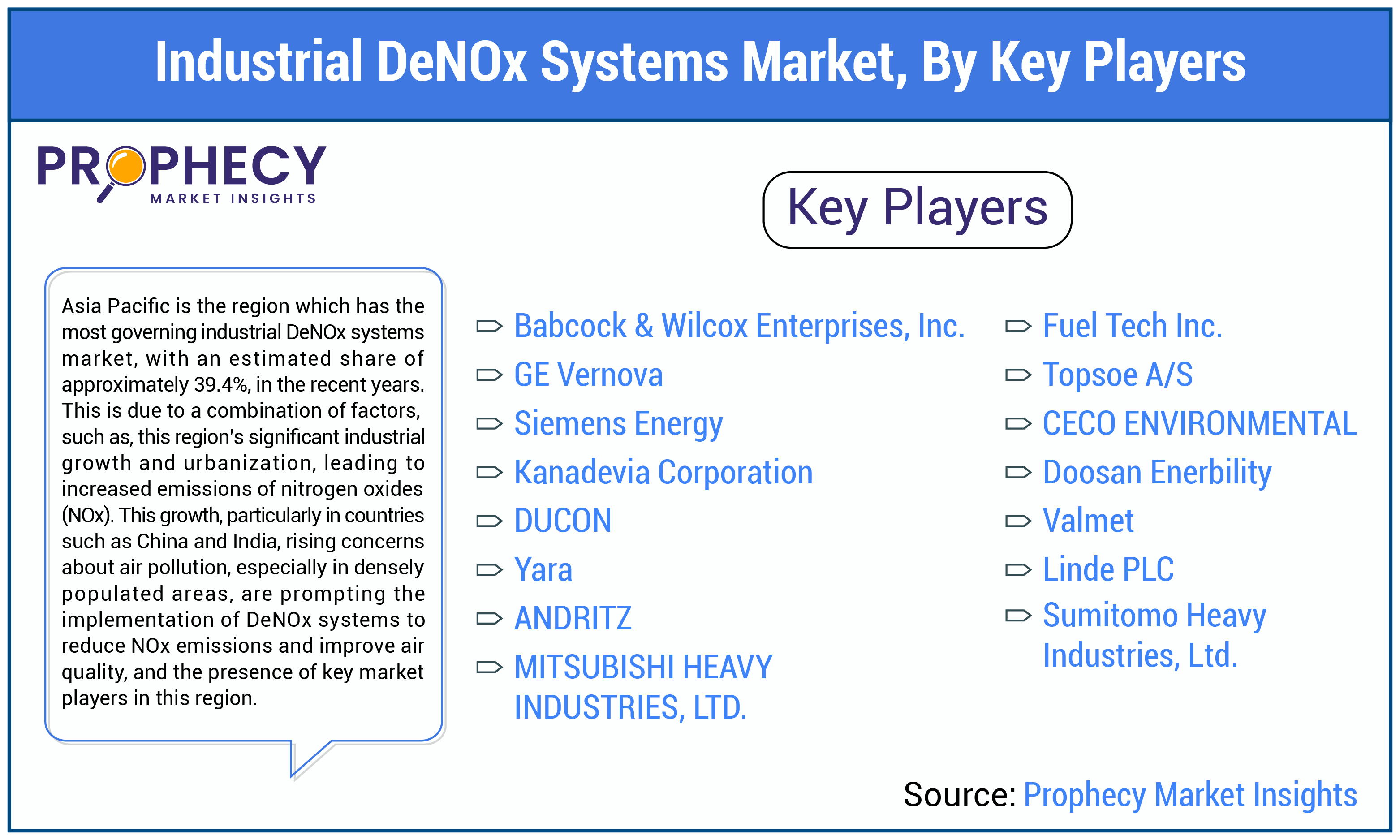
Asia Pacific: This is the region which has the most governing industrial DeNOx systems market, with an estimated share of approximately 39.4%, in the recent years. This is due to a combination of factors, such as, this region’s significant industrial growth and urbanization, leading to increased emissions of nitrogen oxides (NOx). This growth, particularly in countries such as China and India, rising concerns about air pollution, especially in densely populated areas, are prompting the implementation of DeNOx systems to reduce NOx emissions and improve air quality, and the presence of key market players in this region.
- China Industrial DeNOx Systems Market Insights:
The industrial DeNOx systems market in China is the most ruling market, in the recent years. This is due to this country’s rapid industrial growth across various sectors, including manufacturing, energy production, and transportation, rapid growth of urban areas in China also contributes to increased NOx emissions from various sources, rising awareness and concern about air quality and the health impacts of NOx emissions have spurred government regulations and industry initiatives to reduce emissions, investment in DeNOx technologies, and favorable government policies.
Europe: This is the region which has the industrial DeNOx systems market, growing with the fastest growth rate, during the forecast period, in the recent years. This is due to a confluence of factors, primarily driven by environmental regulations and a growing focus on sustainability. The European Union's Industrial Emission Directive (IED) and other environmental regulations mandate the installation of DeNOx systems in certain industries to control NOx emissions, which are harmful pollutants. Additionally, the region's strong commitment to environmental protection and its push for sustainable practices further drive the demand for these systems.
- Germany Industrial DeNOx Systems Market Insights:
The industrial DeNOx systems market in Germany is growing with the highest CAGR, during the forecast period, in the recent years. This is due to this country’s significant industrial base, particularly its power generation sector, which heavily relies on coal-fired plants, driving a need for NOx emission control technologies such as DeNOx systems. The European Union's Industrial Emissions Directive also pushes for the use of DeNOx systems in various industries, including power generation.
North America: The region which has the industrial DeNOx systems market experiencing considerate amount of growth, in the recent years, is North America. This is due to several factors, such as, this region’s strong history of environmental regulations, such as the Clean Air Act, which mandates emission reduction targets, growing public awareness of the impact of industrial pollution on air quality and the environment, growing demand for sustainable solutions and technologies that can reduce environmental impacts and improve air quality, technological advancements, and diverse industrial applications.
- U.S. Industrial DeNOx Systems Market Insights:
The industrial DeNOx systems market in the U.S., is experiencing significant amount of growth, in the recent years. This is due to this country’s diverse and significant industrial base, including manufacturing, energy, and transportation, implementation of regulations to reduce NOx emissions, presence of coal-fired power plants, and the adoption of advanced technologies, including DeNOx systems, to improve environmental performance.

Industrial DeNOx Systems Market Report Scope:
|
Attribute |
Details |
|
Market Size 2025 |
USD 8.6 Billion |
|
Projected Market Size 2035 |
USD 19.8 Billion |
|
CAGR Growth Rate |
9.1% (2025-2035) |
|
Base year for estimation |
2024 |
|
Forecast period |
2025 – 2035 |
|
Market representation |
Revenue in USD Billion & CAGR from 2025 to 2035 |
|
Regional scope |
North America - U.S. and Canada Europe – Germany, U.K., France, Russia, Italy, Spain, Netherlands, and Rest of Europe Asia Pacific – China, India, Japan, Australia, Indonesia, Malaysia, South Korea, and Rest of Asia-Pacific Latin America - Brazil, Mexico, Argentina, and Rest of Latin America Middle East & Africa – GCC, Israel, South Africa, and Rest of Middle East & Africa |
|
Report coverage |
Revenue forecast, company share, competitive landscape, growth factors, and trends |
Segmentation:
By Type:
- Selective Non-Catalytic Reduction
- Selective Catalytic Reduction
By Application:
- Waste Incineration Plants
- FCC Units in Refineries
- Calcination Plants
- Nitric Acid Plants
- Power Plants
- Cement Plants
- Gas Turbines
- Steel Mills
- Others
By Region:
- North America
- U.S.
- Canada
- Europe
- Germany
- U.K.
- France
- Russia
- Italy
- Spain
- Netherlands
- Rest of Europe
- Asia Pacific
- China
- India
- Japan
- Australia
- Indonesia
- Malaysia
- South Korea
- Rest of Asia Pacific
- Latin America
- Brazil
- Mexico
- Argentina
- Rest of Latin America
- Middle East & Africa
- GCC
- Israel
- South Africa
- Rest of Middle East & Africa
Global Industrial DeNOx Systems Market Competitive Landscape & Key Players
The key players operating in the market include, Babcock & Wilcox Enterprises, Inc., MITSUBISHI HEAVY INDUSTRIES, LTD., GE Vernova, and others. These key players are leveraging strategies such as expanding application areas, focusing on environmental regulations, and fostering partnerships. Additionally, these companies are employing marketing strategies including content marketing, digital channels, and social media engagement, for driving Industrial DeNOx Systems Market growth.
Industrial deNOx systems market Companies:
- Babcock & Wilcox Enterprises, Inc.
- MITSUBISHI HEAVY INDUSTRIES, LTD.
- GE Vernova
- Siemens Energy
- Kanadevia Corporation
- DUCON
- Yara
- ANDRITZ
- Fuel Tech Inc.
- Topsoe A/S
- CECO ENVIRONMENTAL
- Doosan Enerbility
- Sumitomo Heavy Industries, Ltd.
- Valmet
- Linde PLC
View an Additional List of Companies in the Industrial deNOx systems market
Global Industrial DeNOx Systems Market Recent News
- In October 2024, a second GEA DeNOx facility for gas generation on the Adriatic coast was purchased by Pilkington, Italy. A DeNOx reactor and related parts for reagent storage, transportation, and dosing were part of GEA's "state-of-the-art" gas cleaning system. By reducing NOx emissions to 500 mg/Nm, the new GEA gas cleaning facility significantly lowers the ecologically damaging pollutants that come from the energy-intensive glassmaking process. In this sense, GEA solutions significantly help the client achieve its sustainability and environmental legislation compliance goals.
- In February 2024, TPC Group has ordered a Selective Catalytic Reduction (SCR) system from international technology company ANDRITZ to reduce nitrogen oxides (NOx) at the power boiler in Houston, Texas, USA. Leading petrochemical product maker TPC Group was making calculated investments to boost production capacity while adhering to strict local NOx emission regulations set by federal, state, and municipal authorities.
- In September 2023, in order to reduce NOX at the Lanjigarh Combined Gas Power Plant (CGPP) unit, GE Power India has obtained a purchase order from Vedanta. The order, which is for the 90 MW (3 x 30 MW) unit, is worth INR 25 crores, without including 18% GST. One well-known producer of equipment for power production and transmission was GE Power India. Boilers, mills, air quality control systems, services, and automation and control are among the company's many business segments.
Analyst View:
Rising energy demand, particularly in developing nations, is driving the expansion of power plants and other industrial facilities; strict environmental regulations, such as those under the Clean Air Act in the United States, are encouraging businesses to adopt DeNOx technologies to reduce NOx emissions; and the cost of raw materials and the availability of funding are all contributing factors to the growth of the industrial DeNOx systems market. The development of more economical and efficient DeNOx technologies, especially selective catalytic reduction (SCR), is another factor contributing to the market's diversification. Other industries, such as waste incineration, gas turbines, cement plants, and FCC units, are also implementing DeNOx systems.
More Related Reports
Industrial Boiler Market
Industrial Lubricants Market
Industrial Sugar Market
Industrial Microwave Heating Equipment Market
Industrial Internet of Things Market
Global Industrial DeNOx Systems Market Company Profile
|
Company Name |
Babcock & Wilcox Enterprises, Inc. |
|
Headquarter |
Akron, Ohio, United States |
|
CEO |
Mr. Kenneth Young |
|
Employee Count (2024) |
2,629 Employees |
Global Industrial DeNOx Systems Market Highlights
FAQs
Industrial DeNOx systems market size was valued at USD 8.6 Billion in 2025 and is expected to reach USD 19.8 Billion by 2035 growing at a CAGR of 9.1%.
Type, application, and region are the segmentation for the target market.
North America, Asia Pacific, Europe, Latin America, and the Middle East & Africa. Asia Pacific is expected to dominate the market.
The key players operating in the industrial DeNOx systems market include Babcock & Wilcox Enterprises, Inc., MITSUBISHI HEAVY INDUSTRIES, LTD., GE Vernova, Fuel Tech Inc., Siemens Energy, Kanadevia Corporation, DUCON, Yara, ANDRITZ, Topsoe A/S, CECO ENVIRONMENTAL, Doosan Enerbility, Sumitomo Heavy Industries, Ltd., Valmet, and Linde PLC